
Subsequent days in the park had us spending time at the Pog lake beach and surrounding area. The fog swirling across the calm lake was a wonderful sight to begin our Algonquin days. One morning the shapes of loons speared the fog and then dropped below the still surface of the lake. Loons may be a common sight within the lakes of Algonquin park, but that does not mean that they are a boring sight at all. Their calls and dives are woven into the atmosphere of Algonquin Park.
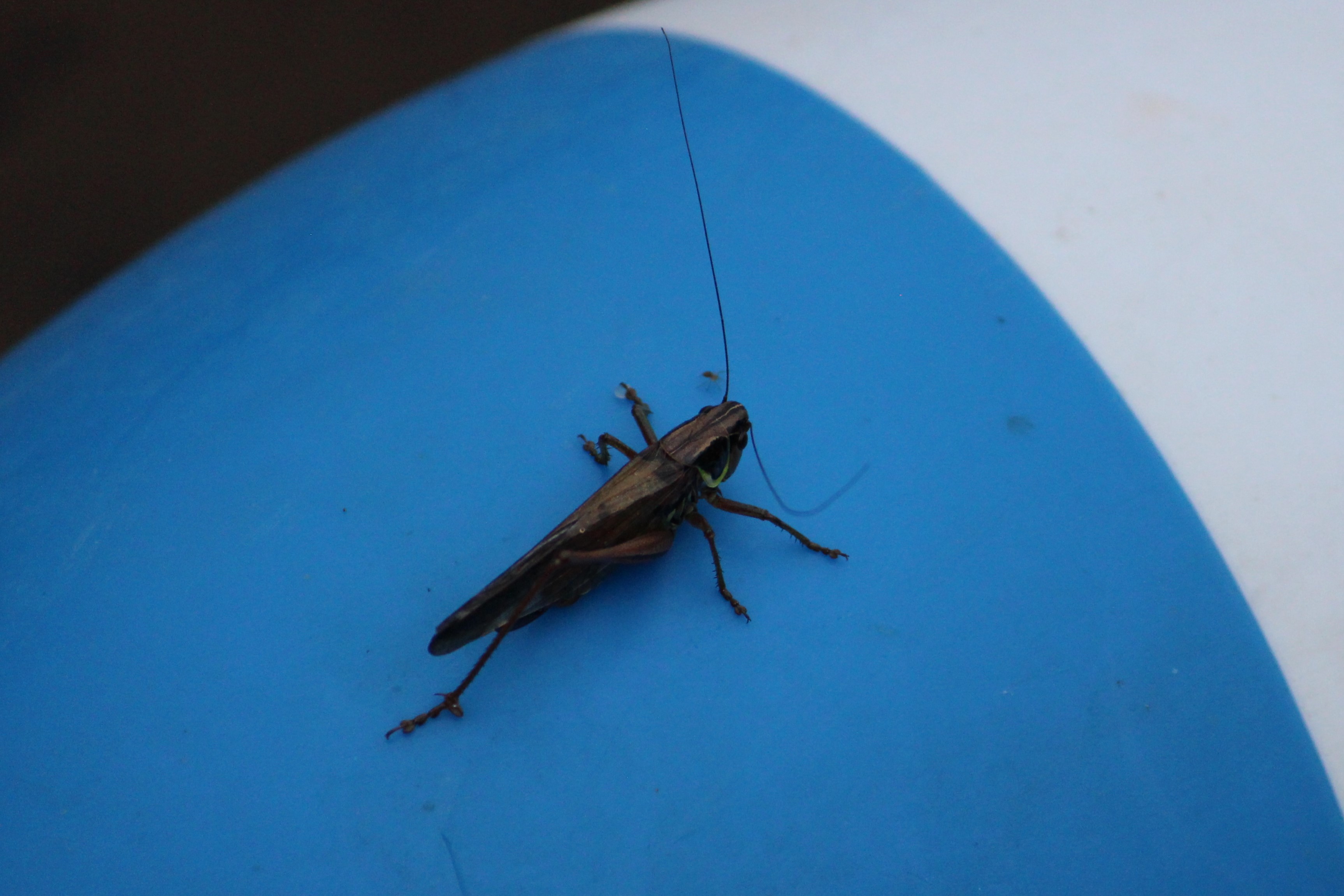
The charisma of Loons did not prevent my eyes being drawn to the small living denizens of the beach area as well. Resting on a buoy was a Large Orthopteran (grasshopper/cricket/katydid) of some sort. This was a Roesel’s Bush-Cricket (Roeseliana roeselii), an introduced Katydid from Europe. There are two forms to this species, one long-winged, and one short-winged. I believe the one I spotted is of the longer-winged variety.
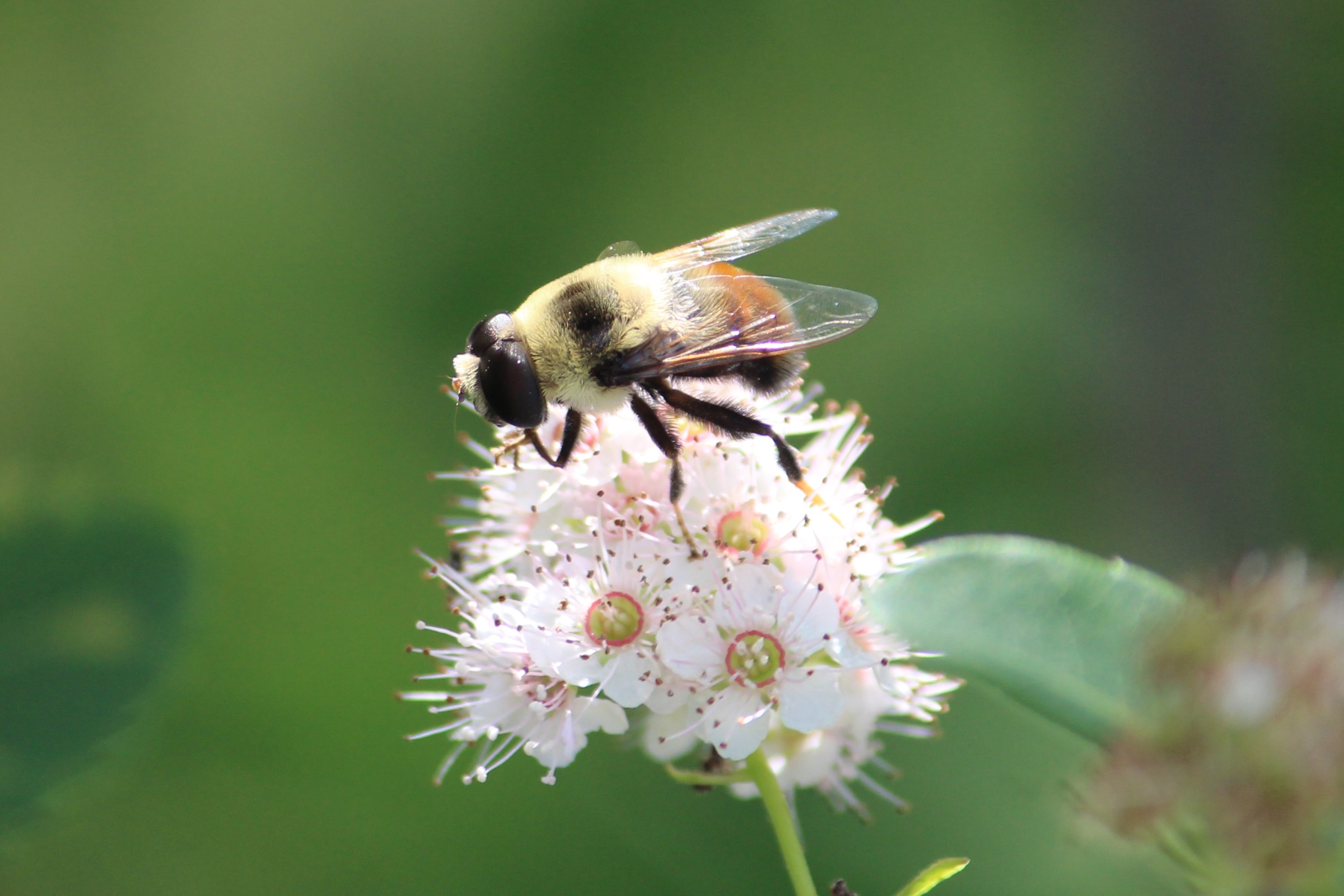
As the days progressed, more insect activity became apparent. A flower near the lake’s edge was visited by a bumblebee-look-alike: the Orange-legged Drone Fly (Eristalis flavipes). The larvae of this species feed within moist decomposing plant material and are known as “rat-tailed maggots” because of the long thin breathing tube that extends from the larvae. But the adults are beautiful bumblebee-mimics, one of many examples where one stage in an insect’s life is more attractive (to us) than another.
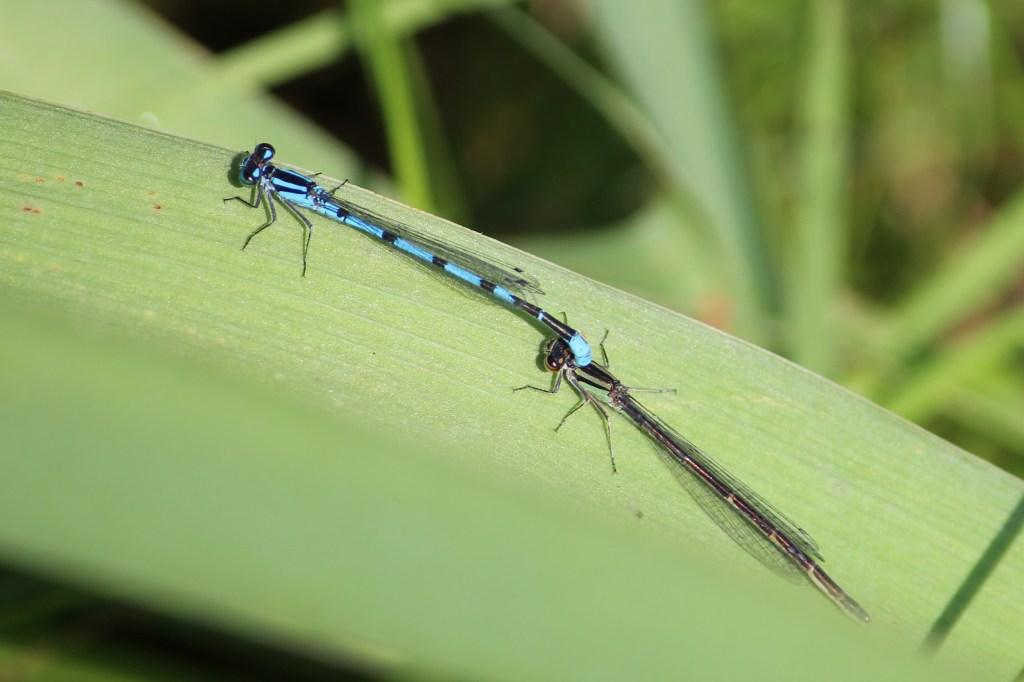
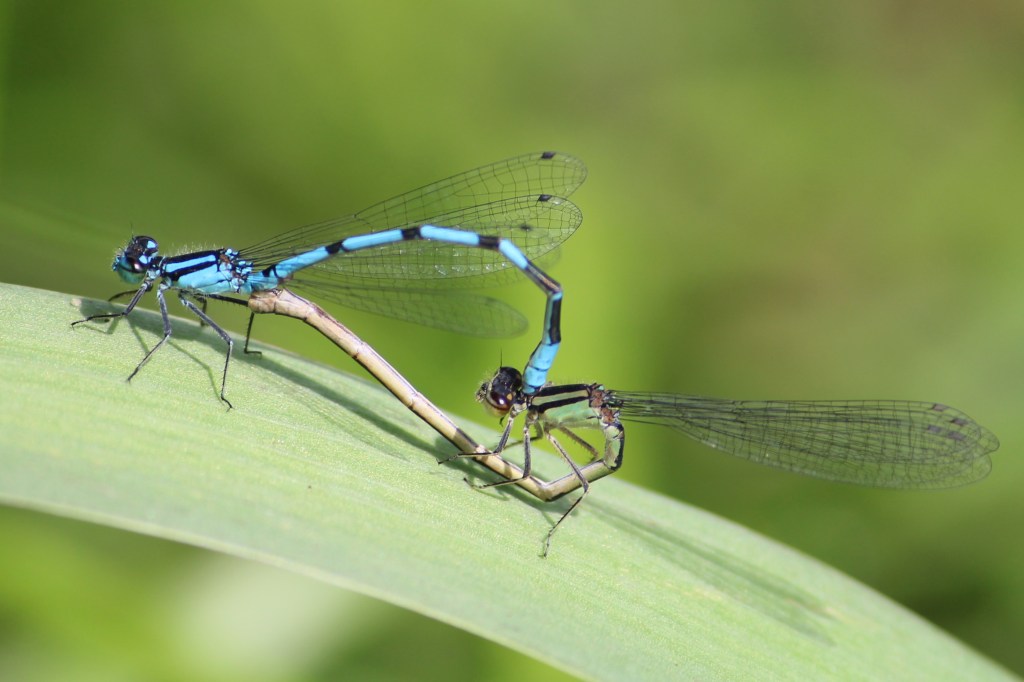
Nearby the flower was a pair of damselflies (Bluets, Enallagma) performing their heart-shaped coupling.
I’m unsure of the species but there are over 30 species of Bluets in North America (bugguide.net), so called because of the often bright blue colour of the male.

Damselflies have a strong ovipositor which they use to pierce vegetation in order to lay their eggs inside. Oftentimes, the plants they lay eggs into are partly underwater, causing the damselflies to stretch their abdomens beneath the water surface to cut into a suitable stem.
There were other encounters within the Pog Lake Campground, but the most memorable for me were in a location separated by a walk from our campsite and the beach, a wonderful place I came to call “Warbler River”. That will be the subject of my next post.
For Previous Algonquin Observation posts, see:
–Campsite Companions (Algonquin Observations August 2023, Part 1)
–Canada Jay (Perisoreus canadensis)
–Algonquin Observations, Part 5 – Spruce Bog: The Reckoning
–Algonquin Observations, Part 4 – Spruce Bog Speedrun and the Logging Museum Trail
–Algonquin Observations, Part 3 – Peck Lake Trail
–Algonquin Observations, Part 2 – Opeongo Road
–Algonquin Observations, Part 1 – Pog Lake Campground
Discover more from Norfolk Naturalist
Subscribe to get the latest posts sent to your email.

 Norfolk Naturalist
3 replies on “Lakeside Lives (Algonquin Observations August 2023, Part 2)”
[…] –Lakeside Lives (Algonquin Observations August 2023, Part 2) […]
LikeLike
[…] –Lakeside Lives (Algonquin Observations August 2023, Part 2) […]
LikeLike
[…] things I observed there. I began with organisms observed on or near our campsite, moved on to the Lake shore observations within Pog Lake Campground, and then described what I have come to call “Warbler River”. My […]
LikeLike