Categories
Nature Observations

Norfolk Naturalist Year in Photos, (Dec 2023-Nov 2024)

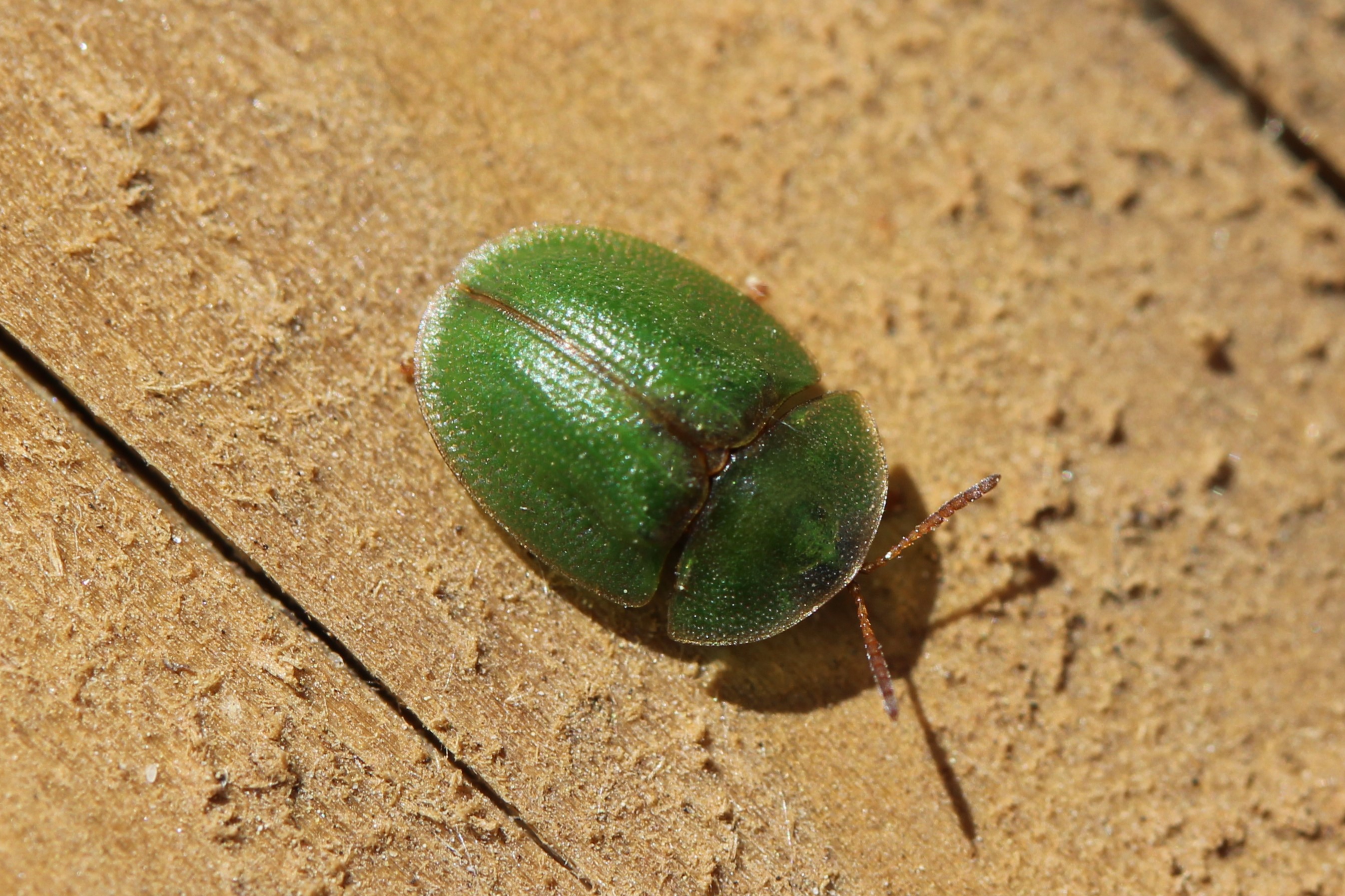
Thistle Tortoise Beetle (Cassida rubiginosa), Backyard, May 2024:

Tortoise Beetles (Beetles in the subfamily Cassidinae of the Family Chrysomelidae) have always been some of my favourite insects. Their wide elytra (wing-covers) protect their limbs and heads from predators and provide them with an appealingly round shape. The Thistle Tortoise Beetle is not native to Canada (having been introduced to combat the non-native Thistle plant), but it was still exciting to spot this charismatic insect on my back porch, trundling along. Their larval stage is less appealing, but still interesting, protecting itself not with a hardened armor covering but a “fecal parasol”. Yes, that’s right, larval Tortoise beetles carry their poop within a forked abdomen curved forward over their backs to ward off predators. There is even a specific word for this behaviour: “merdigery” – from the Latin for “dung” and “carry” (Costa 2006). Likely not a word you’ll find too much use for.

Armored Resin-bee (Heriades), Backyard, June 2024:

This strange-looking bee lays its eggs inside of constructions left behind by other insects, “especially beetle holes in wood, but they may also use pine cones” according to Wilson and Carril (2016). Their nest cells are divided with resin which is where they get their common name of “resin-bee”. Their generic name “Heriades” means “wool” referring to their woolly hairs, evident in the photo.

Related Chaclid Wasp (Leucospis affinis), Backyard, June 2024:

Although her colouration may remind you of a paper wasp or other social, stinging wasp, the long ovipositor curled over her back indicates that she is in fact something quite different: a parasitic wasp. This female will lay her eggs inside the nest of a leafcutter bee (bees in the family Megachilidae), and the larvae that hatch will locate and consume their host bee larvae (Holm 2021). Holm, in her amazingly detailed books on common garden wasps, says this about the larval stage of this wasp: “The larva is initially equipped with sensory and locomotive hairs on its head and body to help it find the host as it moves around the dark nest cell… has an oversized head, and large mandibles used to kill the host larva and destroy any other Leucospis eggs. Like many cleptoparasitic bees, the larva loses most of these prey-finding apparatus after molting” (Holm 2021).
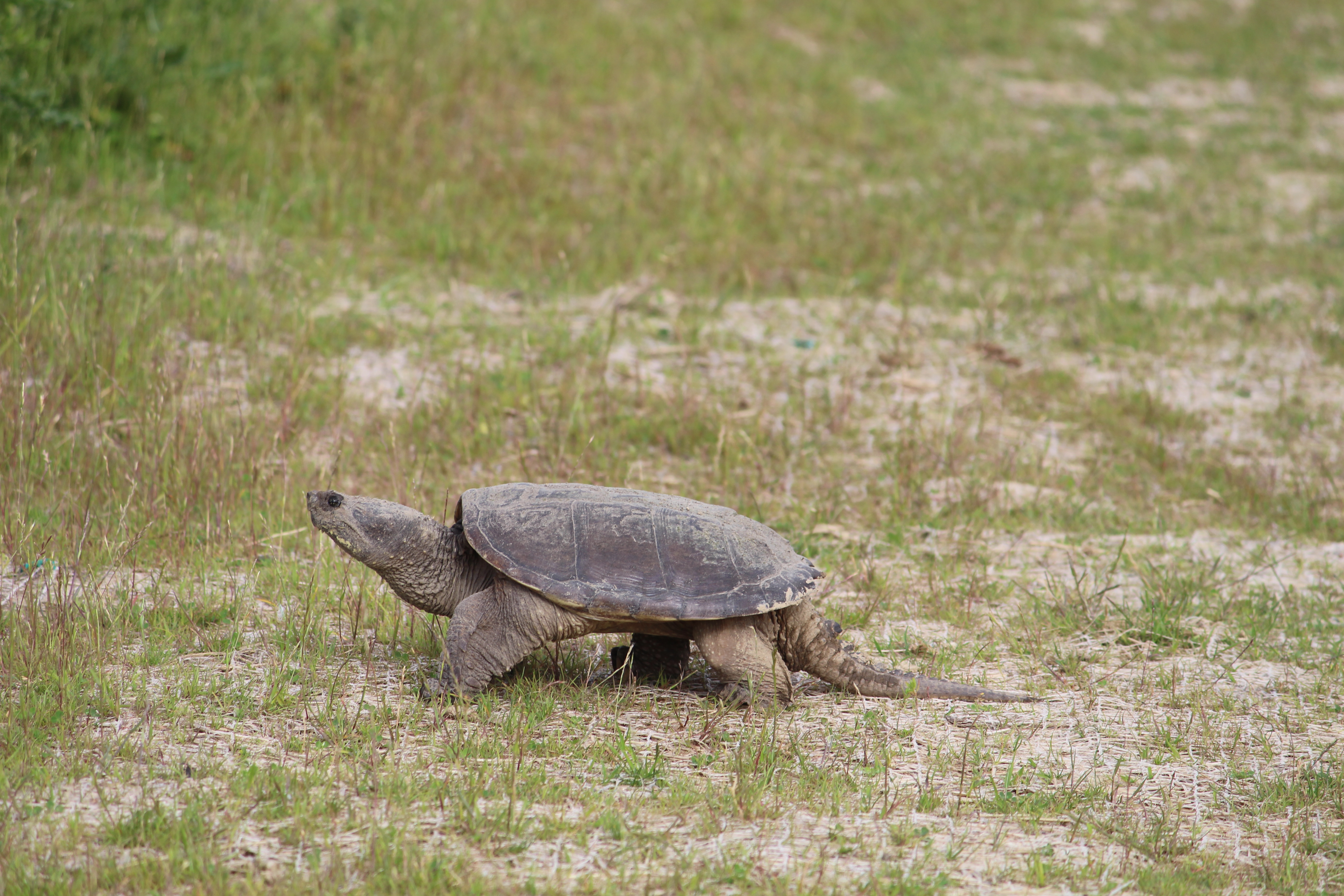
Common Snapping Turtle (Chelydra serpentina), Long Point, June 2024:

The sight of a Snapping Turtle walking across land always makes me think of a prehistoric beast lumbering out of some primeval swamp. Despite the fact that Snapping Turtles are well adapted to their environment, and no more primitive a species than any others, they give the impression of an ancient power, a relic from the days of the lumbering dinosaurs.
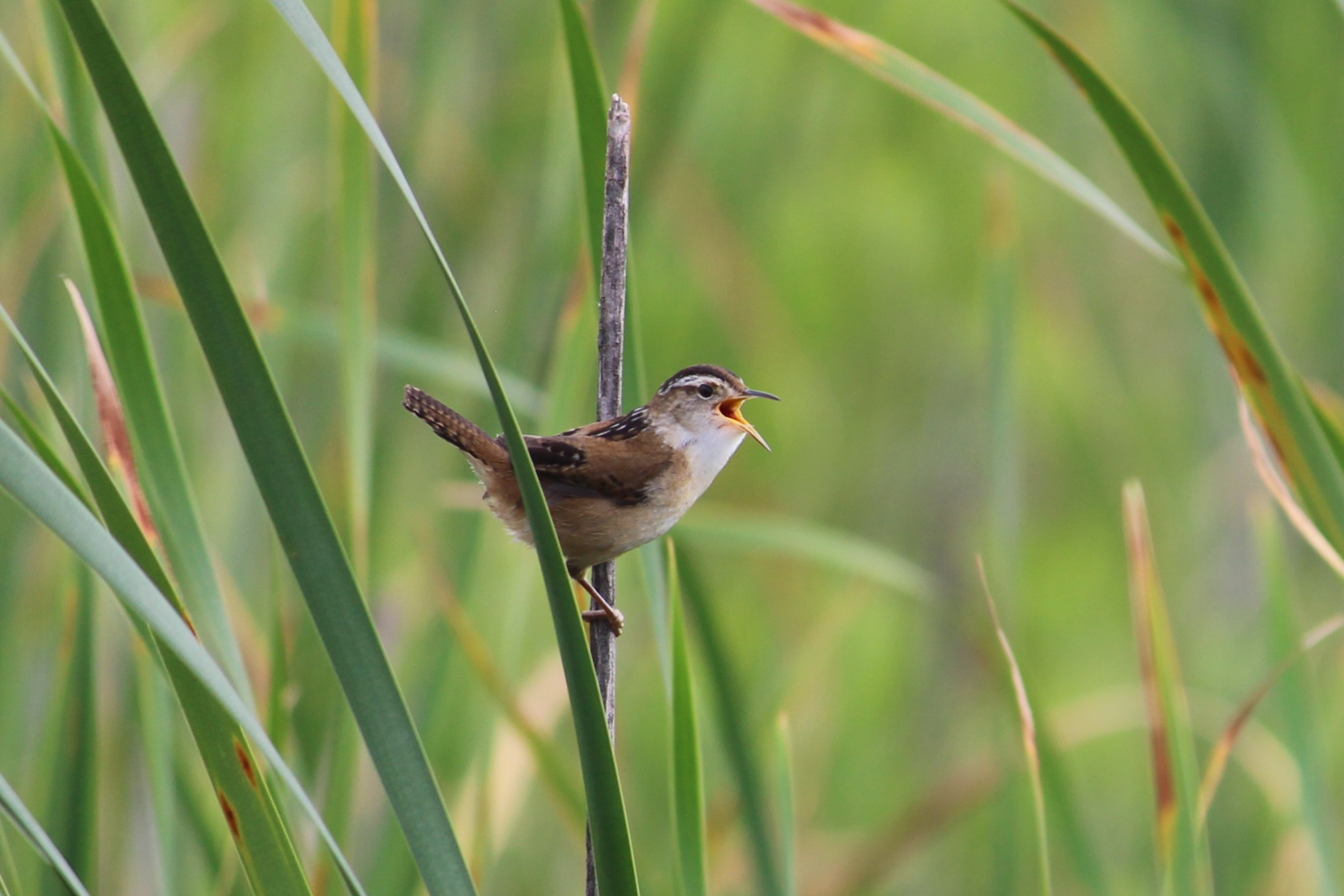
Marsh Wren (Cistothorus palustris), Long Point, June 2024:

The sound of these energetic birds clambering among the cattails of a wetland is one of the backdrops of my summer, going out to take photos of birds and other wildlife. I was surprised to learn that Marsh Wrens are major predators on Red-winged Blackbird eggs and nestlings in some parts of their range (Beletsky 1996). Marsh Wrens mostly eat insects, and they construct several nests within their territories from which the females choose, just like in House Wrens (Stokes and Stokes 1983).
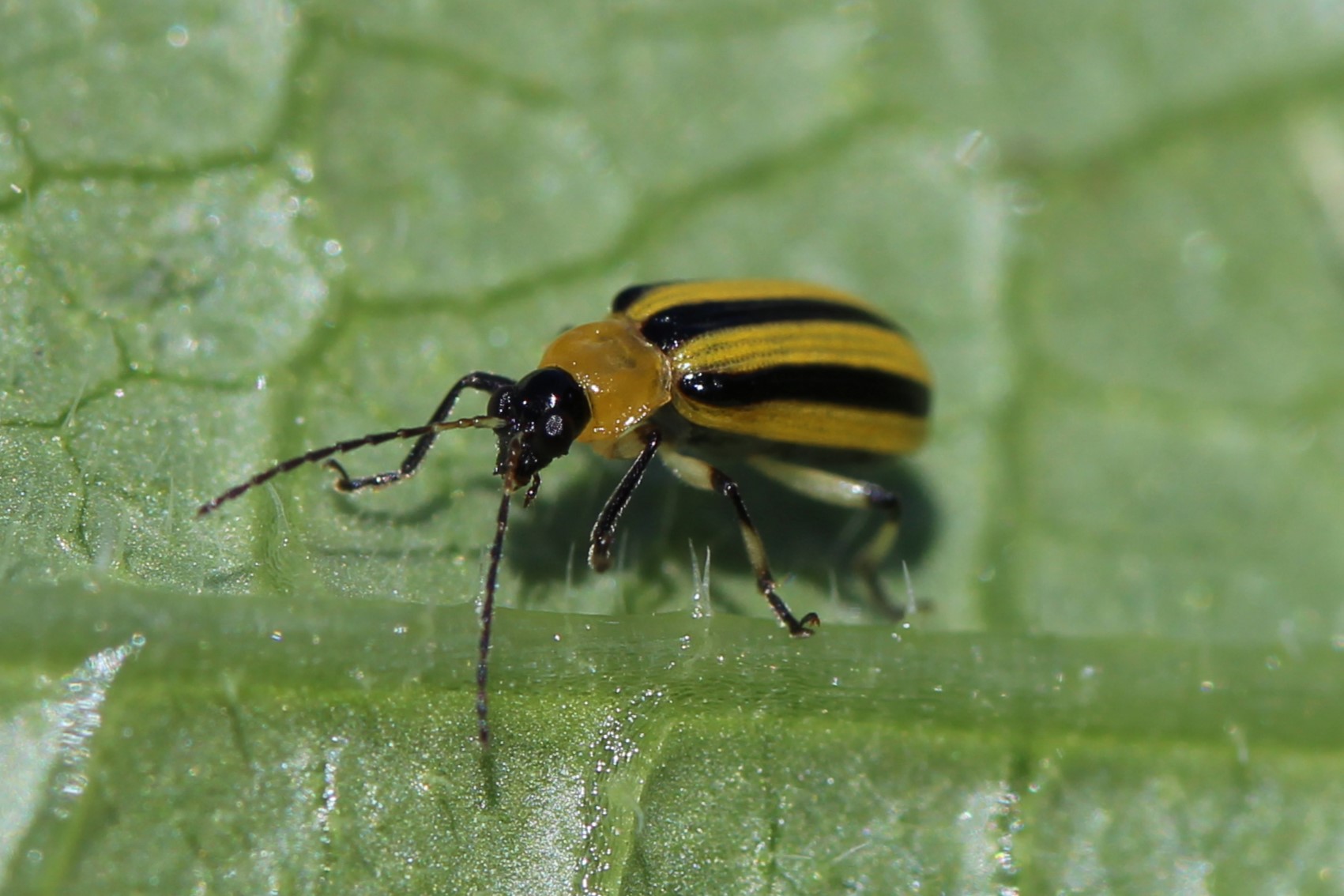
Striped Cucumber Beetle (Acalymma vittatum), Backyard, July 2024:

The Striped Cucumber Beetle is considered a pest because it consumes plants that we like to consume ourselves: members of the Cucurbitaceae (cucumbers, watermelons, gourds, pumpkins, squash and many others). The adults feed on leaves, while their larvae feed on the roots (Marshall 2018).
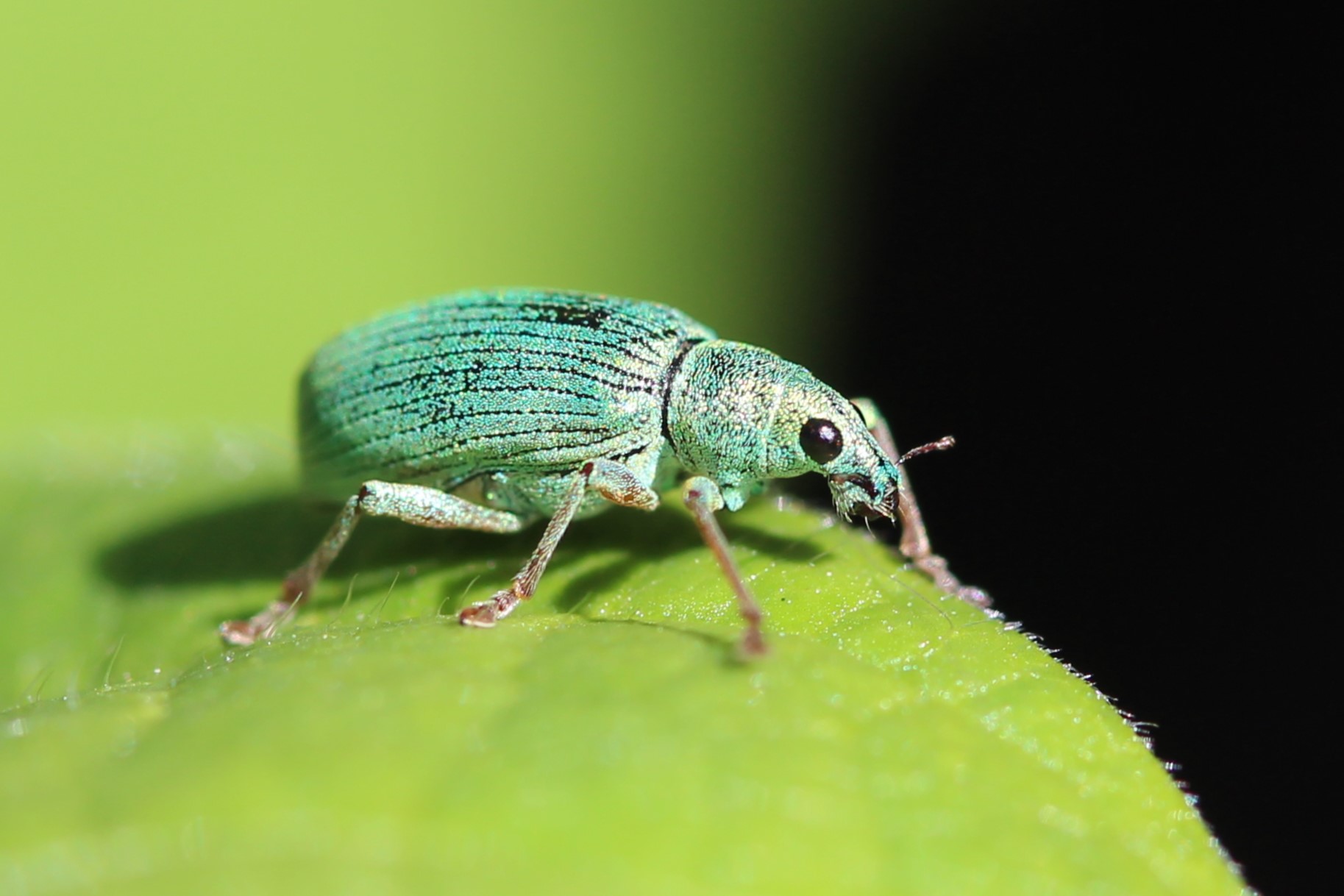
Green Immigrant Leaf Weevil (Polydrusus formosus), Backyard, July 2024:

Another pest beetle species, this one non-native to North America (accidentally introduced, and not deliberately like the Thistle Tortoise Beetle), the Green Immigrant Leaf Weevil feeds on various shrubs and trees. Eggs are laid in the bark of host plants or in the soil, the larvae feed on roots through Spring and Summer and then emerge as adults in the following Spring (Lisak et. al. 2024).
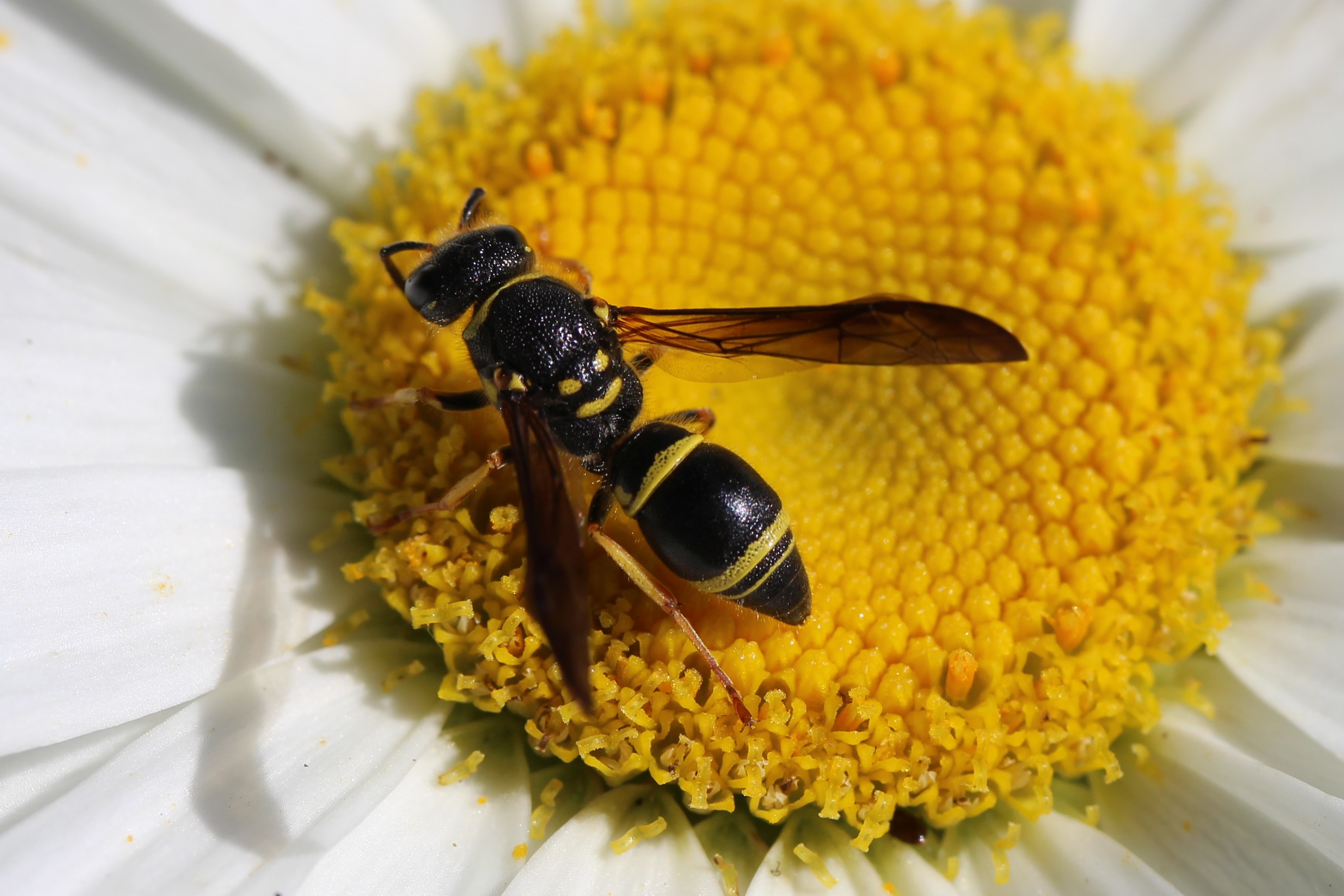
Smiling Mason Wasp (Ancistrocerus campestris), Backyard, July 2024:

In the photo above, you can clearly see the smile emblazoned on the Smiling Mason Wasp’s thorax. These wasps lay their eggs in pre-existing cavities, creating several nest cells by dividing the cavity with mud walls (Holm 2021). You can think of each nest cell as a nursery for individual wasp larvae, as the Smiling Mason Wasp female lays a single egg in each chamber (and hangs it from the ceiling by a silken thread) (O’Neill 2001). Each nursery is filled with several paralyzed caterpillars for the larva to consume upon hatching (Holm 2021).
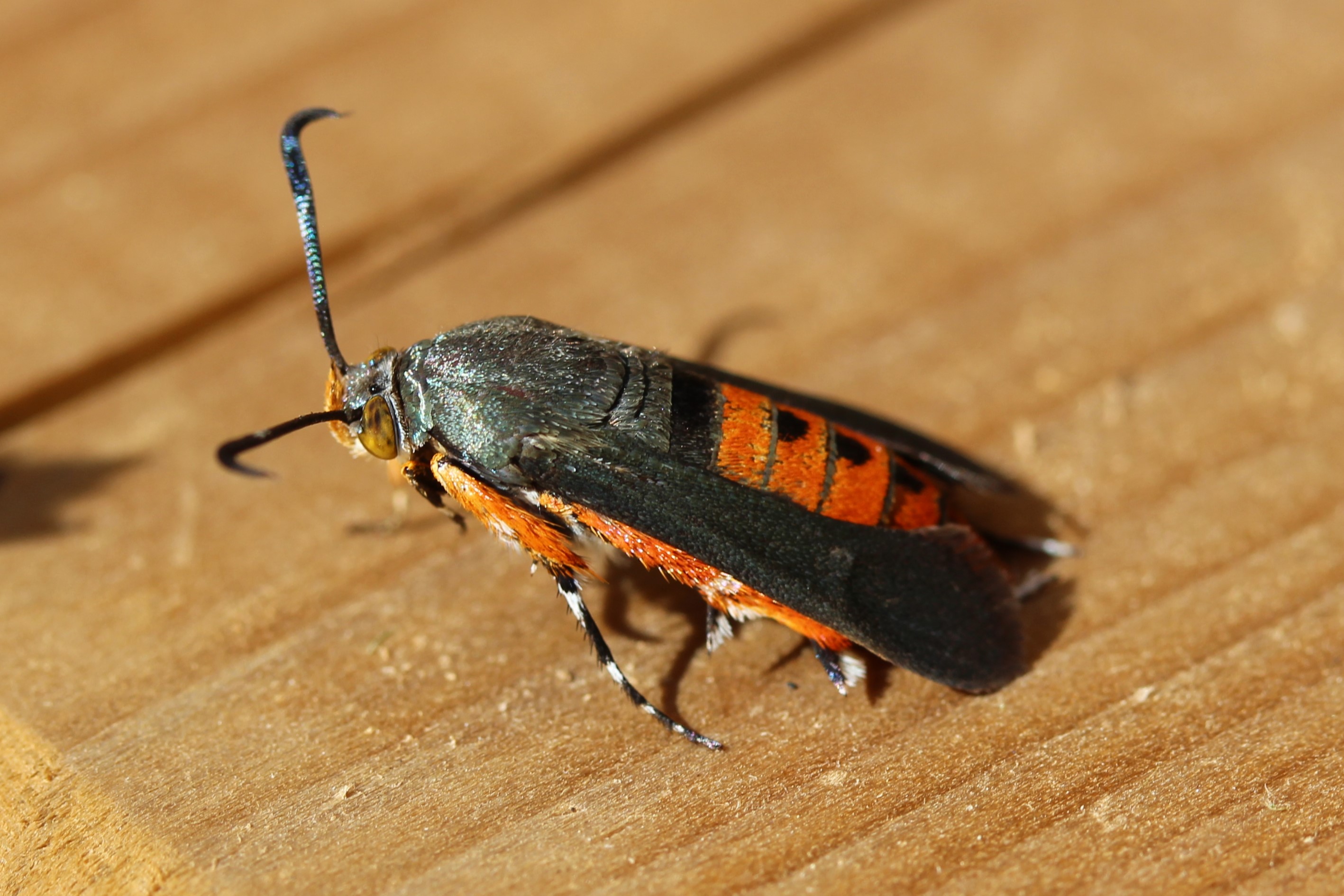
Squash Vine Borer (Eichlinia cucurbitae), Backyard, July 2024:

Standing still, the illusion is not very convincing, but when this little moth was in constant buzzing motion, hovering from flower to flower, the resemblance to a wasp was impressive (specifically the Great Golden Digger Wasp, Sphex ichneumoneus). The mimicry helps keep this moth safe from predators which hesitate to interfere with a stinging wasp but would love to snack on a harmless moth. As with several other insects on this list, the Squash Vine Borer feeds on squash, cucumbers, gourds, or pumpkin during its larval stage, giving some indication of what we were growing in our garden this past summer.

Pruinose Squash Bee (Peponapis pruinosa), Backyard, July 2024:

Unlike many other bees, Squash Bees are specialist pollinators on one plant family: the Cucurbitaceae (the pumpkins, squash, cucumbers etc). These are solitary bees, meaning that each female creates her own nest for her offspring, rather than contributing to a social construction such as a honeybee or bumblebee colony made up of many non-reproducing individuals. Female Squash Bees dig their nests into the soil, 1.5 feet deep or more, before branching off the main tunnel into several off-shoots with each one receiving pollen and an egg (Wilson and Carril 2016).
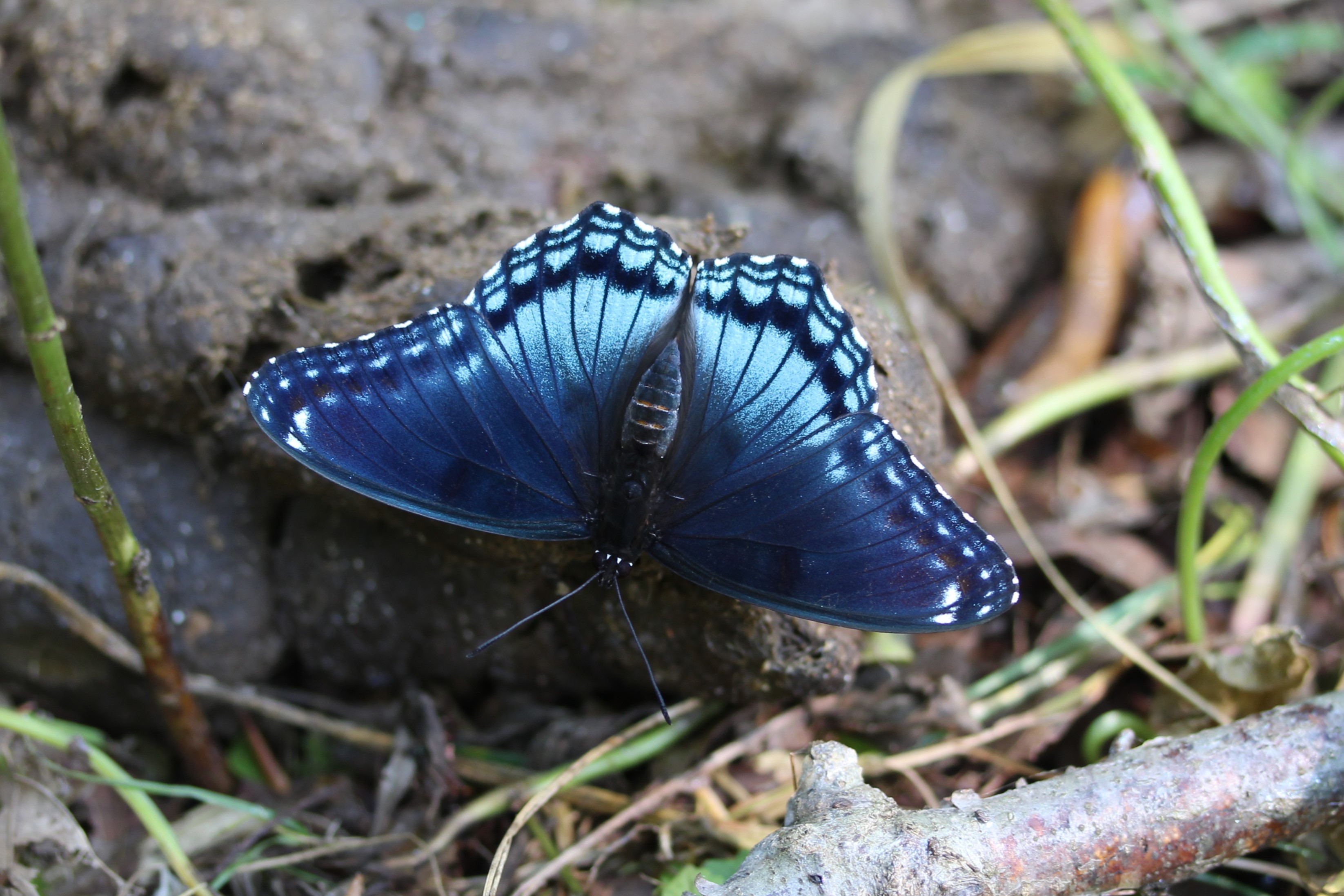
Red-Spotted Purple Butterfly (Limenitis arthemis astyanax), Backus Woods, July 2024:

This beautiful butterfly was spreading its wondrous wings as it fed on dung (I believe this was of the horse variety). Many butterflies feed on dung for valuable minerals, creating such jarring juxtapositions.
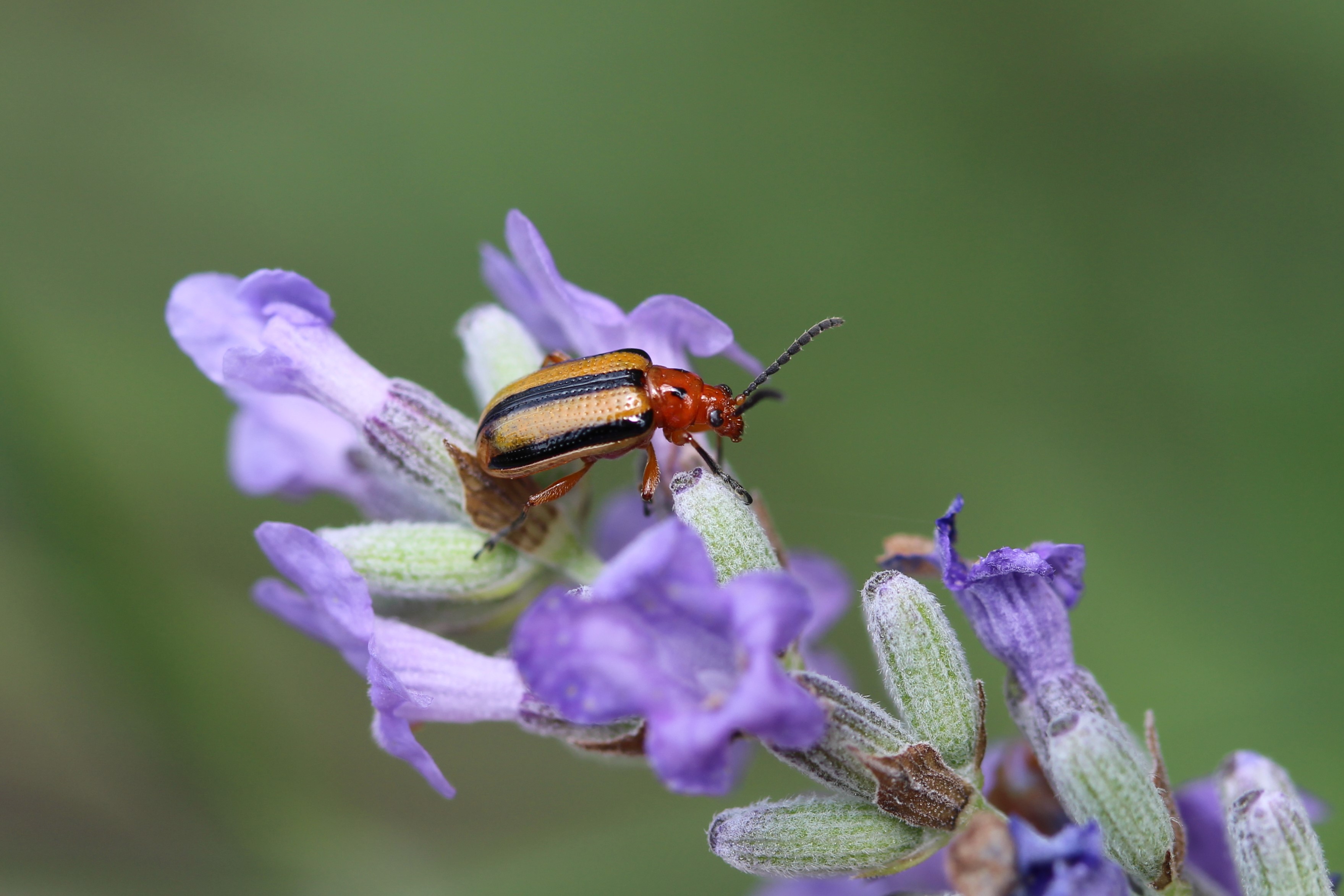
Three-lined Potato Beetle (Lema daturaphila), Backyard, July 2024:

This attractively coloured beetle is a native leaf beetle (in the subfamily Criocerinae) which feeds on potatoes and other related plants. Its larvae exhibit merdigery (bet you didn’t think that word was coming back again so soon, did you!?).
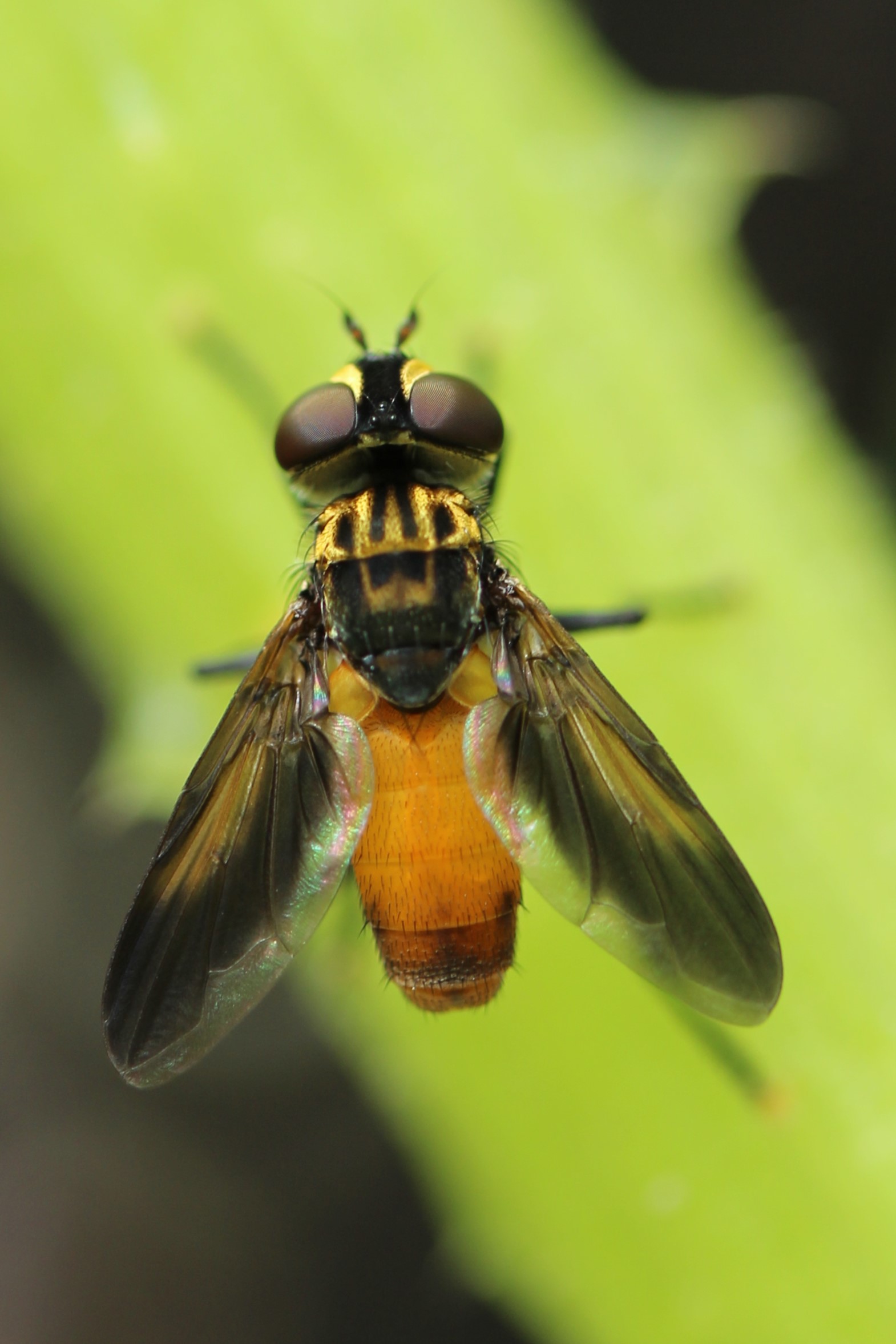
Swift Feather-legged Fly (Trichopoda pennipes), Backyard, July 2024:

These flies are part of the vast fly Family Tachinidae, which are largely bristly and parasitic. Trichopoda pennipes lays its eggs directly onto its hosts which are various true bugs (Hemipterans), including Squash Bugs, Stink Bugs and Leaf-footed bugs. The egg hatches and the larva burrows directly into the host bug, consuming it from the inside. This gruesome life cycle is helpful to gardeners as many of its hosts are pests of garden plants.
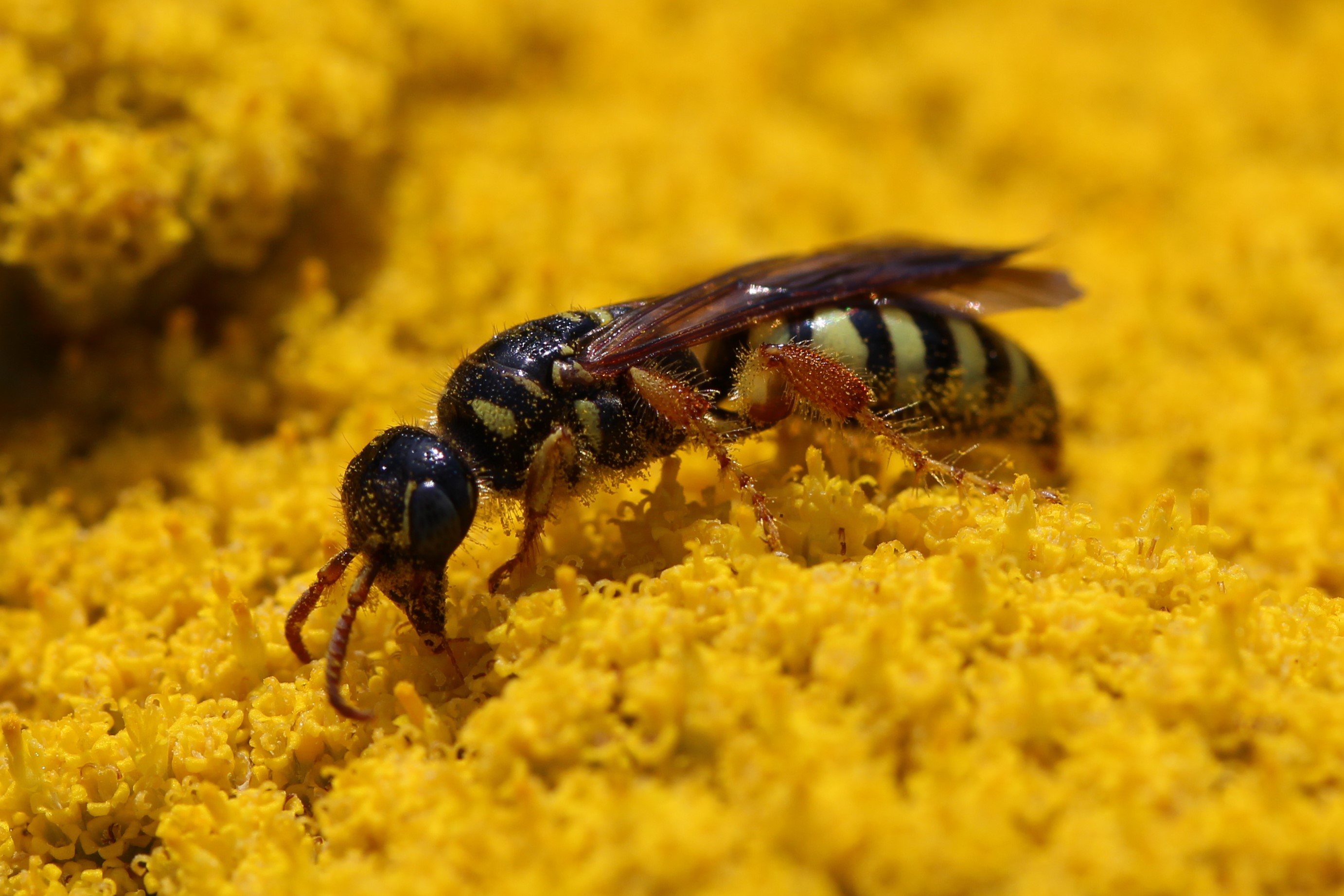
Five-Banded Thynnid Wasp (Myzinum quinquecinctum), Backyard, July 2024:

These large wasps again demonstrate the familiar patterning and colouring of a social paper wasp, but are very distinct in their life cycle. Female Five-Banded Thynnid Wasps dig up to six inches into the ground at night, in search of scarab beetle larvae (or occasionally tiger beetle larvae) (Holm 2021). Once found, the female paralyzes the grub and lays her egg on its abdomen (Holm 2021). The wasp larva consumes the beetle larva and creates a silken cocoon within its late host’s underground chamber to spend the winter (Holm 2021). Once spring arrives, the wasp pupates and emerges as the impressive adult pictured above in summer (Holm 2021).
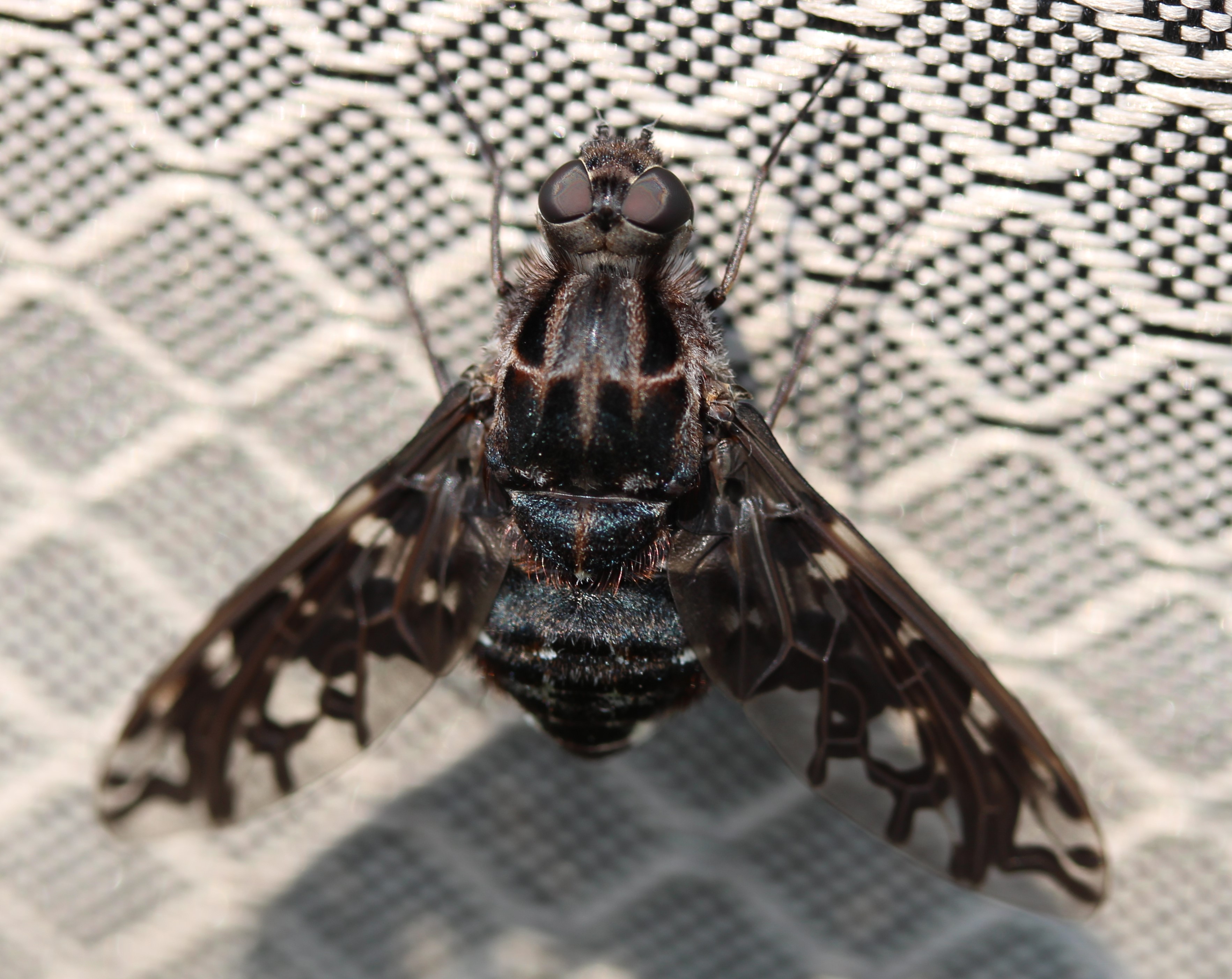
Tiger Bee-Fly (Xenox tigrinus), Backyard, July 2024:

Despite its large and striking appearance, this formidable fly does not bite or sting people and should only be feared by its prey: Carpenter Bees (Xylocopa spp.). The Tiger Bee-Fly lays its eggs near Carpenter Bee nests, and the larvae make their way inside to consume the bee larvae.

Belted Kingfisher (Megaceryle alcyon), Grant Anderson Park, September 2024:

I have tried in vain to take a good, clear, photo of a kingfisher for many years now. These distinctive, charismatic birds are always on the move, and very aware of me whenever I approach with camera in hand. They need their good senses to spy fish underwater which they dive and catch. This past September, I finally managed to get a nice photo of this bird in the local park in Simcoe.
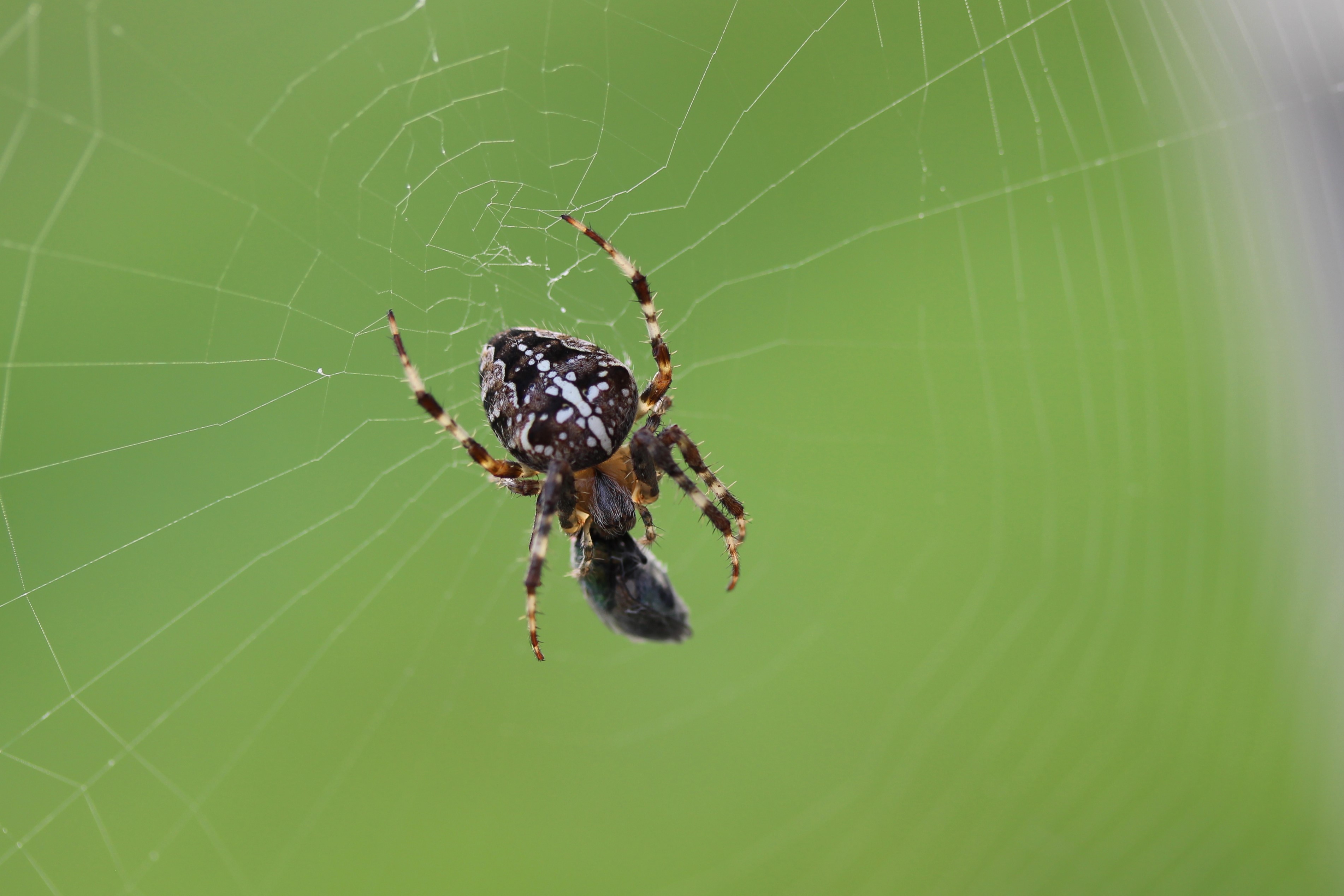
Cross Orbweaver (Araneus diadematus), Backyard, September 2024:

This large spider feasting on its dipteran prey had constructed a web on the edge of my back porch. Cross Orbweavers are introduced spiders here, native to Europe.
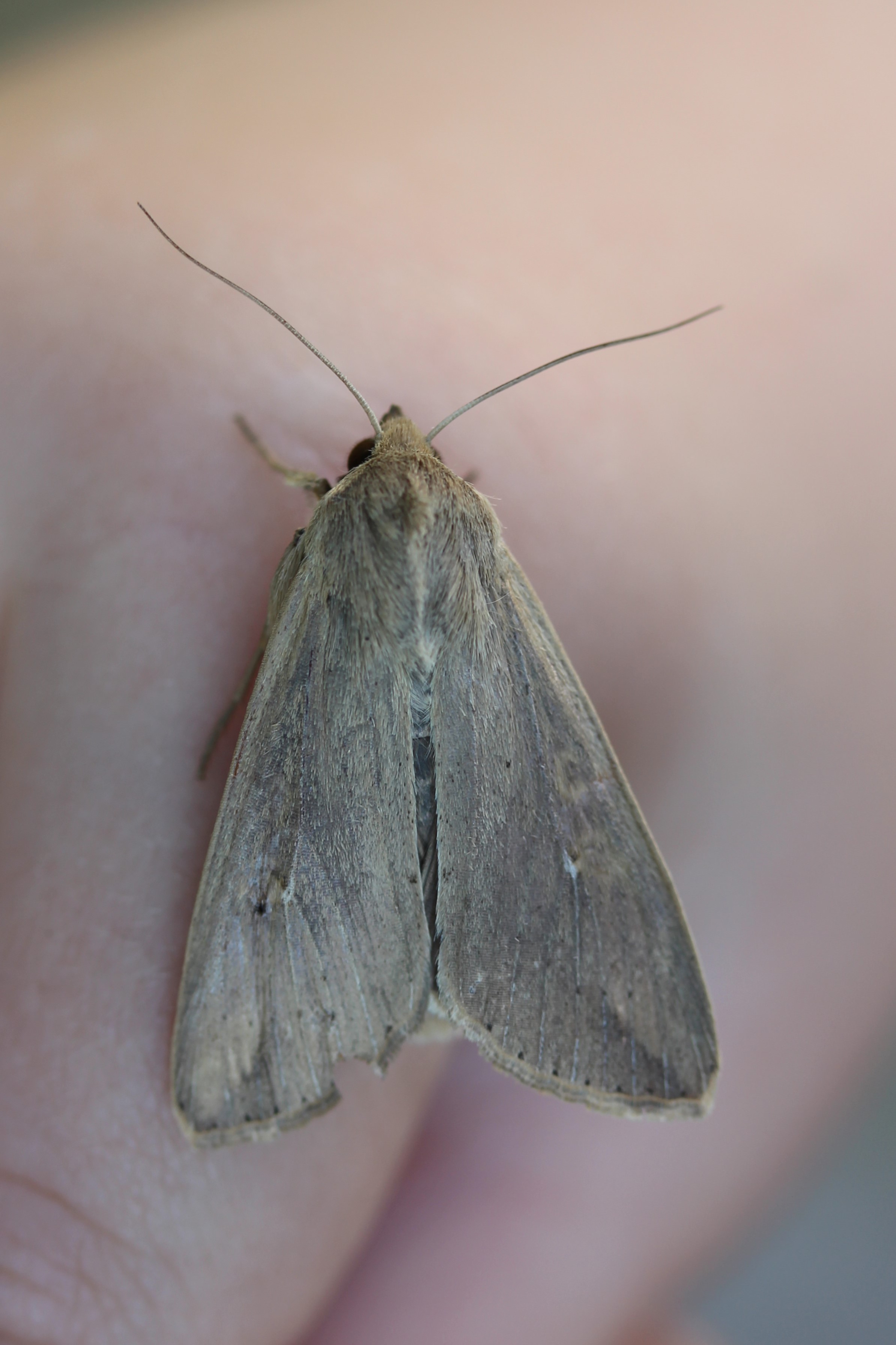
Mythimna Moth, Backyard, September 2024:

I believe this moth is of the genus Mythimna, but I’m not quite sure as it’s a fairly nondescript moth. The moths in this genus feed on grasses when larvae which would also line up with its discovery within my lawn (Beadle and Leckie 2012).
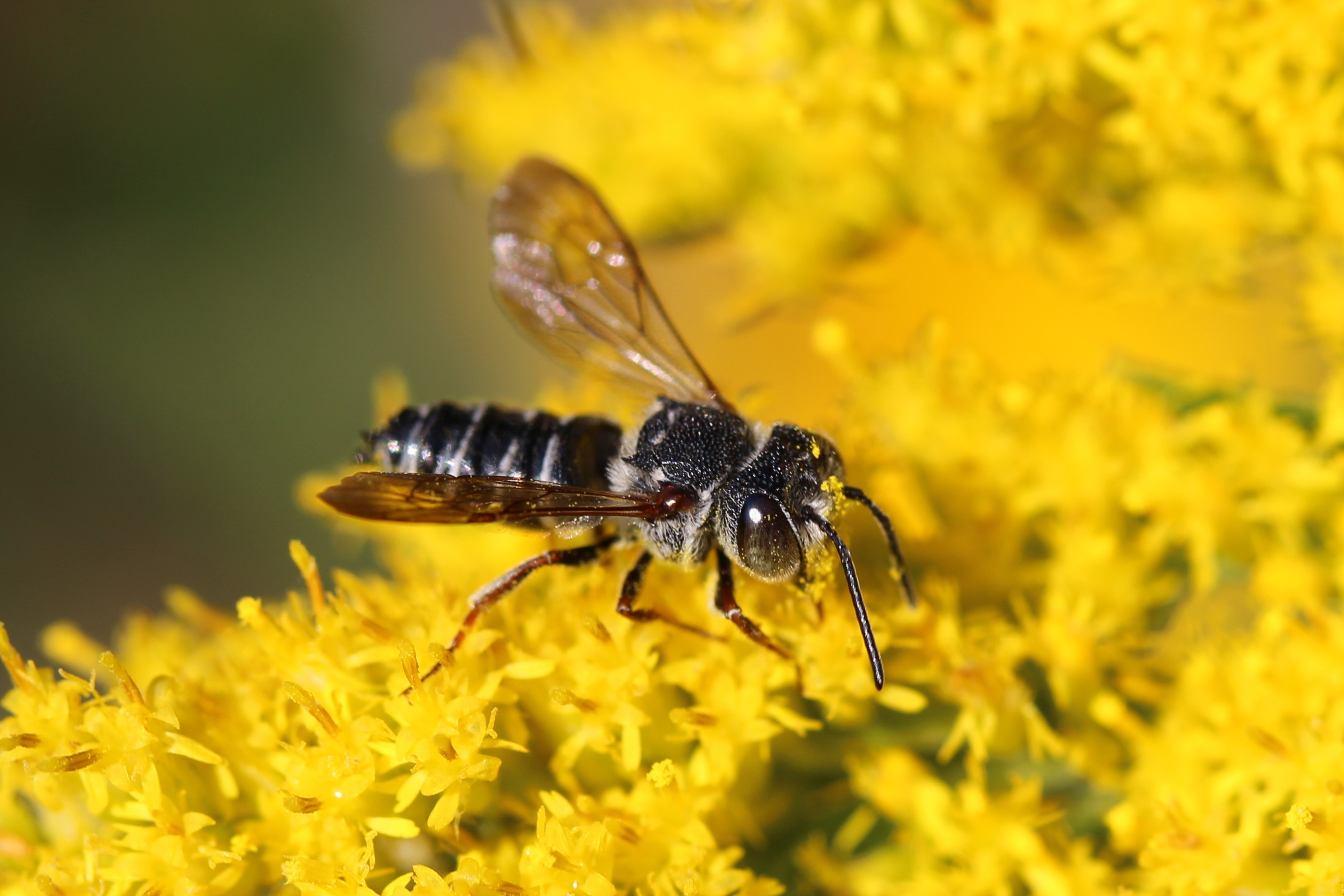
Sharptail Bee (Coelioxys), Backyard, September 2024:

Although the proportions of the pictured individual lead the head to be much larger than the thinning abdomen, the common name “Sharptail Bee” refers more to the females of these bees (the bee in the photo is a male) who have very pointed abdomens used to puncture the nest cells of Megachilid bees (Wilson and Carril 2016). Coelioxys eggs laid inside their hosts’ nests hatch and the emerging larva “uses tweezer-sharp mandibles to snip the egg or young larva of the host bee in half” (Wilson and Carril 2016). The larva then proceeds to consume the pollen that was stored away for the host bee’s young.

Apple Leaf Skeletonizer Moth (Choreutis pariana), Backyard, September 2024:

These are day-active moths, with larvae that feed on crab apple leaves. They were introduced to North America sometime around 1917 (Beadle and Leckie 2012).

References:

Beadle, David and Leckie, Seabrooke 2012. Peterson Field Guide to Moths of Northeastern North America. Houghton Mifflin Harcourt.

Beletsky, Les. The Red-Winged Blackbird: The Biology of a Strongly Polygynous Songbird. 1996. Academic Press.

Costa, James T. 2006. The Other Insect Societies. Harvard University Press.

Holm, Heather 2021. Wasps: Their Biology, Diversity, and Role as Beneficial Insects and Pollinators of Native Plants. Pollination Press.

Lisak, Sarah C., Hailey N. Shanovich, Amelia R.I. Lindsey, and Brian H. Aukema. “The Polydrusus Weevils (Coleoptera: Curculionidae) of the United States of America and Canada: Identification and Insights into the Ecology of Two Nonnative Species in Hazel (Corylus Spp.).” The Canadian Entomologist 156 (2024): e10. https://doi.org/10.4039/tce.2024.7.

Marshall, Stephen. 2018. Beetles: Their Natural History and Diversity. Firefly Books.

Marshall, Stephen. 2023. Hymenoptera: The Natural History and Diversity of Wasps, Bees, and Ants. Firefly Books.

O’Neill, Kevin M. 2001. Solitary Wasps: Behavior and Natural History. Cornell University Press.

Stokes, Donald and Stokes, Lillian. 1983. A Guide to Bird Behavior Volume 2. Little, Brown and Company.

Wilson, Joseph S. and Carril, Olivia M. 2016. The Bees in Your Backyard. Princeton University Press.

For previous Photo recap posts, see:
Norfolk Naturalist Year in Photos, (Dec 2022-Nov 2023)

Norfolk Naturalist Year in Photos (Dec 2021-Nov 2022)

Categories
Nature Observations Tumblr Repost

Hidden Worlds

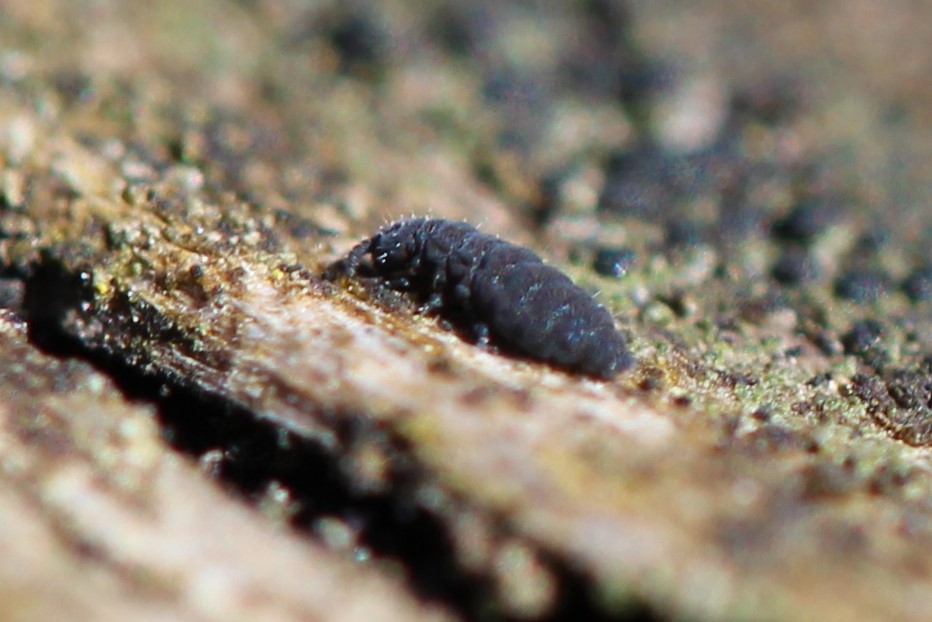
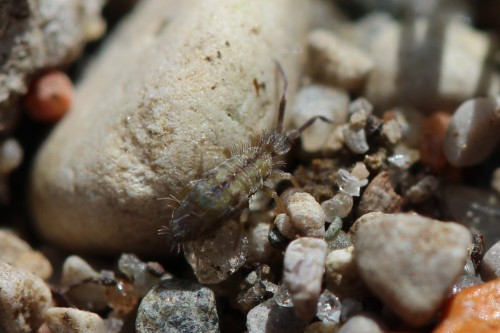
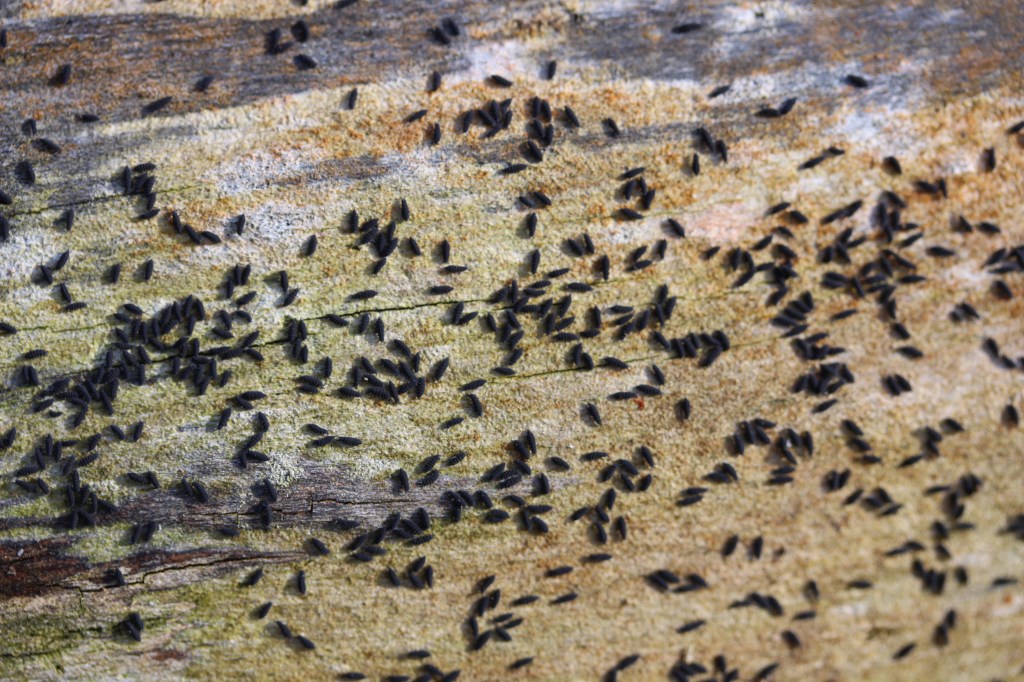
Using a magnifying hand lens, or a macro camera lens opens up whole worlds of detail and diversity unappreciated by the naked eye. One of these worlds is that of the Springtails.

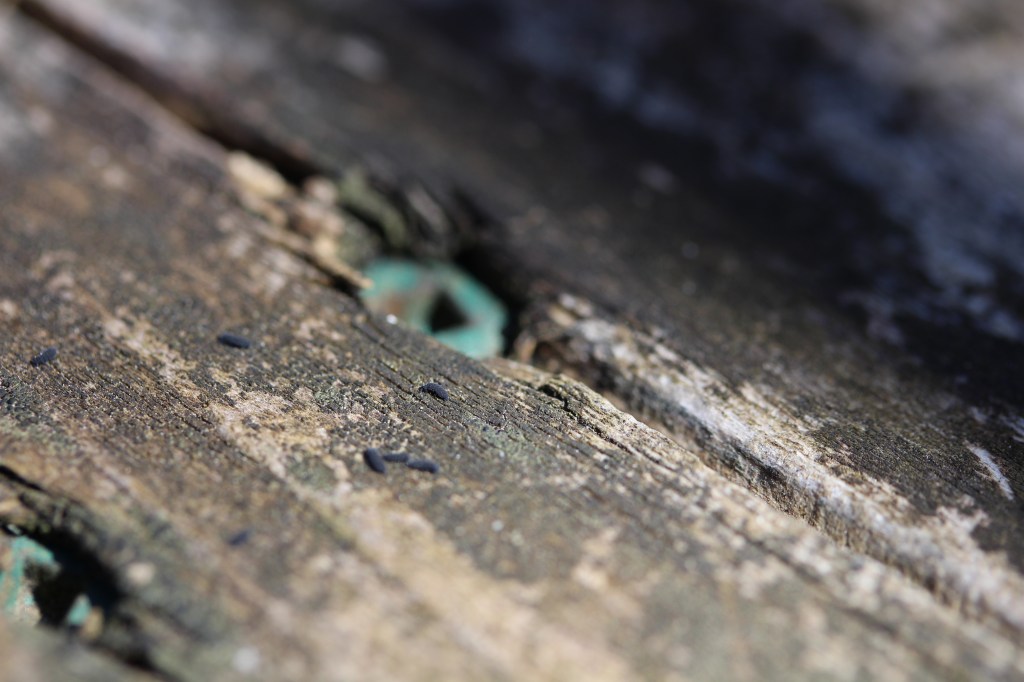
A group of Springtails on the Lynn Vally Trail on a log.

This past winter* I encountered them where they are most often seen, even without any sort of magnifying equipment: bounding by the millions atop the snow. While at Algonquin’s Mew Lake Campground, I observed these tiny pinpricks of dark life in stark contrast against the bright white snow. In this context, these Springtails are called “snow-fleas”, and it’s easy to see why. The tiny creatures are about the size of fleas and hop about with amazing ability. Springtails are not fleas, and leap about not by their legs but by a “spring-like tail” that curves under their body and can launch them through the air.

*This was originally written and posted on my tumblr blog in April 2018, so the winter referred to was 2017-2018.

They are actually part of a group known as Collembola, which is not quite under the group Insecta. They are not true insects, but are closely related. I had the privilege of being able to observe Springtails several times since our Algonquin trip and it is an incredible pleasure to be able to resolve something so tiny (about 1-3 mm long) into an individual animal, complete with legs, head, and antennae.

Even though they are quite numerous, they are small, and many Springtails spend most or all of their time belowground. This makes them difficult to study, and little is known about these amazing creatures.

Some closer views of individuals.
To give some more context on their size: the green blurred object in the background is the head of a screw on the bridge, and the Springtails are the bluish-grey specks in the focus.
Categories
Nature Observations

Port Burwell Observations, July 2023

At the beginning of July, my family and I were camping in Port Burwell Provincial Park. While there, as I usually do when camping, I took some photos of the creatures I encountered and I’d like to explore some of them and what I can find out about them here. So here goes…

On my first night there I found myself sitting alone with a book and a small clip-on reading light in a dining tent (which was open to the outside, for at least part of the night). My tiny beacon of light attracted several insect investigators and I quickly became distracted from my reading*.

*If you must know (as I would want to know if I was the blog’s reader), I was reading a collection of sci-fi short stories: Galaxy: Thirty Years of Innovative Science Fiction, edited by Frederik Pohl, Martin H. Greenberg, and Joseph D. Olander.

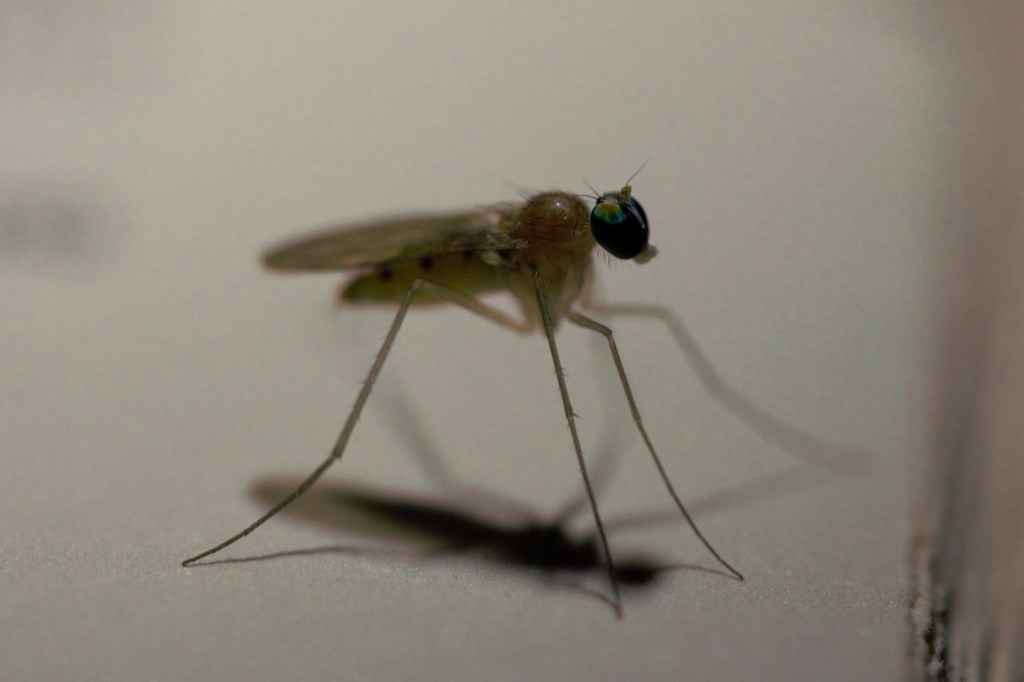
The most abundant insects alighting on my illuminated pages were members of that vast insect Order: Diptera, the Flies. Two that I photographed were likely the same species, and I suspect were male and female representatives. I have tentatively identified them as members of the genus Neurigona based on iNaturalist. They are certainly long-legged dance flies (Family Dolichopodidae). Dolichopodids are diverse flies (there are around 7000 species in the world (Marshall 2012)) which often hunt other flies and springtails as adults. There are about 150 species in the genus Neurigona (Marshall 2012).

Long-legged Dance Fly (Family Dolichopodidae) attracted to my reading light, possibly of the genus Neurigona.

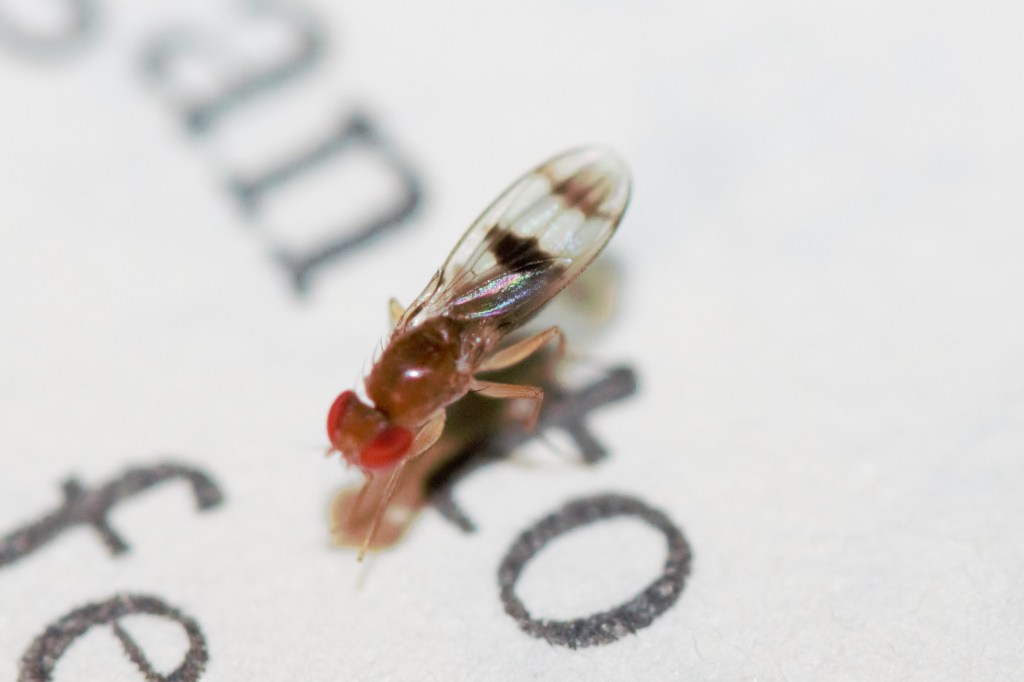
A beautiful little vinegar fly (a member of the Family Drosophilidae) graced the pages of my book as well: Chymomyza amoena. This species, along with the other members of its genus are “almost invariably present on fallen or wounded trees” (Marshall 2012 p. 477).

Chymomyza amoena, a member of the Family Drosophilidae, of which the most famous member is the Common Fruit Fly Drosophila melanogaster, ubiquitous in kitchens and laboratories the world over.

Two notable non-Flies made their appearance amid the glowing reading light. A tiny pale yellow leafhopper was just barely noticeable among the typed letters on the page, a member of the genus Edwardsiana

Tiny tiny leafhopper of the genus Edwardsiana.

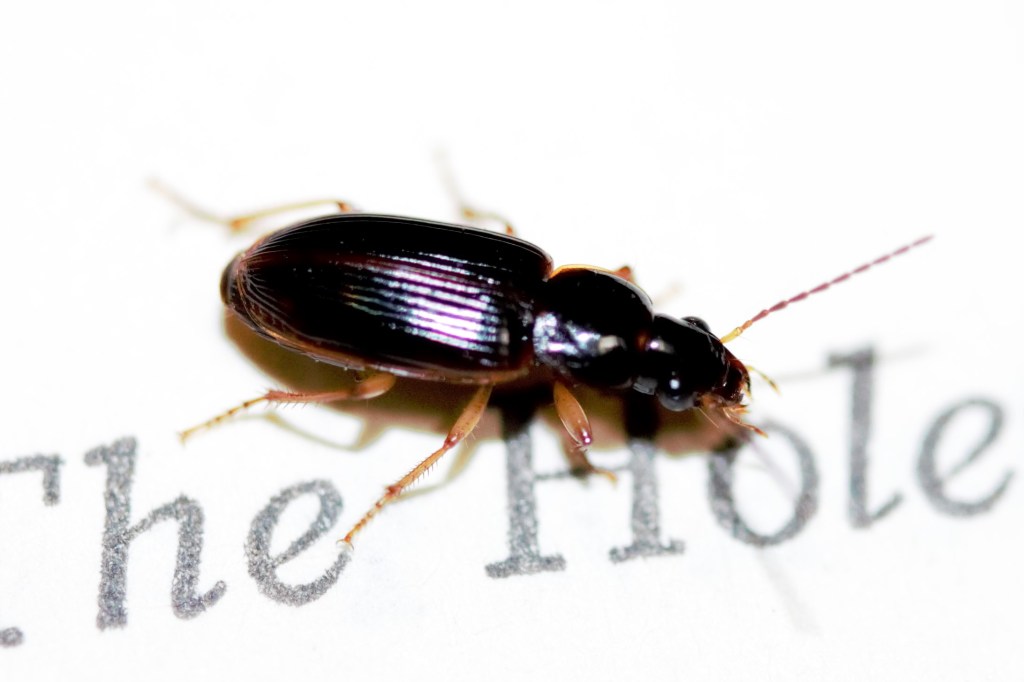
A dark beetle also scuttled across the words of my reading material, which I believe to be a Ground Beetle (Family Carabidae), possibly of the genus Bembidion.

Ground Beetle scurrying across the title of the sci-fi story I was reading, “The Holes Around Mars” by Jerome Bixby.

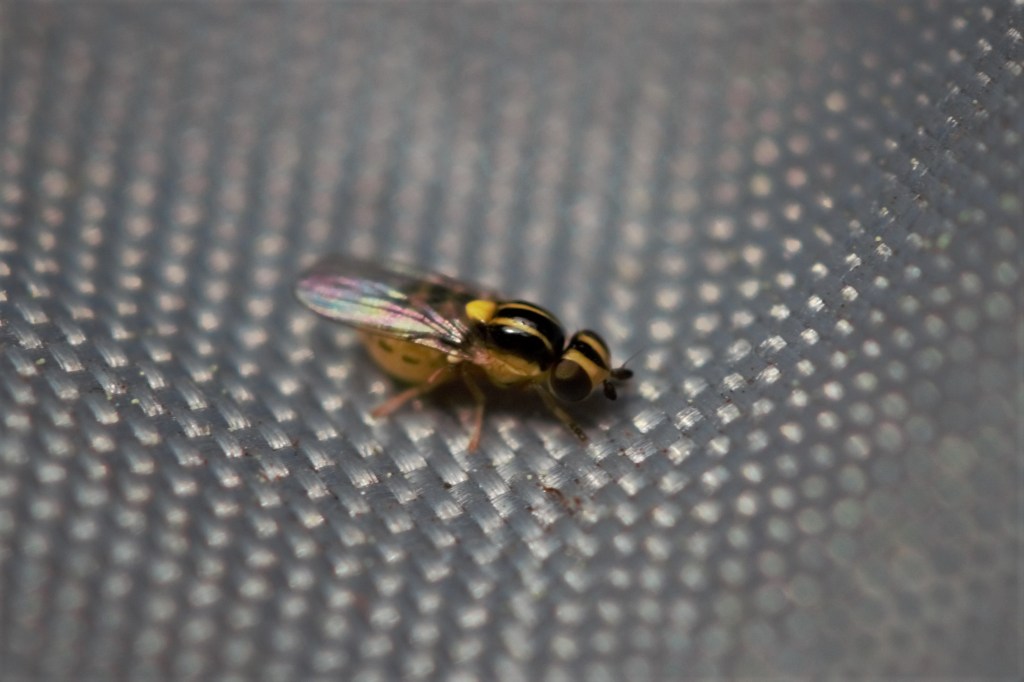
The next day, I did a tour of the campsite with my camera in order to find more subjects to photograph and identify. One creature located on my dining tent was another beautifully patterned fly: Thaumatomyia. This genus of flies contains some species which feed on aphids as larvae and others which bore and feed within grass stems (Marshall 2012).

Chloropid fly in the genus Thaumatomyia.

Nearby was a prowling spider which is possibly the False Pirate Spider (Platnickia tincta):

Sliding slowly across the leaf litter was a pale orange slug of the genus Arion:

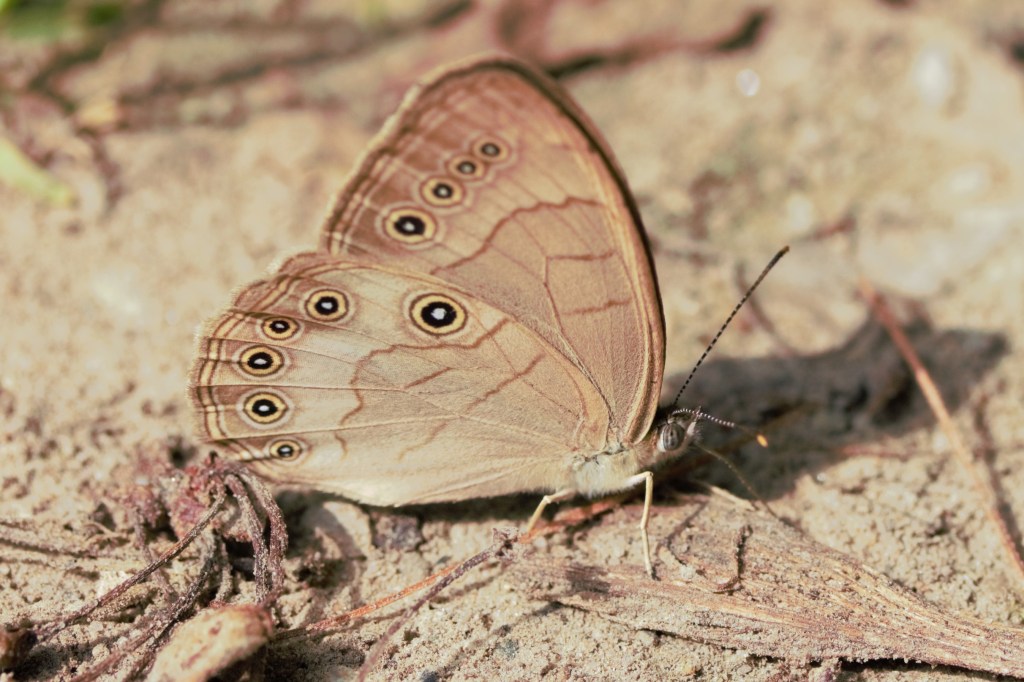
I was just able to capture this amazing butterfly that landed for a few moments on the ground, an Appalachian Brown (Lethe appalachia). Appalachian Brown caterpillars feed on sedges (Carex spp) and spend the winter in the caterpillar stage (Hall et. al. 2014).

Appalachian Brown Butterfly (Lethe appalachia).

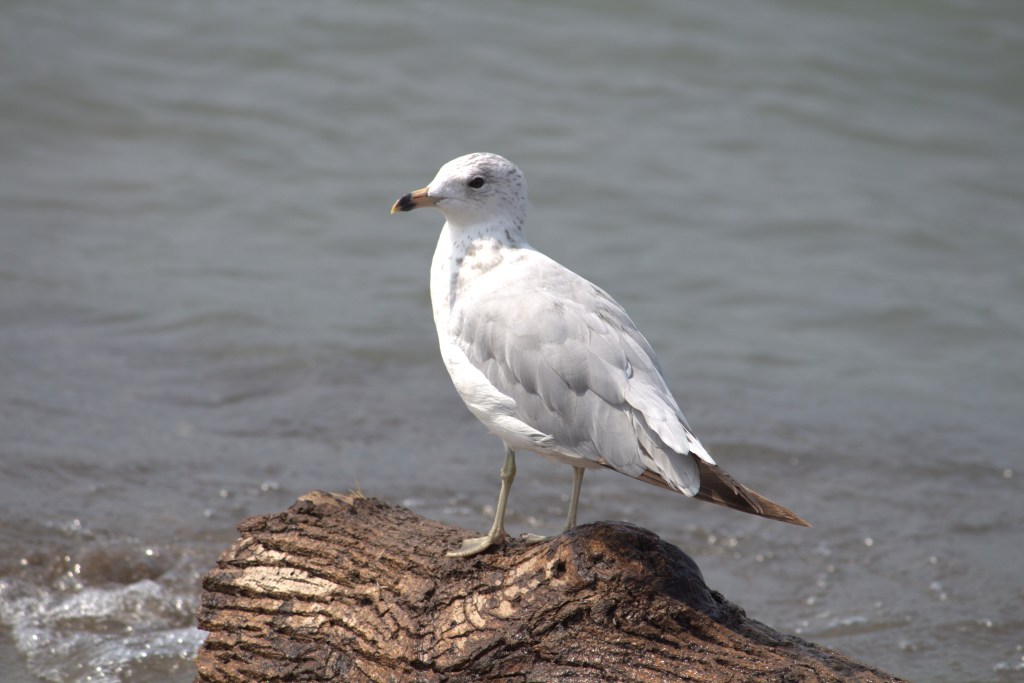
On the walk to the beach there were plenty of insects worthy of attention but I didn’t want to block the path of water-seeking pedestrians by crouching with my macro lens, so I decided to photograph birds there instead. There were swallows darting above the sands (more evidence of insect abundance) but they proved impossible to photograph. I took several photos of what I believed to be 2 different gull species. While reviewing my photos and posting them on iNaturalist it became clear that despite the contrast between the large brown-feathered birds and the sleek grey-and-white ones the birds were all members of the same species: the Ring-billed Gull (Larus delawarensis). 

Ring-Billed Gull (Larus delawarensis) panting in the heat to keep cool.
Another Ring-billed Gull, lacking the sharp white-and-grey plumage of the individual photographed panting above.
All of the birds in this photo are Ring-billed Gulls (Larus delawarensis) despite the one in the background appearing larger and in a very different plumage, the mottled brown look is that of a 1-2 year old bird before they acquire the more clearly defined gray and white feathers.

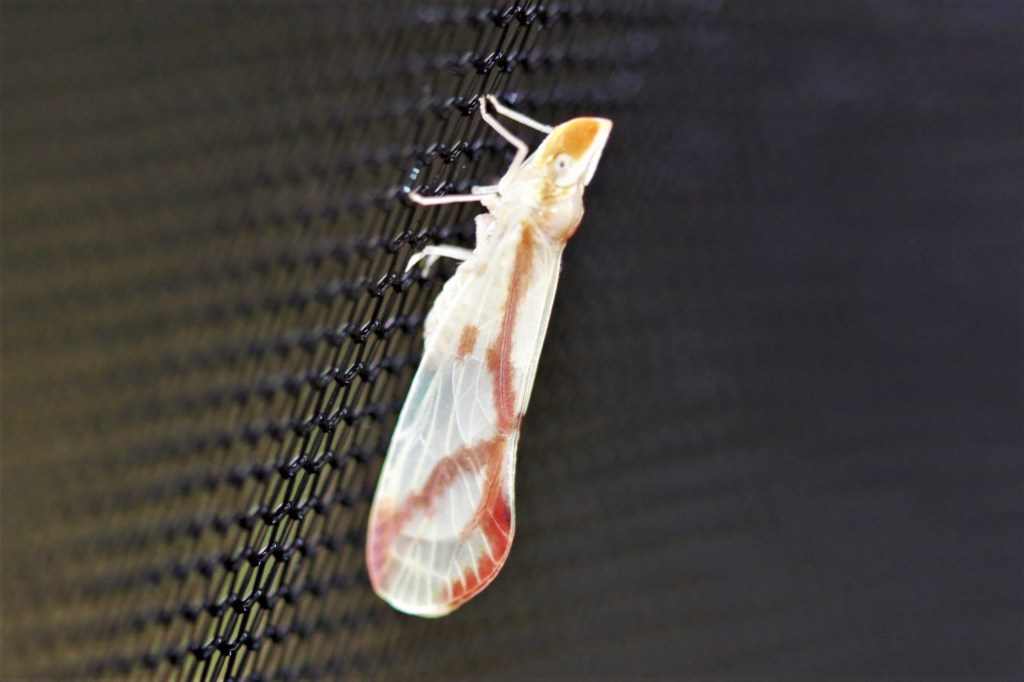
My final observation of the trip was a beautiful tiny leafhopper resting on a dining tent: Otiocerus coquebertii. This species is associated with Beech, Maple and Oak, possibly feeding on fungal hyphae (the underground microscopic portions of fungi) as nymphs (Bartlett 2020).

Otiocerus coquebertii, a tiny and beautiful leafhopper.

References:

Bartlett, C. R. 2020 (and updates). Planthoppers of North America (accessed August 12, 2023). https://sites.udel.edu/planthoppers/north-america/north-american-derbidae/genus-otiocerus-kirby-1821/

Hall, Peter, Jones, Colin, Guidotti, Antonia, and Hubley, Brad. 2014. The ROM Field Guide to Butterflies of Ontario. Royal Ontario Museum.

Marshall, Stephen. 2012. Flies: The Natural History and Diversity of Diptera. Firefly Books.

For other related blogposts, see:
MacGregor Point Observations (May 2018)

Port Burwell Observations

Categories
Nature Observations

The American Woodcock in Literature and in Life

There we were, a dozen or so people standing in a field, waiting, watching, and listening. The sky began to darken, the pinks and oranges of sunset had mostly disappeared, melting into a deep purple. The chorus of trilling toads (Anaxyrus americanus) and the Eastern Towhee (Pipilio erythropthalmus) calling out its name in the woods only increased the tension on our strained ears. Suddenly, we heard the first sharp peent from the distance. We moved as a group to try to line ourselves up with the repeated metallic sound. The almost electronic or perhaps frog-like sound was produced by a very strange-looking bird, a bird that was our focus tonight. Once we thought we knew where the bird was calling from, we resumed our watchful stance, binoculars and camera lenses trained on the brush and the purplish sky above it. Then suddenly our guide, Audrey Heagy, announced that the bird was rising through the air because she could hear its wings whistling upward. Looking around I couldn’t see any living thing against the dusk sky. It felt for the first few times like a sort of magic trick. And indeed, misdirection is the bird’s intent. Eventually I got used to watching the sky for tiny dark shapes and my ears became attuned to the pitch of the birds’ wings on their ascents and descents above the darkening fields. Even so, there were times when we would hear the peent of a grounded bird so sharply and clearly that we knew exactly where it was patrolling on the ground despite not being able to see it. We would focus all of our senses on this presumed location and then be fooled by the mysterious bird’s magic tricks. 

There are many natural phenomena that I have read about before encountering personally. This was one such event: the skydance of the American Woodcock (Scolopax minor) male.

To give you an idea of what this bird looks like, and to show you their camouflage, here is a video I took of a Woodcock foraging in Pinery Provincial Park, in October 2018.

There are a few ways the Woodcock gets away with such an obvious display and yet remains safe from predators. When first launching and on final landing approach, the Woodcock moves not vertically but horizontally for a few meters, without making a sound. This silent horizontal movement really works to confuse observers as evidenced by the group of naturalists whipping their heads around every time a Woodcock would begin ascending not directly above where it was on the ground, but several meters away. The sound of their whistling wings seems to fill the air, making it extremely difficult to pinpoint where in the sky the sound is coming from.

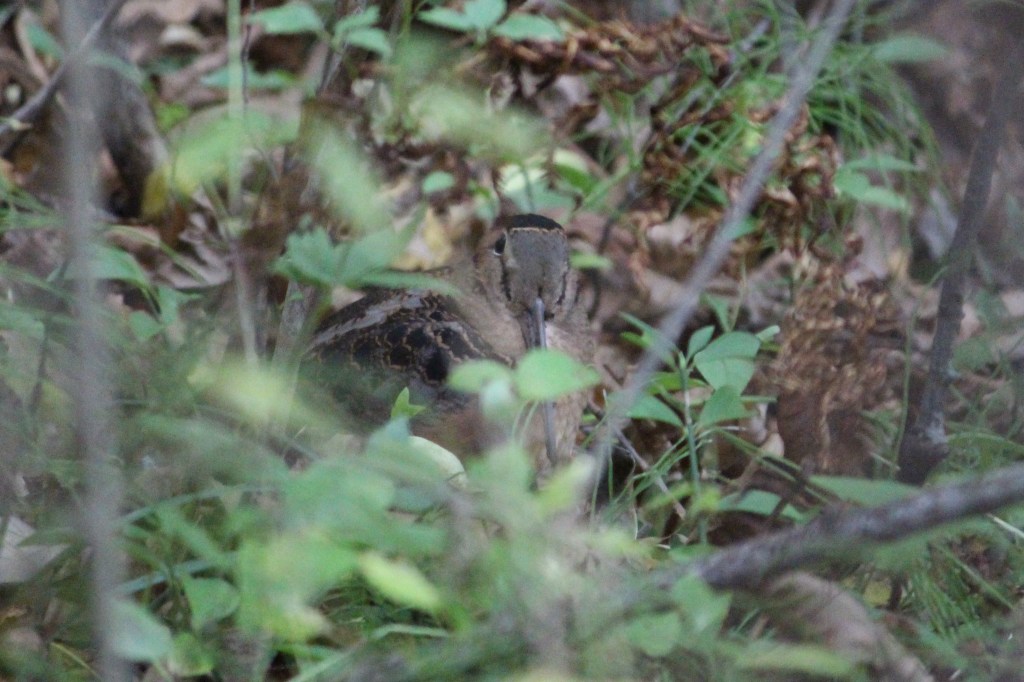
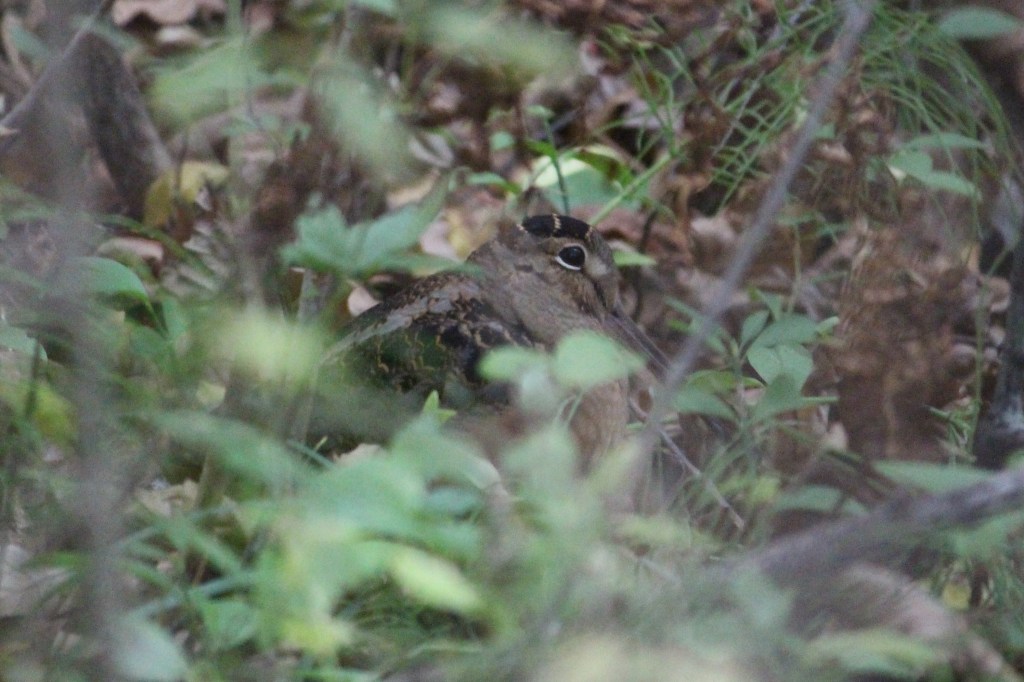
Besides a blurry shape overhead (once winging directly over our group), we didn’t get a visual on these mysterious dancing birds. I had observed one of these stealthy creatures on a previous occasion in the woods of Pinery Provincial Park and every time I looked away I had to re-locate the foraging Woodcock. Their camouflage helps them escape predators and is extremely effective.

Here is a photo I took of the Woodcock I observed in Pinery Provincial Park in October 2018. My wife spotted the Woodcock first, somehow picking out its amazingly camouflaged form from among the fallen leaves.

I would like to end where I began my encounters with the American Woodcock: in the pages of a book. Here is a passage from one of my favourite natural history authors, Edwin Way Teale, who described the Woodcock’s behaviour so elegantly and inspired me to seek it out myself.

From A Naturalist Buys an Old Farm, by Edwin Way Teale:

“Its performance begins with the brown chunky long-billed bird walking about in the open field, turning this way and that, uttering again and again a buzzing nasal ‘peent!’… The call seems now far away, now close at hand, according to the direction the bird is pointing. Then there is a moment of silence. It is followed by the winnowing sound of its wings and we see its dark little form speeding in a wide climbing curve against the light of the sky… Higher and higher in great sweeping circles it mounts above the pasture. We follow with our eyes its retreating form, often losing it in the sky. At the height of its ascent the song begins. The sweet frail twittering sound at times seems to come from all directions, the notes to shower down around us. And while the song goes on it is joined by a quavering musical strain produced by three stiff narrow feathers at each wingtip. They vibrate int he wind as the bird plunges, veering wildly, falling through the sky like a gust-blown leaf. The end comes abruptly – an almost vertical descent to the darkened meadow. Then the “peenting” calls begin once more.”

For previous bird observation blogposts, see:
Eaters of the Dead

The Teal Tale Teale Told

A Green Heron Stalks the Shallows

Return of the Ravens

3. Canada Jay (Perisoreus canadensis)

The Wonders of Wrens

Pinery Birds, Winter 2019

Categories
Nature Observations Tumblr Repost

Eaters of the Dead

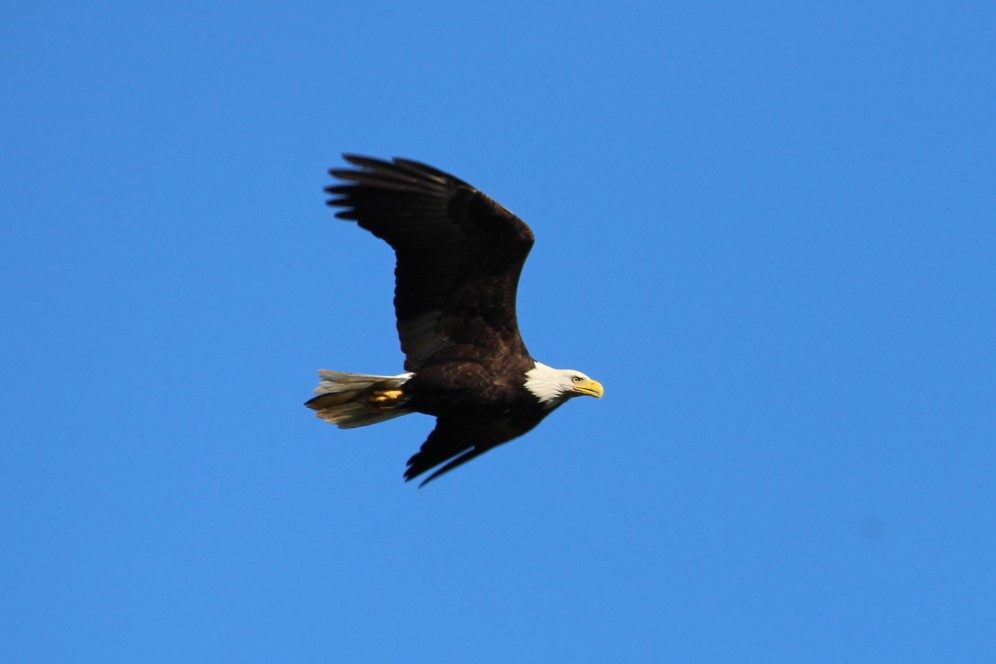
Bald Eagle photographed in Pinery Provincial Park, September 2021.

Here’s another repost from my old tumblr blog norfolknaturalist.tumblr.com. I’ve added some newer photos of the species involved but otherwise unchanged. Much of this article was inspired by my reading of the book Life Everlasting: The Animal Way of Death, by Bernd Heinrich. I thought the subject and title were appropriate for Halloween season.

Just as we were about to turn into my parents’ driveway last weekend (in April 2018), we saw probably the most iconic bird in North America less than 100 metres away from us down the road. A Bald Eagle (Haliaeetus leucocephalus) was dining on a Raccoon roadkill in clear sight. 

Perhaps it’s surprising that a bird of such noble renown was seen stooping to consuming carrion, something that we often see as repulsive. The truth is that the line between ‘predator’ and ‘scavenger’ is often a very blurred one. Most animals that eat other animals are willing to eat one that has already died or been killed. To the predator, it contains the same nutrients that it would obtain from its own kill but with much less effort (valuable time and energy) on their part. This isn’t to say that eating pre-killed remains is without risk for a predator or a scavenger. Besides the conflicts with other hunters over the resource, there is an omnipresent and invisible threat to all dead flesh.

Bacteria: organisms that are so tiny they are dwarfed by individual cells of our bodies. Despite being so small, and unseen without a powerful microscope, bacteria operate everywhere in the natural world and one of the most profound activities they perform is nutrient recycling and breakdown. While they disassemble cells and consume dead flesh, bacteria proliferate. Bacteria are the reason that predators can’t eat an animal body that’s been dead for too long. They are the reason dead things go “rotten” and become unpalatable by almost any animals. They are the unseen “competitor” with the visible and charismatic predators.

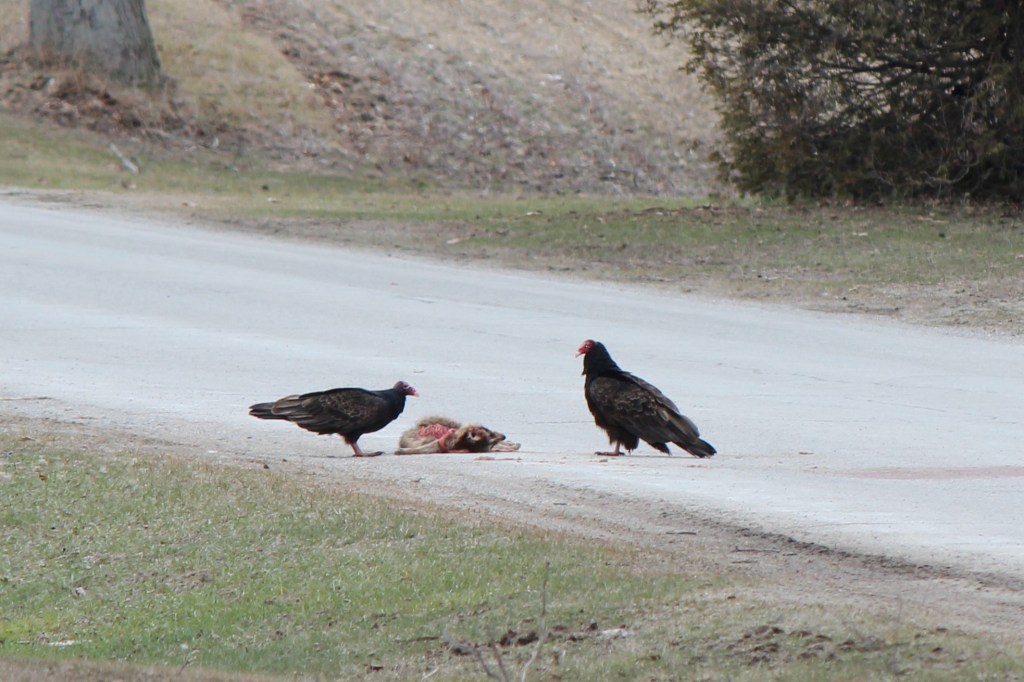
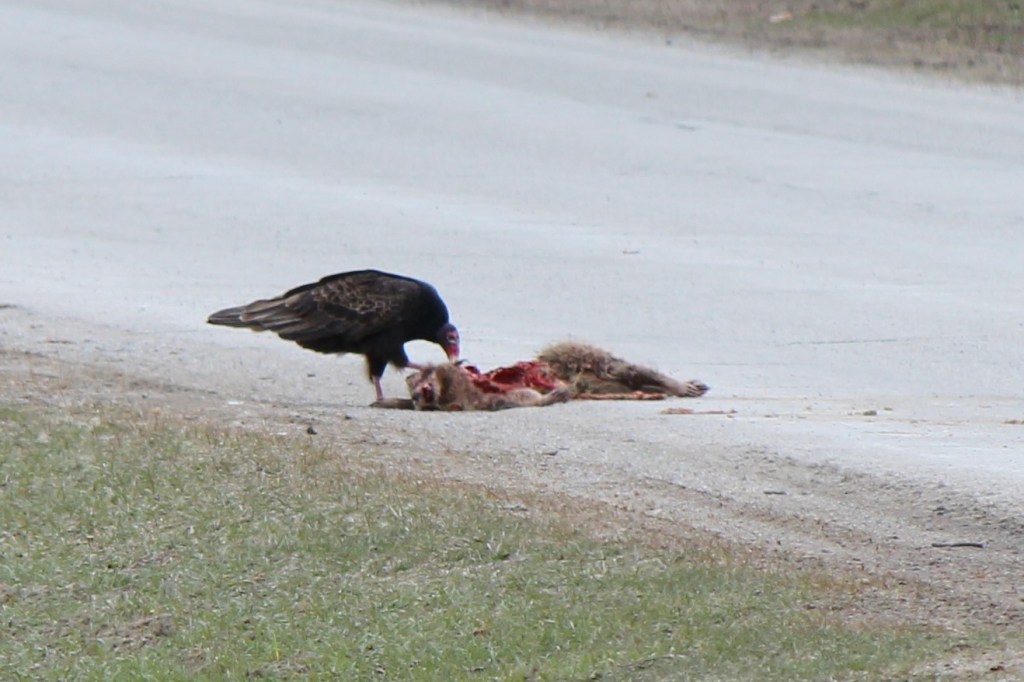
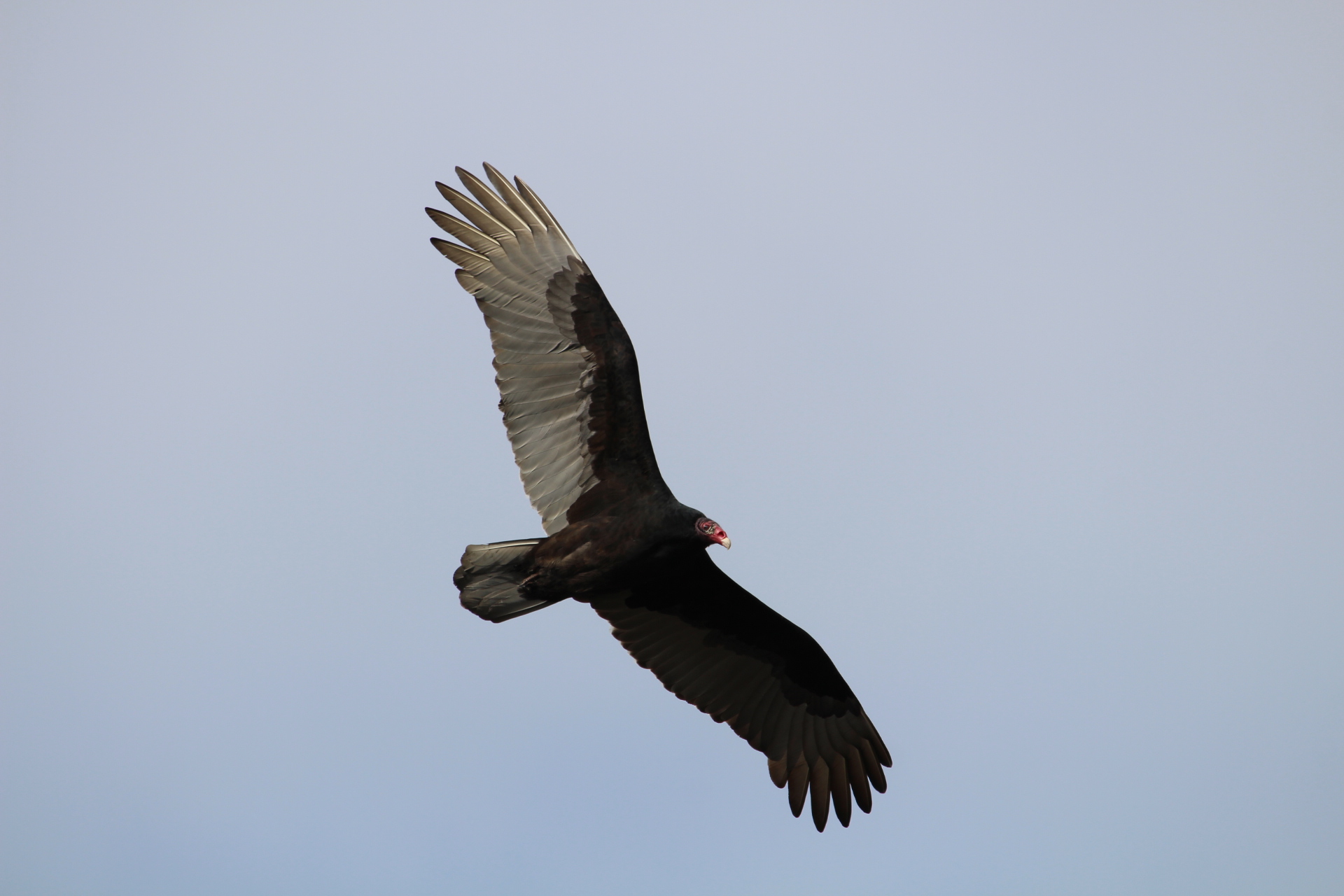
After at least an hour of feeding, and the frequent interruptions of cars passing, the eagle flew off and left the dead Raccoon. That is when the Turkey Vultures (Cathartes aura) moved in, creatures much more commonly associated with scavenging. And for good reason. Turkey Vultures have the most powerful sense of smell of any bird, and can detect a dead animal from over a mile away. What’s more, they can eat flesh that other creatures would turn down as too far gone. Their digestive system is able to break down the toxins of the ever-present bacteria, making them capable of consuming rotten flesh, where others cannot. 

It may be a grisly business, the consumption of the dead, but it is an essential (and amazing) part of ecosystems around the world.

Turkey Vulture photographed in Long Point, October 2021.

Categories
Nature Observations

Bullfrogs and Buffleheads

I usually like to discuss my nature observations soon after I make them, but that’s not always possible. In light of this, I’d like to describe some photos I took way back in March of this year. The week was rainy except for one day and I was determined to get out there and take some photos of birds, so I took a drive to Long Point and visited two marshy trails and was successful.

One of my main sightings on this trek were various ducks and geese. Ducks other than Mallards (Anas platyrhynchos) have the annoying habit of staying on the far side of whatever water body they are in, which means that I usually can’t take good pictures of them with my camera. On this excursion, I spied many of these groups of ducks keeping a wary distance and took many blurry photos of them. Most of these shy non-Mallards* were Ring-necked Ducks (Aythya collaris). One pair of ducks actually allowed me to get much closer and take decent pictures of them. These were Buffleheads (Bucephala albeola). By their extravagant head design, it was a pair of males. Buffleheads are related to mergansers and similarly dive for their food, which is mostly aquatic insects and snails (Baldassarre 2014). They make their nests in tree cavities (mainly those fashioned by Northern Flickers (Colaptes auratus)), and breed in the northern forests of North America wherever these woodpeckers are commonly nesting (Baldassarre 2014). The Buffleheads I spied floating across a Long Point marsh were either spending the winter here or moving back north to breeding habitats.

*for the record, I have nothing against Mallard Ducks and I usually end up taking pictures of them too (they are quite beautiful birds) but there is definitely a part of me that wants to see and encounter creatures that are new to me and Mallards are… well, they’re the most commonly encountered ducks in the world. I could use a very similar paragraph to explain my feelings toward Canada Geese (Branta canadensis).

Hanging out with the Buffleheads was another waterbird which I initially mistook for a female Bufflehead because of its close proximity to the males and lack of head adornment. A few minutes later the pair of males took off from the water and flew down the waterway in a flurry of black-and-white. Yet this other bird didn’t follow, instead making occasional dives beneath the water surface and popping back up again. When reviewing my photos it became clear that this bird wasn’t a Bufflehead, and it wasn’t even a Duck (member of the family Anatidae). My mystery bird was from an entirely different branch of the bird family tree, despite its superficially duck-like appearance. It was a Grebe (a member of the Family Podicepididae), specifically a Horned Grebe (Podiceps auritus).

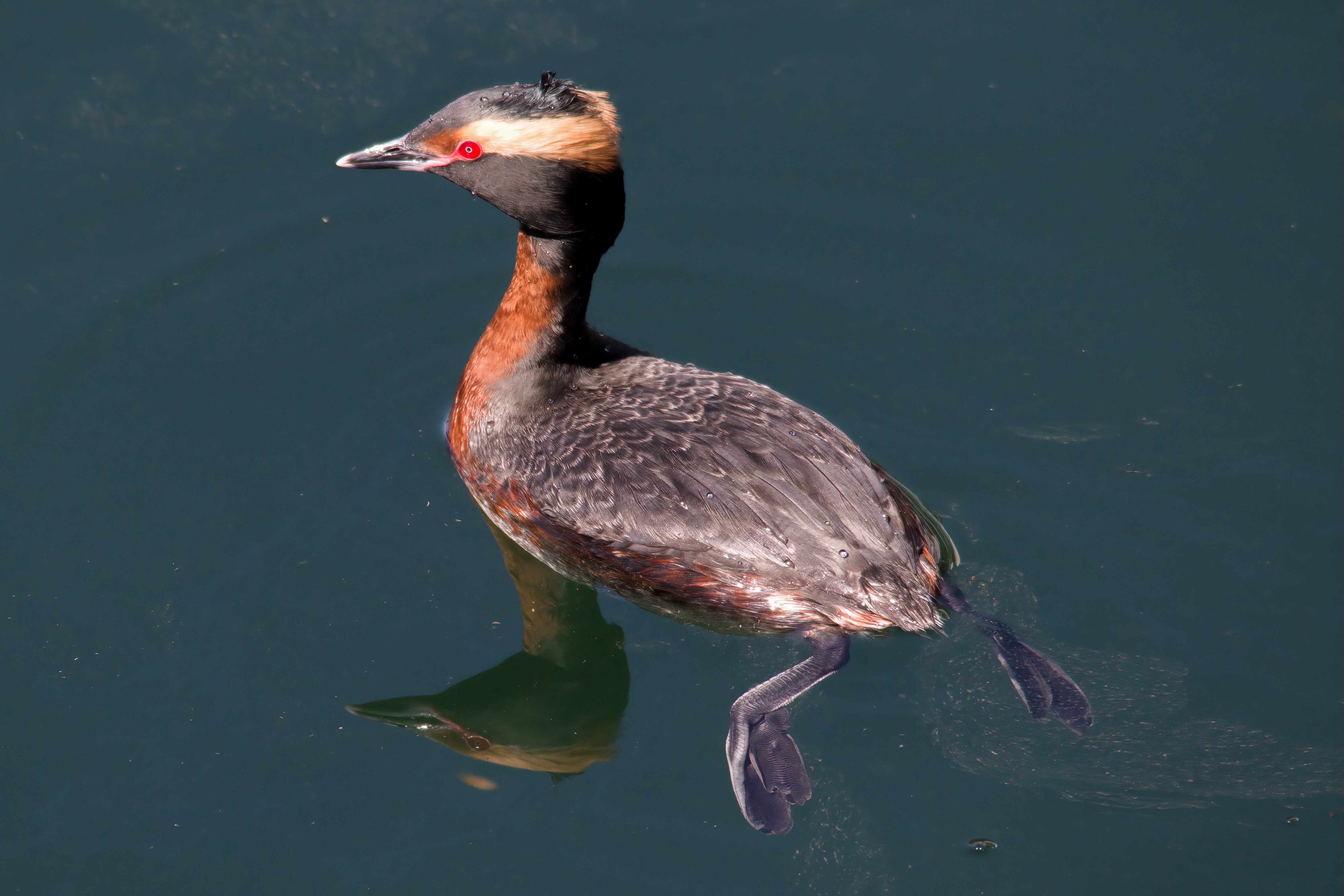
Grebes swim in the water by means of their feet which like ducks are expanded to have more surface area but unlike a duck’s ‘webbed’ feet, grebe feet are said to be ‘lobed’. I have never seen a grebe foot before, because their feet are usually under the water while these superb swimmers float or dive. But take a look at this photo of a Horned Grebe and you will see why I mention the feet as they are very impressive.

Horned Grebe, with visible impressive feet, photo by Tomas Wuschke, used with permission.

The Horned Grebe I saw at Long Point was in its much less dramatic winter plumage (cross-reference the beautifully patterned adult in Tomas Wuschke’s photo above with the drab gray/black bird in my photo). They only very rarely breed in Ontario, and even then only at the very northern edge of the province, preferring northern Canada and Alaska where they create nests on floating vegetation in wetlands (Hughes 2001).

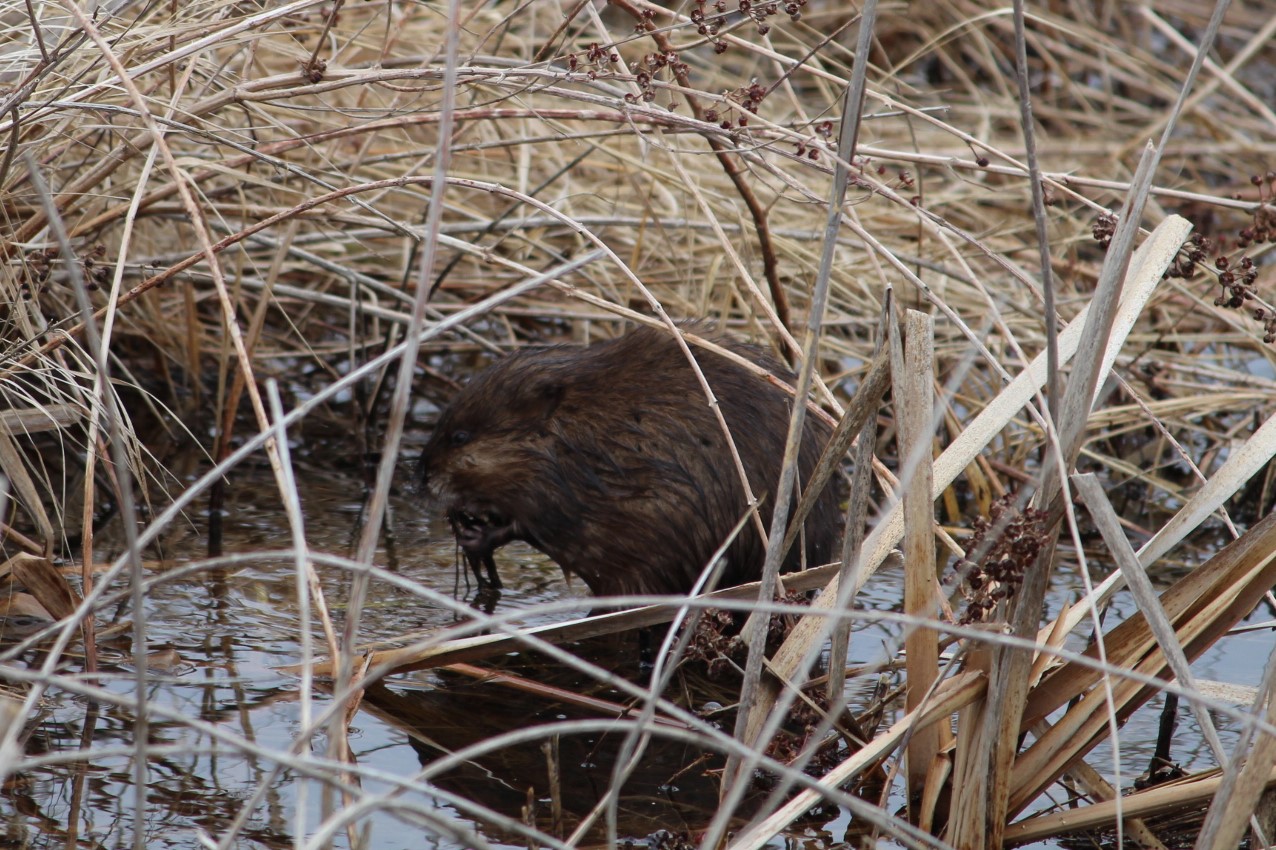
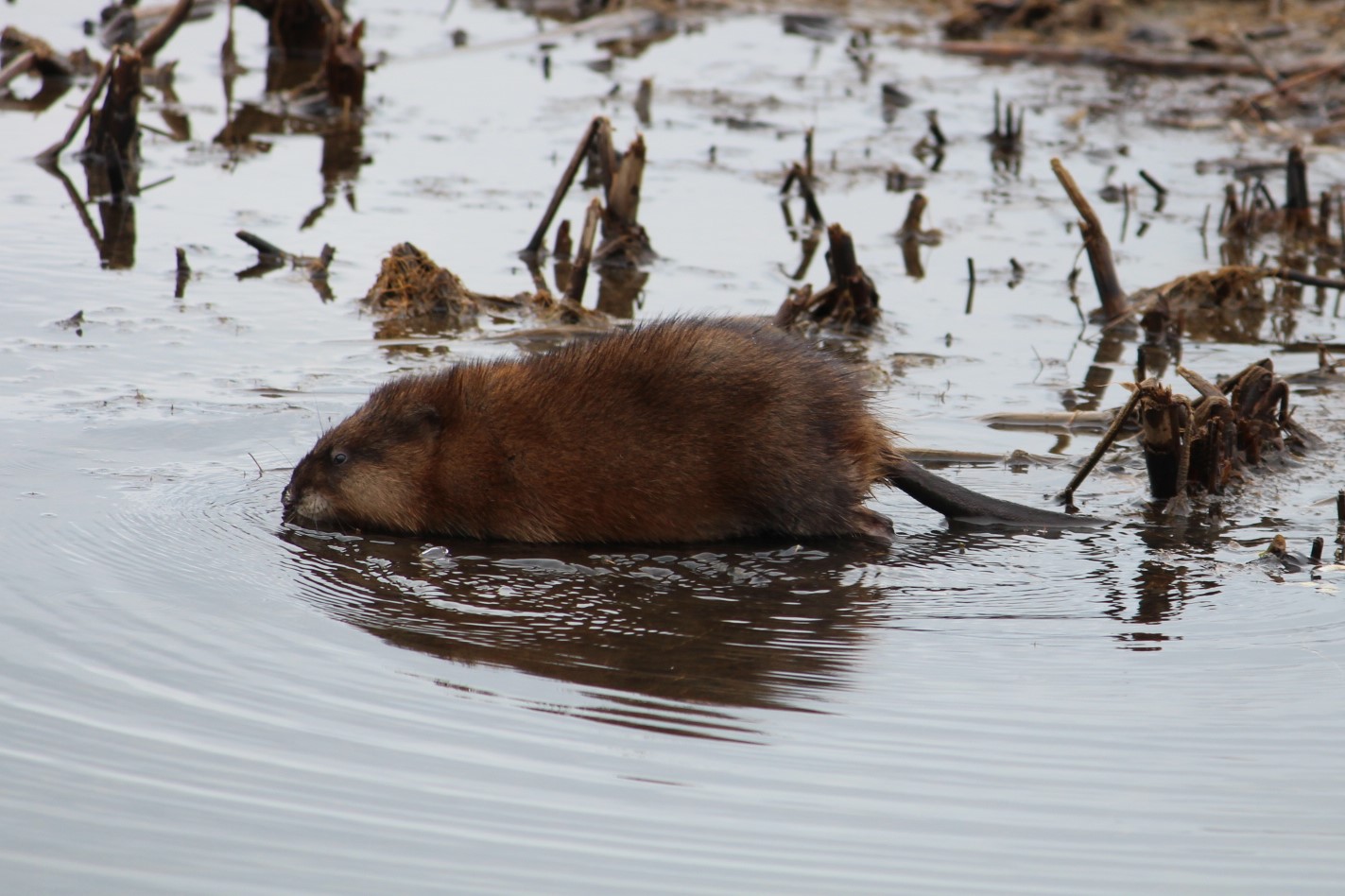
Muskrats (Ondatra zibethicus) were ubiquitous on both trails, frequently startling me with sudden splashes before scooting along at the surface or under the water. I observed a couple of these large rodents munching and was curious what they were eating but I was unable to tell from my photos. It could have been anything from vegetation to arthropods to fish since Muskrats are extreme generalists.

Two shockingly large birds flew in from the lake across the marsh, majestic and powerful eagles. Because of their large wingspan, I initially thought the birds to be Herons, which move south to avoid frozen water but will return once the ice has melted. Once I took some pictures I saw that the heads were definitely the heads of raptors, and I later figured out that they were juvenile Bald Eagles (Haliaeetus leucocephalus). 

While driving between the two trails I noticed a frog and did a double take. To notice a frog while driving says something about the frog’s size and indeed this was a representative of the largest frog species in North America: an American Bullfrog (Lithobates catesbeianus). This frog’s tympanum (the circular depression below and behind the eye) is much larger than its eye and its throat is yellow which indicates that this is a male, and males are generally smaller than females in this species! Bullfrogs can reach 20.3 cm (8 inches) long and will “eat nearly any animal they can capture and swallow” (Harding and Mifsud 2017).

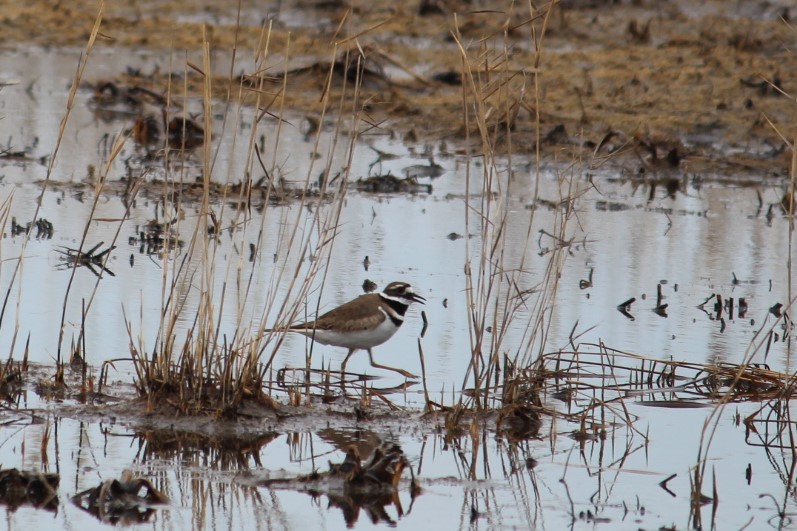
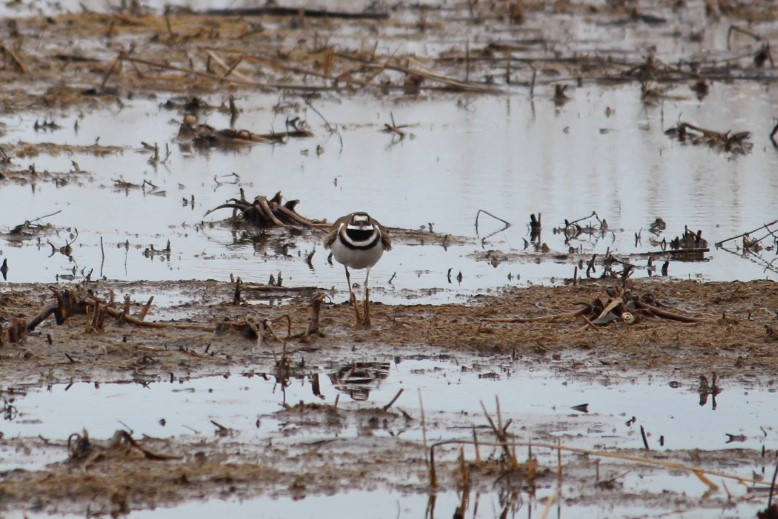
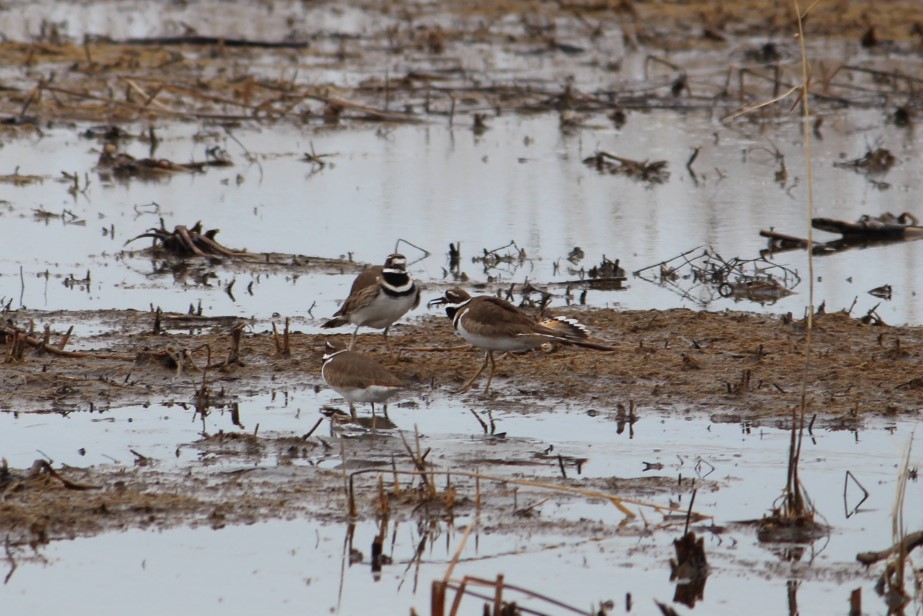
The most noticeable resident on the second trail were the Killdeer (Charadrius vociferus), tearing about on their long legs and piercing the air with their high-pitched repeating calls. I love these birds and their distinctive cries, and seeing this many together at one time was a treat.

Before leaving each trail, I was able to photograph some small sparrows that were foraging along the paths. Watching these birds picking at the ground and presumably finding something to eat made me wonder what they could possibly be finding. A glance at the ground surface revealed no insects to me, but the Killdeer too were digging into the mud and finding plenty to eat. Watching birds forage like this always makes me marvel at the amount of life that must be present to sustain them, life that I couldn’t even see! There must be hundreds of tiny invertebrates that each bird was finding to sustain themselves. What an incredible invisible foundation to these flocks. 

American Tree Sparrow (Spizelloides arborea) photographed at the end of the second trail in Long Point.

References:

Baldassarre, Guy. 2014. Ducks, Geese and Swans of North America, 2 Vols. (revised and updated edition). Johns Hopkins University Press.

Harding, James H. and Mifsud, David A. 2017. Amphibians and Reptiles of the Great Lakes Region. University of Michigan Press.

Hughes, Janice M. 2001. The ROM Field Guide to Birds of Ontario. Royal Ontario Museum.

For related nature observations in Long Point, see:

A Green Heron Stalks the Shallows

A Visit to Big Creek, Part 1

-A Visit to Big Creek, Part 2

Categories
Nature Observations

Algonquin in August

At the beginning of August, I was at Algonquin for a week, and although I didn’t take as many pictures as on previous trips I still managed to spot some fascinating creatures and I’d like to describe my observations here.

Early on a rainy morning I was on a drive down Opeongo road, searching for wildlife beneath the grey skies. Only at the end of the road, which terminates at the store at the edge of Lake Opeongo did I manage to find any photo subjects. Off in the distance was the most iconic bird of northern lakes, the beautiful and sleek Common Loon (Gavia immer). I was surprised that the distant bird drifted closer and closer across the smooth water until I was able to get some very close shots of it dipping its head in and out of the lake. Perhaps it was as curious as I was or perhaps there were some fish that it sought near the dock. Either way, I was able to get a close look at this wonderful bird.

Along the dock, there was another familiar bird, one that has almost the opposite reputation to the Loon. While the Loon is a symbol of wildness and its strange call echoing across lakes evokes mystery
and beauty, Gulls are often symbols of trash-mongering, scavenging, and filth. Loons are revered and Gulls are vilified. If you’ve read any of my blog you may have gathered that I greatly dislike the vilification of animals. Not only does it cause unjustified persecution of animals it also hides their true nature as fascinating creatures in a complex world. Gulls are a great example of this. I saw two species of gulls while at the edge of Lake Opeongo: three Herring gulls (Larus argentatus) perched atop the store roof, and one ring-billed gull (Larus delawarensis) stood majestically on the dock, before taking to the air and soaring across the water.

Ring-Billed Gull (Larus delawarensis) at the edge of Lake Opeongo.

The ring-billed gull used to be a rare sight in Algonquin park, but has become more common since the 1970s partly because of the general population growth of this species from a low in the early 1900s due to human persecution and egg-collecting (Tozer 2012). Herring gulls on the other hand, are the only gulls to nest in Algonquin Park and have been a common sight by lakeshores for many years. Some of their nests are in large colonies on rocky islands in lakes such as on Lake Opeongo, but often they nest individually or in small groups. Herring gulls have even been recorded nesting in abandoned bird nests made by large birds in trees (such as Herons, Bald Eagles or Osprey (Tozer 2012)), though this is uncommon.

Herring gulls perched atop the Opeongo store roof.

During our stay at Algonquin I also went on the Spruce Bog Boardwalk trail in the evening to take some photos. My most startling encounter was with a Spruce Grouse (Falcipennis canadensis) bursting from beside the path
in a flurry of wings and landing in a tree far away. Unfortunately the shocking appearance and subsequent departure was so quick that I was unable to take a photo of the bird. On this same trail, I found a crab spider waiting on a leaf for insects to capture with its long extended legs, and a tricoloured bumblebee (Bombus ternarius) humming from flower to flower.

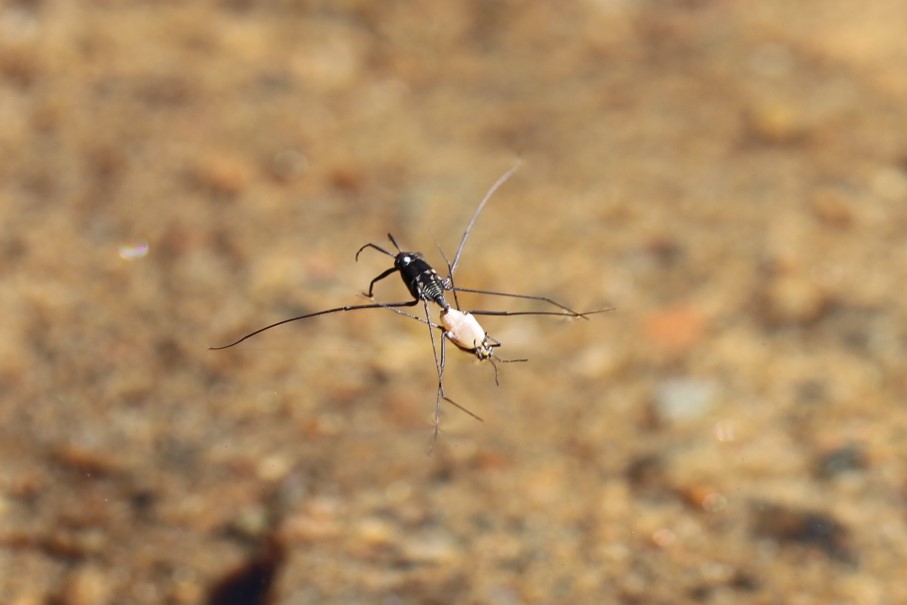
On my final day in Algonquin I saw something in the Pog Lake Campground that caught my eye: a water strider with a striking white abdomen. I couldn’t get very close to it because it was skimming the surface of a river so I had to lean out with the macro lens to try to get a photo. This is all to explain why my photos are not super great, but they do reveal a surprise. My water strider’s white abdomen was in fact another water strider’s underside. What I thought to be a single insect was a mating pair of water striders (Metrobates hesperius).

Water Striders mating on the surface of a river, one upside down beneath the other.

They moved in so coordinated a fashion that it was a fair mistake to believe they were a single insect. Water striders are fascinating insects, which use the water surface the way an orbweaving spider uses its web. They are able to detect vibrations in the surface and hone in on them to locate prey which they dispatch and consume with their piercing mouthparts. Water striders use these vibrations to communicate with each other as well, for purposes such as mate finding.

Despite not taking as many photos as usual, I still managed to find fascinating creatures to observe which I have found to be the case whether in Algonquin Provincial Park or my own backyard.

References:

Tozer, Ron. 2012. Birds of Algonquin Park. The Friends of Algonquin Park.

For Previous Posts about Algonquin Observations, see:
Canada Jay (Perisoreus canadensis)

Moose (Alces alces) Family

-Algonquin Observations (2021):

Part 1: Pog Lake Campground

Part 2: Opeongo Road

Part 3: Peck Lake Trail

Part 4: Spruce Bog Speedrun and the Logging Museum Trail

Part 5: Spruce Bog: The Reckoning

Categories
Nature Observations Species Profile

A Green Heron Stalks the Shallows

Over the past few years I have come to appreciate how beautiful and wonderful birds are. Along with that appreciation has been the realization that there are diverse birds within a short walk or drive of my home. I have encountered new species of birds almost every time I go out to my new favourite birding destination: Long Point. Globally renowned for being a biodiversity hotspot, and a corridor for migrating birds crossing the Great Lakes, Long Point is full of a variety of freshwater habitats and a corresponding diversity of bird species. 

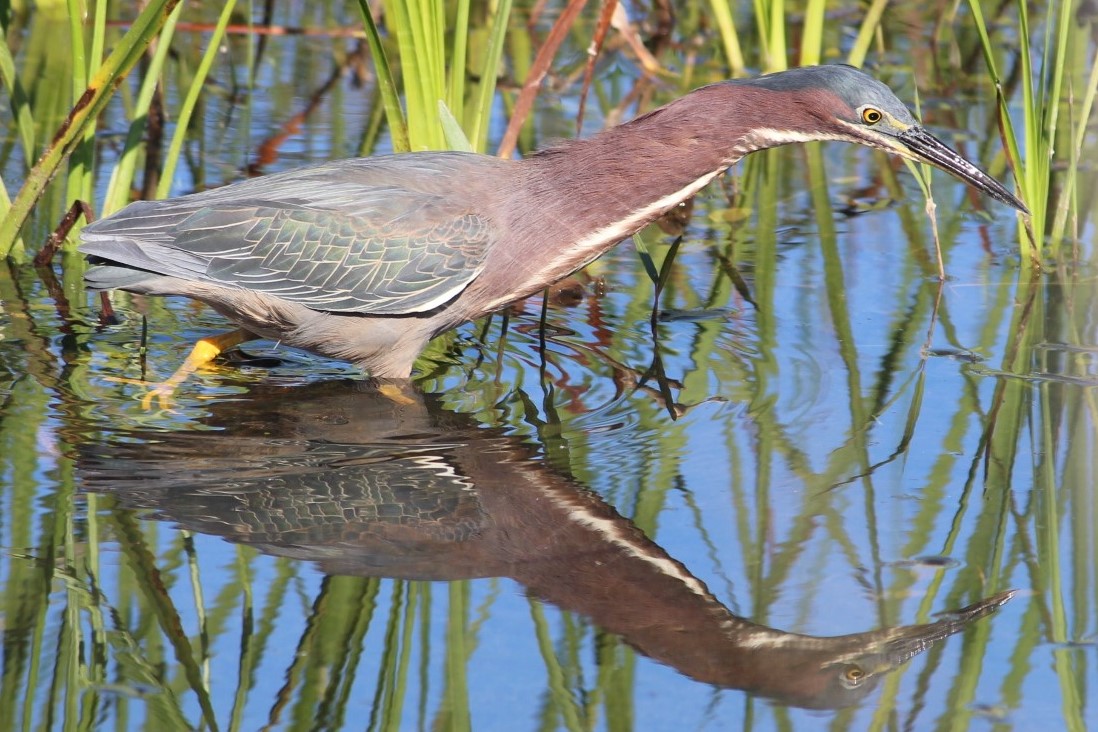
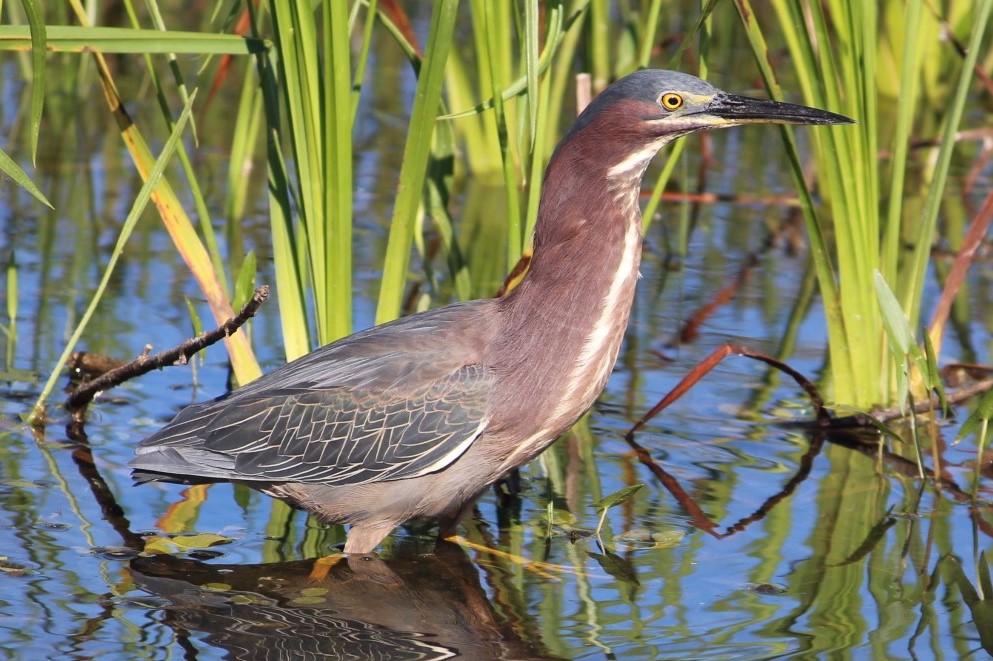
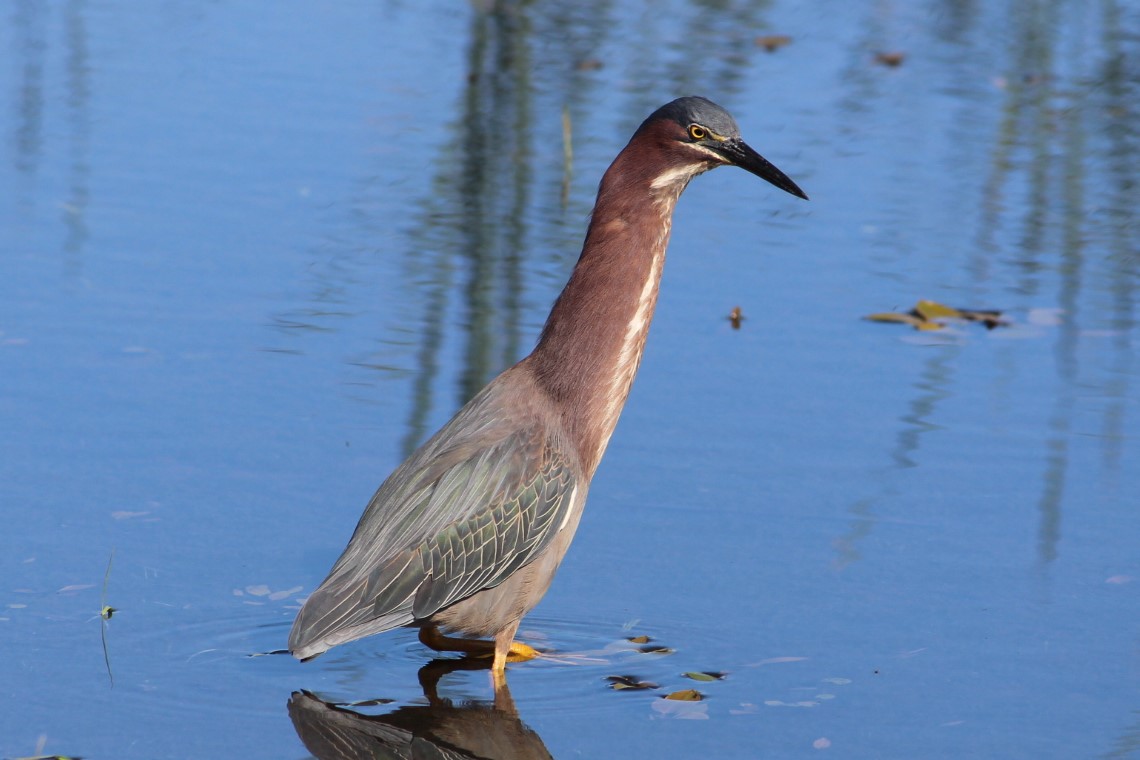
My most recent exciting encounter was with a species I had never before seen up close. Before this past year “Heron” meant the Great Blue Heron (Ardea herodias) the only species of heron I saw regularly, certainly the most conspicuous heron species across North America. But as I was wandering down a trail amid mudflats and shallow coastal marsh, I was treated to an incredible sighting: the small agile form of a Green Heron (Butorides virescens). Stalking swiftly through the shallow water, the Green Heron snapped at the water surface with fair frequency and was always on the move while it foraged. I wasn’t sure exactly what it was eating, but it certainly wasn’t fish unless it was catching tiny individuals. My guess is that it was feeding on aquatic invertebrates such as dragonfly larvae, or other water-dwelling insects. I couldn’t believe my luck to see this beautiful little hunter foraging within a few metres of me. 

Green herons breed across the eastern United States and Southeastern Canada (including Southern Ontario). The birds start arriving in Ontario at the end of April and are gone by the end of October (Davis and Kushlan 2020). Green herons spend the winter in Mexico, Central America and Northern South America. Throughout their range they utilize essentially any fresh or salt-water habitat from inland marshes to coastal mangrove forests (Davis and Kushlan 2020). With such a diversity of habitats, they feed on a wide range of prey depending on where they are hunting including fish, frogs (and tadpoles), lizards and snakes, rodents, crayfish and crabs, aquatic and flying insects, spiders, snails, earthworms and leeches (Davis and Kushlan 2020). Besides these aquatic organisms, they even feed on such surprising prey as nestling birds (Wiley 2001). Clearly Green Herons are opportunistic foragers using a variety of feeding methods to capture such diverse prey. One of the most fascinating foraging behaviours is bait-fishing. Several birds are known to do this*, but Green Herons are the heron most frequently observed using this strategy to catch prey. In one of the first reported instances of bait-fishing in the Green Heron (Lovell 1958) the bird used bread thrown by people to attract fish to the surface and even chased American Coots (Fulica americana) away from its bait.   

*Many herons have been reported to use bait such as the Black-crowned Night Heron (Nycticorax nycticorax), the Great Blue Heron (Ardea herodias) and the Great Egret (Ardea alba), but other birds are also reported bait-fishers, such as the Pied Kingfisher (Ceryle rudis) and the Black Kite (Milvus migrans). Check out this article for more fascinating details: Davis and Zickefoose 1998 (Bait-fishing by Birds: A Fascinating Example of Tool Use | Searchable Ornithological Research Archive (unm.edu))

This photo of the Green Heron shows it off in a more “typical” Heron pose, demonstrating how long its neck is.

The individual that I watched wading through the shallows was not using any bait-fishing techniques, but rather seemed to be doing the more commonly observed stalk-and-stab technique of herons the world over. After roaming across the patch of water directly across from me, it took to the air and flew a short distance to begin combing a new area of wetland for food. What a beautiful, amazing bird.

References:

Davis Jr., W. E. and J. A. Kushlan (2020). Green Heron (Butorides virescens), version 1.0. In Birds of the World (A. F. Poole and F. B. Gill, Editors). Cornell Lab of Ornithology, Ithaca, NY, USA. https://doi.org/10.2173/bow.grnher.01

Wiley, James. 2001. Green Heron (Butorides virescens) predation at Village Weaver (Ploceus cucullatus) nests. Journal of Society of Caribbean Ornithology Vol 14 No. 3 pp 130-133. (https://jco.birdscaribbean.org/index.php/jco/article/view/571/475)

Lovell, Harvey B. 1958. Baiting of Fish by a Green Heron. The Wilson Bulletin Vol. 70, No. 3 (Sep., 1958), pp. 280-281 

Davis, William E. and Zickefoose, Julie., 1998. Bait-Fishing by Birds: A Fascinating Example of Tool Use. Bird Observer Vol. 26 No. 3, pp 139-143.

For previous posts focused on birds or Long Point, see:
Return of the Ravens

Canada Jay (Perisoreus canadensis)

The Wonders of Wrens

A Visit to Big Creek, Part 1 and Part 2

Pinery Birds, Winter 2019

Categories
Nature Observations Tumblr Repost

MacGregor Point Observations (May 2018)

Once again, I’m going to repost one of my tumblr blog posts, this time from May of 2018.

On May 18-21, 2018, we took a trip to MacGregor Point Provincial Park. Today’s post is going to be a highlight of the animal observations/encounters that we had that weekend.

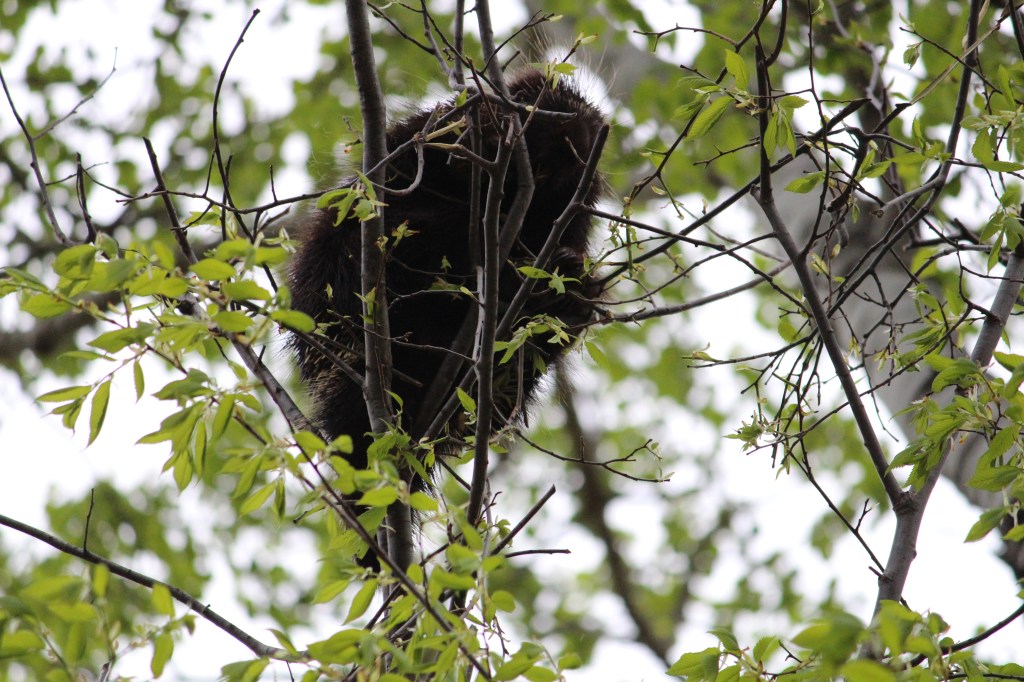
We awoke early the first morning of our stay and looked at the grey skies that promised rain. Hoping to spot some wildlife beneath the somber dawn sky, we set off on the Tower Trail. Our early start was rewarded with the sight of a strange animal resting in a tree.

image

It was a mammal with spines, and the second largest rodent in North America (only beaten by the Beaver): a North American Porcupine (Erethizon dorsatum). After consuming some buds and plants that it foraged in the night it found a perch to rest in for the day, one that seemed awfully thin for the size of the animal.

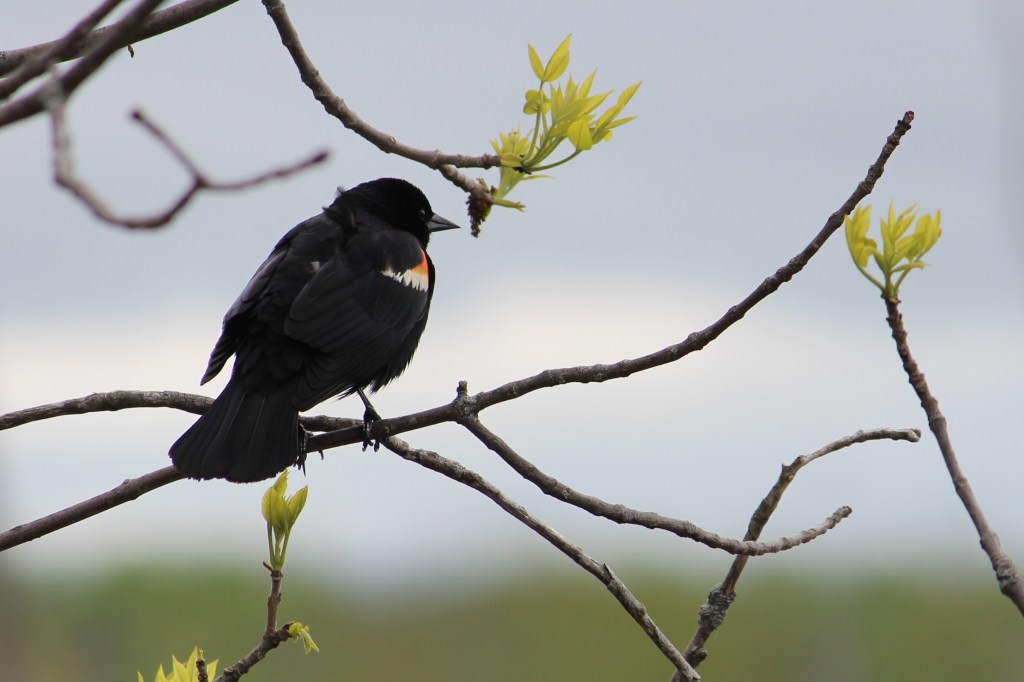
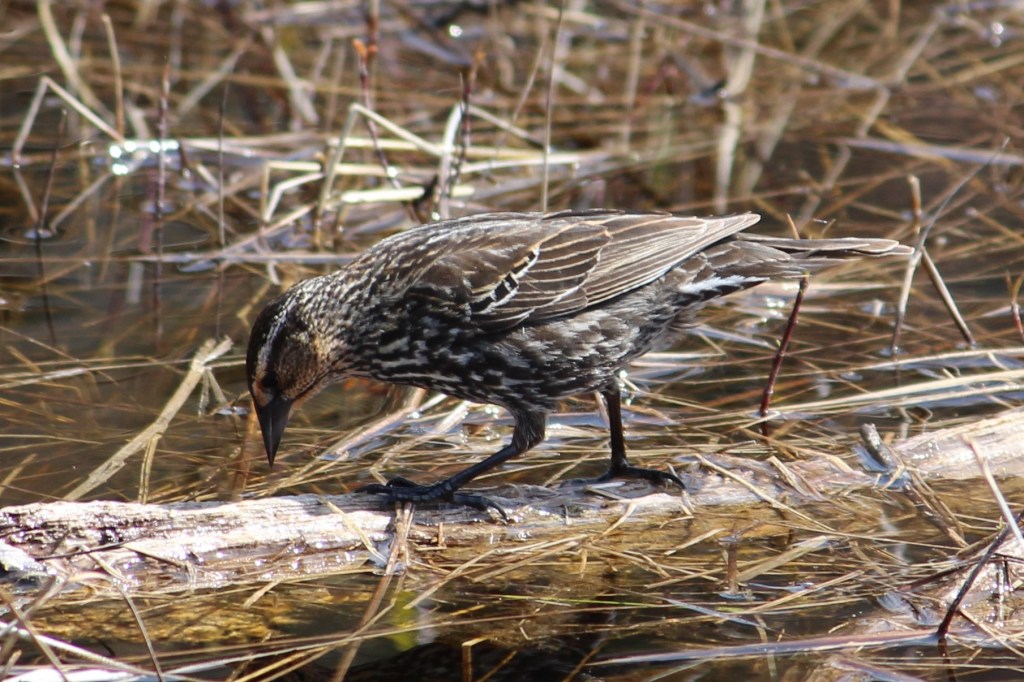
Further down the trail, we moved through various ponds until the horizon opened into spreading wetlands filled with reeds and bordered by grasses and trees. Here, the red-winged blackbirds (Agelaius phoeniceus) were in abundance, uttering their O-ka-leeeee calls from their various perches. We saw males with their velvet black plumage offset by epaulets of red-and-yellow, and we also occasionally spotted the much more camouflaged females. On our last morning camping, we saw one of the females and believed it to be a different species of marsh-bird, but later came to the realization that it was a female red-winged blackbird.

image
image

Male (top) and Female (bottom) Red-winged Blackbirds (Agelaius phoeniceus).

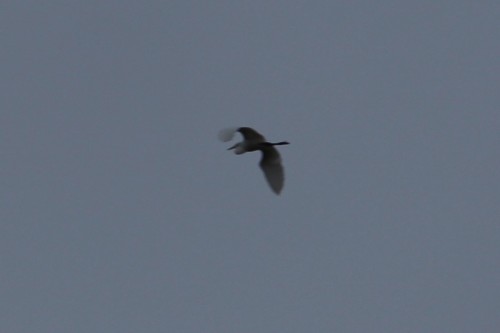
Mixed with the sounds of the blackbirds, were the trumpeting calls of the Canada Geese (Branta canadensis), always the loudest birds present. As we were leaving the wetlands, we heard a strange call and a bird departing the marsh. We were able to snap a quick picture of it and now believe it’s a Great Egret (Ardea alba).

image

Our fleeting glimpse of a Great Egret (Ardea alba).

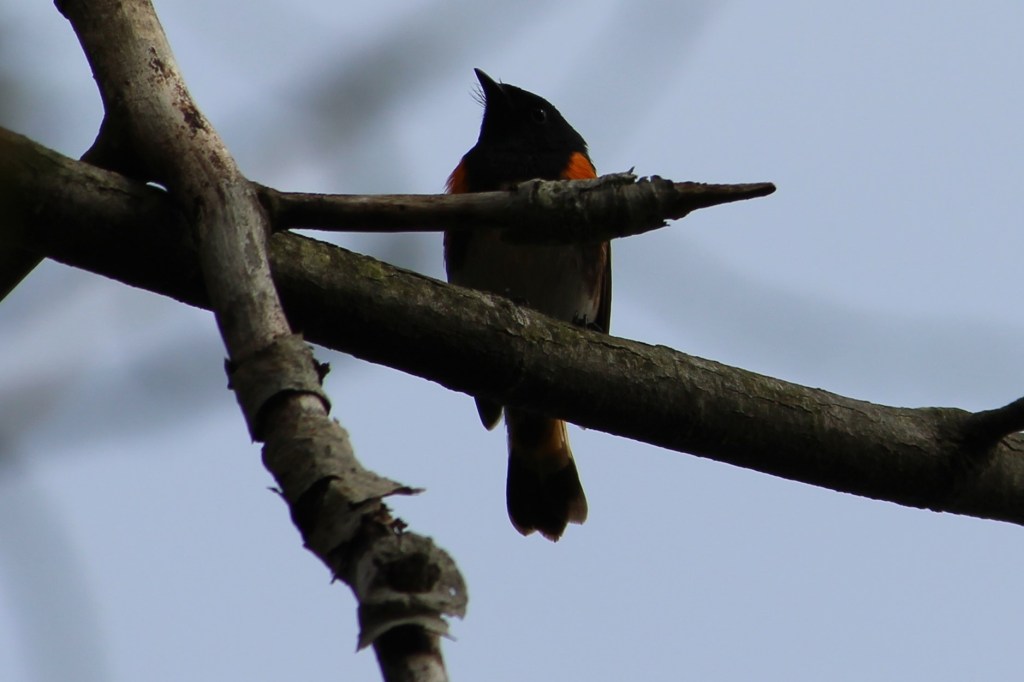
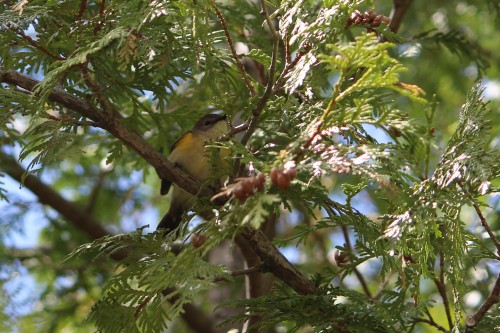
Throughout our stay, our campsite was host to several small, flitting birds that would rarely sit still. Every time the eyes caught one in full view the birds would then dart off again, a streak of orange flickering through the branches of the tree like an avian fire. We were barely able to take some pictures of these quick warblers foraging among the branches. They were American Redstarts (Setophaga ruticilla), who had returned from their wintering grounds in Central America and northern South America. Like the Red-wings, the male and female birds look very different- the male sporting a dark coat with orange dashes on the wings and chest, and the female a gray-white with yellow patches on the sides.

image
image

Male (top) and Female (bottom) American Redstarts (Setophaga ruticilla). The pictures unfortunately do not capture their boundless energy.

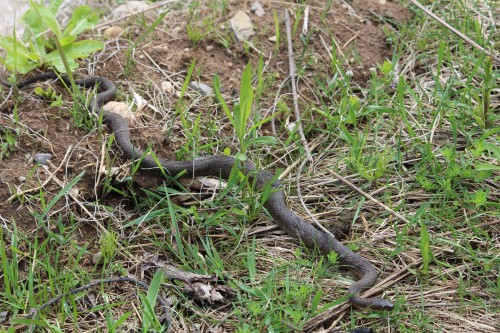
Beneath clear skies the next day, we set off on the Tower Trail once more, hearing and seeing the blackbirds again. On our way through the wetlands trail, we spotted another creature enjoying the warmth and sun: a Northern Watersnake (Nerodia sipedon).

image

Northern Watersnake (Nerodia sipedon) basking in the sun.

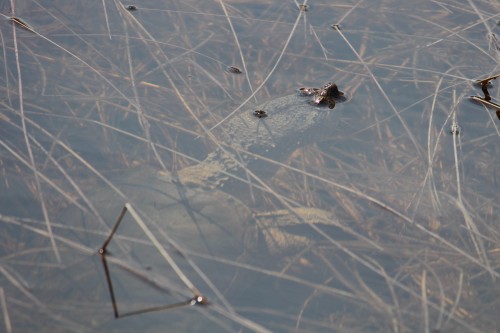
While visiting the trail near the Visitor’s Centre, we were in the right place to see a creature that resembles a mythical beast: a swimming Snapping turtle (Chelydra serpentina). Snapping turtles are beautiful creatures and the one we saw moved very stealthily. Despite the clear waters, and the size of the reptile, it was difficult to keep track of its scaly skin among the water-plants as it slowly and gracefully swam through.

image

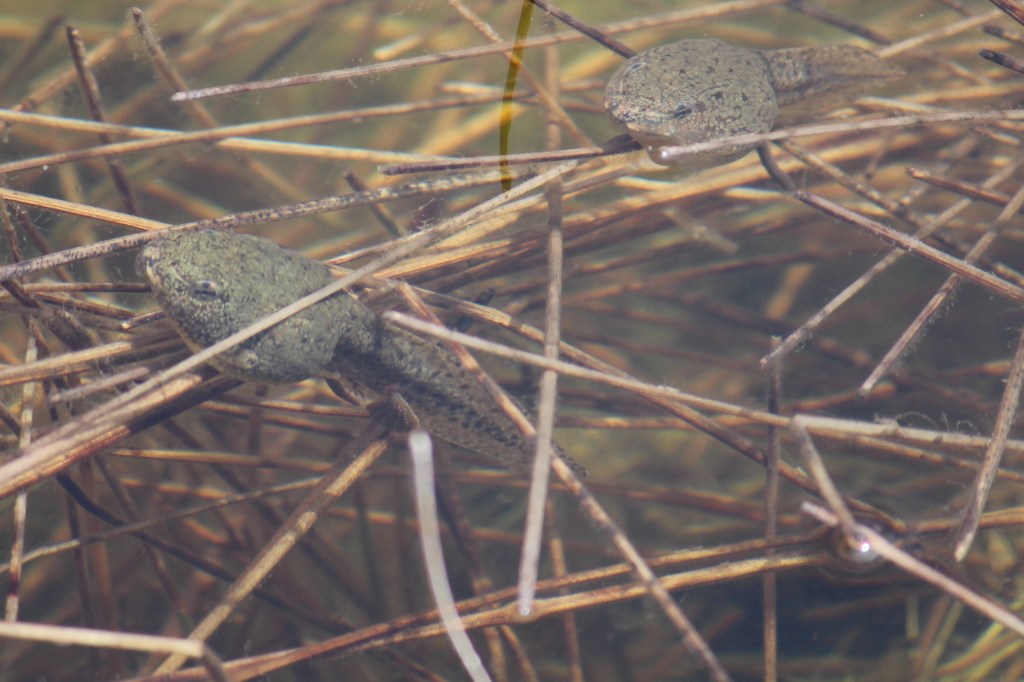
Also moving through the waters of the marsh were large tadpoles, with heads the size of a toonie or larger. Some were beginning to display the stubs of legs, but continued to swim in wriggling pollywog fashion, so unlike the athletic strokes of their adult frog legs.

image

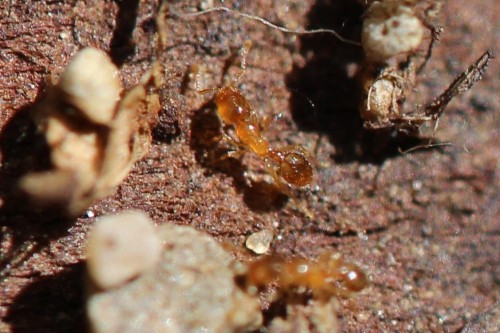
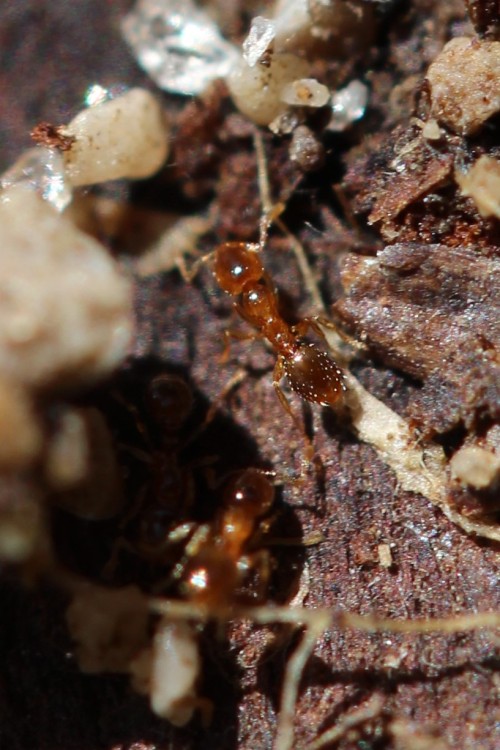
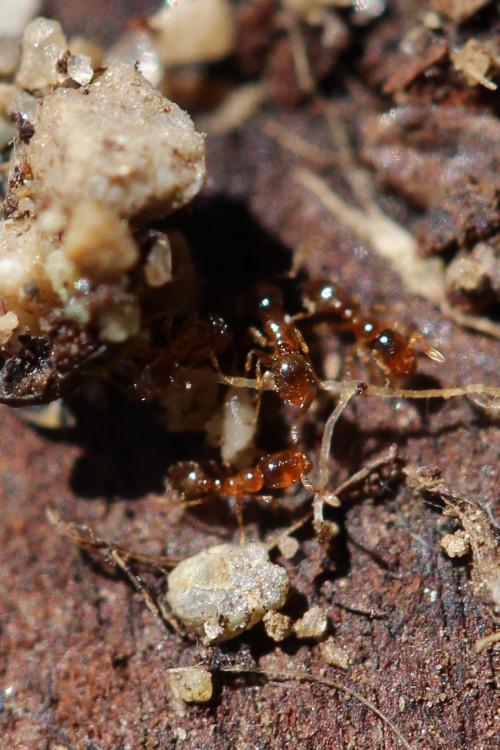
Once back at our site, I had an itch to use my macro lens to capture some of the tiny creatures that abounded there. Turning over a piece of bark on the gravel of our site, no larger than my palm revealed a portion of a miniature society. Tiny orange-brown ants scurried frantically about. They were Temnothorax ants, which are also known as “acorn ants” because some species of Temnothorax house their entire colony within an acorn.

image
image
image

Temnothorax ants, tiny workers under a piece of bark.

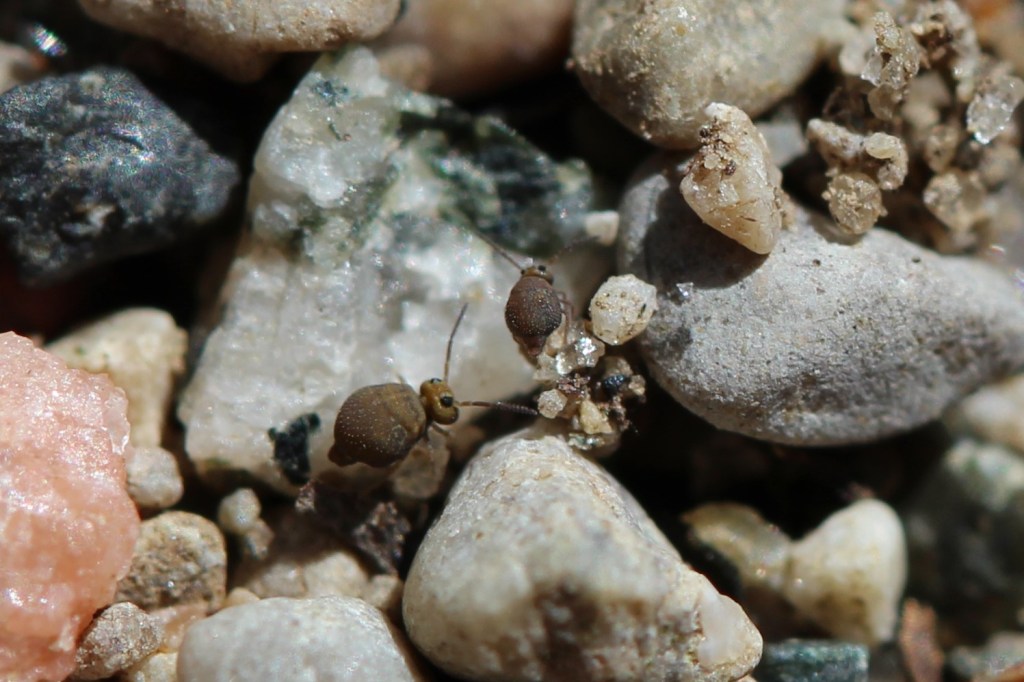
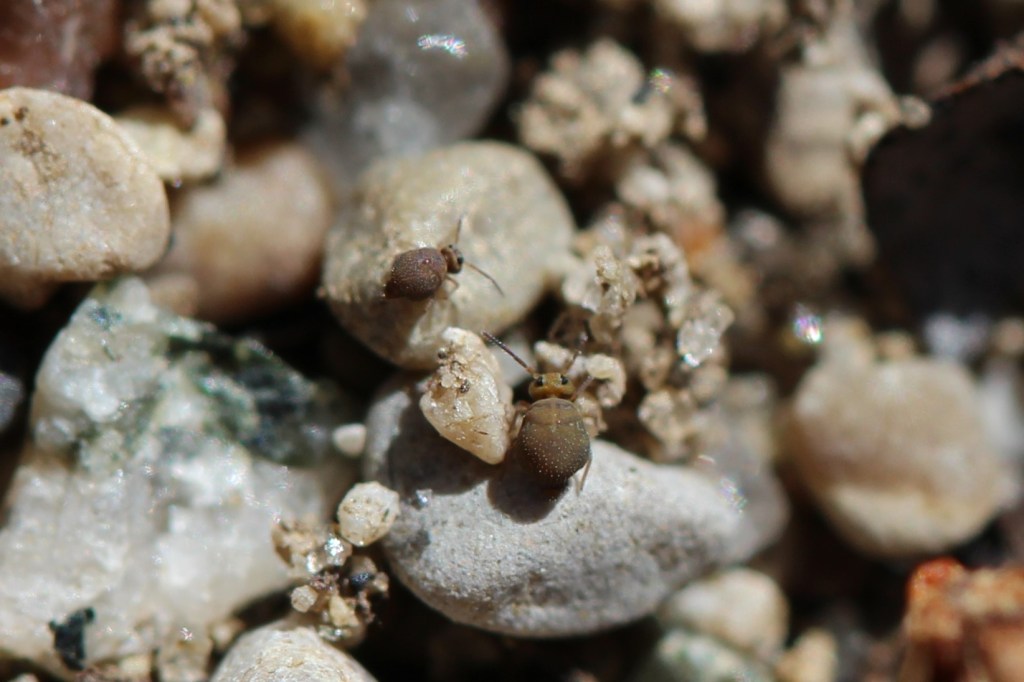
I turned my gaze on equally tiny, but even more numerous inhabitants of our site. Everywhere one looked in the sun, dark specks that slowly moved or hopped about on the gravel, could be seen. To see them in their full was a delight to me. The specks were Springtails, and these were a quite different kind to the ones I had seen before in the snow and on the trail by our house. These Springtails were like tiny rabbits when one could view them up-close. They were Globular springtails (Order Symphypleona) and I’m fairly sure the species was the Garden Springtail (Bourletiella hortensis) or something closely related: 

image
image

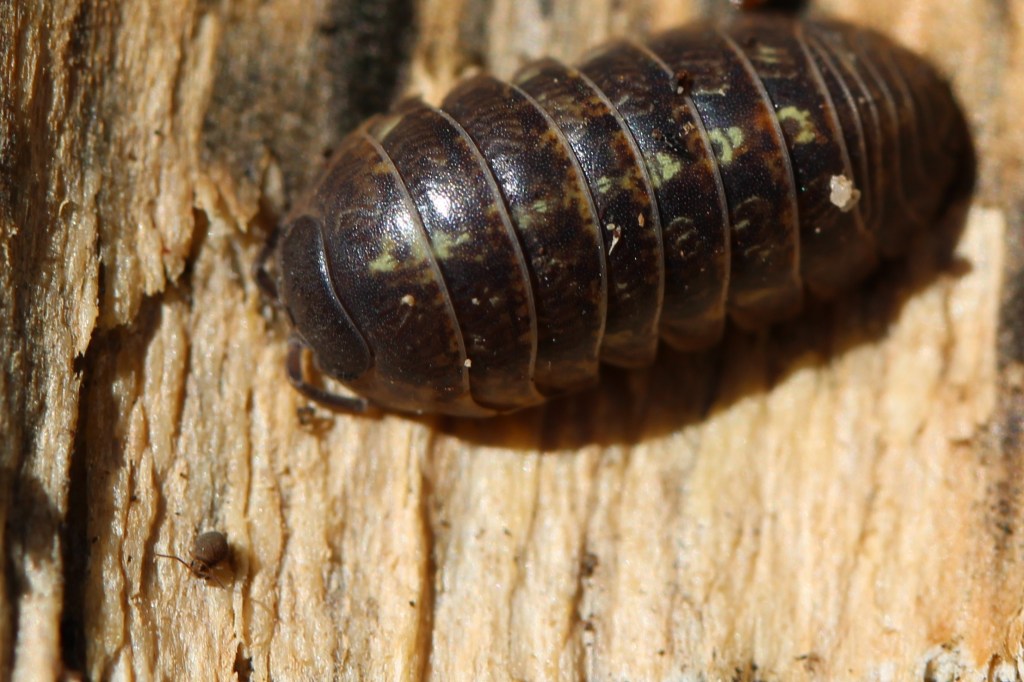
For size context, see the following picture of a Woodlouse (Armadillium vulgare). In the bottom left corner, there is one of the little Springtails:

image

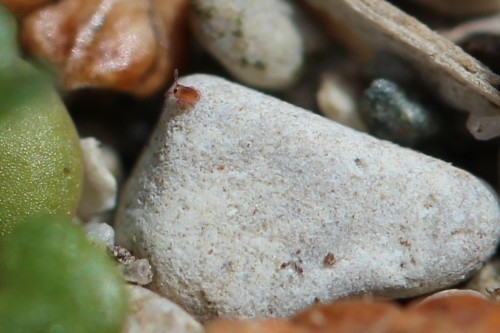
In my quest to focus the macro lens on these miniature creatures I inadvertently took a picture of something even smaller than an adult Springtail: a baby Springtail! 

image

As if to demonstrate fully the diversity of these tiny almost-insects, an entirely different species of Springtail was also rushing through the gravel: a member of the genus Orchesella, one of the Elongate Springtails: 

image

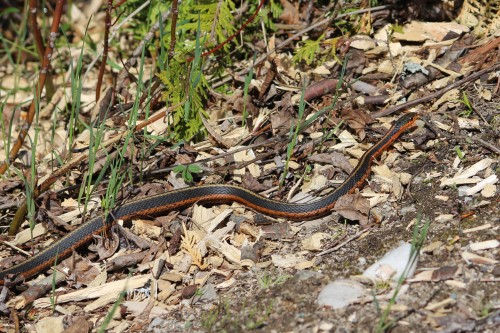
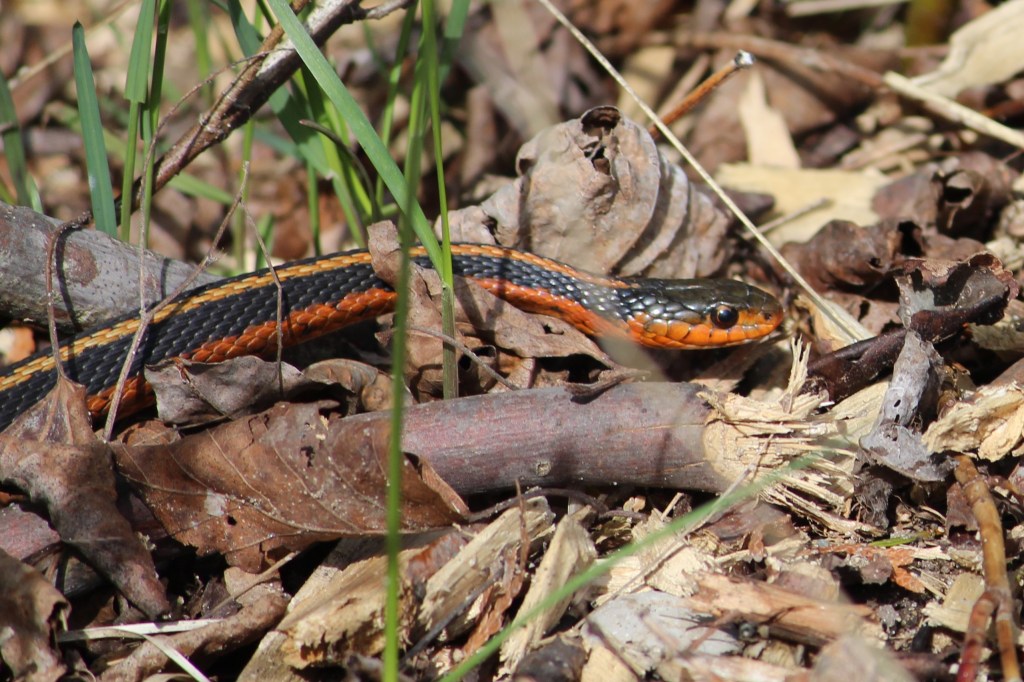
Right at the edge of our site, my friend Marshall sighted a beautiful snake with orange underbelly and stripes along its dark body. We thought it must be a rare species but it turned out to be a variant of the diverse Eastern Garter Snake (Thamnophus sirtalis), which did nothing to diminish its beauty or wonder.

image
image

A beautiful Eastern Garter Snake (Thamnophis sirtalis).

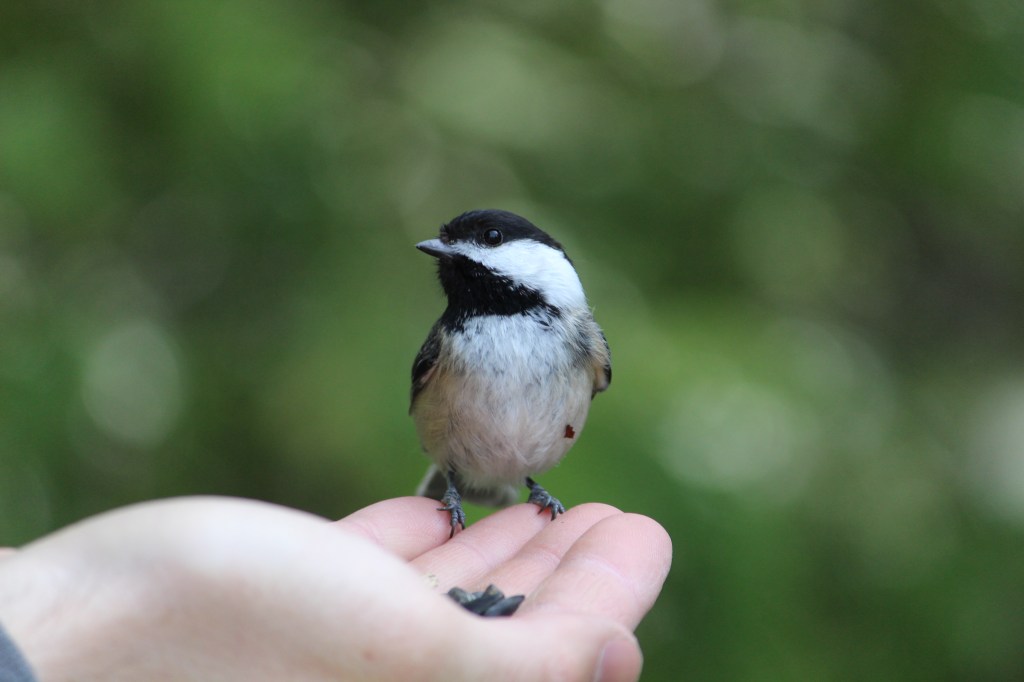
On our last day we went to the Visitor Center trail to feed the Chickadees (Poecile atricapillus) from our hands, along with the occasional red-breasted Nuthatch (Sitta canadensis). Despite some of the rain and cloudy weather, we observed a variety of wild organisms at MacGregor Point and marveled at their diversity and beauty.

image
Categories
Nature Observations

Return of the Ravens

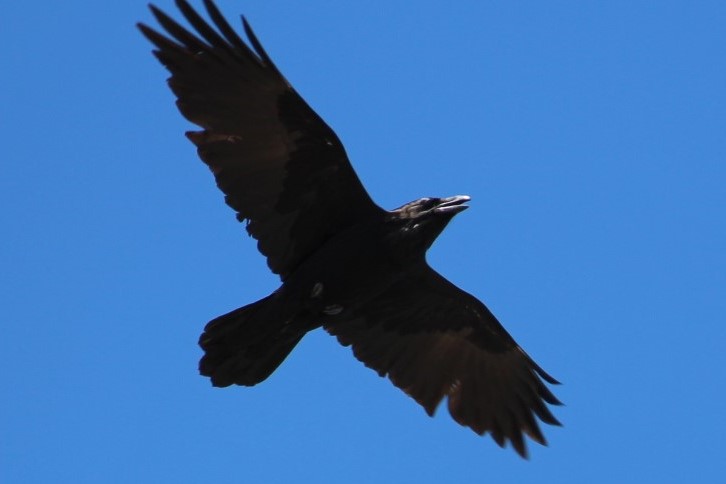
Ravens are awesome, beautiful birds.

My parents’ farm property in Norfolk County has been blessed by the construction of a very exciting nest. One day when I arrived at their house and opened my car door I was greeted by the distinctive “croak” of a Common Raven (Corvus corax). The sound startled me, placing me in the woodlands of Algonquin Park, but there was no mistaking that call, and the size of the bird making it. I could see the calling raven, perched atop an unused silo. As exciting as this brief sighting was, the true significance of this bird’s presence was not yet revealed.

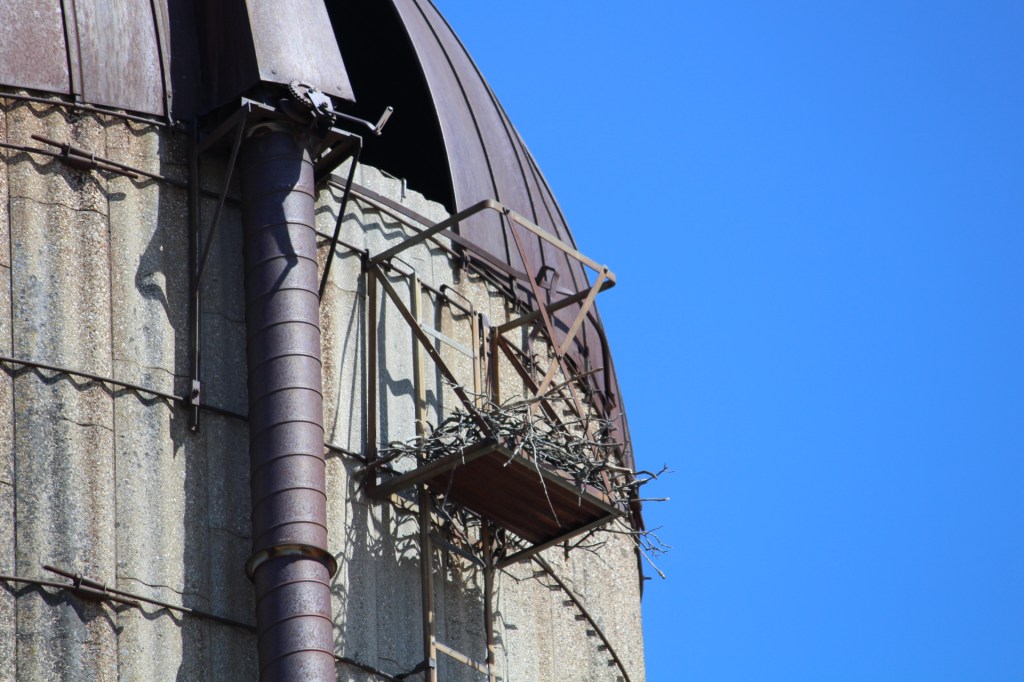
Later that same week, my Mom asked about the large crows and mentioned that they were building a nest on top of the silo. She said they went back and forth with sticks in their beaks. Maybe this news wouldn’t be so exciting to some people but for myself the thought of a raven nest that I could regularly observe was exhilarating.

And observe it I have!

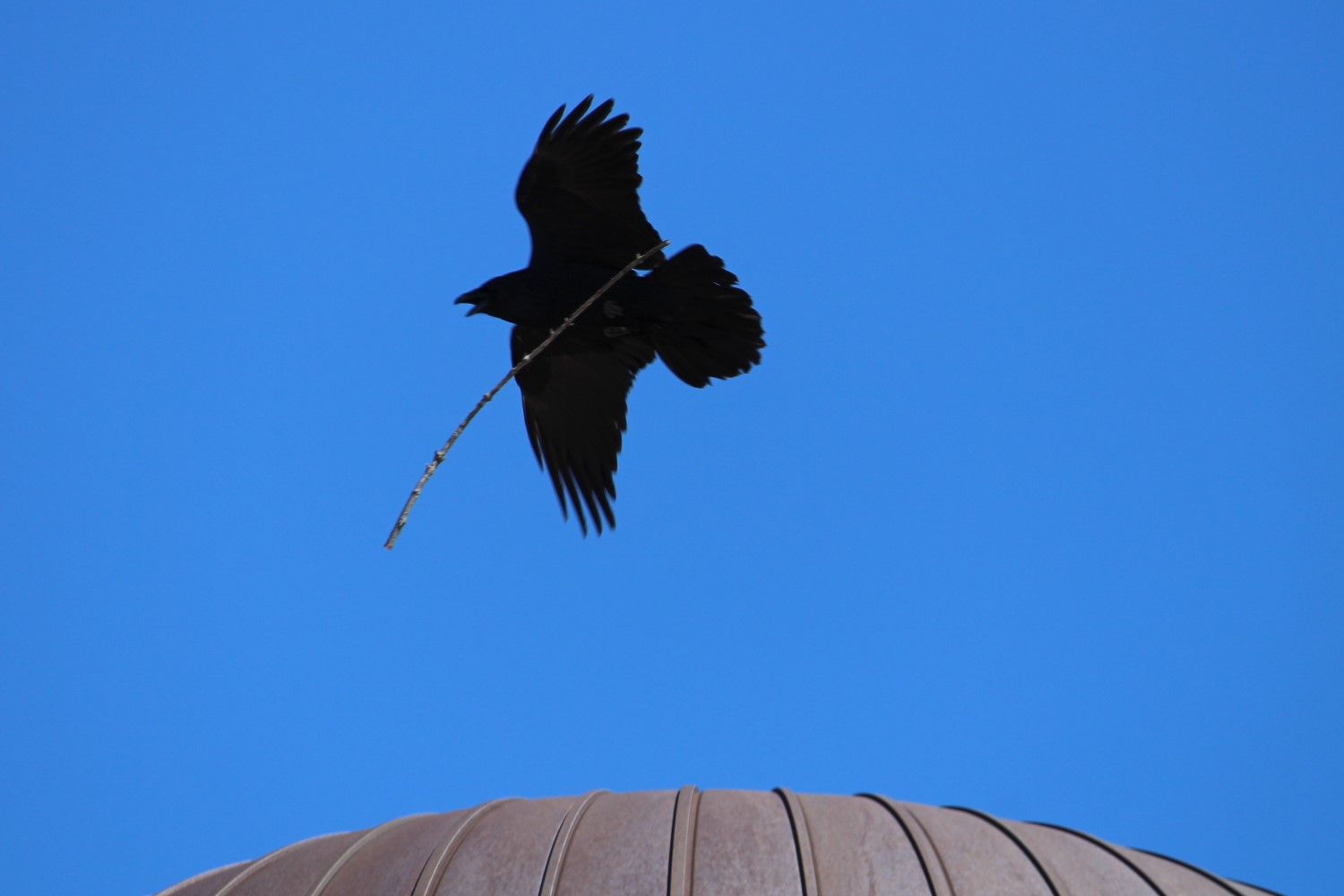
On a recent visit, I went back to check out the nest and take some pictures. After only a few moments of watching the silo, I heard the sounds of one of these amazing birds returning and saw it carrying a  large stick in its beak. The raven dropped the stick onto the nest pile without even landing, continuing to soar through the sky on its powerful wings. Apparently, if a dropped stick doesn’t stay in the nest, the ravens won’t pick them up again off the ground (Stokes and Stokes 1989). The sticks are taken from tree branches, broken off by the ravens, not collected from the ground (Stokes and Stokes 1989). In addition to large sticks, the nest could contain dirt and grass clumps as well as an interior lining of gathered hair or bark (Stokes and Stokes 1989).

The raven didn’t even land, just dropped the stick from the air onto its nest.

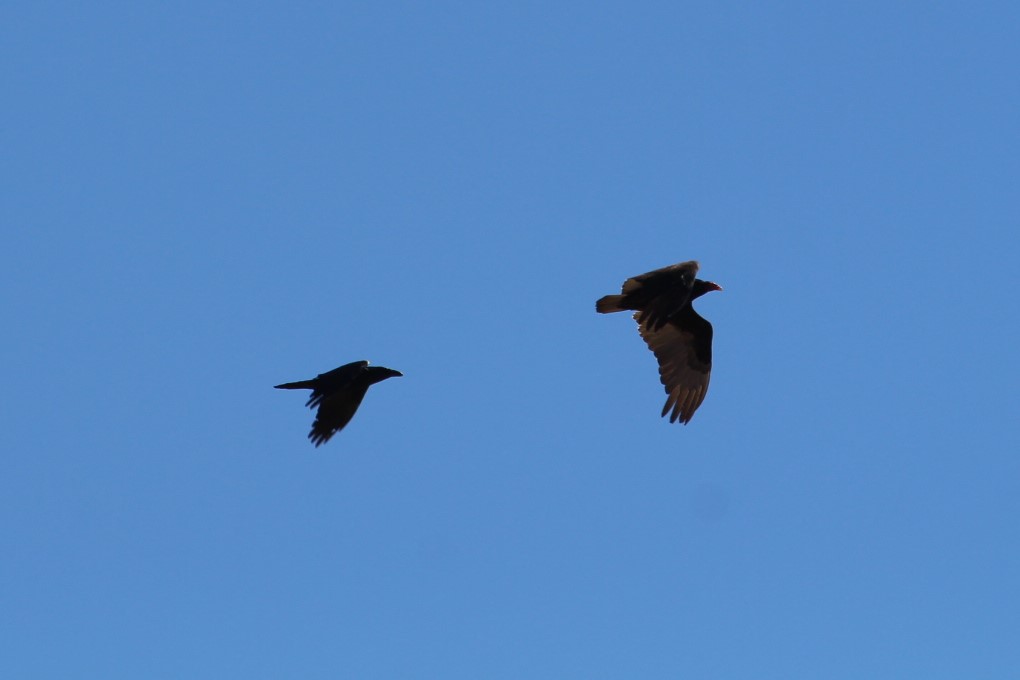
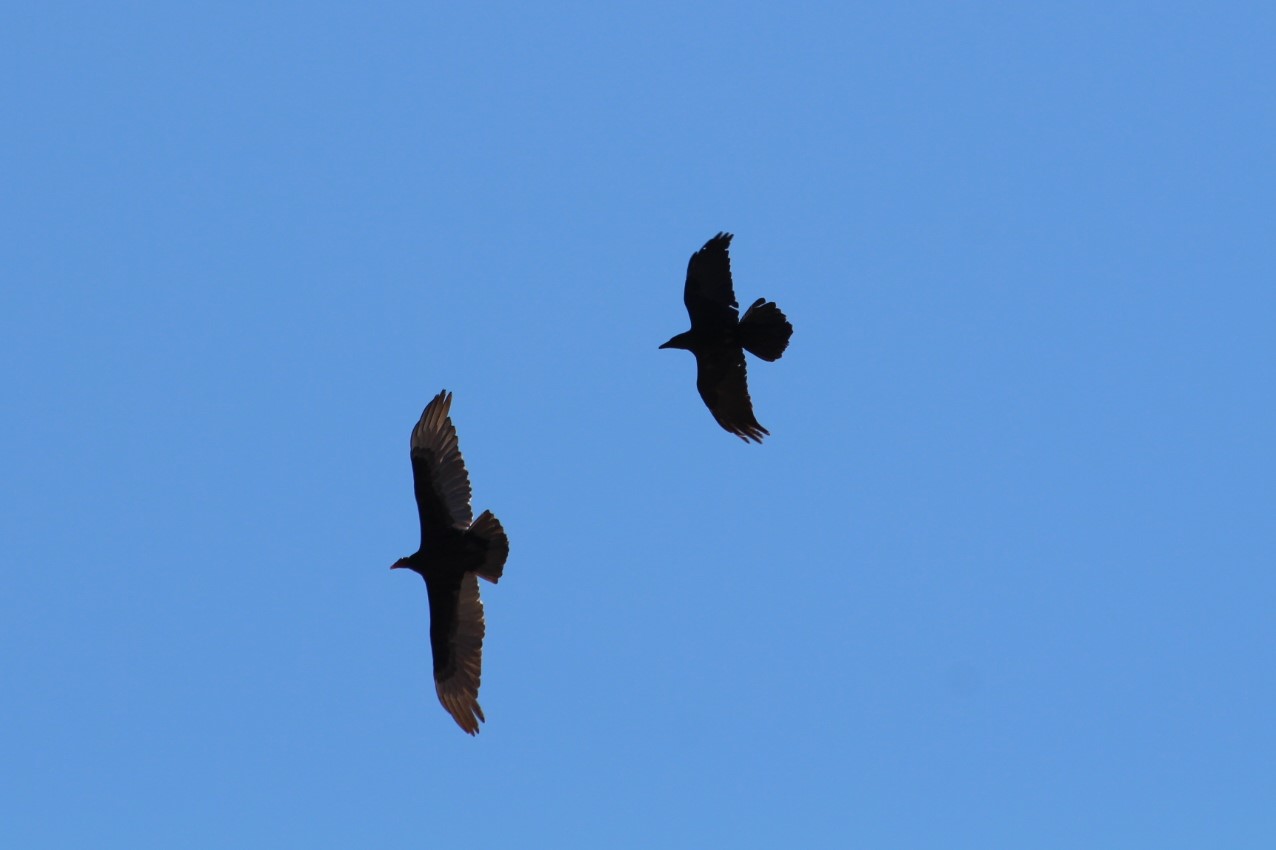
A few minutes later, a turkey vulture (Cathartes aura) came drifting towards the silo. The large bird seemed to be planning to perch atop the silo, something I have seen vultures do previously. Swooping onto the scene with deep throaty “croaks” the raven pair chased the vulture off into the distance, something that was reminiscent of the classic behaviour of corvids mobbing raptors or owls.

One of the ravens pursuing a turkey vulture.

As I said at the beginning of this post, the call and sight of ravens makes me think of Algonquin Park, and that’s for good reason. Until now, it was the only location I had seen these birds. Ravens used to be common across all of Ontario but mainly due to habitat destruction and human persecution, they have been mostly absent from far southern Ontario for about a century (Cadman et. al. 1987). Ravens were even rare in Algonquin Park until the 1960s because of the poisoned baits left out for wolves (Tozer 2012). The most recent field guide I have (Bezener 2016) still has the raven range map cut off before reaching most of Southern Ontario.

I’ve tried unsuccessfully to find a good source for the current breeding range of ravens in Ontario, but I suppose I’ll have to wait for the next edition of the Breeding Bird Atlas, which is collecting data right now (2021-2025) for its creation. It’s an amazing project, and if you have the time to contribute go for it! Suffice to say, this nest of ravens is a fairly new thing in my area and is very exciting. I hope that they have a successful nesting season, and I have a feeling I will have more posts about this nest in the future! At the time these observations were made (March 29, 2022) the ravens have possibly already laid eggs in the nest, as Tozer (2012) gives a range for Alqonquin raven egg-laying as March 20 – April 19. Stay tuned!

Raven and turkey vulture, showing nicely the relative wingspans of these two large birds.

References:

Bezener, Andy. 2016. Birds of Ontario. 376 pp. Partners and Lone Pine Publishing.

Cadman, M. D., Eagles, P. F. J., and Helleiner, F. M. 1987. Atlas of the Breeding Birds of Ontario. 617 pp. University of Waterloo Press.

Tozer, Ron. 2012. Birds of Algonquin Park. 474 pp. The Friends of Algonquin Park.

Stokes, Donald and Stokes, Lillian. 1989. A Guide to Bird Behavior. Volume III. 397 pp. Little, Brown, and Company.

For Previous articles that have some relevance to this one, see:
Canada Jay (Perisoreus canadensis)

Algonquin Observations, Part 3 – Peck Lake Trail

Fuzzy Flies and Song Sparrows