Categories
Amphibians Top 20 Photos 2013-2020

6. Spring Peeper (Pseudacris crucifer)

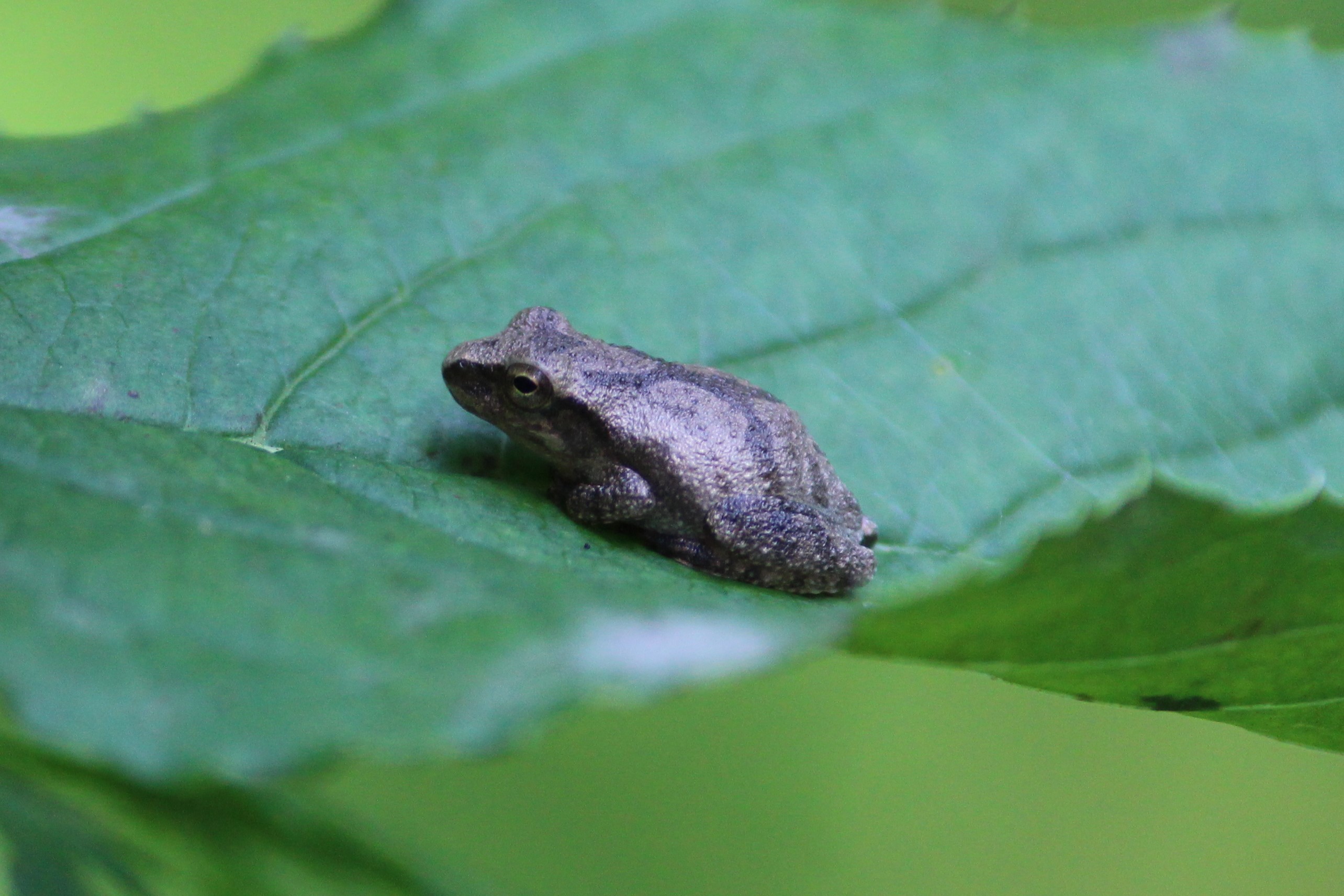
Subject: Spring Peeper (Pseudacris crucifer)

Location: MacGregor Provincial Park

Date: August 2017

The Story behind the Shot: While hiking at Macgregor Provincial Park, my wife spotted a tiny frog crouched on a leaf. It was one of those opportunities that would have been so easy to miss, and made for a beautiful shot of a tiny creature.

The Story Behind the Species:

“There are some creatures which are the quintessence of the slang word “cute,” which, interpreted, means the perfection of Lilliputian proportions, permeated with undaunted spirit. The chickadee is one of these, and the spring peeper is another.” – Anna Botsford Comstock (from Handbook of Nature Study, originally published in 1911, revised edition 1939)

The quote above nicely captures the wonder I felt at finding such a quintessentially cute animal, a frog that is less than 4 cm long. Their name itself gives a good description of this tiny frog, because they are one of our earliest calling amphibians in the Spring (late March to early April)* and their call is a piercing “peep”! (Harding and Mifsud 2017). Below, I’ve added an audio file recorded by BudJillett on freesound.org, reposted here under Creative Commons Attribution 3.0 license. so you can hear what these tiny frogs sound like:

*the further north a population of Spring Peepers are, the later in the year they will begin breeding. As Spring Peepers are distributed across Eastern North America, there are fairly large variations in breeding times across their range, with southern populations (in northern Florida and Texas) breeding in Winter and Northern populations breeding later in Spring (Wells 2007).

The male Spring Peepers are the ones calling, to attract females to their location near or in a suitable breeding pond which could be a temporary pool caused by spring melt or a marsh or ditch (Harding and Mifsud 2017). The eggs (up to 1300 per female!) hatch in 4-15 days, into tiny tadpoles that feed on algae and other aquatic plant material (Harding and Mifsud 2017). These tadpoles will feed and grow enough to become tiny froglets over the course of 1.5 months to 3 months (Harding and Mifsud 2017). That may seem like a wide time range, and that’s because there are many factors that promote or delay tadpole growth and development, one of which is canopy cover. In breeding ponds that were closed-canopy (ie. low light and low plant productivity because of low access to light), Spring Peepers grew slower than in more open, high productivity pools (Wells 2007).

The tiny adults spread out from their breeding ponds and hunt through the undergrowth for various small arthropods, avoiding any creatures larger than themselves which could hunt them in turn. Each Spring Peeper must make it through not only a gauntlet of predators, but northern populations must survive freezing temperatures in the Winter. To do this, they produce their own internal “antifreeze” suubstances and have a very similar strategy to Wood Frogs (Lithobates sylvaticus), which I discussed in a previous blogpost.

Spring Peepers can live up to 5 years (Wells 2007) but it’s likely only the rare individual out of those 1300 eggs that makes it to their 2nd year of life.

These tiny heralds of Spring, peeping in the night are one of the many fascinating creatures that we seldom see, but I am glad I had the opportunity to see one and take its photo.

References:

Comstock, Anna Botsford. 1911, 1939, 1967. Handbook of Nature Study. Comstock Publishing, a division of Cornell University Press.

Harding, James and Mifsud, David. 2017. Amphibians and Reptiles of the Great Lakes Region. University of Michigan Press.

Wells, Kentwood D. 2007. The Ecology and Behavior of Amphibians. University of Chicago Press.

For other posts in this series, see:

My Top 20 Nature Photos of 2013-2020

1. The Pale-Painted Sand Wasp (Bembix pallidipicta)

2. Moose (Alces alces) Family

3. Canada Jay (Perisoreus canadensis)

4. Common Five-Lined Skink (Plestiodon fasciatus)

5. Robber Fly Hunting Queen Ant

And for other posts featuring Amphibians, see:

Bullfrogs and Buffleheads

Freezing Frogs and Fascinating Fungi (NFN Fungi Hike, Part 1)
Categories
Nature Observations Tumblr Repost

MacGregor Point Observations (May 2018)

Once again, I’m going to repost one of my tumblr blog posts, this time from May of 2018.

On May 18-21, 2018, we took a trip to MacGregor Point Provincial Park. Today’s post is going to be a highlight of the animal observations/encounters that we had that weekend.

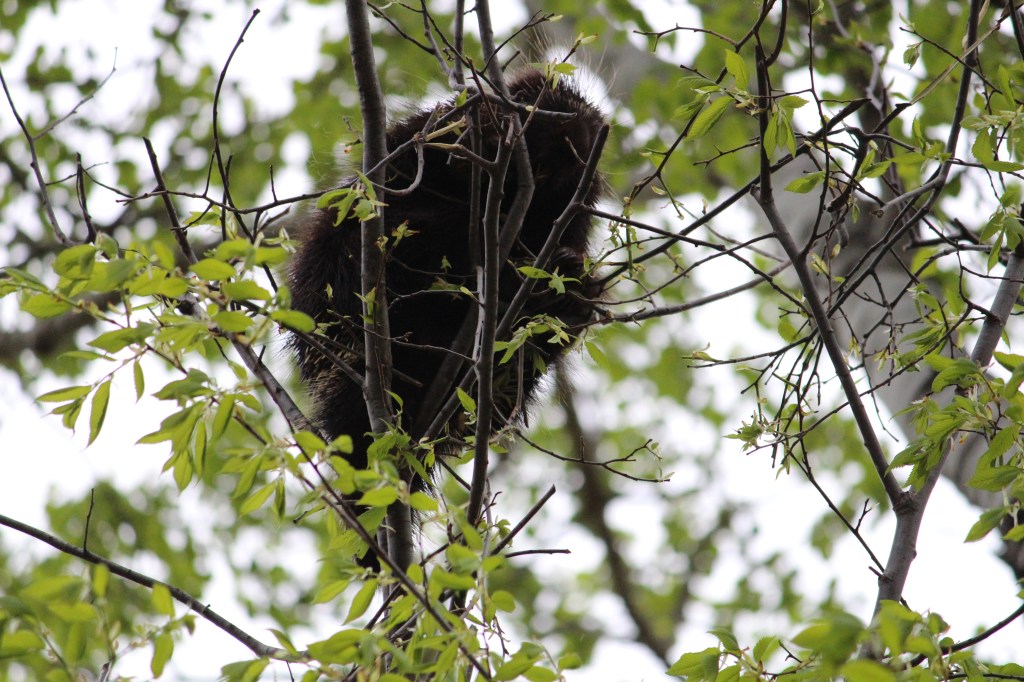
We awoke early the first morning of our stay and looked at the grey skies that promised rain. Hoping to spot some wildlife beneath the somber dawn sky, we set off on the Tower Trail. Our early start was rewarded with the sight of a strange animal resting in a tree.

image

It was a mammal with spines, and the second largest rodent in North America (only beaten by the Beaver): a North American Porcupine (Erethizon dorsatum). After consuming some buds and plants that it foraged in the night it found a perch to rest in for the day, one that seemed awfully thin for the size of the animal.

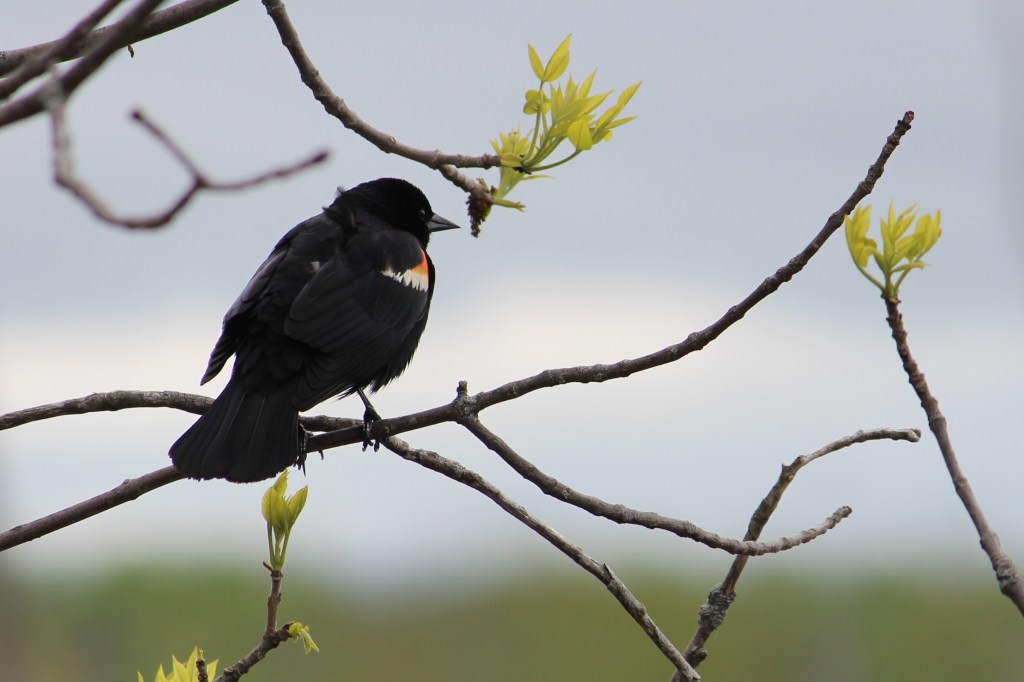
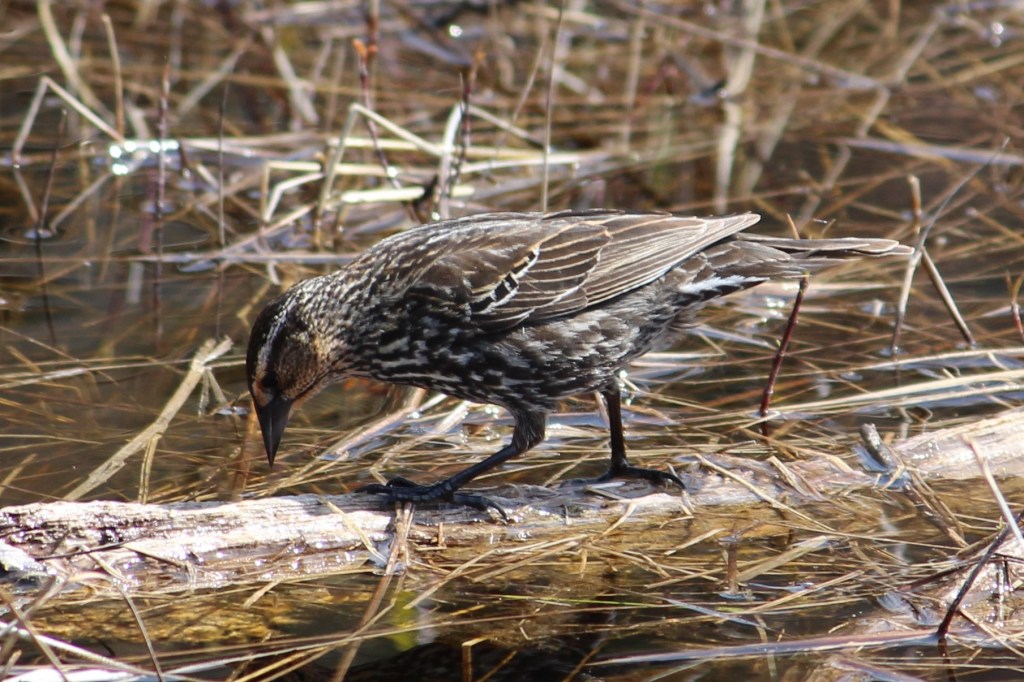
Further down the trail, we moved through various ponds until the horizon opened into spreading wetlands filled with reeds and bordered by grasses and trees. Here, the red-winged blackbirds (Agelaius phoeniceus) were in abundance, uttering their O-ka-leeeee calls from their various perches. We saw males with their velvet black plumage offset by epaulets of red-and-yellow, and we also occasionally spotted the much more camouflaged females. On our last morning camping, we saw one of the females and believed it to be a different species of marsh-bird, but later came to the realization that it was a female red-winged blackbird.

image
image

Male (top) and Female (bottom) Red-winged Blackbirds (Agelaius phoeniceus).

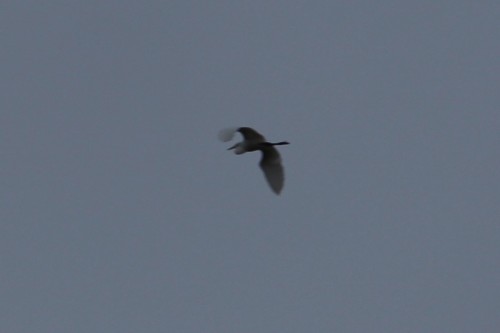
Mixed with the sounds of the blackbirds, were the trumpeting calls of the Canada Geese (Branta canadensis), always the loudest birds present. As we were leaving the wetlands, we heard a strange call and a bird departing the marsh. We were able to snap a quick picture of it and now believe it’s a Great Egret (Ardea alba).

image

Our fleeting glimpse of a Great Egret (Ardea alba).

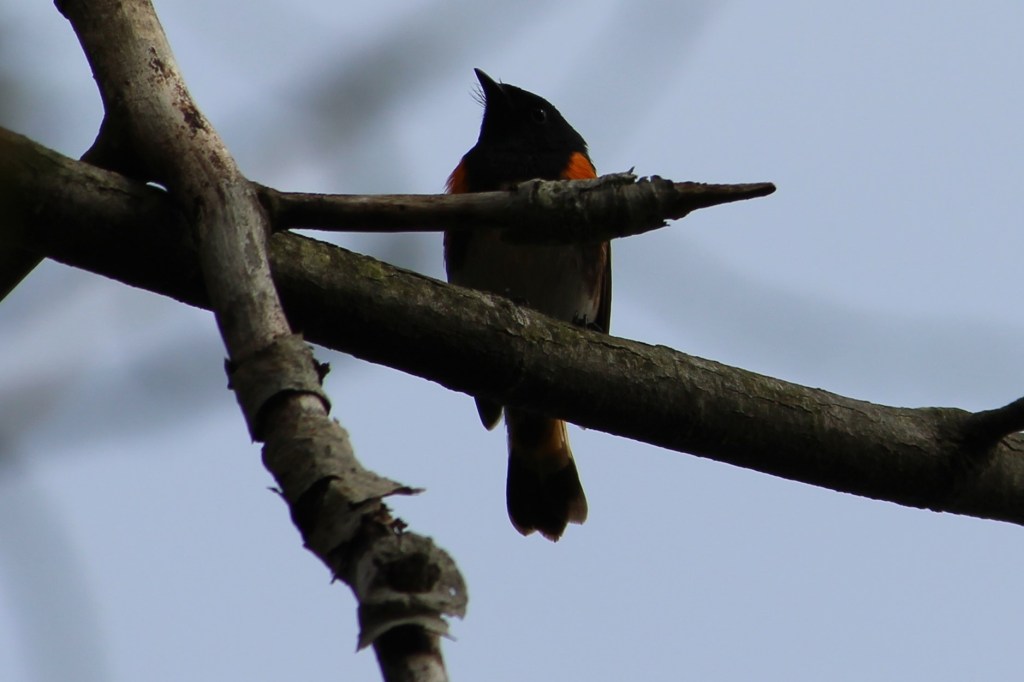
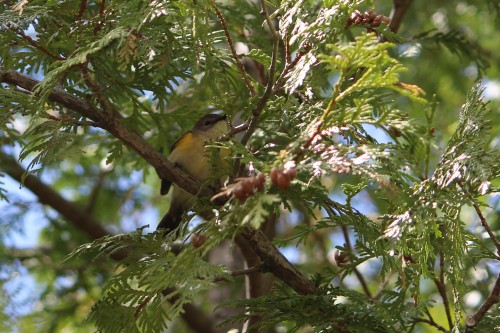
Throughout our stay, our campsite was host to several small, flitting birds that would rarely sit still. Every time the eyes caught one in full view the birds would then dart off again, a streak of orange flickering through the branches of the tree like an avian fire. We were barely able to take some pictures of these quick warblers foraging among the branches. They were American Redstarts (Setophaga ruticilla), who had returned from their wintering grounds in Central America and northern South America. Like the Red-wings, the male and female birds look very different- the male sporting a dark coat with orange dashes on the wings and chest, and the female a gray-white with yellow patches on the sides.

image
image

Male (top) and Female (bottom) American Redstarts (Setophaga ruticilla). The pictures unfortunately do not capture their boundless energy.

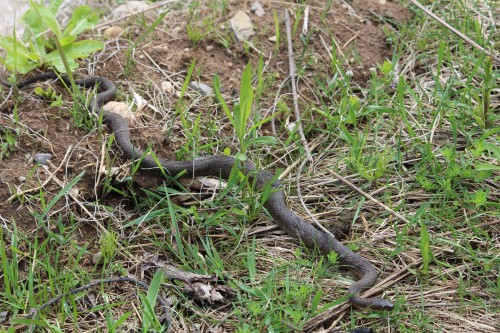
Beneath clear skies the next day, we set off on the Tower Trail once more, hearing and seeing the blackbirds again. On our way through the wetlands trail, we spotted another creature enjoying the warmth and sun: a Northern Watersnake (Nerodia sipedon).

image

Northern Watersnake (Nerodia sipedon) basking in the sun.

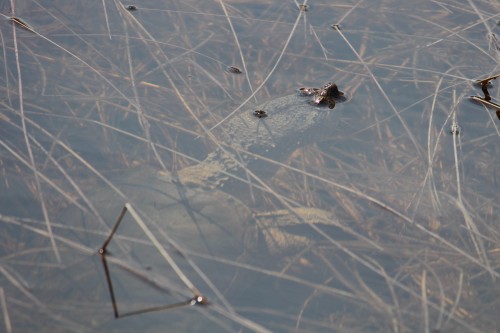
While visiting the trail near the Visitor’s Centre, we were in the right place to see a creature that resembles a mythical beast: a swimming Snapping turtle (Chelydra serpentina). Snapping turtles are beautiful creatures and the one we saw moved very stealthily. Despite the clear waters, and the size of the reptile, it was difficult to keep track of its scaly skin among the water-plants as it slowly and gracefully swam through.

image

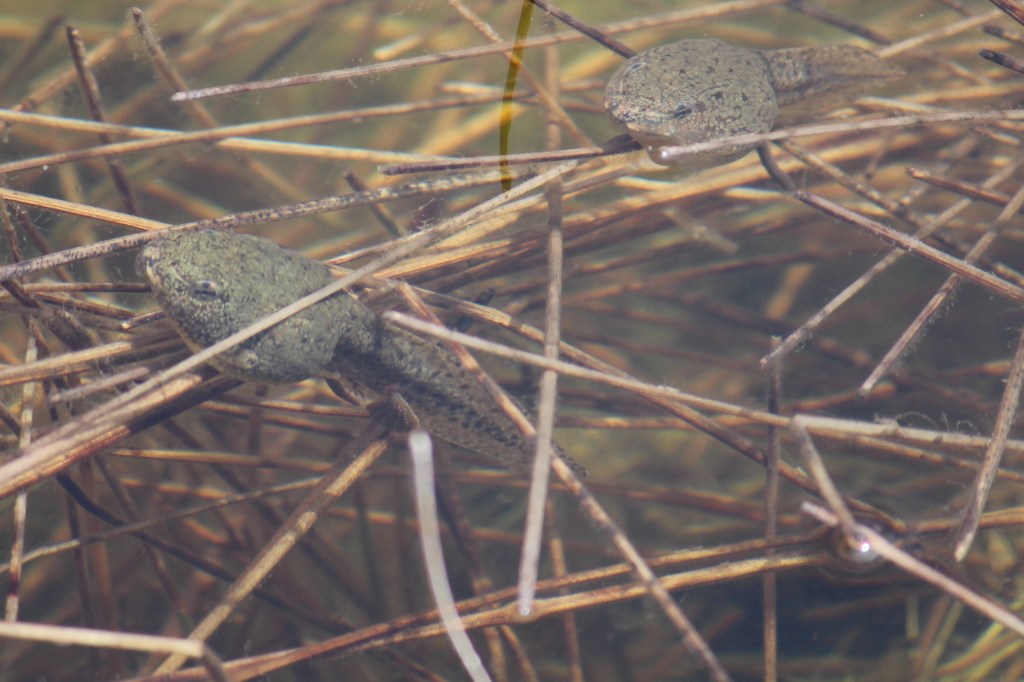
Also moving through the waters of the marsh were large tadpoles, with heads the size of a toonie or larger. Some were beginning to display the stubs of legs, but continued to swim in wriggling pollywog fashion, so unlike the athletic strokes of their adult frog legs.

image

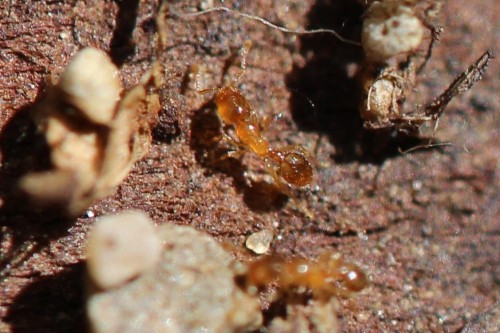
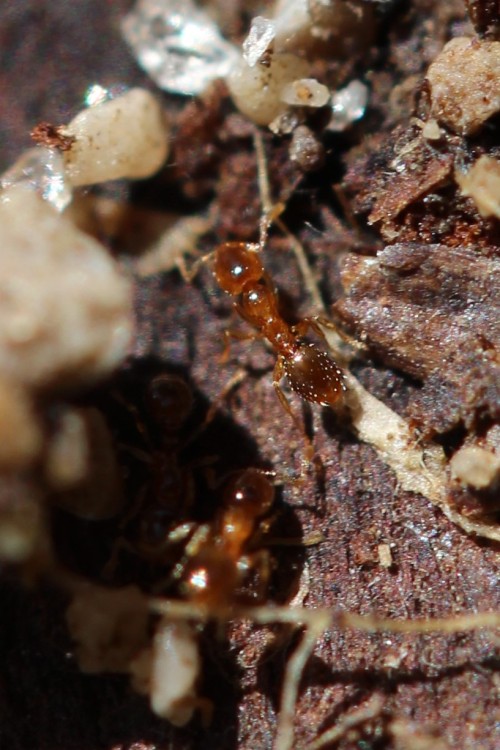
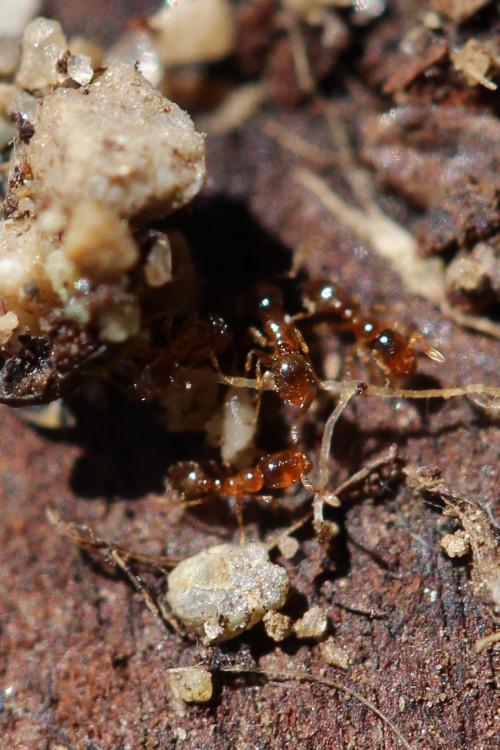
Once back at our site, I had an itch to use my macro lens to capture some of the tiny creatures that abounded there. Turning over a piece of bark on the gravel of our site, no larger than my palm revealed a portion of a miniature society. Tiny orange-brown ants scurried frantically about. They were Temnothorax ants, which are also known as “acorn ants” because some species of Temnothorax house their entire colony within an acorn.

image
image
image

Temnothorax ants, tiny workers under a piece of bark.

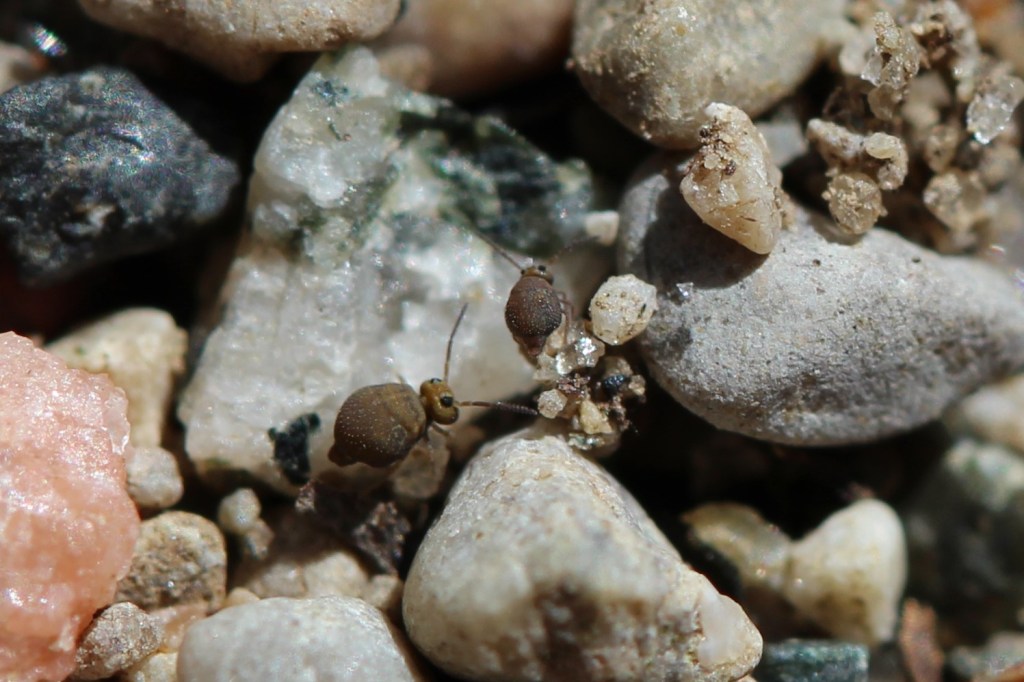
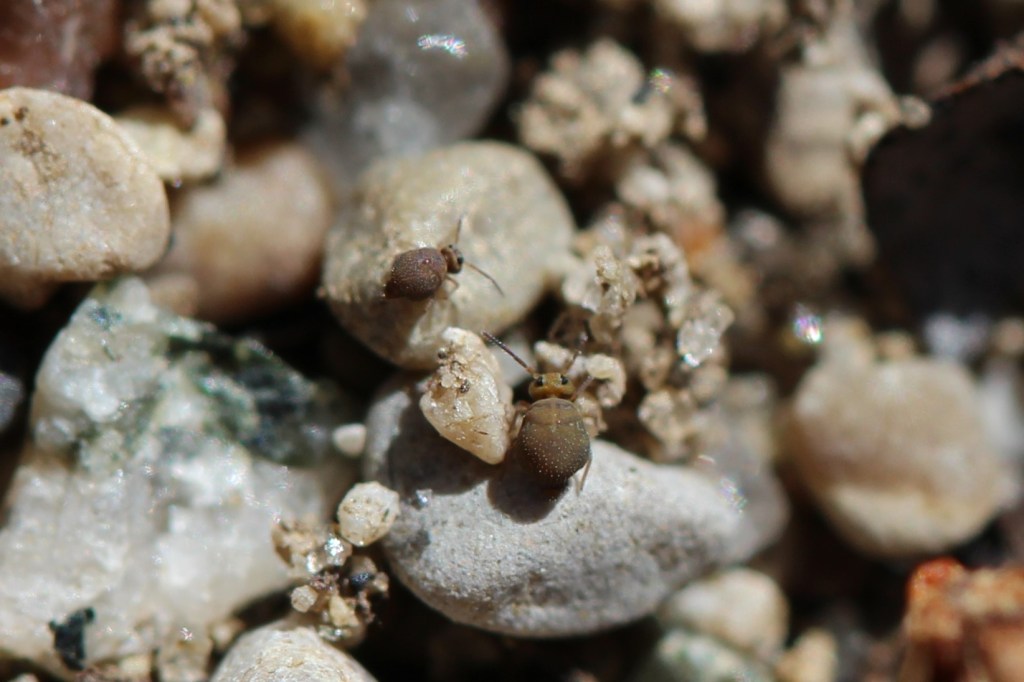
I turned my gaze on equally tiny, but even more numerous inhabitants of our site. Everywhere one looked in the sun, dark specks that slowly moved or hopped about on the gravel, could be seen. To see them in their full was a delight to me. The specks were Springtails, and these were a quite different kind to the ones I had seen before in the snow and on the trail by our house. These Springtails were like tiny rabbits when one could view them up-close. They were Globular springtails (Order Symphypleona) and I’m fairly sure the species was the Garden Springtail (Bourletiella hortensis) or something closely related: 

image
image

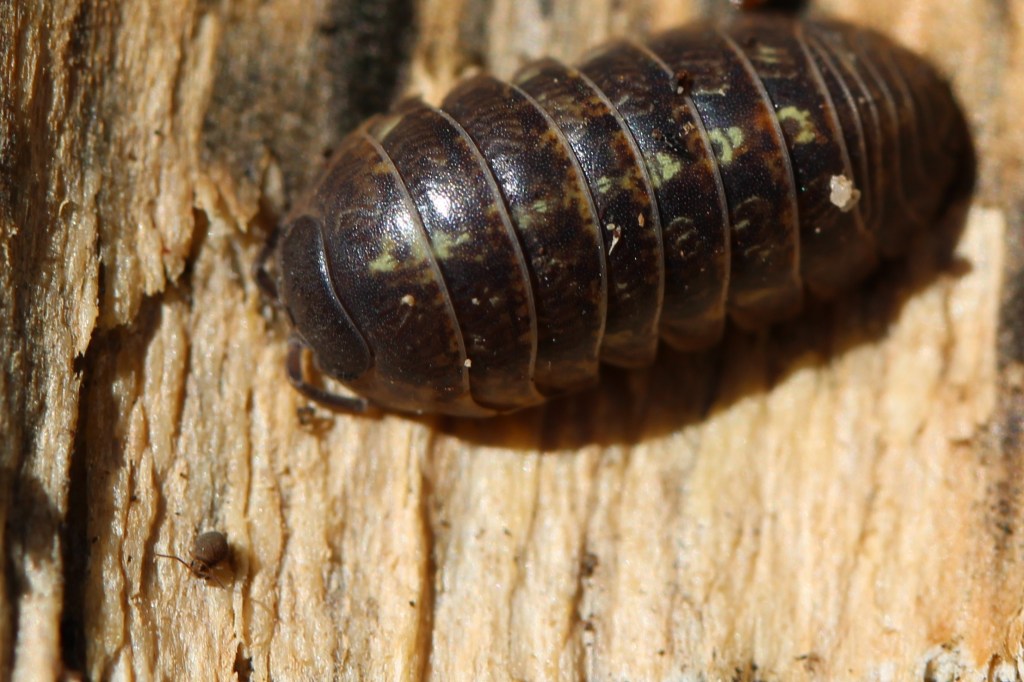
For size context, see the following picture of a Woodlouse (Armadillium vulgare). In the bottom left corner, there is one of the little Springtails:

image

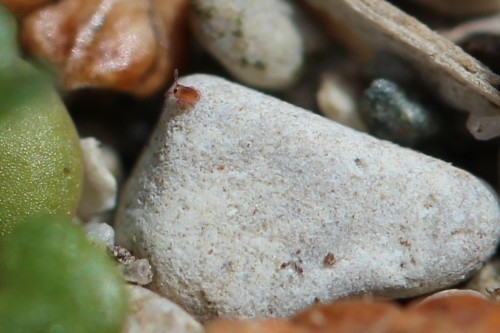
In my quest to focus the macro lens on these miniature creatures I inadvertently took a picture of something even smaller than an adult Springtail: a baby Springtail! 

image

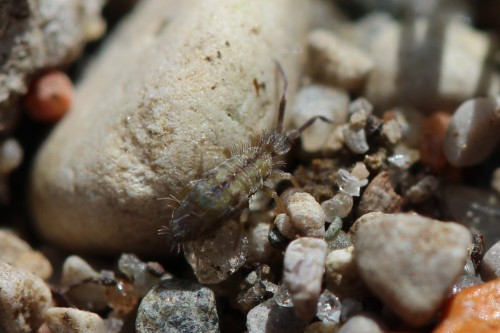
As if to demonstrate fully the diversity of these tiny almost-insects, an entirely different species of Springtail was also rushing through the gravel: a member of the genus Orchesella, one of the Elongate Springtails: 

image

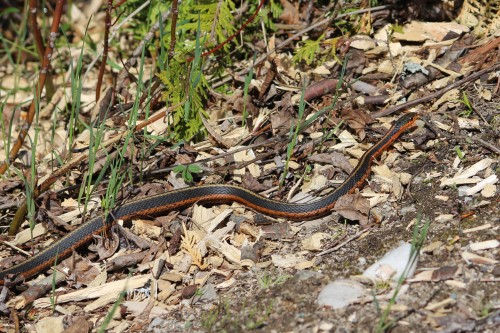
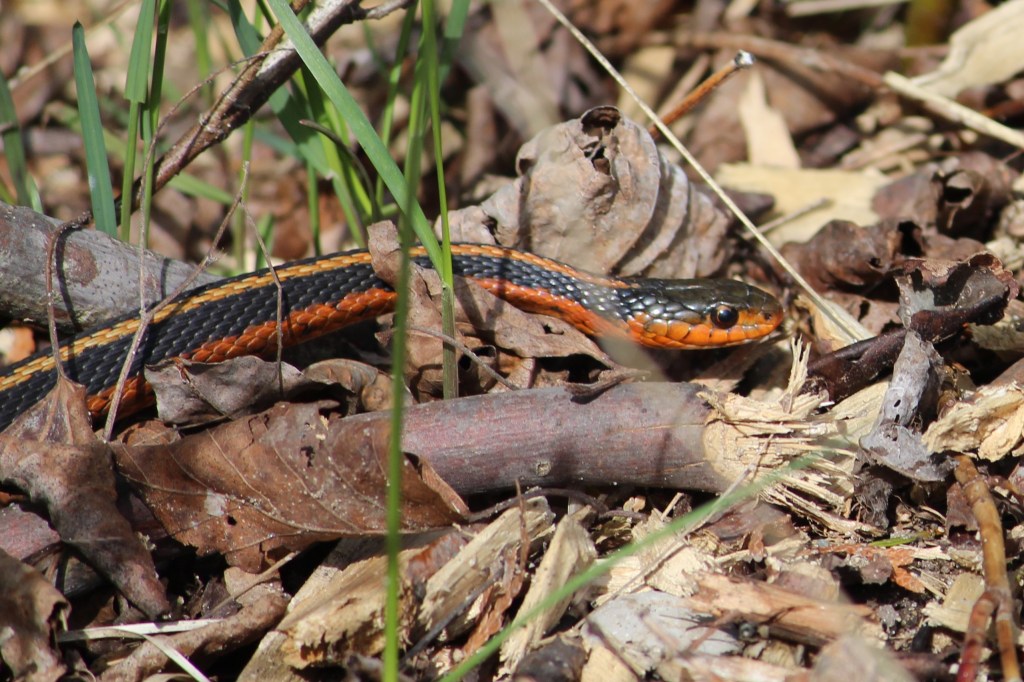
Right at the edge of our site, my friend Marshall sighted a beautiful snake with orange underbelly and stripes along its dark body. We thought it must be a rare species but it turned out to be a variant of the diverse Eastern Garter Snake (Thamnophus sirtalis), which did nothing to diminish its beauty or wonder.

image
image

A beautiful Eastern Garter Snake (Thamnophis sirtalis).

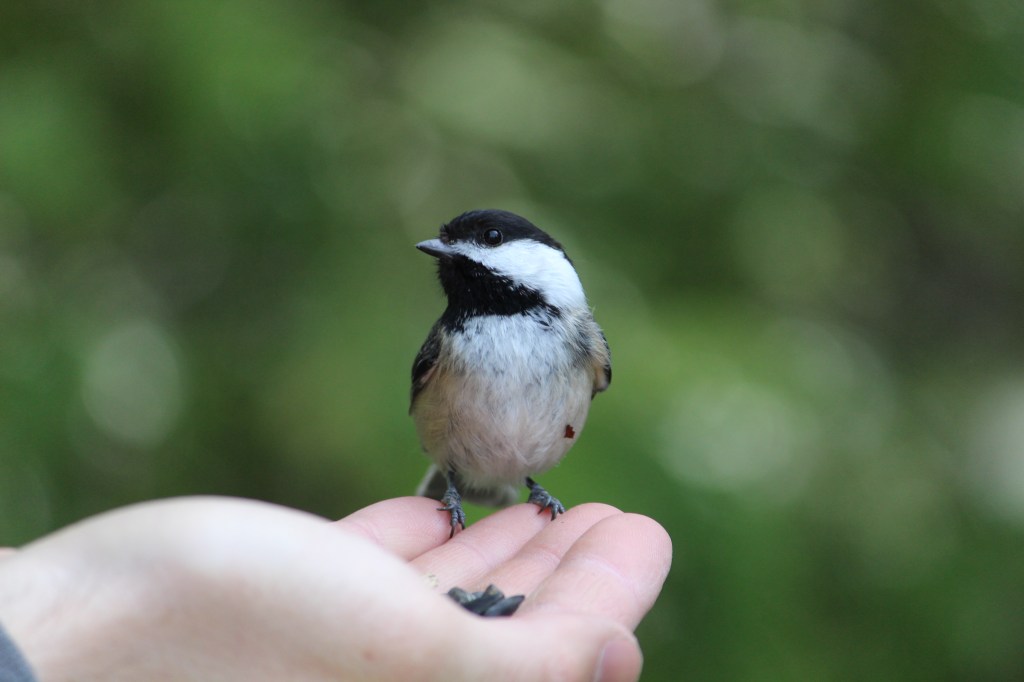
On our last day we went to the Visitor Center trail to feed the Chickadees (Poecile atricapillus) from our hands, along with the occasional red-breasted Nuthatch (Sitta canadensis). Despite some of the rain and cloudy weather, we observed a variety of wild organisms at MacGregor Point and marveled at their diversity and beauty.

image