This was originally posted on my old blogsite April 2018.
We took a day-trip to Pinery yesterday, and aside from the fascinating species of birds flitting and calling among the trunks of the trees and the underbrush, we encountered something quite ordinary, and yet, as I hope to demonstrate, quite beautiful.
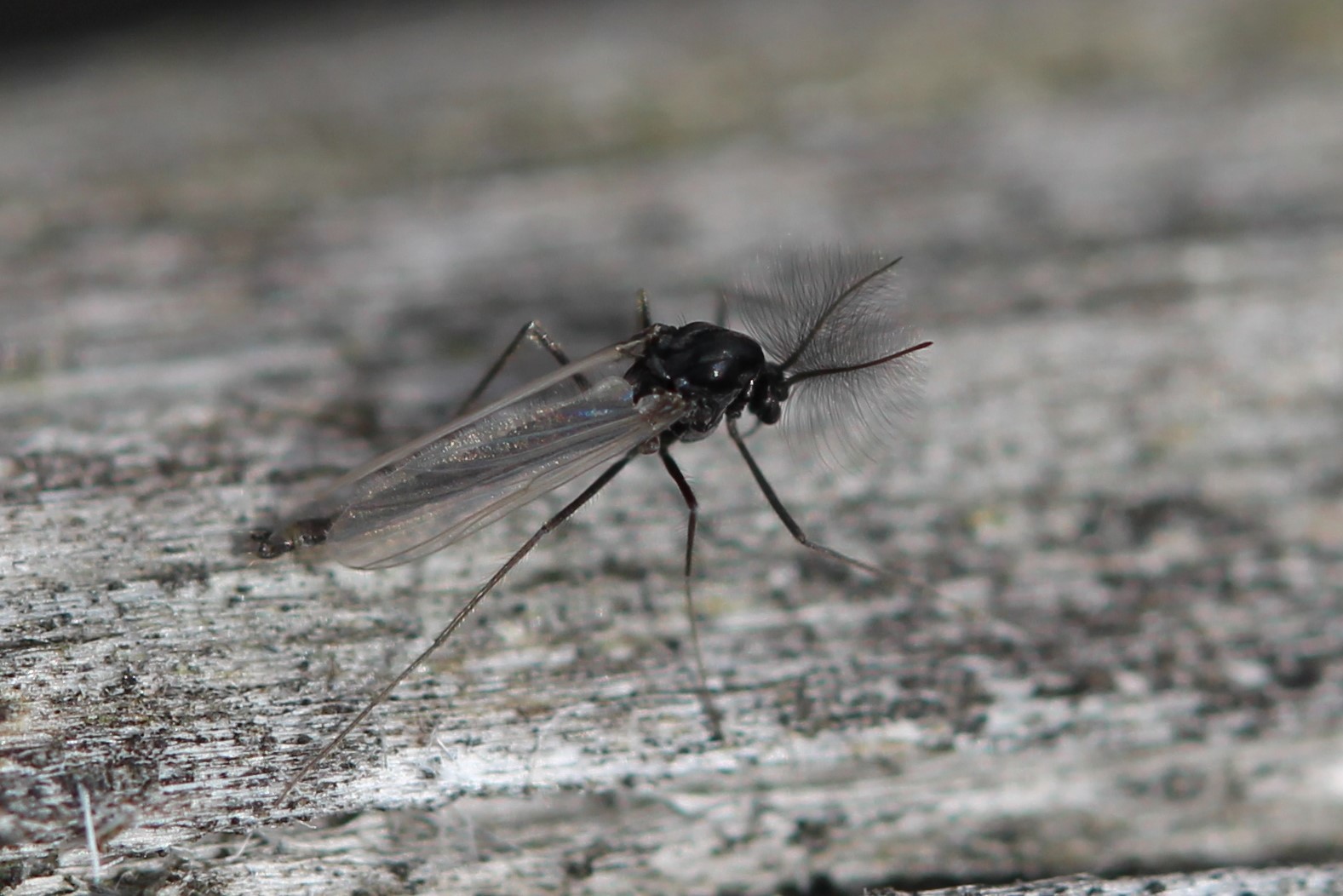
While walking along the trails by the river, we saw clouds of swirling insects. These tiny flies were creating their own signal, for potential mates. You’ve probably encountered their kind before, creating a smoke-like cloud above your head as you walked. Even though we are much larger than them, we certainly take notice of their swarms, which are made up of male midges.
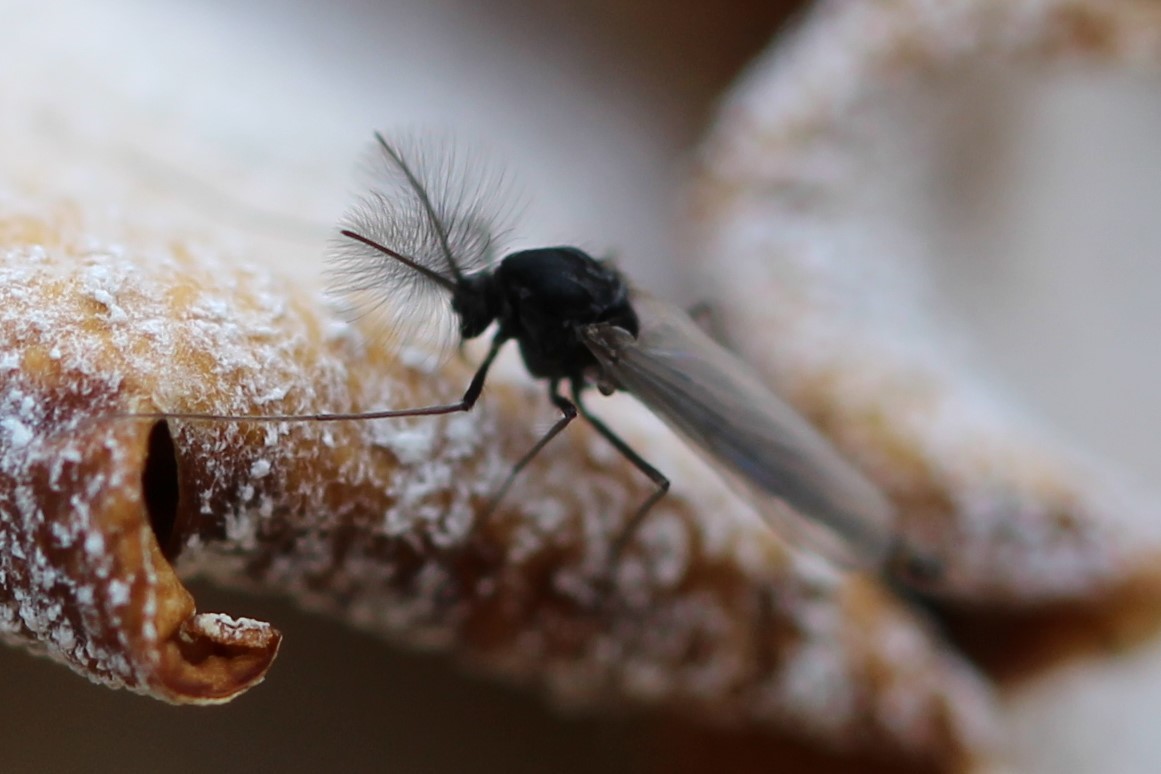
These particular insects were of the Family Chironomidae (the common, nonbiting midges). They may look like mosquitoes, but they won’t bite or seek blood. As such, you can see they don’t have the needle-like mouthparts that a mosquito uses to probe beneath skin. And you can even tell that these midges were male, because they had delicate feathered antennae atop their heads. With these, the male midges seek out female mates.
These midges most likely developed in the river, as small worm-like larvae, to become the graceful adults that we encountered. Because they are so numerous in and out of the water, they are incredibly important pieces of food chains and can also contribute to pollination of various plant species. These small and delicate insects may seem to be a nuisance, but they won’t bite and are a beautiful component of the world’s fauna.
Several of the midges landed on some fungi near the water.
After the Swallows, the most abundant and frequently encountered birds that I photographed on my recent Point Pelee trip were the New World Blackbirds (Icteridae). Unlike the swallows, I have seen and photographed all 3 of the Icterids I saw on this trip in my own backyard in Simcoe. There are 105 species of Icterids worldwide that range across North, Central and South America (Elphick 2019), so as always the species I encountered are the tip of this bird family’s iceberg.
Red-winged Blackbird (Agelaius phoeniceus):
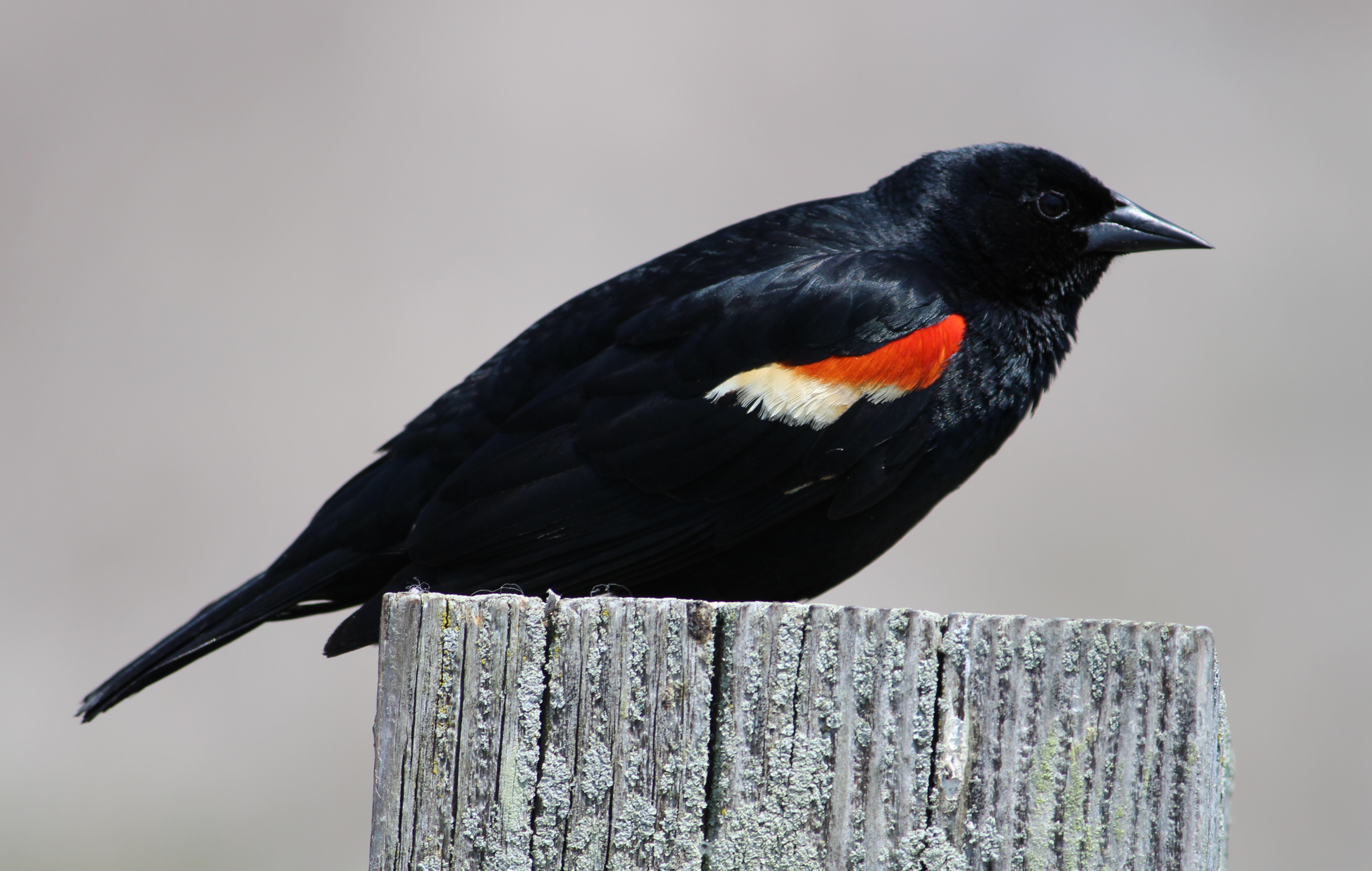
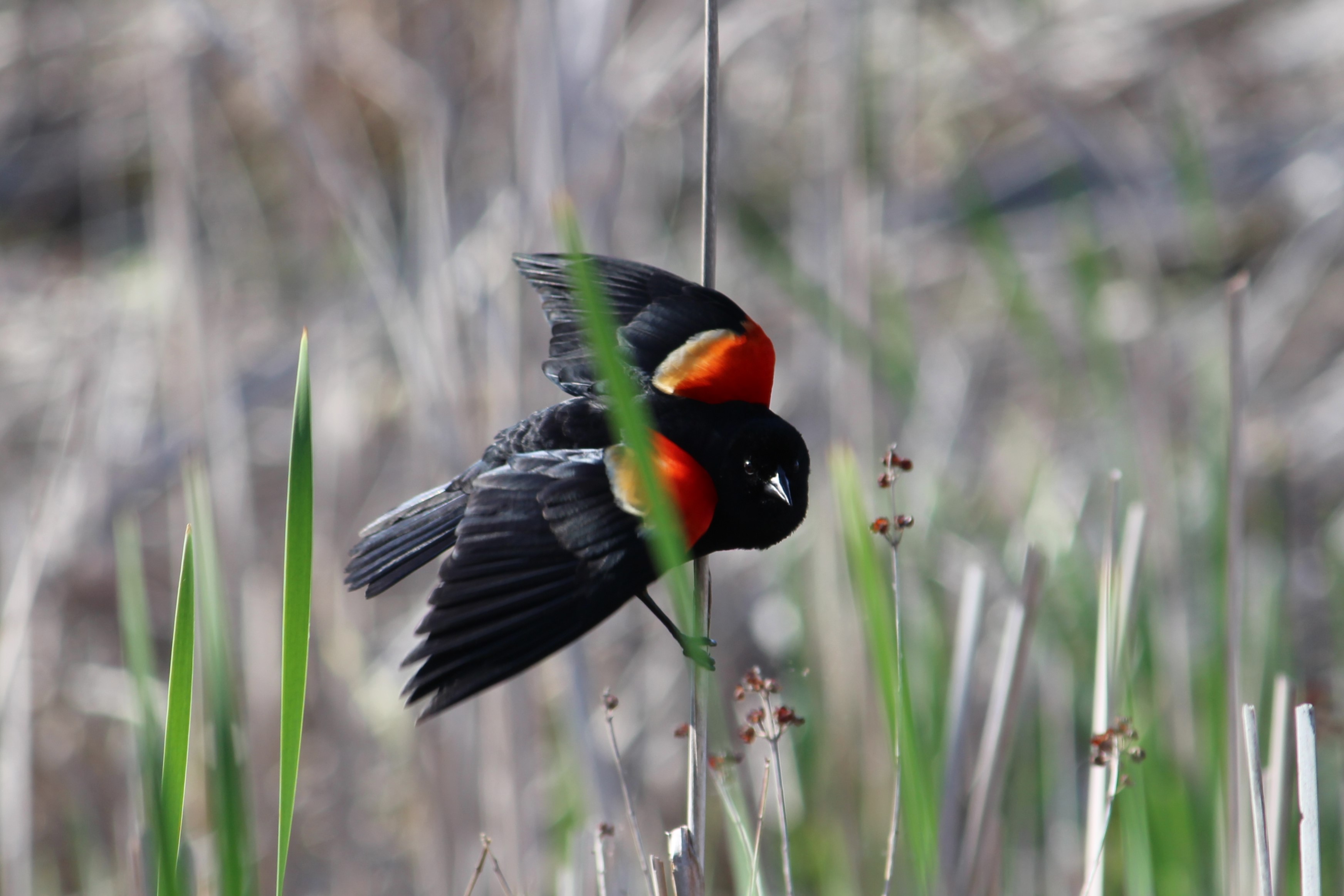
Not only are Red-winged Blackbirds abundant, they are also very noticeable thanks to their loud and frequent “Oh-ka-leeee!” calls and territorial behaviour. Males arrive earlier in the Spring to secure territories, and females arrive to survey the prospective male mates. Female Red-wings look strikingly different (we’ll see clear sexual dimorphism again with another species below), and it’s likely because the male and female blackbirds are under very different pressures from their very different behaviours. Besides being distinctly patterned, male and female Red-wings are also very different sizes, males being much larger. These differences are likely the result of the Red-winged Blackbird mating system, where male Red-wings fight and signal among themselves to establish territories and female Red-wings choose the male to join, but as always in biology, establishing the data is very difficult and there isn’t an easy answer. I’ve been reading The Red-Winged Blackbird by Les Beletsky and it’s fascinating how much research has been done on this widespread species, and yet even still there are so many mysteries about its behaviour and biology (Beletsky 1996).
According to the ROM Field Guide to Birds of Ontario (Hughes 2001), Red-winged Blackbirds are year-round residents along the north shores of Lake Erie, but I believe they become less noticeable outside of the summer breeding season because they are no longer calling and pronouncing territories.
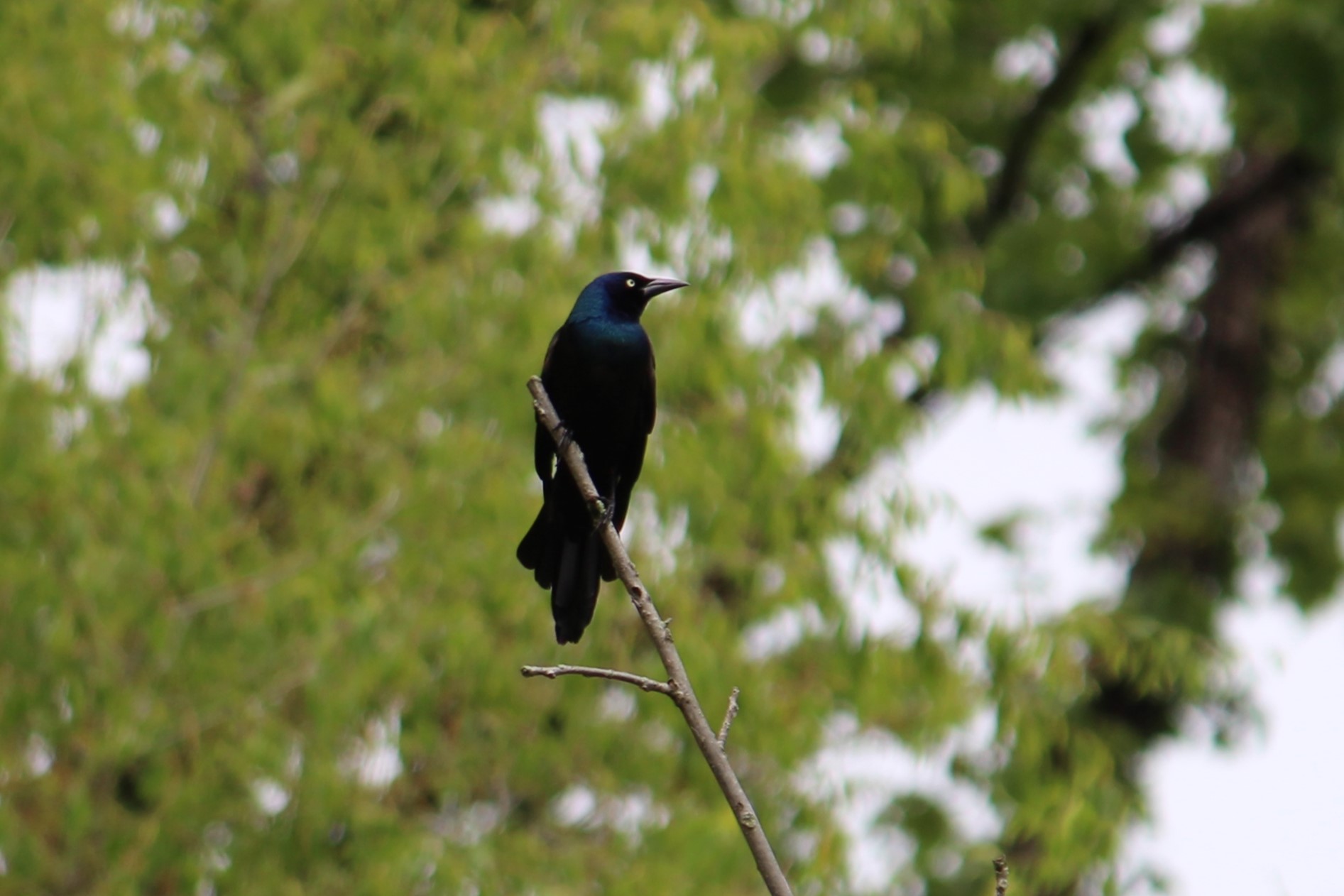
Common Grackle (Quiscalus quiscula):
Common Grackles are a familiar sight and sound to many people. Like Red-winged Blackbirds, their call is harsh, metallic, and frequent. Grackles are year-round residents of Southern Ontario, feeding in grain fields during fall and winter (Bezener 2016). Apparently their diet is quite varied overall, as demonstrated in a list of food items from the National Audubon Society Field Guid to North American Birds: “insects, crayfish, frogs, mice, nestling birds, and eggs as well as grains and wild fruits” (Bull and Farrand 1994).
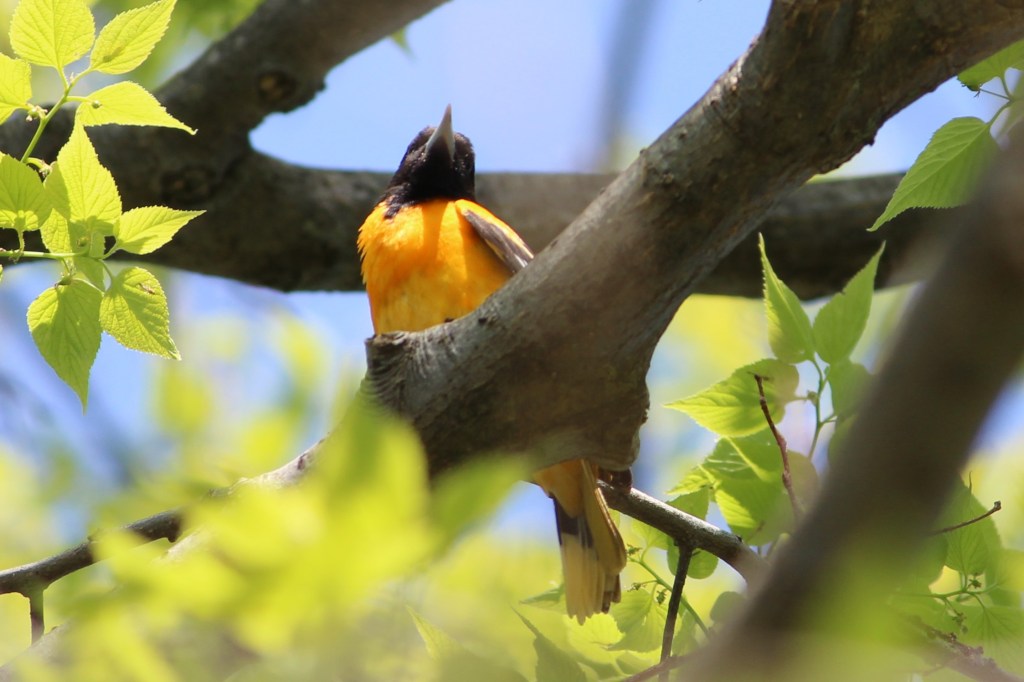
Baltimore Oriole (Icterus galbula):
Orioles are a beautiful and welcome Spring migrant here in Southern Ontario. Of all the backyard birds that I have seen and photographed, Baltimore Orioles* seem to bring the Tropics north with them. Their brilliant colours, sharp and clear song, and fruit-seeking behaviour all seem to show how at-home they would be among the tropical rainforests they live in for half the year. Every year, I await the return of these beautiful birds to my backyard where they scoop up grape jelly in their long and thin beaks.
*Baltimore Orioles are named after the coat-of-arms of Cecil, the 2nd Baron Baltimore, who owned the state (then colony) of Maryland for a time (his coat-of-arms is featured on the Maryland flag). The heraldry is orange-and-black just like the plumage of the male Baltimore Oriole. “Oriole” likely comes from the Latin word for “golden” also in reference to the rich colours of these wonderful birds. The name Oriole was originally applied to a family of birds in Europe and Asia but was later used for some bright members of the New World Blackbird family (Icteridae). New World Blackbirds are named “Blackbirds” because the darkly coloured members of the group reminded Europeans of the Blackbirds (Turdus merula) back home, which are Thrushes (Turdidae). The Family name Icteridae comes from another colour reference, this time referring to the yellow-feathered members of this group (such as female Baltimore Orioles), ikteros is a Greek word for ‘yellow bird’ (Elphick 2019). Aren’t names fun?
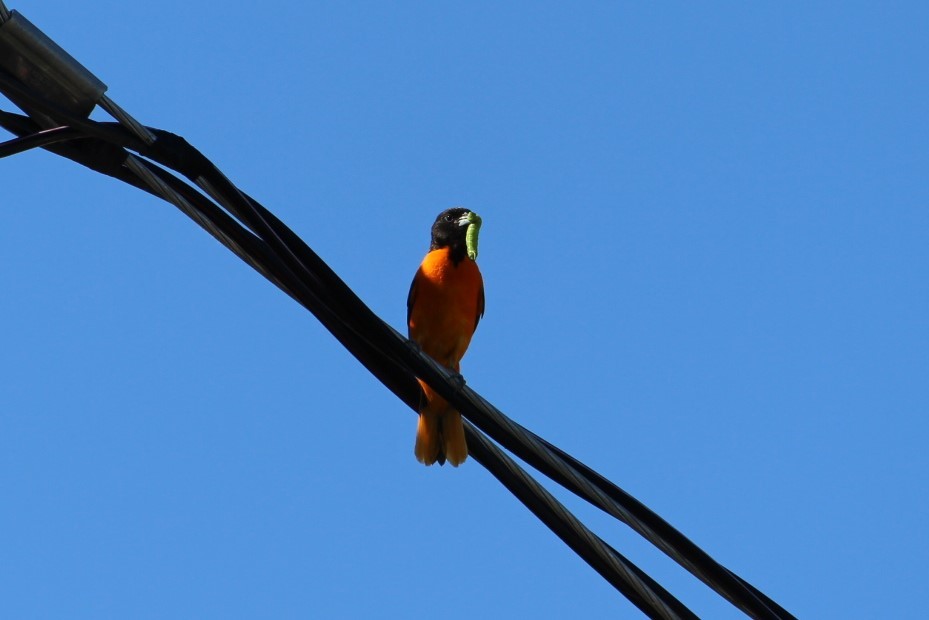
As with many fruit-eating birds (and for that matter, flower-drinking wasps), the adults can subsist on sugary foods but the young require protein and feed on insect prey brought to the nests by the parent birds. This is a male Baltimore Oriole with a large caterpillar in its beak. This photo was taken in my front yard in June 2020, the year Orioles were nesting in my birch tree.
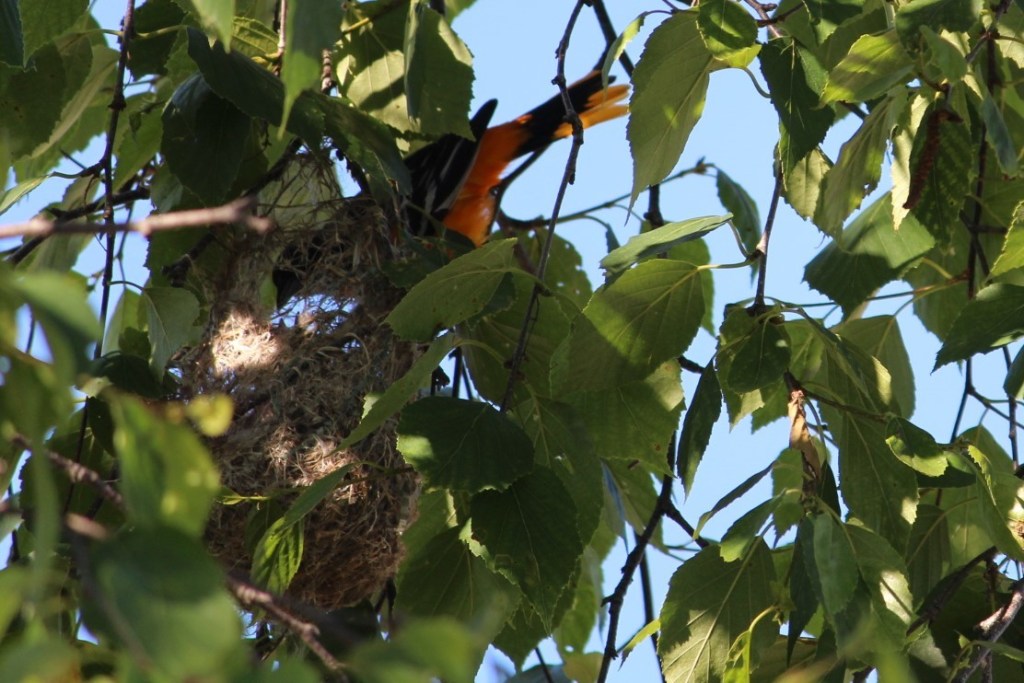
Here is the male Oriole delivering his caterpillar prey to his nestlings.
Baltimore Orioles fly all the way from South America (some winter as far north as Mexico) to my backyard in Southern Ontario, and they never cease to delight me with their song and bright colours.
That’s 2 Bird Families observed on my Point Pelee trip down! Only 20 or so more to go!
References:
Beletsky, Les. 1996. The Red-winged Blackbird: The Biology of a Strongly Polygynous Songbird. Academic Press.
Bezener, Andy. 2016. Birds of Ontario, New Edition. Lone Pine Publishing.
Bull, John, and Farrand, John Jr., 1994. Field Guide to North American Birds: Eastern Region. Chanticleer Press.
Elphick, Jonathan. 2019. The Handbook of Bird Families. Firefly Books.
I took a weekend trip to Point Pelee area, renowned for birding and I was amazed at the abundant and diverse birdlife passing through or permanently residing. There were quite a few non-bird surprises along the way and I’ll discuss them as well. I think for this adventure, I’m going to break it up into discussions by species rather than a more chronological approach I’ve used before for nature encounters on a trip. So we’re going to move through the Avian tree of life, family-by-family because not only did I encounter and photograph many different species of birds but I was surprised to find that most of them come from different bird families, representing a diversity of form and behavior.
We’re going to begin with the bird family I encountered first and most frequently throughout the trip: the Swallows (Hirundinidae). These acrobatic aeronauts were abundant wherever spaces were made available for them to construct their nests. I saw 3 different species of Swallows, of the 84 species worldwide (Elphick 2019).
Barn Swallow (Hirundo rustica):
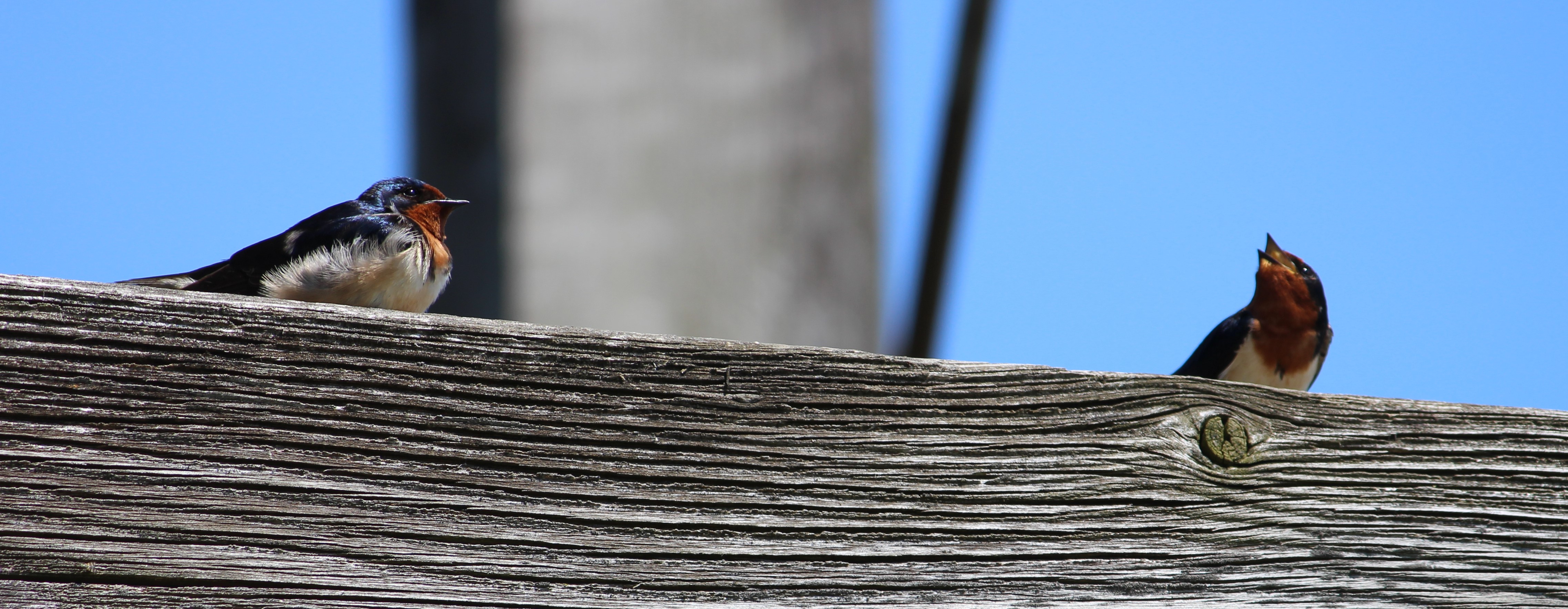
Barn Swallows on a lookout tower in Point Pelee National Park.
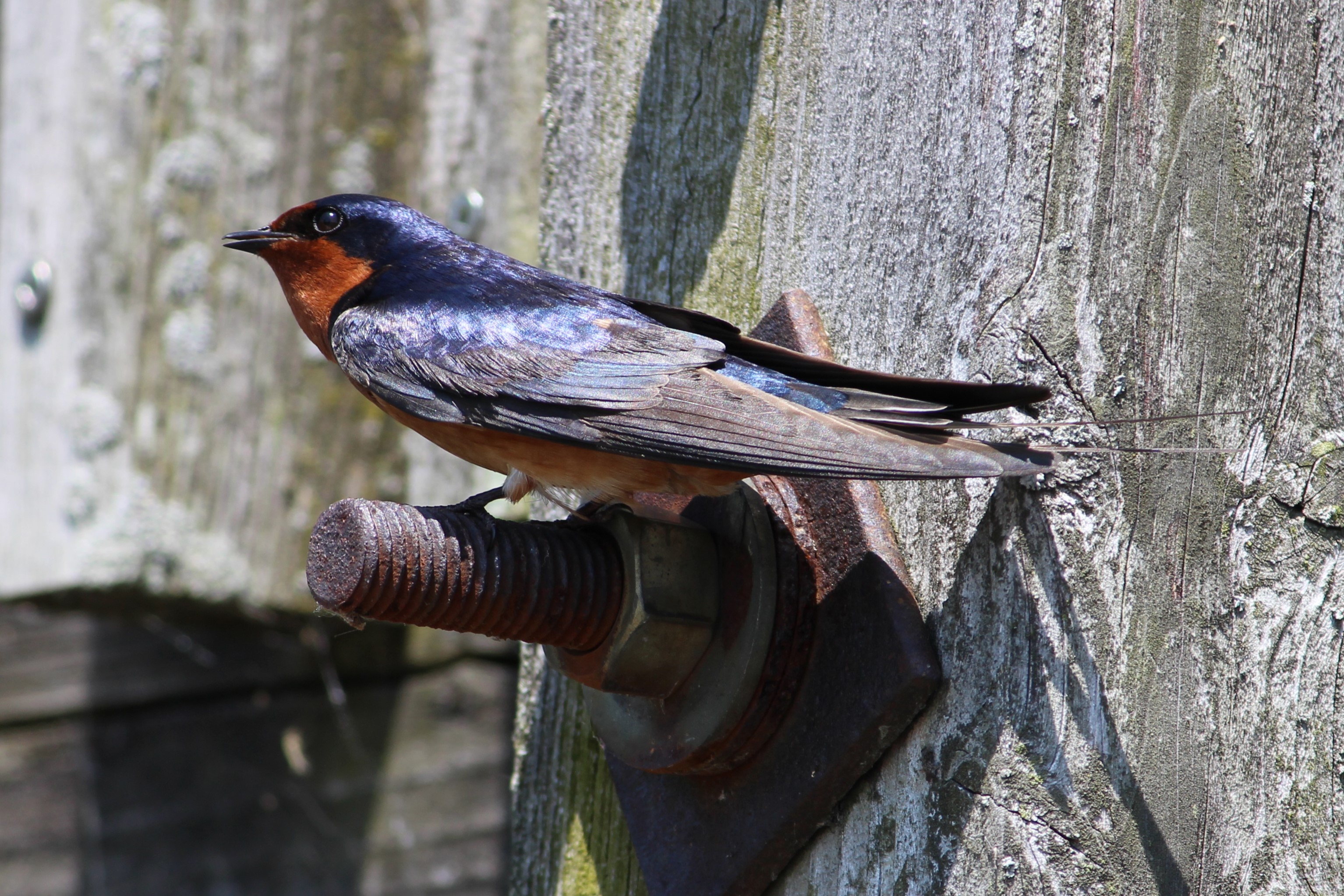
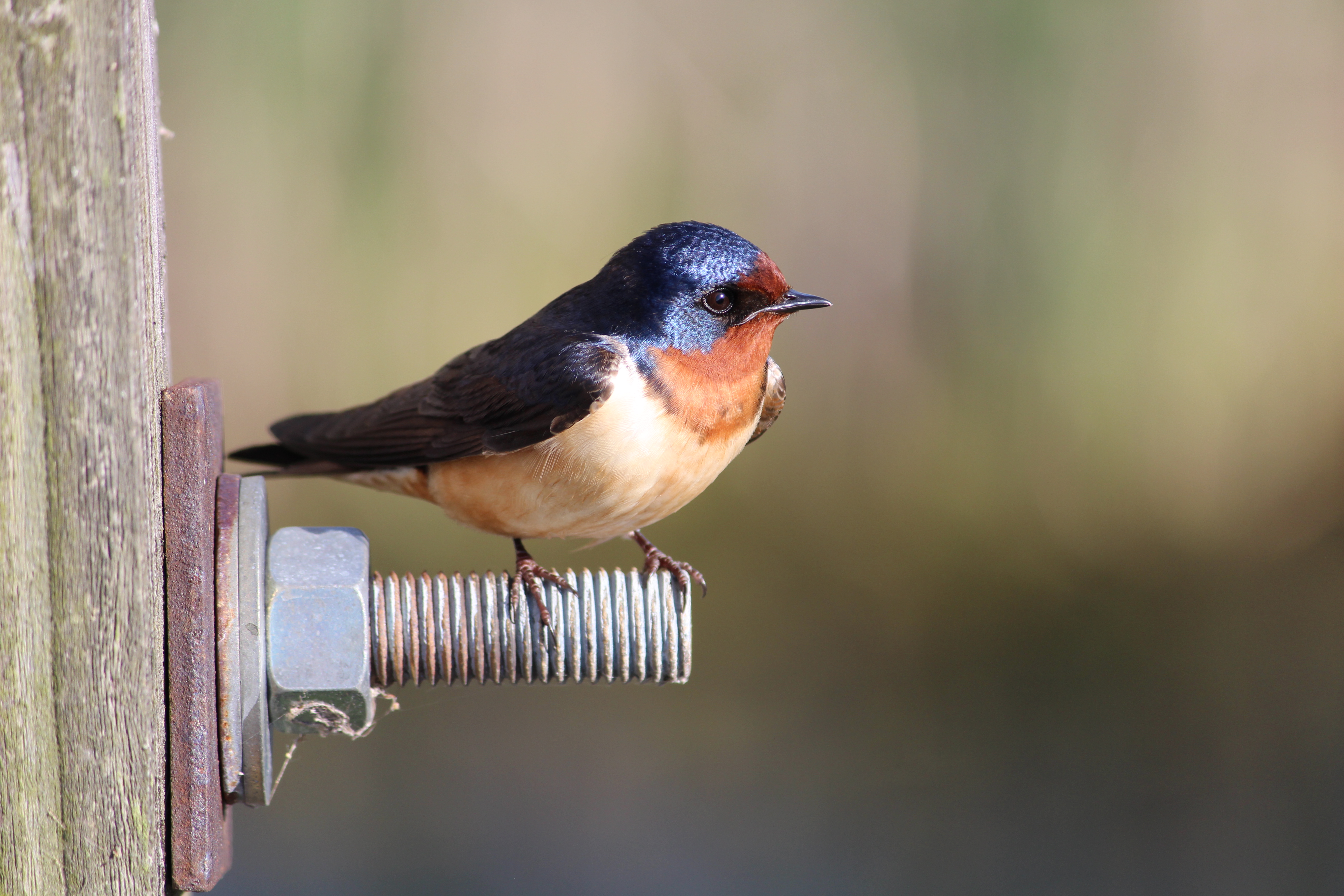
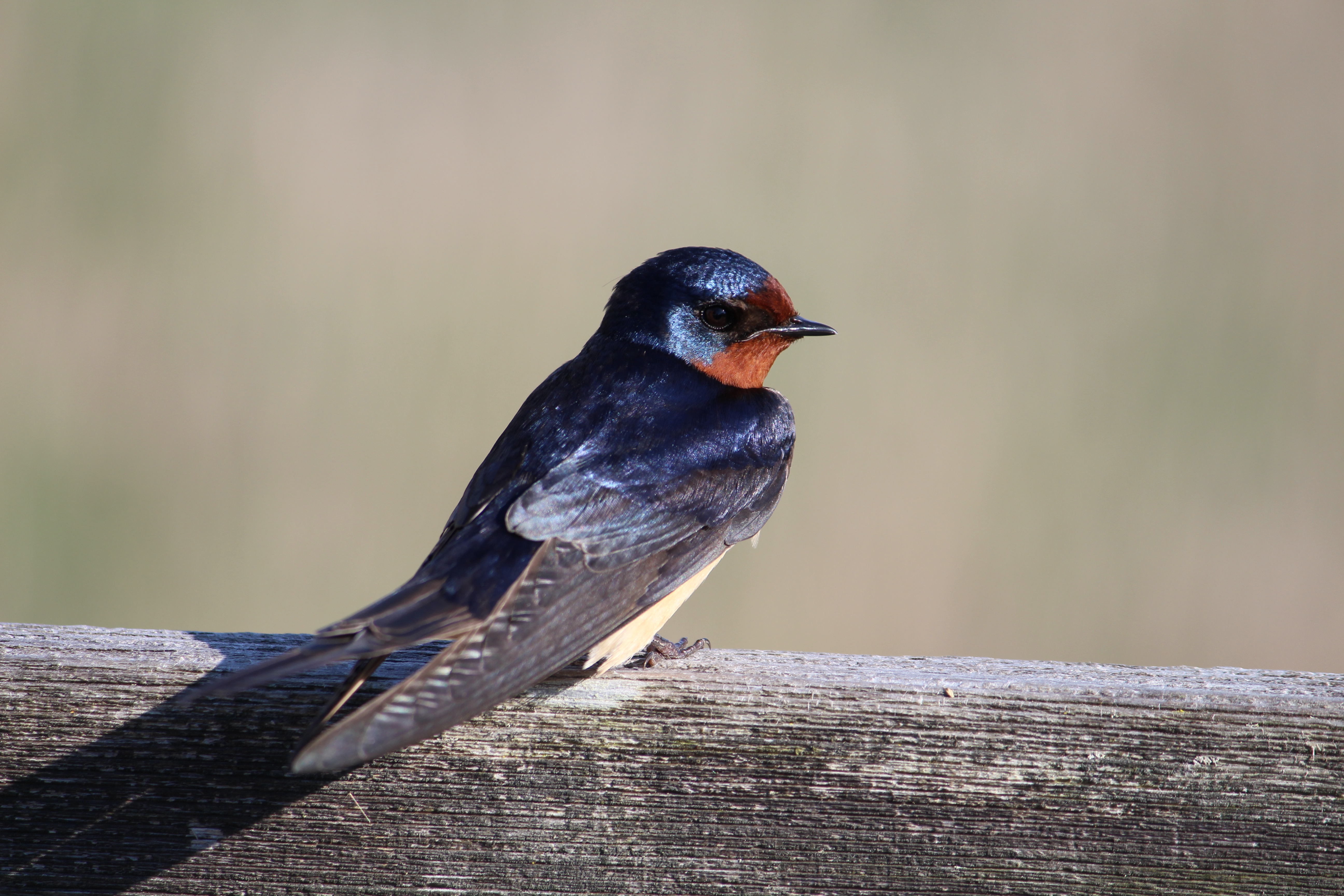
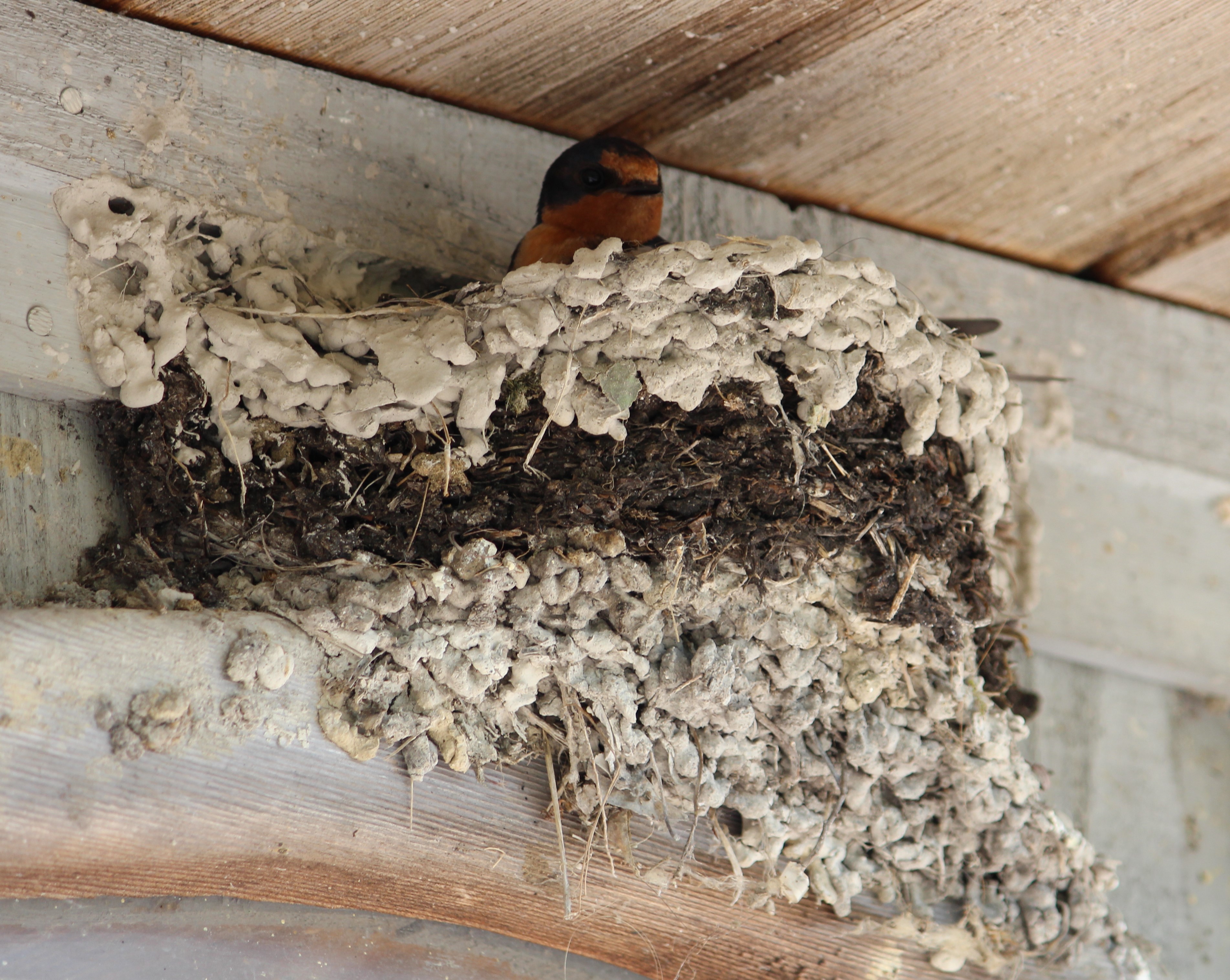
Most semi-enclosed overhangs were populated by the mud nests of Barn Swallows. These beautifully patterned and colourful birds swooped in and out of their nest locations, snatching insects from the air, skimming shockingly close to a water surface for a drink, or gathering mud to bolster their constructions. The chattering darts of Barn Swallows gave a frenetic energy to the buildings within Point Pelee National Park, some passing close enough to startle you. Never once did one dive at my head, like the divebombing behaviour I had experienced at the claws of a Red-winged Blackbird in Long Point. There were so many energetic birds coming and going, creating the impression of small, busy cities of mud.
Barn Swallow in a mud nest mixed with grass fibers.
Cliff Swallow (Petrochelidon pyrrhonota):
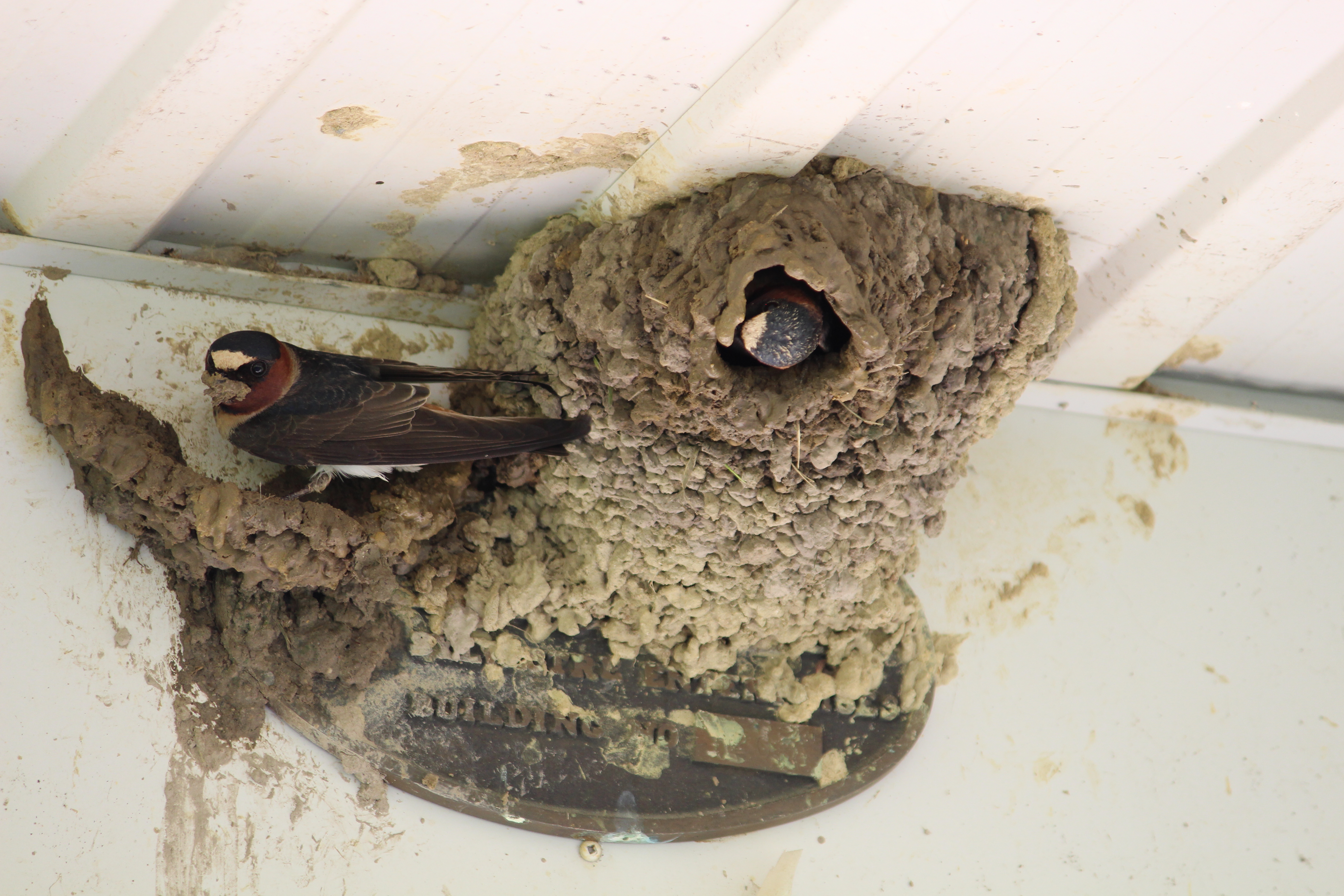
Cliff Swallows, one inside their nest applying mud, the other adding mud to a budding nest, supported partly by its neighbours’.
Cliff Swallows appear very similar to Barn Swallows in their nest construction, location and their physical appearance. Cliff Swallow nests are similar mud nests, but have a downward facing entrance rather than an open bowl like the Barn Swallow nest. Cliff Swallows will occasionally use the remains of Barn Swallow nests as a beginning point for their own constructions (del Hoyo et. al. 2004). Like all the swallows I saw, and all Hirundinids in Ontario, these birds arrive in Spring, breed and then depart in the Fall. As Swallows are dependent on insects (especially flying insects) for food, they can’t stay within northern areas during the winter when insects rarely if ever fly and most are hidden away and dormant.
Tree Swallow (Tachycineta bicolor):
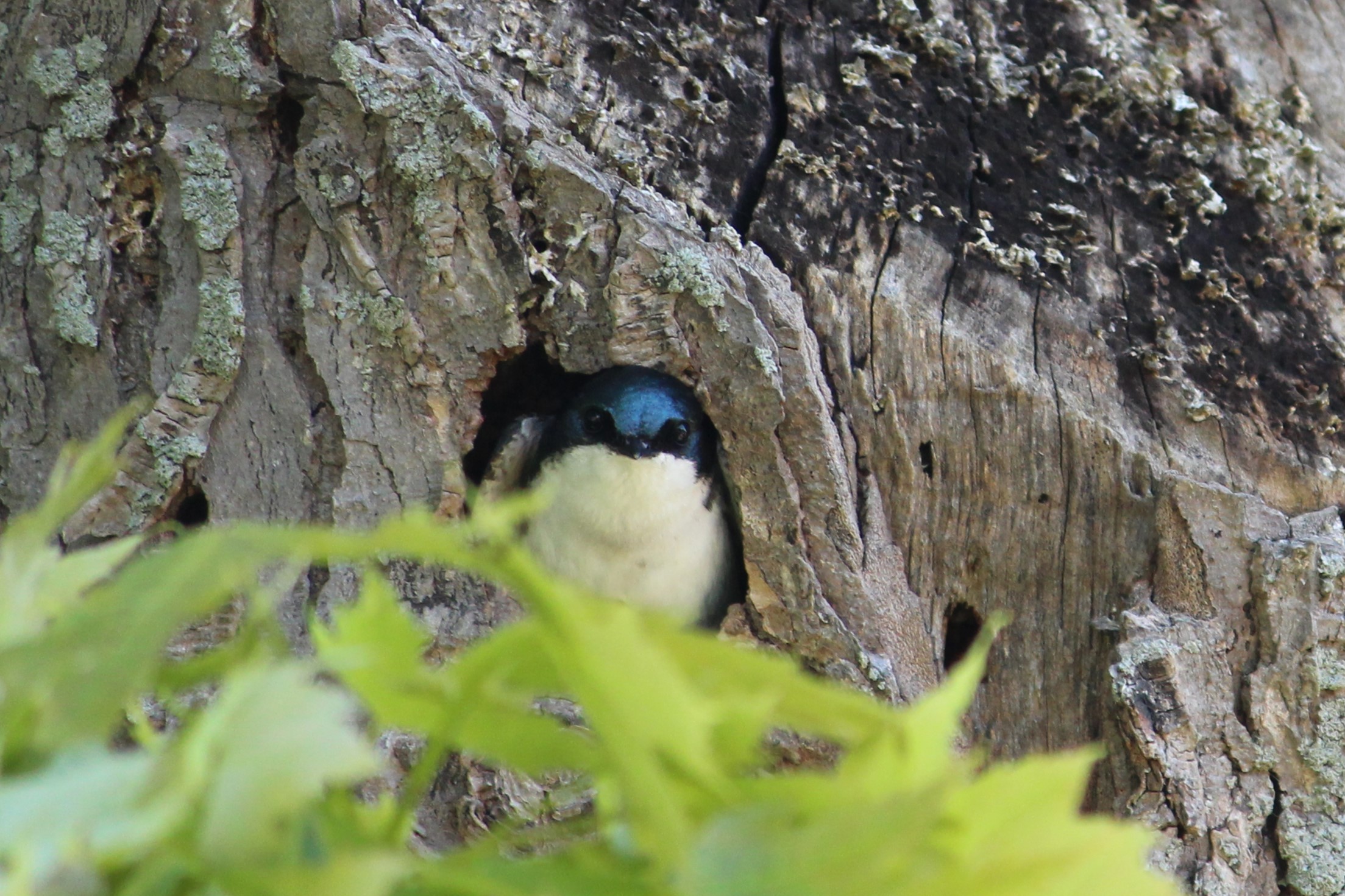
Tree Swallow peeking out of its home.
Contrasting sharply with the other two swallow species observed, the Tree Swallow does very little in the way of nest construction. Tree Swallows nest in tree holes but they do not make the holes, and they will readily nest in human-made nestboxes or other artificial cavities as well (del Hoyo et. al. 2004). They will add some nesting material to the tree hole, but this preparation pales in comparison to the mud constructions of the Barn and Cliff Swallows.
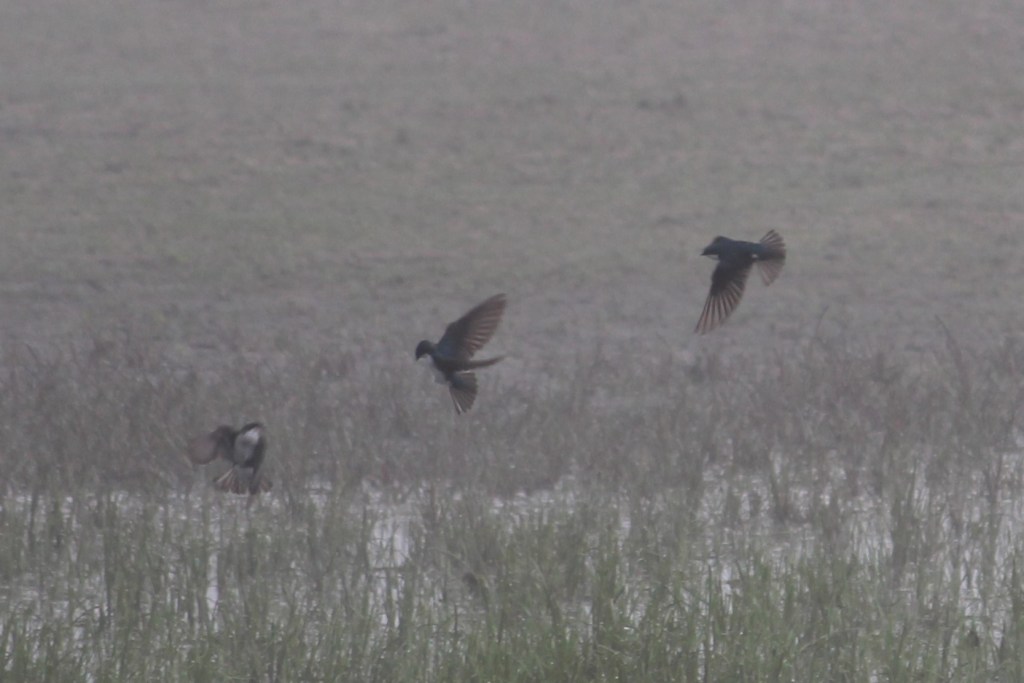
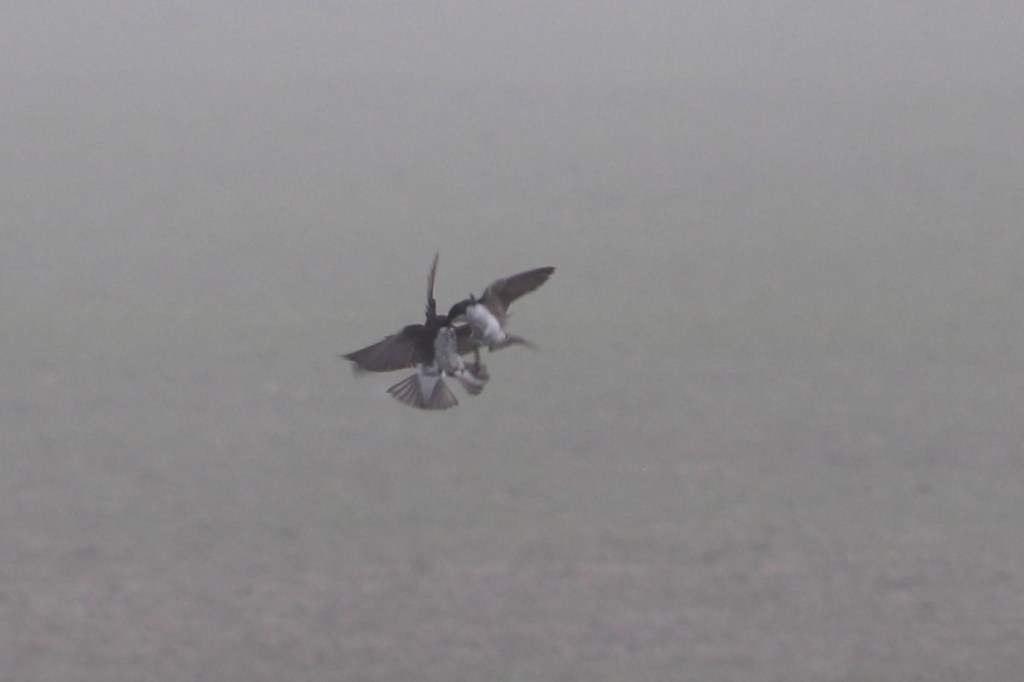
Tree Swallows having some sort of aerial battle in the Hillman Marsh Conservation Area, Essex County.
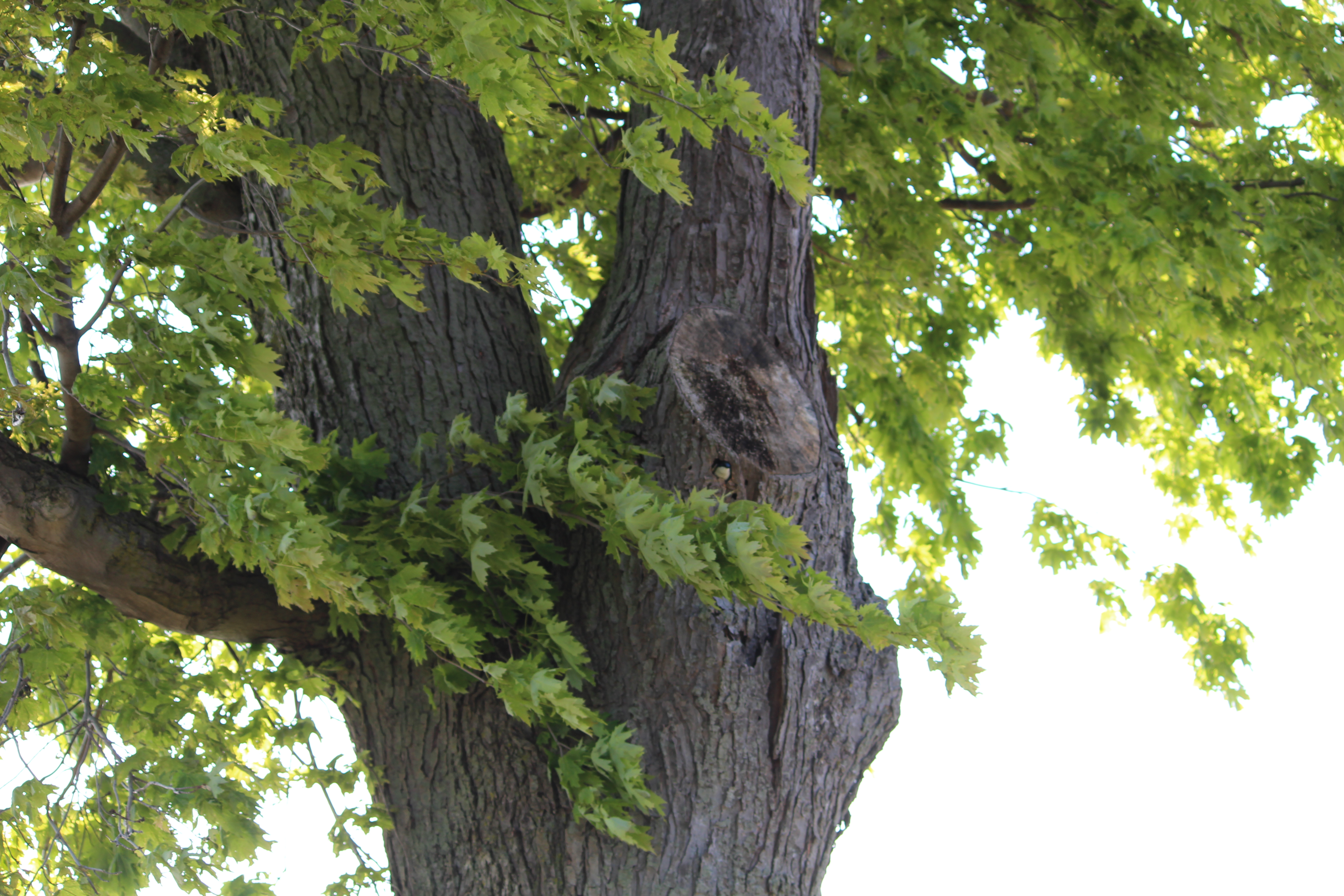
I was excited to discover a Tree Swallow was staying on the property where I was staying for this eventful birding weekend. Throughout my stay, I would occasionally check on the treehole where I had seen the inquisitive face staring out at me. Sometimes the beak would be open, chittering away, sometimes the bird would cock its head to the side as if examining the world outside its snug abode, and other times there would be no face filling the cavity, only a dark entrance to a hidden nest.
Some perspective on the tiny Tree Swallow’s treehole.
Swallows are incredible birds, and only one of the many bird families observed on my recent trip. Check in next time for another abundant and noisy bird family.
References:
del Hoyo J., Elliott A., & Christie D. A. eds. 2004. Handbook of the Birds of the World Vol. 9: Cotingas to Pipits and Wagtails. Lynx Edicions.
Elphick, Jonathan. 2019. The Handbook of Bird Families. Firefly Books.
Subsequent days in the park had us spending time at the Pog lake beach and surrounding area. The fog swirling across the calm lake was a wonderful sight to begin our Algonquin days. One morning the shapes of loons speared the fog and then dropped below the still surface of the lake. Loons may be a common sight within the lakes of Algonquin park, but that does not mean that they are a boring sight at all. Their calls and dives are woven into the atmosphere of Algonquin Park.
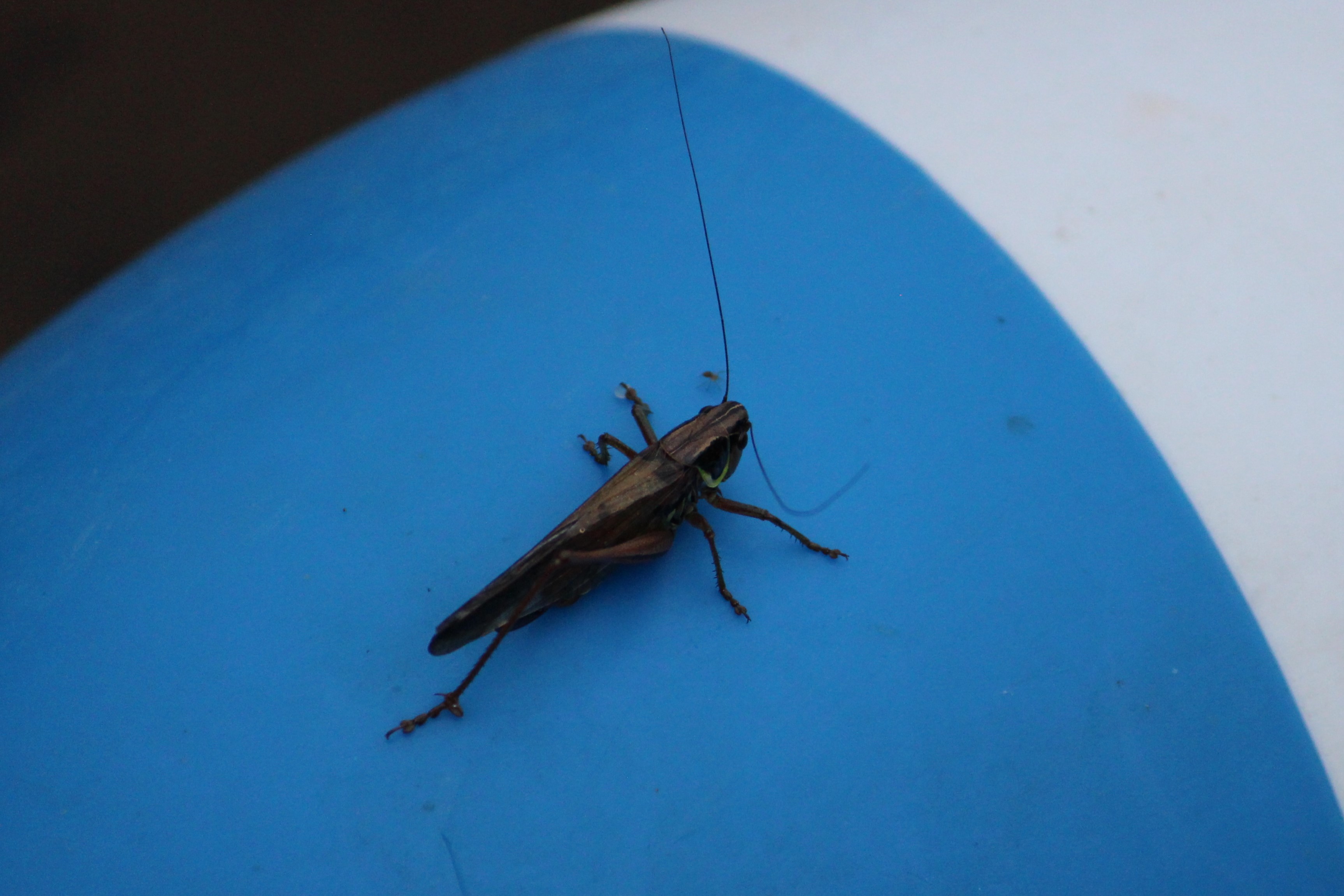
The charisma of Loons did not prevent my eyes being drawn to the small living denizens of the beach area as well. Resting on a buoy was a Large Orthopteran (grasshopper/cricket/katydid) of some sort. This was a Roesel’s Bush-Cricket (Roeseliana roeselii), an introduced Katydid from Europe. There are two forms to this species, one long-winged, and one short-winged. I believe the one I spotted is of the longer-winged variety.
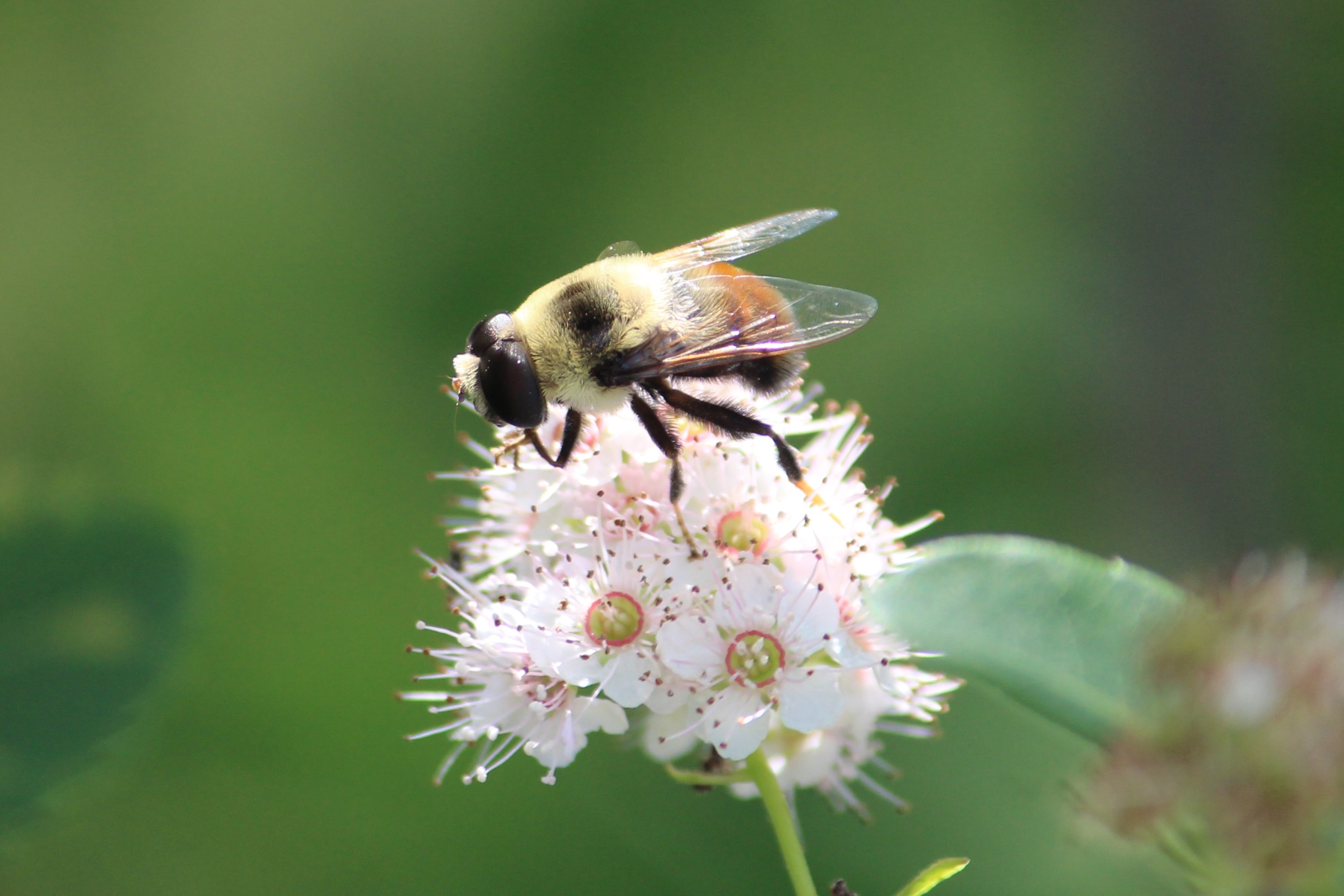
As the days progressed, more insect activity became apparent. A flower near the lake’s edge was visited by a bumblebee-look-alike: the Orange-legged Drone Fly (Eristalis flavipes). The larvae of this species feed within moist decomposing plant material and are known as “rat-tailed maggots” because of the long thin breathing tube that extends from the larvae. But the adults are beautiful bumblebee-mimics, one of many examples where one stage in an insect’s life is more attractive (to us) than another.
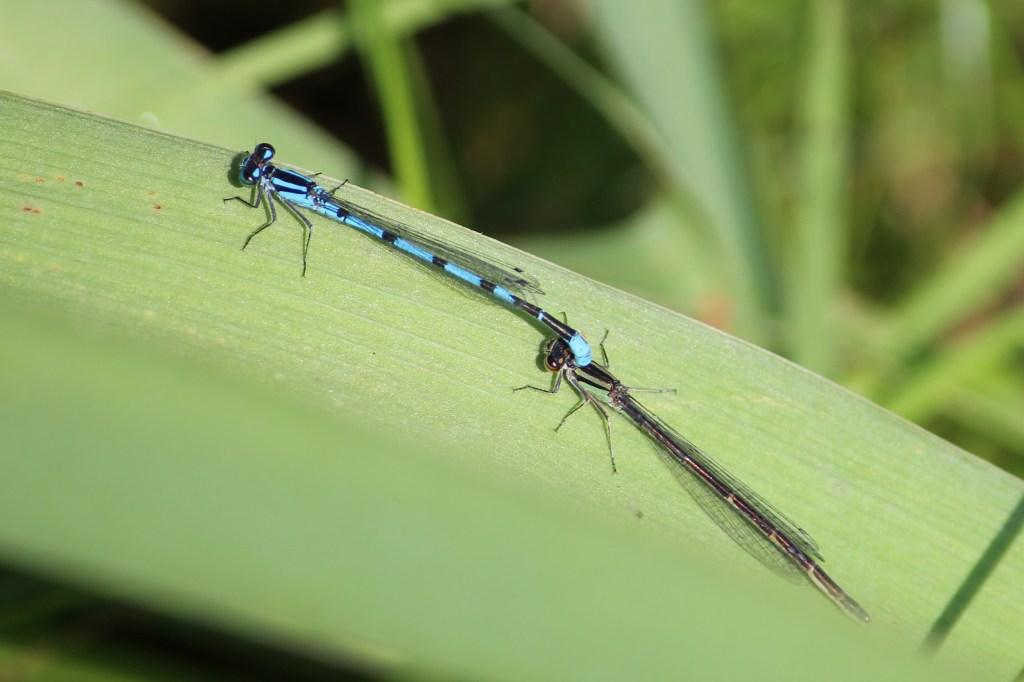
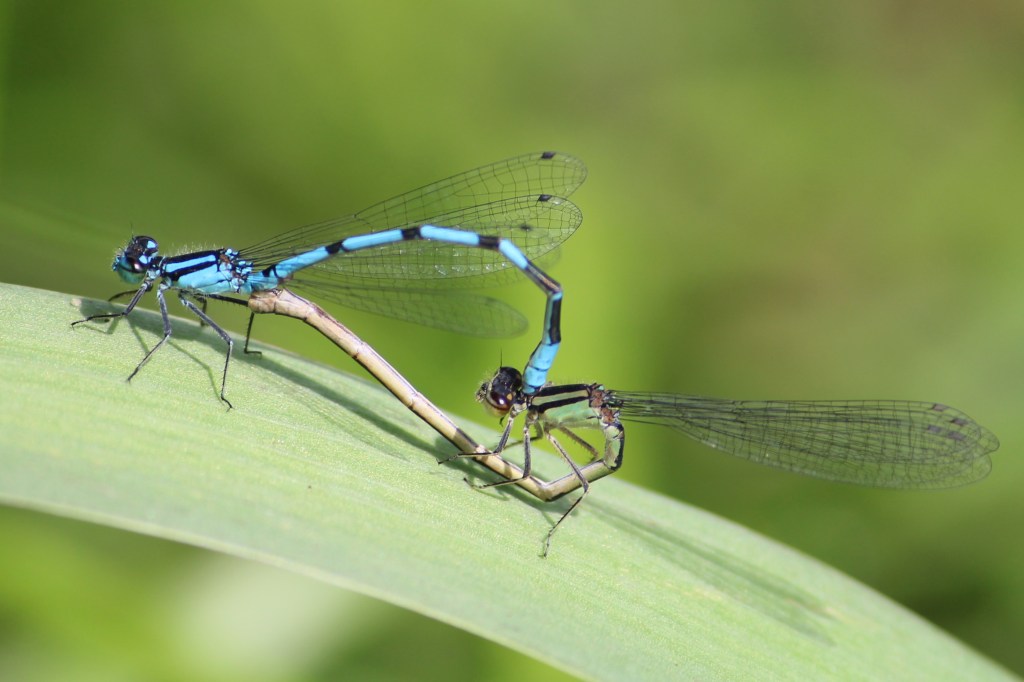
Nearby the flower was a pair of damselflies (Bluets, Enallagma) performing their heart-shaped coupling.
Part 1: The Male has clasped onto the female behind her head.
I’m unsure of the species but there are over 30 species of Bluets in North America (bugguide.net), so called because of the often bright blue colour of the male.
Part 2: Acrobatics incoming…
Damselflies have a strong ovipositor which they use to pierce vegetation in order to lay their eggs inside. Oftentimes, the plants they lay eggs into are partly underwater, causing the damselflies to stretch their abdomens beneath the water surface to cut into a suitable stem.
Part 3: Union.
There were other encounters within the Pog Lake Campground, but the most memorable for me were in a location separated by a walk from our campsite and the beach, a wonderful place I came to call “Warbler River”. That will be the subject of my next post.
The Story Behind the Shot: The amazing hovering capabilities of Flower Flies (the Family Syrphidae) have always impressed me and I really wanted to capture this one in the air. The fact that I was able to take this shot is a testament to how little these insects falter while hovering in mid-air.
The Story Behind the Species:
Common Compost Fly males are some of the most impressive flyers in the world of insects. They use their skills to patrol among flowers and pursue females which visit the flowers with incredible agility. Their singleminded pursuits seem to have sacrificed discrimination for the sake of directness, as these flies are known to pursue “any insect of almost any size that appears in their search area” (Marshall 2012 p. 307). After mating, the females lay their eggs in decomposing plant material, which can include compost, hence their common name.
Syritta pipiens is an introduced species in North America, brought over accidentally from Europe around 1895 (Skevington et. al. 2019).
References:
Marshall, Stephen A. 2012. Flies: The Natural History and Diversity of Diptera. Firefly Books.
Skevington, Jeffrey H., Locke, Michelle M., Young, Andrew D., Moran, Kevin, Crins, William J., and Marshall, Stephen A. 2019. Field Guide to the Flower Flies of Northeastern North America. Princeton University Press.
Once again, I’m going to repost one of my tumblr blog posts, this time from May of 2018.
On May 18-21, 2018, we took a trip to MacGregor Point Provincial Park. Today’s post is going to be a highlight of the animal observations/encounters that we had that weekend.
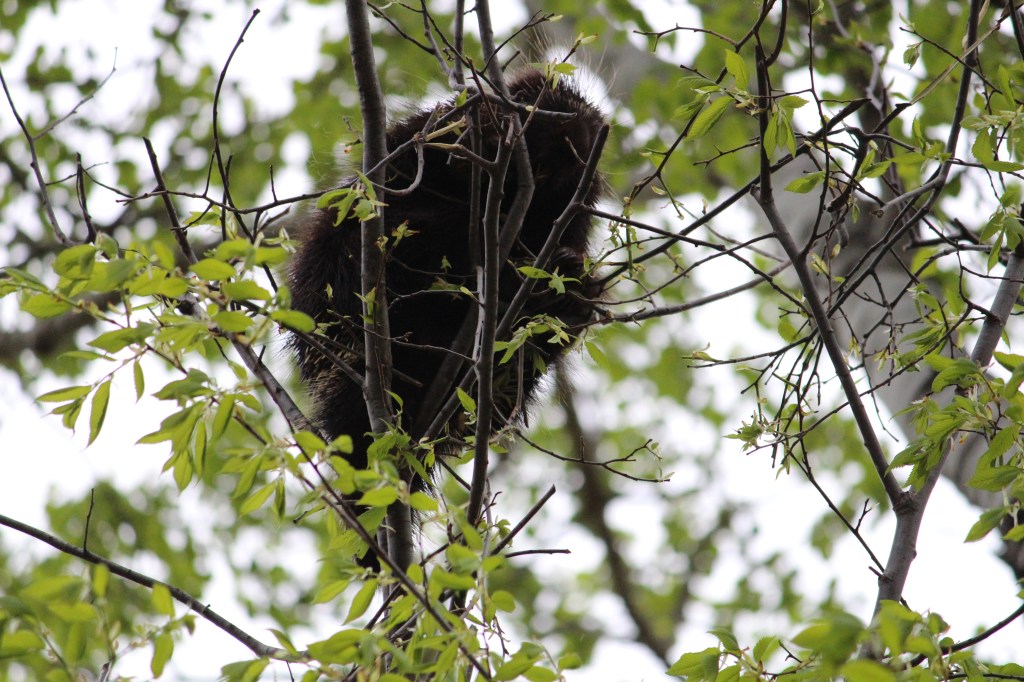
We awoke early the first morning of our stay and looked at the grey skies that promised rain. Hoping to spot some wildlife beneath the somber dawn sky, we set off on the Tower Trail. Our early start was rewarded with the sight of a strange animal resting in a tree.
It was a mammal with spines, and the second largest rodent in North America (only beaten by the Beaver): a North American Porcupine (Erethizondorsatum). After consuming some buds and plants that it foraged in the night it found a perch to rest in for the day, one that seemed awfully thin for the size of the animal.
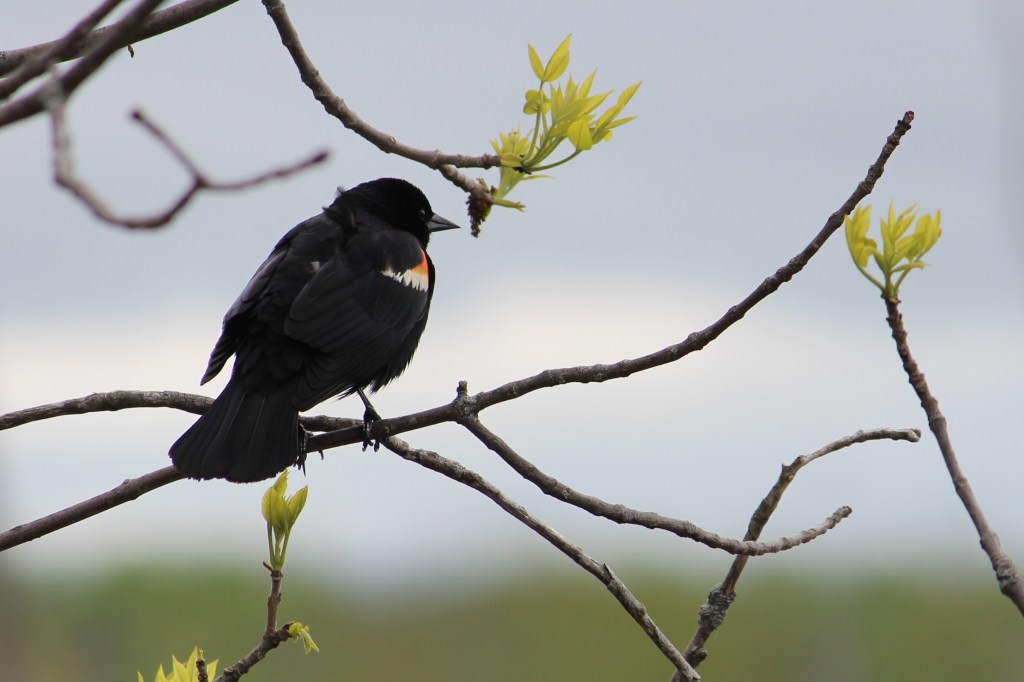
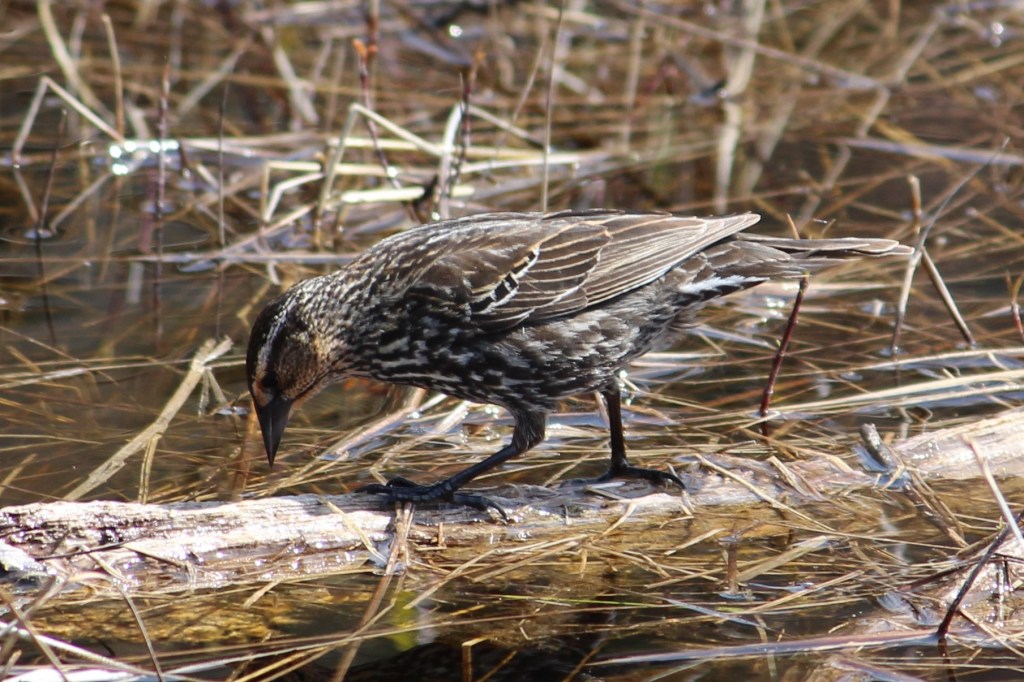
Further down the trail, we moved through various ponds until the horizon opened into spreading wetlands filled with reeds and bordered by grasses and trees. Here, the red-winged blackbirds (Agelaius phoeniceus) were in abundance, uttering their O-ka-leeeee calls from their various perches. We saw males with their velvet black plumage offset by epaulets of red-and-yellow, and we also occasionally spotted the much more camouflaged females. On our last morning camping, we saw one of the females and believed it to be a different species of marsh-bird, but later came to the realization that it was a female red-winged blackbird.
Male (top) and Female (bottom) Red-winged Blackbirds (Agelaius phoeniceus).
Mixed with the sounds of the blackbirds, were the trumpeting calls of the Canada Geese (Branta canadensis), always the loudest birds present. As we were leaving the wetlands, we heard a strange call and a bird departing the marsh. We were able to snap a quick picture of it and now believe it’s a Great Egret (Ardea alba).
Our fleeting glimpse of a Great Egret (Ardea alba).
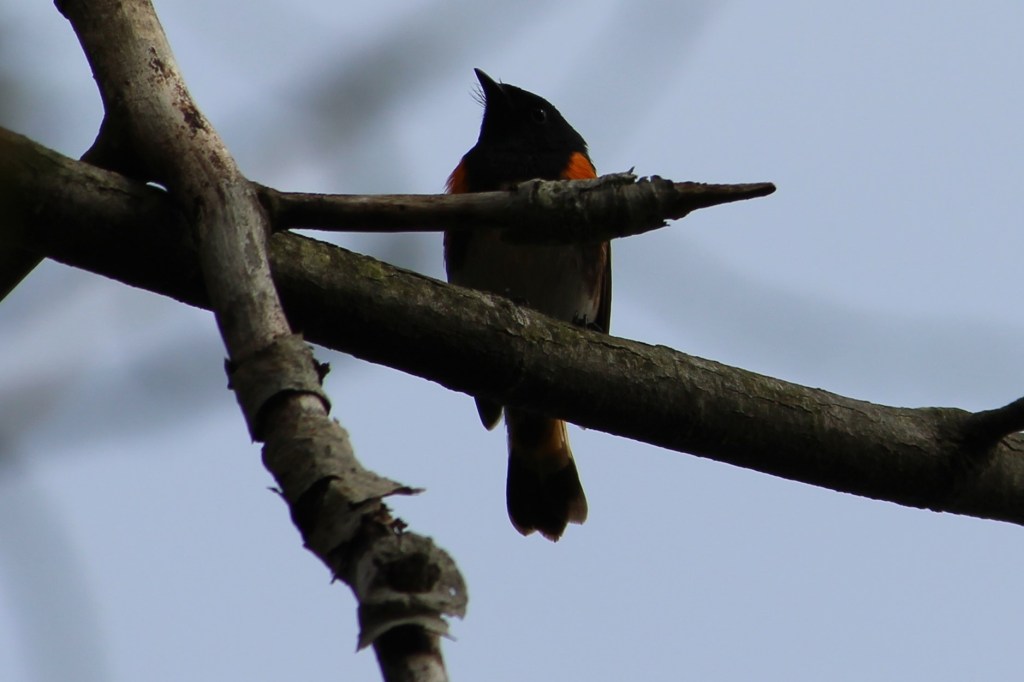
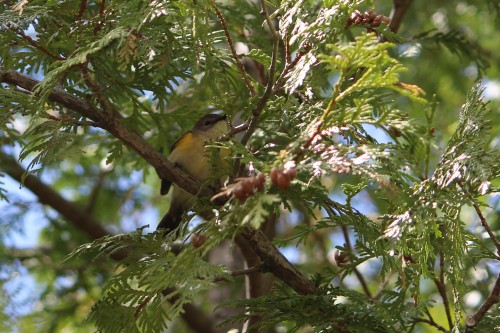
Throughout our stay, our campsite was host to several small, flitting birds that would rarely sit still. Every time the eyes caught one in full view the birds would then dart off again, a streak of orange flickering through the branches of the tree like an avian fire. We were barely able to take some pictures of these quick warblers foraging among the branches. They were American Redstarts (Setophaga ruticilla), who had returned from their wintering grounds in Central America and northern South America. Like the Red-wings, the male and female birds look very different- the male sporting a dark coat with orange dashes on the wings and chest, and the female a gray-white with yellow patches on the sides.
Male (top) and Female (bottom) American Redstarts (Setophaga ruticilla). The pictures unfortunately do not capture their boundless energy.
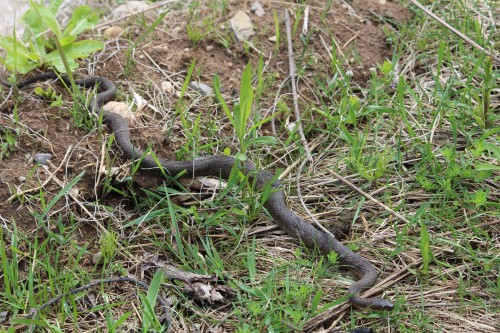
Beneath clear skies the next day, we set off on the Tower Trail once more, hearing and seeing the blackbirds again. On our way through the wetlands trail, we spotted another creature enjoying the warmth and sun: a Northern Watersnake (Nerodia sipedon).
Northern Watersnake (Nerodia sipedon) basking in the sun.
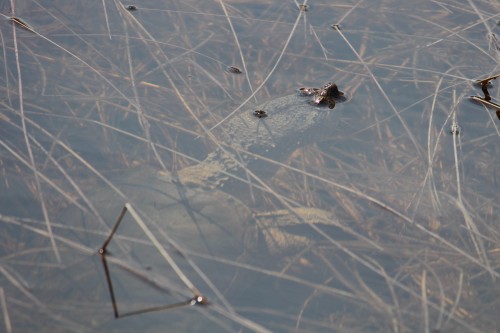
While visiting the trail near the Visitor’s Centre, we were in the right place to see a creature that resembles a mythical beast: a swimming Snapping turtle (Chelydra serpentina). Snapping turtles are beautiful creatures and the one we saw moved very stealthily. Despite the clear waters, and the size of the reptile, it was difficult to keep track of its scaly skin among the water-plants as it slowly and gracefully swam through.
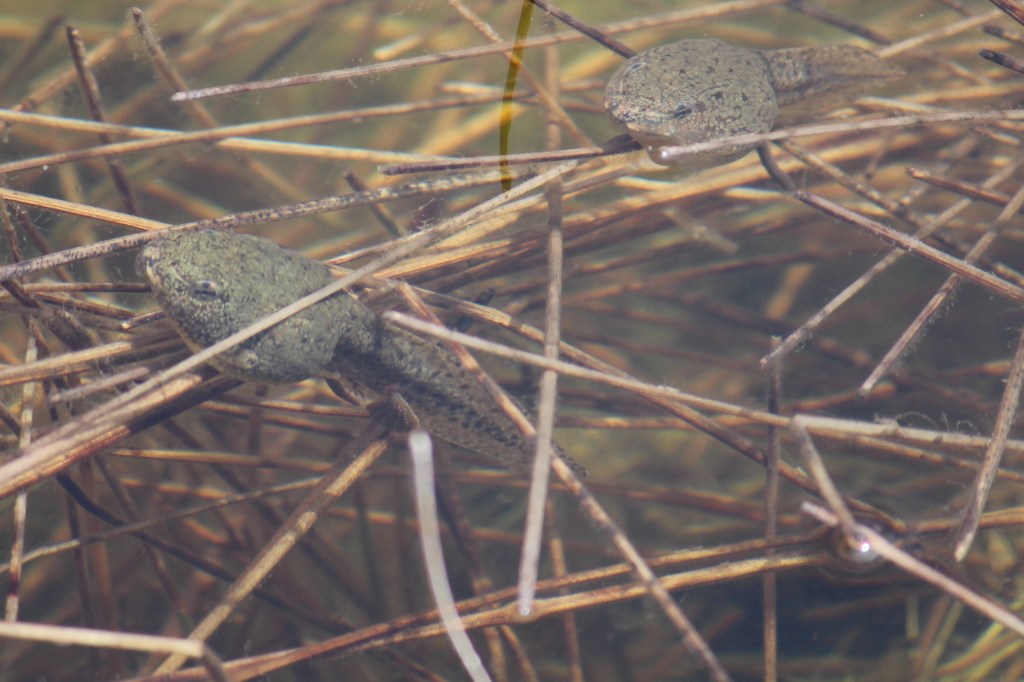
Also moving through the waters of the marsh were large tadpoles, with heads the size of a toonie or larger. Some were beginning to display the stubs of legs, but continued to swim in wriggling pollywog fashion, so unlike the athletic strokes of their adult frog legs.
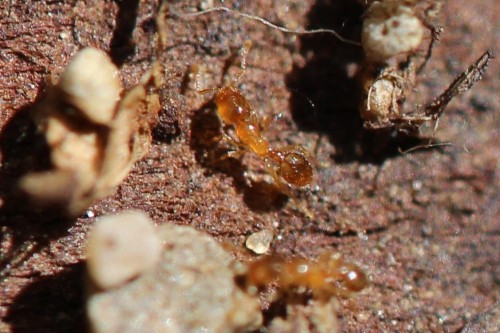
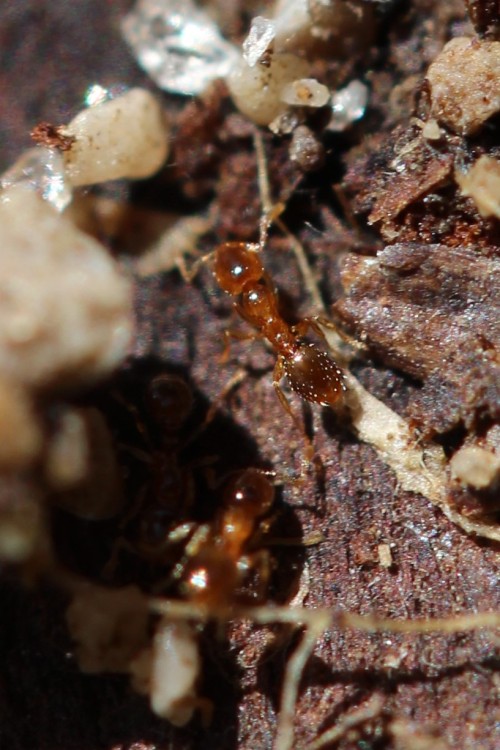
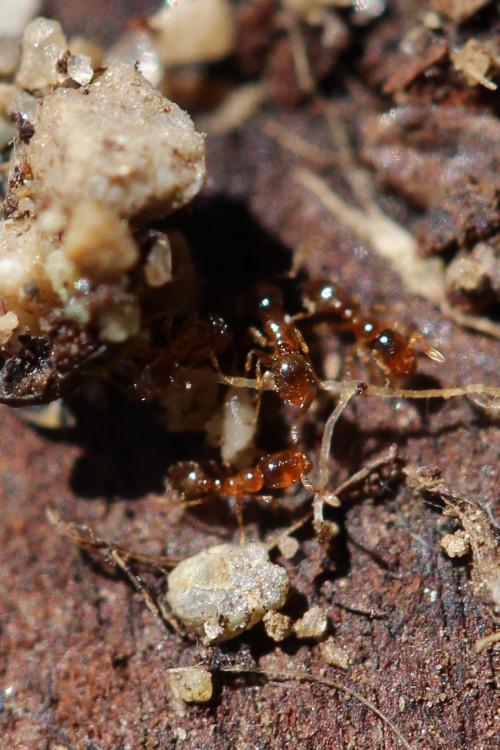
Once back at our site, I had an itch to use my macro lens to capture some of the tiny creatures that abounded there. Turning over a piece of bark on the gravel of our site, no larger than my palm revealed a portion of a miniature society. Tiny orange-brown ants scurried frantically about. They were Temnothorax ants, which are also known as “acorn ants” because some species of Temnothorax house their entire colony within an acorn.
Temnothorax ants, tiny workers under a piece of bark.
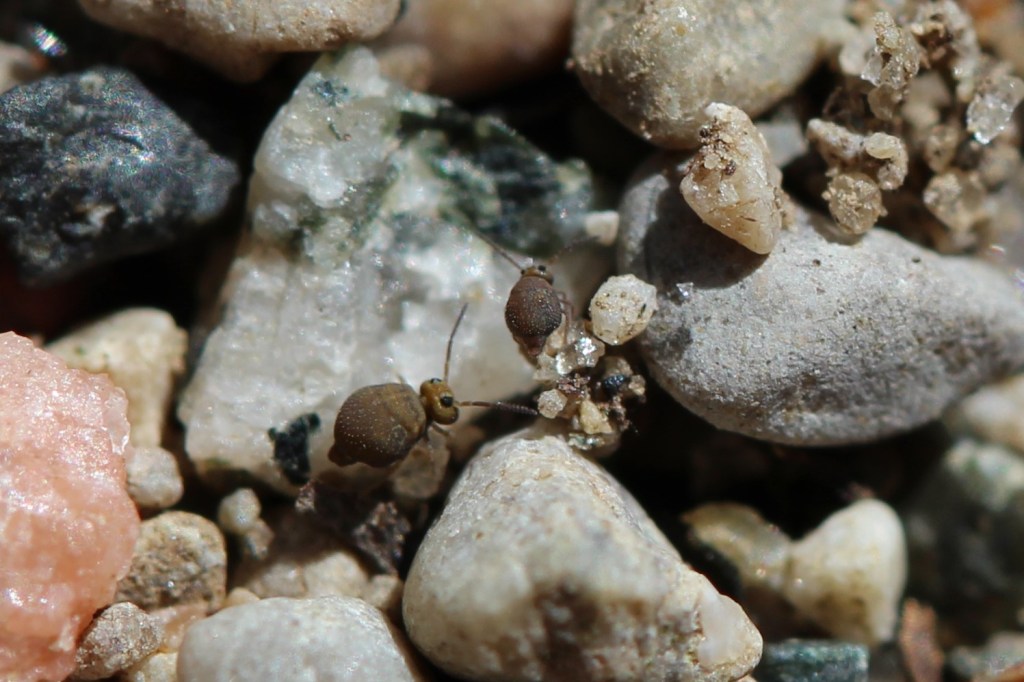
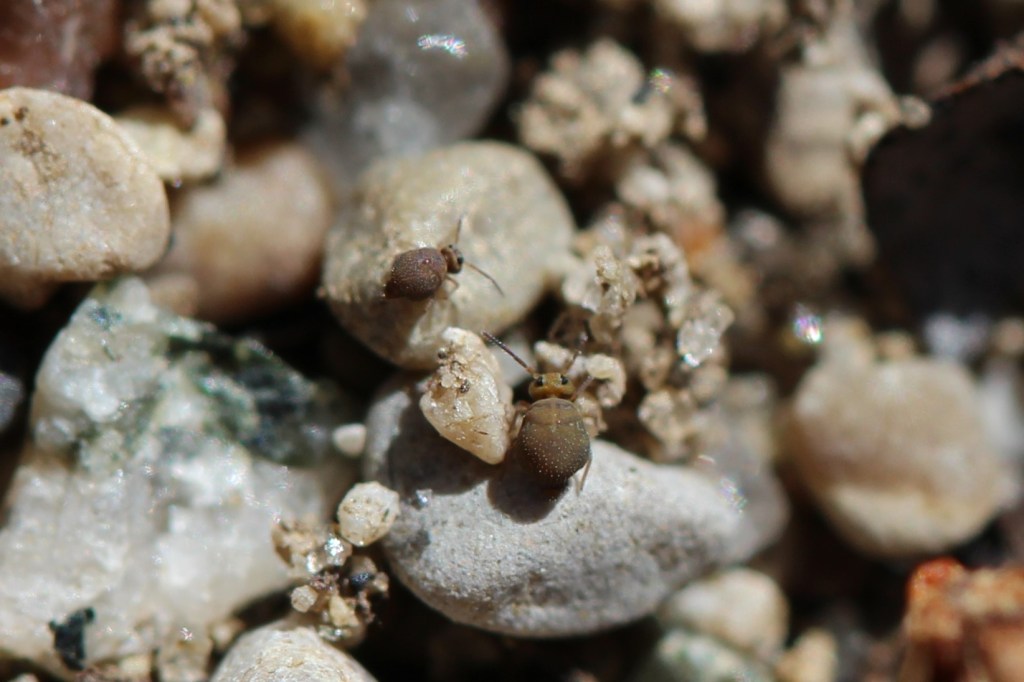
I turned my gaze on equally tiny, but even more numerous inhabitants of our site. Everywhere one looked in the sun, dark specks that slowly moved or hopped about on the gravel, could be seen. To see them in their full was a delight to me. The specks were Springtails, and these were a quite different kind to the ones I had seen before in the snow and on the trail by our house. These Springtails were like tiny rabbits when one could view them up-close. They were Globular springtails (Order Symphypleona) and I’m fairly sure the species was the Garden Springtail (Bourletiella hortensis) or something closely related:
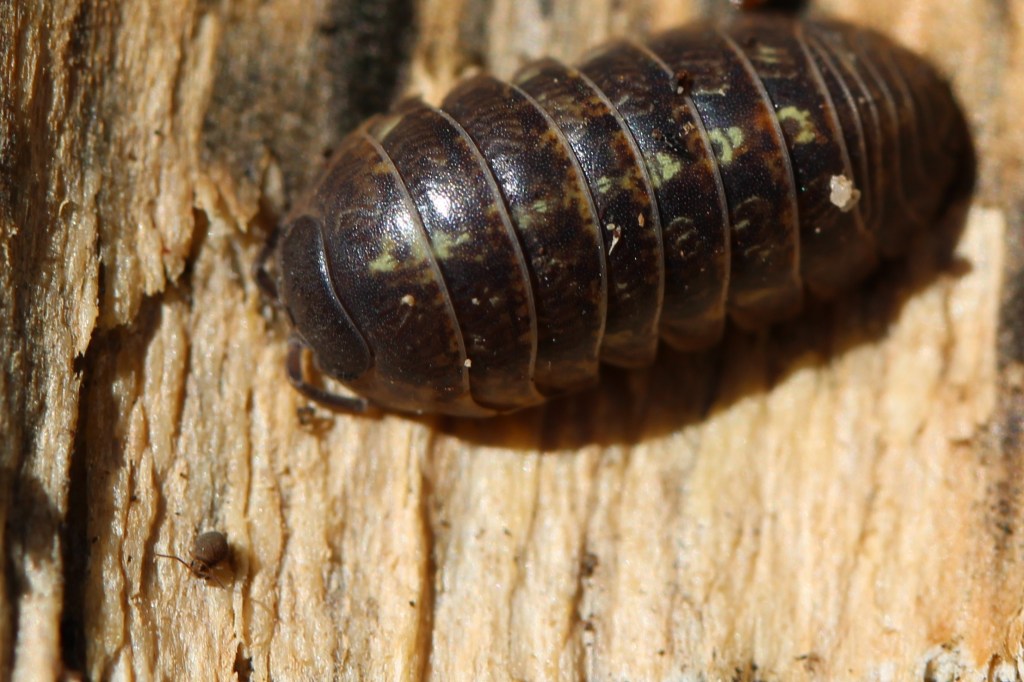
For size context, see the following picture of a Woodlouse (Armadillium vulgare). In the bottom left corner, there is one of the little Springtails:
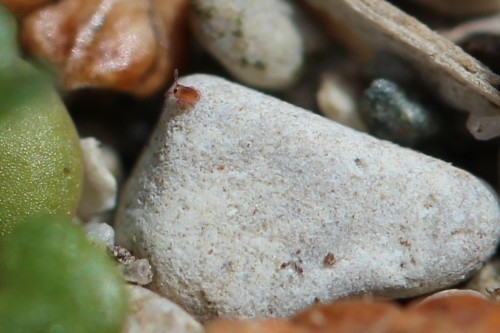
In my quest to focus the macro lens on these miniature creatures I inadvertently took a picture of something even smaller than an adult Springtail: a baby Springtail!
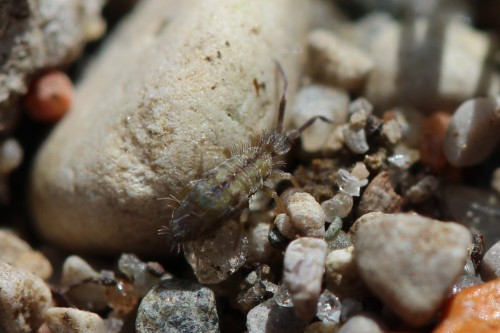
As if to demonstrate fully the diversity of these tiny almost-insects, an entirely different species of Springtail was also rushing through the gravel: a member of the genus Orchesella, one of the Elongate Springtails:
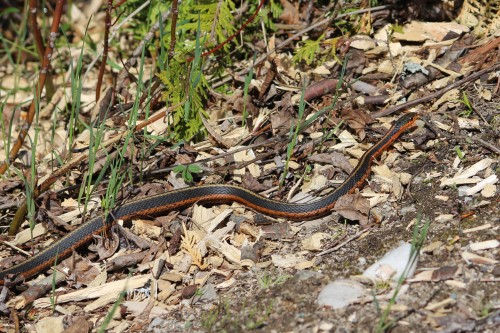
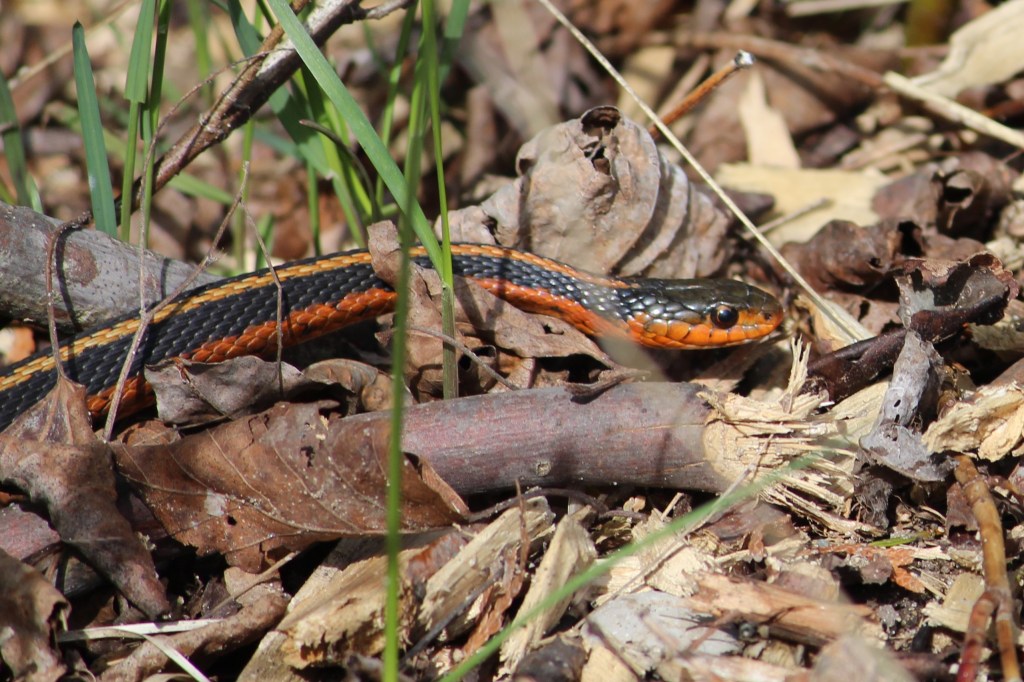
Right at the edge of our site, my friend Marshall sighted a beautiful snake with orange underbelly and stripes along its dark body. We thought it must be a rare species but it turned out to be a variant of the diverse Eastern Garter Snake (Thamnophus sirtalis), which did nothing to diminish its beauty or wonder.
A beautiful Eastern Garter Snake (Thamnophis sirtalis).
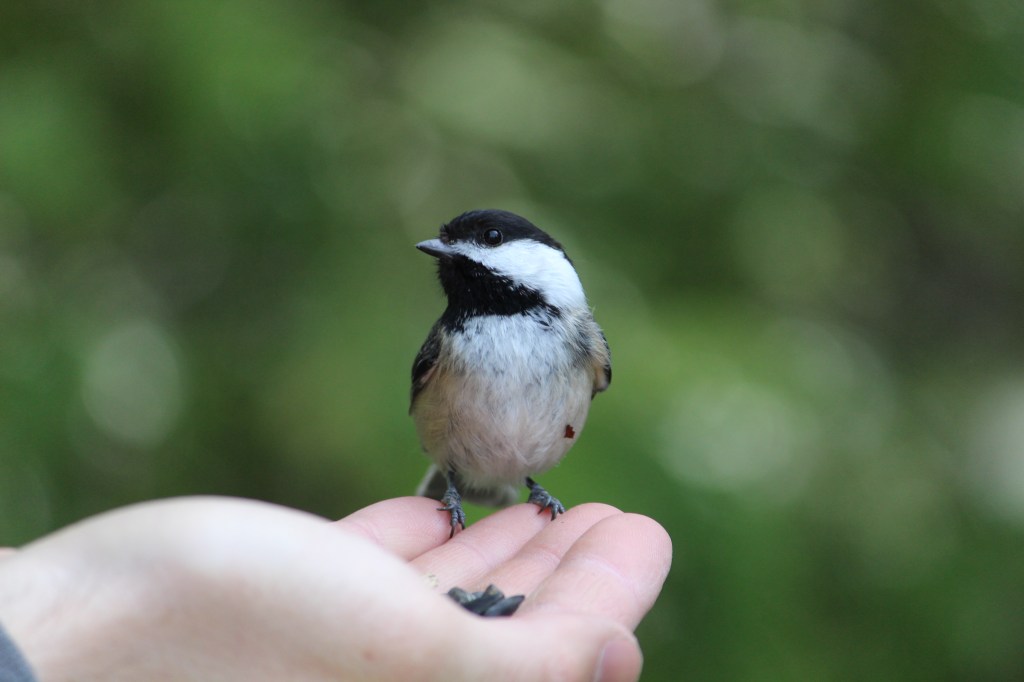
On our last day we went to the Visitor Center trail to feed the Chickadees (Poecile atricapillus) from our hands, along with the occasional red-breasted Nuthatch (Sitta canadensis). Despite some of the rain and cloudy weather, we observed a variety of wild organisms at MacGregor Point and marveled at their diversity and beauty.
In the interests of my own personal goals to post at least once a month, I’m going to re-publish my very first post on my first iteration of the Norfolk naturalist blog, which was on tumblr. I’m planning to re-post all of my articles that I wrote on my tumblr on this site at some stage (possibly with some slight updates/alterations) since I would like them all in one place, and my own website seems like the best place to have that. So here is my first Norfolk Naturalist post, originally published on my tumblr back in 2018 (over 4 years ago!):
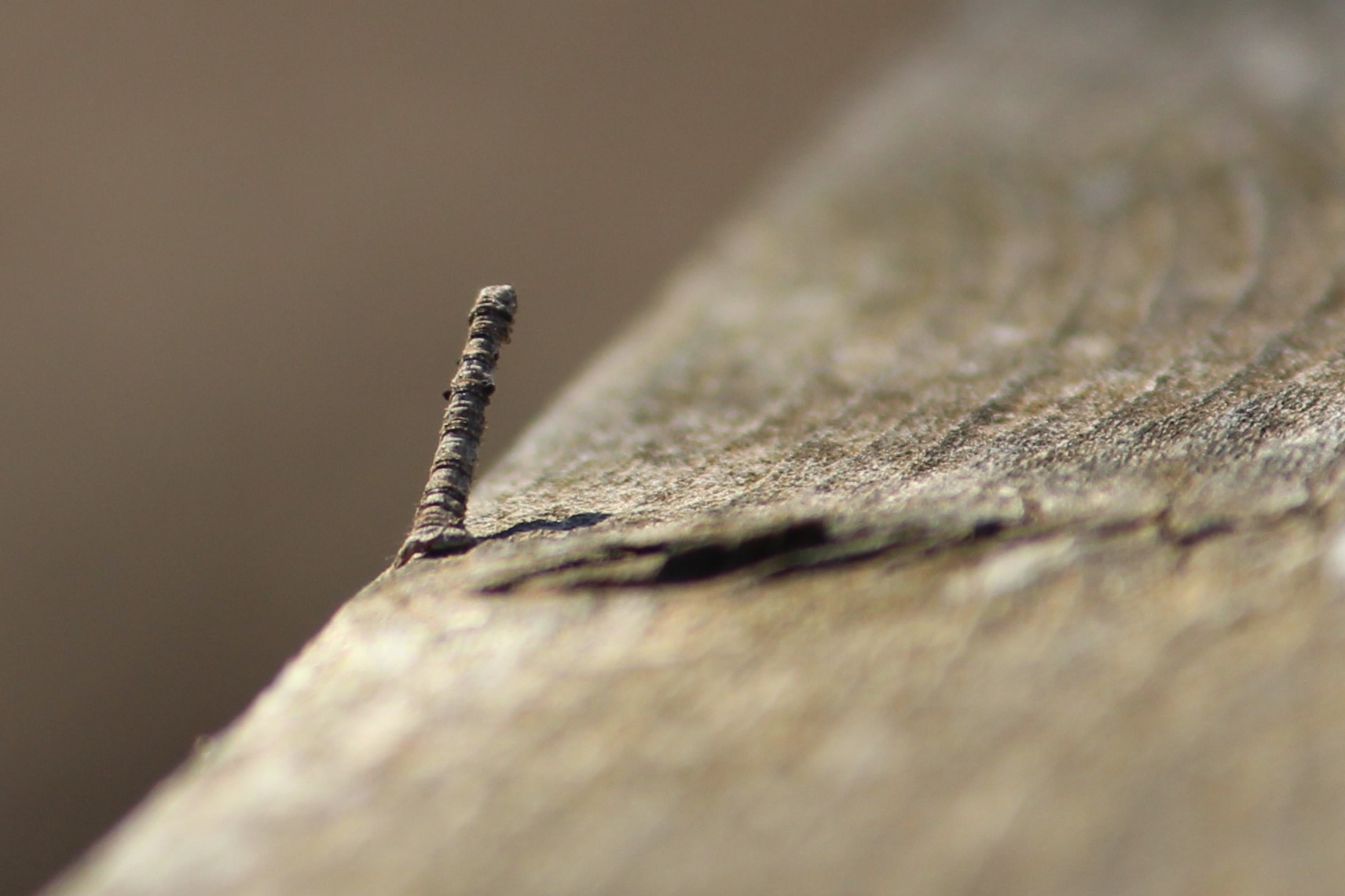
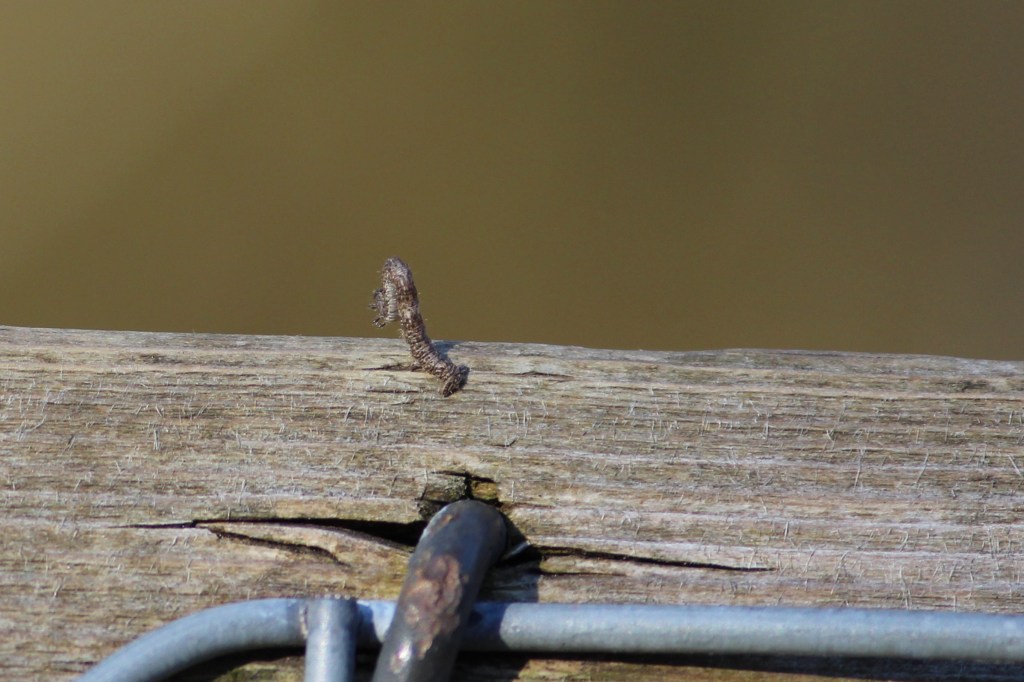
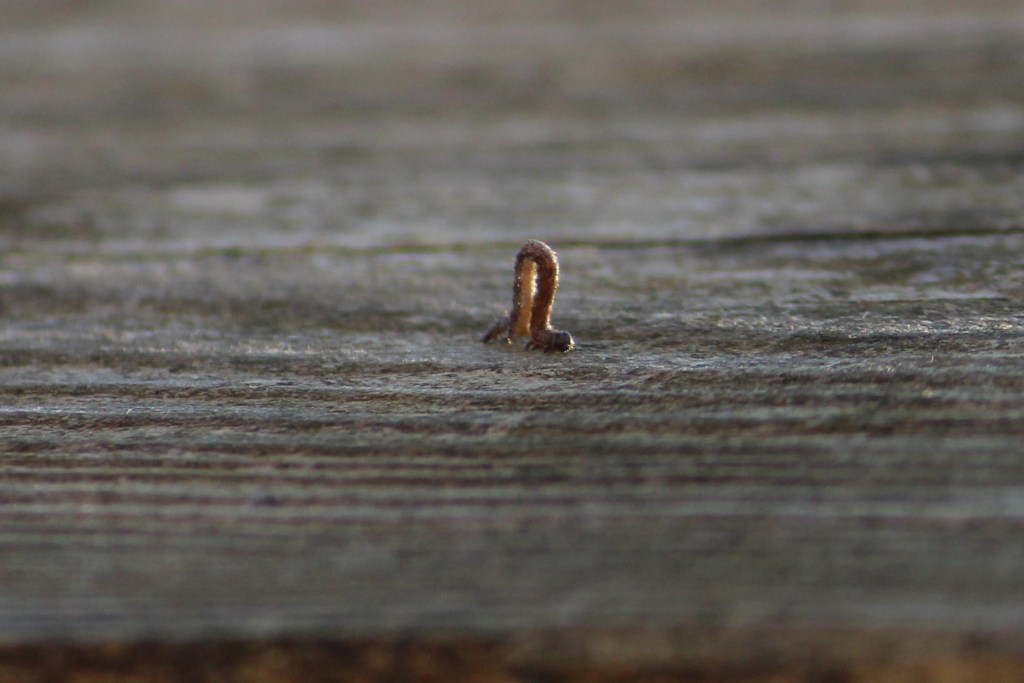
While walking the trail near my house, I spotted a twig in an unlikely spot. Instead of forming the final split of a growing or dead branch, the tiny twiglet (just larger than my fingernail) was jutting out into the air from the railing of the bridge. Something strange was going on. On closer inspection, it turned out not to be a twig at all. Rather, a caterpillar had chosen a poor and rather conspicuous spot to hide.
If this caterpillar had chosen a better location, it surely would have fooled me. Even where it was, it was extremely difficult to spot. The coloration and shape of its back was a perfectly mottled gray-brown, and its posture was that of a twig. It was thin-bodied and elongate, only about a millimeter around.
The caterpillar’s odd shape is provided by it having a large space between what are its true legs (the six legs just behind the head) and its ‘prolegs’ which are fleshy stubs coming off of its abdomen. This large space also causes these caterpillars to move in a unique fashion. They lift the front group of legs and extend it forward, reaching ahead and securing themselves there. Then they lift their rear group of legs and move them forward to reconnect with the front legs. Once together, the rear legs hold their place and the caterpillar once more reaches forward with its front legs. This “inching along” process provides this group of caterpillars with their name: the Inchworms (Family Geometridae).
A caterpillar’s main predators are birds which hunt visually. If the caterpillar appears to be something other than a morsel to a hungry bird, then it has succeeded and survived another moment. This type of behavior has a technical name: “crypsis” or “cryptic behavior”, which just sounds amazing. It strikes this cryptic pose when threatened, and so effectively disappears from a hunting bird’s search. I suppose it must have assumed this position when I walked near, thinking me to be hunting it for food. In reality, I was hunting only for a few pictures.
I hope you enjoyed that “repost” from the older version of norfolk naturalist blogging. I promise I’m still working on My Top 20 Nature Photos of 2013-2020 series and I also have several other posts about more recent nature sightings in the works. Hopefully April will be a more productive writing month!
During our stay at Algonquin Park, I made a few trips down Opeongo Lake Road watching for wildlife. It’s a good place to see some of the rare creatures of Algonquin Park, as it forces you to go slow and there are wetlands and woodlands on either side of the road, ending in a lake. My sightings along this road were good even if I didn’t see any of the target species: Moose (Alces alces).
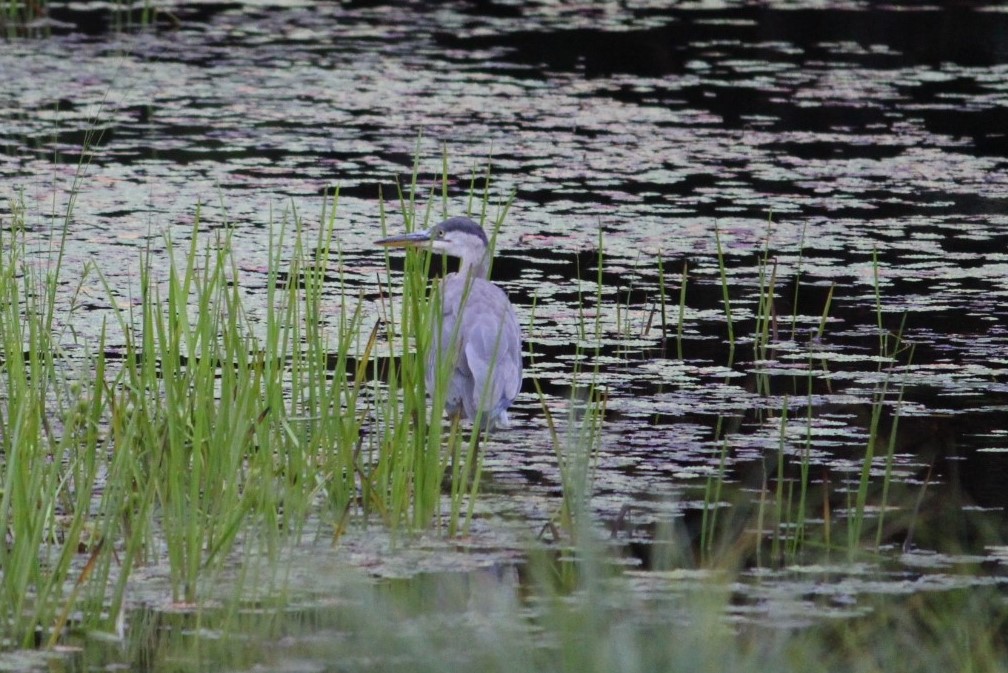
One of the most common species sighted on the trip were Great Blue Herons (Ardea herodias). It seemed as though these tall predatory birds were stalking every waterway, and I guess they might have been. Herons’ sinuous and powerful necks and the way they creep around slowly so as not to disturb their prey never ceases to catch my attention.
Great Blue Heron, stalking among the reeds (or rushes or sedges or something, I’m not a Botanist ok?).
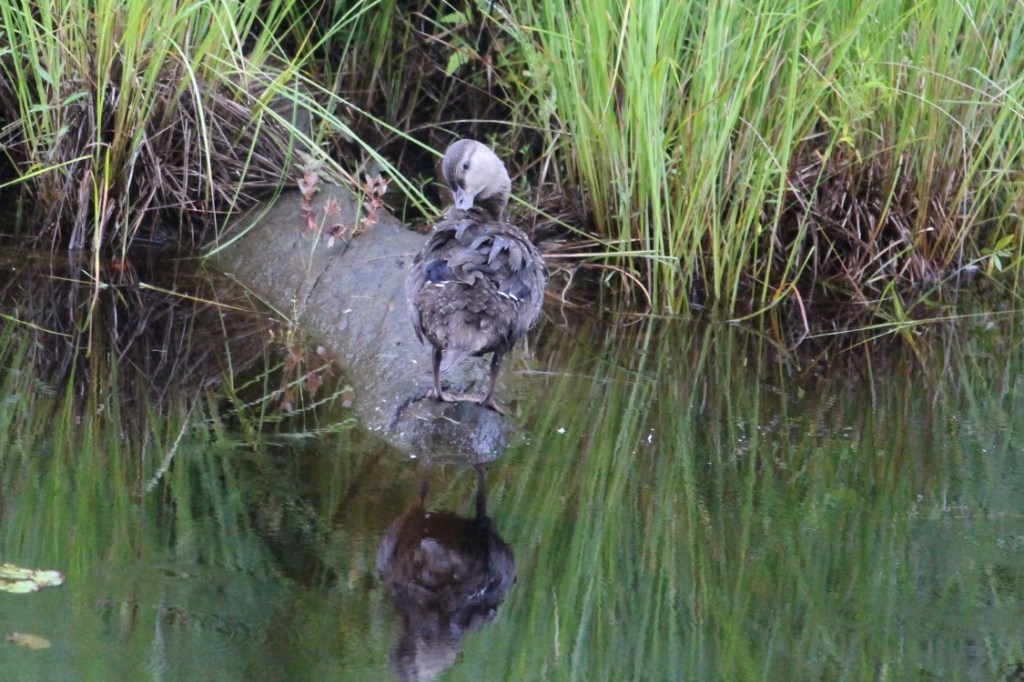
Another common bird spotted in the water was the American Black Duck (Anas rubripes). Two years ago, I had a few of these Ducks visiting my campsite, searching for handouts and I assumed then that they were female or juvenile male Mallards (Anas platyrhynchos). When I posted my pictures from October 2019 on iNaturalist, the ducks were instead identified as American Black Ducks. They really do look like female Mallards superficially, the main difference being that female Mallards are “paler and sandier” and the bill is orange/black in the Mallard, whereas the American Black Duck has a greenish bill (Bull and Farrand, 1994). Because of changes in land practices and overhunting in the past, as well as hybridization with Mallards, the American Black Duck is rarer than it used to be. Within Algonquin Park however, the American Black Duck is one of the most common Ducks (Tozer, 2012).
American Black Duck
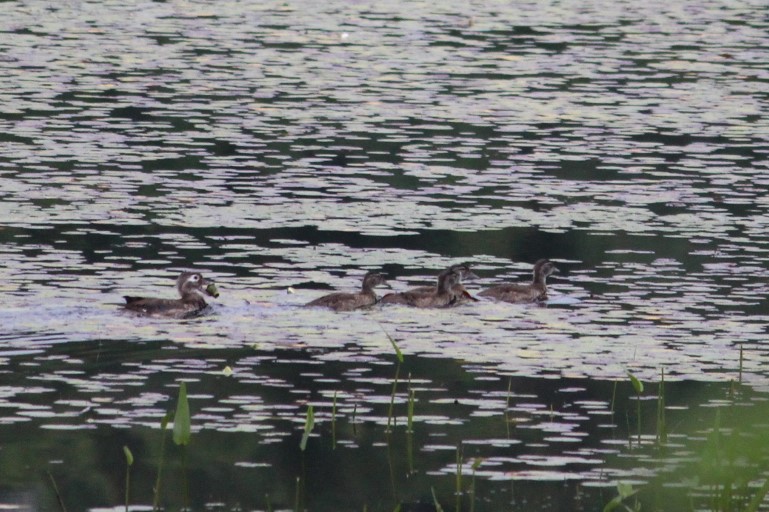
The other Duck (member of the Family Anatidae) spotted occasionally was the Wood Duck (Aix sponsa). Wood Ducks are remarkable (to me, at least) for nesting within tree-holes, something that seems strange for a Duck to be doing. I photographed a female Wood Duck leading a group of young across the marsh. Interestingly, the adult has something in its bill, I believe it’s the flower of a lily (Nymphaea).
Wood Duck female with a plant part in her mouth (lily flower?), and some young ahead of her.
One of the only Mammals* spotted on my trip was the animal responsible for creating some of the wetlands I observed: the Canadian Beaver (Castor canadensis). These giant Rodents (second in size among Rodents only to the Capybara of South America) engineer their surroundings, turning rivers into ponds where they create lodges. Beavers do not eat fish, unlike their smaller lookalikes, the Muskrats (Ondatra zibethicus).
*(the only other Mammals were the ubiquitous Red Squirrels (Tamiasciurus hudsonicus) and Chipmunks (Tamias striatus))
Beaver swimming through its marshland habitat.
Perched high in the trees or on wires was a Bird which I always confuse with Swallows (Hirundinidae): the Eastern Kingbird (Tyrannus tyrannus). This bird also has one of the best Scientific names ever, which is apparently because of its aggressiveness in defending its nest or territory, but also the “Kingbird” is because it has a crown of yellow (or sometimes red) feathers that is only displayed when its head feathers are parted in aggressive displays, which I have never seen (Cornell Lab of Ornithology website). This aggression in defending its nest extends to such formidable foes as crows, ravens, and hawks (Tozer, 2012)!
Eastern Kingbird perched in a tree.
The rarest sighting on the Opeongo Lake Road tours was a group of foraging Snipes, specifically Wilson’s Snipe (Gallinago delicata). I didn’t get amazing pictures, because they were far away and they were really difficult to keep track of. I love the way these birds move, so I also attempted to take a video of them, which isn’t great but it demonstrates the way they start and stop, dipping their long beaks into the marsh to probe for invertebrates.
Wilson’s Snipe(s?) moving through the marshes. At left, one is plunging its sensitive bill into the mud, at right one is stepping off a log with its large foot.
More to come from my Algonquin Observations series!
References:
Bull, John and Farrand, John Jr. National Audubon Society Field Guide to Birds of North America: Eastern Region. 1994.
Tozer, Ron. Birds of Algonquin Park. 2012.
For Other Nature Observations in Algonquin Park, see:
And if you’re interested in seeing more of my photos and learning some facts about the organisms I’ve observed, follow me on Instagram at norfolknaturalist.
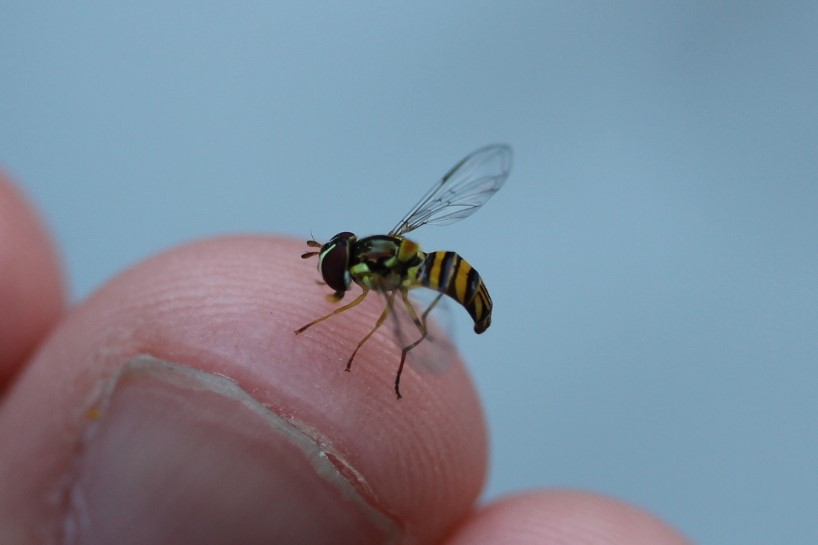
I recently spent a weekend camping at Port Burwell Provincial Park and took several photos of interesting creatures I encountered there (as I usually do on camping trips). One of the first creatures I encountered was a beautiful Flower Fly which hovered right in front of my face for a few minutes and even landed on my glasses, as well as several times on my hands. My Flower Fly Friend was an Oblique Streaktail (Allograpta obliqua).
Oblique Streaktail Flower Fly which landed repeatedly on my fingers and even on my glasses.
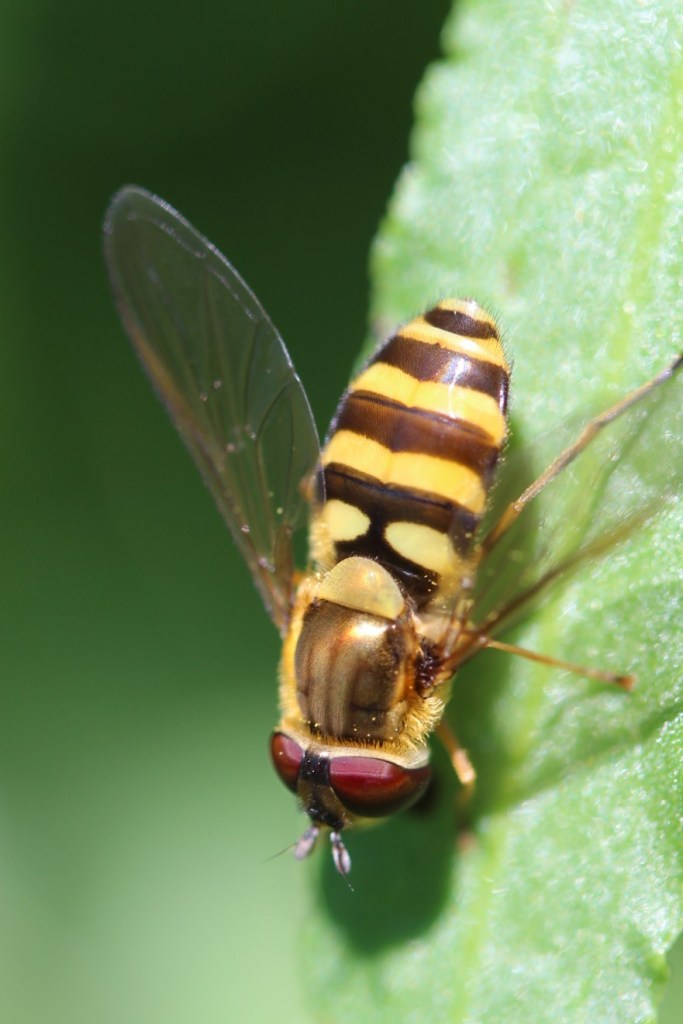
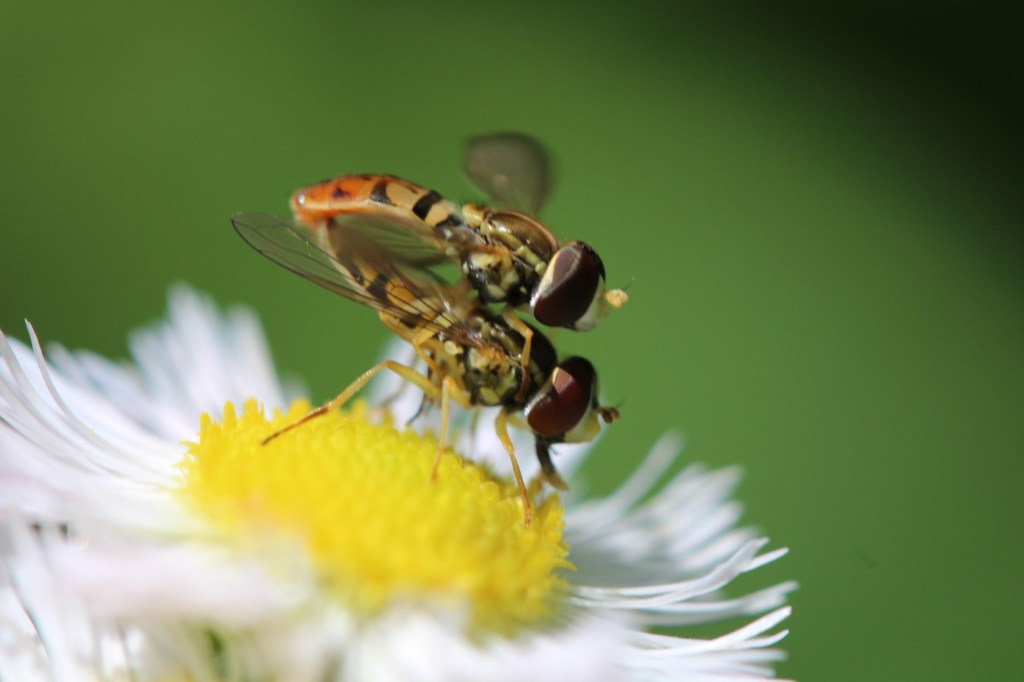
Flower Flies (Family Syrphidae) are wonderfully diverse and easily observed Insects, as they spend time hovering and landing on Flowers for the nectar they contain. In feeding on nectar, these Flies contribute greatly to Pollination, much like their similarly coloured models, the Bees and Wasps. I observed several other Flower Flies during my Port Burwell visit:
Common Flower Fly (Syrphus ribesii).Mating Pair of Margined Calligrapher Flower Flies (Toxomerus marginatus).
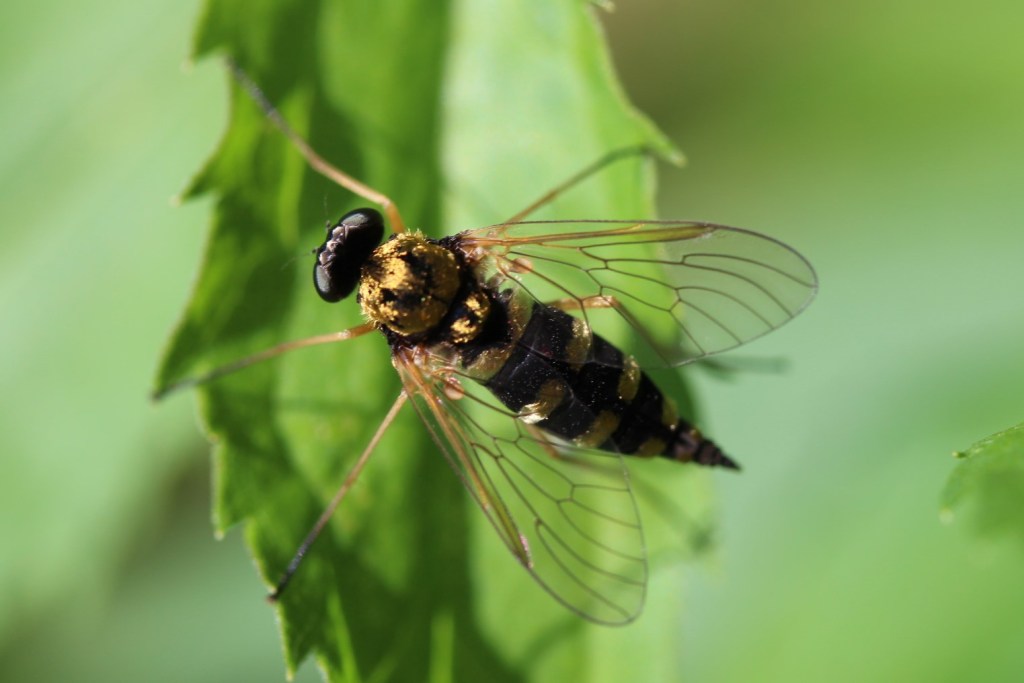
Most people don’t consider Flies beautiful, but that’s because they’re thinking of the House Fly variety, and not the colorful Flower Flies. Another beautiful fly I observed was this Ornate Snipe Fly:
Ornate Snipe Fly (Chrysopilus ornatus). Who says Flies aren’t beautiful?
The Snipe Flies (Rhagionidae) are predators as larvae in the soil where they hunt invertebrates, but as adults don’t seem to feed at all (Marshall, 2012).
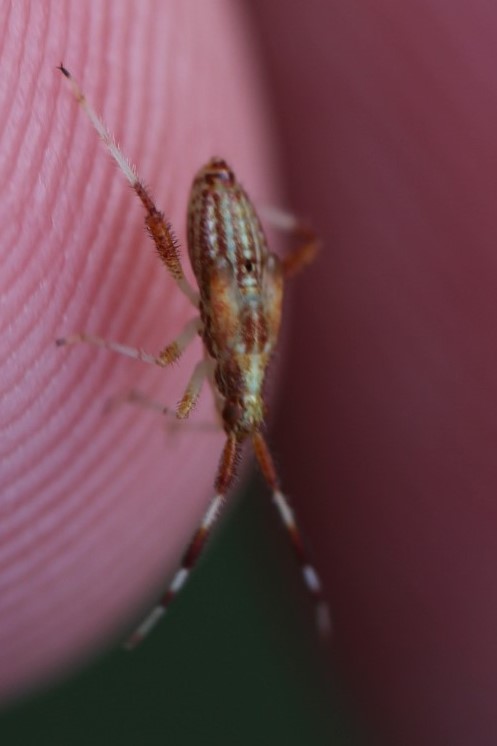
Like my Flower Fly Friend, another Insect was quite content to wander over my hands. I’m not sure the exact ID of this Bug (a True Bug, that is a member of the Order Hemiptera) but I’m pretty sure it’s a larval Plant Bug (Family Miridae).
Plant Bug nymph (Family Miridae) on my fingertips.
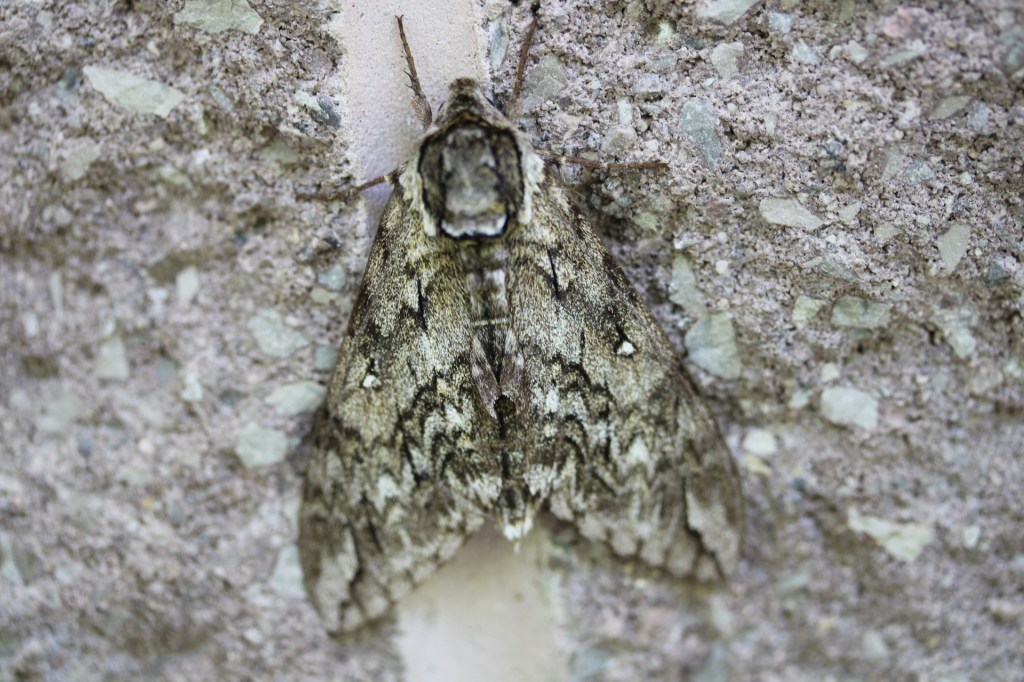
The little Plant Bug was probably the smallest Insect I took pictures of that weekend. The Largest is much easier to determine, and was clearly this Waved Sphinx (Ceratomia undulosa) which was on the outside wall of the restroom, blending in fairly well with the bricks.
Waved Sphinx Moth blending into a wall.
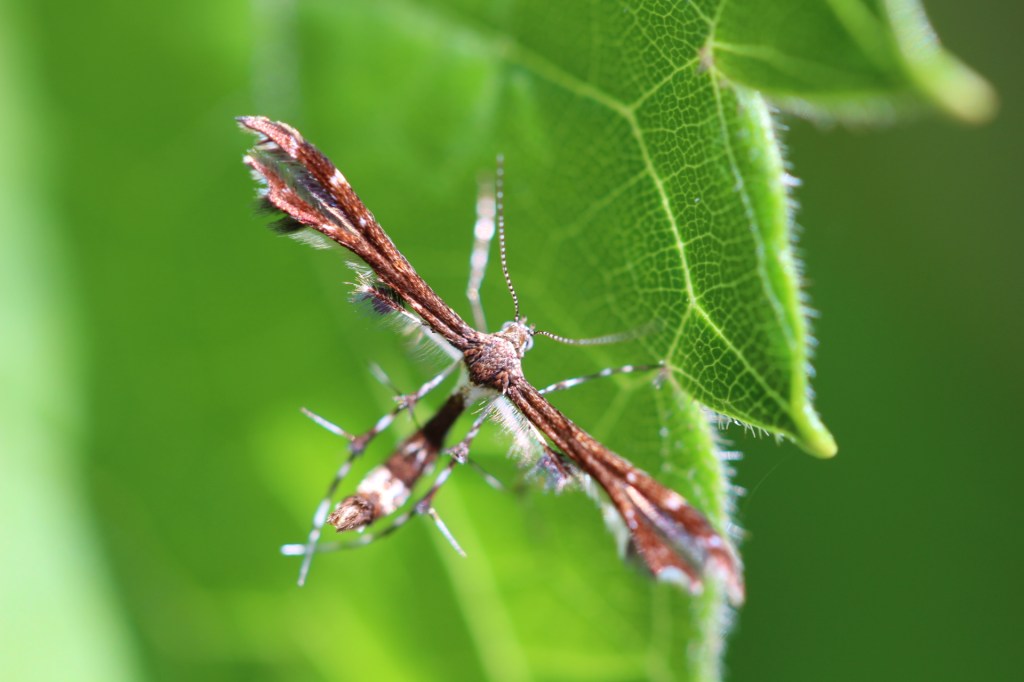
Another Moth I observed couldn’t be more different from the bulky and camouflaged Waved Sphinx. This bizarre Grape Plume Moth (Geina periscelidactylus) doesn’t even look like a Moth at all because of its oddly shaped wings.
Grape Plume Moth (Geina periscelidactylus).
The forewing is the brown and white portion with a large notch carved into it from the outside. The hindwing has been transformed into three “plume” structures which resemble black-and-white wire brushes.
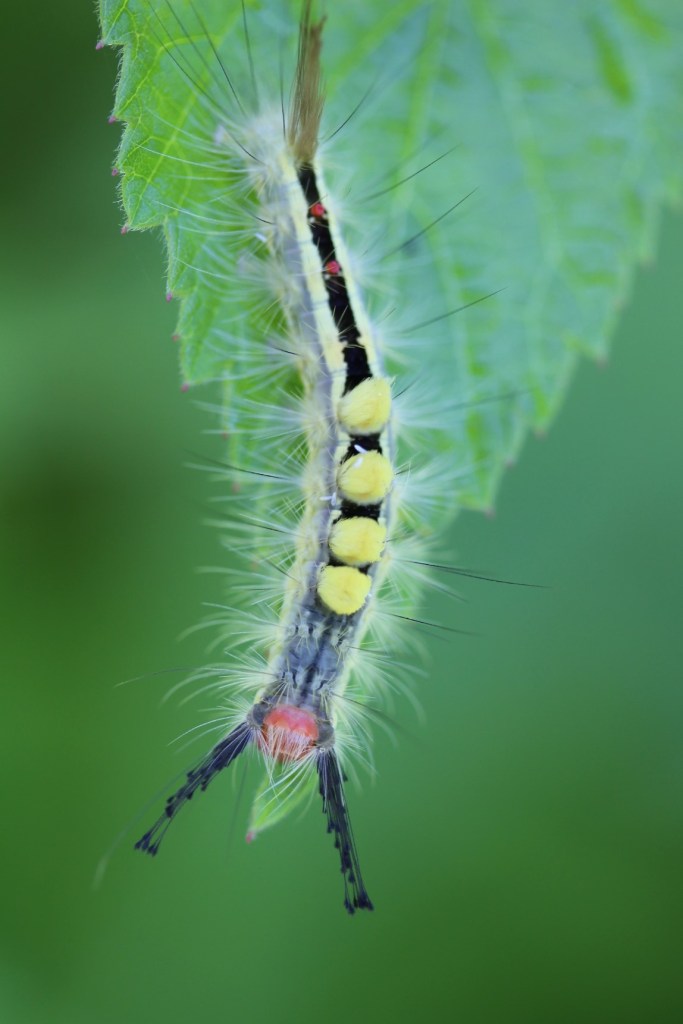
One other Moth drew my attention, but this one didn’t have any wings, because it was still in its Caterpillar stage: the Tussock Moth Orgyia leucostigma. These caterpillars have some of the most extraordinary decorations in our area. It’s possible the row of white tufts along their back resemble Parasitoid wasp cocoons in order to avoid subsequent parasitism, but I have no idea where to start explaining the bright orange head or black spiky tufts around its face.
Tussock Moth Caterpillar (Orgyia leucostigma).
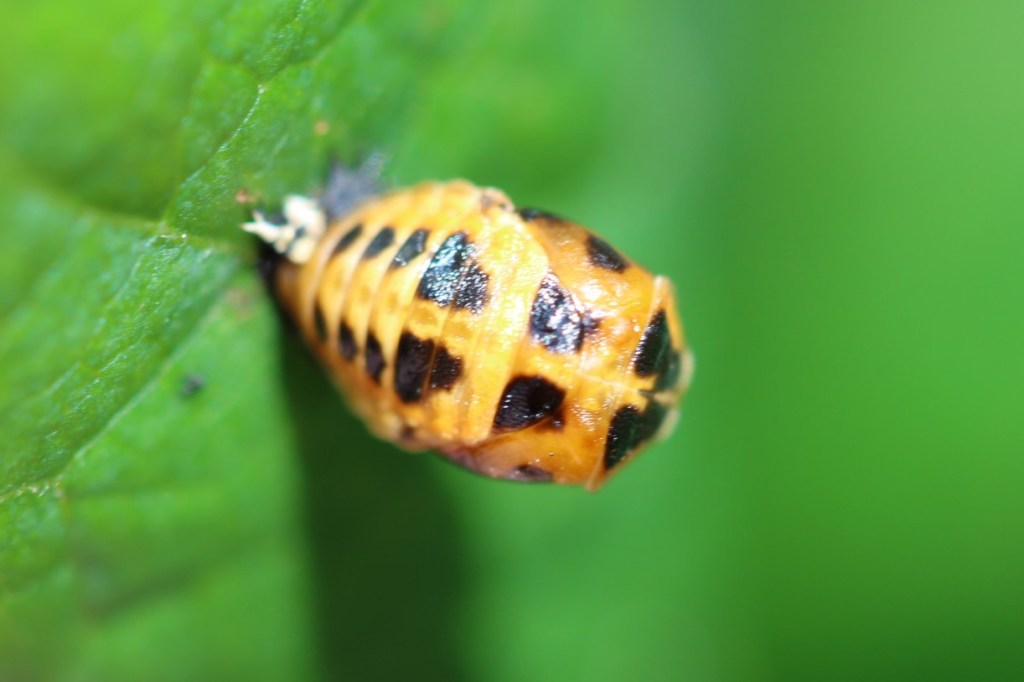
It’s well known that caterpillars turn into Moths and Butterflies, but many people are surprised to find that “baby” Ladybugs look quite different from the roly-poly adults. During the weekend, I spied the intermediate stage, the pupa, of a Ladybug stuck to the top of a leaf. Within, a Ladybug larva was being rearranged into the far more familiar form of its orange shielded adult beetle.
Asian Ladybird Pupa (Harmonia axyridis).
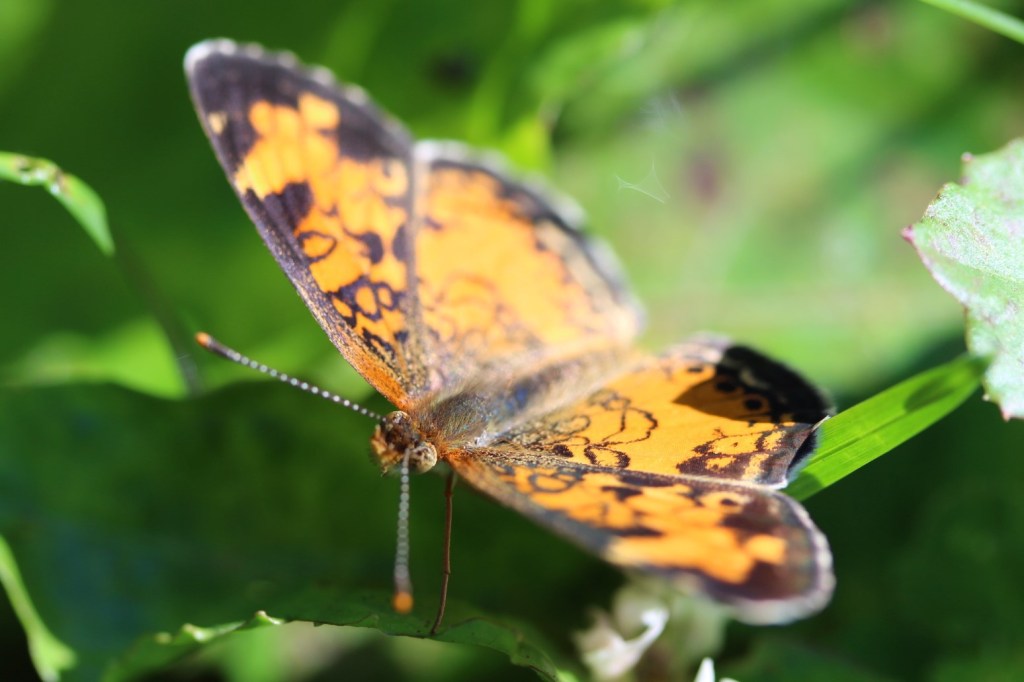
There were a number of smaller orange Butterflies flitting about our campsite which were difficult to photograph. This is the best picture I could manage of the upperside wings:
One of this same species (the Northern Crescent, Phycioides cocyta) was resting inside the Dining Tent, allowing me a good photo of the underside of its wings:
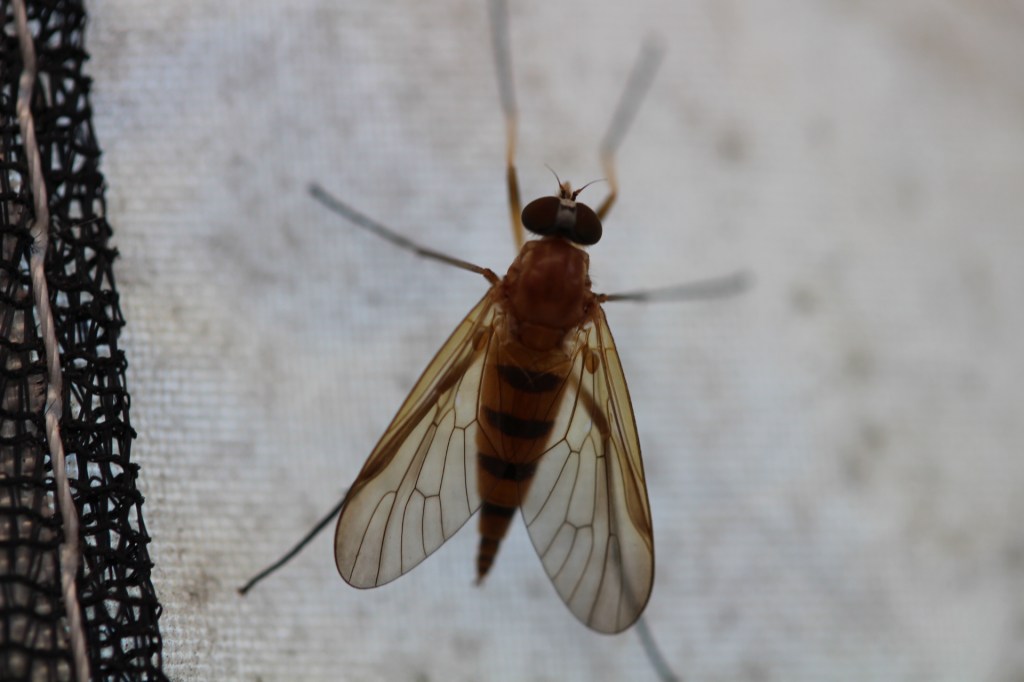
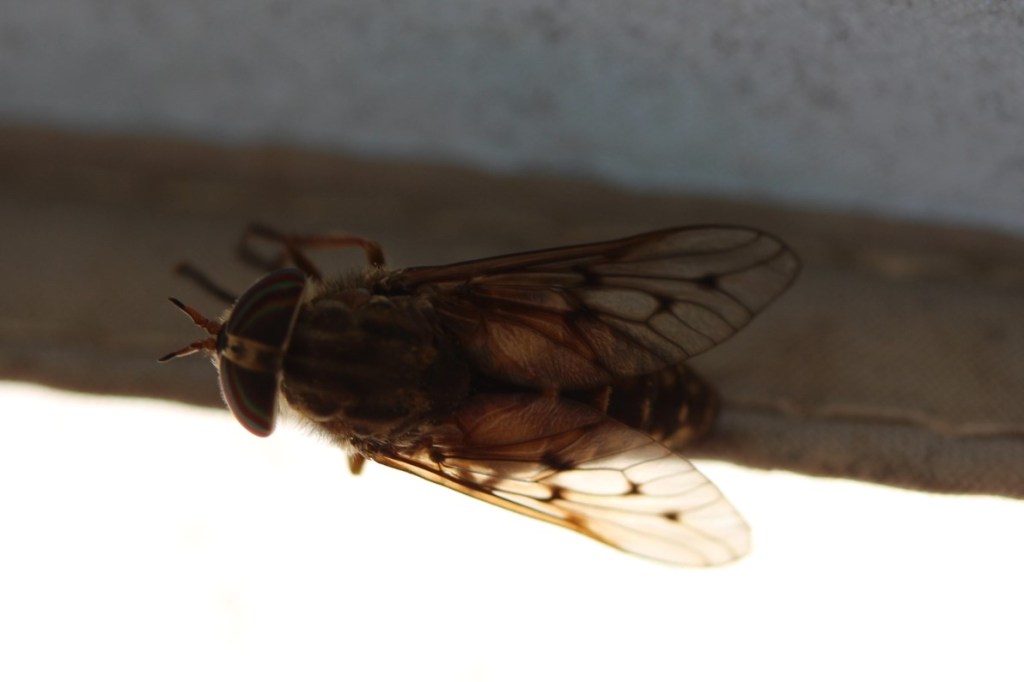
The interior of the Dining tent provided many other Insect observations that weekend. I observed this same phenomenon in my own backyard in May of this year. For whatever reason, many Insects enter the tent and then possibly get trapped inside because they have difficulty relocating the entrance (and are drawn to the light visible through the roof of the tent). In any case, it often presents myself with picture opportunities of insects I might not otherwise observe.
Most of the Dining Tent insects were Flies (and these are the ones I got good pictures of):
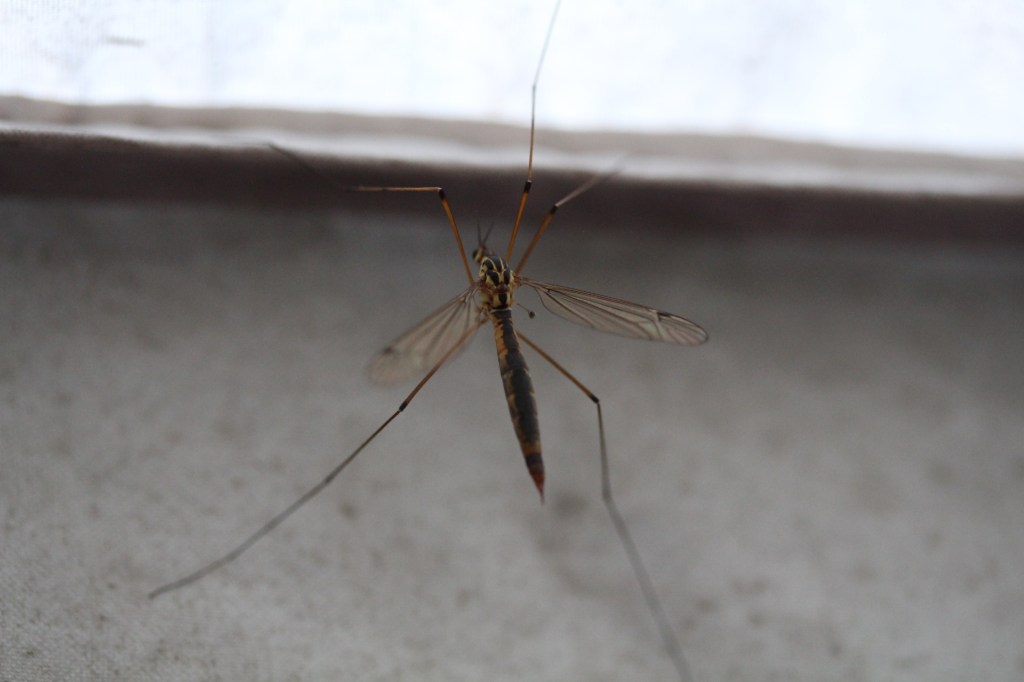
Rhagio Snipe Fly.Horse Fly, I believe of the genus Hybomitra.Crane Fly (Family Tipulidae).
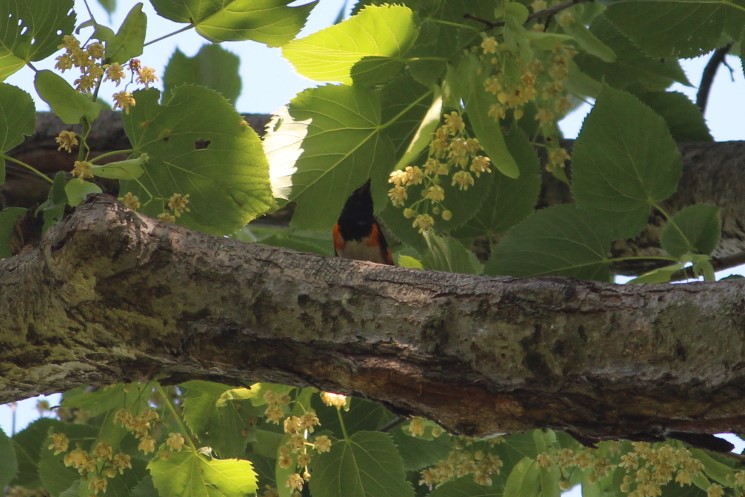
The majority of my observations were of Insects, and this reflects their abundance and diversity well, but I did have a chance to see a few Birds moving through the campsite. Most commonly spotted was a Catbird (Dumetella carolinensis) that seemed to have a particular liking for the berries that grew at the edge of the site. Flitting through the trees occasionally were American Redstarts (Setophaga ruticilla), fabulous black-orange-and white Warblers. Prior to this trip, I thought of the Redstart as a migrant, passing through Southern Ontario in the Spring and Fall. Since seeing it in Port Burwell in July, I have learned that the species breeds across most of Ontario during the summer (Cadman et. al. 1987).
American Redstart.
References:
Cadman, Michael D., Eagles, Paul F. J. and Helleiner, Frederick M., Atlas of the Breeding Birds of Ontario. 1987.
Marshall, Stephen. Flies: The Natural History and Diversity of Diptera. 2012.
For other posts about Nature Observations similar to these, see:
Probably the most commonly observed insect group in my backyard (at least observed with my camera) is the Order Hymenoptera (the Bees, Wasps, Ants, and Sawflies). Partly this is because they are one of my favourite groups, and partly it’s because they make good subjects for photography, what with the bees and wasps having a tendency to land and sit still (momentarily) on colourful flowers. These are some of the pollinator visits I’ve captured this month:
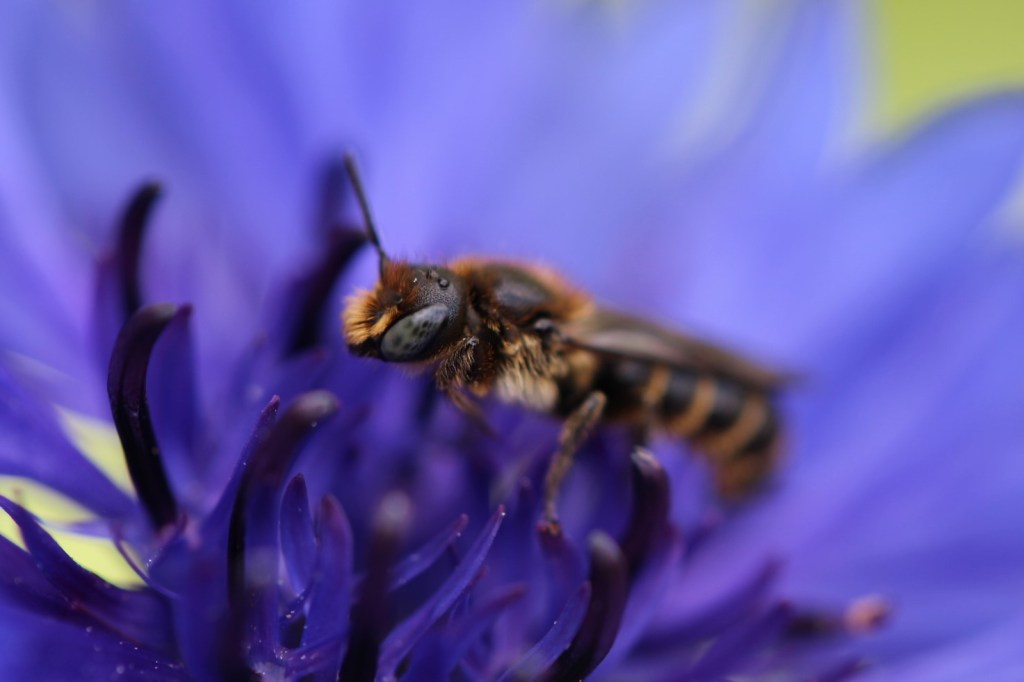
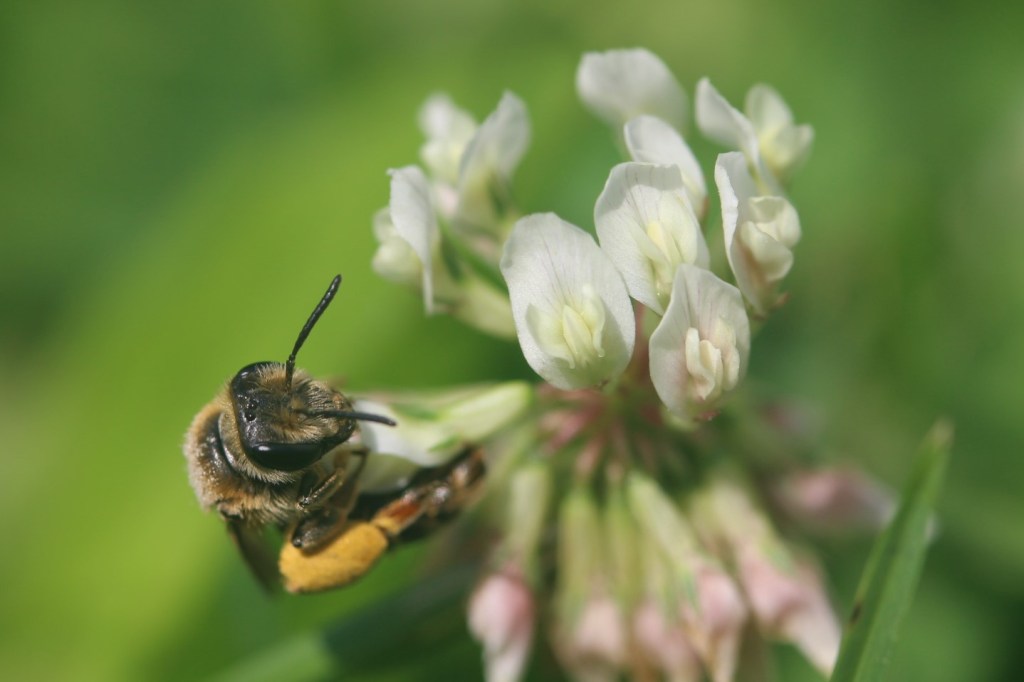
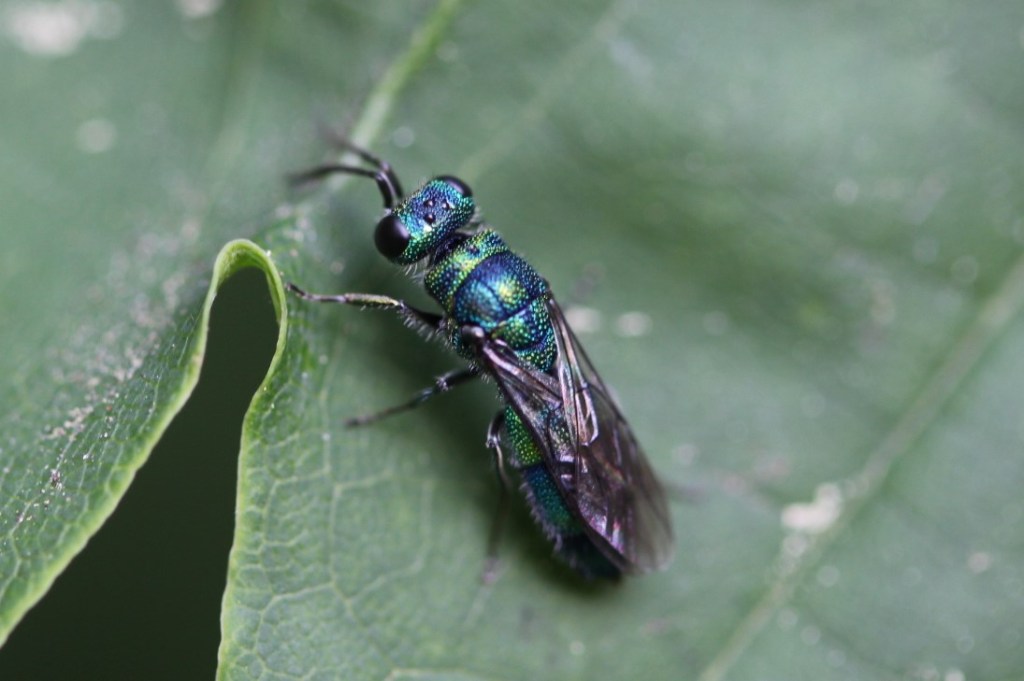
Unidentified Bee visiting my garden flowers.Bee in the Genus Andrena.I’m not sure what kind of Bee this is, but it’s coated in Pollen!This is a Chrysis cuckoo wasp, which gets its young into other Hymenopterans’ nests, much like the Cuckoo Bird does in other bird nests.
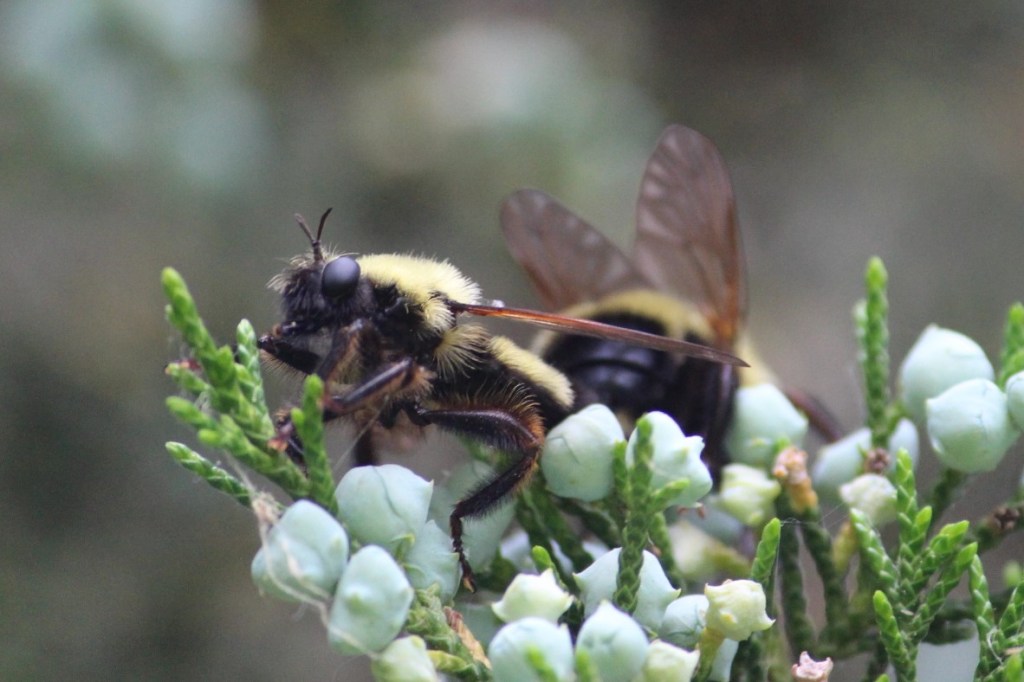
This next backyard visitor looks like another Hymenopteran, but is actually a convincing Bumblebee Mimic, a Robber Fly Laphria thoracica pretending to be a Bumblebee. This mating pair zipped through the garden up into a tree, so I had to use the telephoto lens rather than attempting a macro shot.
Mating Pair of Bumblebee Mimic Robber Flies.
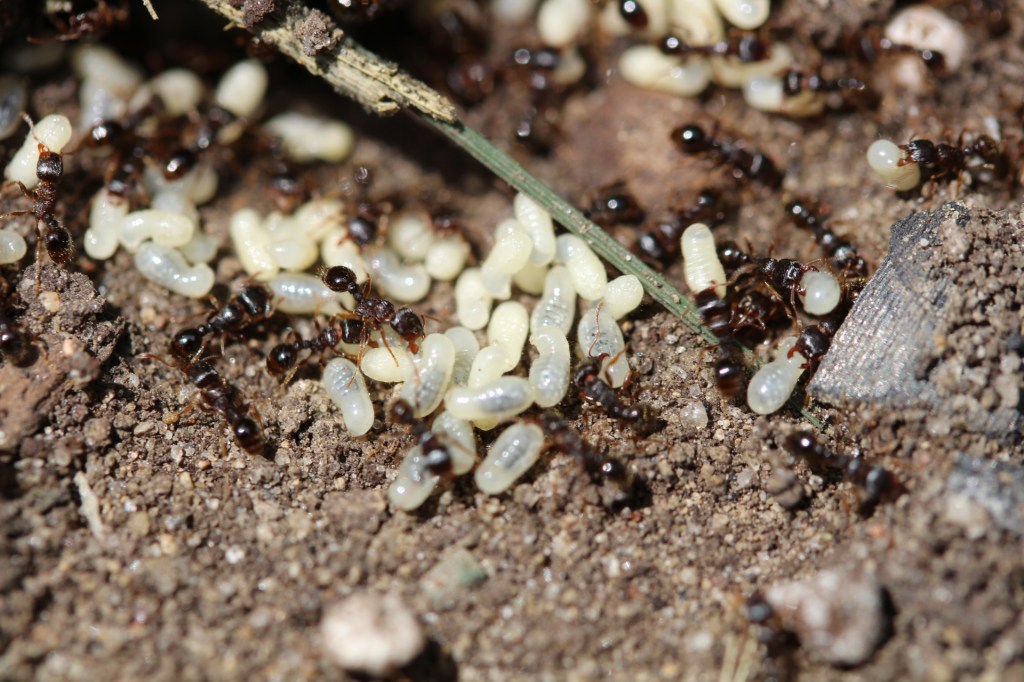
Not all Hymenoptera were zipping through the garden from flower to flower. Some were setting up their homes there. One such home was the thriving Pavement Ant (Tetramorium immigrans) colony under a large rock in the middle of our flowerbed. Whenever the rock is lifted, the exposed larvae are whisked away by frantic workers. The flurry of activity is like a living explosion of insects when the colony is uncovered.
Pavement Ant colony in my backyard garden, larvae and workers exposed under a rock.
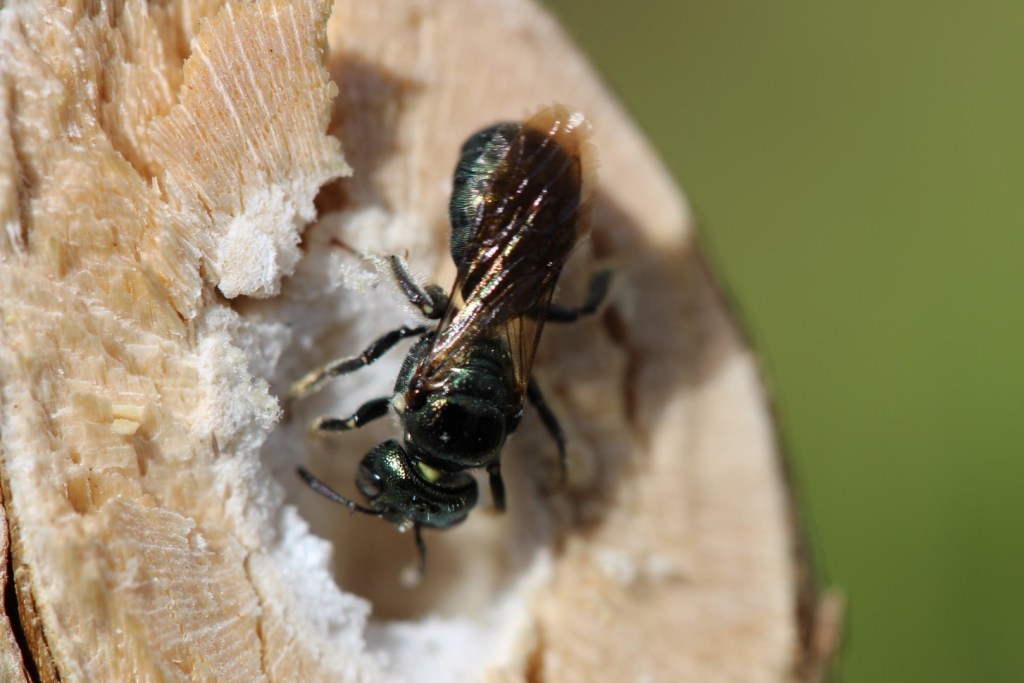
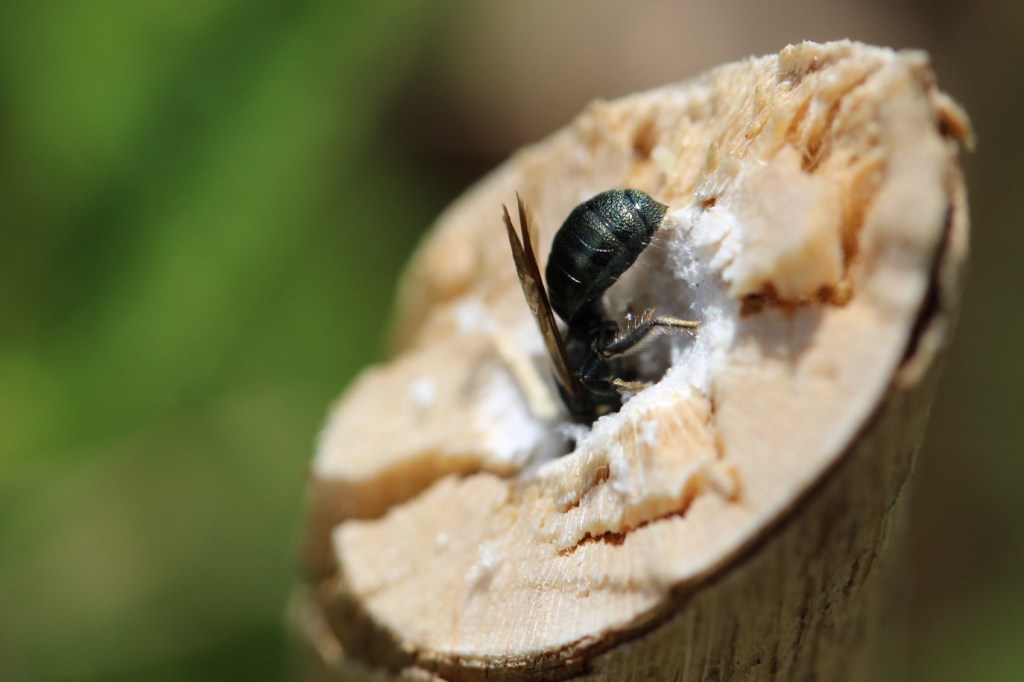
The other fascinating Hymenopteran homebuilding was the infiltration of leftover dried stems by Small Carpenter Bees (Ceratina). I watched one digging into the middle of the stems and was able to get some decent pictures of the process. Unlike the Ants, these Bees don’t work together in a colony, each female constructs her own nest and provisions it with pollen. Despite this lack of cooperation, there is parental care within the Genus. Ceratina females guard their developing young by waiting at the nest entrance and will even open up sealed nest chambers to check on them (Wilson and Carril, 2016). Looks like I’m going to have to take a second look at those stems…
Small Carpenter Bee excavating her nest in a dried and broken twig in my garden.
References:
Wilson, Joseph S. and Carril, Olivia. The Bees In Your Backyard. 2016.







 Norfolk Naturalist