Categories
August 2021 Observations July 2021 Observations Nature Observations

Algonquin Observations, Part 1 – Pog Lake Campground

I love Algonquin Provincial Park. There is a special place in my heart for the vistas of trees, lakes and rock that extend to the horizon. Whenever I stay in the park, I encounter new creatures and make new observations, or if I encounter familiar organisms, I often appreciate them in a new light.

The first observation of my most recent trip (over the July/August Long Weekend) was a familiar bird creating a familiar knocking sound as it chipped away at the outer bark of a pine tree. The bird was a Hairy Woodpecker (Dryobates villosus), and its hammering into the edge of a tree is common in Norfolk County as well as Algonquin Park.
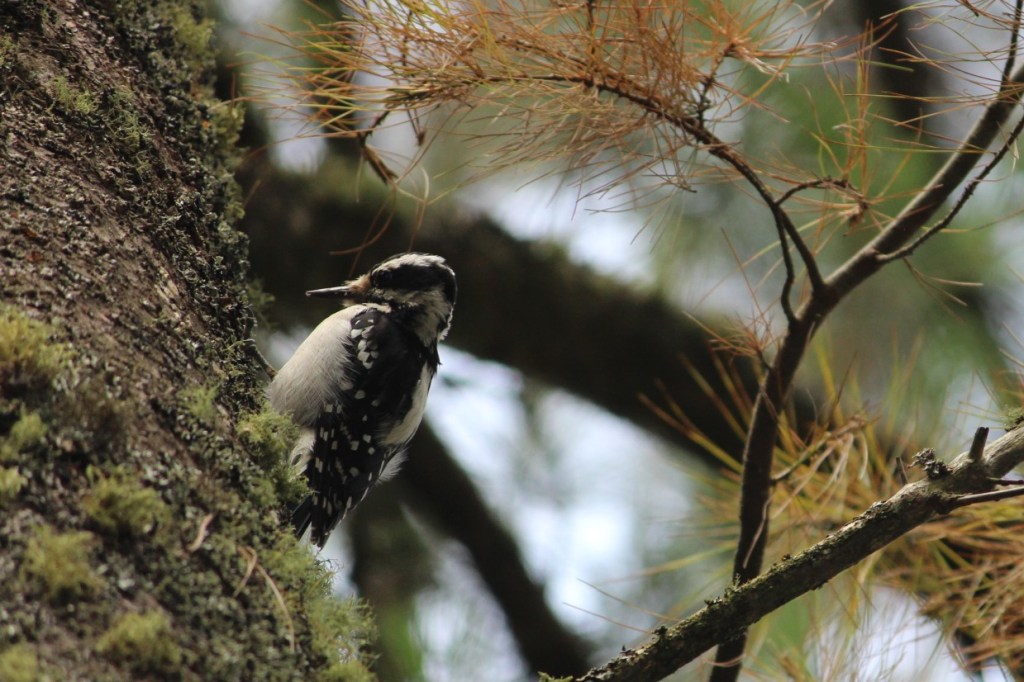
Hairy Woodpecker foraging on a Pine tree.

The other species of Woodpecker I encountered on this trip was not so familiar, and certainly not a species I could encounter in the more southern parts of Ontario. The Black-backed Woodpecker (Picoides arcticus) has a range across the Boreal Forests of North America, and Algonquin Provincial Park is at the southern edge of its range. They are a species tied to the disturbance of fire, as they mainly feed on insects (such as bark beetles and wood-boring beetles) which increase in population in fire-killed stands of trees (Backhouse, 2005). I observed the female and male of this species (likely a mated pair) foraging on the trees surrounding our campsite, and I also observed the male digging into what must have been a stump (the stump was obscured by vegetation, but I could see the yellow spot on the male’s head as he knocked away from ground level). As just mentioned, the male and female can be distinguished based on the presence or absence of a yellow patch on the head (the male has the yellow patch, the female does not). Not only did I see this species foraging but within the campground at Pog Lake there was actually a nest! Like most Woodpeckers (maybe all, but I’ve learned not to make rash generalizations), the Black-backed Woodpecker creates a new nest each year, carving a hole into a tree to house its young. I could hear the young inside the nest cavity, producing almost continuous begging calls for food. I saw the male drop by to drop off food he had collected, and I also got some pictures of the male on nest-guarding duty, sticking his head out of the nest entrance which was not too much higher than eye level. 

Black-backed Woodpecker Male, guarding his nest.

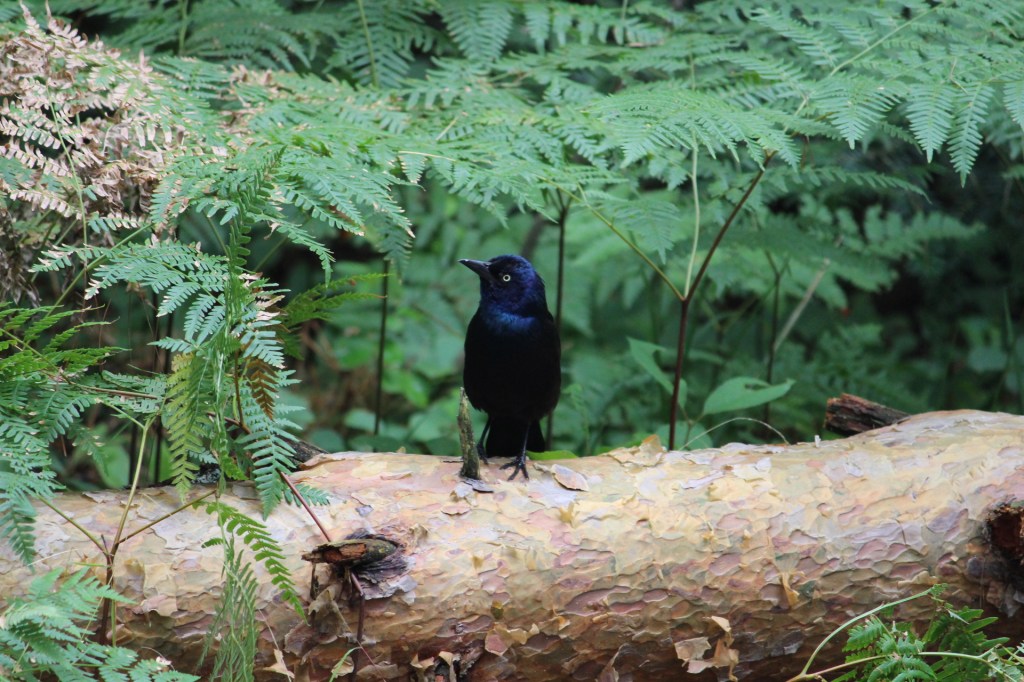
The Hairy Woodpecker I first spotted was not the only familiar bird encountered within Algonquin Park. Robins (Turdus migratorius) are a common sight throughout the campground, and the screams of Blue Jays (Cyanocitta cristata) frequently break the solemnity of the sky-stretching Pines. Another vocal bird which is quite common in suburban backyards is the Common Grackle (Quiscalus quiscula). Grackles patrolled through the campground, searching for any scraps of food left out by unwary campers. They may not be everyone’s favourite bird sighting, but I think their metallic blue heads are quite beautiful, and their overall appearance and movements are striking. 
Two birds very much associated with Algonquin Park in my mind (even though I’ve also seen both on the Lynn Valley Trail in Norfolk County) are common ascenders and descenders of trees. The Brown Creeper (Certhia americana) often swirls around a tree trunk as it descends and then begins to work its way up in leaps and bounds, plucking insects and spiders from their secluded hiding places. I wonder if the rapid spiralling descent is some sort of signal to other members of its species (I’ve seen Brown Creepers foraging in pairs, or more than two) or if it’s a way to locate potential prey for their way up.
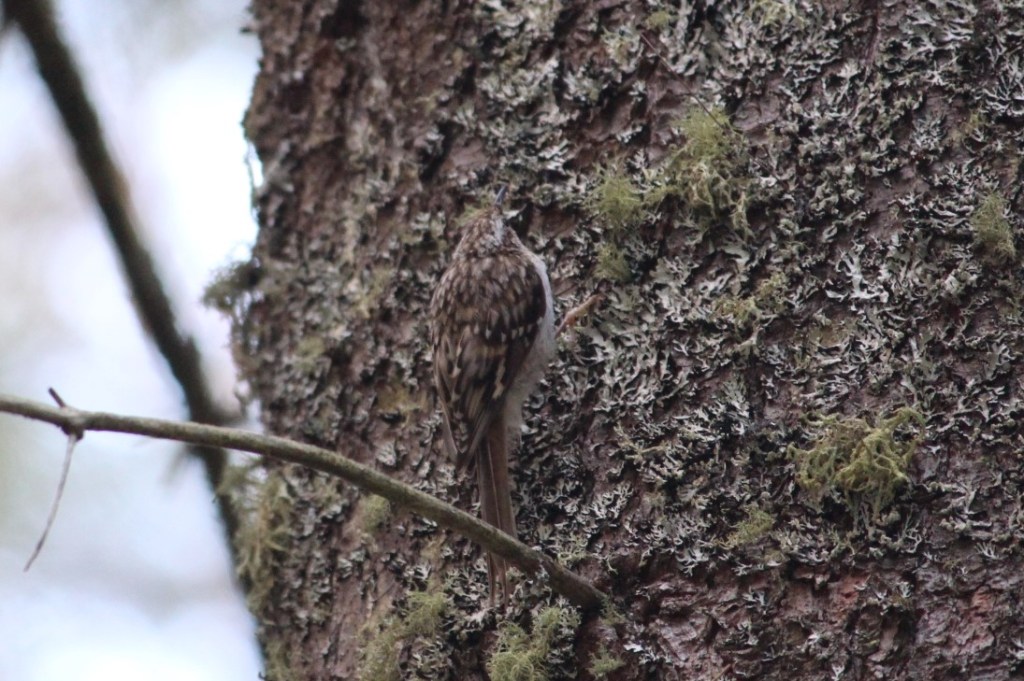
Brown Creeper… creeping (more like leaping)… up a tree.

The Red-breasted Nuthatch (Sitta canadensis) doesn’t move up and down a tree in the same stereotyped way as the Brown Creeper, and it certainly stands out more from the bark with its attractive white-and-black face, blue back and red breast feathers. Nuthatches are renowned for their ability to walk head-first down a tree rather than up like most other bark-foraging birds (including Woodpeckers, Chickadees and Brown Creepers). 
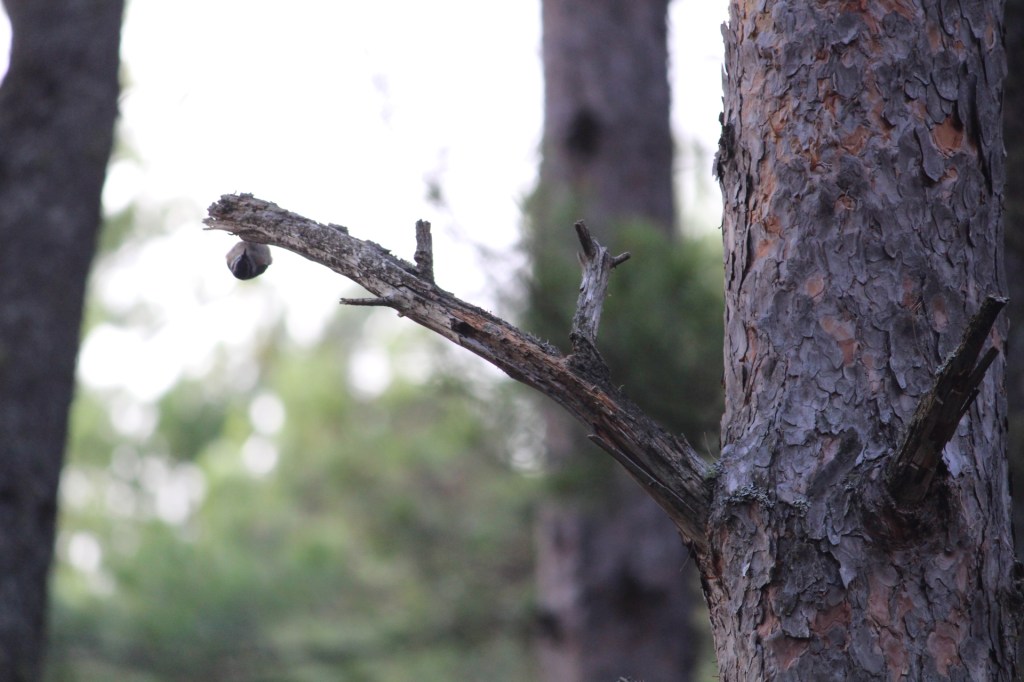
Red-breasted Nuthatch demonstrating its maneuverability at the end of a broken branch.

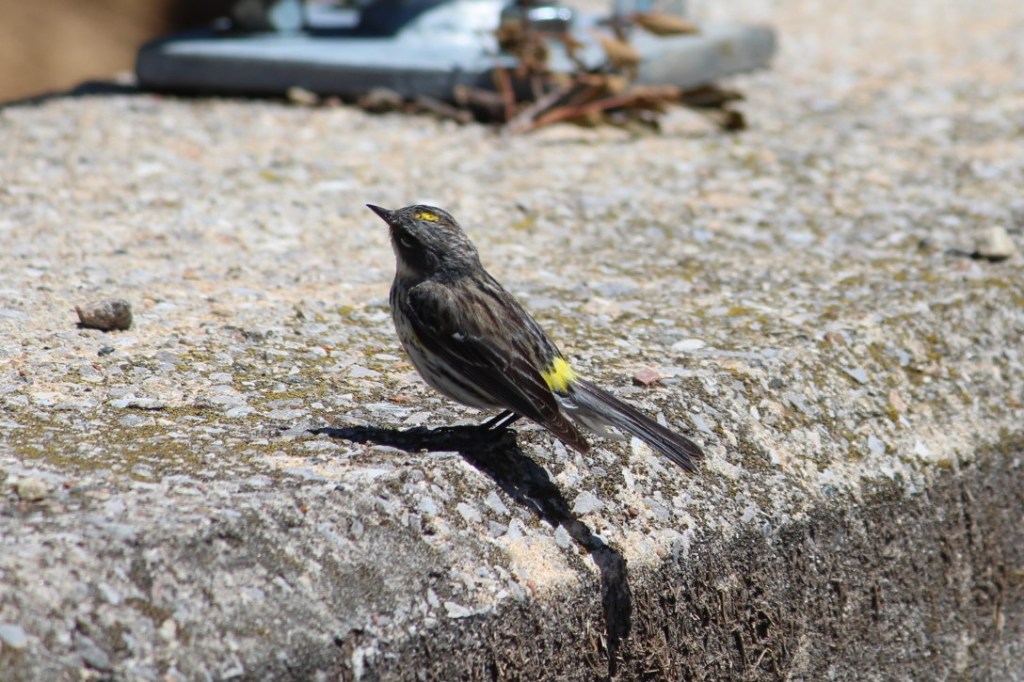
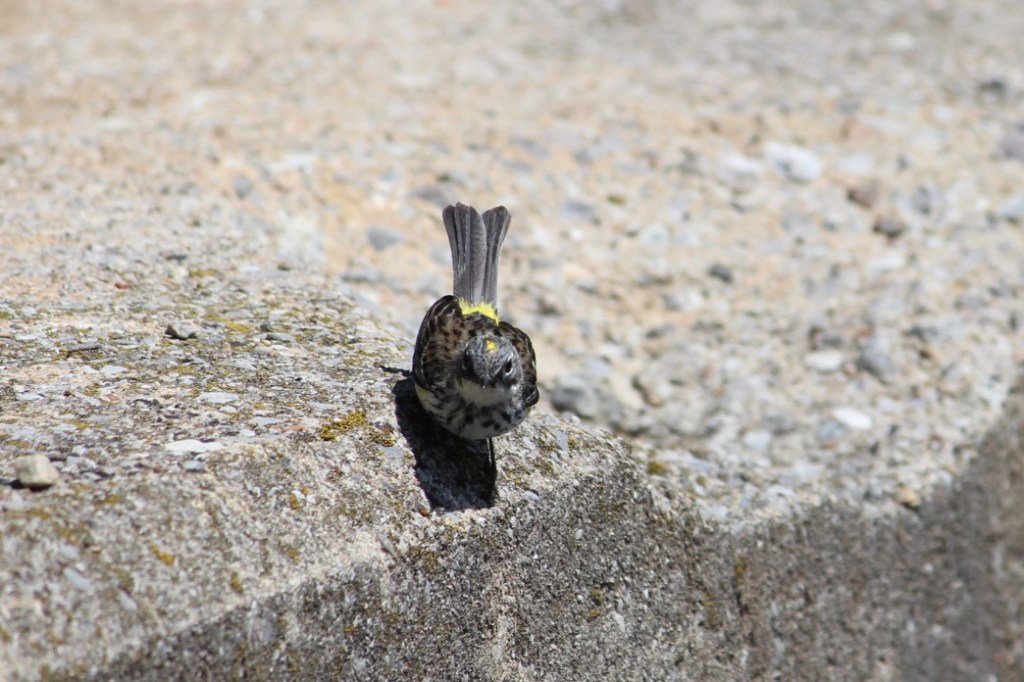
Possibly the most beautiful bird observation in the Pog Lake campground was this Yellow-rumped Warbler (Setophaga coronata). These birds are often migratory through more Southern Ontario, arriving in the coniferous forests of Algonquin in mid-to-late April to breed (Tozer, 2012). According to the Atlas of the Breeding Birds of Ontario (Cadman et. al. 1987), they will breed in coniferous or mixed forests across Ontario (though they are more abundant in the more Boreal regions).

Usually Insects are my focus, and part of the reason for that is their abundance, diversity, and accessibility. Because of the rainy and cool weather for most of my visit, there were not as many Arthropods out and about (at least not as noticeable). A few notables made themselves known however. One striking spider was resting on the side of my car.

Spider, on the side door of my car. Not sure of the species, but I believe it’s an Orbweaver (Family Araneidae).

A Northern Pearly-eye Butterfly (Lethe anthedon) was resting on someone else’s car and I had to snap a picture.

Northern Pearly-eye Butterfly spotted on someone else’s car (the car was parked, obviously).

A very impressive Insect sighting in the Pog Lake Campground came on our last day in Algonquin. I found a massive Northeastern Pine Sawyer Beetle (Monochamus notatus). The Sawyer was very cooperatively still on the cool damp morning, allowing me to get some really great closeups. It was also silent, despite being moved to a more convenient location for photos. That may seem like a strange observation to make, but apparently Longhorn Beetles (Family Cerambycidae, of which Monochamus notatus is a part) make a “squeak”, not with their mouth but with parts of their thorax rubbing together (Marshall, 2006).
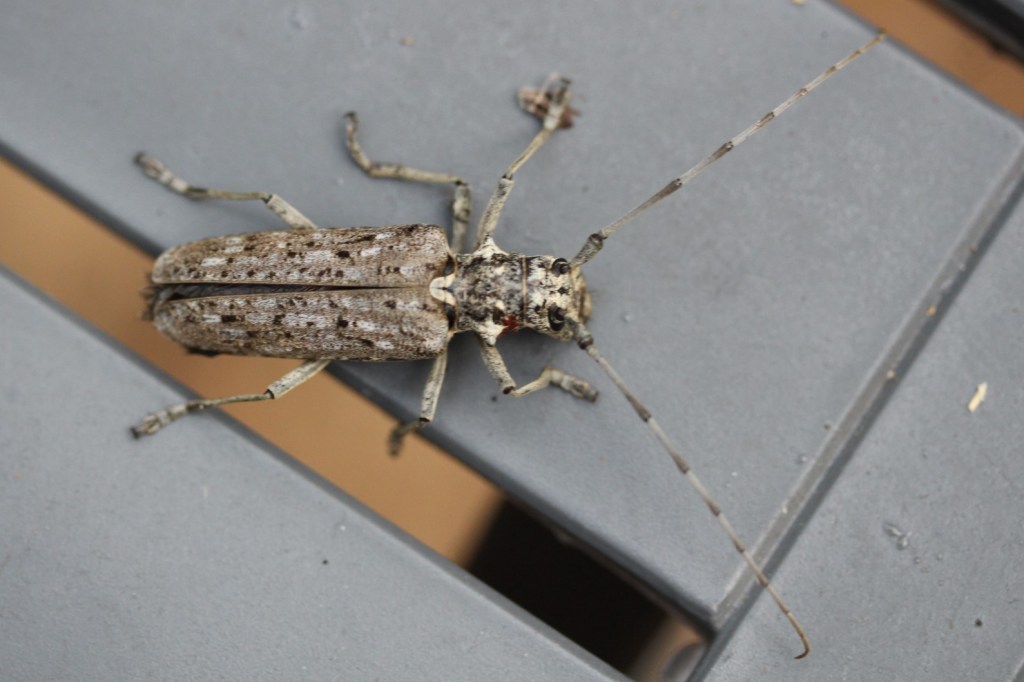
Northeastern Pine Sawyer Beetle. I hope you can see why members of this Beetle Family (Cerambycidae) are called Longhorn Beetles.

A few points of interest for this particular Sawyer Beetle. As the image above demonstrates, its antennae were almost as long as the rest of the body which marks it as a female. The males are the ones with the really long antennae, often twice the length of the rest of the body. Here’s a male of the same species to show you what I mean. (photo from wikipedia):
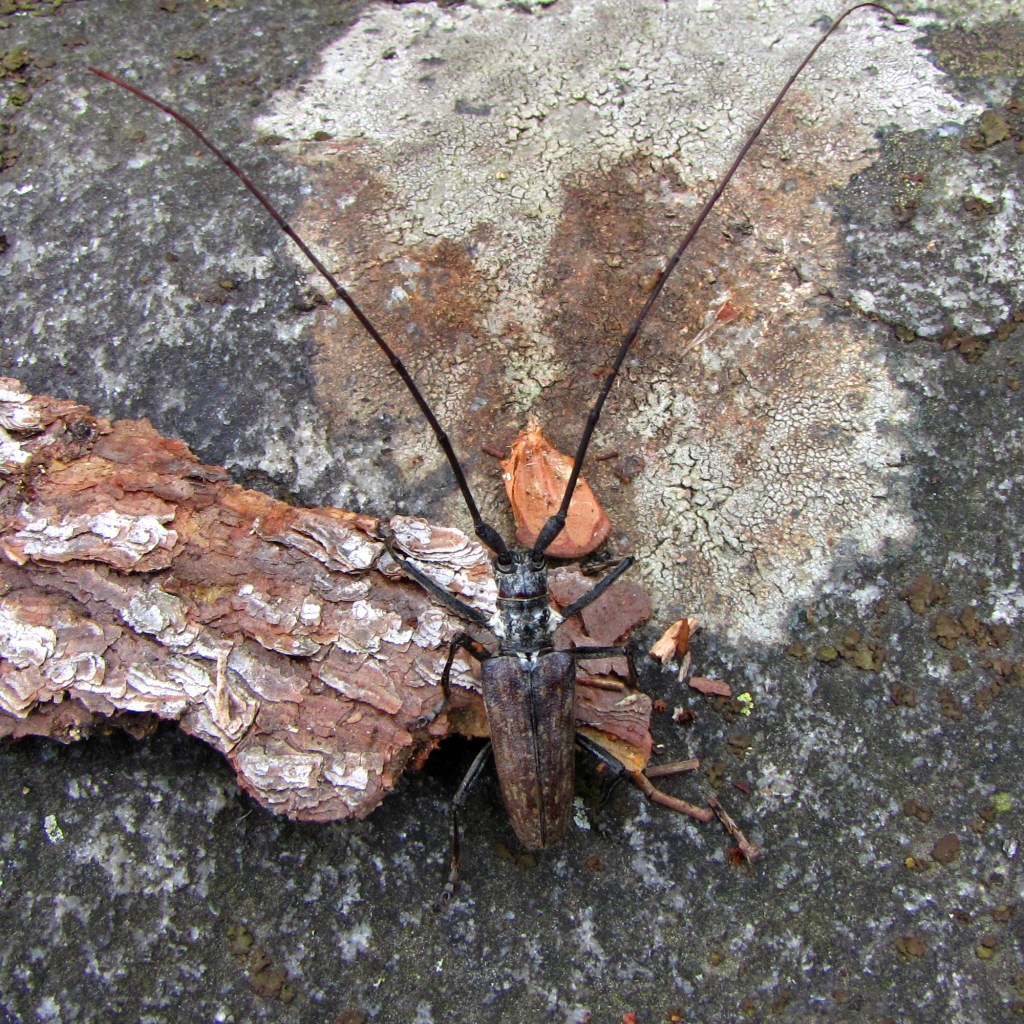
Male Monochamus notatus By D. Gordon E. Robertson – Own work, CC BY-SA 3.0, https://commons.wikimedia.org/w/index.php?curid=11369161

It may be hard to see in my photo above, but these Beetles (including the female I observed) often have invertebrate hitchhikers. From a different angle it’s a bit clearer that my Beetle had a cluster of red Mites on her thorax.

Closeup of the M. notatus I found in Algonquin Park.

These Mites are presumably hitching a ride to dead/dying trees which the Beetle will be seeking (Monochamus beetle larvae feed inside of dead/dying trees). I’m not sure what the Mites will do once there, as Mites are incredibly diverse and have numerous ecologies and life histories and I don’t know what kind of Mites these are. The other interesting thing to note in my closeup picture above is the eye of the Beetle. Notice how it curves around in a crescent shape around the base of the antennae. Just thought that was sort of a strange arrangement for eyes/antennae. One more closeup shot of this Beetle because it was so cooperative:

Closeup portrait of M. notatus.

As I mentioned above, Insects are often what I notice and focus on. During our trip, I couldn’t help but take note of the wonderful beauty and diversity of some of the plant life in Algonquin Park as well. I suffer from “plant blindness” and I have been trying to rid myself of the condition as much as possible (see my book review of Flora of MiddleEarth for more on this subject). So I will end this post with a plant observation (and there will be more to come as I continue to write up my Algonquin observations). Throughout the Pog Lake Campground, there were some beautiful bright red berries amid ground-level green leaves. I found out that these plants are Bunchberry (Cornus canadensis).

Bunchberry Berries (and leaves).

Bunchberry has white flowers which spread pollen via the wind and insects in order to reach other flowers and reproduce (ie. form fertile berries). Amazingly, Bunchberry flowers are equipped with a mechanism to launch their pollen on an insect that triggers them, unfolding their petals at incredible speed to fling pollen onto the insect and up into the air (for possible wind-dispersal of pollen). This truly impressive feat is accomplished in 0.5 milliseconds. To put this into perspective, the Mantis Shrimp has the fastest movement of all Animals, and its record-holding strike lasts 2.7 milliseconds… five times as long as the Bunchberry flower petals take to open (Runtz, 2020). If that doesn’t make you want to pay more attention to plants, I don’t know what will.

Stay tuned… more to come from my trip to Algonquin, including more Birds, more Plants, and more Insects!

References:

Backhouse, Frances. Woodpeckers of North America. 2005.

Cadman, Michael D., Eagles, Paul F. J. and Helleiner, Frederick M., Atlas of the Breeding Birds of Ontario. 1987.

Marshall, Stephen. Insects: Their Natural History and Diversity. 2006.

Runtz, Michael. Wildflowers of Algonquin Provincial Park. 2020.

Tozer, Ron. Birds of Algonquin Park. 2012.

For Other Nature Observations in Algonquin Park, see:

-Algonquin Observations (July 2018), Day One, Two, Three, Four, Five, Six

And if you’re interested in seeing more of my photos and learning some facts about the organisms I’ve observed, follow me on Instagram at norfolknaturalist.
Categories
July 2021 Observations Nature Observations

Port Burwell Observations

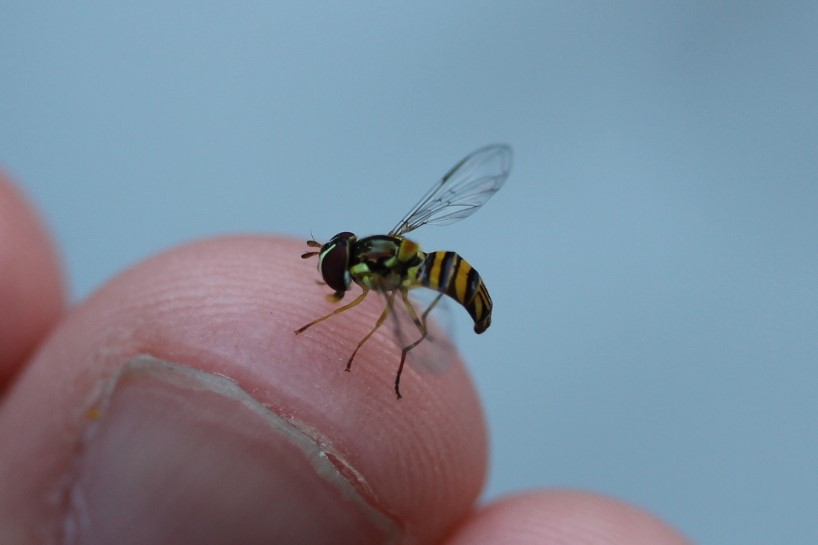
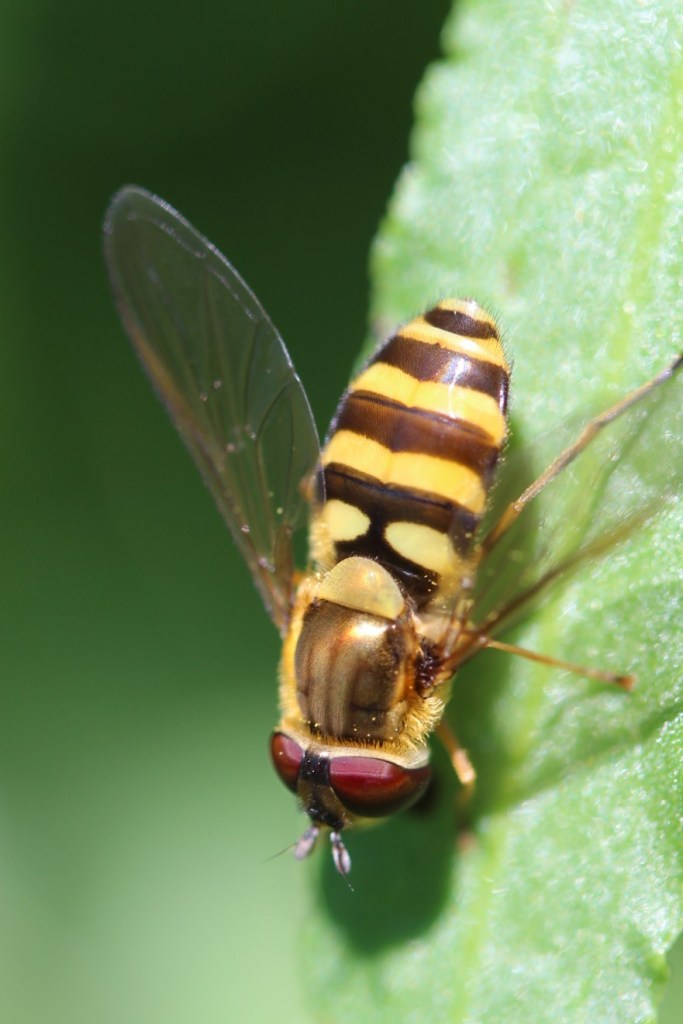
I recently spent a weekend camping at Port Burwell Provincial Park and took several photos of interesting creatures I encountered there (as I usually do on camping trips). One of the first creatures I encountered was a beautiful Flower Fly which hovered right in front of my face for a few minutes and even landed on my glasses, as well as several times on my hands. My Flower Fly Friend was an Oblique Streaktail (Allograpta obliqua).

Oblique Streaktail Flower Fly which landed repeatedly on my fingers and even on my glasses.

Flower Flies (Family Syrphidae) are wonderfully diverse and easily observed Insects, as they spend time hovering and landing on Flowers for the nectar they contain. In feeding on nectar, these Flies contribute greatly to Pollination, much like their similarly coloured models, the Bees and Wasps. I observed several other Flower Flies during my Port Burwell visit:

Common Flower Fly (Syrphus ribesii).
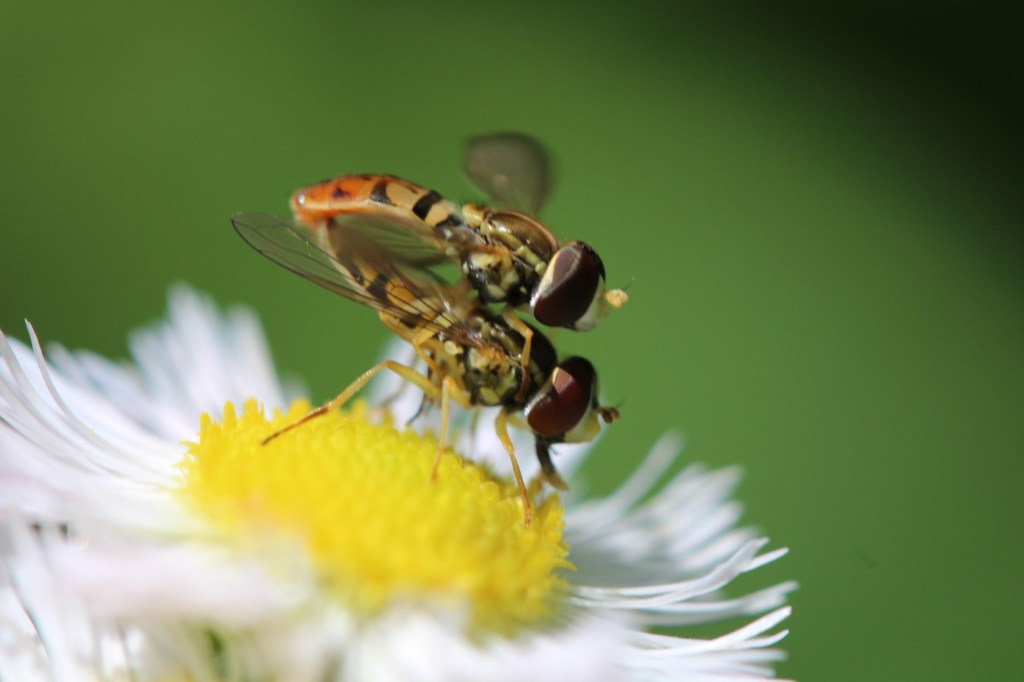
Mating Pair of Margined Calligrapher Flower Flies (Toxomerus marginatus).

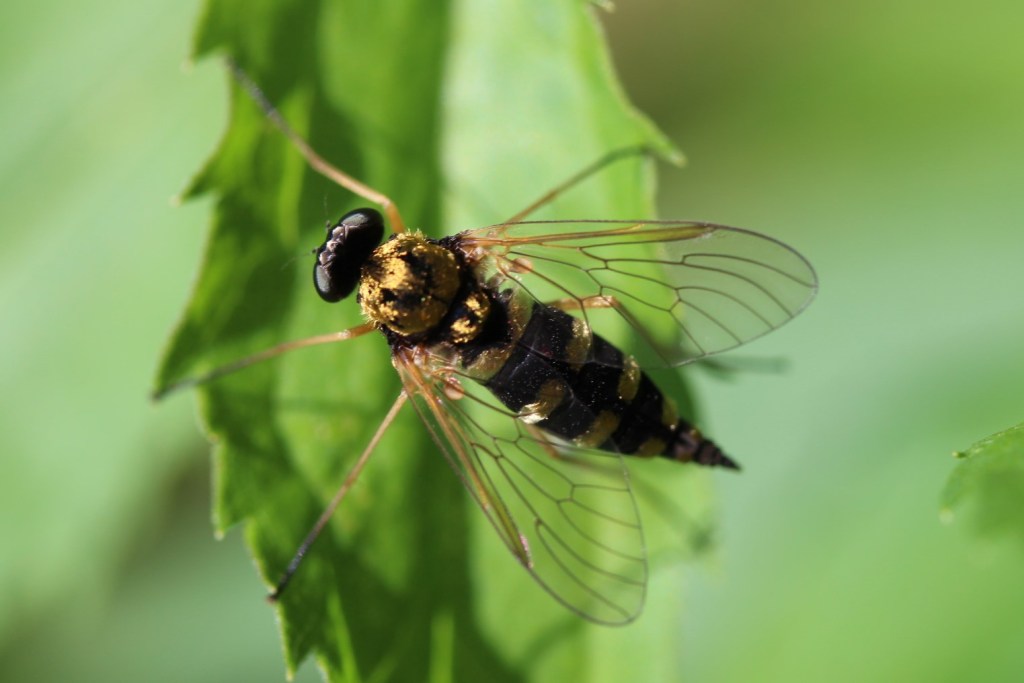
Most people don’t consider Flies beautiful, but that’s because they’re thinking of the House Fly variety, and not the colorful Flower Flies. Another beautiful fly I observed was this Ornate Snipe Fly:

Ornate Snipe Fly (Chrysopilus ornatus). Who says Flies aren’t beautiful?

The Snipe Flies (Rhagionidae) are predators as larvae in the soil where they hunt invertebrates, but as adults don’t seem to feed at all (Marshall, 2012).

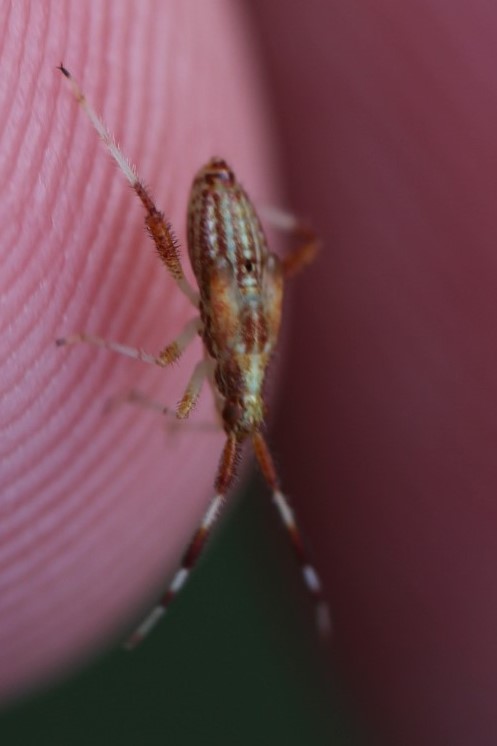
Like my Flower Fly Friend, another Insect was quite content to wander over my hands. I’m not sure the exact ID of this Bug (a True Bug, that is a member of the Order Hemiptera) but I’m pretty sure it’s a larval Plant Bug (Family Miridae).

Plant Bug nymph (Family Miridae) on my fingertips.

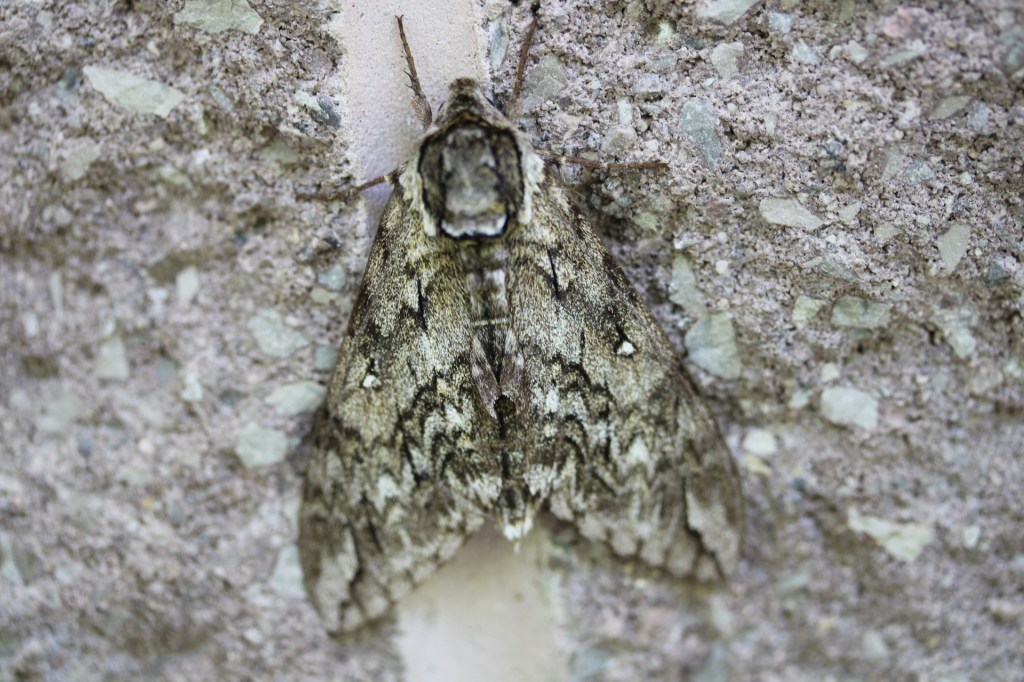
The little Plant Bug was probably the smallest Insect I took pictures of that weekend. The Largest is much easier to determine, and was clearly this Waved Sphinx (Ceratomia undulosa) which was on the outside wall of the restroom, blending in fairly well with the bricks.

Waved Sphinx Moth blending into a wall.

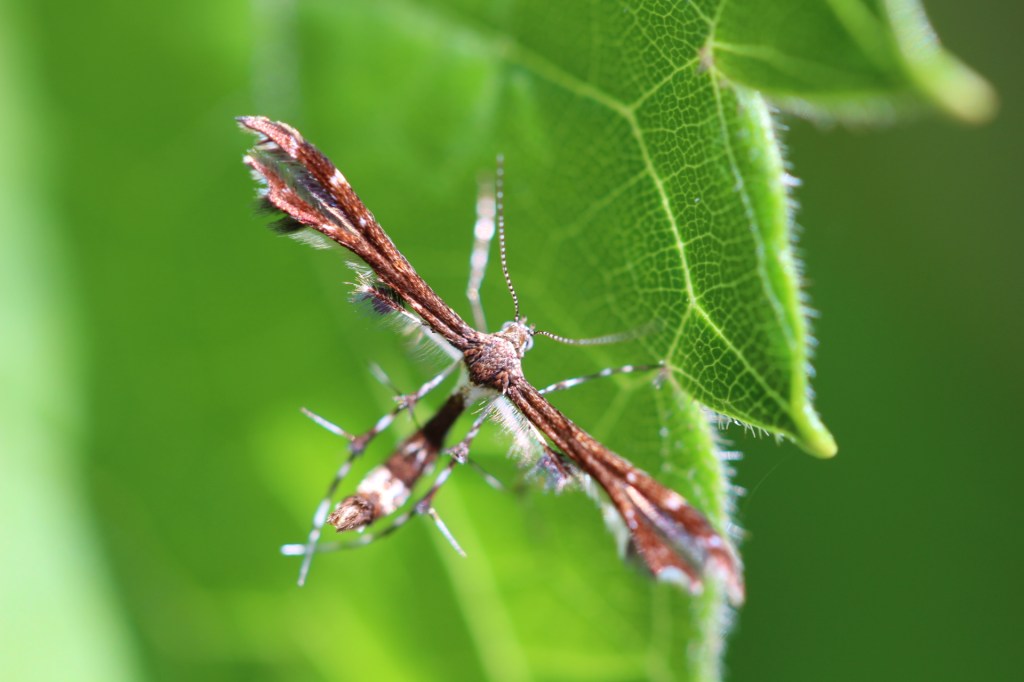
Another Moth I observed couldn’t be more different from the bulky and camouflaged Waved Sphinx. This bizarre Grape Plume Moth (Geina periscelidactylus) doesn’t even look like a Moth at all because of its oddly shaped wings. 

Grape Plume Moth (Geina periscelidactylus).

The forewing is the brown and white portion with a large notch carved into it from the outside. The hindwing has been transformed into three “plume” structures which resemble black-and-white wire brushes.

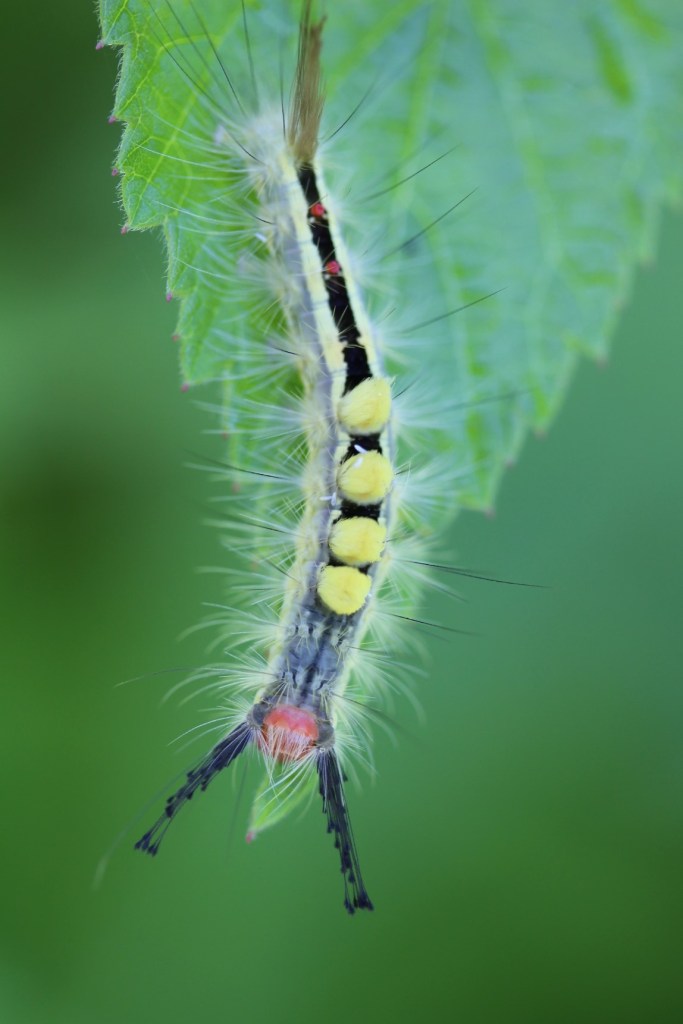
One other Moth drew my attention, but this one didn’t have any wings, because it was still in its Caterpillar stage: the Tussock Moth Orgyia leucostigma. These caterpillars have some of the most extraordinary decorations in our area. It’s possible the row of white tufts along their back resemble Parasitoid wasp cocoons in order to avoid subsequent parasitism, but I have no idea where to start explaining the bright orange head or black spiky tufts around its face.

Tussock Moth Caterpillar (Orgyia leucostigma).

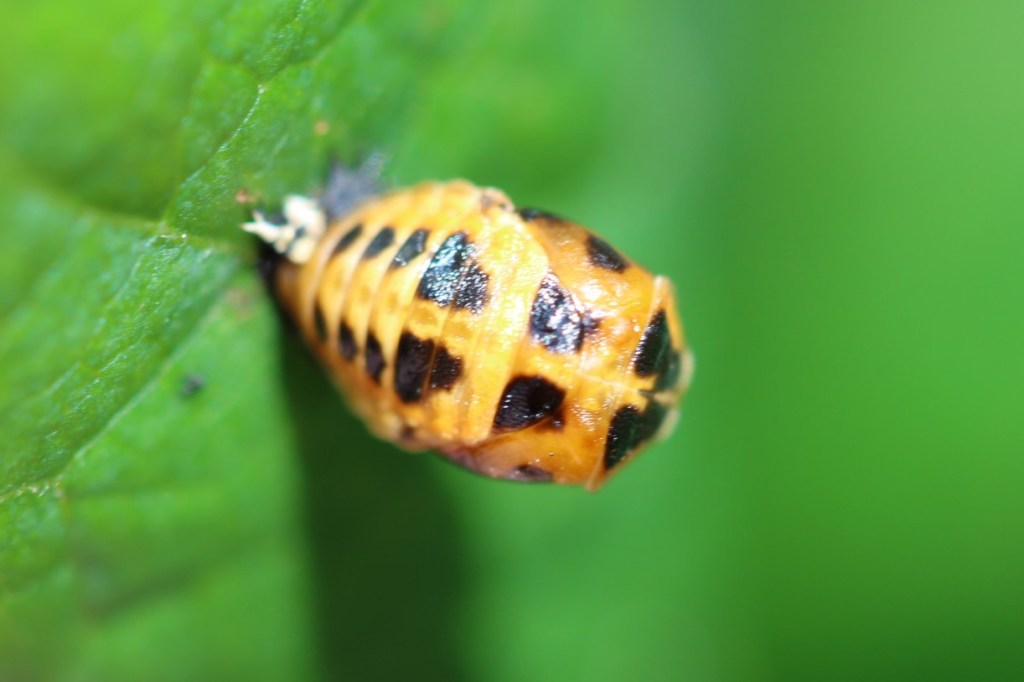
It’s well known that caterpillars turn into Moths and Butterflies, but many people are surprised to find that “baby” Ladybugs look quite different from the roly-poly adults. During the weekend, I spied the intermediate stage, the pupa, of a Ladybug stuck to the top of a leaf. Within, a Ladybug larva was being rearranged into the far more familiar form of its orange shielded adult beetle.

Asian Ladybird Pupa (Harmonia axyridis).

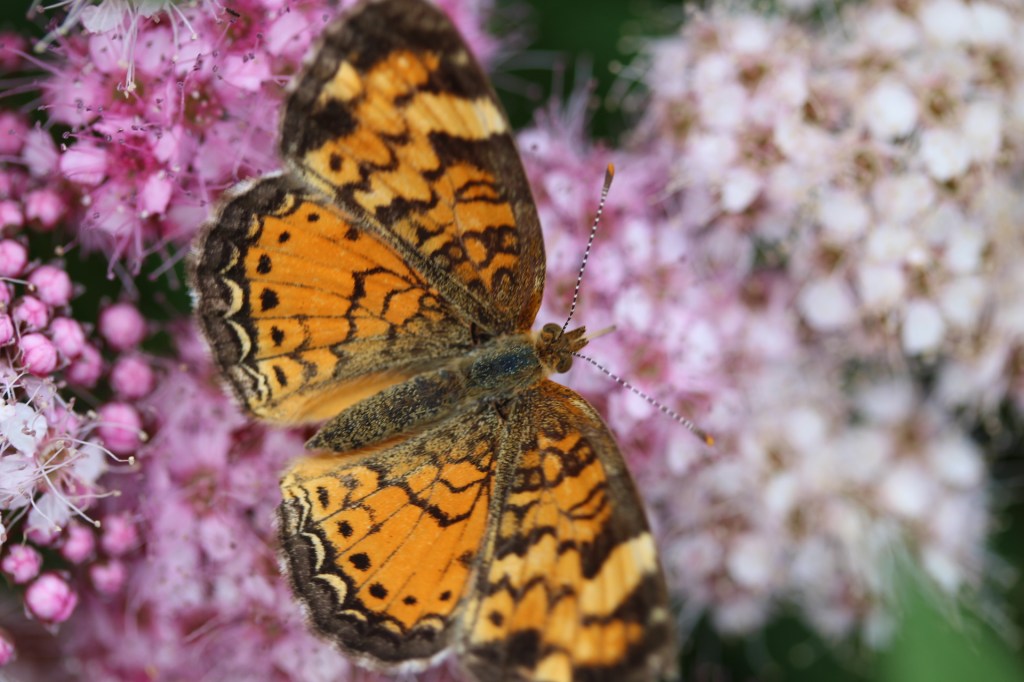
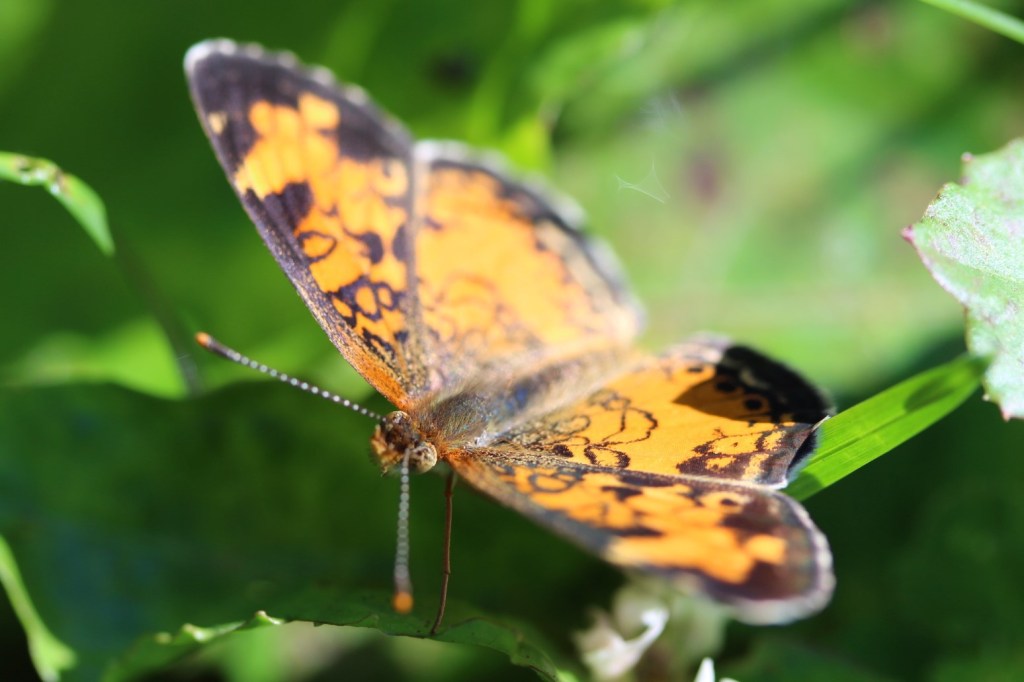
There were a number of smaller orange Butterflies flitting about our campsite which were difficult to photograph. This is the best picture I could manage of the upperside wings:

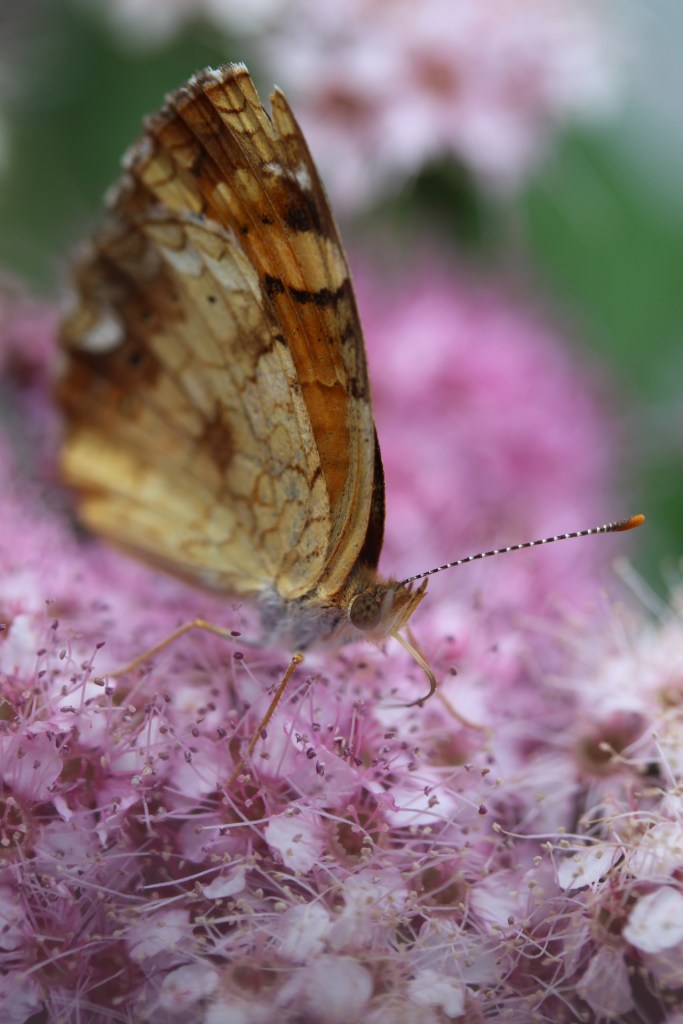
One of this same species (the Northern Crescent, Phycioides cocyta) was resting inside the Dining Tent, allowing me a good photo of the underside of its wings:

The interior of the Dining tent provided many other Insect observations that weekend. I observed this same phenomenon in my own backyard in May of this year. For whatever reason, many Insects enter the tent and then possibly get trapped inside because they have difficulty relocating the entrance (and are drawn to the light visible through the roof of the tent). In any case, it often presents myself with picture opportunities of insects I might not otherwise observe.

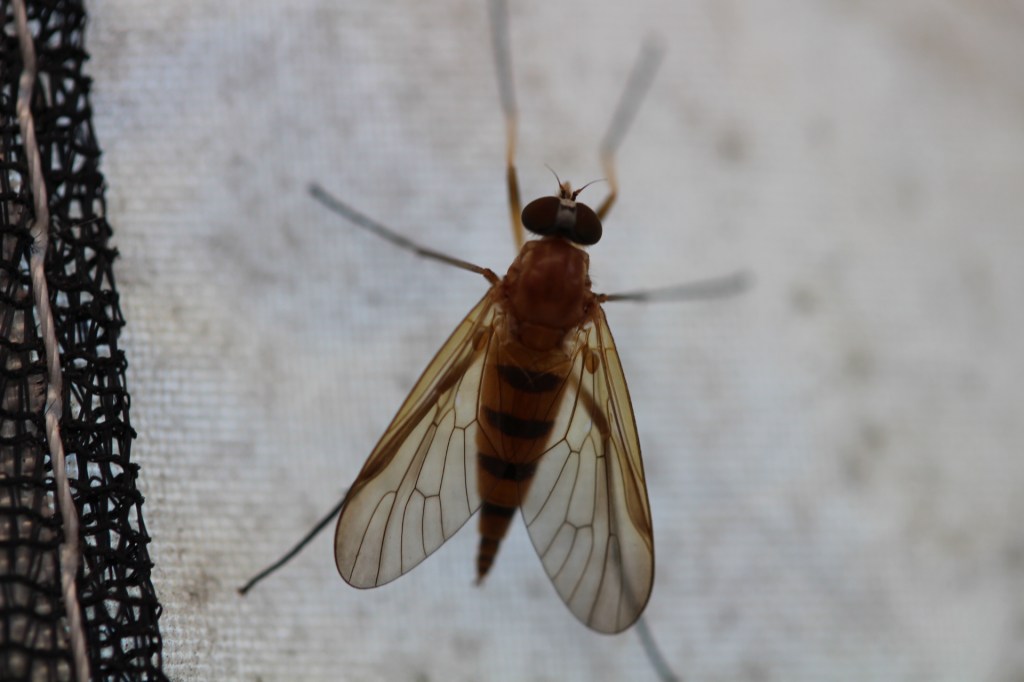
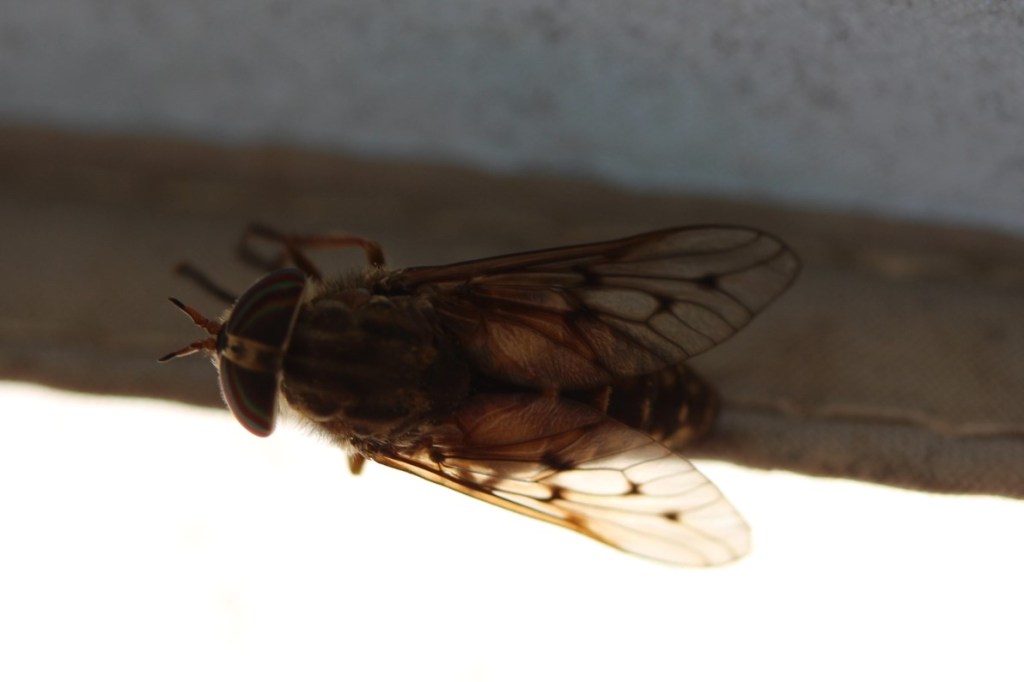
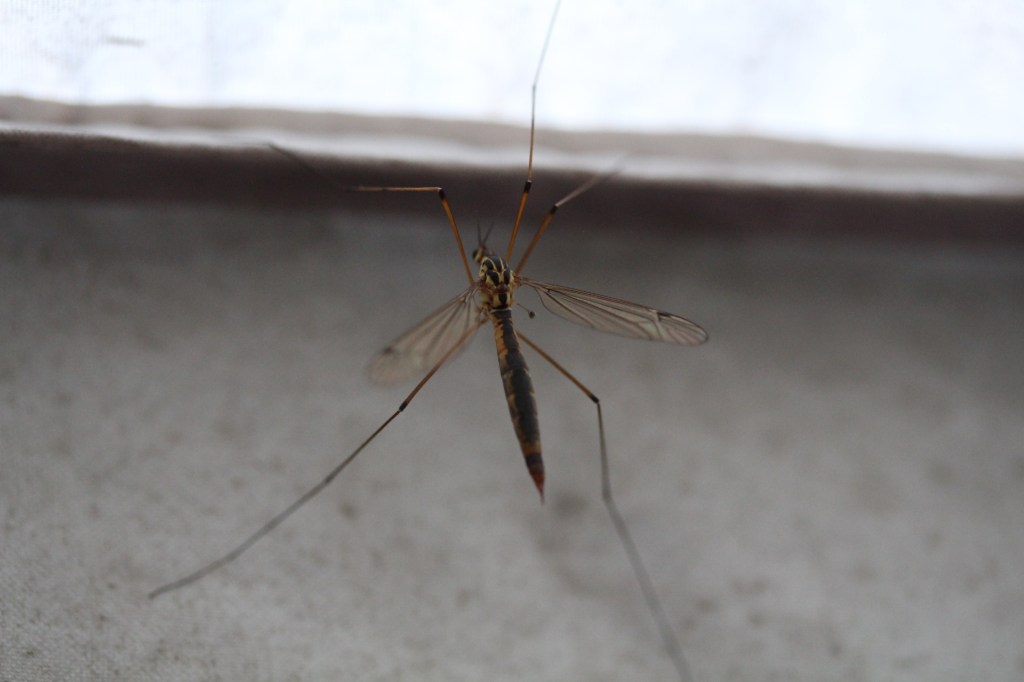
Most of the Dining Tent insects were Flies (and these are the ones I got good pictures of):

Rhagio Snipe Fly.
Horse Fly, I believe of the genus Hybomitra.
Crane Fly (Family Tipulidae).

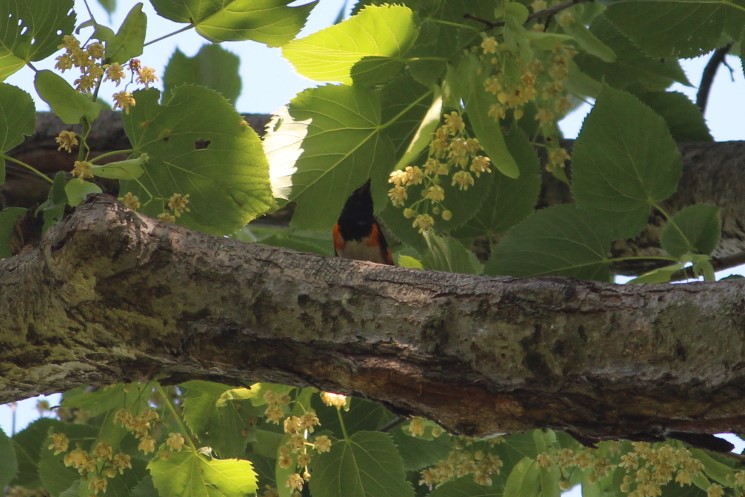
The majority of my observations were of Insects, and this reflects their abundance and diversity well, but I did have a chance to see a few Birds moving through the campsite. Most commonly spotted was a Catbird (Dumetella carolinensis) that seemed to have a particular liking for the berries that grew at the edge of the site. Flitting through the trees occasionally were American Redstarts (Setophaga ruticilla), fabulous black-orange-and white Warblers. Prior to this trip, I thought of the Redstart as a migrant, passing through Southern Ontario in the Spring and Fall. Since seeing it in Port Burwell in July, I have learned that the species breeds across most of Ontario during the summer (Cadman et. al. 1987).

American Redstart.

References:

Cadman, Michael D., Eagles, Paul F. J. and Helleiner, Frederick M., Atlas of the Breeding Birds of Ontario. 1987.

Marshall, Stephen. Flies: The Natural History and Diversity of Diptera. 2012.

For other posts about Nature Observations similar to these, see:

Leafhoppers, Lepidopterans and Longhorns

Fuzzy Flies and Song Sparrows

Cuckoo Wasps and Carpenter Bees

Flies Falling to Fungi and Other Dipteran Observations

And for more nature observations, photos and natural history facts, follow me on instagram at norfolknaturalist.
Categories
June 2021 Observations Nature Observations

Fuzzy Flies and Song Sparrows

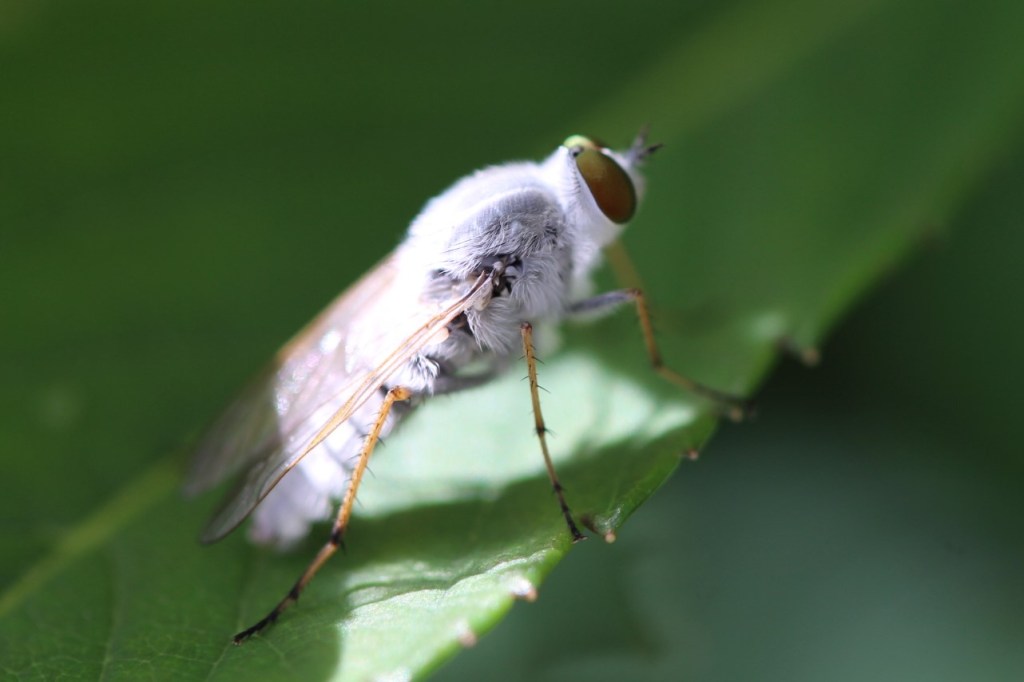
Sometimes my reading and my outside explorations overlap wonderfully. This year I’ve been reading through Flies: The Natural History and Diversity of Diptera by Stephen Marshall, and it is an incredible book, one I will have to review on here at some point. One particular group of Flies that I came across while reading grabbed my attention: the Thereviidae. They’re known as Stiletto Flies, but what really struck me was the fuzzy white appearance of the adult pictured in the book. I thought to myself, I have never seen such a creature and would love to see one. Well, about a month after reading about that group of flies, I came across one very similar. I’m not sure that it’s the same genus, but it certainly seems to match the general look of the Acrosathe featured in the book.

A Thereviid Fly, possibly Genus Acrosathe.

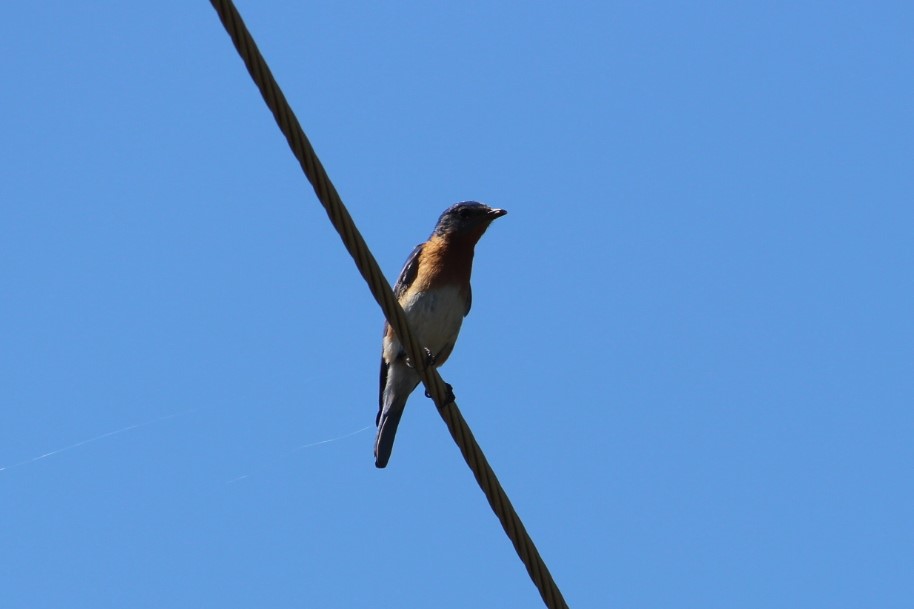
I attempted to take pictures of the Bluebirds (Sialia sialis) that are at my parents’ place. I never see Bluebirds in Simcoe, so it seems they prefer more open farmland habitat. I was proud of myself, upon seeing the shape/size of the bill and the face that I thought they looked Robin-like. And it turns out that they are part of the Thrush family which includes the American Robin (Turdus migratorius). The Bluebirds kept their distance, so this is the best picture I managed.

Eastern Bluebird. Note the longish blunt bill reminiscent of their relatives, the Robins.

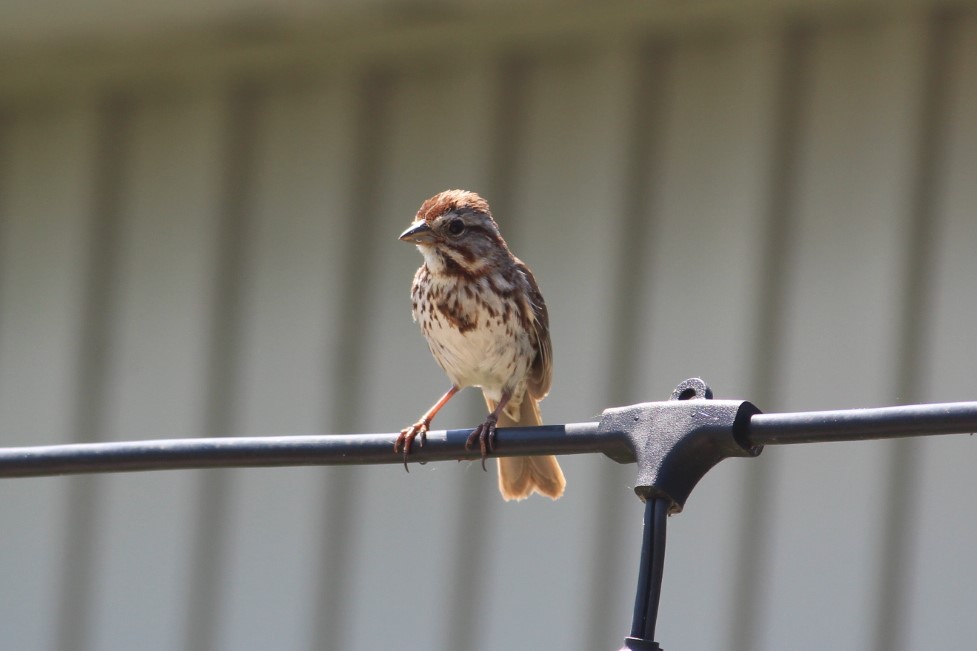
Another bird caught my attention in my parents’ garden by its beautiful song. I should have guessed its identity right then and there, since it turned out to be a Song Sparrow, but I’m very cautious in IDing small sparrows or sparrow-like birds in the field. Recently I’ve come to appreciate the diversity of these types of birds. 

Song Sparrow perched in my parents’ garden.

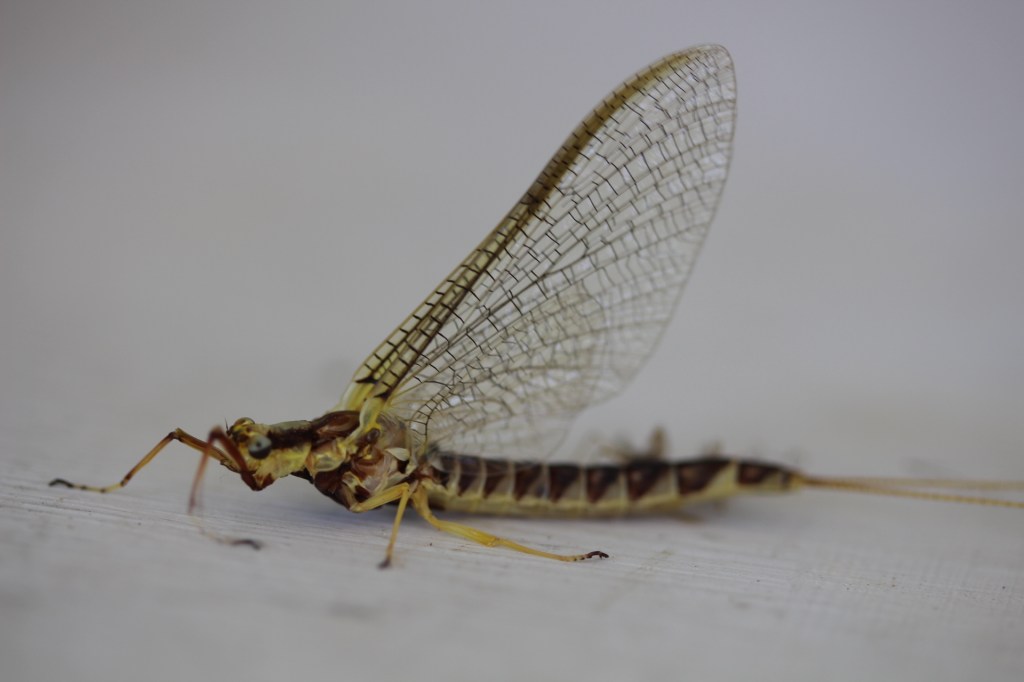
The most exciting Arthropod find at my parents’ house, besides the fuzzy Acrosathe, was this Giant Mayfly (Hexagenia).

Giant Mayfly (Hexagenia).

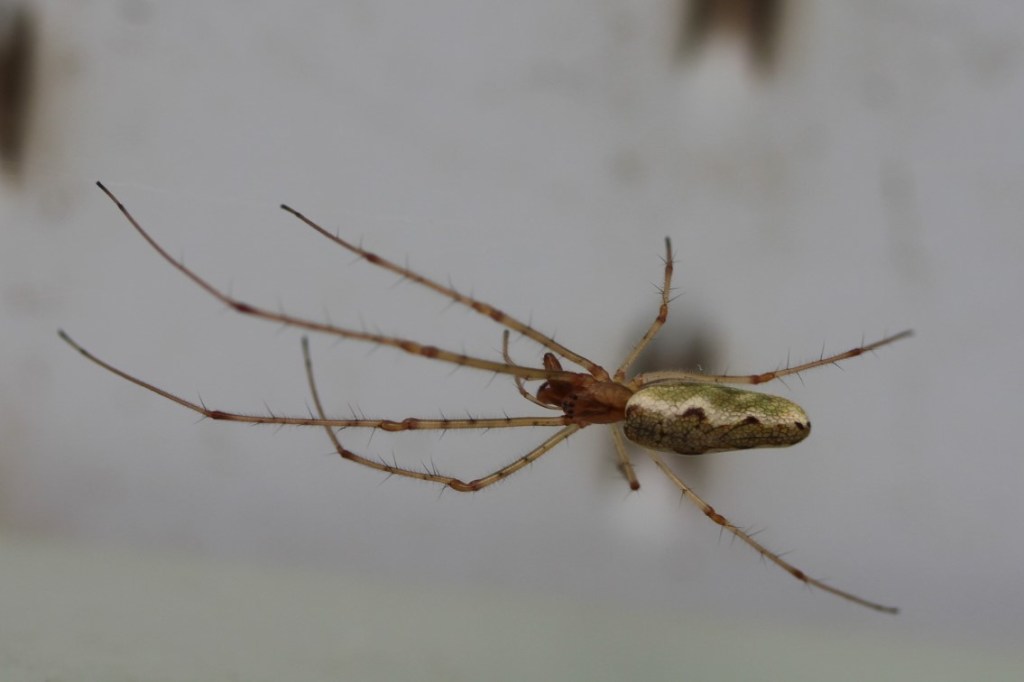
When I arrived to take pictures of this individual it was somewhat entangled in a spider web, from which I freed it. The Spider owner of the web that caught a Giant Mayfly was suitably large and intimidating herself. 

Long-Jawed Orbweaver (Tetragnathidae) that had caught the Giant Mayfly pictured above.

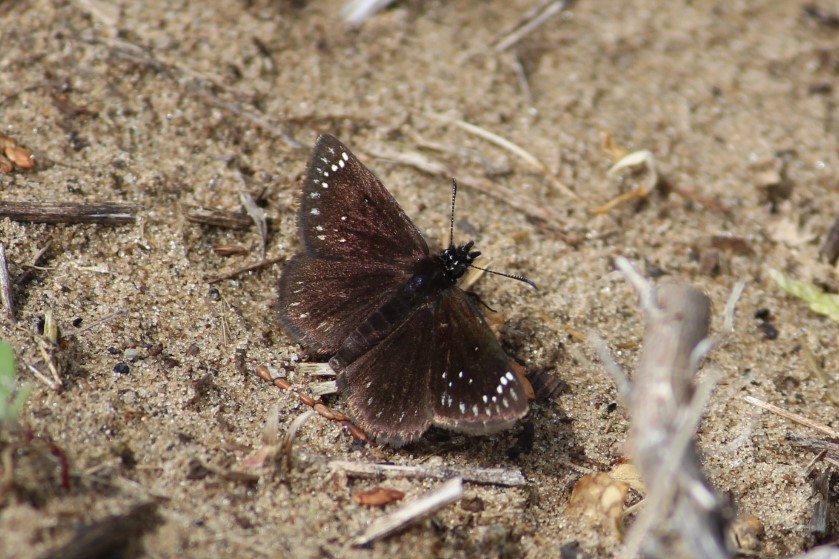
Two other notable observations should be mentioned, and both are Butterflies. In the sandy areas of my parents’ farm I encountered several Common Sootywings (Pholisora catullus) fluttering about. 

Common Sootywing

And in the garden I managed to photograph a beautiful Northern Crescent (Phycioides cocyta) drinking nectar from flowers.

For other Nature Observations like this post, see:

The Wonders of Wrens

-A Visit to Big Creek, Part 1 and 2

Nature Observations: Pinery, Winter 2019

And for more nature observations, photos and natural history facts, check out my instagram at norfolknaturalist.