Subsequent days in the park had us spending time at the Pog lake beach and surrounding area. The fog swirling across the calm lake was a wonderful sight to begin our Algonquin days. One morning the shapes of loons speared the fog and then dropped below the still surface of the lake. Loons may be a common sight within the lakes of Algonquin park, but that does not mean that they are a boring sight at all. Their calls and dives are woven into the atmosphere of Algonquin Park.
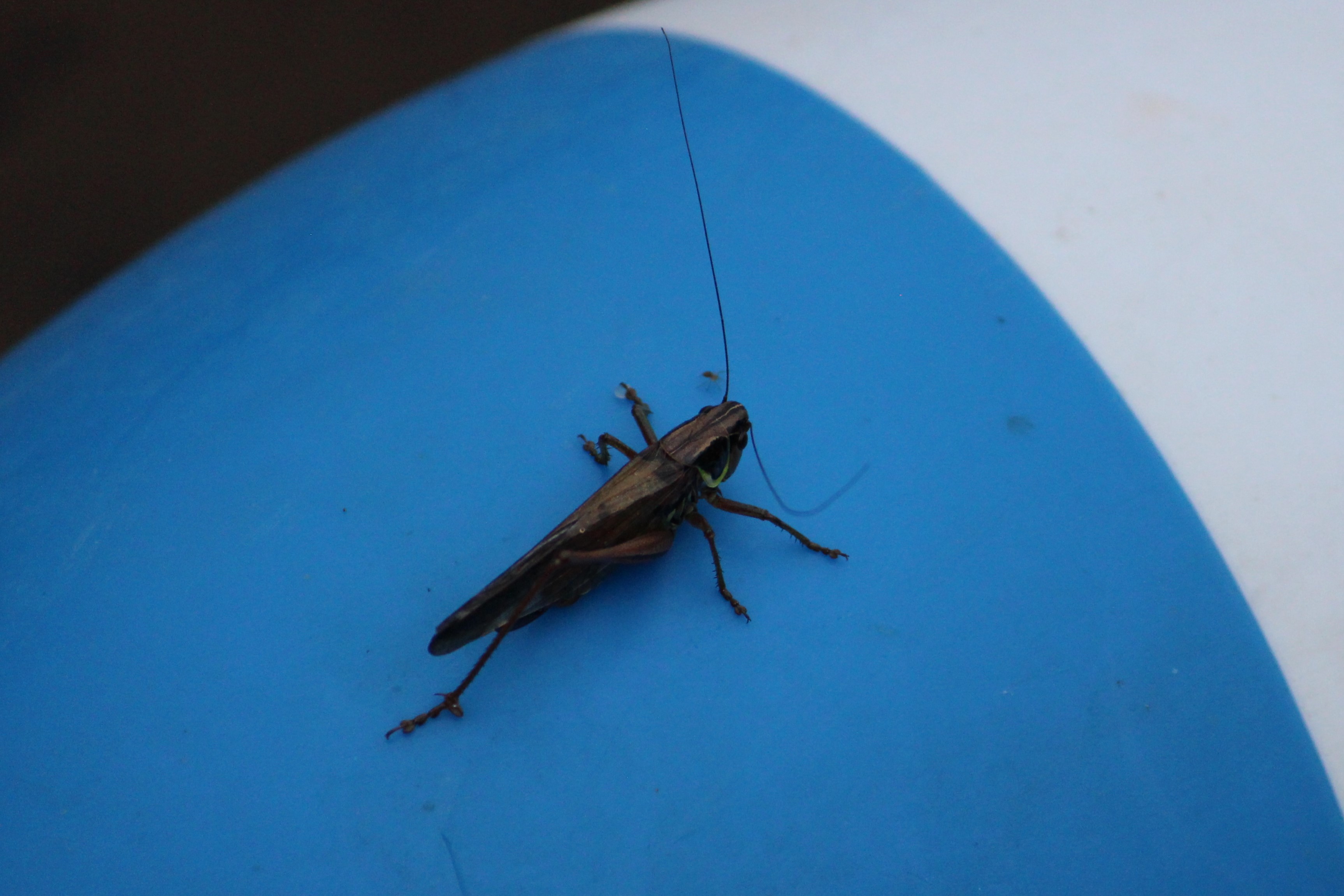
The charisma of Loons did not prevent my eyes being drawn to the small living denizens of the beach area as well. Resting on a buoy was a Large Orthopteran (grasshopper/cricket/katydid) of some sort. This was a Roesel’s Bush-Cricket (Roeseliana roeselii), an introduced Katydid from Europe. There are two forms to this species, one long-winged, and one short-winged. I believe the one I spotted is of the longer-winged variety.
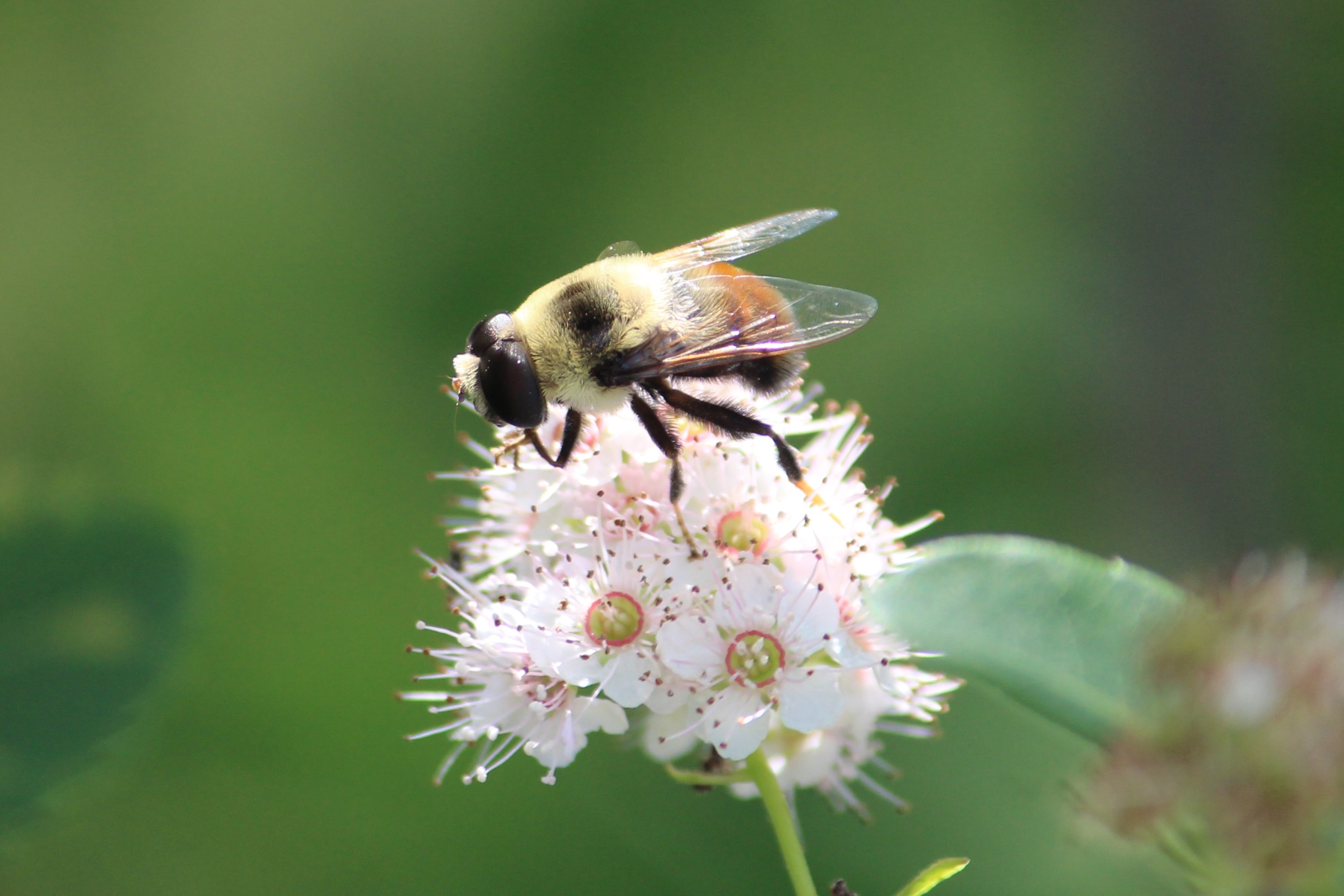
As the days progressed, more insect activity became apparent. A flower near the lake’s edge was visited by a bumblebee-look-alike: the Orange-legged Drone Fly (Eristalis flavipes). The larvae of this species feed within moist decomposing plant material and are known as “rat-tailed maggots” because of the long thin breathing tube that extends from the larvae. But the adults are beautiful bumblebee-mimics, one of many examples where one stage in an insect’s life is more attractive (to us) than another.
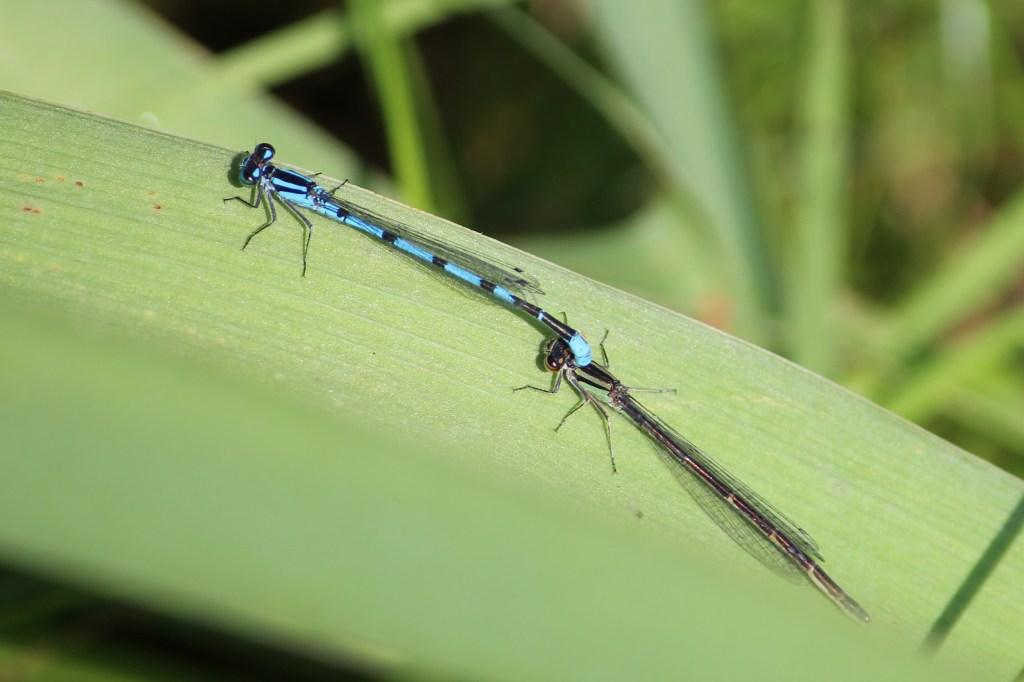
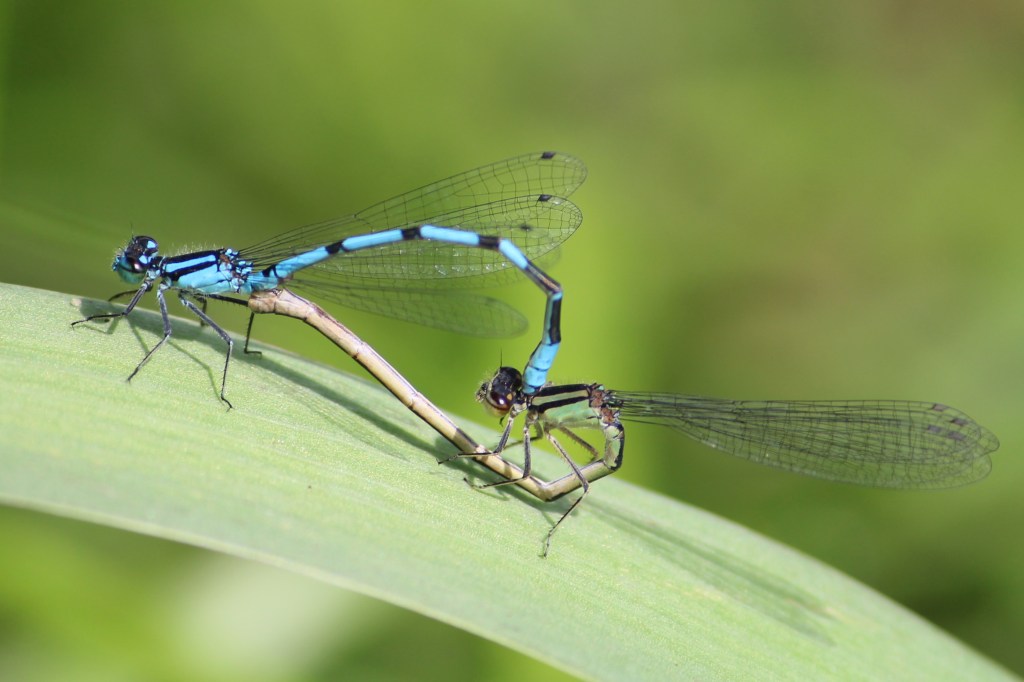
Nearby the flower was a pair of damselflies (Bluets, Enallagma) performing their heart-shaped coupling.
Part 1: The Male has clasped onto the female behind her head.
I’m unsure of the species but there are over 30 species of Bluets in North America (bugguide.net), so called because of the often bright blue colour of the male.
Part 2: Acrobatics incoming…
Damselflies have a strong ovipositor which they use to pierce vegetation in order to lay their eggs inside. Oftentimes, the plants they lay eggs into are partly underwater, causing the damselflies to stretch their abdomens beneath the water surface to cut into a suitable stem.
Part 3: Union.
There were other encounters within the Pog Lake Campground, but the most memorable for me were in a location separated by a walk from our campsite and the beach, a wonderful place I came to call “Warbler River”. That will be the subject of my next post.
In August of 2023, I returned to one of my favourite places: Algonquin Provincial Park. While there, I photographed and encountered varied organisms and I’d like to take the opportunity to explore and describe these nature observations in a series of blogposts, as I often do.
When first arriving at our campsite, I observed not a living thing itself, but rather the mark of a living thing on its environment: I found a bird nest. According to iNaturalist it is likely the creation of a Vireo (genus Vireo, who said Scientific names were hard to remember?). The most common Vireo in Southern Ontario is the Red-eyed Vireo (Vireo olivaceus), so this was likely constructed by a member of this species. A description of their nest construction is appropriate here: “The female spends 4 to 5 days constructing a nest of bark strips, grasses, pine needles, wasp-nest paper, twigs, and plant fibers that hangs below the branch. She glues the materials (some of which are provided by the male) together and to the branch fork with spider-web adhesive, occasionally supplemented with spider egg cases and sticky plant fibers.” (Cornell Lab of Ornithology 2019). I love thinking of the time and effort that went into this small nest. Just think of the spiders’ webs and egg cases that went into this architecture.
Small eye-level nest of a songbird, likely a Vireo of some sort.
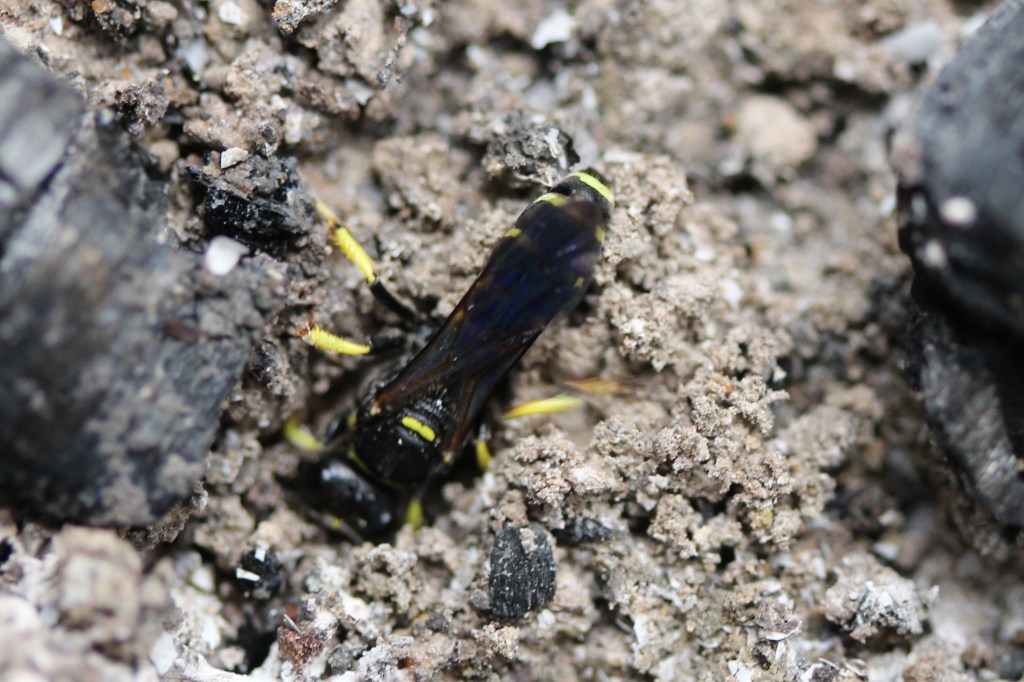
While exploring our campsite, a very different organism was in the process of creating a nest, a crabronid wasp female. This tiny black-and-yellow wasp was investigating the ground of our campsite for a location to create a burrow. The wasp landed several times and dug a little bit into the sandy soil then hovered for a while, circling the area before dropping to the ground once more. At one point, it entered the firepit and dug rapidly into the ashes within, crafting itself a very easily constructed but frightfully unwise burrow. It put me in mind of the parable of the man building a house on sand, perhaps there is a Hymenopteran equivalent about “digging one’s burrow in ashes”. In any case, I don’t think the wasp was settled on the firepit as its burrow location because after forming these temporary exploratory burrows, she flew off and wasn’t seen the rest of the day.
“Do not dig your burrow in ash” – ancient Hymenopteran proverb.
A few days later, I spotted her hovering form once more, this time accompanied by a prey item. Dragging below her was a corpse larger than herself, that of a Horse Fly (Tabanidae). I never witnessed the end of her journey, I’m not sure if she found a good spot to bury her large prey to feed her young. But I hope that she did.
Crabronid wasp dragging her larger horse fly prey below herself.
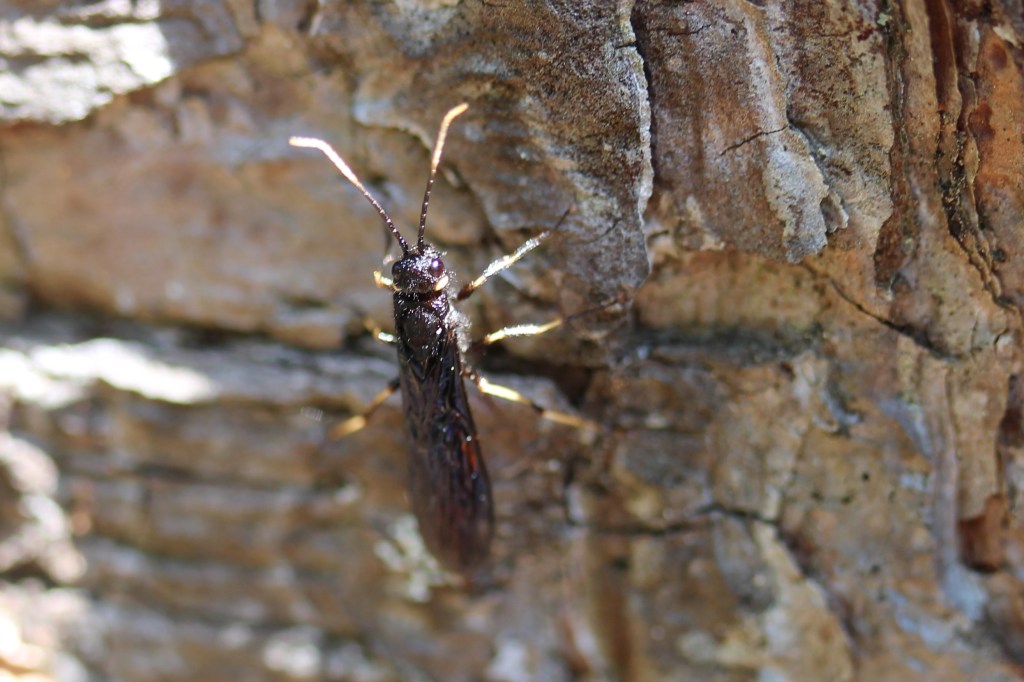
Another Hymenopteran was looking to provision for its young, although its prey was far larger than a horsefly. The creature was a Black-and-red Horntail (Urocerus cressoni) and its prey was a tree. Horntails (Suborder Symphyta) lay their eggs inside the trunks of trees and the larvae feed within. Urocerus cressoni larvae feed inside of Pine trees and their relatives (Marshall 2023).
Black-and-Red Horntail (Urocerus cressoni) resting on the trunk of a tree, likely searching for a place to lay her eggs.
Many other insects were observed on the trees, plants and litter of our campsite and the surrounding areas of the Pog Lake Campground. Some True Flies (Order Diptera) caught my attention. A bright and shiny Dolichopus skittered about in the leaf litter, and an elongate Robber Fly (Genus Machimus) was spotted on fallen pine needles.
Dolichopus Fly.Robber fly of the genus Machimus.
Some of the most beautiful insects found in the Pog Lake campground were the Dragonflies (Order Odonata). A strikingly large Dragonfly of the genus Aeshna was basking in the sun on the trunks of trees and (when I was able to take its photo) on our dining tent entrance.
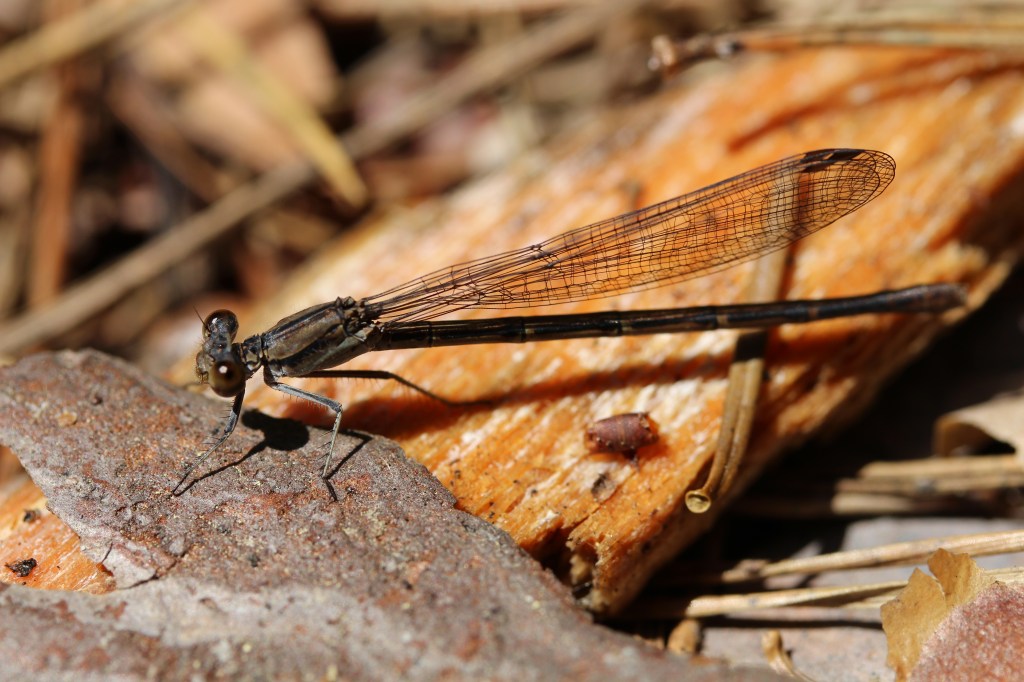
A much more easily missed odonate was the Variable Darner (Argis fumipennis), a smoky grey presence among the pine needles and fallen bark.
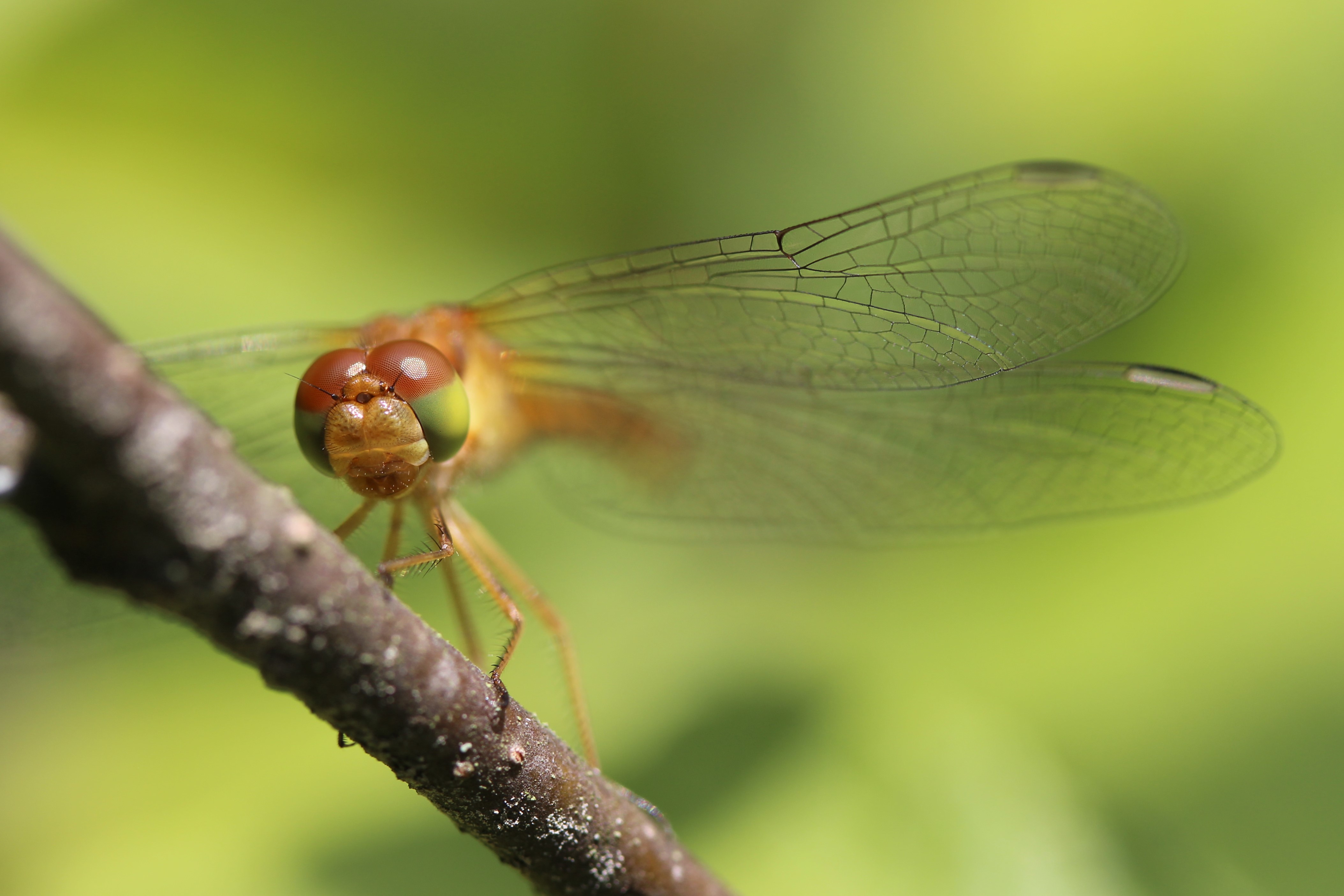
Resting along a branch was a beautiful Autumn Meadowhawk (Sympetrum vicinum), in a colour phase that I hadn’t observed before. Males of this species are a bright red with a rusty-red thorax, but females (like the one I encountered) are yellowish. I was able to get very close to this dragonfly and was rewarded with some beautiful photographs.
We didn’t just hang out by our campsite in Pog Lake, but we spent quite a bit of time at the campground beach and that will be the focus of my next blogpost.
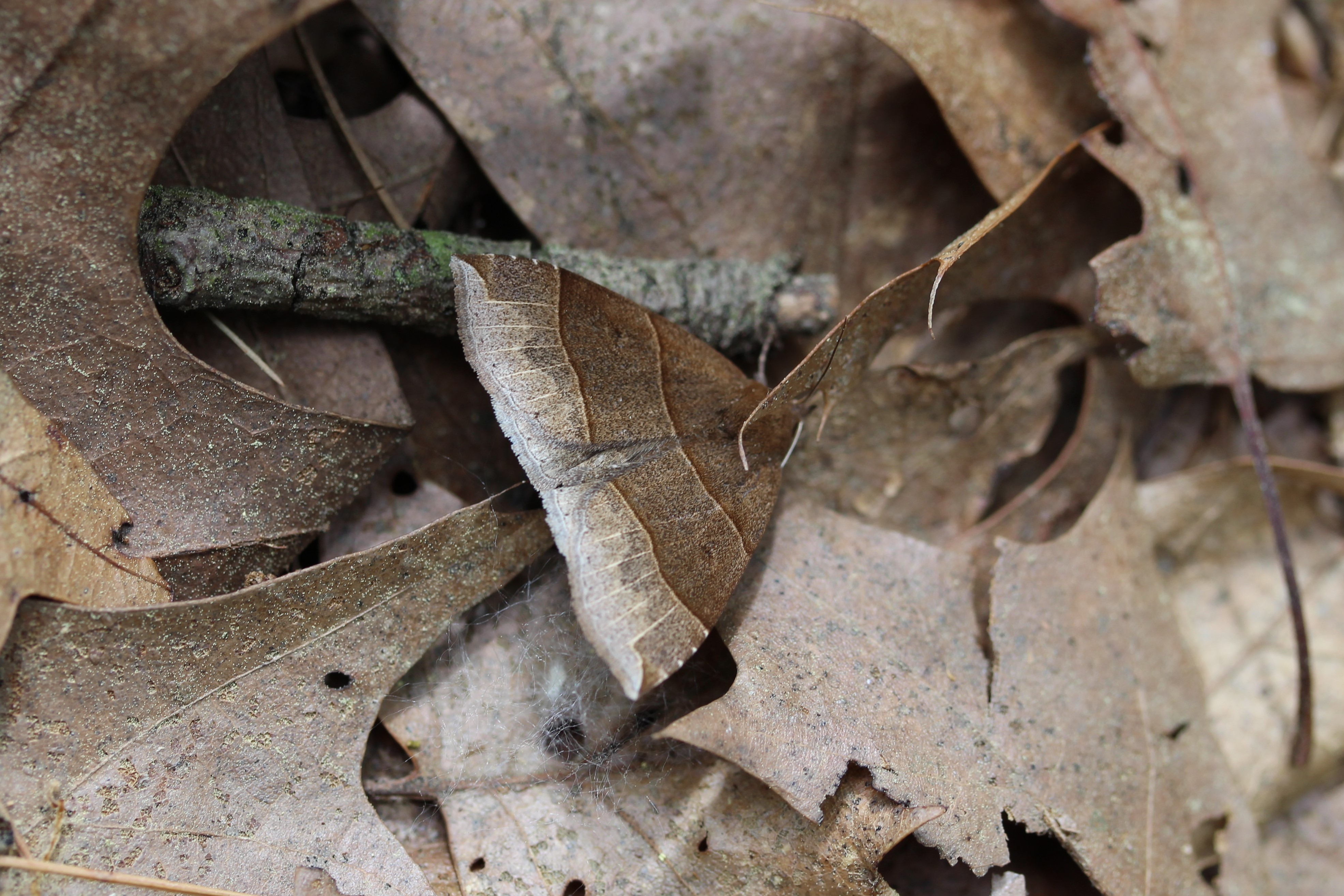
Subject: Maple Looper Moth (Parallelia bistriaris)
Location: Turkey Point Provincial Park.
Date: June 2018.
The Story behind the Shot: While hiking down a trail at Turkey Point Provincial Park, my wife somehow spotted this moth among the leaves which it matched so closely. I was overjoyed to get such a close-up shot of an amazingly camouflaged insect.
The Story behind the Species:
This moth could be the poster-child for camouflage. Such an elegant example of hiding-in-plain-sight. Positioned among fallen leaves which it matches in tone and general shape, this moth is incredibly hard to spot! To hide itself even more, the Maple Looper Moth positions itself head down, thus hiding its least leaf-like feature and accentuating the lighter edge of its hindwings (Keiper 1969).
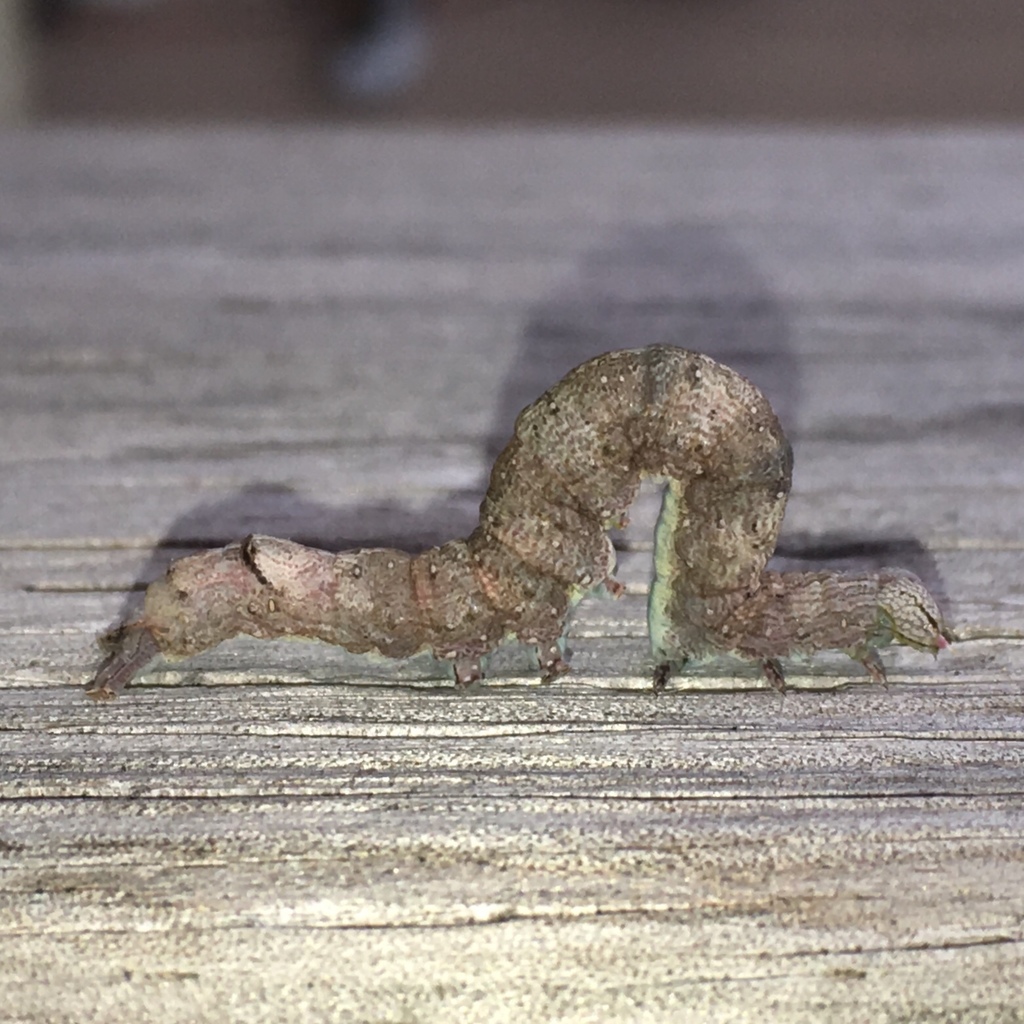
The larvae of this superbly secretive moth are also camouflaged, resembling twigs rather than leaves.
Maple Looper Moth larva (or caterpillar) demonstrating both its twig mimicking colouration and its looping movement. Photo by Dan MacNeal, used with permission.
The larvae, unsurprisingly, feed on Maple leaves (Crumb 1956), but bugguide.net lists Birch and Walnut as food plants as well (https://bugguide.net/node/view/3356).
I’m glad to have found and captured a photograph of this mysterious moth. A beautiful secret of the forest floor.
Keiper, Ronald. 1969. “Behavioral Adaptations of Cryptic Moths IV. Preliminary Studies on Species Resembling Dead Leaves”. Journal of The Lepidopterist’s Society 23: 4: 205-210.








 Norfolk Naturalist