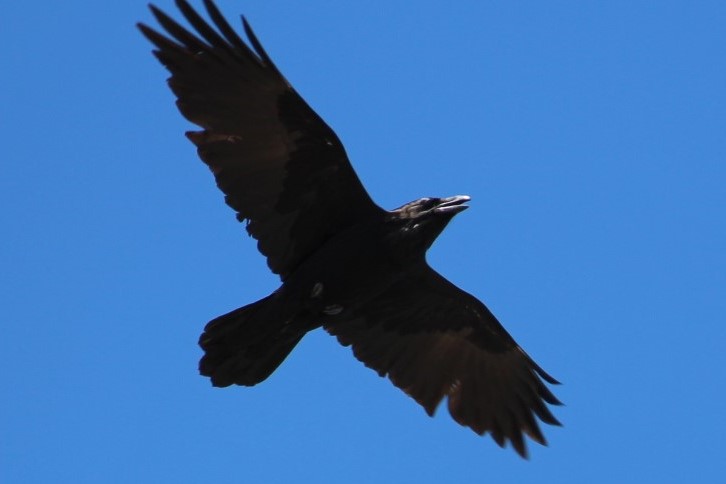
My parents’ farm property in Norfolk County has been blessed by the construction of a very exciting nest. One day when I arrived at their house and opened my car door I was greeted by the distinctive “croak” of a Common Raven (Corvus corax). The sound startled me, placing me in the woodlands of Algonquin Park, but there was no mistaking that call, and the size of the bird making it. I could see the calling raven, perched atop an unused silo. As exciting as this brief sighting was, the true significance of this bird’s presence was not yet revealed.
Later that same week, my Mom asked about the large crows and mentioned that they were building a nest on top of the silo. She said they went back and forth with sticks in their beaks. Maybe this news wouldn’t be so exciting to some people but for myself the thought of a raven nest that I could regularly observe was exhilarating.
And observe it I have!
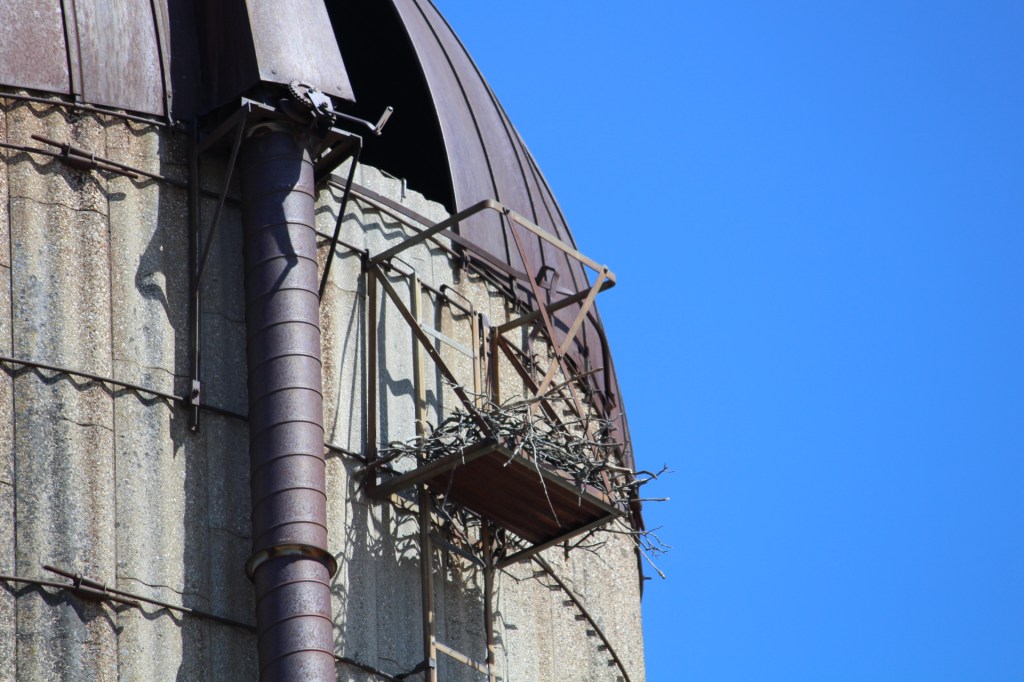
A stick nest constructed by a pair of ravens on my parents’ farm.
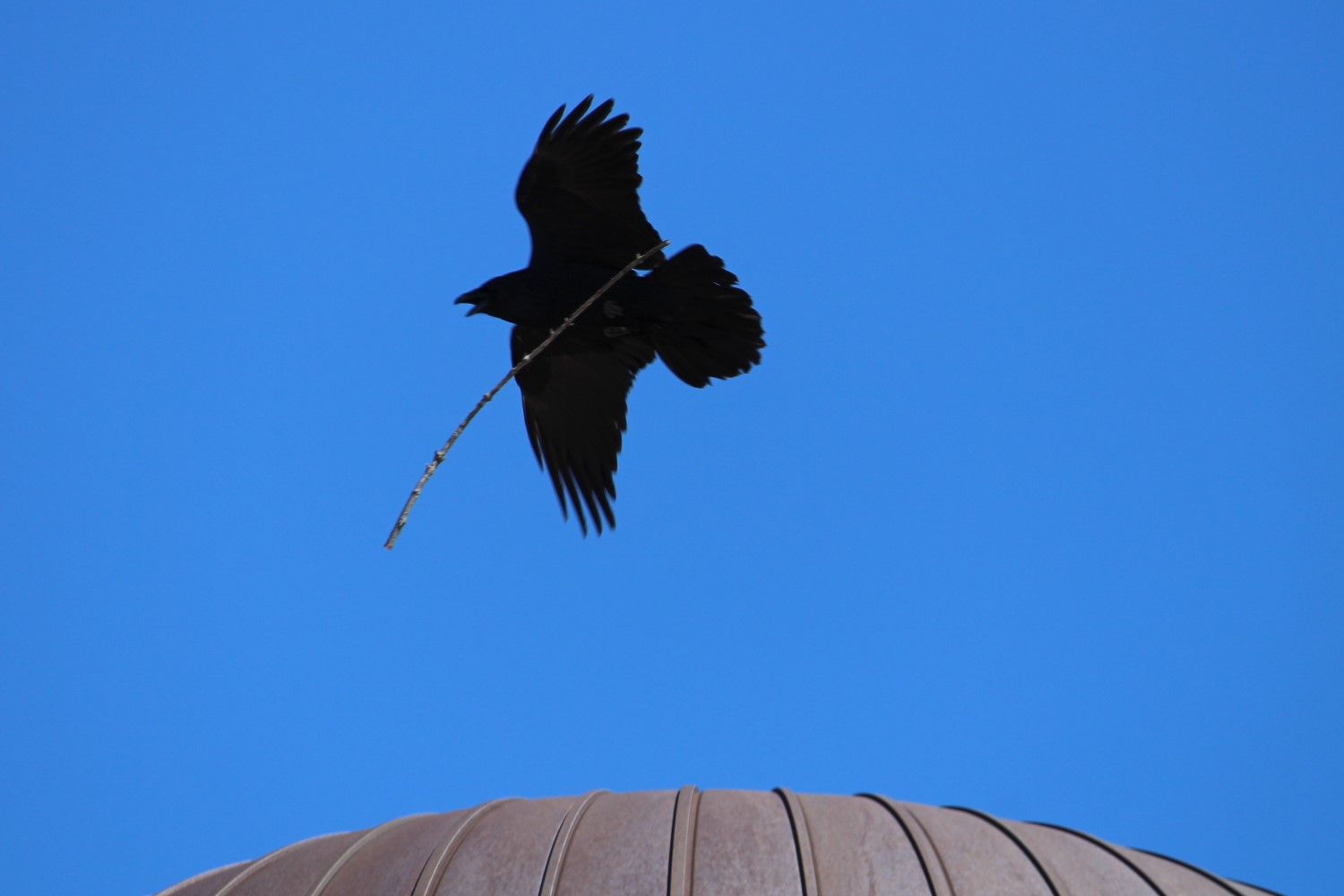
On a recent visit, I went back to check out the nest and take some pictures. After only a few moments of watching the silo, I heard the sounds of one of these amazing birds returning and saw it carrying a large stick in its beak. The raven dropped the stick onto the nest pile without even landing, continuing to soar through the sky on its powerful wings. Apparently, if a dropped stick doesn’t stay in the nest, the ravens won’t pick them up again off the ground (Stokes and Stokes 1989). The sticks are taken from tree branches, broken off by the ravens, not collected from the ground (Stokes and Stokes 1989). In addition to large sticks, the nest could contain dirt and grass clumps as well as an interior lining of gathered hair or bark (Stokes and Stokes 1989).
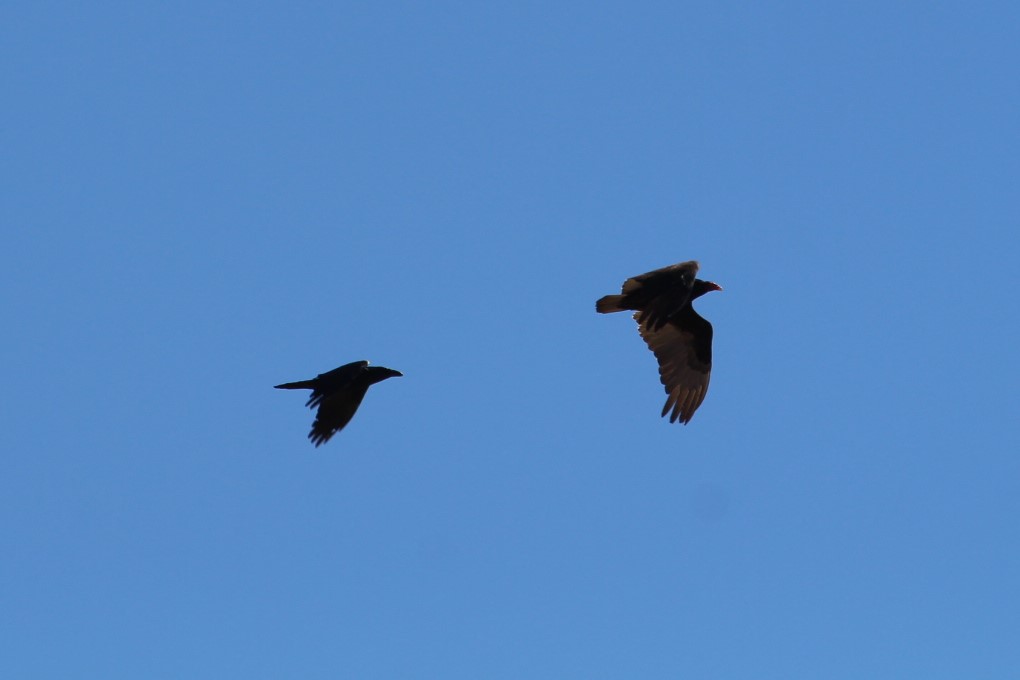
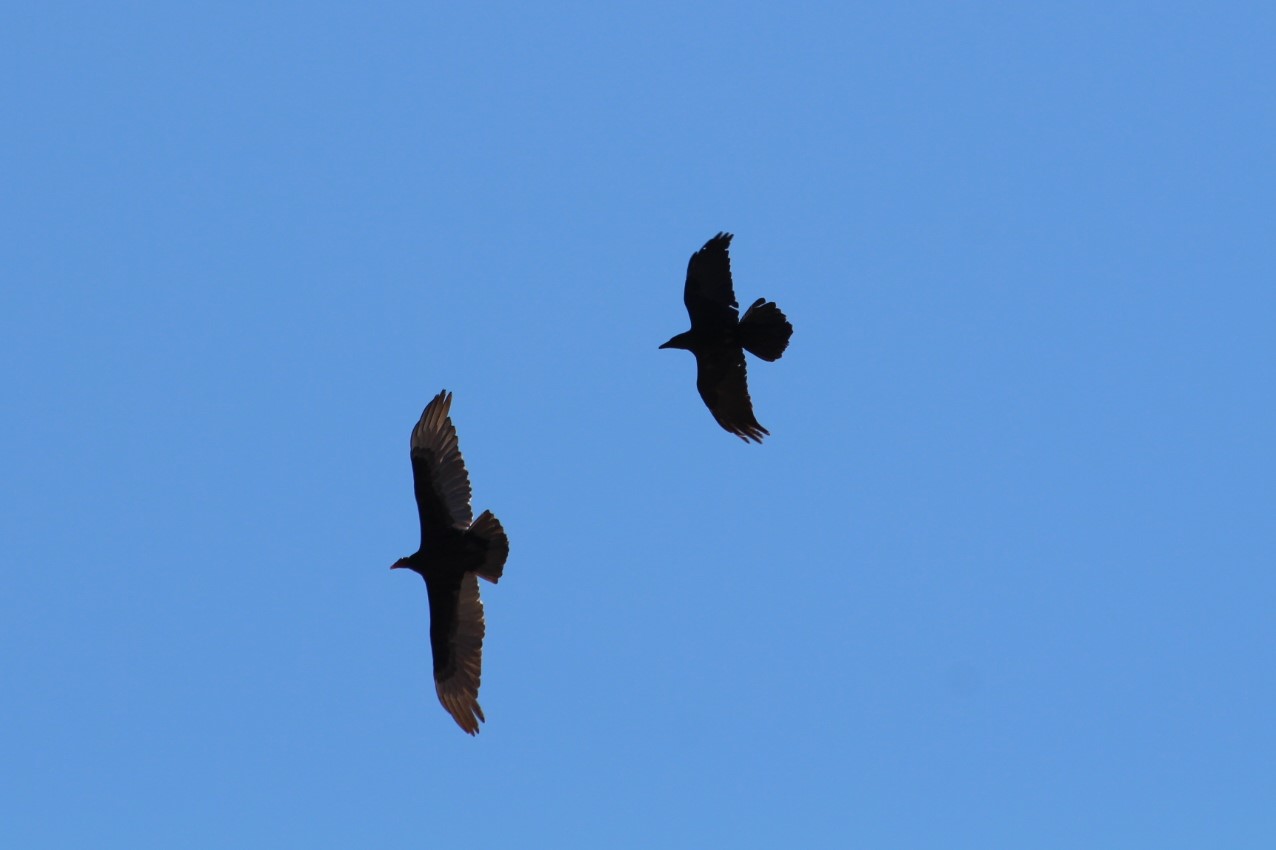
A few minutes later, a turkey vulture (Cathartes aura) came drifting towards the silo. The large bird seemed to be planning to perch atop the silo, something I have seen vultures do previously. Swooping onto the scene with deep throaty “croaks” the raven pair chased the vulture off into the distance, something that was reminiscent of the classic behaviour of corvids mobbing raptors or owls.
As I said at the beginning of this post, the call and sight of ravens makes me think of Algonquin Park, and that’s for good reason. Until now, it was the only location I had seen these birds. Ravens used to be common across all of Ontario but mainly due to habitat destruction and human persecution, they have been mostly absent from far southern Ontario for about a century (Cadman et. al. 1987). Ravens were even rare in Algonquin Park until the 1960s because of the poisoned baits left out for wolves (Tozer 2012). The most recent field guide I have (Bezener 2016) still has the raven range map cut off before reaching most of Southern Ontario.
I’ve tried unsuccessfully to find a good source for the current breeding range of ravens in Ontario, but I suppose I’ll have to wait for the next edition of the Breeding Bird Atlas, which is collecting data right now (2021-2025) for its creation. It’s an amazing project, and if you have the time to contribute go for it! Suffice to say, this nest of ravens is a fairly new thing in my area and is very exciting. I hope that they have a successful nesting season, and I have a feeling I will have more posts about this nest in the future! At the time these observations were made (March 29, 2022) the ravens have possibly already laid eggs in the nest, as Tozer (2012) gives a range for Alqonquin raven egg-laying as March 20 – April 19. Stay tuned!
References:
Bezener, Andy. 2016. Birds of Ontario. 376 pp. Partners and Lone Pine Publishing.
Cadman, M. D., Eagles, P. F. J., and Helleiner, F. M. 1987. Atlas of the Breeding Birds of Ontario. 617 pp. University of Waterloo Press.
Tozer, Ron. 2012. Birds of Algonquin Park. 474 pp. The Friends of Algonquin Park.
Stokes, Donald and Stokes, Lillian. 1989. A Guide to Bird Behavior. Volume III. 397 pp. Little, Brown, and Company.
For Previous articles that have some relevance to this one, see:
–Canada Jay (Perisoreus canadensis)
–Algonquin Observations, Part 3 – Peck Lake Trail
–Fuzzy Flies and Song Sparrows
Discover more from Norfolk Naturalist
Subscribe to get the latest posts sent to your email.

 Norfolk Naturalist
11 replies on “Return of the Ravens”
Oh man, little did I know what those “big crows” were! Haha
LikeLike
[…] –Return of the Ravens […]
LikeLike
[…] April I was amazed and delighted to find that Ravens were nesting on my parents’ property (specifically on their silo), so I wrote a post about my observations and their […]
LikeLike
We live in Norfolk County, just south of Simcoe and thought we heard ravens this spring. Yesterday (May 17, 2024) we heard a big ruckus and looked up to see crows chasing a very large bird that appeared to be all black. They flew out of sight behind the neighbours’ big spruce trees and continued their quarrel. Then we recognized the distinctive croaking of a raven amidst the cawing of the crows. There was no doubt, a raven! Here in the south. We were thinking it was late in the spring for a raven passing through. That’s when I did a little “googling” and found your article. It was exciting to see the raven but also very interesting to see how crows react to a threat. They came from all directions to help out and went it was over, mostly went their separate ways.
LikeLike
Very neat observation! Thank you for taking the time to share. I’m so glad that you found my article and that it helped put your observations in context. Since noting the nest I mention in the article, I have seen another pair of ravens in Simcoe which I’m positive must be nesting adjacent to the Lynn Valley Trail. I love hearing their sounds added to the local bird calls.
LikeLike
[…] –Return of the Ravens […]
LikeLike
[…] –Return of the Ravens […]
LikeLike
[…] –Return of the Ravens […]
LikeLike
We also had a Raven pair here last spring. I realized I heard them in 2023 as well at the edge of our farm field. We are in South Uxbridge township Ontario. Last year, spring, the pair built a very large nest in the rafters of our barn. They were very aggressive towards us, the barn is quite close to the house abx yard and our driveway passed right next to the barn where the nest was in view. We never saw young, and during the summer they disappeared, we couldn’t see into the nest so we didn’t know if eggs were ever laid. I did hear the Raven in the fall, but only saw one. This spring (it’s still early) we haven’t seen or heard them. Do they tend to use and old nest, or build new?
LikeLiked by 1 person
Hi! Thanks for the comment. Interesting observations. If a Raven pair finds a good nesting area, they will return to it for years. But they will often have 2 or 3 nest sites within that territory, and they will rotate between them. Sometimes they use the same exact site twice in a row but it seems more common that they will use a site every other year.
LikeLike
[…] in my parents’ barn, host to Ravens these past few years (see my article about this here: Return of the Ravens). You could almost imagine they were Odin’s Ravens, Huginn and Muninn (Thought and Memory), […]
LikeLike