Categories
book review Norfolk Naturalist Bookshelf

Books About Ants

I love ants. If you’ve read some of my blogposts or know me personally you already know this. My admiration and appreciation for these animals was built in large part by reading well-written and informative books about ants. I want to take a mini tour through my bookshelf to describe, introduce, and recommend my favourite books about ants.

The Ants, by Bert Holldobler and Edward O. Wilson
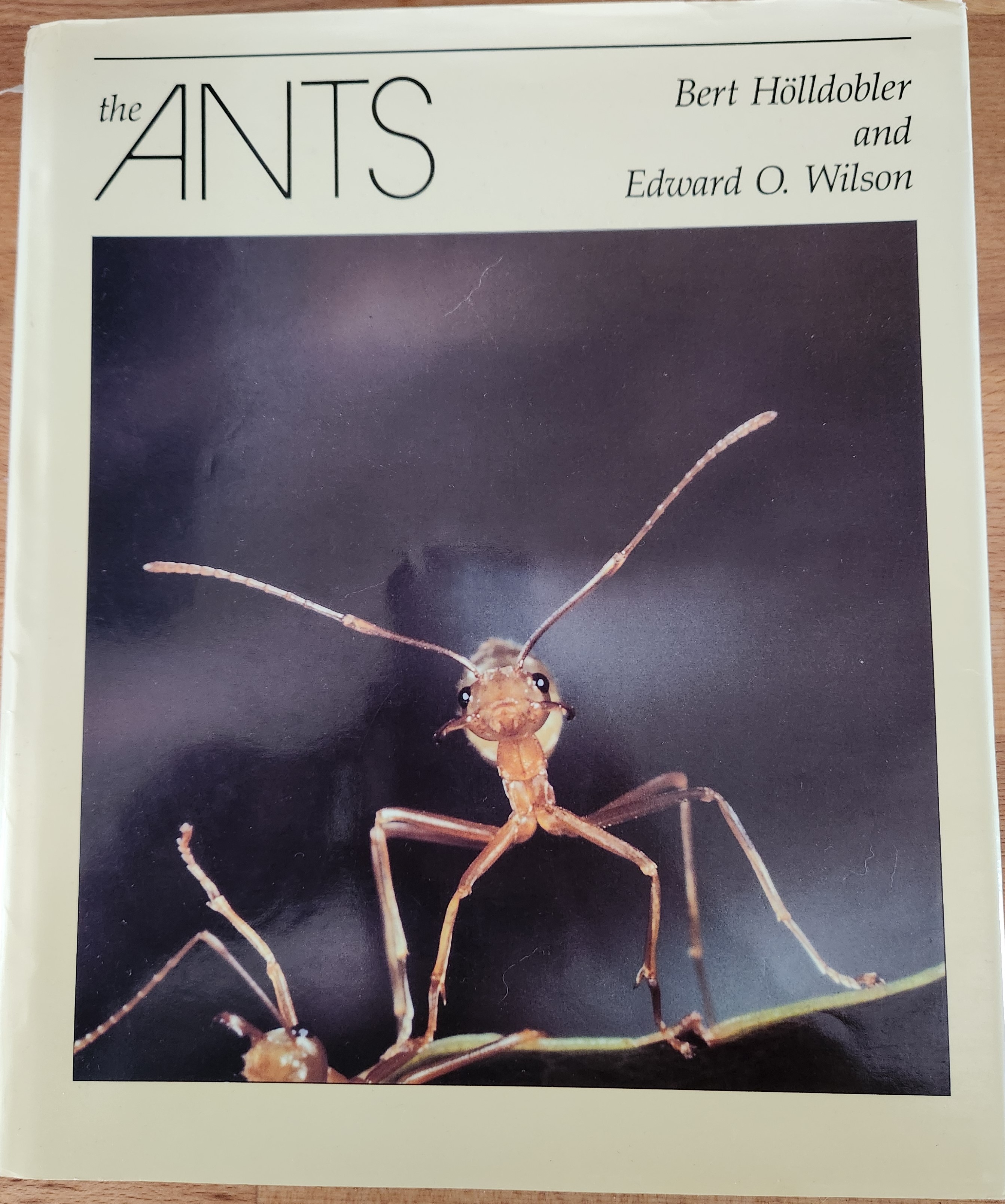
As you can guess from the monolithic title, this is THE book about Ants, covering them comprehensively from their anatomy to their ecology. Despite the wide variety of topics, there is a throughline of focus on the sociality of ants which is unsurprising given E. O. Wilson’s personal interest in the subject*. Despite being comprehensive for its time (published in 1990), The Ants reads with a narrative flow and moves smoothly from one fascinating topic into the next. The dense information is conveyed in a very engaging fashion and illustrated with wonderful line drawings throughout. If you are seriously interested in ants, there is no equal to this tome.


*E. O. Wilson has written several books focused on the evolution of social behaviour in animals inspired by his studies of social insects, including Sociobiology, The Social Conquest of the Earth, and The Insect Societies. I can personally recommend The Insect Societies as an excellent introduction to the social insects. Despite being published almost over 50 years ago now (in 1971), the text is engaging and informative and serves as an excellent overview/introduction to the world of eusocial insects.

Things I learned: Weaver ants wage territorial wars across treetop empires, carpenter ants bring their aphid “cattle” inside for winter and then bring them back out to their host plants in Spring, honeypot ants have a “storage” caste which hangs from the ceiling of their nests as living larders and many many more fascinating insights into the incredibly diverse and complex world of ants.

Field Guide to the Ants of New England, by Aaron M. Ellison, Nicolas J. Gotelli, Elizabeth J. Farnsworth and Gary D. Alpert

This is the only pictorial field guide to ants that I’ve encountered and as such it is extremely valuable to me. I haven’t read through it, but have used the keys on the inside of the front and back covers to identify my ant photos to subfamily and then gone through the genus and species photos looking for a match. The layout and design is excellent, and the natural history notes are great as well. Although this is a guide to the ants of New England specifically, the ants of southern Ontario overlap with the ant fauna of New England to a great extent, making this an important field guide for ant enthusiasts in various regions across Eastern North America.

Things I learned: double-petiole ants are almost certainly part of the subfamily Myrmicinae in our area (northeastern North America).

Adventures Among Ants, by Mark W. Moffett
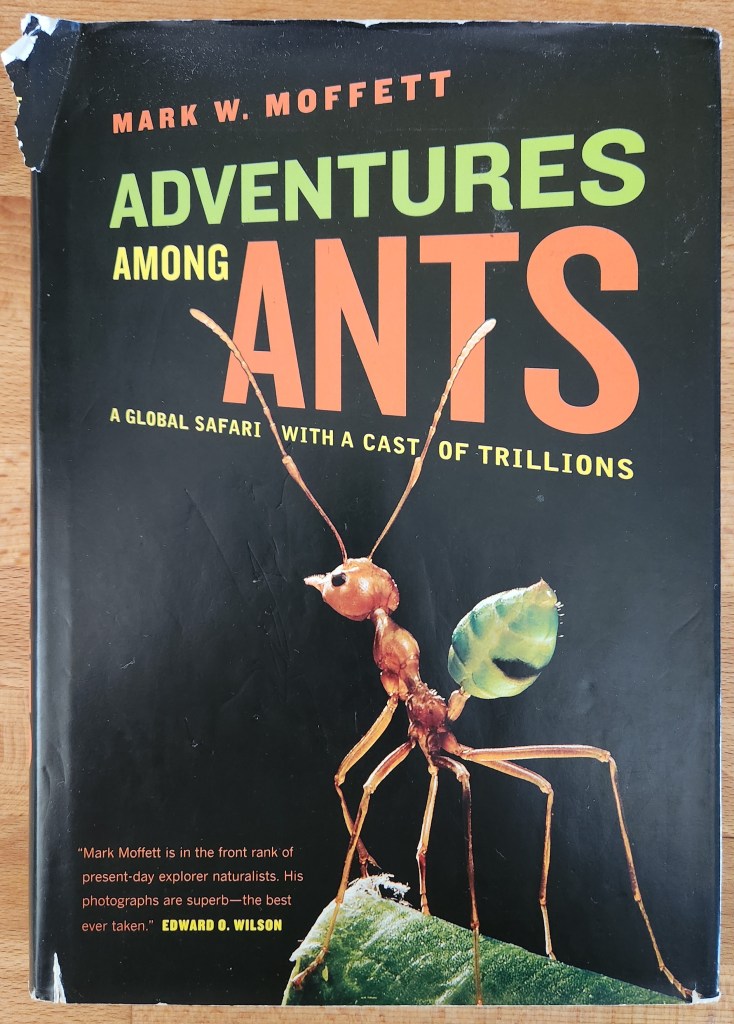
If you’ve ever wondered what it’s like to explore tropical rainforests in search of ant empires, this is the book for you. The stories of fieldwork transport you to the fascinating ecosystems of the tropics and the incredible ants that can be found there. This book was a gateway book for me because it was semi-popular science and also fairly technical. The adventures of fieldwork and the bizarre adaptations of tropical ants combine to make this an exciting dive into myrmecology.

Things I learned: Weaver ants use their larvae as glue guns to sew leaves together in their arboreal nest construction, fire ants construct living rafts with their bodies in order for the colony to survive floods, marauder ants (Carebara diversa) have a 500-fold size difference between minor workers and major workers, such that the minor workers can ride comfortably atop the major’s head without causing a stir.

Army Ants: The Biology of Social Predation, by William H. Gotwald, Jr.
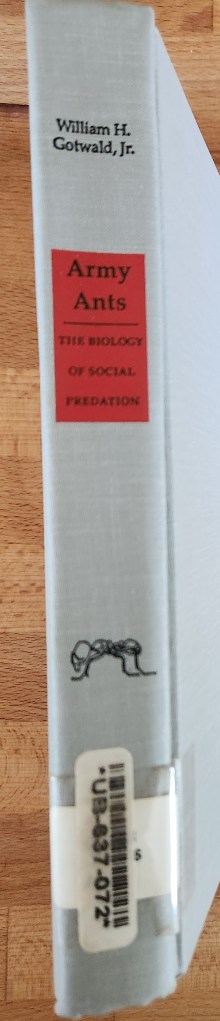
Who isn’t astounded by army ants? They are the ultimate super-organism, a group of tiny individuals acting as one large predator. From reading The Ants I was already introduced to these miniature soldiers and the concept of the “social stomach” where because ants share their food and resources among colony members you can think of them as having one stomach. In the army ants’ case you can also think of them as having “social mandibles”, tearing into prey in their path as a group and subduing surprisingly large prey items.

Things I learned: There are many different species of Army Ants, members of multiple subfamilies.

The Fire Ants, by Walter R. Tschinkel
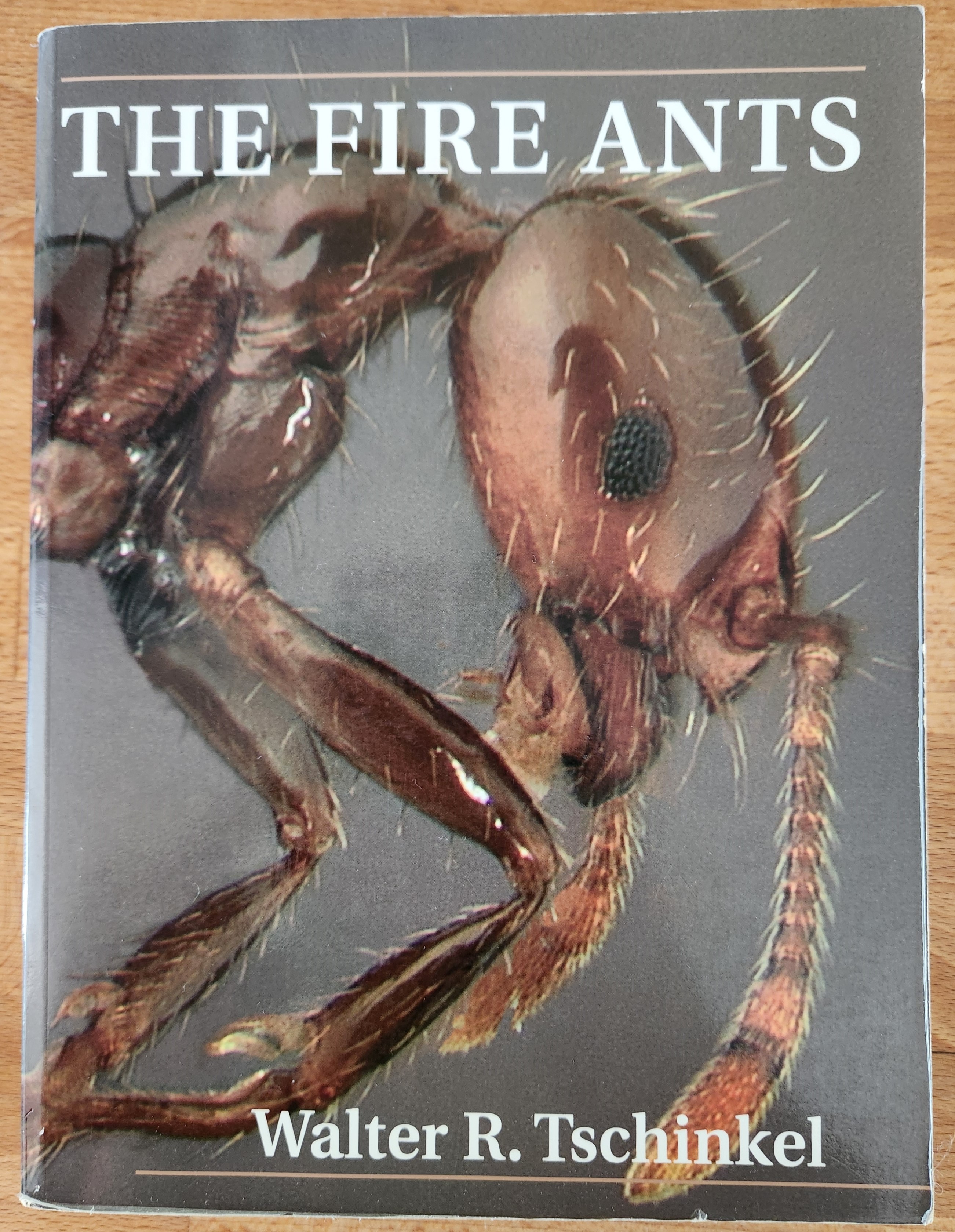
Talk about a monograph. If reading a 600-page book about a single species of ant feels like a dream come true to you, then you are me. Surprisingly humorous and extremely insightful into the world of fire ants, this incredible book deals with some other ant species but is especially focused on the invasive fire ant Solenopsis invicta, which has spread across the southern half of the United States over the past half-century or so. Part case-study of an invasive species, part monograph on all biological aspects of said species, this excellent book also contains vignettes about the author’s work as an ant researcher (properly a myrmecologist) and many fascinating stories about fascinating ants.

Things I learned: fire ants have super complex colony founding, they can become super colonies or super territorial and it’s genetically determined. This discussion of fire ant genetics and alleles was actually the most well-written explanation of the genetic research and relevance that I’ve ever read (as in, I could understand and follow it, genetics is often a bit over my head with all of its complexity and biochemistry).

The Guests of Ants, by Bert Holldobler and Christina L. Kapwich
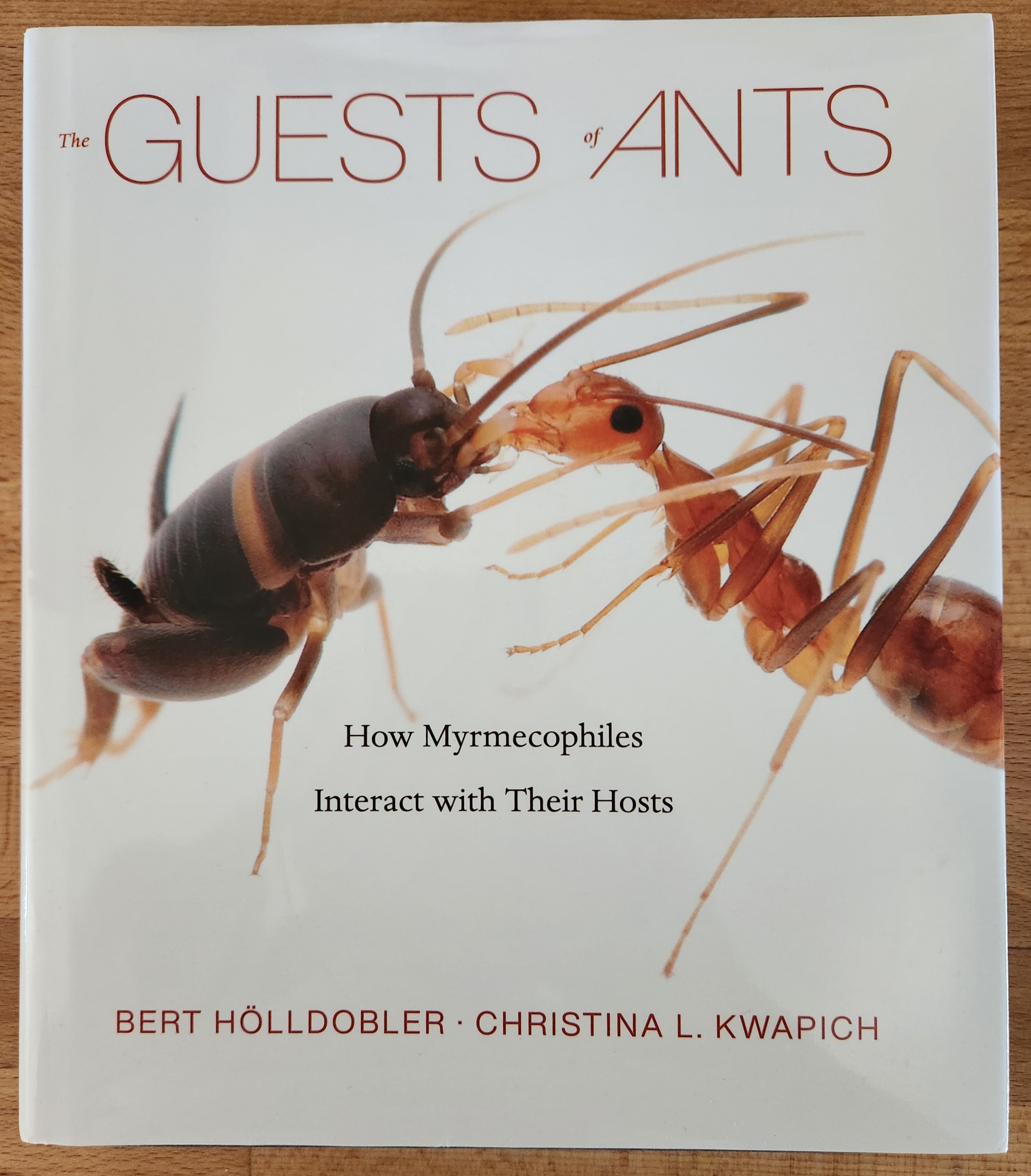
This is the most recent addition to my list of amazing ant books, published just a couple years ago in 2022. The images within are astounding, I found myself gasping as I turned pages to come across beautiful photographs of behaviour rarely seen. This tome is focused on the adaptations and behaviour of “Myrmecophiles”. It’s hard to define myrmecophile* because the interactions range from parasitic organisms dependent on killing their hosts (ant-decapitating phorid flies for instance) to beetles that appease their ant hosts with nectar secretions in exchange for a safe stay within an ant nest. So much is unknown about these complex interspecific interactions and the mysteries unfold in incredible stories throughout this book, leaving me wanting a sequel.

*the word means “ant-lover” which I guess could apply to me? Am I a myrmecophile of sorts? Are you?

Things I learned: Some mites ride on ants’ heads or feet, some spiders are ‘transformational mimics’ of ants: meaning that they resemble different ant species at each successive moult, there is a subfamily of crickets (featured on the cover!) which depend on ants, one species lives exclusively on Yellow Crazy Ant liquid food exchange, there are even frogs which live inside ant nests by chemically masking themselves.

I’m sure there are more excellent books about ants out there (I can actually think of a few more myself…) but these are my top favourites from the ones I’ve read. Do you have any recommendations? Let me know! I’m always up for a good book recommendation about one of my favourite animal groups.
Categories
book review

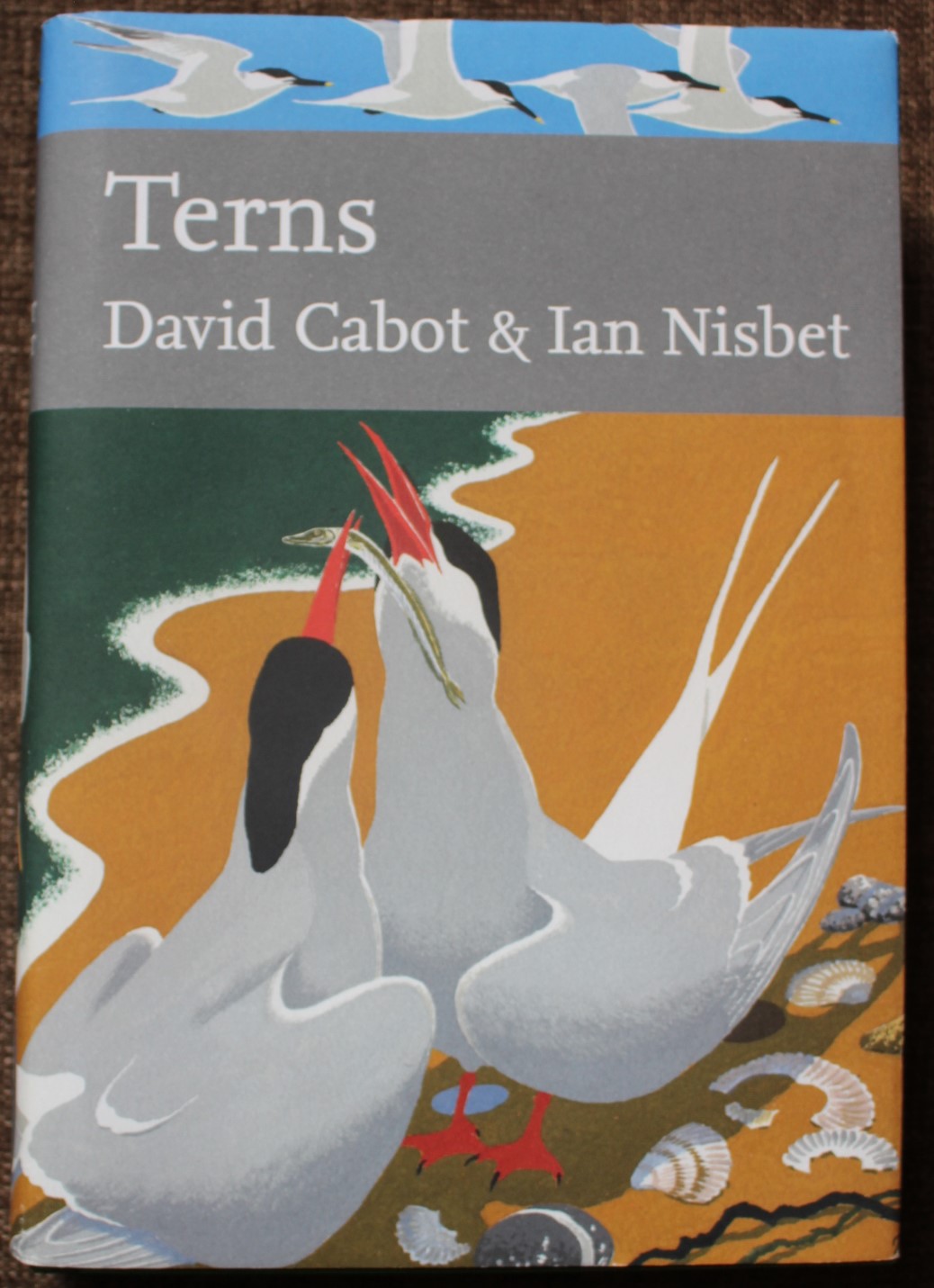
Terns, by David Cabot and Ian Nisbet

I remember the first time that I saw a Tern in Southern Ontario, and believed that I was seeing an especially rare sighting. In my head at the time (this was almost ten years ago) Terns were oceanic birds that migrated huge distances across the waves, and were either in the middle of the Arctic Ocean, or amid stormy Southern seas. This idea of Tern distribution and migration was based on the only Tern species that I knew: the Arctic Tern (Sterna paradisaea) and even then only loosely. The Tern I observed flying and diving for fish in Waterford, Ontario was most likely not an Arctic Tern, but rather a Common Tern (Sterna hirundo). Since that perspective-changing observation, I have been looking forward to learning more about these beautiful birds. Thanks to this excellent book by David Cabot and Ian Nisbet, I now have a much greater grasp on Tern biology, ecology, and life history.

Terns is part of a long-running natural history series produced in the UK called The New Naturalist Library. These books are beautiful to look at, both outside and inside and I love having some of this series displayed on my bookshelf. The subtitle of the series is “A Survey of British Natural History” and I will admit to being originally concerned that the content of the books would be not very relevant to a naturalist on the other side of the Atlantic Ocean. For this book in particular, that fear was unfounded. While the focus is undoubtedly British and sometimes very explicitly so, the coverage of this book is extremely valuable to understanding Terns across the world.

The Collins New Naturalist Books are beautiful together on a bookshelf. This is my collection so far.

The book begins with a chapter titled “Terns of the World”, which gives a brief overview of what the authors consider the “true terns” which includes 39 species, and excludes the noddies (genera Anous and Gygis). This brings me to my first complaint in what I consider an excellent book: the use of scientific names (or lack of use). This first chapter is the only chapter to regularly use scientific names when mentioning related terns (ie. genera) or species. Some might find that scientific names break the flow of a book, and I’m sure that’s why it’s written without them later on (for the most part) but I find it incredibly helpful to have the scientific names referenced more often than once at the beginning of a book. I like to remember scientific names of species, it makes finding information about the species a lot easier, and it can even tell you things right in the name itself: members of a Genus are more closely related to each other than members of a different Genus. To use some Tern species as examples: the Arctic Tern (Sterna paradisaea) is more closely related to the Common (Sterna hirundo) and Roseate (Sterna dougallii) Terns (note the same Genus for all three species) than all three are to the Sandwich Tern (Thalasseus sandvicensis) (different Genus). I think the lack of scientific names in most chapters seems out of place given that the text is fairly in-depth and scientific. Even if they didn’t want the flow thrown off for most of the text, I would have liked it if they included the scientific names for the species that were the focused subject of later chapters (see below) even just in the chapter titles for easy reference. In any case, this first chapter does a great job of introducing the terns as a group, offering overviews of the various genera and setting the stage for the following chapters.

The next three chapters continue the theme of giving information on Terns as a whole, and not just the species that are common in Britain and Ireland. They are titled “Food and Foraging”, “Breeding Biology”, and “Migration”. All were full of fascinating information and surprises. “Food and Foraging” described the various ways that Terns find and capture prey (all Terns are predators of mostly aquatic prey except for the Gull-billed Tern (Gelochelidon nilotica) which feeds on mostly terrestrial prey). The chapter conveyed well the foraging strategies of Terns from their perspective, demonstrating how difficult it is for birds to find and catch fish out of water that is often deep. Something I never really considered before is how Terns depend on fish being closer to the surface than fish normally swim. There are various factors that bring fish within the top portion of the water, and thus within reach of Terns (and other aerial predators). One is currents forcing fish to move over shallower sections of a lake or ocean such as sandbars or reefs. But the authors state: “The most widespread factor making prey fish come towards the surface, however, is predatory fish chasing them from below.” Because of this, many Terns follow predatory fish in order to reap the rewards from their attacks on prey fish. This sort of dependence is the sort of behaviour and ecology that I find so fascinating: Terns and Tuna, two utterly different organisms in shape and lifestyle are connected through their use of common prey species. In this sort of way, all species are interconnected and it’s this sort of thing that ecology strives to document and understand. Through the use of photographs, illustrations, and excellent description Tern food acquisition is explored (including the always interesting kleptoparsitism, or food piracy).

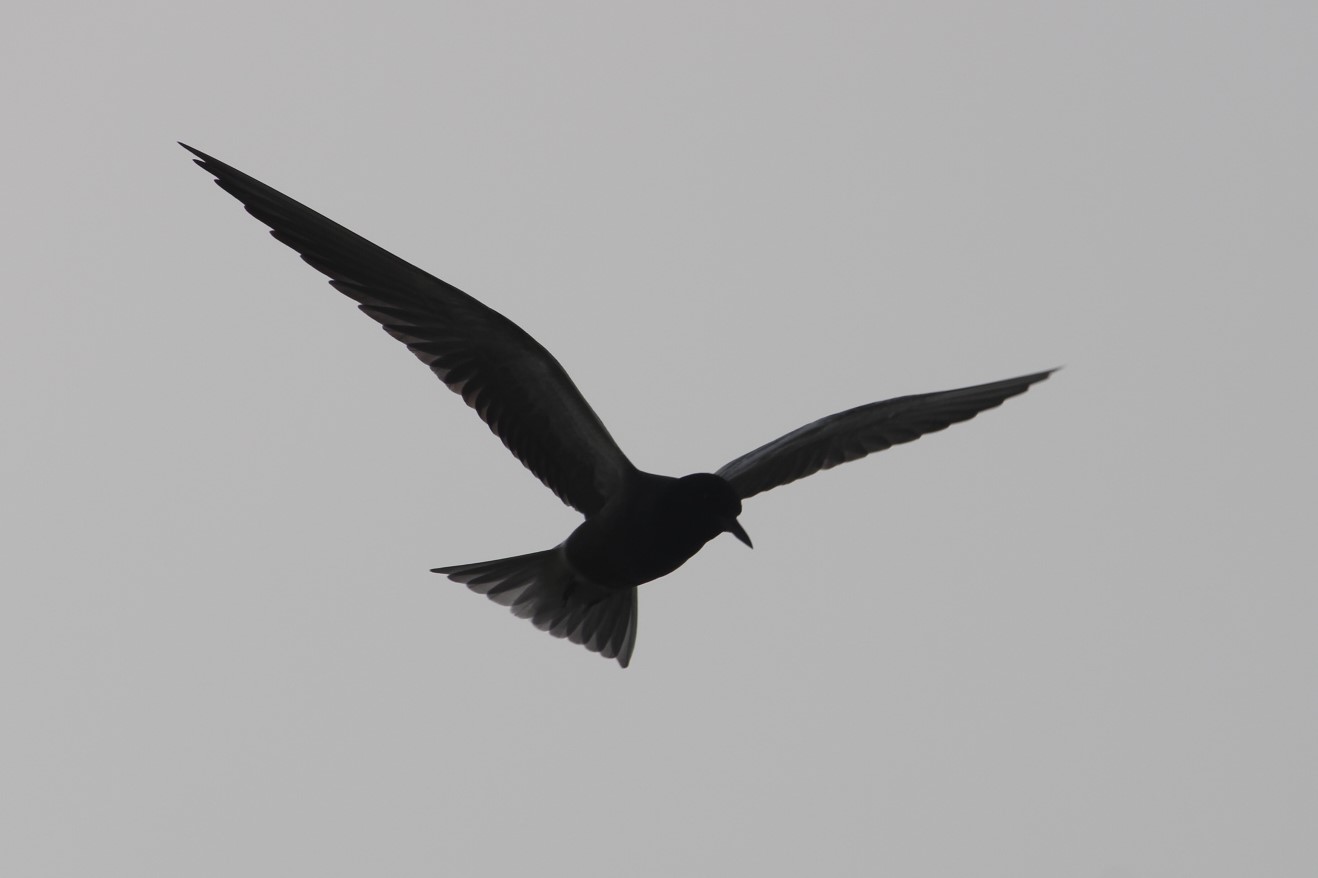
This is the closest encounter I’ve ever had with a Tern, a Black Tern (Chlidonias niger) hovering near me in Long Point.

The following chapter, “Breeding Biology” describes the generalizations and variations on the ways Terns reproduce. Terns use impressive courtship displays both in the air and on the ground to attract and retain mates. I found the description of courtship-feeding (in which the male brings prey to the female) to be especially interesting, summarized nicely by the authors: “Thus, the function of courtship-feeding evolves gradually from advertising the male’s proficiency, through attracting a mate, establishing and cementing a relationship, to provisioning the female and providing the nutrition required for making the eggs.” Once the pair is established, both partners incubate the eggs, feed the chicks and guard them, though males are more likely to provision more often both the female and the chicks (probably because of the continuing courtship-feeding described above).

The final chapter in the broader overview section of the book is all about Migration. My vision of Arctic Terns being exotic oceanic birds crossing the globe is actually not entirely inaccurate. Some populations of Arctic Terns spend the northern summer breeding in the Arctic, and spend the northern winter in the Antarctic, literally crossing from the top of the world to the bottom. It’s mentioned that because of this incredible world-spanning migration: “These birds would experience more daylight in the course of a year than any other animal.” (p 91). Despite these amazing journeys that inspire appropriate awe and interest, we know very little about how Arctic Terns actually migrate, or even their migration routes in detail. This is true of other Terns as well, though the picture is slowly resolving as we gain better technology for tracking bird movements. This chapter explains the current state of tern migration knowledge well and mentions where we are still lacking information.

The chapter following the overview chapters detailed above brings the focus more directly onto Britain and Ireland, as it’s titled “History of Terns in Britain and Ireland”. The chapter delivers on its title, including excellent historical illustrations. Not only does the chapter describe the population changes of the different species of Terns in Britain and Ireland over time, but it mentions some of the reasons (when known) for such changes, as well as various human interactions with these species. Mentioned several times through this chapter is the egg collecting and the methods of scientific collecting in the past (shooting dozens of birds per colony with guns instead of cameras), which obviously had negative effects on tern populations.

The main portion of the book (almost half, if you don’t include the Appendices and References) is made up of five chapters each of which is devoted to a single species of Tern, the five species of Terns that breed in Britain and Ireland. These are: Little Tern (Sternula albifrons), Sandwich Tern (Thalasseus sandvicensis), Common Tern (Sterna hirundo), Roseate Tern (Sterna dougallii), and Arctic Tern (Sterna paradisaea).

These species-focused chapters are thorough and engaging, presenting a detailed account of breeding biology, habitat use, and behaviour. There are specific details included about the populations within the region of focus (the British Isles) such as historical population trends and distribution. Despite this regional focus, the descriptions of tern behaviour and biology is applicable across these species’ range. The Least Tern (Sternula antillarum) is closely related to the Little Tern, and has been spotted in Ontario. Common Terns are widely distributed, also occurring in Ontario. Arctic Terns sometimes occur in Ontario as well. So 2 of 5 species occur both in the British Isles and my own region, and another is very closely related and similar to a local species.

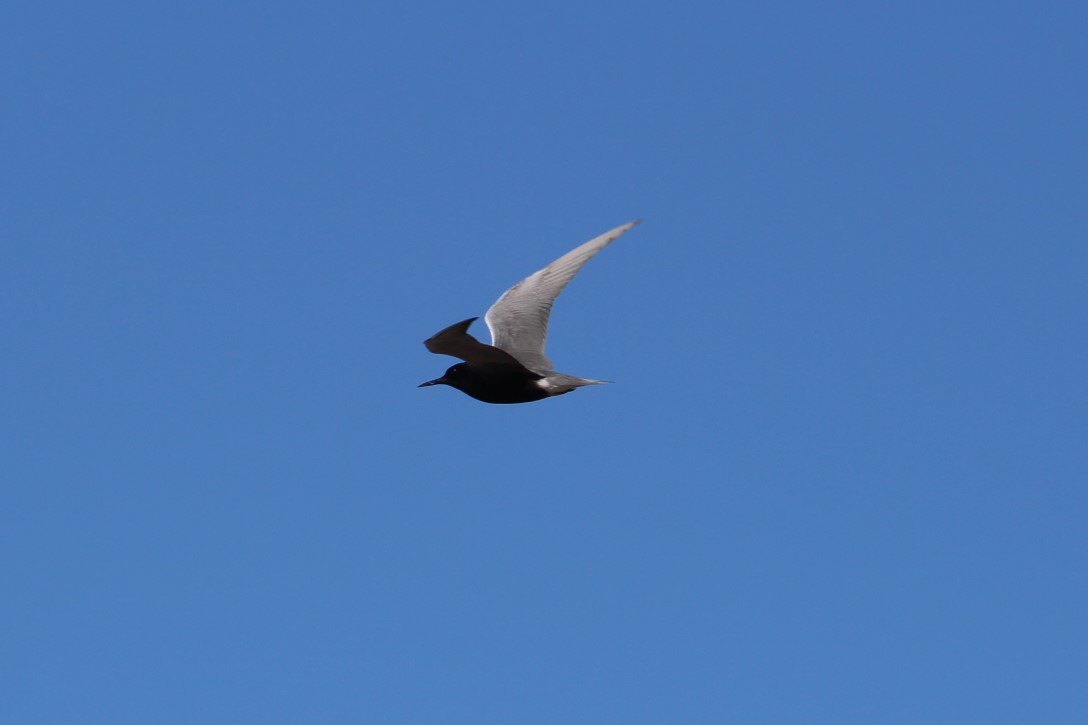
This photo demonstrates better the colouration of Black Terns though it is further away.

Following the species-chapters is a chapter on Conservation, full of case studies and the description of various effects on tern populations in the British Isles, as well as the efforts to alleviate the negative effects.

The final chapter was probably my least favourite, only because I don’t live in Britain or Ireland. Chapter 12: “Vagrants, Passage Migrants, and Occasional Breeders” is aimed very specifically at the British Isles Birder, describing the rare tern sightings within the region.

To round off the book, there are a few Appendices which were good supplementary material on Tern Research and Population monitoring.

Overall, Terns is an excellent book about the biology and behaviour of Terns with a distinct focus on the species that breed in the British Isles. But don’t let your locality deter you from checking out this book if you are interested in diving deep into the world of these fascinating seabirds.

For previous book reviews, see:

Flora of Middle-Earth

Pterosaurs, by Mark Witton

The Social Biology of Wasps

The Palaeoartist’s Handbook, by Mark Witton

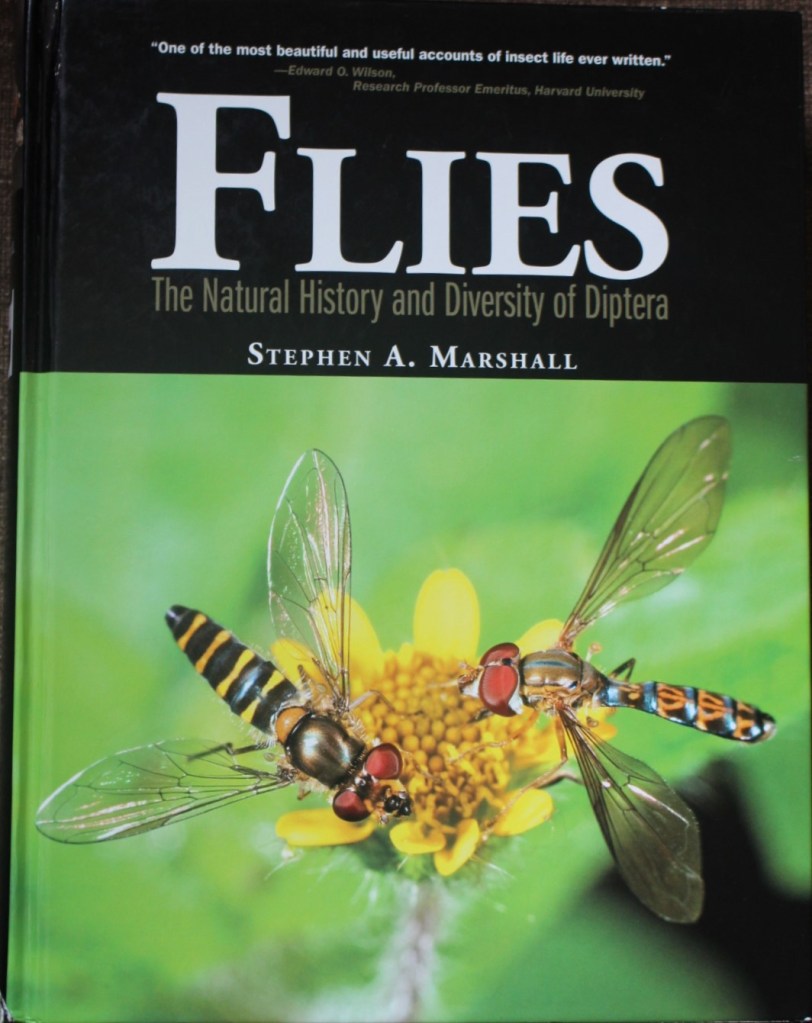
Flies: The Natural History and Diversity of Diptera, by Stephen A. Marshall

Categories
book review

Flies: The Natural History and Diversity of Diptera, by Stephen A. Marshall

People are always going on about how Beetles are so diverse, biologists are always explaining to theologians that God must really love Beetles*, and whenever anyone asks “What’s the most diverse group of organisms?” Beetles are always top of the list. UNTIL NOW.

*in case you don’t know the anecdote this is referring to, the earliest source (according to quoteinvestigator.com) runs thus: “There is a story, possibly apocryphal, of the distinguished British biologist, J. B. S. Haldane, who found himself in the company of a group of theologians. On being asked what one could conclude as to the nature of the Creator from a study of his creation, Haldane is said to have answered, “An inordinate fondness for beetles.”” (Hutchinson 1959).

Stephen Marshall proposes in his magnificent volume on the diversity of flies that there are historical reasons why beetles are held up as so diverse when the truth is that they might just be more closely studied than other insect groups… other groups like the order Diptera (true Flies), for instance. And if you read through this 600 page volume loaded with superb photographs and covering every single family of flies in some detail you will come away with the powerful impression that Stephen Marshall is on to something. Flies, a group often neglected because they don’t always photograph well, many look very similar to each other, and a lot of them have distasteful feeding habits, are showcased as the hyper-diverse evolutionary marvel that they are.

Metallic Green Long-legged Fly (Condylostylus sp.), photographed in my backyard, June 2018. I’m just going to post some of the many interesting flies that I’ve photographed myself throughout this article. Stephen Marshall mentions that digital photography is opening up the realms of entomology to amateurs in a way that hadn’t been possible in the past. I wholeheartedly agree!

The book’s first part: “Life Histories, Habits and Habitats of Flies” runs through a sampler of what flies do as larvae and adults. This includes the life cycles of Diptera in general, but elaborates on more specific groups where appropriate. Other sections in this part describe flies interacting with plants, fungi, invertebrates and vertebrates. This entire section comprises about 90 pages and goes into considerable detail on specific guilds* such as the worldwide coastal communities of “wrack flies”, flies that have larvae that feed within decomposing piles of seaweed washed upon shores. Along with the various interactions between flies and invertebrates, this section also includes a discussion of the many human diseases caused or carried by flies such as mosquitoes (Family Culicidae) or house flies (Musca spp.).

*A guild is a group of animals that are united by a common feeding strategy or resource use, but not necessarily united in relatedness. For example, flies from different branches of the Dipteran family tree are considered part of the leaf-mining guild if their larvae produce mines in leaves.

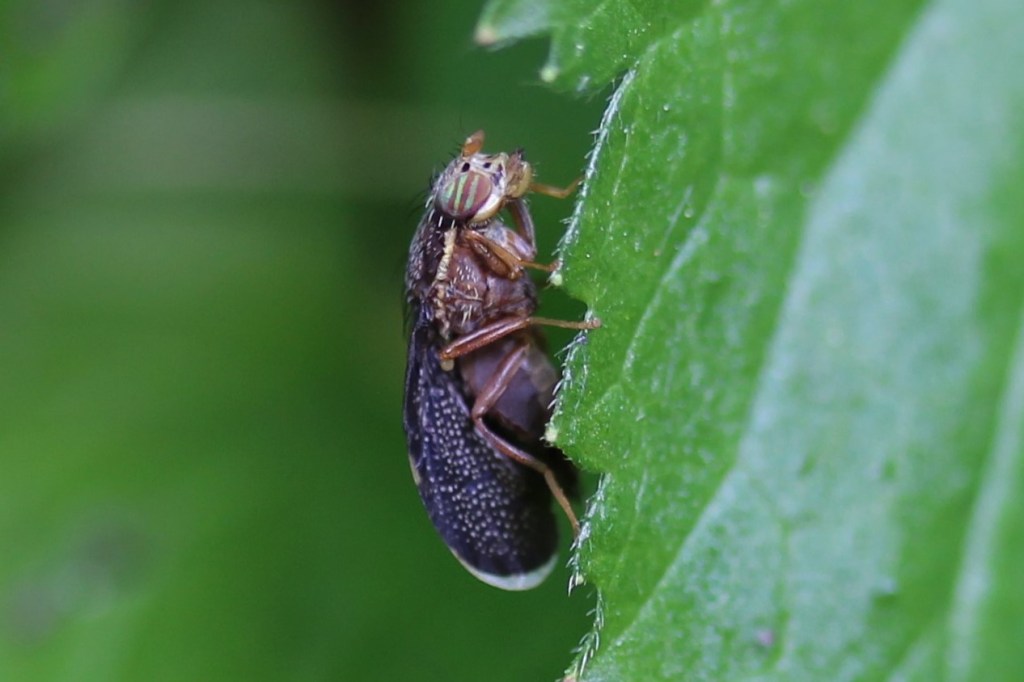
Eutreta novaboracensis, a Fruit Fly of the family Tephritidae, photographed in my backyard, June 2018.

The second part of the book is titled “Diversity” and reading through this catalog of fly families and subfamilies truly does drive home just how incredibly diverse the Order Diptera is. Each chapter covers a large portion of the fly family tree and opens with a diagram of the proposed relationships between the fly groups within. This opening section of each chapter moves from family to family, and describes the basic characteristics of each group detailing subfamilies where possible as well. Within these descriptions are not just lists of characters used to distinguish one family from another but also the basic biology of each group when known. A couple of key things to note here: even when dividing up the flies into smaller and smaller groups it can be hard to generalize because you are still dealing with huge swaths of species in some instances and in others you are simply dealing with species doing very different things despite their close-relatedness. Marshall does a good job of explaining this and I’ll provide an example here from the section on Tipulidae (the Crane Flies, of which there are more than 15 000 described species): “Although most larvae with known biologies are saprophagous and eat microbe-rich organic matter (normally, decaying plant material) in wet environments, some crane flies are predaceous, fungivorous or phytophagous… Some groups have become specialists in extreme environments such as caves, marine intertidal zones and deserts, but most occur in humid forests and wetlands. Most Tipulidae are unknown as larvae.” (Marshall 2012 p. 110).

Crane Fly (Tipula sp.) photographed on the Lynn Valley Trail, May 2018.

The above quote demonstrates the way in which Marshall overviews the lifestyles of the fly groups providing tantalizing glimpses of their diverse life histories, but it also provides an example of something that is rife within the 600 page volume: the overwhelming amount of flies or fly habits that are unknown. To demonstrate, here are some quotes from throughout the book (Marshall 2012):

Valeseguya rieki is known only from a single male specimen” (p 136)

“Larvae and larval habitats of the Lygistorrhinidae remain unknown” (p 141)

“Nothing is known of the biology of these obscure little flies [Ohakunea]” (p 141)

“adults of Oreoleptis (and thus the family Oreoleptidae) have yet to be collected in the field” (p 198)

“The 500 or so species of Acroceridae occur in every part of the world, but most are known from only a few specimens” (p 205)

“Essentially nothing is known about the biology of either Apystomyia or Hilarimorpha” (p 235).

“Even though signal flies [Platystomatidae] are usually conspicuous and attractive flies, many species remain undescribed.” (p 332).

“Larvae are unknown for most species in the family [Lonchaeidae] and little is known about behavior” (p 335).

“The biology of most Pallopteridae species remains unknown” (p 339).

“The truth, however, is that we know almost nothing about the life histories of these bizarre flies [Ctenostylidae]” (p 340)

“Nothing is known about the biology of this group [Nothybidae]” (p 348)

“Despite a worldwide distribution, with about 140 known species spread over every zoogeographic region, not much is known about asteiid biology.” (p 363)

“Nothing is known of the biology of the Neotropical dwarf fly genera [Periscelididae]” (p 365)

The quote list above is not comprehensive, but rather a sampling to show some of the many groups of flies that are mysterious despite their ubiquity in some cases. I don’t want the quotes above to be taken as evidence that the book contains little in the way of information on the flies of the world, seeing as so little is known overall. On the contrary, this volume is chock-full of biological details found nowhere else except the specialized literature and I found myself blown away by many intriguing and fascinating descriptions of fly families and subfamilies. Below are a few of the more interesting groups I had never encountered before reading through this book.

Frog midges (Corethrellidae) are attracted to singing frogs where the females feed on the frog’s blood. Some Phorid flies lay their eggs inside ants, where their larvae consume the ant’s head from the inside. After feeding within, the larvae decapitate the ants and pupate within the armored shelter before emerging as adult flies. These flies are known as ant-decapitating flies, and there are more than 300 species of them in the genus Apocephalus. Vermileonidae is a family of flies known as “wormlions” which are essentially the antlions of the diptera, their larvae constructing cone-shaped pits to trap wandering insects for prey. The Fergusoninidae is a family of flies that “develop only in galls induced by a specialized and codependent group of nematodes” (Marshall 2012, p 366).

Probably my personal favourite are the smoke flies. The smoke flies, platypezid Microsania spp., are attracted to fires (even campfires) but are rarely seen elsewhere. The smoke fly swarms are often followed by the predatory empidid dance fly Hormopeza which “seems to be a specialized predator of smoke flies. Like Microsania, the smoke dance flies are rarely seen except when they appear in plumes of smoke.” (p 298). I feel like the smoke flies, a group of species that can be attracted to something as common as a campfire, and yet are known from basically nowhere else (and thus poorly understood biologically) perfectly encapsulate the mystery and wonder of flies that I have gained from reading this book.

All of this fascinating information is found within the comprehensive and authoritative text, and after going through family by family in this fashion, each chapter in the “Diversity” section has a “photographic guide” portion which covers representatives of most subfamilies with further notes on natural history and significance of genera pictured. The scope of the pictures is mind-boggling and further bring home the diversity of flies, as well as their surprising beauty.

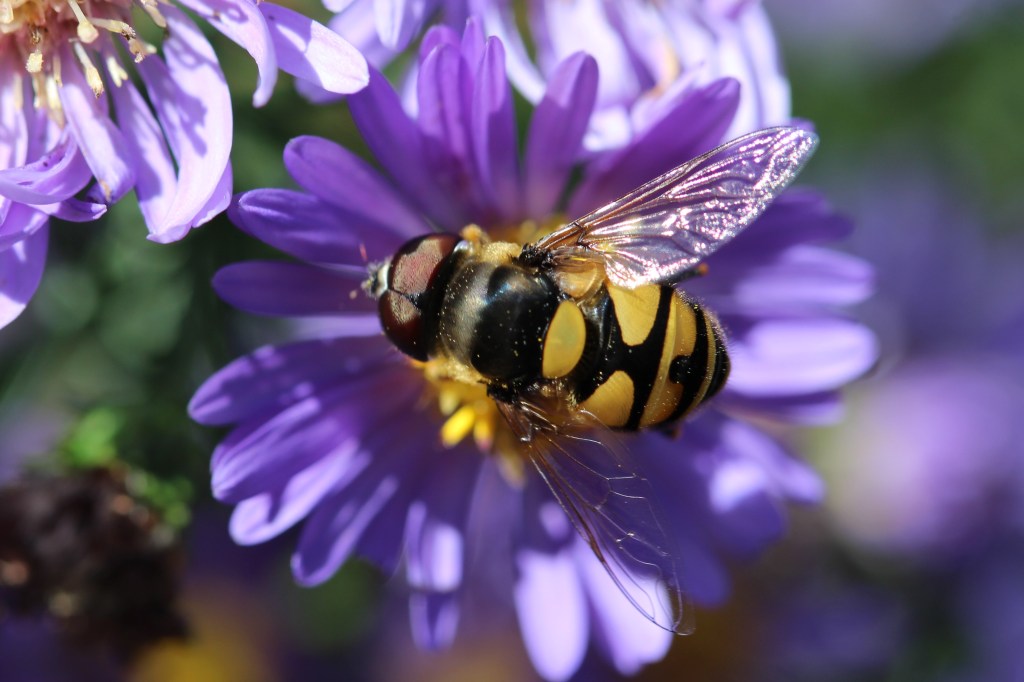
Transverse-banded Flower Fly (Eristalis transversa), photographed in my backyard, September 2018.

The final, shortest section covers collecting, preserving and identifying flies, and contains notes for those interested in starting insect collections of their own (as in, pinned specimens) as well as keys for identifying the major fly groups.

I can honestly say that if this book were published with only the text portions I would buy it because the text is just that valuable in overviewing the enormous diversity of the fly families. And I can also say that if this book were published with only the pictures and captions, I would also buy it for the incredible amount of biodiversity on display, captured in wonderful images of flies from around the world.

I cannot recommend this book highly enough. If you are an insect enthusiast, if you are at all interested in the diversity of life and if you enjoy gasping at revelations about the tiny wonders that flit around the world you have to read this book.

References:

Hutchinson, G. E. 1959. “Homage to Santa Rosalia or Why Are There So Many Kinds of Animals?” The American Naturalist93(870), 145–159. http://www.jstor.org/stable/2458768

Marshall, Stephen A. 2012. Flies: The Natural History and Diversity of Diptera.

For previous book reviews, see:

The Paleoartist’s Handbook, by Mark Witton

The Social Biology of Wasps, ed. by Kenneth Ross and Robert Matthews

Pterosaurs, by Mark Witton

Flora of Middle-Earth, by Walter Judd and Graham Judd

And for a podcast review, see:

The Field Guides

Categories
book review

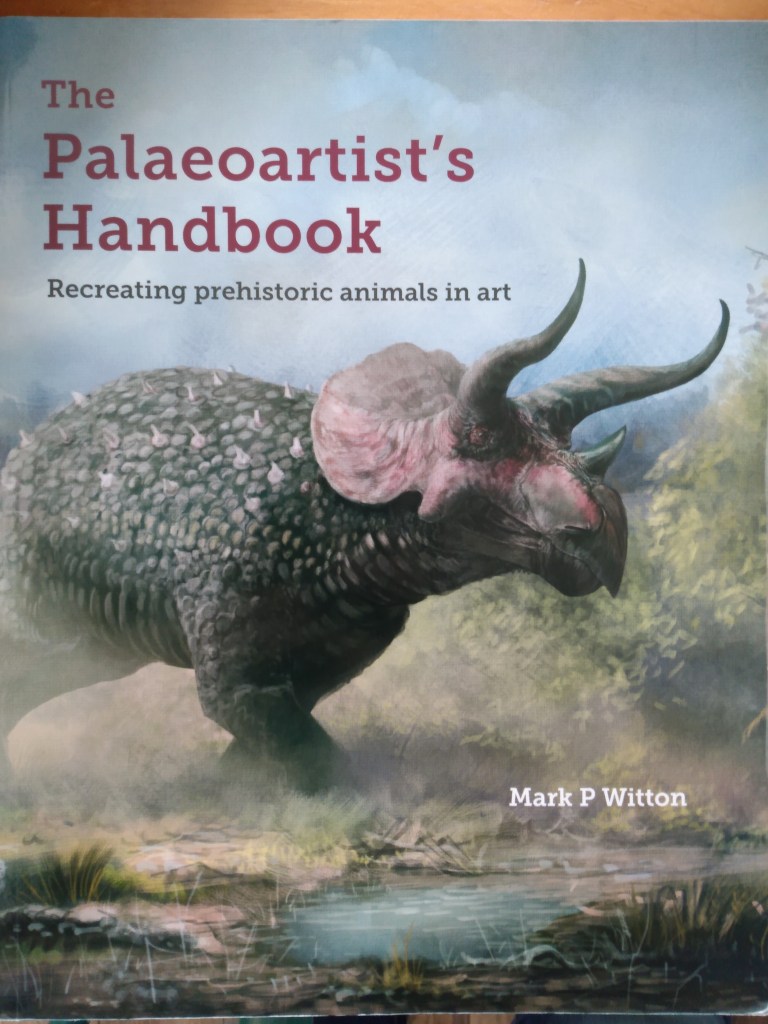
The Palaeoartist’s Handbook, by Mark Witton

I’ll start by saying that I’m no artist. And I have no intention of trying to become one in any form, let alone a Paleoartist (specializing in artistic reconstructions of living things known from fossils). That being said, I can heartily recommend this book to anyone interested in fossil animals, ancient ecosystems, or even just beautiful illustrations of both. The truly impressive quality of this book is that I can even recommend it to someone interested in living animals, as there’s much within that describes how living animals look and function and how that’s applied to the past.

The subtitle of this book is “Recreating prehistoric animals in art”, and the book essentially delves into the process of how one can look at fossils and interpret them into a fully realized organism. The first two chapters define Paleoart (= the subtitle of the book, see above), and go through a brief history of the genre. The history was quite interesting, demonstrating how interpretations of fossil organisms, and the methods used to examine and reconstruct them have changed through the years.

Chapter 3 is titled “Researching, Resource Gathering and Planning a Paleoartwork”. At first glance, this chapter seems to be aimed directly at one who is actually going to create Paleoart, and as I said earlier that’s not me! As with this entire book, however, the focus is on the research itself, and the animals themselves and the principles of imagining and portraying extinct life. So this chapter was actually quite interesting for myself, as someone looking for information on how we believe extinct animals looked. Additionally, there’s a table at the end which lists “Paleoart Memes” which was quite fun to read through. From Marine Reptiles being portrayed as almost fully exposed on the surface of the ocean to the constant violence and roaring of prehistoric creatures, this table is a compilation of ideas that are often repeated in Paleoart but are unlikely to be accurate portrayals of the animals involved. Of course prehistoric animals would have occasionally vocalised, and of course ocean-going animals occasionally spend time at the surface, but the constant repetition of these scenarios is what creates a false impression of the prehistoric world. Animals today don’t habitually yell at each other, especially not while pursuing prey. It’s counterproductive for a Lion to keep roaring while it’s chasing down a gazelle, just as it’s unlikely that Tyrannosaurs unleashed a scream every time they burst from cover after some hapless hadrosaur.

The next 5 chapters (comprising about half the book) are titled “Reconstruction Principles” with various subheadings. This section delves into the nitty-gritty of how we know what we know about extinct animals, and how to find out more. I appreciated the fact that these chapters, while dealing with reconstructing extinct animals, continually offered living examples of the principles being examined so that the ideas presented were always backed by living examples. We can’t KNOW what Tyrannosaurus rex exactly looked like and how it moved without a direct observation of the living animal (which isn’t going to happen without some real sci-fi intervention). We can KNOW what living animal bones tell us about their life appearance and behaviour, and so we can work backward from there. One of the big debates out there about dinosaur life appearance is the visibility of their impressively long and intimidating teeth. For so long dinosaurs’ teeth were prominently on display and exposed to the air and viewer. If we look at living animals, however, we can see that even enormous teeth, such as those of monitor lizards (various Varanus species), are usually concealed within lips most of the time. As with many of these ideas, they are speculative, but looking at the extent of features within living species of animals that we can actually observe help us to familiarize ourselves with the diversity of structures and behaviours and enable us to make better speculation about what extinct animals looked like. This is essentially the theme of this book, and it’s a case that is made wonderfully throughout with countless demonstrations of research on living animals’ correlates between bones and life appearance (as well as trackways, traces and even cave art).

Chapter 9 brings the principles we’ve explored through the middle half of the book to their logical conclusions: “The Life Appearance of Some Fossil Animal Groups”. Using the evidence we have from living species (some of which are related/descended from the fossil species in question), and fossils, Witton describes what many groups of extinct animals may have looked like in life. Absolutely fascinating stuff, this was a wonderful tour through an ancient and unreachable world. The groups covered are all Tetrapods (those ‘four-limbed’ vertebrates from Amphibians to Birds), which is understandable given that adding Invertebrates to the list would substantially extend the book. Some Invertebrates are briefly mentioned in the next chapter along with Plants and surrounding environment: “Recreating Ancient Landscapes”.

The final three chapters are the most artist-focused in the book, detailing how a Paleoartist can depict extinct animals and environments in evocative ways while still remaining true to the science involved. As I’ve said a few times now, I’m no artist, but even these chapters proved interesting reading with analyses of some of Witton’s personal reconstructions and how they may be accurate or inaccurate based on the evidence available.

Finally, I’d like to mention that the book is (probably unsurprisingly) chock-full of wondrous illustrations created by not only Mark Witton himself but a handful of other amazingly talented paleoartists. In addition to this wealth of beautiful paleoart (which in my opinion is worth buying the book for in and of itself), there are countless diagrams and charts that add so much to the presentation of the material. All in all, The Palaeoartist’s Handbook is a fascinating read, full of information about extinct and living animals and ecosystems and detailing how we know what we know about the past. We may not be able to visit past ecosystems in person, but with a book like this, we can begin to truly imagine what they may have been like.

For Other Norfolk Naturalist Book Reviews, see:

The Social Biology of Wasps, ed. by Kenneth Ross and Robert Matthews

Pterosaurs, by Mark Witton

Flora of Middle-Earth, by Walter Judd and Graham Judd

Categories
book review

The Social Biology of Wasps

by Kenneth G. Ross and Robert W. Matthews (ed.)

This book was published in 1991 so it’s certainly not hot off the presses but I’ve recently read it and thought it was worth a Review.

The Social Biology of Wasps is a collection of chapters written by different authors, which can sometimes make the book repetitive but for the most part this volume maintains a consistency of quality and focus that keeps the whole tied together.

The title of this book is key. As much as I would love “The Biology of Social Wasps” this book is more focused than that, instead detailing Social Biology of Social Wasps. The positive side to this focus is that it allows the subject of sociality in the vespids to be explored in great detail, but the negative result is that natural history and basic biology of most species is not discussed in any detail. In this book it allows a more focused discussion, but I would occasionally find it frustrating to find the asnwers to basic questions about the species discussed (what do they eat, what are their nests like, what’s a typical life cycle?) missing or mentioned only in passing in a way that made it difficult to connect some of the arguments of social theory with the species subjects of said arguments/theories.

The first half of the book is called “The Social Biology of the Vespidae”. The chapters in this section begin with two chapters detailing some background on the family tree of Vespidae (where the subfamilies fit) and a very brief overview of the solitary and presocial vespids.

The next six chapters overview the social biology of different groups of vespids. The first, Stenogastrinae, was fascinating to me because it was a group I had never heard of. Stenogastrines are also known as hover wasps and because they’re in the tropics they haven’t received as much study as the temperate wasps. A quote from this chapter will illustrate some of the fascination I felt: “Authors… described with wonder their hovering flight… their shy habits, and their strange, camouflaged nests hidden in the wet and dark parts of the jungle, hanging from roots and threadlike fungi along streams and near the spray of waterfalls.” Another highlight from the chapter on hover wasps was the illustrations of their varied nest architecture, which range from cells lined up in a stack along a stem to cells arranged in a ring, facing inward, creating a donut shaped nest.

There are excellent drawn illustrations through the volume, many done by Amy Bartlett-Wright. Amy is a scientific illustrator and artist who has been doing this now for 35 years. Check out her website: https://amybartlettwright.com/.

These chapters overviewing the subfamilies do well to illustrate what we know and what awaits further study in the social biology of these wasps. They often highlight similarities between strategies but also fascinating differences. One of the comments mentioned multiple times through the book is the influence that ants have had on wasp evolution, as there have been suggestions that they have driven many of the nest designs and defensive strategies of these insects by their relentless ubiquity. A quote that describes this: “There is no potential nesting site in the tropics that is entirely free of ants, many of which readily accept wasp brood as food. It seems likely that the Azteca-wasp nesting associations [an association where Polybia wasps nest inside the nests of Azteca ants, using them as unwitting guards against more dangerous ants] are only the most conspicuous examples of ant-wasp interactions, and that further study will reveal that swarm-founding wasps have as many “words” for ants as Inuit have for snow.”

As I mentioned earlier, these overviews could have done with a little more natural history in my opinion, but as the focus of the book is on the sociality of the wasps, the brevity of such information can be forgiven (the book is already 600 pages long minus the references section).

The second half of the volume is titled “Special Topics in the Social Biology of Wasps”. This half of the book is where repetition between chapters occurs, but usually it’s helpful rather than hindering. Most of the chapters take a particular aspect of the wasps’ biology and use it as a lens to view their sociality through it, demonstrating the various pressures or influences that piece of the puzzle has. For excample, three chapters in a row are about Nutrition, Genetics, and Nest Architecture. Each of these chapters looks at the Social Wasps through their particular focal point and illustrates how it could have provided an impetus for these insects to gain sociality, or at least start them on the path they’re on now. Because of this, it can be repetitive, but usually the repetition reinforces the fact that these are distinct, but not mutually exclusive influences on the evolution and maintenance of sociality. They should be looked at as pieces of the same puzzle, rather than all-encompassing explanations by themselves. One of the most intriguing chapters for myself was Robert L. Jeanne’s chapter “Polyethism” which convincingly demonstrated how individual behaviour can lead to sociality and even maintain it in the colonies of these wasps today, mostly through the comparison of direct reproductive fitness and indirect reproductive fitness.

The chapters on the nests of Social Wasps are fascinating as well, because a nest is something constructed not by an individual as in birds, but by a group of cooperating insects (in many cases, several generations of cooperating insects). These chapters are illustrated with some of the more bizarre nest arrangements (as well as the more familiar) and demonstrate some of the ways in which nest types could develop in relation to each other.

The chapter on the exocrine glands was not particularly fascinating to me, and felt somewhat out of place, since no other chapter dealt with physiology/anatomy of the subject species.

The final chapter, “Evolution of Social Behavior in Sphecid Wasps” was an excellent overview of Sphecid wasps’ social biology. This chapter gave plenty of examples of the diverse paths wasps have evolved down, and the many questions that are raised by viewing comparatively wasps and bees.

Because this book was published almost 30 years ago now, I’m sure that much would be updated and edited in a newer edition. Some of the questions raised will have been answered, many would have branched into further questions. I’m not a professional Social Wasp Biologist, and so I can’t say what those answers are, where the questions now lie, of the focus of such studies are now. I can tell you that as far as I know, there is no other overview volume like this one for Social Wasps. So if you’re fascinated by them like I am and can handle dense science writing, then dive in and learn to appreciate the incredible insect societies that blossom and buzz all around us.

Categories
book review

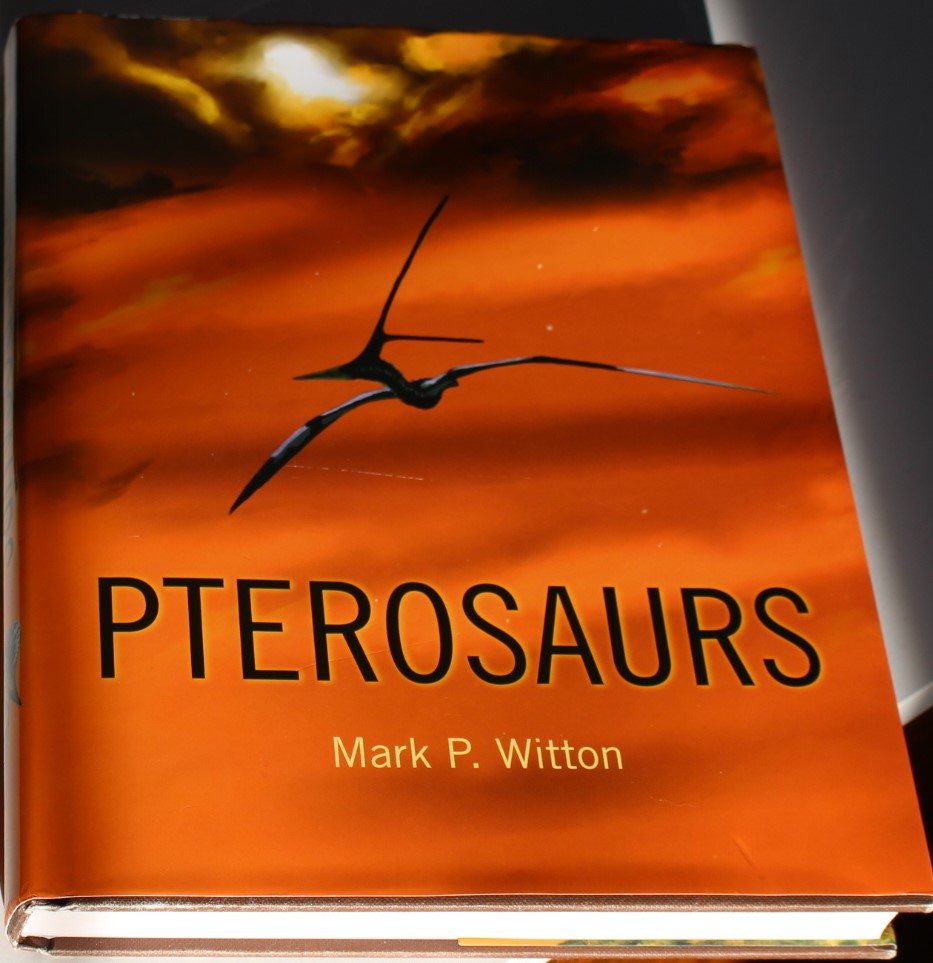
Pterosaurs, by Mark Witton

Anyone who finds fossil animals fascinating will be delighted by this book by Mark Witton. The science is well-explained, yet in-depth, and the illustrations (photographs of fossils, skeletal reconstructions, and paintings) are incredible.

Pterosaurs begins with several overview chapters to bring the reader up to speed on the basics of pterosaur anatomy and terms, demonstrating some of what we know and what we don’t know about these flying reptiles. The majority of the book details each pterosaur group with a chapter. Here you will familiarize yourself with the ornithocheiroids, pteranodontians, and dsungaripterids. As with many dinosaur names, some of the scientific nomenclature can be a bit tongue-twisting, but by reading this book you will begin to tease apart the differences between pterosaur groups and so become more apt to recognize the names even if you have trouble saying them aloud.

Each pterosaur group chapter has a history of the group’s study, an overview of their anatomy (often highlighting differences and similarities between other groups), hypothesized locomotion (how each group of pterosaurs moved both on the ground and in the air), and ideas about the group’s ecology in the Mesozoic. The history of study was often interesting, seeing how a pterosaur group’s identity changed with new fossils or new ideas about old fossils. The anatomy sections are a bit difficult for myself to get through because I’m not a paleontologist and had to often reference the anatomy overview chapter at the beginning of the book. With the overview diagrams’ help, I was able to comprehend most of what was being described, at the least I was able to recognize the major differences between groups that were being highlighted. The sections on locomotion were fuel for the imagination, conjuring images of how these ancient creatures actually moved through their environments. Witton would often compare each groups’ purported flying ability to a modern group of birds to better convey their distinctive flying style. Of course much of this and the ecology sections are speculation, but Witton provides lines of evidence for and against various flying and feeding modes that have been suggested which brings to light what we know and what we don’t about how these animals lived. The ecology sections are my favourite because I love to imagine the animals as part of the Mesozoic environment, living their lives alongside the plants and animals of their time.

Along with the informatively dense but readable text are the illustrations which are amazing. For each pterosaur group there is at least one skeletal reconstruction of a species along with a fully realized painting of them launching. Besides these, there are photos and drawings of particularly well-preserved fossils. Accompanying each chapter is at least one full-page painting of a scene from the time of the pterosaurs, whether it’s Pteranodon diving into the ocean after a bait-ball of fish, or a Rhamphorynchid investigating a Jurassic snail. These paintings are wonderful at giving life and colour to the fossils and placing these creatures in their setting.

Sprinkled throughout the information-rich text is humour. My personal favourite is a caption for a painting of Azhdarchids which describes them as fleeing the next chapter about pterosaur extinction.

All in all, the book is a wonderfully informative, beautifully illustrated volume, full of descriptions and context for a group that doesn’t get as much press as the Dinosaurs. After finishing this book, you’ll be convinced that pterosaurs were an amazing and unique group of fossil animals as well, that deserve to be treated with the same amount of awe and wonder.

Categories
book review

Flora of Middle-Earth

Despite paying a lot of attention to the little invertebrates that scurry about in the undergrowth, I tend not to pay too much attention to plants. This isn’t on purpose, or because I dislike them for any particular reason, but I think it’s difficult for us to look at them in the same way that we look at animals because they don’t move about (on the same timescale or in the same ways) and they don’t seem to display varied behaviours. If we can move past these false ideas about plants we may realize that life doesn’t flourish against a green background, but rather, the drama of life plays out amid the foliage and thorns and seeds and roots just as much as it does amid the fur and feathers, claws and teeth.

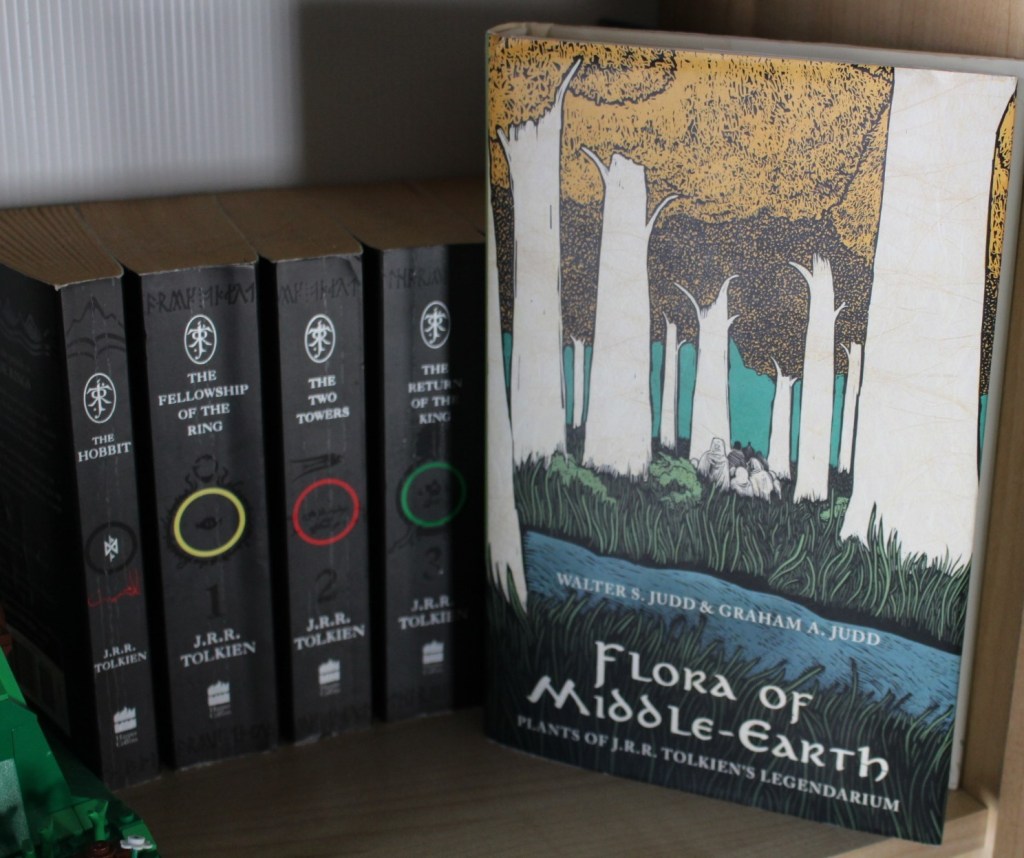
One book that has opened my eyes to this world of green, growing things is Flora of Middle-Earth by Walter S. Judd and Graham A. Judd. 

I have been an avid fan of Tolkien’s mythos and the science of living things for most of my life, so when I found this book, I felt that it had been written specifically for me. What really drew me to the book was that it was written by a world-renowned plant scientist and this knowledge shows through details of plant biology and ecology within its pages. The book succeeds on both a scientific and a literary level, as the author and illustrator understand plants and Middle-Earth extensively. They even draw on the History of Middle-Earth series which are unfinished manuscripts by J. R. R. Tolkien put together by Christopher Tolkien, to fill out the botanical landscape of this fictional, yet powerful world. The first chapters give an overview of plant biology, evolution and ecology, as well as outlining the biogeography of plant ecosystems in Middle-Earth throughout its known history (First to Third Ages). After this, there is a chapter that contains a key to identifying the plants that are detailed through the majority of the book so that if you encountered a plant in our world you could follow the descriptions to its genus or species. This section isn’t particularly useful in my opinion because although Tolkien mentions over a hundred plant groups within his legendarium there are many more plants that exist, so that you could very easily follow the keys to a dead end. Next is a chapter devoted to the two most important plants in Middle-Earth: Telperion and Laurelin, the Two Trees of Valinor. This was interesting, seeing where Tolkien might have drawn his inspiration for the fictional Trees from plants that exist in our time and place. 

Following this is the largest section of the book which runs through over 140 plant types mentioned in Tolkien’s writings. For each plant, there is a quote containing a mention of it, a general overview of its place within Middle-Earth ecology and culture, a study of the plants names (how Tolkien can you get?), a description of the plant’s ecology and biology in our world, a mention of its place in human culture and a botanical description of its form. Alongside this impressively detailed treatment, many of the plants receive a woodcut-style illustration which shows them in the context of Tolkien’s stories and world. 
The final chapter is a Note from the Illustrator, so if you’re interested in this book primarily for the artwork, there is a description at the end of how and why he created the illustrations the way he did.

Part of what enhanced my appreciation of the book was reading it while in Algonquin Provincial Park, a place filled with memory and meaning for myself, just as Middle-Earth is. Reading about a plant’s place in Tolkien’s writings while encountering some of the same plants in Algonquin Park was an experience that is a microcosm of what is so special about this book and the Tolkien legendarium as well. Tolkien’s writings shed a new light on the world around us, just as this book sheds light on a piece of that world (Middle-Earth) and our own world.

The greatest accolade I can give this book is that I learned a lot about Tolkien’s Middle-Earth and the ecology of plants in our own world. If you’re interested in either of those things, I would highly recommend this excellent, beautiful book.

Algonquin Park in Autumn.