I love ants. If you’ve read some of my blogposts or know me personally you already know this. My admiration and appreciation for these animals was built in large part by reading well-written and informative books about ants. I want to take a mini tour through my bookshelf to describe, introduce, and recommend my favourite books about ants.
The Ants, by Bert Holldobler and Edward O. Wilson
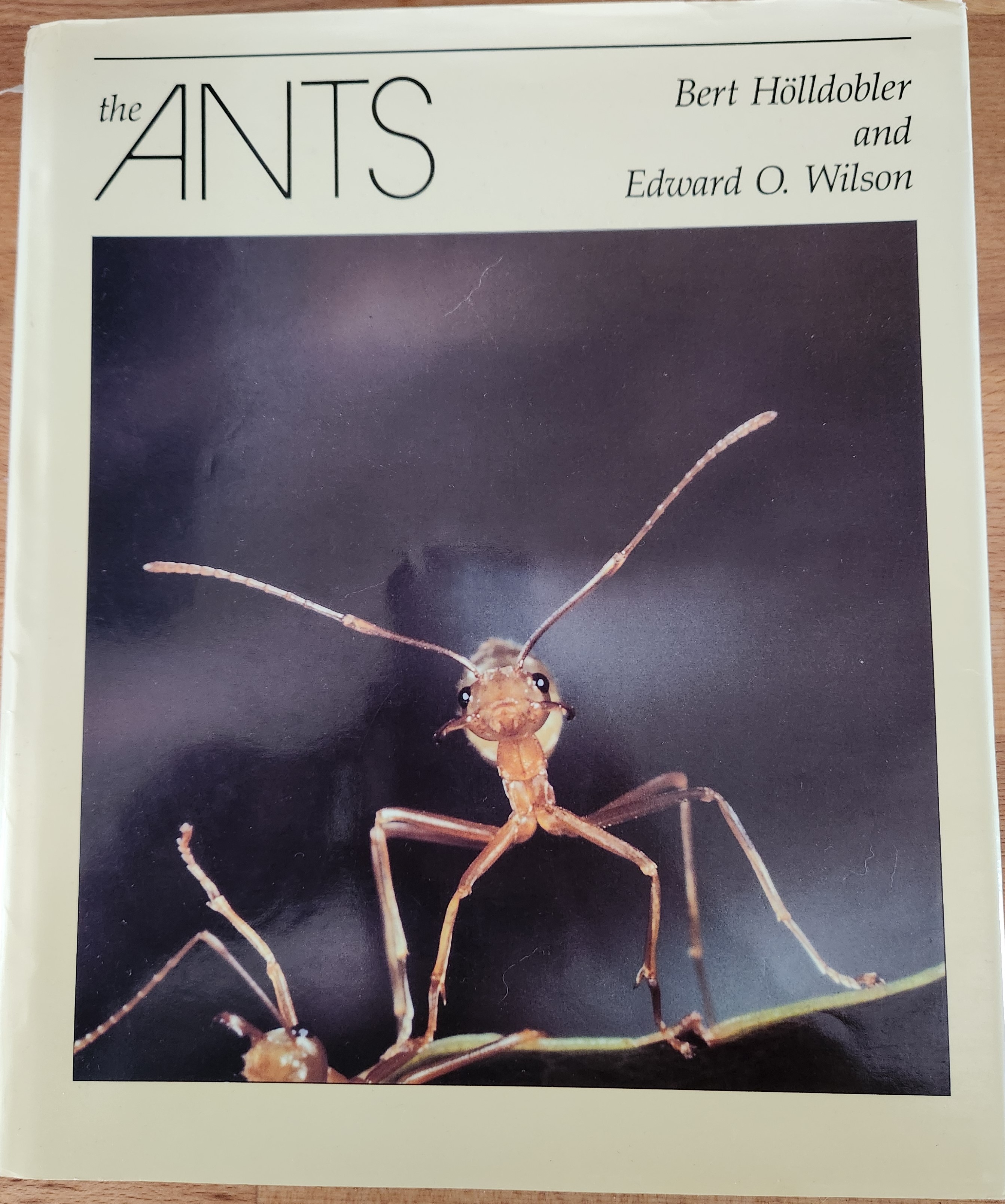
As you can guess from the monolithic title, this is THE book about Ants, covering them comprehensively from their anatomy to their ecology. Despite the wide variety of topics, there is a throughline of focus on the sociality of ants which is unsurprising given E. O. Wilson’s personal interest in the subject*. Despite being comprehensive for its time (published in 1990), The Ants reads with a narrative flow and moves smoothly from one fascinating topic into the next. The dense information is conveyed in a very engaging fashion and illustrated with wonderful line drawings throughout. If you are seriously interested in ants, there is no equal to this tome.
*E. O. Wilson has written several books focused on the evolution of social behaviour in animals inspired by his studies of social insects, including Sociobiology, The Social Conquest of the Earth, and The Insect Societies. I can personally recommend The Insect Societies as an excellent introduction to the social insects. Despite being published almost over 50 years ago now (in 1971), the text is engaging and informative and serves as an excellent overview/introduction to the world of eusocial insects.
Things I learned: Weaver ants wage territorial wars across treetop empires, carpenter ants bring their aphid “cattle” inside for winter and then bring them back out to their host plants in Spring, honeypot ants have a “storage” caste which hangs from the ceiling of their nests as living larders and many many more fascinating insights into the incredibly diverse and complex world of ants.
Field Guide to the Ants of New England, by Aaron M. Ellison, Nicolas J. Gotelli, Elizabeth J. Farnsworth and Gary D. Alpert

This is the only pictorial field guide to ants that I’ve encountered and as such it is extremely valuable to me. I haven’t read through it, but have used the keys on the inside of the front and back covers to identify my ant photos to subfamily and then gone through the genus and species photos looking for a match. The layout and design is excellent, and the natural history notes are great as well. Although this is a guide to the ants of New England specifically, the ants of southern Ontario overlap with the ant fauna of New England to a great extent, making this an important field guide for ant enthusiasts in various regions across Eastern North America.
Things I learned: double-petiole ants are almost certainly part of the subfamily Myrmicinae in our area (northeastern North America).
Adventures Among Ants, by Mark W. Moffett
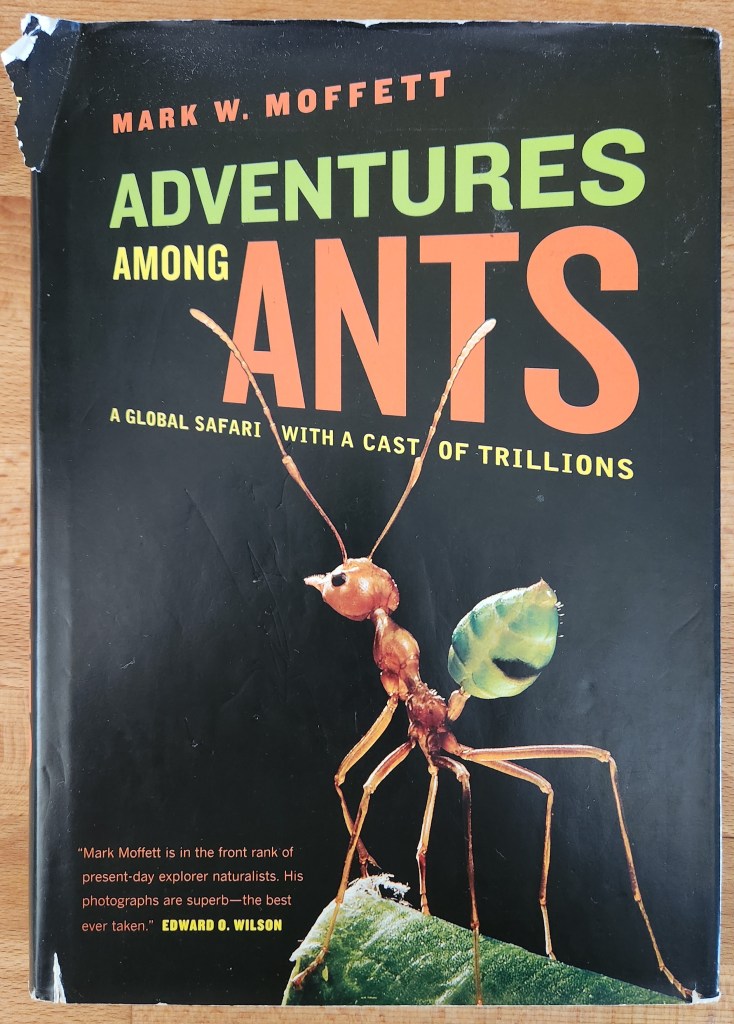
If you’ve ever wondered what it’s like to explore tropical rainforests in search of ant empires, this is the book for you. The stories of fieldwork transport you to the fascinating ecosystems of the tropics and the incredible ants that can be found there. This book was a gateway book for me because it was semi-popular science and also fairly technical. The adventures of fieldwork and the bizarre adaptations of tropical ants combine to make this an exciting dive into myrmecology.
Things I learned: Weaver ants use their larvae as glue guns to sew leaves together in their arboreal nest construction, fire ants construct living rafts with their bodies in order for the colony to survive floods, marauder ants (Carebara diversa) have a 500-fold size difference between minor workers and major workers, such that the minor workers can ride comfortably atop the major’s head without causing a stir.
Army Ants: The Biology of Social Predation, by William H. Gotwald, Jr.

Who isn’t astounded by army ants? They are the ultimate super-organism, a group of tiny individuals acting as one large predator. From reading The Ants I was already introduced to these miniature soldiers and the concept of the “social stomach” where because ants share their food and resources among colony members you can think of them as having one stomach. In the army ants’ case you can also think of them as having “social mandibles”, tearing into prey in their path as a group and subduing surprisingly large prey items.
Things I learned: There are many different species of Army Ants, members of multiple subfamilies.
The Fire Ants, by Walter R. Tschinkel
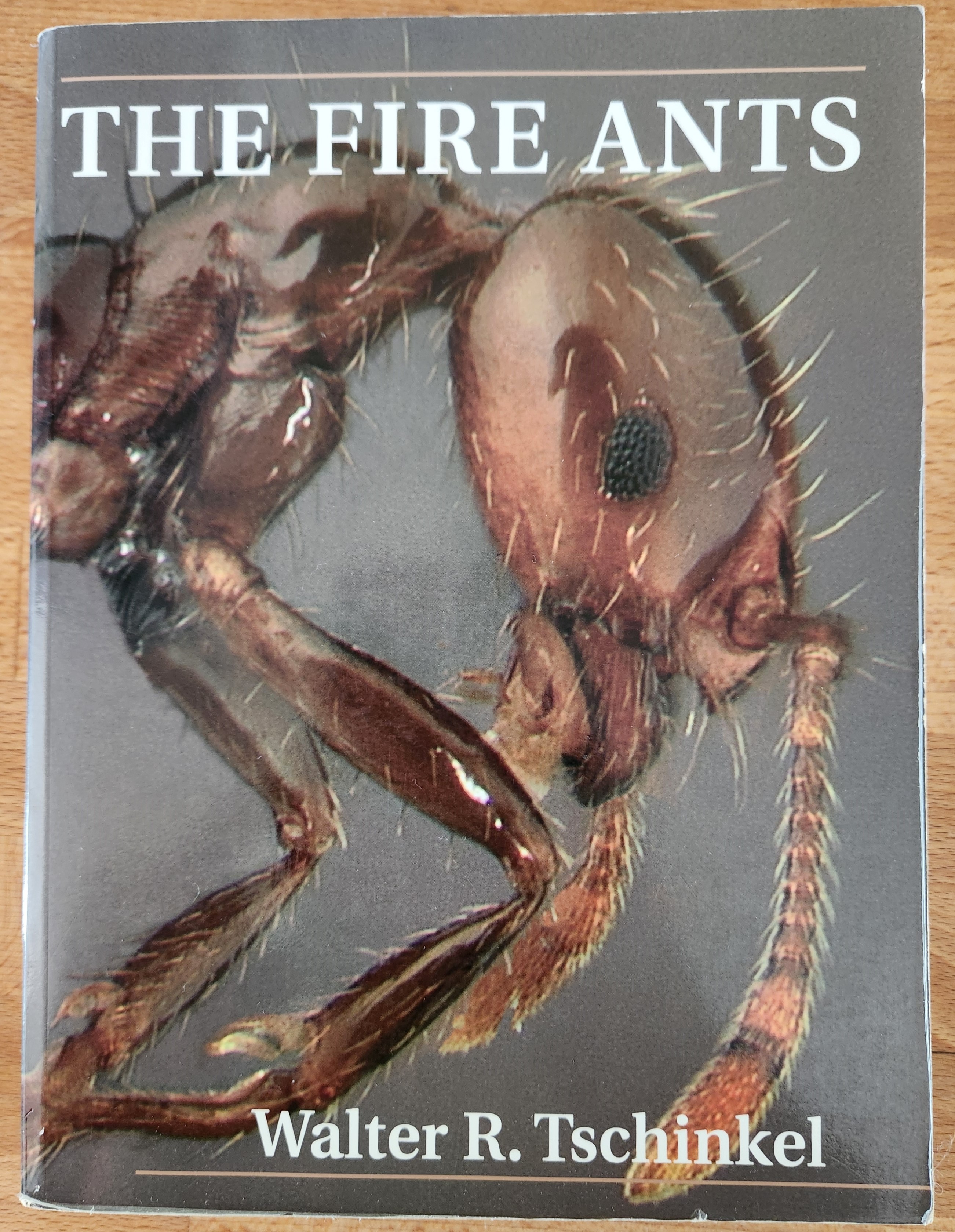
Talk about a monograph. If reading a 600-page book about a single species of ant feels like a dream come true to you, then you are me. Surprisingly humorous and extremely insightful into the world of fire ants, this incredible book deals with some other ant species but is especially focused on the invasive fire ant Solenopsis invicta, which has spread across the southern half of the United States over the past half-century or so. Part case-study of an invasive species, part monograph on all biological aspects of said species, this excellent book also contains vignettes about the author’s work as an ant researcher (properly a myrmecologist) and many fascinating stories about fascinating ants.
Things I learned: fire ants have super complex colony founding, they can become super colonies or super territorial and it’s genetically determined. This discussion of fire ant genetics and alleles was actually the most well-written explanation of the genetic research and relevance that I’ve ever read (as in, I could understand and follow it, genetics is often a bit over my head with all of its complexity and biochemistry).
The Guests of Ants, by Bert Holldobler and Christina L. Kapwich
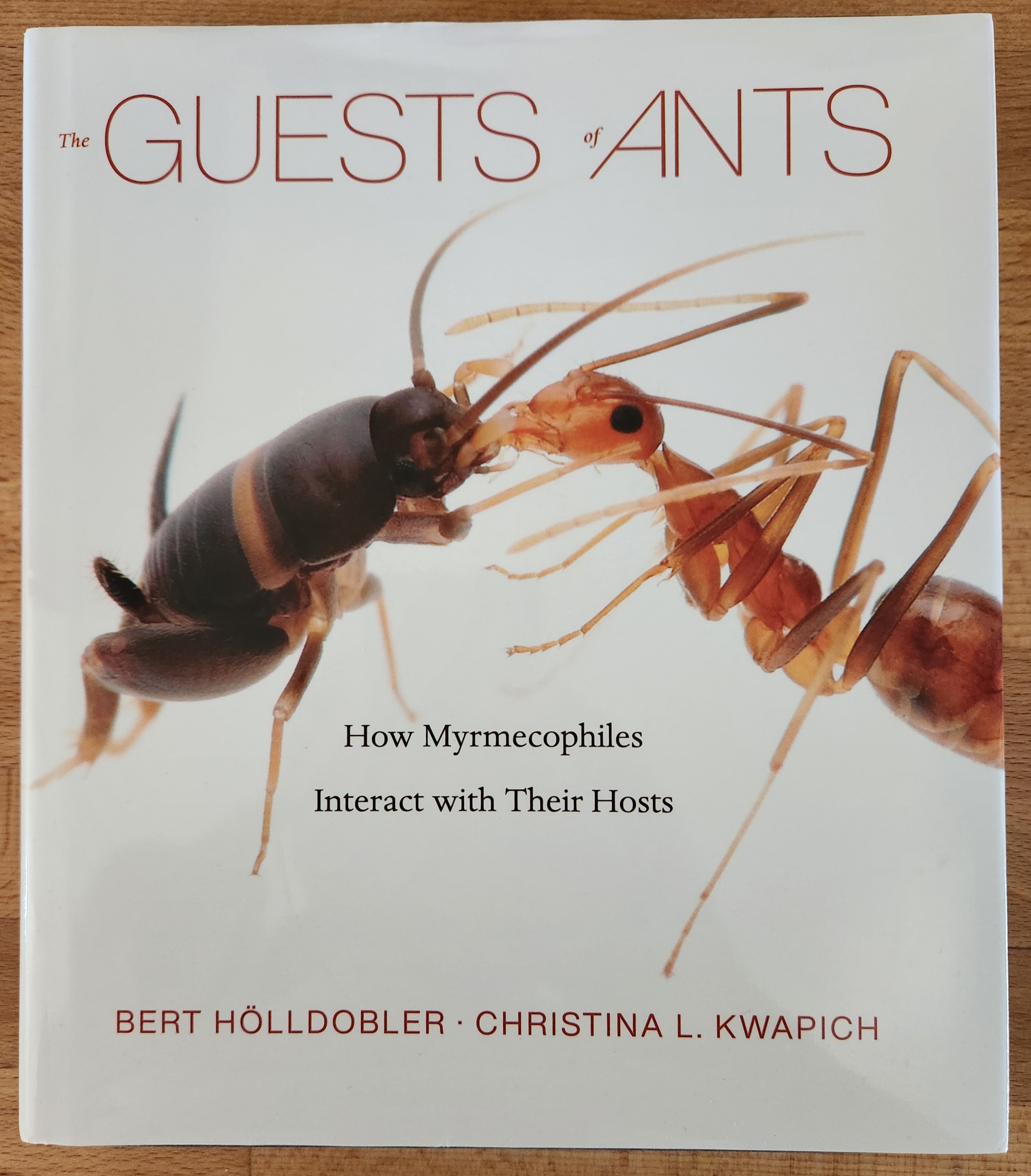
This is the most recent addition to my list of amazing ant books, published just a couple years ago in 2022. The images within are astounding, I found myself gasping as I turned pages to come across beautiful photographs of behaviour rarely seen. This tome is focused on the adaptations and behaviour of “Myrmecophiles”. It’s hard to define myrmecophile* because the interactions range from parasitic organisms dependent on killing their hosts (ant-decapitating phorid flies for instance) to beetles that appease their ant hosts with nectar secretions in exchange for a safe stay within an ant nest. So much is unknown about these complex interspecific interactions and the mysteries unfold in incredible stories throughout this book, leaving me wanting a sequel.
*the word means “ant-lover” which I guess could apply to me? Am I a myrmecophile of sorts? Are you?
Things I learned: Some mites ride on ants’ heads or feet, some spiders are ‘transformational mimics’ of ants: meaning that they resemble different ant species at each successive moult, there is a subfamily of crickets (featured on the cover!) which depend on ants, one species lives exclusively on Yellow Crazy Ant liquid food exchange, there are even frogs which live inside ant nests by chemically masking themselves.
I’m sure there are more excellent books about ants out there (I can actually think of a few more myself…) but these are my top favourites from the ones I’ve read. Do you have any recommendations? Let me know! I’m always up for a good book recommendation about one of my favourite animal groups.
 Norfolk Naturalist