This was originally posted on my old blogsite April 2018.
We took a day-trip to Pinery yesterday, and aside from the fascinating species of birds flitting and calling among the trunks of the trees and the underbrush, we encountered something quite ordinary, and yet, as I hope to demonstrate, quite beautiful.
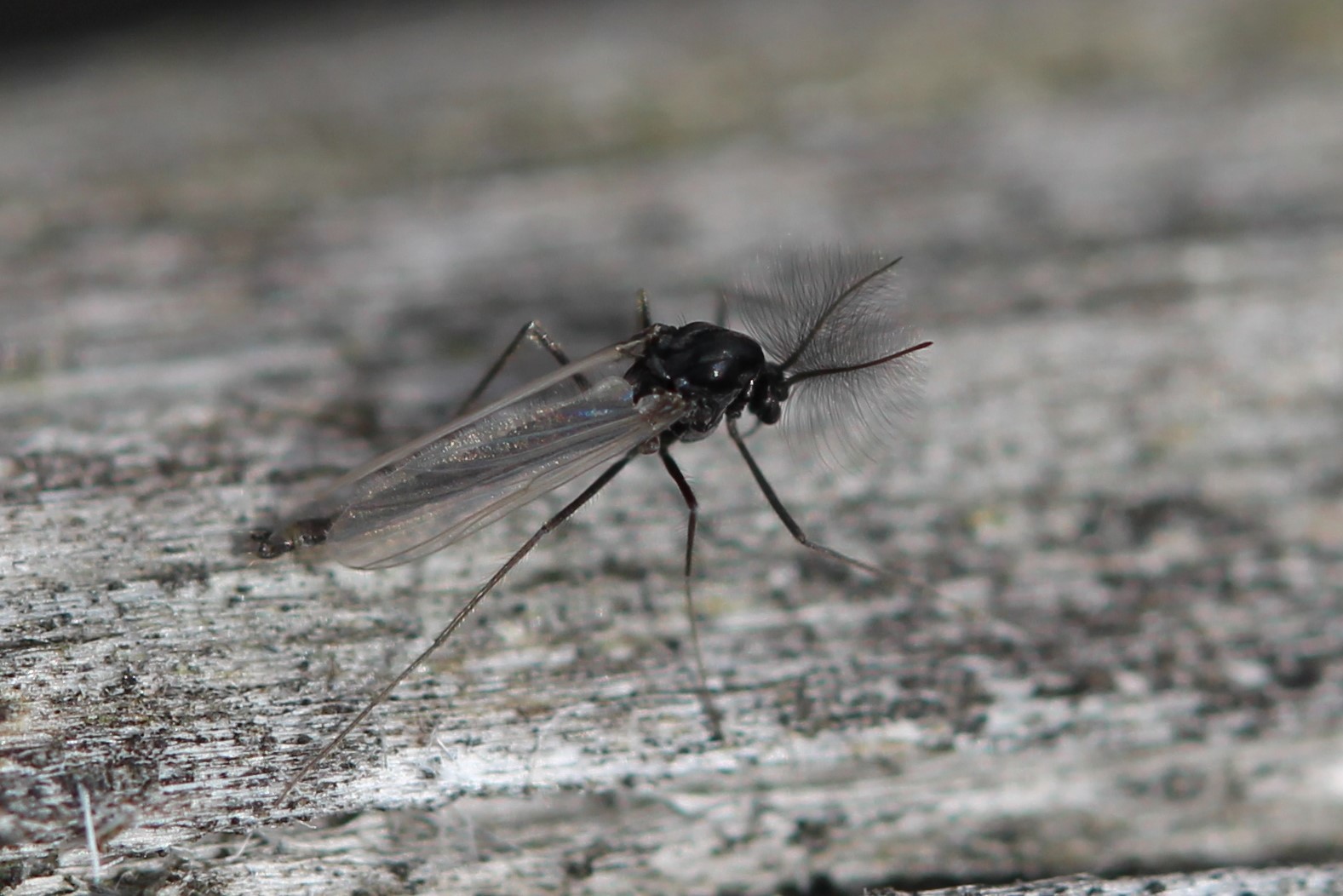
While walking along the trails by the river, we saw clouds of swirling insects. These tiny flies were creating their own signal, for potential mates. You’ve probably encountered their kind before, creating a smoke-like cloud above your head as you walked. Even though we are much larger than them, we certainly take notice of their swarms, which are made up of male midges.
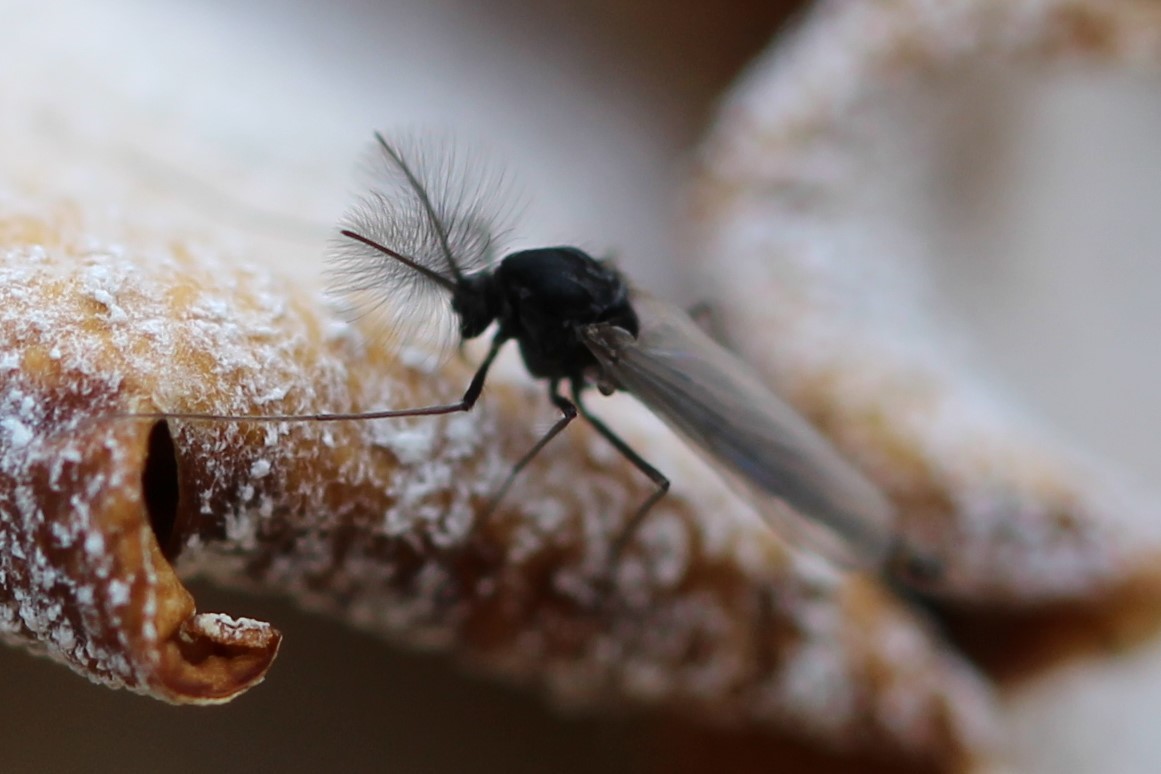
These particular insects were of the Family Chironomidae (the common, nonbiting midges). They may look like mosquitoes, but they won’t bite or seek blood. As such, you can see they don’t have the needle-like mouthparts that a mosquito uses to probe beneath skin. And you can even tell that these midges were male, because they had delicate feathered antennae atop their heads. With these, the male midges seek out female mates.
These midges most likely developed in the river, as small worm-like larvae, to become the graceful adults that we encountered. Because they are so numerous in and out of the water, they are incredibly important pieces of food chains and can also contribute to pollination of various plant species. These small and delicate insects may seem to be a nuisance, but they won’t bite and are a beautiful component of the world’s fauna.
Several of the midges landed on some fungi near the water.
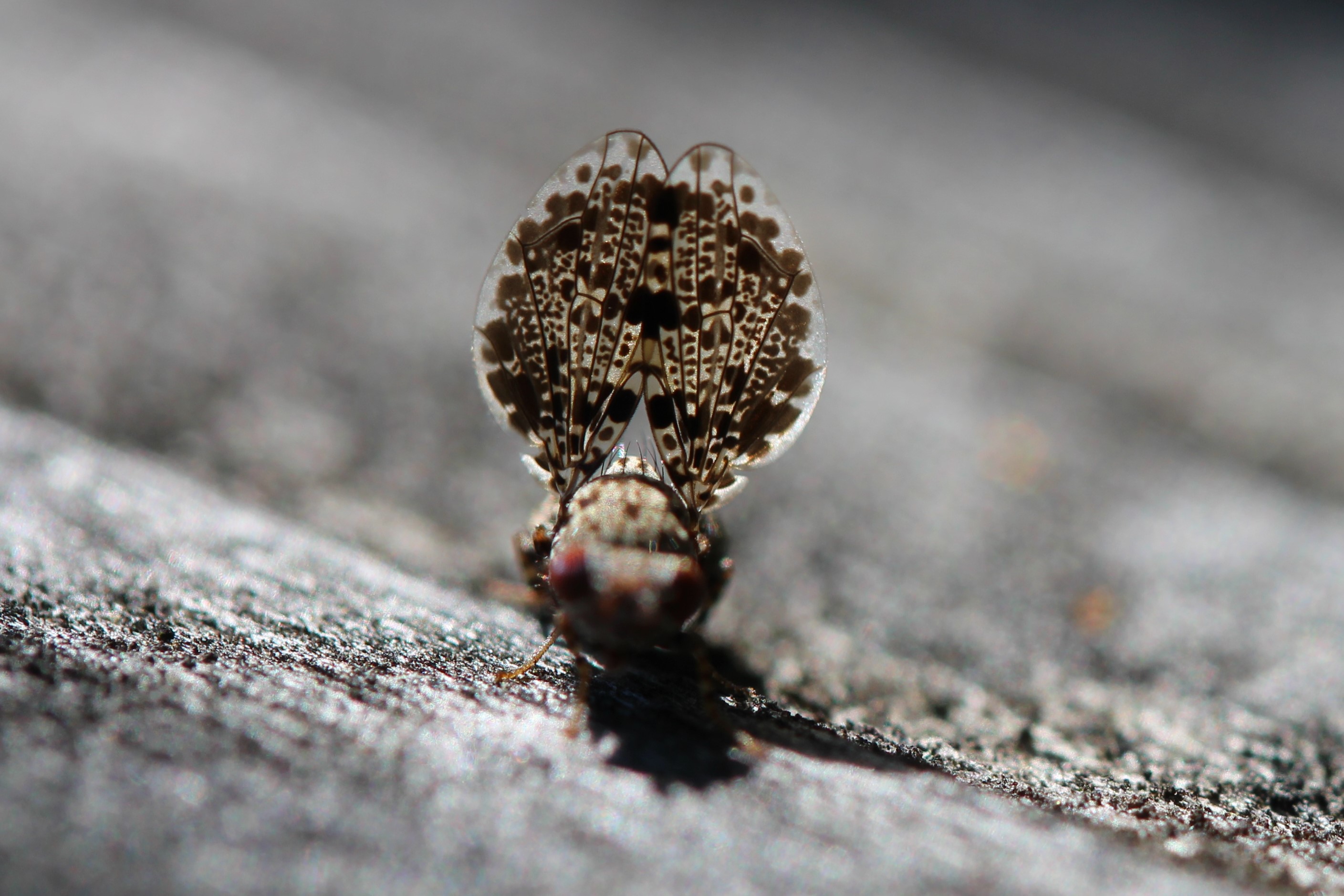
For this article I’d like to consider one of the most beautiful insects I’ve ever had the pleasure of observing: the Peacock Fly (Callopistromyia annulipes) and its relative, the only other member of its genus the Peahen Fly (Callopistromyia strigula)*. The main difference in appearance between these two species is in their wings: C. strigula contains much narrower wings than C. annulipes (Kameneva and Korneyev 2006).
*There is no common name for C. strigula, so I made one up. You might be surprised that there isn’t a common name, but consider that there are hundreds of thousands of species of Flies, and many of these are only known within specialist groups that study the differences between them. This is also the reason that there isn’t much information available for these Flies despite their beauty and conspicuousness.
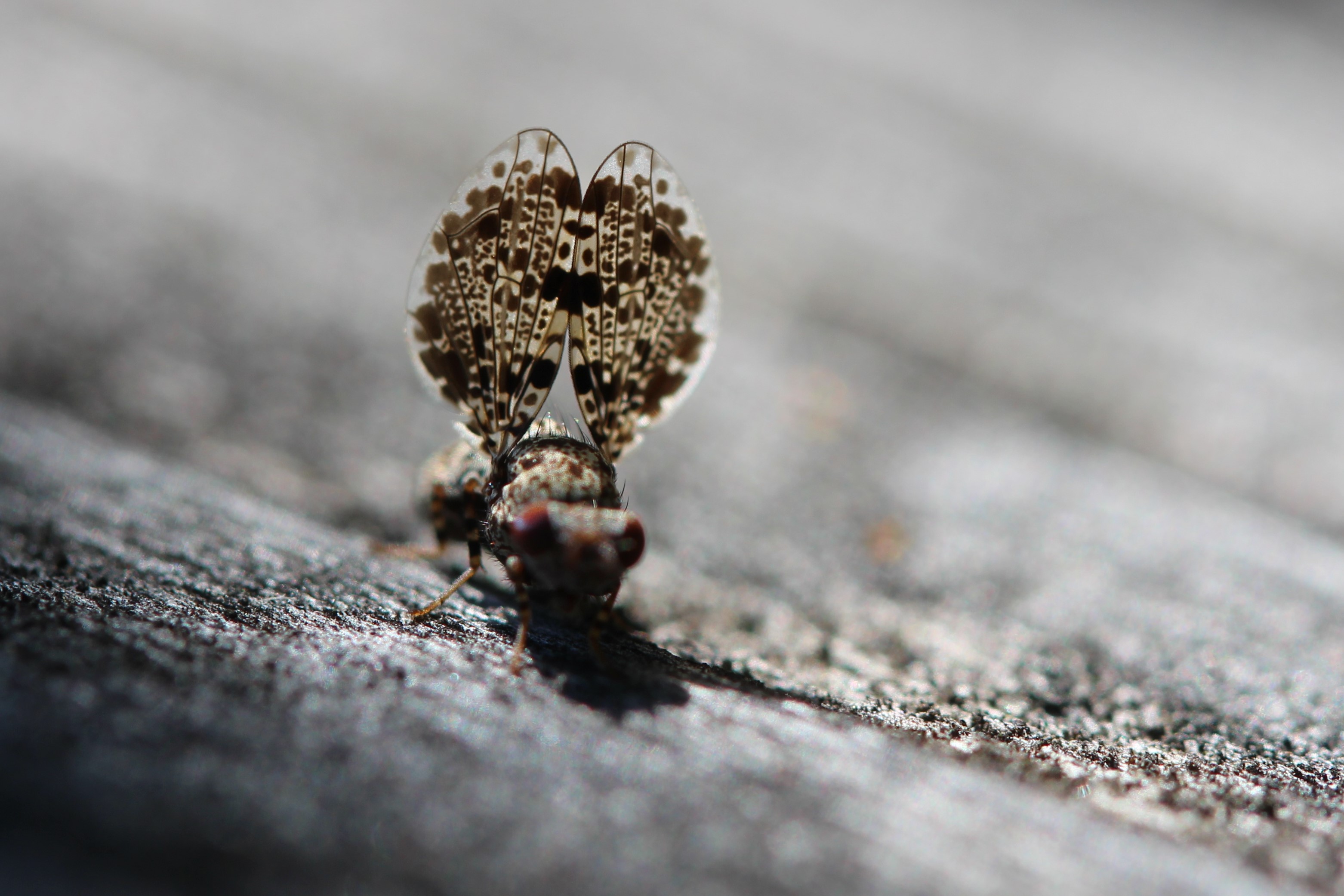
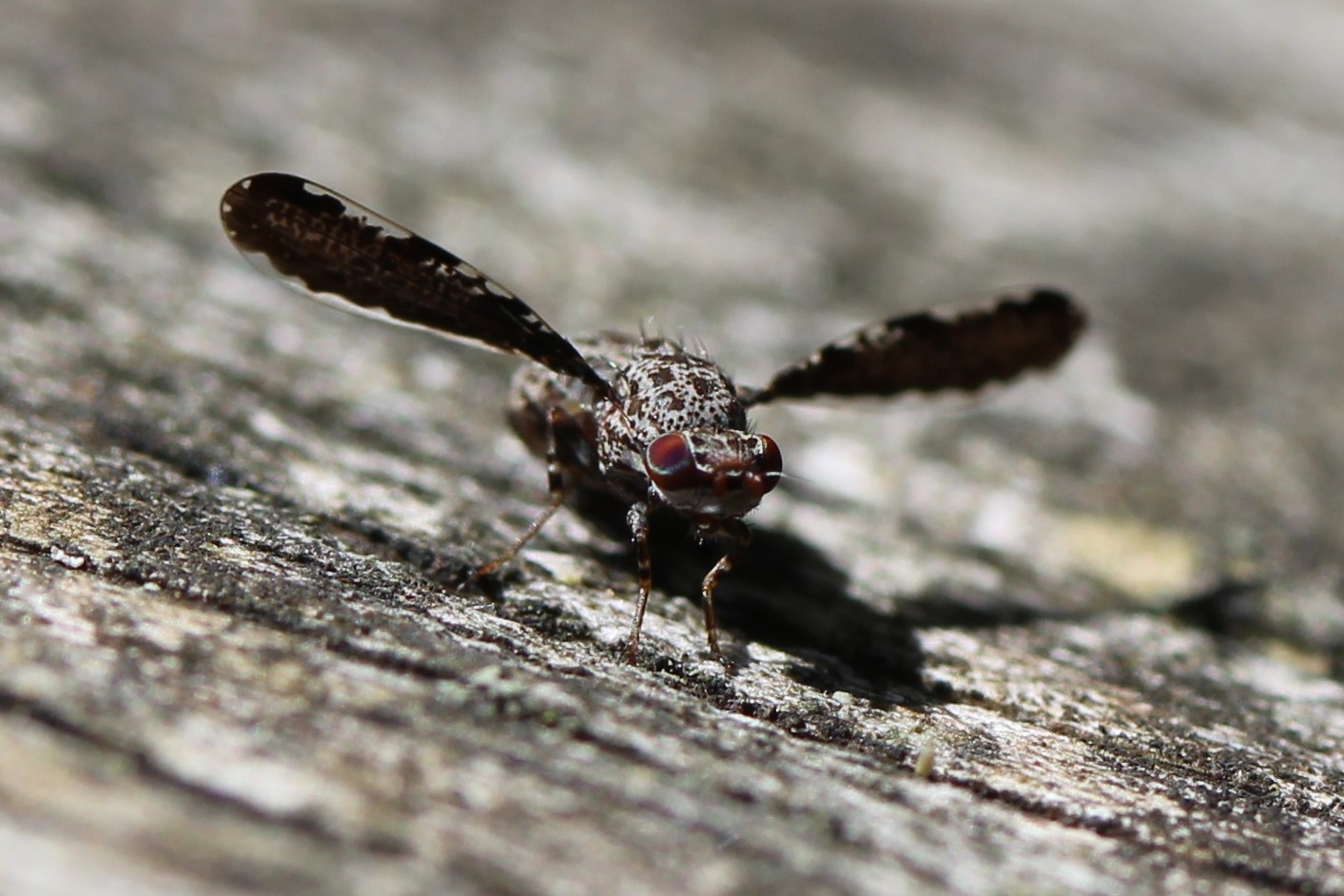
Callopistromyia annulipes, the Peacock Fly. Note the wide wings and the position they are held in above the body.Callopistromyia strigula, the Peahen Fly. Note the relatively narrow wings, and their position held out to the sides of the body.
C. annulipes is distributed across the United States and occurs in three provinces of Canada: British Columbia, Alberta, and Ontario, while C. strigula is found in Manitoba, Ontario and Saskatchewan as well as several States. Over the past several years, this species has spread into Europe as well, no doubt via human means (Pintilioaie and Manci 2020).
In both species males and females display, contrasting with many fly species in which only the males display for the females to choose from among them. I don’t want to discuss sexual selection and mate choice here in any depth. Suffice to say that because both males and females perform displays there is likely mutual sexual selection going on in these species, meaning that traits are preferred and chosen by both sexes in this species, rather than a female-choice bias or male-choice bias.*
*of course, this only applies if the displays and accompanying appearances are sexually selected for, but there are other ideas for what forces are selecting these displays (see further below).
Video of Peacock Fly (Callopistromyia annulipes) displaying on a bridge railing on the Lynn Valley trail in Simcoe.
Little is known of these species’ biology other than that they display on conspicuous surfaces (more on this below), and there are records of the adults of C. annulipes feeding on the frass from wood-feeding beetle tunnels* (Steyskal 1979). Their puparia** have been found beneath the bark of various deciduous trees, so it’s presumed that their larvae feed on dead wood, or fungi within dead wood or something associated with dead wood.
*Frass is a fancy way of saying “insect excrement and related material” usually used in connection with wood-boring insects… that ‘related material’ bit is key here since although a lot of what we call frass passes through an insect’s digestive system it can also be broken up bits moved behind a wood-boring beetle, so less insect “poop” and more insect “debris”.
**puparia refers to the hardened larval skin that encloses the pupal stage of derived Diptera… which probably doesn’t explain very much unless you know what those other terms mean. Basically, instead of nothing surrounding the pupa (the transformative stage of insects, between larva and adult), a huge branch of the Fly Family Tree (the Cyclorrapha) hardens their final larval stage skin into a protective case, sort of the fly version of a chrysalis.
As with many Diptera, their larvae are mysterious. After much searching, I managed to find a few pictures of Callopistromyia larvae online. I was amazed and contacted the person who recorded these organisms to obtain permission to share the relevant information and images.
The pictures depict larval and pupal C. strigula which were found feeding on the inner bark of a boxelder tree (Acer negundo) (van der Linden 2018). I can’t find any pictures or information pertaining to C. annulipes larvae, but presumably they have the same or similar feeding habits.
Finally, the most attractive thing about these species are their displays. The reason I’m writing about these flies is because I noticed them, and the reason I noticed them is because they strutted about on the railings of bridges on the Lynn Valley Trail. The Peacock Fly (Callopistromyia annulipes) in particular raises its large wings so that they meet above its back presenting a very noticeable display. By contrast, C. strigula adults display their wings in a more horizontal fashion. Presumably, these displays are about attracting mates and because the displays are performed by both sexes, they are about mutual mate choice. In other words, males are displaying to attract the attention of females and females are displaying to attract the attention of males. An intriguing possibility is that these wing displays are about more than finding a mate… they could also be an example of predator mimicry.
Can you see the face of a Jumping Spider in the Peacock fly’s wing-pattern?
A fascinating paper with an excellent title* describes how other species of Ulidiidae (the family of Flies that includes Callopistromyia) have wing patterns and displays that mimic the appearance of Jumping Spiders (Salticidae) (Hill et. al. 2019). The reason? Jumping Spiders are visually hunting predators of basically any insect they can catch. The wing patterns are possibly exploiting the visual system of Jumping Spiders by causing the spiders to believe they are staring down another Jumping Spider and so to be cautious. I can’t help but be intrigued by this idea, and somewhat skeptical. Despite its appeal, there are some problems with the hypothesis. One problem that came to my mind is that Jumping Spiders will hunt other Jumping Spiders. So if the pattern is supposed to resemble a Jumping Spider and deter them from predating the fly, why would it? The paper acknowledges that there are still many unknowns, but the authors make a good case that at least some insects are manipulating salticid responses to prey with visually deterrent patterns. And they also note: “In a natural setting even a brief delay in the attack of a salticid could allow these flies to escape” (Hill et. al. 2019). As always in science, more studies are needed…
*The title, for those of you who don’t read through the References section, is “Do jumping spiders (Araneae: Salticidae) draw their own portraits?” The idea is that in avoiding hunting insects that resemble themselves, jumping spiders leave those ones alive to reproduce in like kind and so jumping spider resemblances are crafted by the natural selection of the jumping spiders themselves.
There is always more to learn, and always new organisms to explore in the world. I hope you enjoyed my dive into the beautiful flies of the genus Callopistromyia, the Peacock Flies.
References:
Hill, David, A. P. C., Abhijith, and Burini, Joao. 2019. “Do jumping spiders (Araneae: Salticidae) draw their own portraits?” Peckhamia 179.1: 1-14. (full pdf available here: https://peckhamia.com/peckhamia/PECKHAMIA_179.1.pdf)
Kameneva, Elena and Korneyev, Valery. 2006. “Myennidini, a New Tribe of the Subfamily Otitinae (Diptera: Ulidiidae), with Discussion of the Suprageneric Classification of the Family”. Israel Journal of Entomology. Vol. 35-36, 2005/6: 497-586.
Pintilioaie A-M, Manci C-O (2020) First record of the peacock fly Callopistromyia annulipes (Diptera: Ulidiidae) in Romania. Travaux du Muséum National d’Histoire Naturelle “Grigore Antipa” 63(1): 87-91. https://doi.org/10.3897/travaux.63.e50920
Steyskal, George C. 1979. “Biological, Anatomical, and Distributional Notes on the Genus Callopistromyia Hendel (Diptera: Otitidae)”. Proceedings of the Entomological Society of Washington. 81(3): 450-455.
The Story Behind the Shot: The amazing hovering capabilities of Flower Flies (the Family Syrphidae) have always impressed me and I really wanted to capture this one in the air. The fact that I was able to take this shot is a testament to how little these insects falter while hovering in mid-air.
The Story Behind the Species:
Common Compost Fly males are some of the most impressive flyers in the world of insects. They use their skills to patrol among flowers and pursue females which visit the flowers with incredible agility. Their singleminded pursuits seem to have sacrificed discrimination for the sake of directness, as these flies are known to pursue “any insect of almost any size that appears in their search area” (Marshall 2012 p. 307). After mating, the females lay their eggs in decomposing plant material, which can include compost, hence their common name.
Syritta pipiens is an introduced species in North America, brought over accidentally from Europe around 1895 (Skevington et. al. 2019).
References:
Marshall, Stephen A. 2012. Flies: The Natural History and Diversity of Diptera. Firefly Books.
Skevington, Jeffrey H., Locke, Michelle M., Young, Andrew D., Moran, Kevin, Crins, William J., and Marshall, Stephen A. 2019. Field Guide to the Flower Flies of Northeastern North America. Princeton University Press.
People are always going on about how Beetles are so diverse, biologists are always explaining to theologians that God must really love Beetles*, and whenever anyone asks “What’s the most diverse group of organisms?” Beetles are always top of the list. UNTIL NOW.
*in case you don’t know the anecdote this is referring to, the earliest source (according to quoteinvestigator.com) runs thus: “There is a story, possibly apocryphal, of the distinguished British biologist, J. B. S. Haldane, who found himself in the company of a group of theologians. On being asked what one could conclude as to the nature of the Creator from a study of his creation, Haldane is said to have answered, “An inordinate fondness for beetles.”” (Hutchinson 1959).
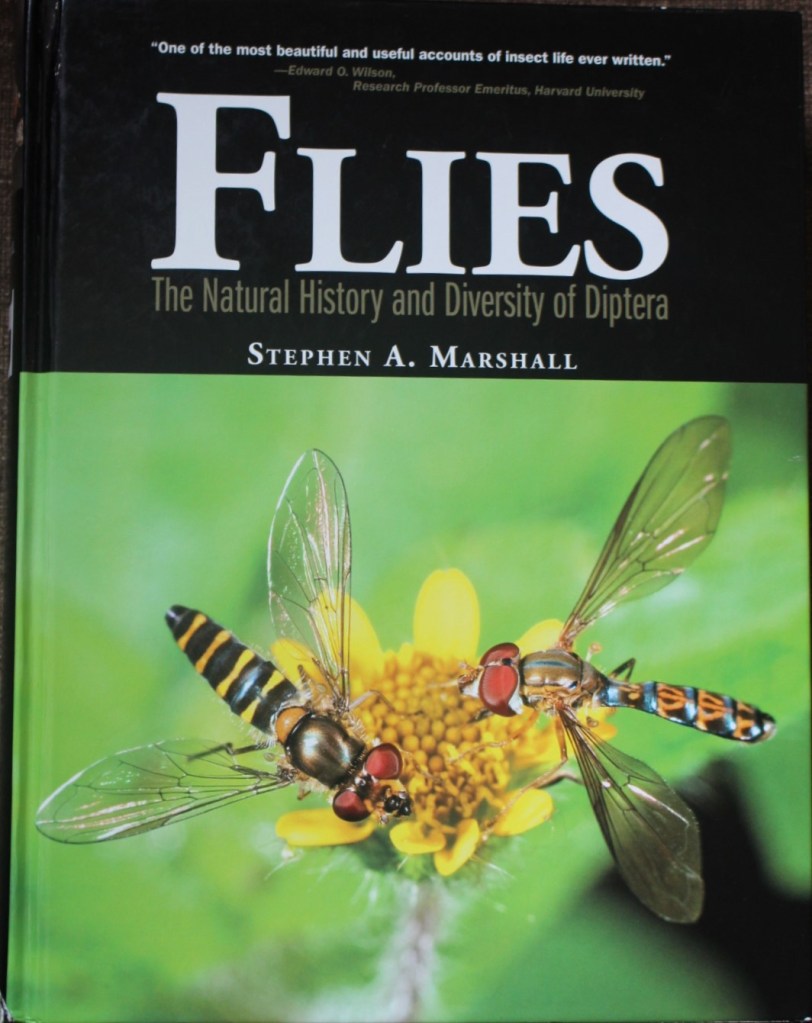
Stephen Marshall proposes in his magnificent volume on the diversity of flies that there are historical reasons why beetles are held up as so diverse when the truth is that they might just be more closely studied than other insect groups… other groups like the order Diptera (true Flies), for instance. And if you read through this 600 page volume loaded with superb photographs and covering every single family of flies in some detail you will come away with the powerful impression that Stephen Marshall is on to something. Flies, a group often neglected because they don’t always photograph well, many look very similar to each other, and a lot of them have distasteful feeding habits, are showcased as the hyper-diverse evolutionary marvel that they are.
Metallic Green Long-legged Fly (Condylostylus sp.), photographed in my backyard, June 2018. I’m just going to post some of the many interesting flies that I’ve photographed myself throughout this article. Stephen Marshall mentions that digital photography is opening up the realms of entomology to amateurs in a way that hadn’t been possible in the past. I wholeheartedly agree!
The book’s first part: “Life Histories, Habits and Habitats of Flies” runs through a sampler of what flies do as larvae and adults. This includes the life cycles of Diptera in general, but elaborates on more specific groups where appropriate. Other sections in this part describe flies interacting with plants, fungi, invertebrates and vertebrates. This entire section comprises about 90 pages and goes into considerable detail on specific guilds* such as the worldwide coastal communities of “wrack flies”, flies that have larvae that feed within decomposing piles of seaweed washed upon shores. Along with the various interactions between flies and invertebrates, this section also includes a discussion of the many human diseases caused or carried by flies such as mosquitoes (Family Culicidae) or house flies (Musca spp.).
*A guild is a group of animals that are united by a common feeding strategy or resource use, but not necessarily united in relatedness. For example, flies from different branches of the Dipteran family tree are considered part of the leaf-mining guild if their larvae produce mines in leaves.
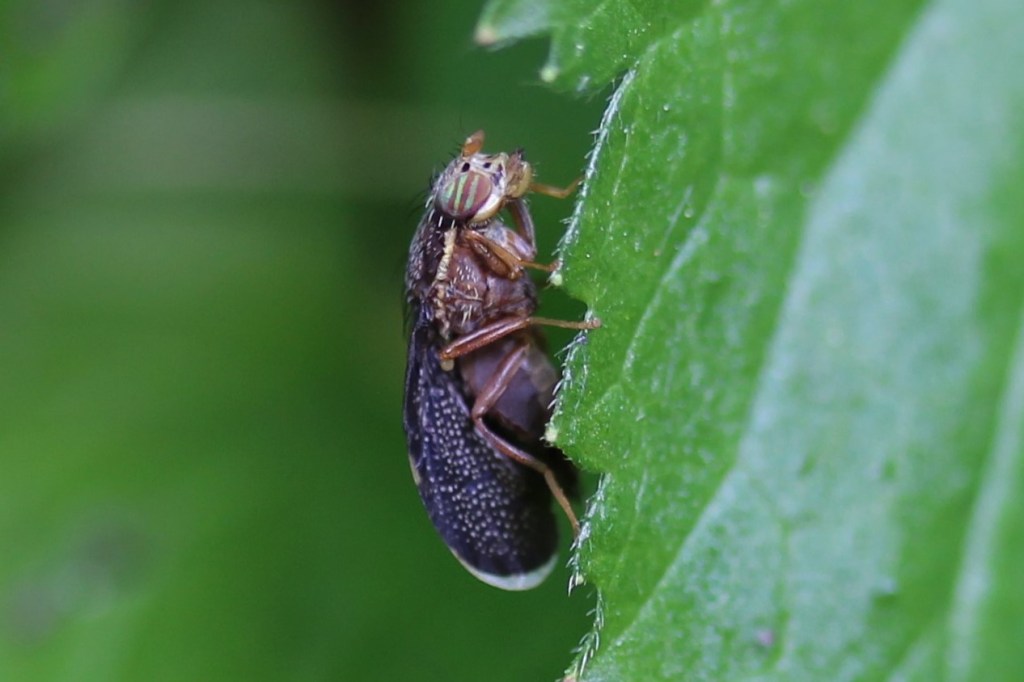
Eutreta novaboracensis, a Fruit Fly of the family Tephritidae, photographed in my backyard, June 2018.
The second part of the book is titled “Diversity” and reading through this catalog of fly families and subfamilies truly does drive home just how incredibly diverse the Order Diptera is. Each chapter covers a large portion of the fly family tree and opens with a diagram of the proposed relationships between the fly groups within. This opening section of each chapter moves from family to family, and describes the basic characteristics of each group detailing subfamilies where possible as well. Within these descriptions are not just lists of characters used to distinguish one family from another but also the basic biology of each group when known. A couple of key things to note here: even when dividing up the flies into smaller and smaller groups it can be hard to generalize because you are still dealing with huge swaths of species in some instances and in others you are simply dealing with species doing very different things despite their close-relatedness. Marshall does a good job of explaining this and I’ll provide an example here from the section on Tipulidae (the Crane Flies, of which there are more than 15 000 described species): “Although most larvae with known biologies are saprophagous and eat microbe-rich organic matter (normally, decaying plant material) in wet environments, some crane flies are predaceous, fungivorous or phytophagous… Some groups have become specialists in extreme environments such as caves, marine intertidal zones and deserts, but most occur in humid forests and wetlands. Most Tipulidae are unknown as larvae.” (Marshall 2012 p. 110).
Crane Fly (Tipula sp.) photographed on the Lynn Valley Trail, May 2018.
The above quote demonstrates the way in which Marshall overviews the lifestyles of the fly groups providing tantalizing glimpses of their diverse life histories, but it also provides an example of something that is rife within the 600 page volume: the overwhelming amount of flies or fly habits that are unknown. To demonstrate, here are some quotes from throughout the book (Marshall 2012):
“Valeseguya rieki is known only from a single male specimen” (p 136)
“Larvae and larval habitats of the Lygistorrhinidae remain unknown” (p 141)
“Nothing is known of the biology of these obscure little flies [Ohakunea]” (p 141)
“adults of Oreoleptis (and thus the family Oreoleptidae) have yet to be collected in the field” (p 198)
“The 500 or so species of Acroceridae occur in every part of the world, but most are known from only a few specimens” (p 205)
“Essentially nothing is known about the biology of either Apystomyia or Hilarimorpha” (p 235).
“Even though signal flies [Platystomatidae] are usually conspicuous and attractive flies, many species remain undescribed.” (p 332).
“Larvae are unknown for most species in the family [Lonchaeidae] and little is known about behavior” (p 335).
“The biology of most Pallopteridae species remains unknown” (p 339).
“The truth, however, is that we know almost nothing about the life histories of these bizarre flies [Ctenostylidae]” (p 340)
“Nothing is known about the biology of this group [Nothybidae]” (p 348)
“Despite a worldwide distribution, with about 140 known species spread over every zoogeographic region, not much is known about asteiid biology.” (p 363)
“Nothing is known of the biology of the Neotropical dwarf fly genera [Periscelididae]” (p 365)
The quote list above is not comprehensive, but rather a sampling to show some of the many groups of flies that are mysterious despite their ubiquity in some cases. I don’t want the quotes above to be taken as evidence that the book contains little in the way of information on the flies of the world, seeing as so little is known overall. On the contrary, this volume is chock-full of biological details found nowhere else except the specialized literature and I found myself blown away by many intriguing and fascinating descriptions of fly families and subfamilies. Below are a few of the more interesting groups I had never encountered before reading through this book.
Frog midges (Corethrellidae) are attracted to singing frogs where the females feed on the frog’s blood. Some Phorid flies lay their eggs inside ants, where their larvae consume the ant’s head from the inside. After feeding within, the larvae decapitate the ants and pupate within the armored shelter before emerging as adult flies. These flies are known as ant-decapitating flies, and there are more than 300 species of them in the genus Apocephalus. Vermileonidae is a family of flies known as “wormlions” which are essentially the antlions of the diptera, their larvae constructing cone-shaped pits to trap wandering insects for prey. The Fergusoninidae is a family of flies that “develop only in galls induced by a specialized and codependent group of nematodes” (Marshall 2012, p 366).
Probably my personal favourite are the smoke flies. The smoke flies, platypezid Microsania spp., are attracted to fires (even campfires) but are rarely seen elsewhere. The smoke fly swarms are often followed by the predatory empidid dance fly Hormopeza which “seems to be a specialized predator of smoke flies. Like Microsania, the smoke dance flies are rarely seen except when they appear in plumes of smoke.” (p 298). I feel like the smoke flies, a group of species that can be attracted to something as common as a campfire, and yet are known from basically nowhere else (and thus poorly understood biologically) perfectly encapsulate the mystery and wonder of flies that I have gained from reading this book.
All of this fascinating information is found within the comprehensive and authoritative text, and after going through family by family in this fashion, each chapter in the “Diversity” section has a “photographic guide” portion which covers representatives of most subfamilies with further notes on natural history and significance of genera pictured. The scope of the pictures is mind-boggling and further bring home the diversity of flies, as well as their surprising beauty.
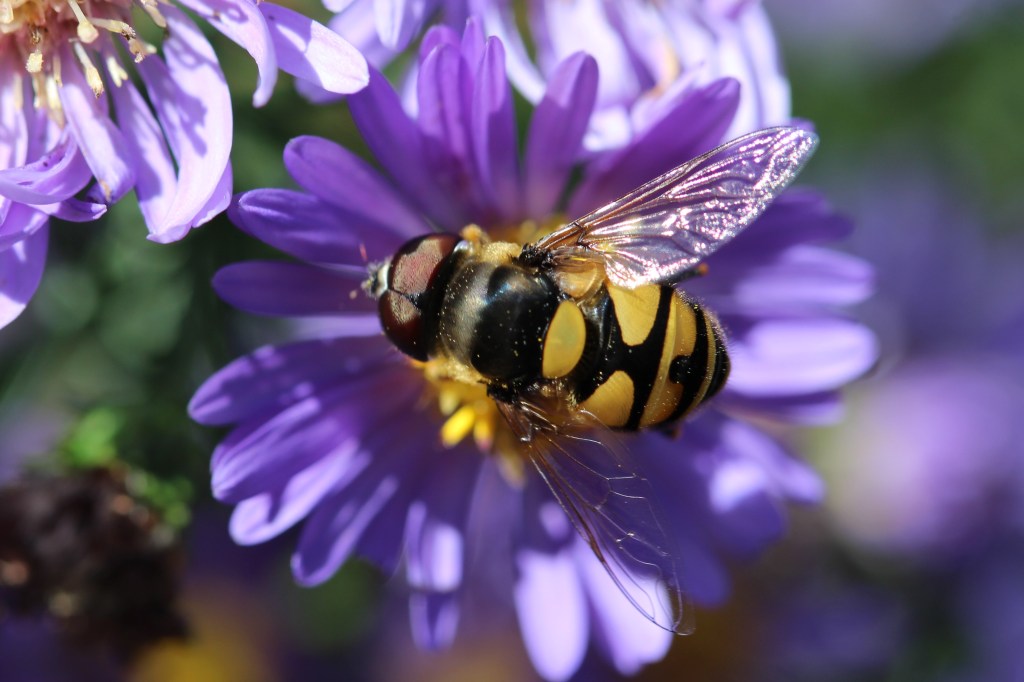
Transverse-banded Flower Fly (Eristalis transversa), photographed in my backyard, September 2018.
The final, shortest section covers collecting, preserving and identifying flies, and contains notes for those interested in starting insect collections of their own (as in, pinned specimens) as well as keys for identifying the major fly groups.
I can honestly say that if this book were published with only the text portions I would buy it because the text is just that valuable in overviewing the enormous diversity of the fly families. And I can also say that if this book were published with only the pictures and captions, I would also buy it for the incredible amount of biodiversity on display, captured in wonderful images of flies from around the world.
I cannot recommend this book highly enough. If you are an insect enthusiast, if you are at all interested in the diversity of life and if you enjoy gasping at revelations about the tiny wonders that flit around the world you have to read this book.
References:
Hutchinson, G. E. 1959. “Homage to Santa Rosalia or Why Are There So Many Kinds of Animals?” The American Naturalist, 93(870), 145–159. http://www.jstor.org/stable/2458768
Marshall, Stephen A. 2012. Flies: The Natural History and Diversity of Diptera.
In my backyard, I usually see a lot of Flies of various species, many of which I find difficult to identify. Flies don’t have the obvious characters or colours that other Insect groups have such as Butterflies and Beetles. There are two broad divisions of the Order Diptera (that is, the True Flies) which can be fairly easily distinguished. Nematocera roughly translates as “long-horned”, referring to their relatively long antennae and includes the Midges, Mosquitoes, Fungus Gnats and many others. Brachycera means “short-horned” and includes the House Flies, Carrion Flies, Fruit Flies, and dozens of other massive groups. As I mentioned in my post about observations at my Parents’ house, I’m reading through Flies by Stephen Marshall and it’s only reinforcing the bewildering diversity of Flies and Insects in general.
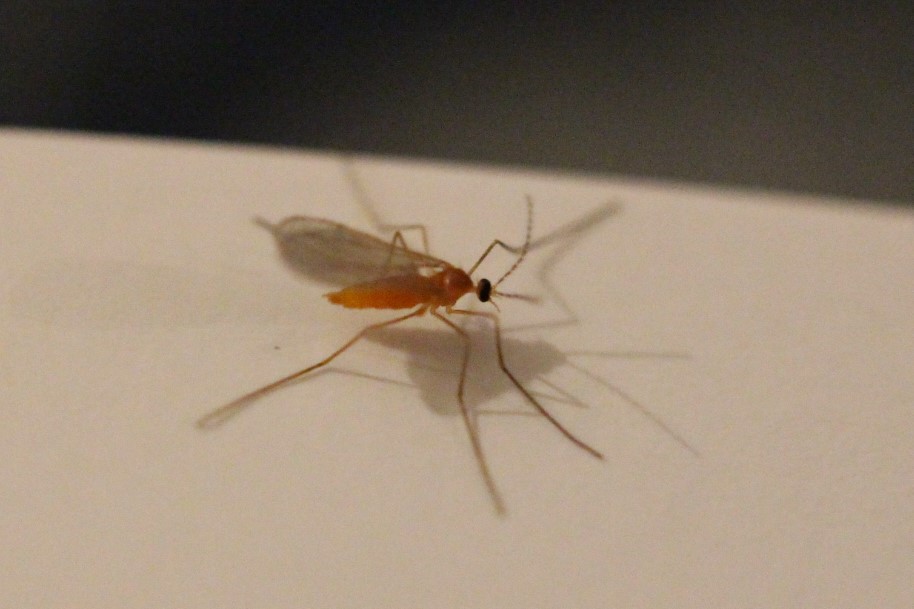
Incidentally, a Fly that I can’t identify landed on the book Flies as I was reading it in my house. There is a Family of Flies called the Ironic Flies (Family Ironomyiidae), but unfortunately this definitely isn’t one of them. That would have just been too perfect. My best guess for this Fly is a Fungus Gnat or a related Family (Sciaroidea).
A Mystery Fly that landed on Flies: The Natural History and Diversity of Diptera by Stephen Marshall while I was reading it.
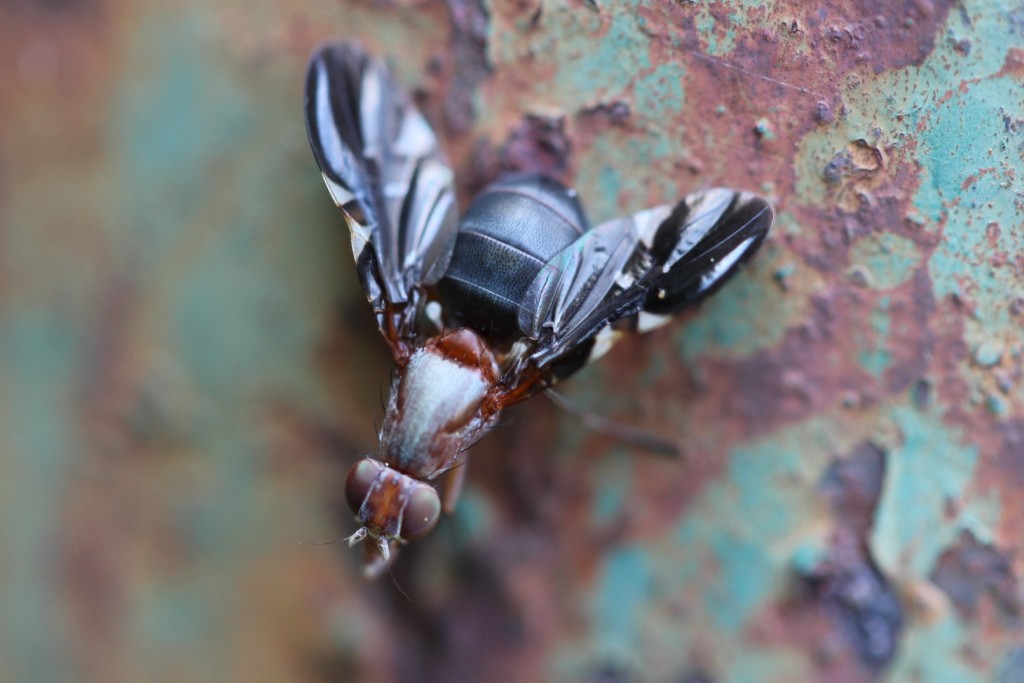
All that being said, there are some Flies that I can now identify on sight such as this Common Picture-Winged Fly (Delphinia picta):
A Common Picture-Winged Fly in my backyard.
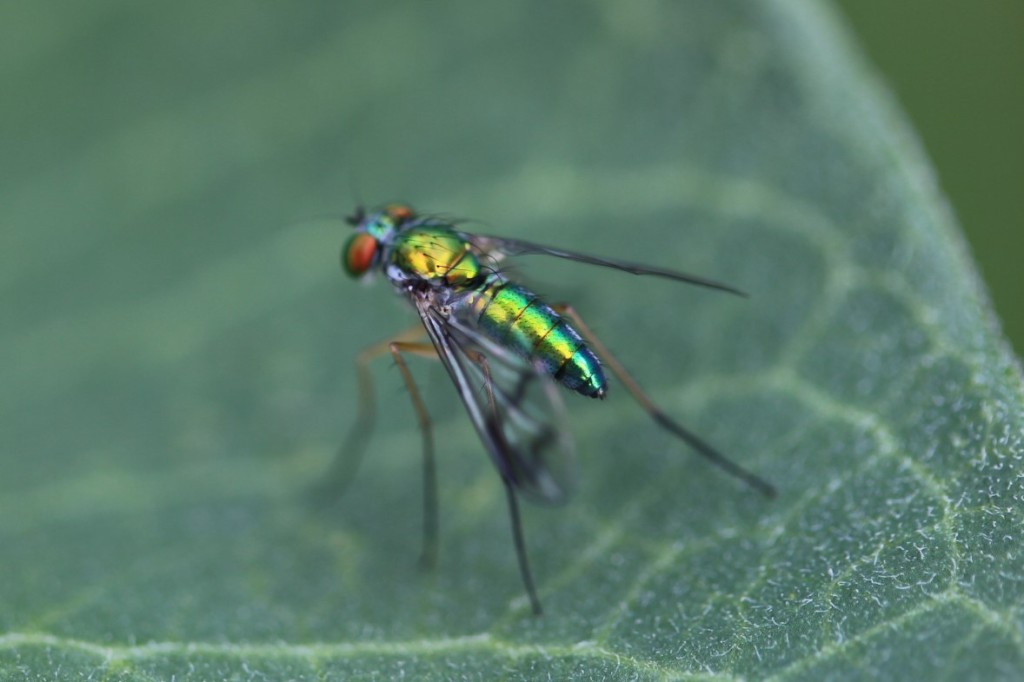
Others easy to identify (to Genus) are the Condylostylus flies which hunt small prey and display on leaves worldwide.
Bright Metallic Green Condylostylus are easily recognizable Flies worldwide.
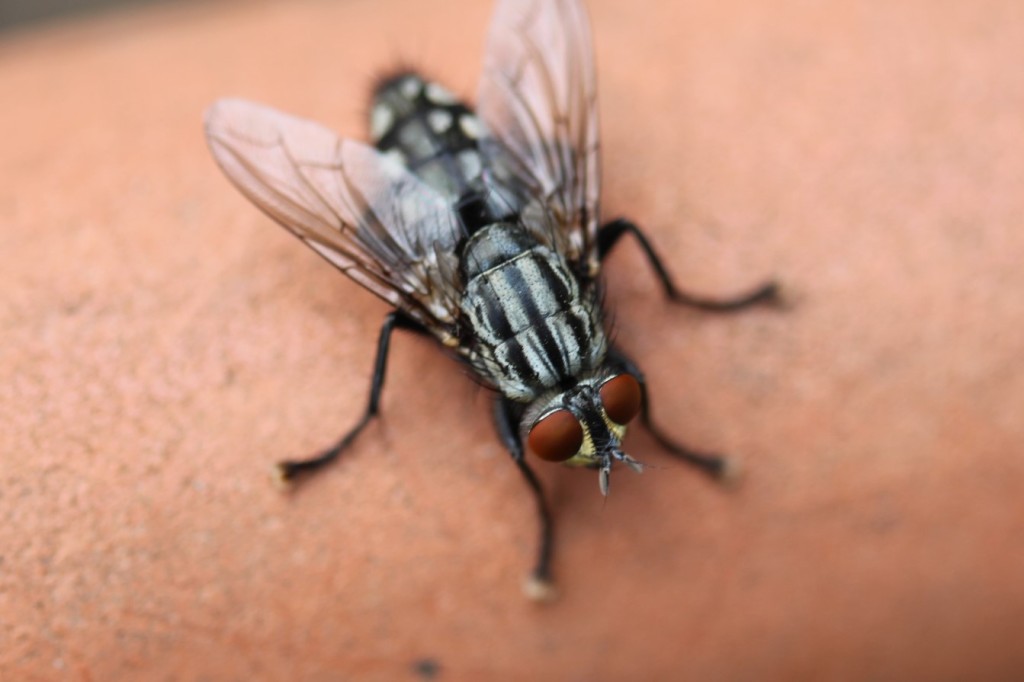
Another group of Flies that I’ve become familiar with have one of the most unsettling Family names ever: the Flesh Flies (Sarcophagidae). The three black stripes on the thorax distinguish them from similar-looking Flies (Marshall, 2012). To make them even more unappealing than their name, many of these Flies lay eggs that hatch immediately after they leave the female, or they simply lay larvae that have already hatched. There are about 3000 species in the Family Sarcophagidae, and the ones I see in my backyard are likely in the Genus Sarcophaga. Within the Genus Sarcophaga there are 800 species, so they are very difficult to generalize about, with some of their larvae feeding on or within other insects, consuming dead vertebrates, or specialist parasitoids of spider or grasshopper eggs (Marshall, 2012).
Flesh Fly, possibly of the Genus Sarcophaga.
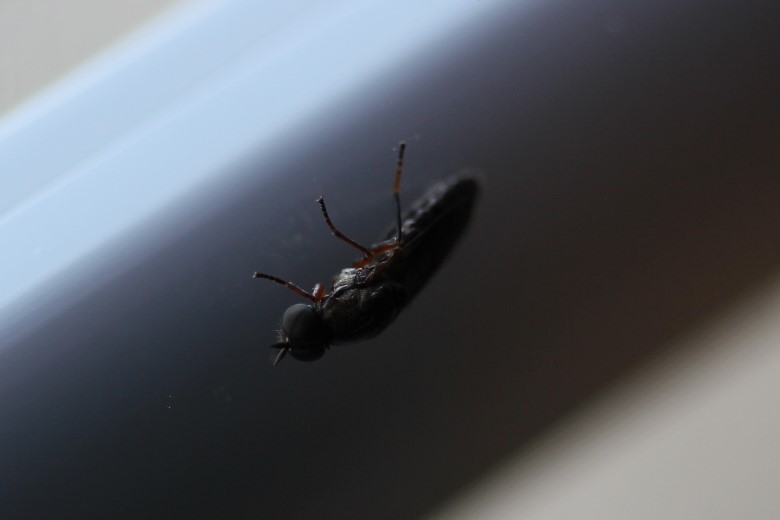
Another Fly observed within my own house is likely a member of the aptly named Window Fly Family (Scenopinidae), as I photographed it on the interior of my back door window. Although this Family of about 350 species is associated with various habits and habitats, they are named for the handful of species that are predators of human-habitat insects such as Carpet Beetles (Dermestidae), which is likely what my Window Fly was.
Window Fly (Scenopinidae), likely one of the human-associated species in the Genus Scenopinus.
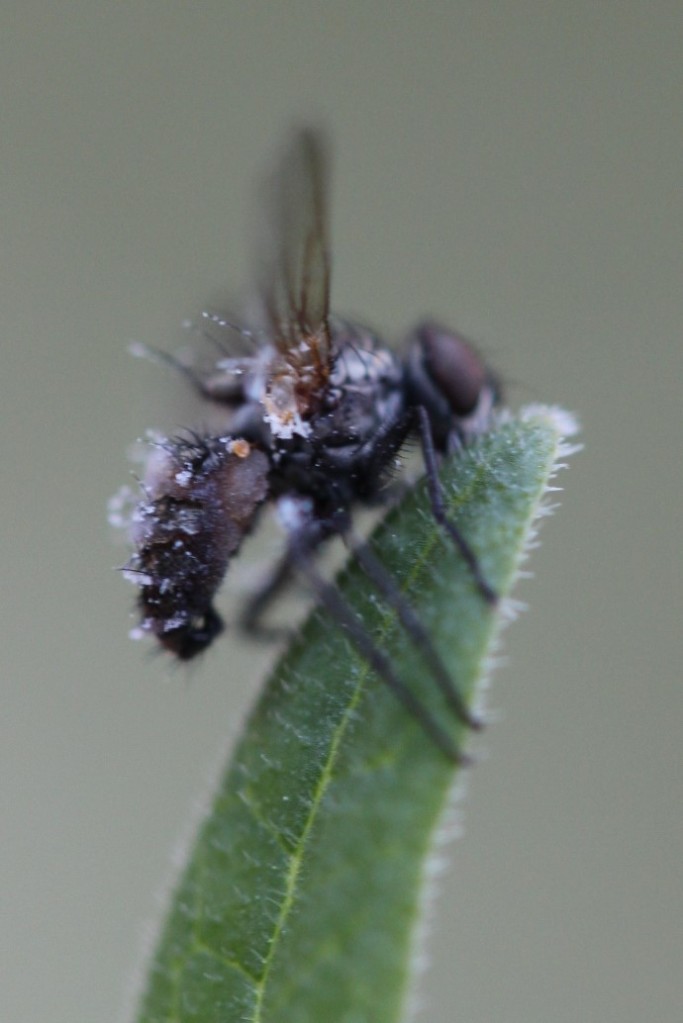
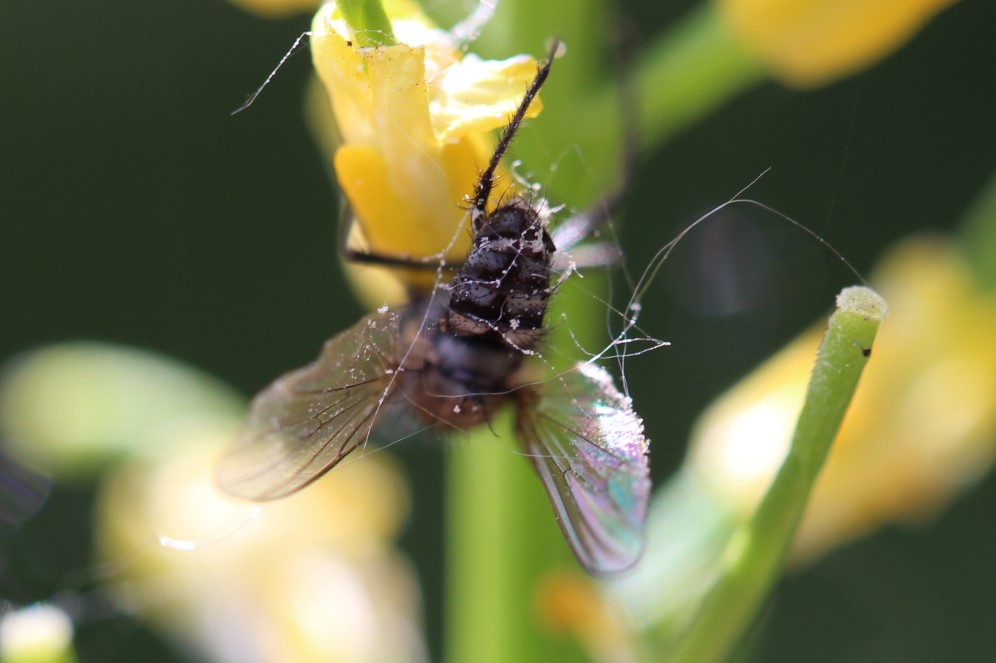
The most eye-opening Fly observation of the month has more to do with the fate of the Flies, rather than the Flies themselves. I found two Flies in my garden in a bizarre position, one at the very end of May and one on the 1st of June. I’m unable to identify either species of Fly beyond the fact that they’re both Brachycerans. Each fly was positioned at the end of a leaf, clutching it with its legs and they were covered with what looked like white dewdrops bursting out of their bodies on tiny filaments. The filaments emerging from the fly bodies (the Flies were also quite dead or at least incredibly still and unresponsive) must have belonged to a type of Fungi.
First Fly I found infected by a fungus at the end of May. All of the whitish flecks across the fly’s abdomen and thorax are fungi.
Many readers may be familiar with the incredible footage in BBC’s Planet Earth of the Cordyceps fungus infecting ant workers and forcing them to climb into the tree canopy in order to release the fungal spores upon death. What might surprise you is that similar insect-infecting fungi are found not only in tropical rainforests but around the globe, even in my own backyard in Simcoe, Ontario. In fact, Cordyceps itself occurs in parts of North America (into the Southern United States), where it infects insects and causes similar scenarios to the one depicted in Planet Earth (Eiseman and Charney, 2010). There is an entire order of fungi, Entomophtorales, in which most species infect insects and other arthropods. If you’re interested in similar observations, there’s a Bugguide page devoted to this sort of thing. I have no idea which species infected these Flies in my backyard, but it’s fascinating to know that these sorts of complex interactions are occurring right where I live.
Another Fungal-infected Fly I found at the start of June. I’m not positive, but the long threads surrounding it could be fungal in nature as well.





 Norfolk Naturalist