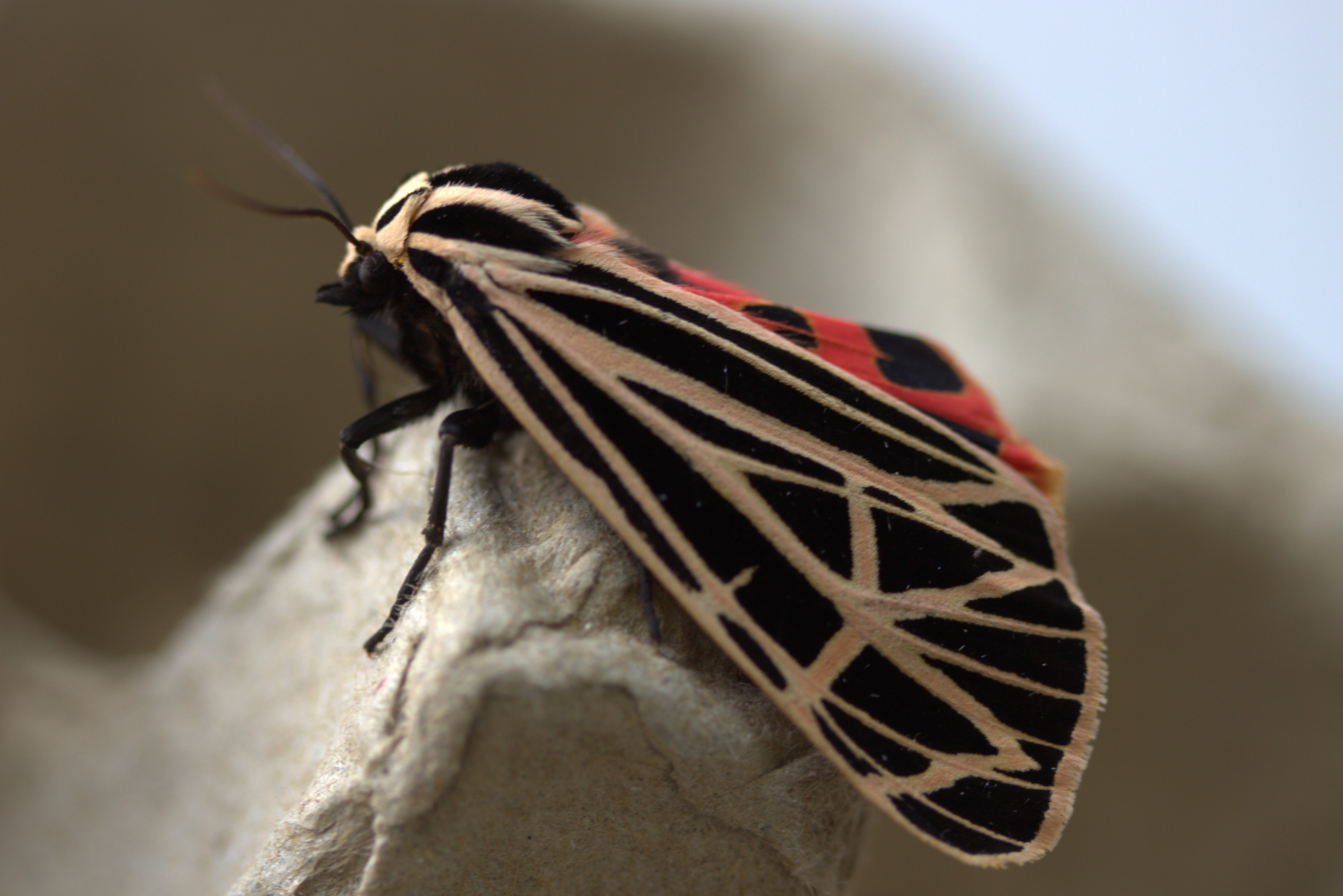
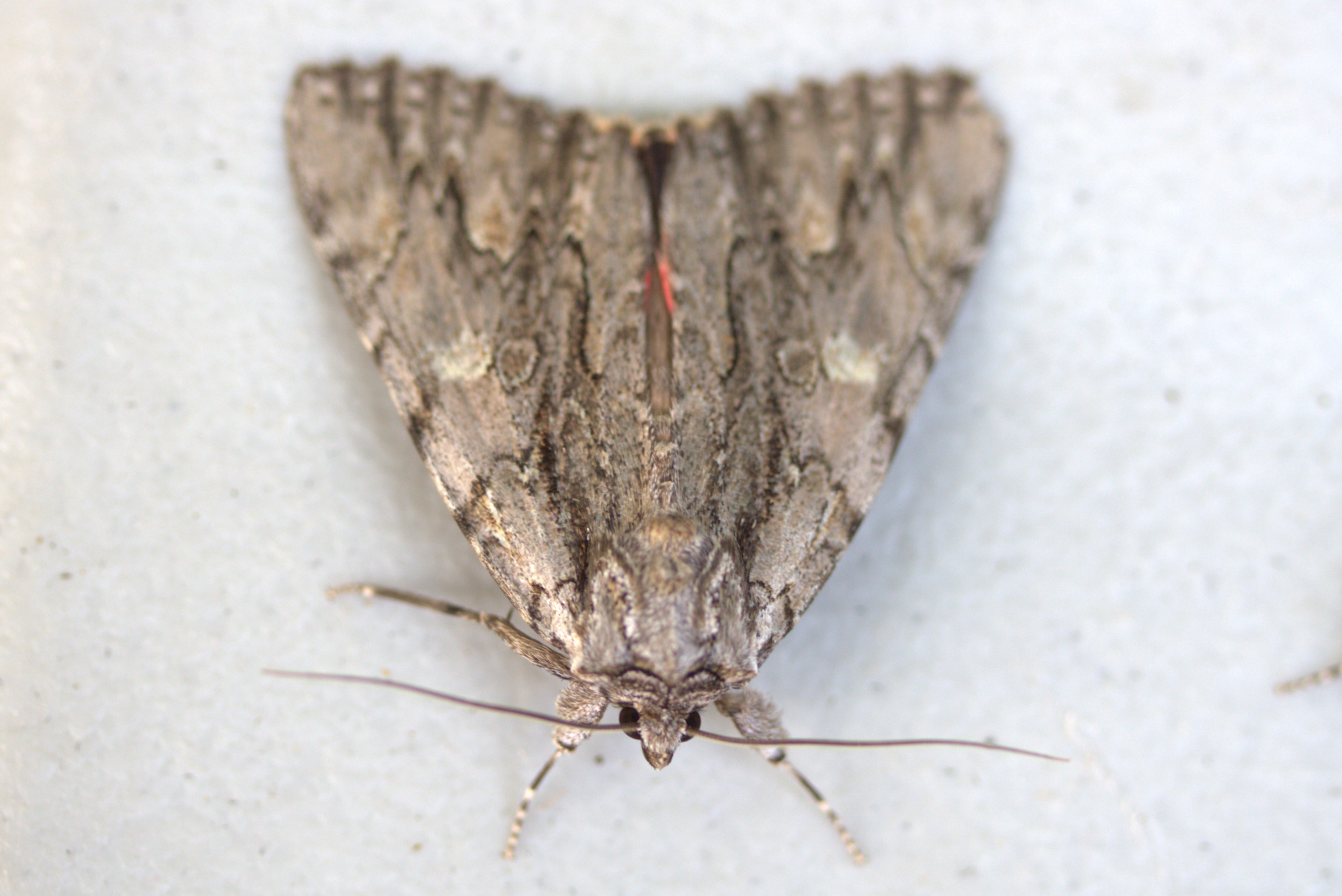
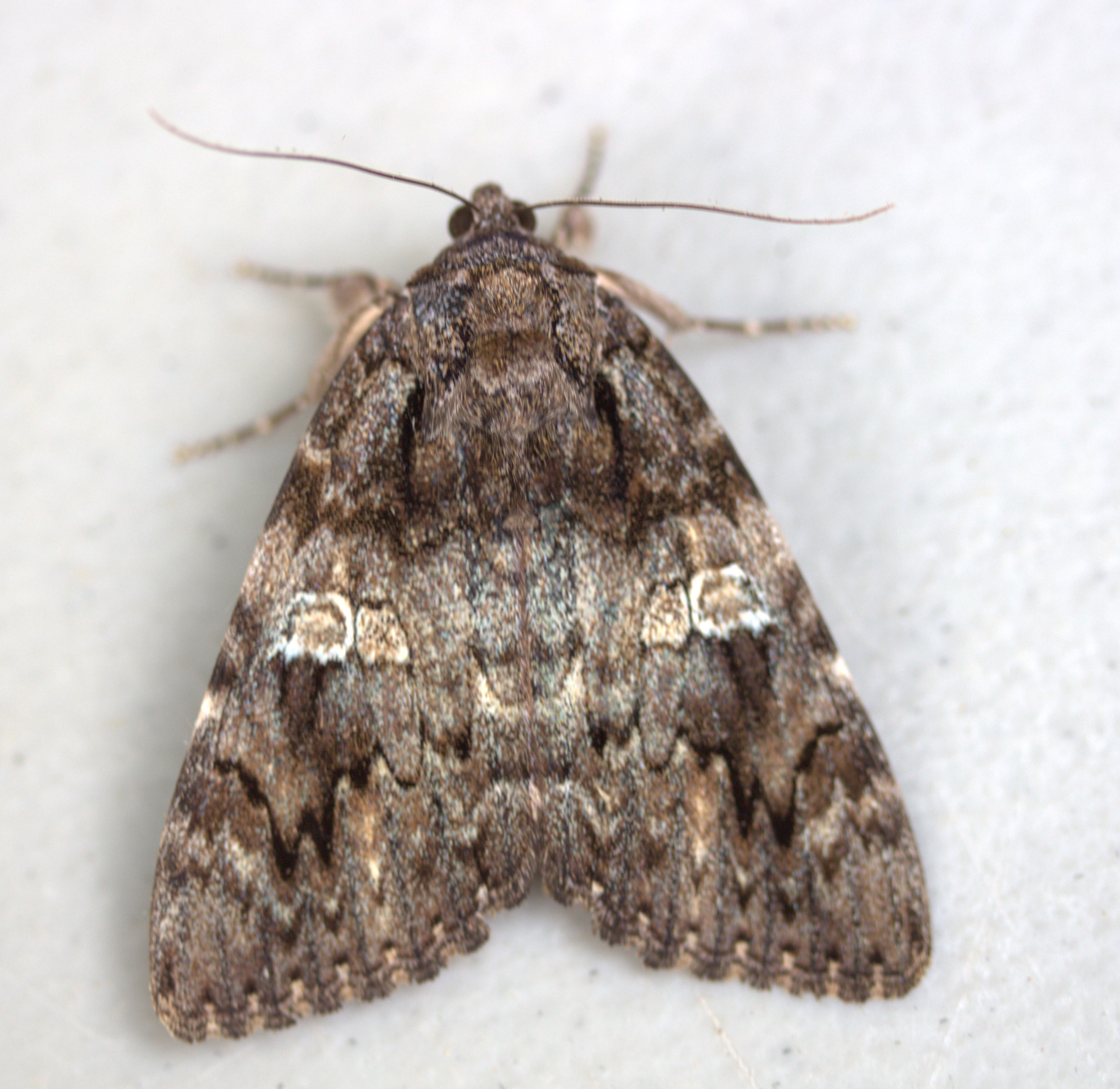
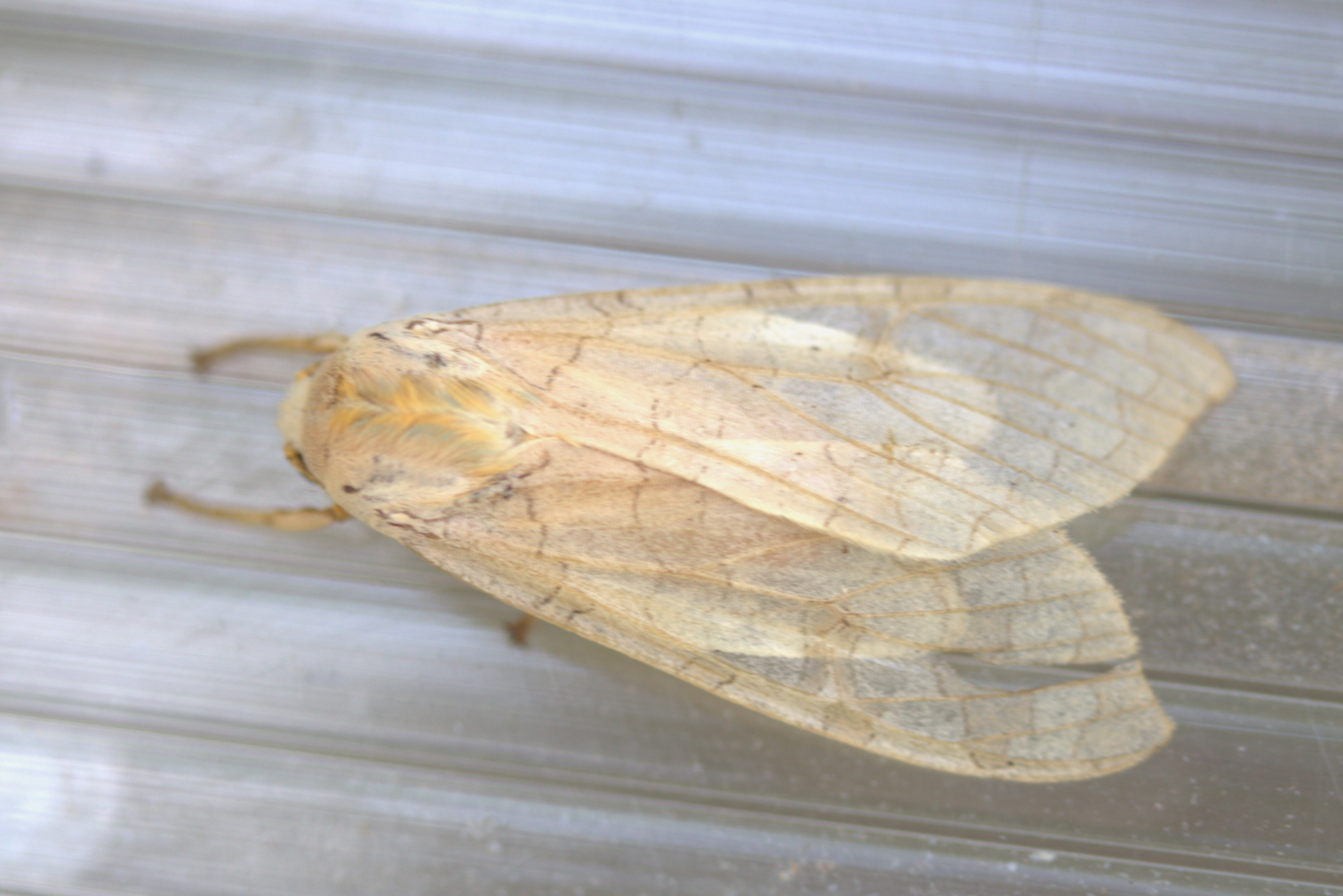
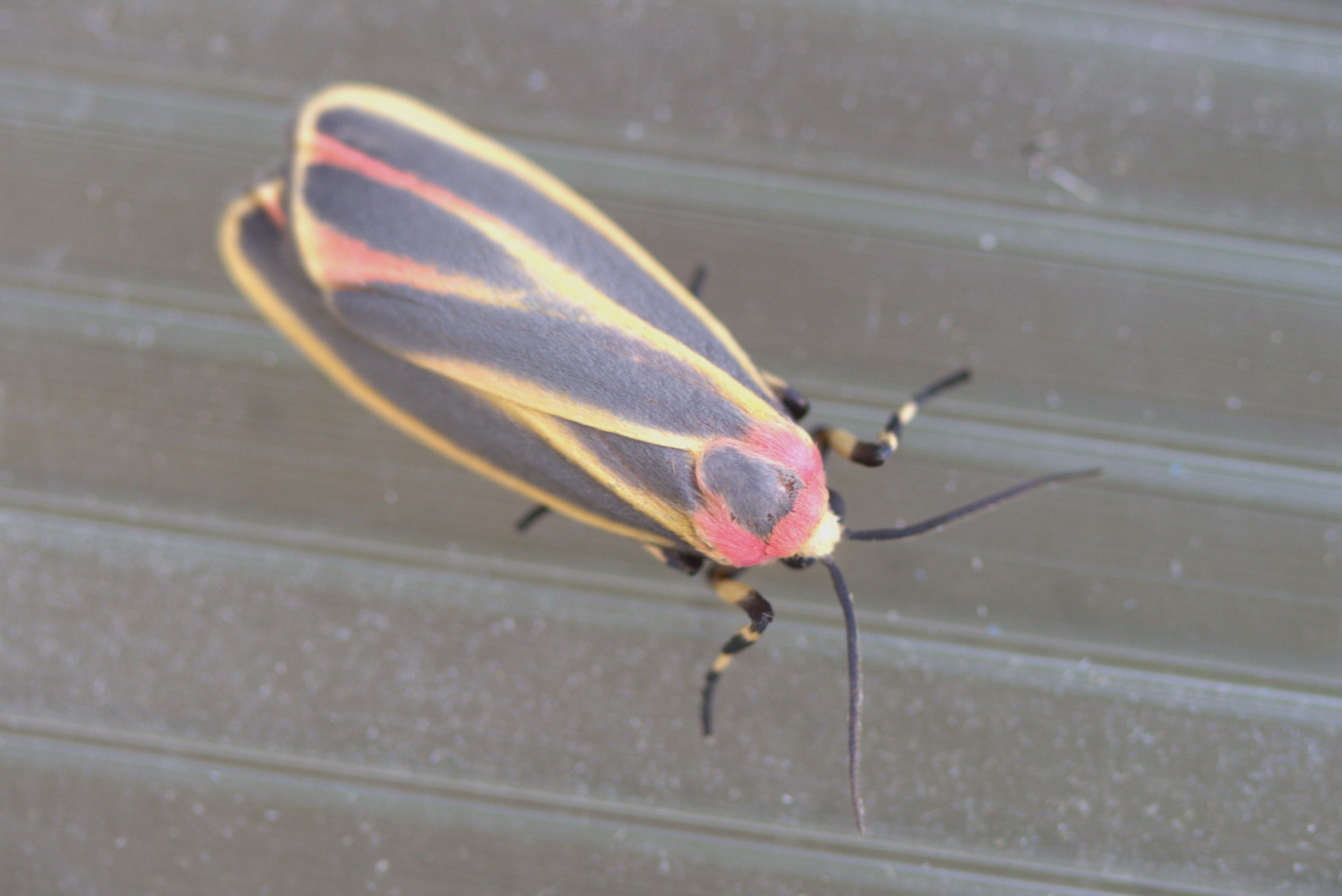
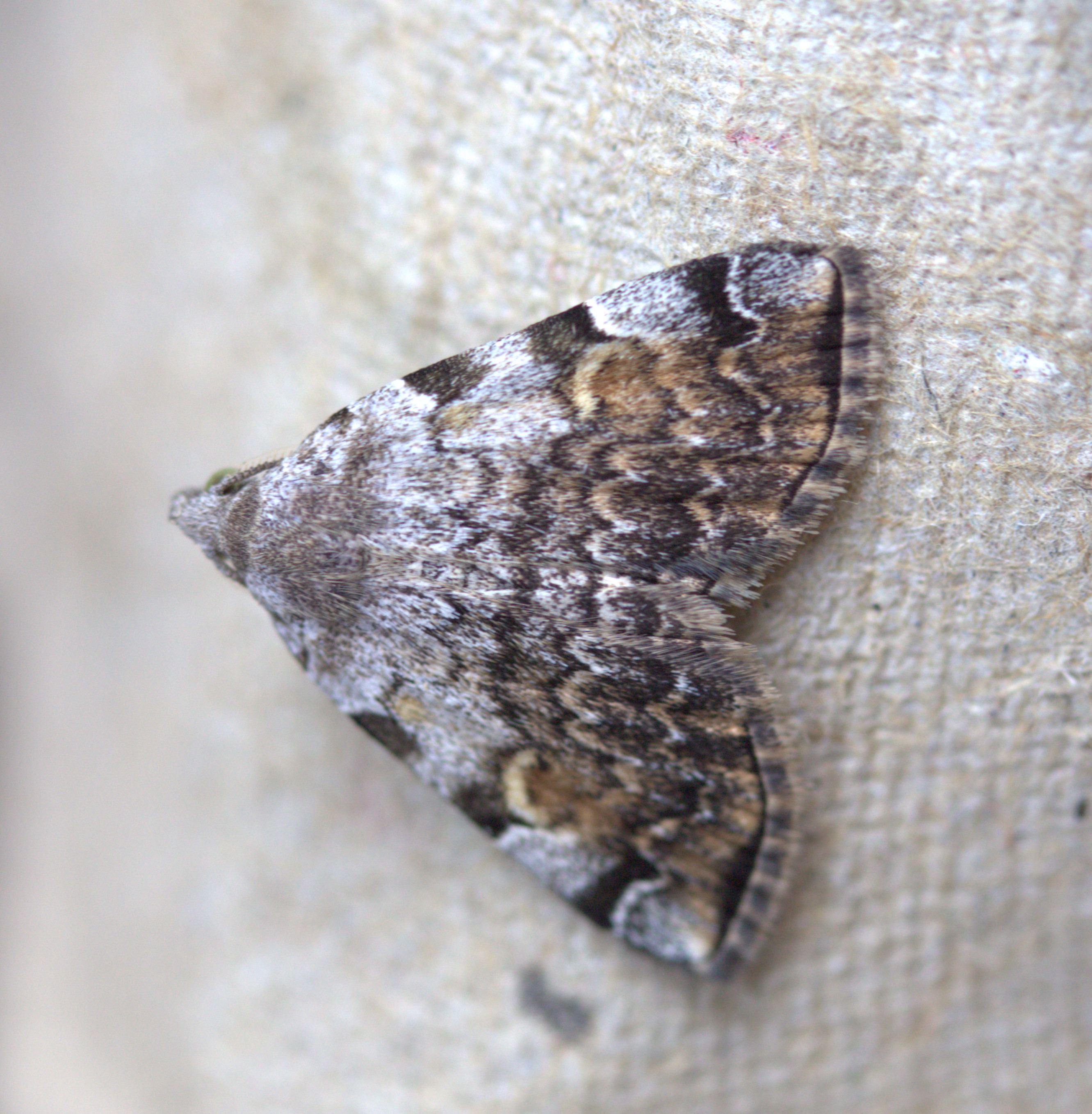
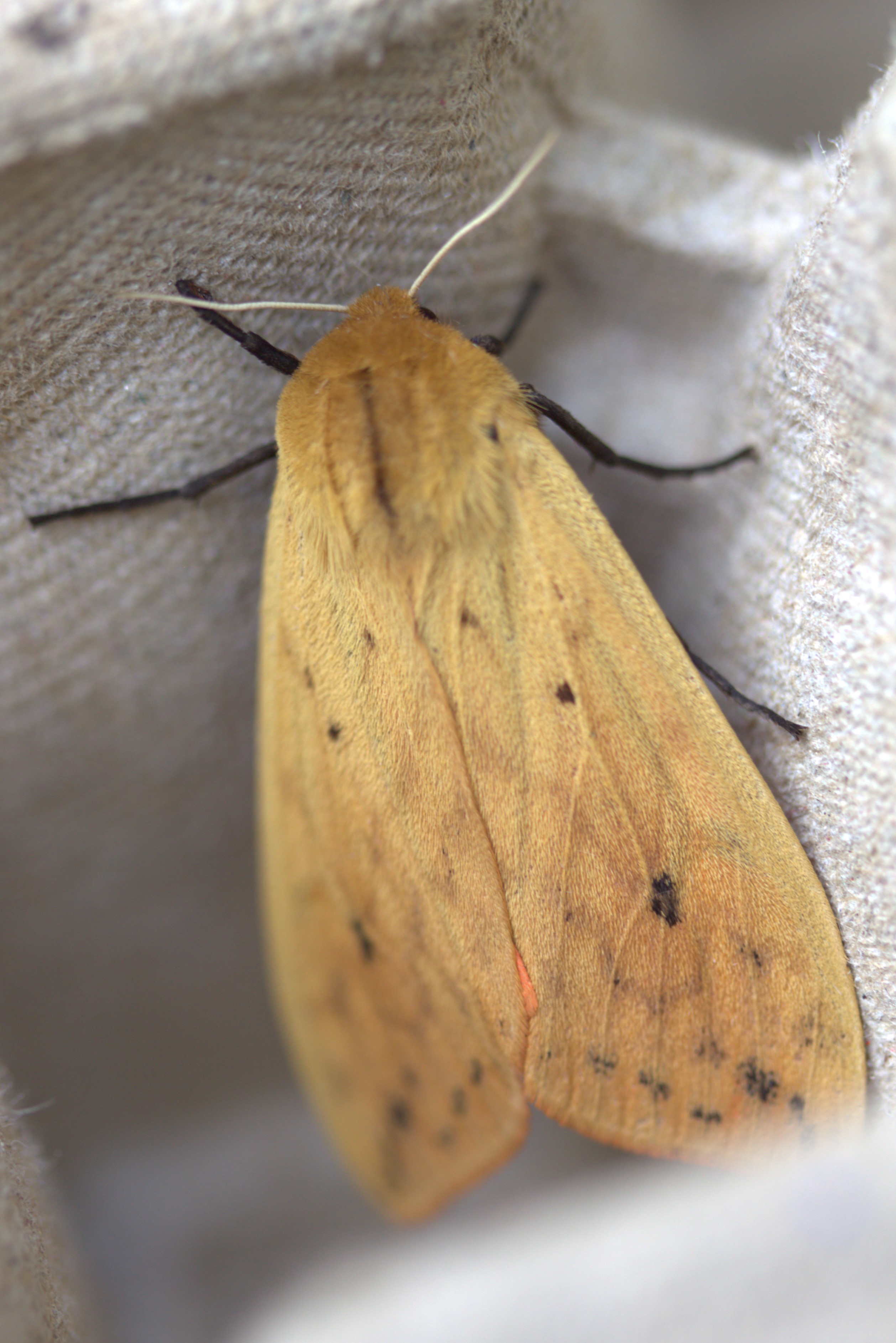
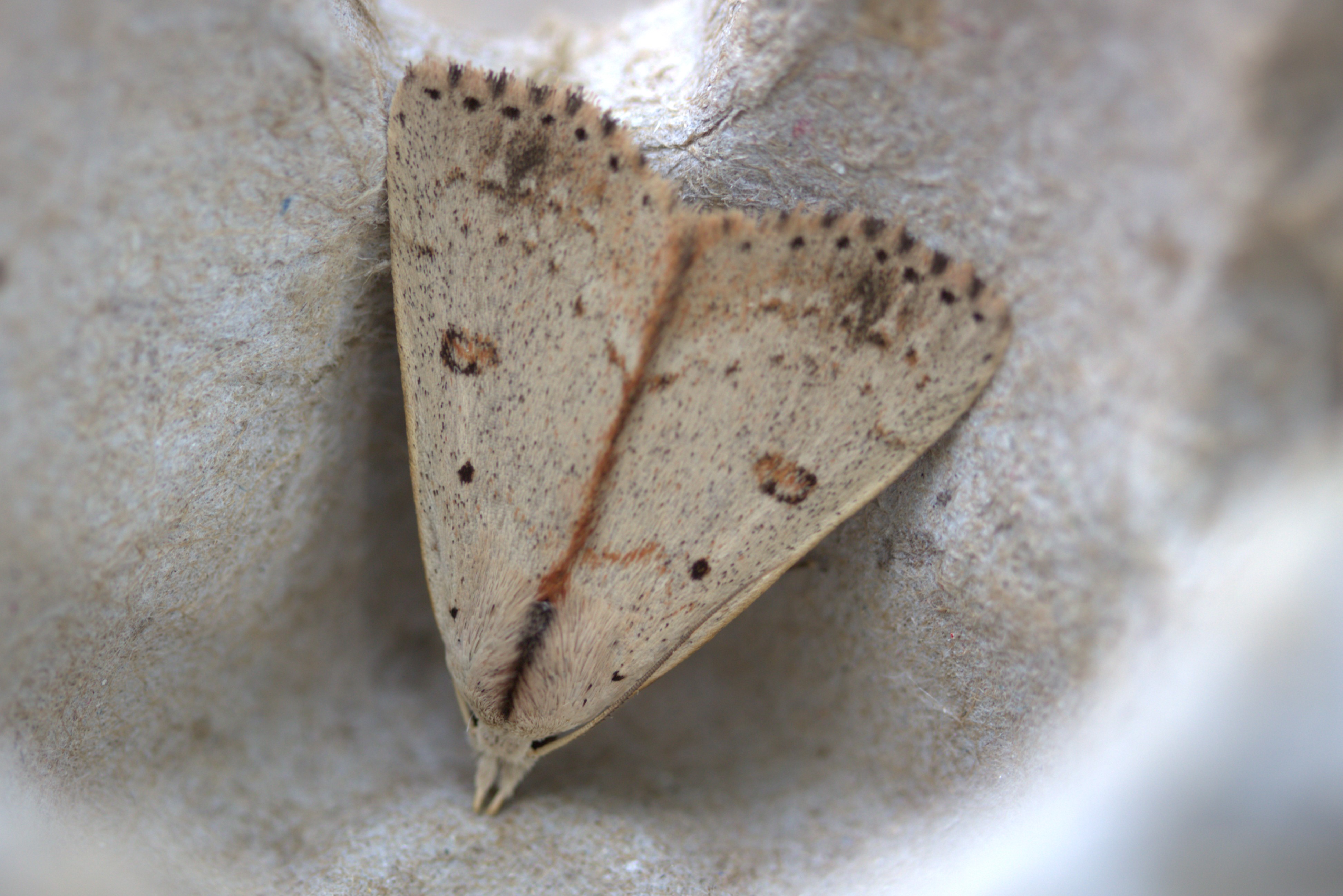
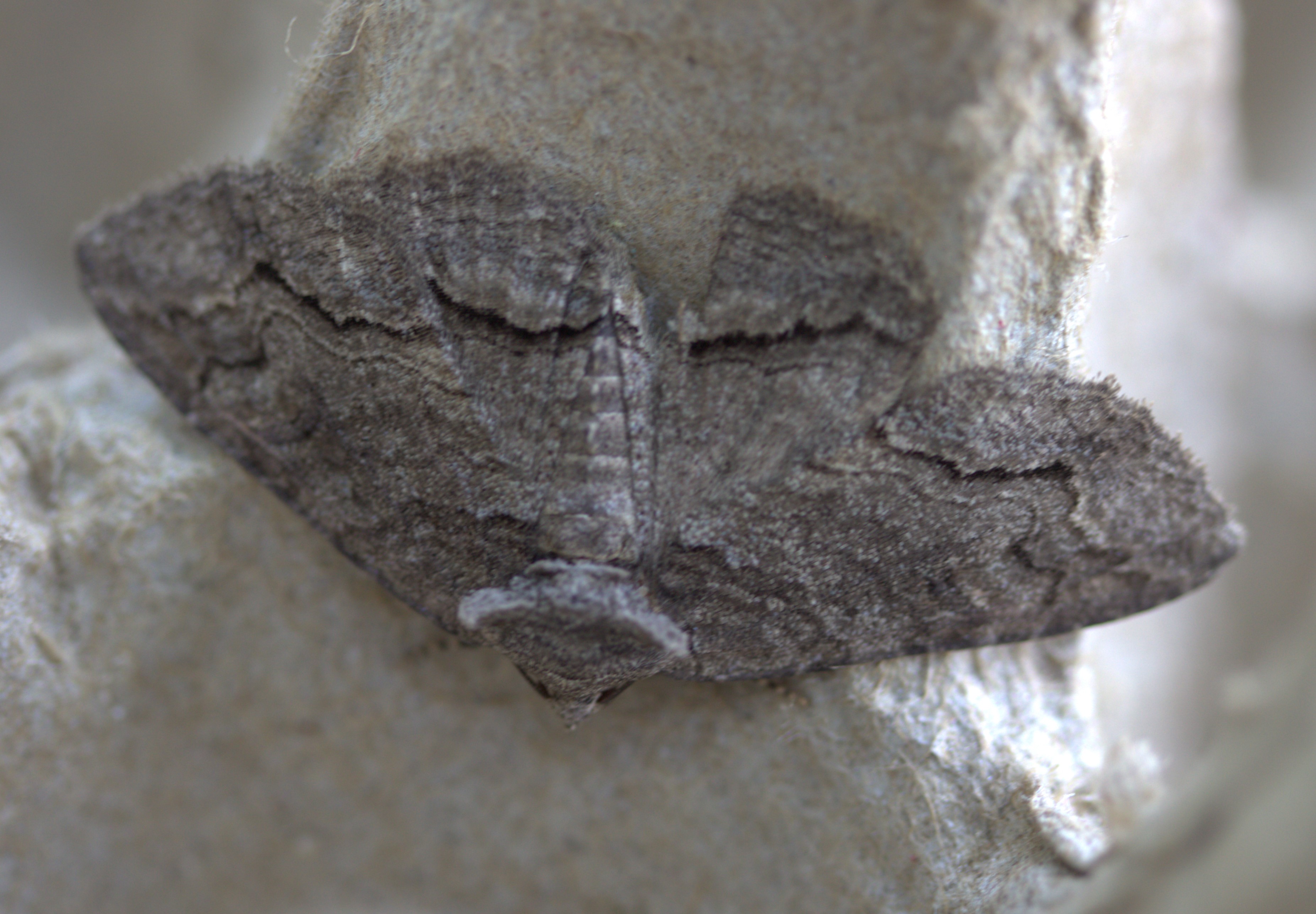
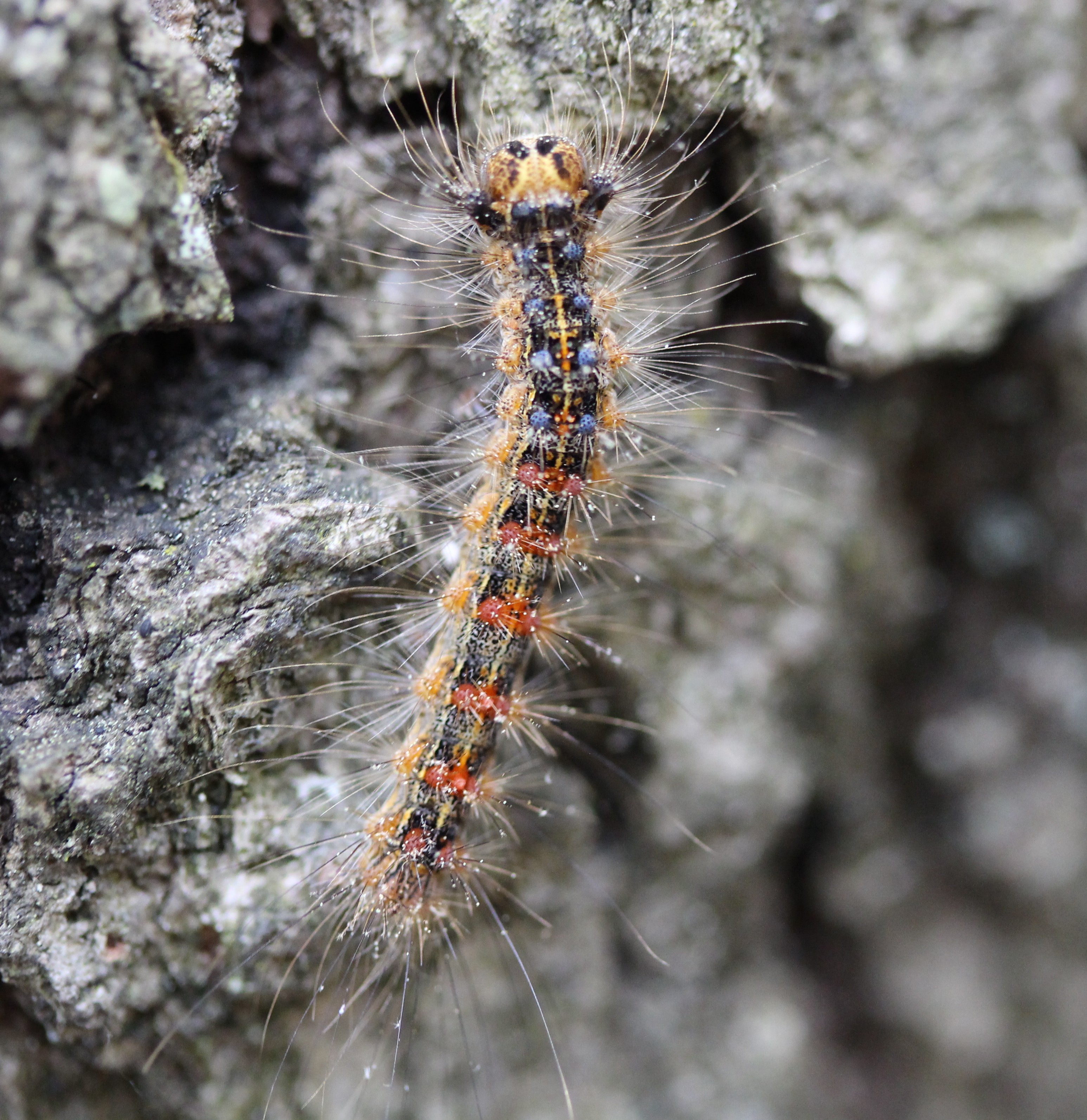
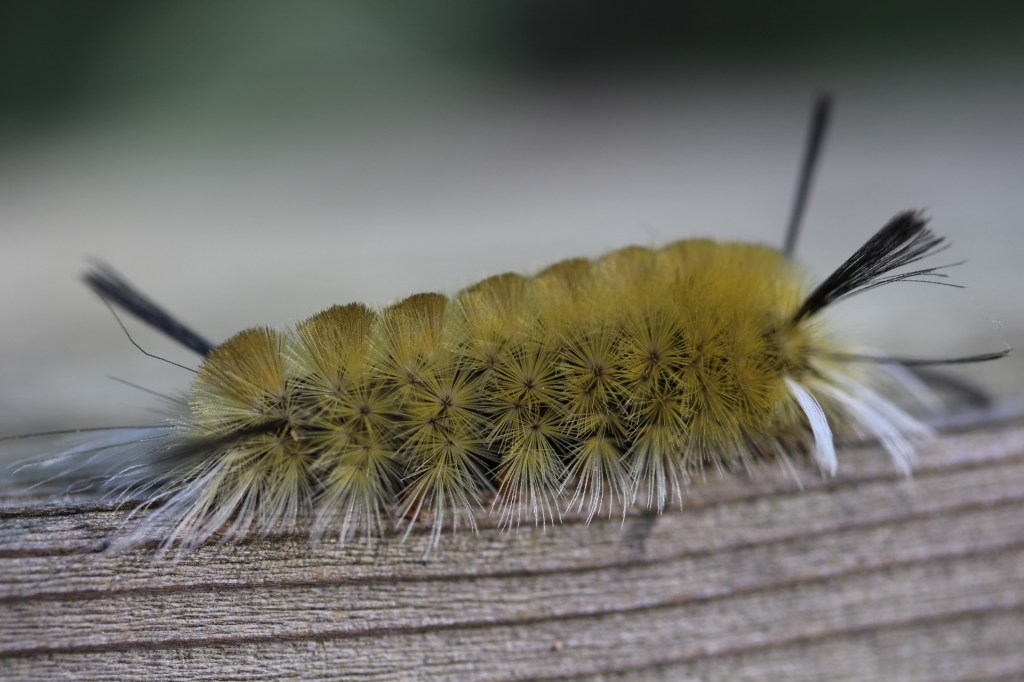
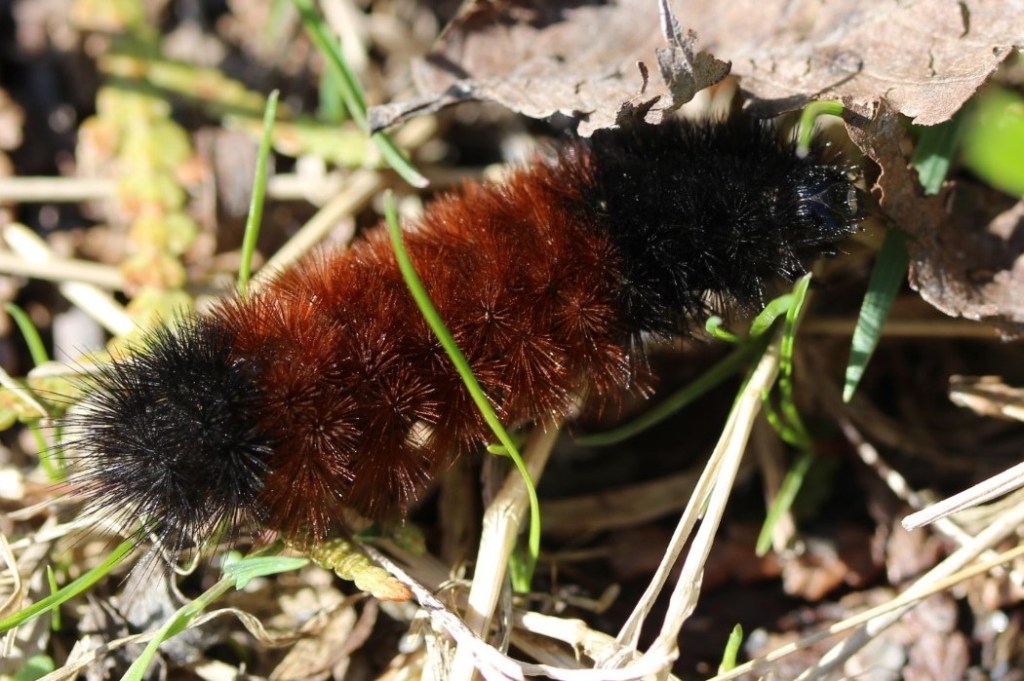
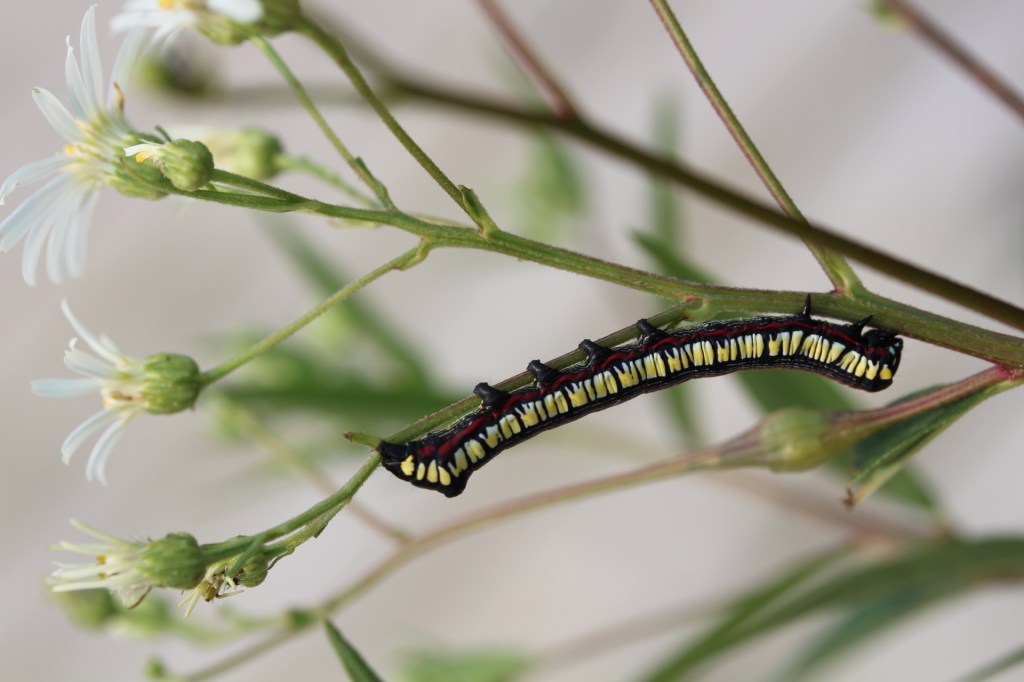
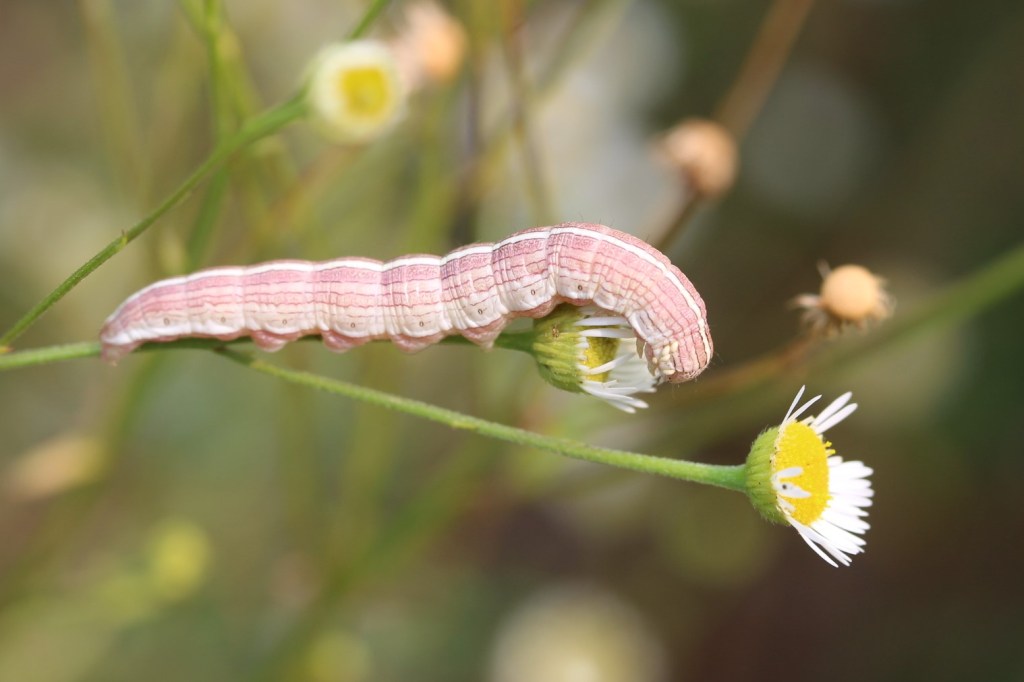
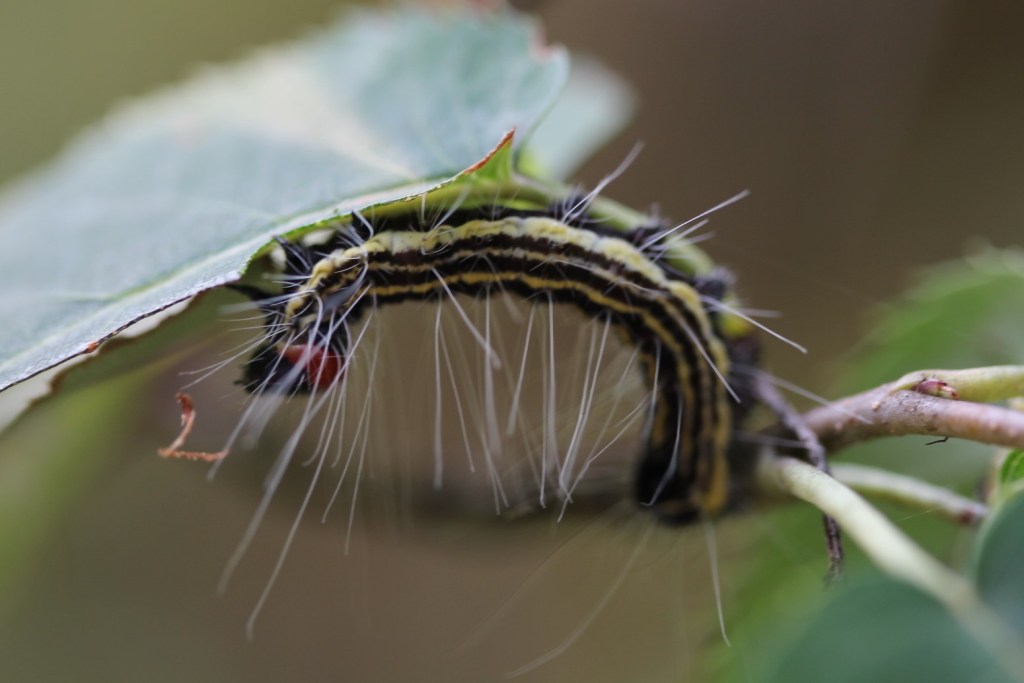
Moths in the Family Erebidae are widespread and diverse (in fact, they are the most speciose family of moths, with over 24,000 described species). They are some of the most colourful and fantastic night fliers, some of the most familiar and exotic moths. Perhaps the most commonly encountered Erebid moth in North America is the Spongy Moth (Lymantria dispar), because of its incredibly invasive caterpillars that have spread across the continent. Spongy Moths are part of the Tussock Moth group, known for their spiky caterpillars covered with long ‘tussocks’. One such moth is featured below, the Banded Tussock Moth. Another incredibly common Erebid caterpillar is the trundling Woolly Bear caterpillar, the adult moth is featured below (known in its winged form as the Isabella Tiger Moth). Another group of Erebids are known as Lichen Moths because their caterpillars feed on lichen. Another lichen-feeding species is featured below: the American Idia, a drab grey moth in contrast to the colourful pastels of its lichen-feeding cousin the Painted Lichen Moth. The Virgin Tiger Moth and the Giant Leopard Moth are two of the larger and more striking of the Erebid moths that I photographed. Other moths in this group are striking for their evocative names such as “The Herald Moth” or “Deadwood-borer Moth”. Another subsection of this family are known as “Underwings” because they have often brilliantly coloured wings concealed beneath their often drab forewings, the better to startle predators with when discovered.
Spongy Moth Caterpillar (Lymantria dispar), Turkey Point Provincial Park, June 2018Banded Tussock Moth Caterpillar (Halydisota tessellaris), Lynn Valley Trail, September 2020Woolly Bear Caterpillar (Pyrrharctia isabella), Lynn Valley Trail, August 2019. Another name would be the Isabella Tiger Moth Caterpillar.
References:
Beadle, David and Leckie, Seabrooke 2012. Peterson Field Guide to Moths of Northeastern North America. Houghton Mifflin Harcourt.
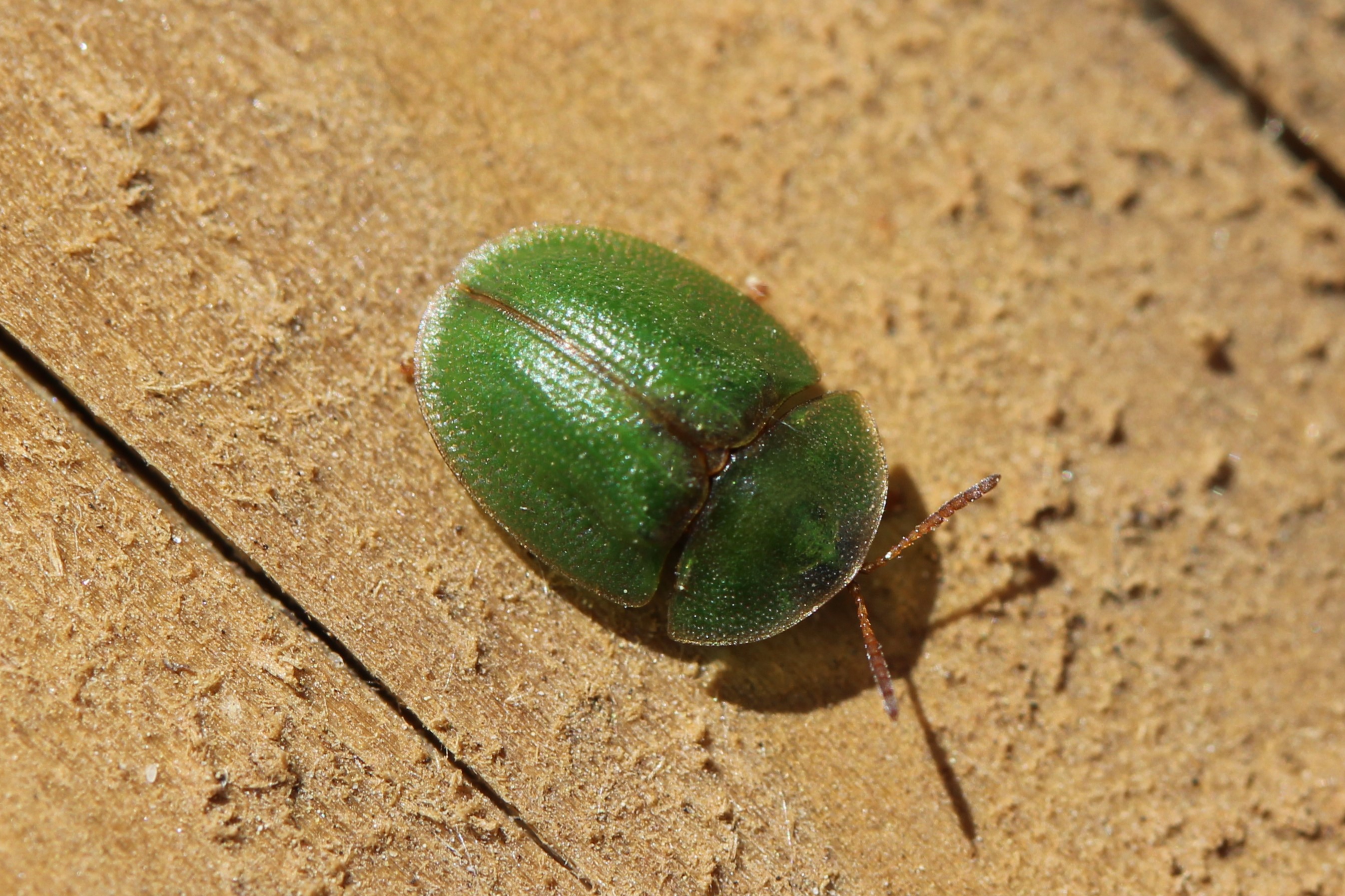
Thistle Tortoise Beetle (Cassida rubiginosa), Backyard, May 2024:
Tortoise Beetles (Beetles in the subfamily Cassidinae of the Family Chrysomelidae) have always been some of my favourite insects. Their wide elytra (wing-covers) protect their limbs and heads from predators and provide them with an appealingly round shape. The Thistle Tortoise Beetle is not native to Canada (having been introduced to combat the non-native Thistle plant), but it was still exciting to spot this charismatic insect on my back porch, trundling along. Their larval stage is less appealing, but still interesting, protecting itself not with a hardened armor covering but a “fecal parasol”. Yes, that’s right, larval Tortoise beetles carry their poop within a forked abdomen curved forward over their backs to ward off predators. There is even a specific word for this behaviour: “merdigery” – from the Latin for “dung” and “carry” (Costa 2006). Likely not a word you’ll find too much use for.
Armored Resin-bee (Heriades), Backyard, June 2024:
This strange-looking bee lays its eggs inside of constructions left behind by other insects, “especially beetle holes in wood, but they may also use pine cones” according to Wilson and Carril (2016). Their nest cells are divided with resin which is where they get their common name of “resin-bee”. Their generic name “Heriades” means “wool” referring to their woolly hairs, evident in the photo.
Related Chaclid Wasp (Leucospis affinis), Backyard, June2024:
Although her colouration may remind you of a paper wasp or other social, stinging wasp, the long ovipositor curled over her back indicates that she is in fact something quite different: a parasitic wasp. This female will lay her eggs inside the nest of a leafcutter bee (bees in the family Megachilidae), and the larvae that hatch will locate and consume their host bee larvae (Holm 2021). Holm, in her amazingly detailed books on common garden wasps, says this about the larval stage of this wasp: “The larva is initially equipped with sensory and locomotive hairs on its head and body to help it find the host as it moves around the dark nest cell… has an oversized head, and large mandibles used to kill the host larva and destroy any other Leucospis eggs. Like many cleptoparasitic bees, the larva loses most of these prey-finding apparatus after molting” (Holm 2021).
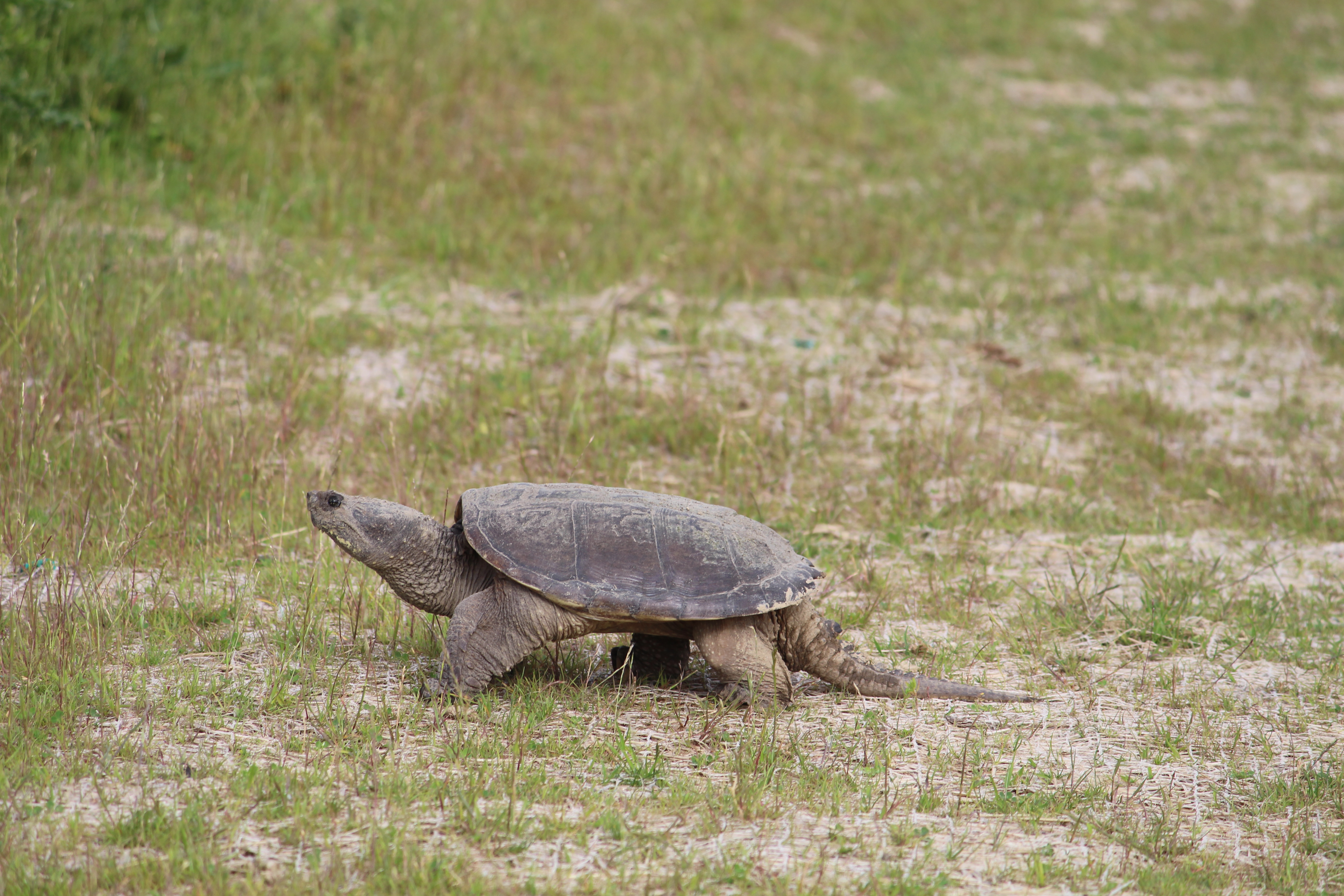
Common Snapping Turtle (Chelydra serpentina), Long Point, June 2024:
The sight of a Snapping Turtle walking across land always makes me think of a prehistoric beast lumbering out of some primeval swamp. Despite the fact that Snapping Turtles are well adapted to their environment, and no more primitive a species than any others, they give the impression of an ancient power, a relic from the days of the lumbering dinosaurs.
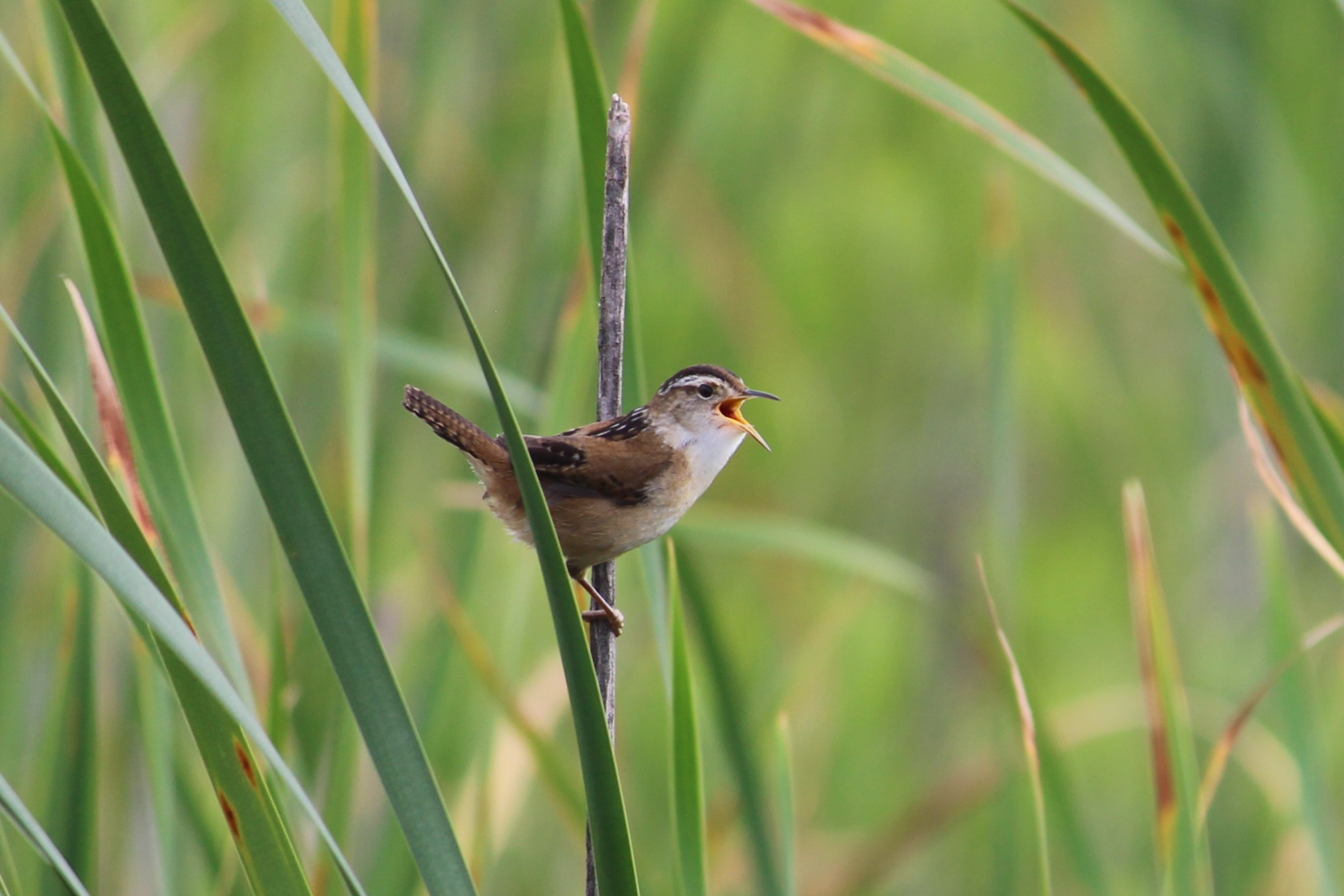
Marsh Wren (Cistothorus palustris), Long Point, June 2024:
The sound of these energetic birds clambering among the cattails of a wetland is one of the backdrops of my summer, going out to take photos of birds and other wildlife. I was surprised to learn that Marsh Wrens are major predators on Red-winged Blackbird eggs and nestlings in some parts of their range (Beletsky 1996). Marsh Wrens mostly eat insects, and they construct several nests within their territories from which the females choose, just like in House Wrens (Stokes and Stokes 1983).
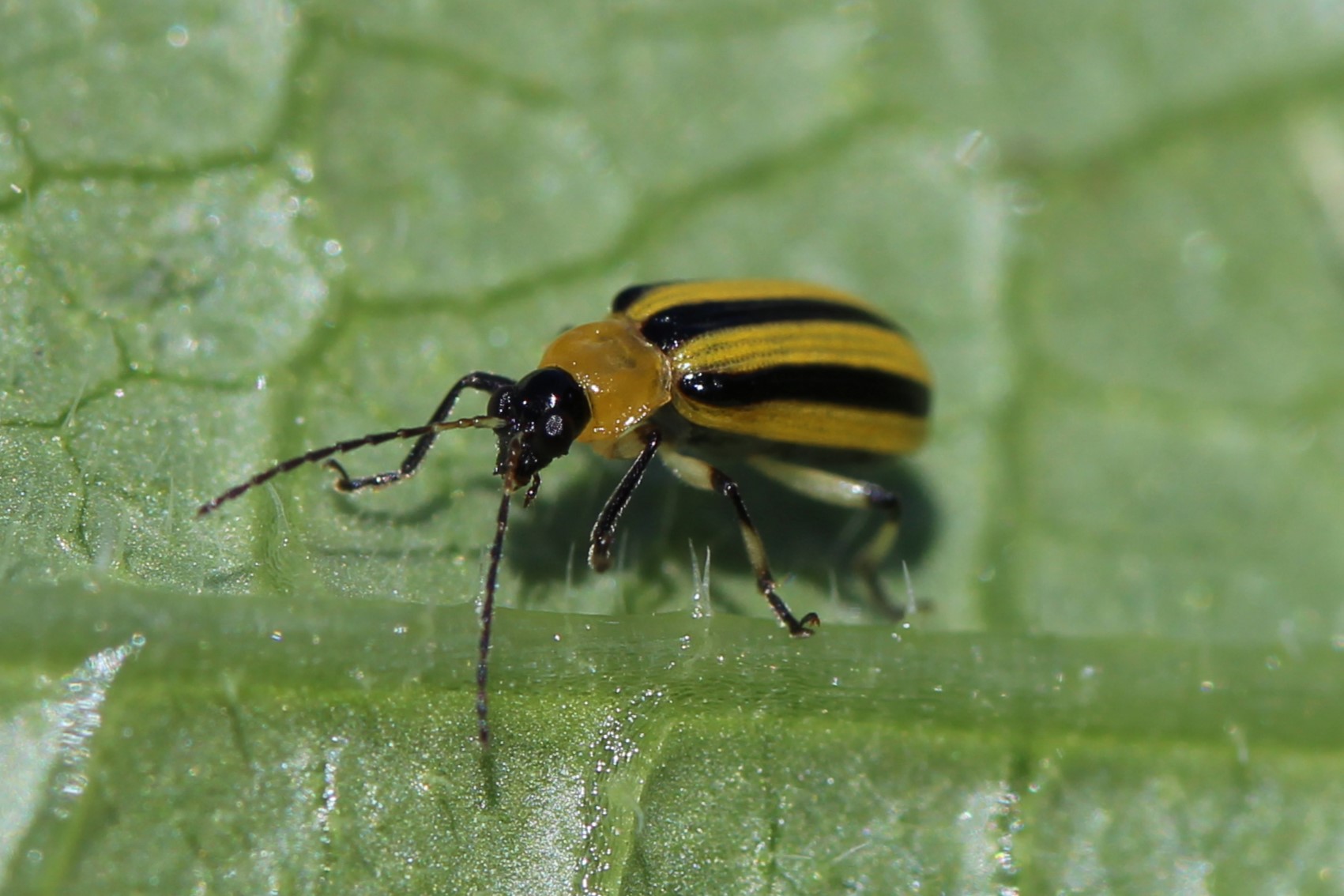
Striped Cucumber Beetle (Acalymma vittatum), Backyard, July 2024:
The Striped Cucumber Beetle is considered a pest because it consumes plants that we like to consume ourselves: members of the Cucurbitaceae (cucumbers, watermelons, gourds, pumpkins, squash and many others). The adults feed on leaves, while their larvae feed on the roots (Marshall 2018).
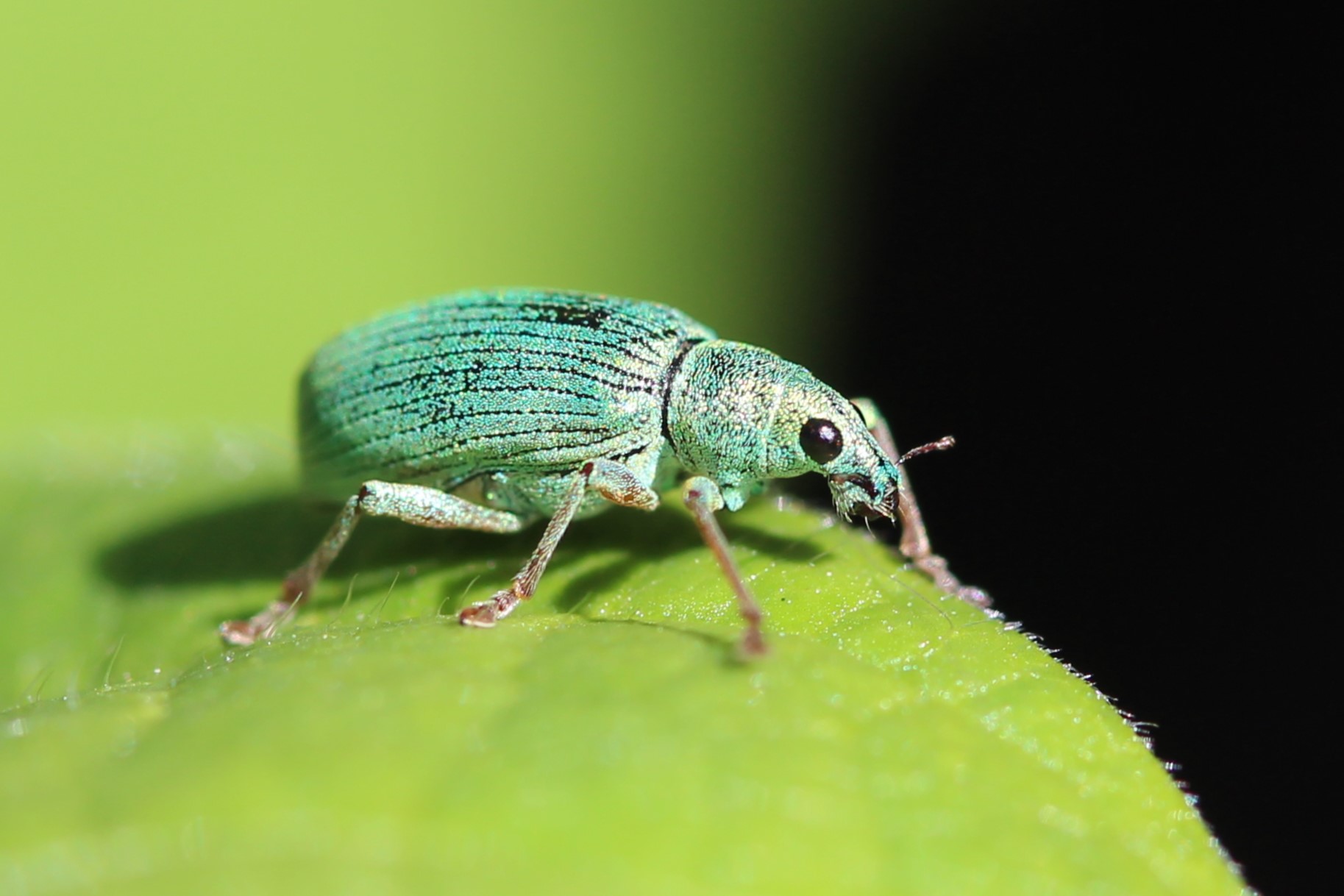
Green Immigrant Leaf Weevil (Polydrusus formosus), Backyard, July 2024:
Another pest beetle species, this one non-native to North America (accidentally introduced, and not deliberately like the Thistle Tortoise Beetle), the Green Immigrant Leaf Weevil feeds on various shrubs and trees. Eggs are laid in the bark of host plants or in the soil, the larvae feed on roots through Spring and Summer and then emerge as adults in the following Spring (Lisak et. al. 2024).
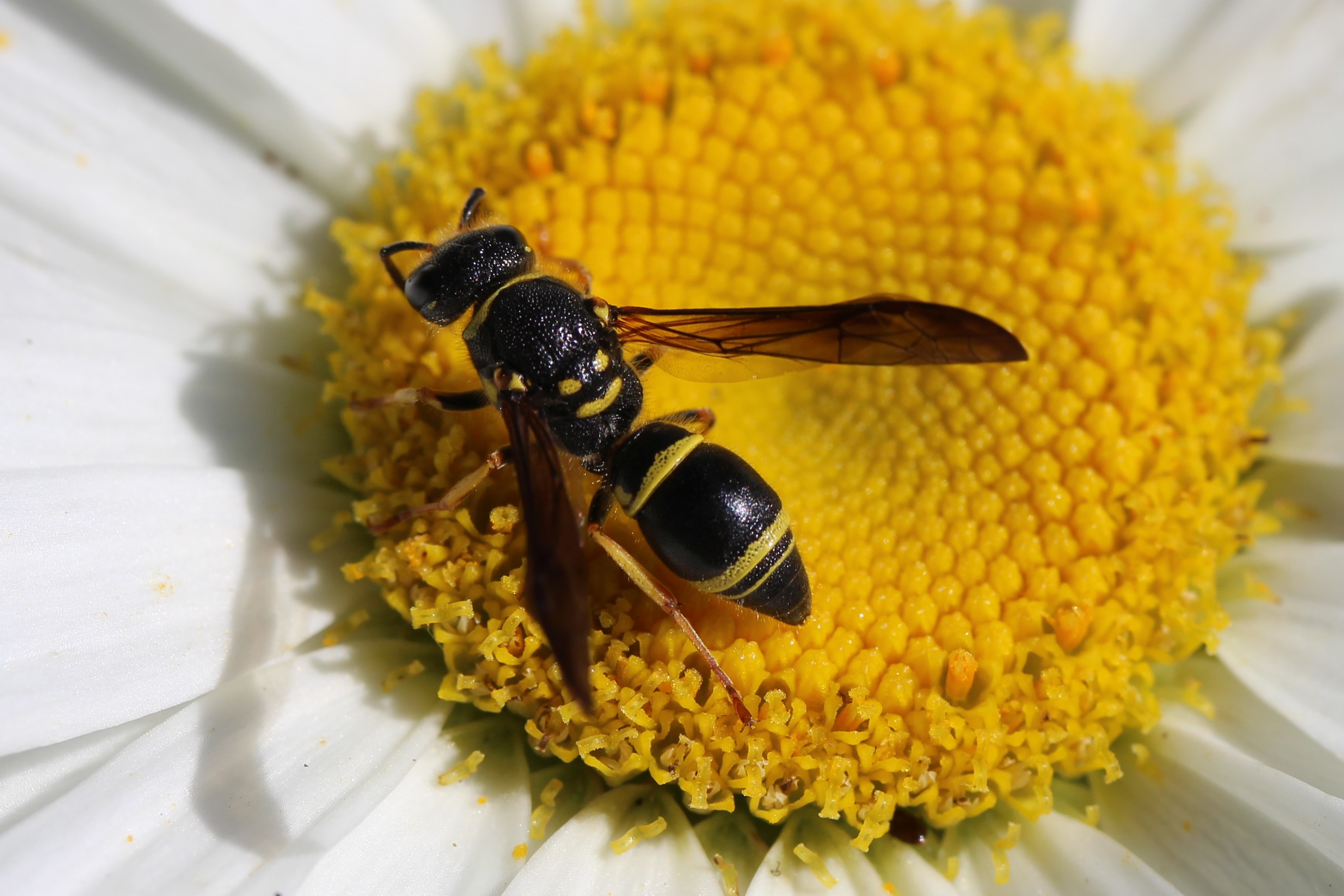
Smiling Mason Wasp (Ancistrocerus campestris), Backyard, July 2024:
In the photo above, you can clearly see the smile emblazoned on the Smiling Mason Wasp’s thorax. These wasps lay their eggs in pre-existing cavities, creating several nest cells by dividing the cavity with mud walls (Holm 2021). You can think of each nest cell as a nursery for individual wasp larvae, as the Smiling Mason Wasp female lays a single egg in each chamber (and hangs it from the ceiling by a silken thread) (O’Neill 2001). Each nursery is filled with several paralyzed caterpillars for the larva to consume upon hatching (Holm 2021).
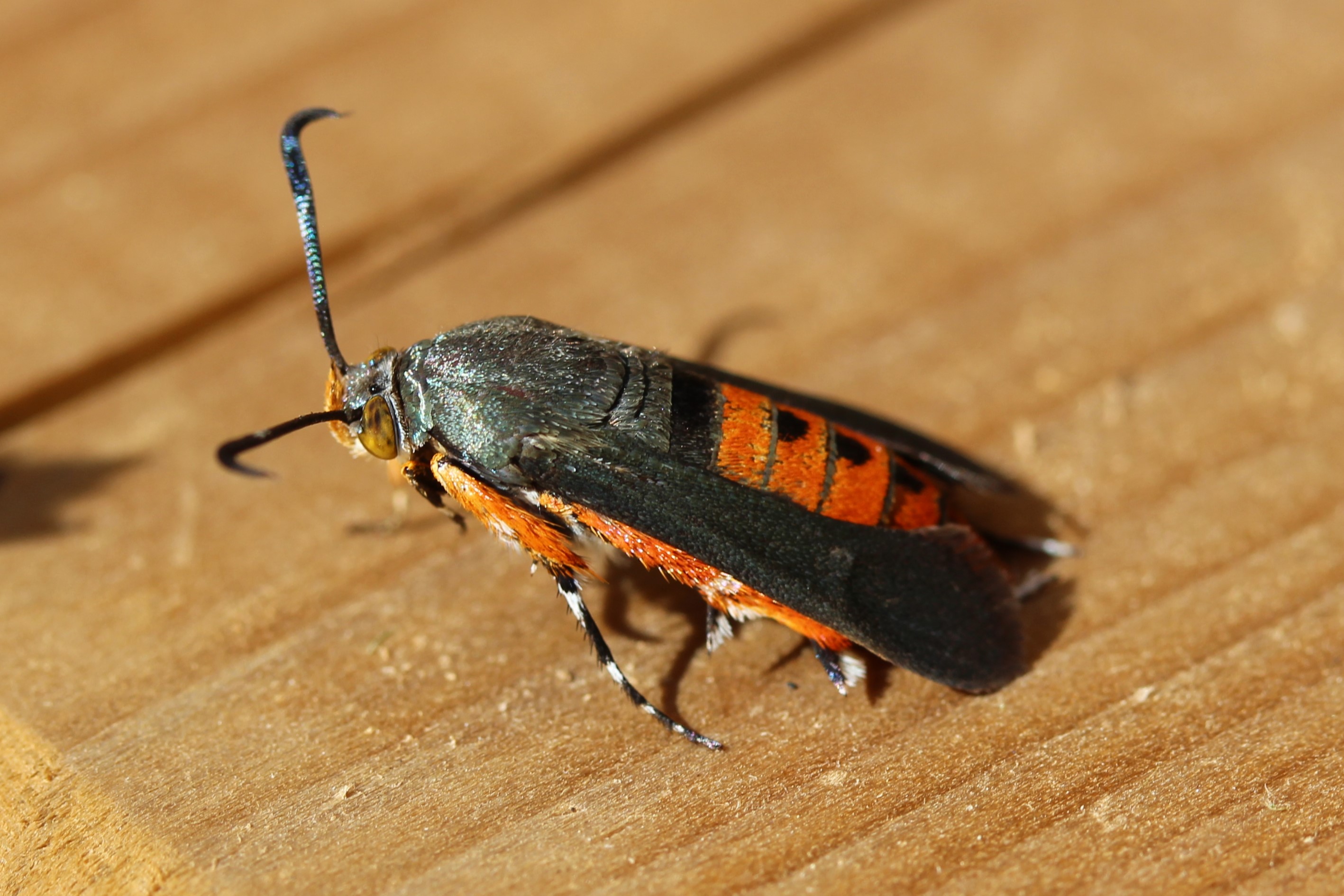
Squash Vine Borer (Eichlinia cucurbitae), Backyard, July 2024:
Standing still, the illusion is not very convincing, but when this little moth was in constant buzzing motion, hovering from flower to flower, the resemblance to a wasp was impressive (specifically the Great Golden Digger Wasp, Sphex ichneumoneus). The mimicry helps keep this moth safe from predators which hesitate to interfere with a stinging wasp but would love to snack on a harmless moth. As with several other insects on this list, the Squash Vine Borer feeds on squash, cucumbers, gourds, or pumpkin during its larval stage, giving some indication of what we were growing in our garden this past summer.
Pruinose Squash Bee (Peponapis pruinosa), Backyard, July 2024:
Unlike many other bees, Squash Bees are specialist pollinators on one plant family: the Cucurbitaceae (the pumpkins, squash, cucumbers etc). These are solitary bees, meaning that each female creates her own nest for her offspring, rather than contributing to a social construction such as a honeybee or bumblebee colony made up of many non-reproducing individuals. Female Squash Bees dig their nests into the soil, 1.5 feet deep or more, before branching off the main tunnel into several off-shoots with each one receiving pollen and an egg (Wilson and Carril 2016).
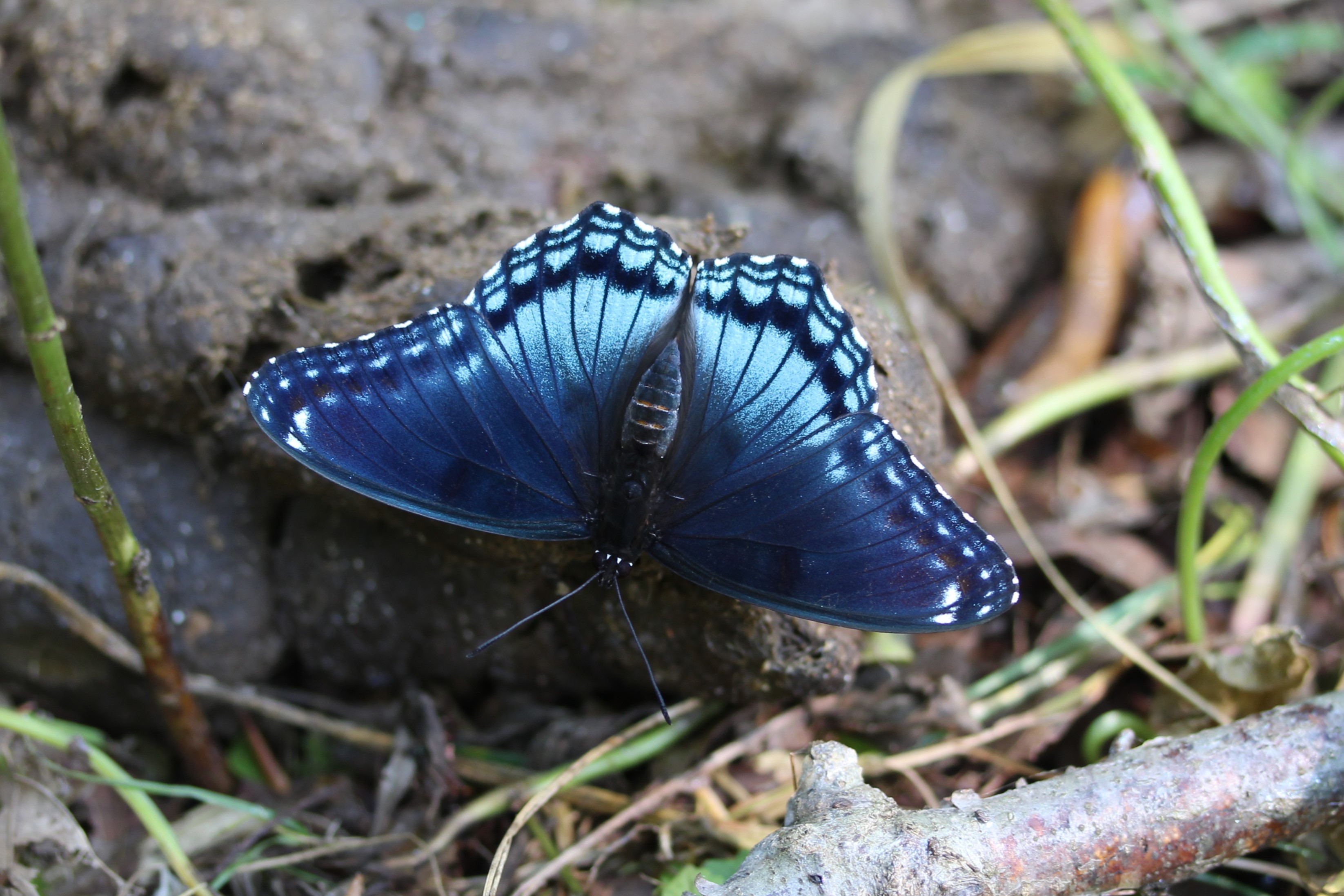
Red-Spotted Purple Butterfly (Limenitis arthemis astyanax), Backus Woods, July 2024:
This beautiful butterfly was spreading its wondrous wings as it fed on dung (I believe this was of the horse variety). Many butterflies feed on dung for valuable minerals, creating such jarring juxtapositions.
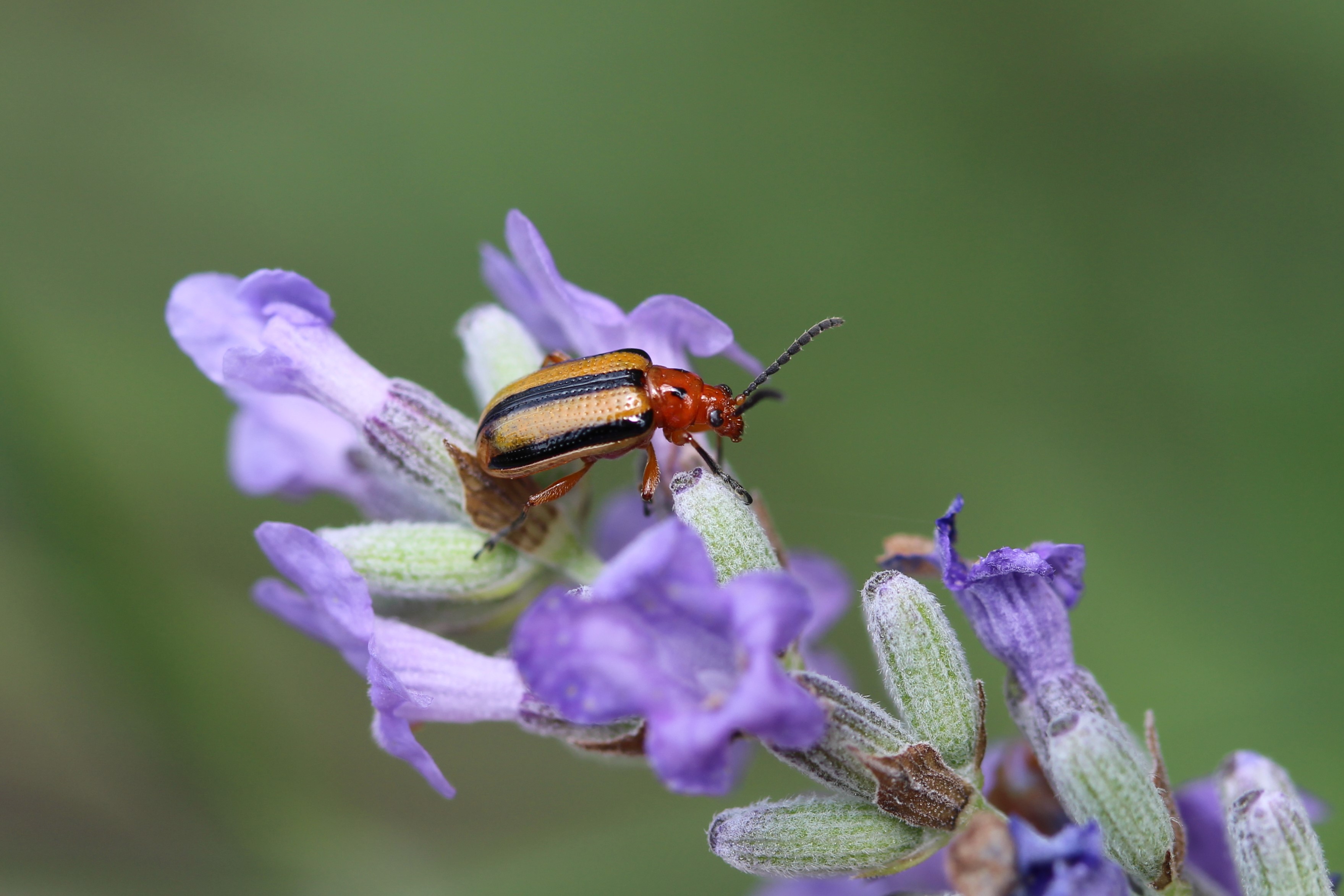
Three-lined Potato Beetle (Lema daturaphila), Backyard, July 2024:
This attractively coloured beetle is a native leaf beetle (in the subfamily Criocerinae) which feeds on potatoes and other related plants. Its larvae exhibit merdigery (bet you didn’t think that word was coming back again so soon, did you!?).
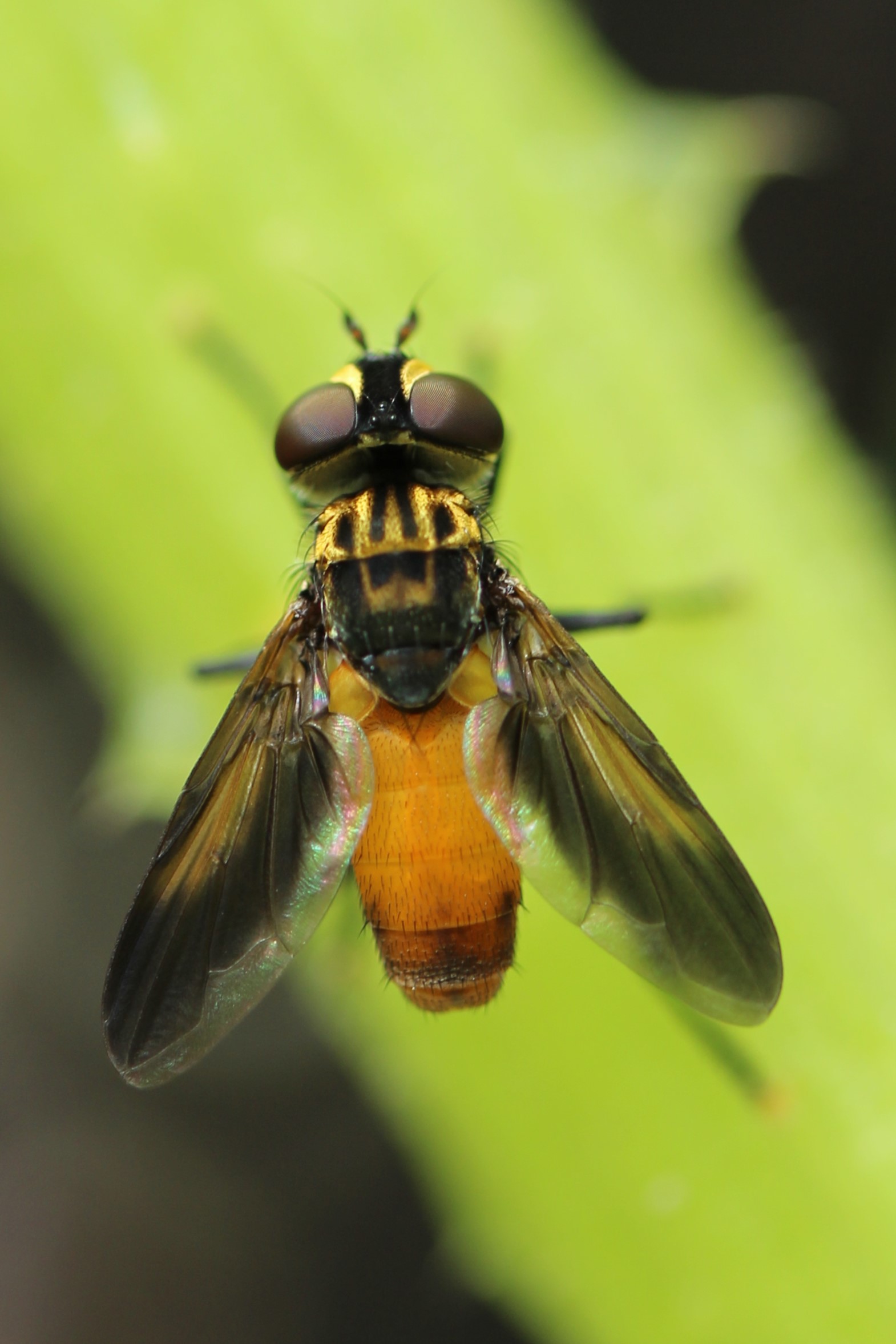
Swift Feather-legged Fly (Trichopoda pennipes), Backyard, July 2024:
These flies are part of the vast fly Family Tachinidae, which are largely bristly and parasitic. Trichopoda pennipes lays its eggs directly onto its hosts which are various true bugs (Hemipterans), including Squash Bugs, Stink Bugs and Leaf-footed bugs. The egg hatches and the larva burrows directly into the host bug, consuming it from the inside. This gruesome life cycle is helpful to gardeners as many of its hosts are pests of garden plants.
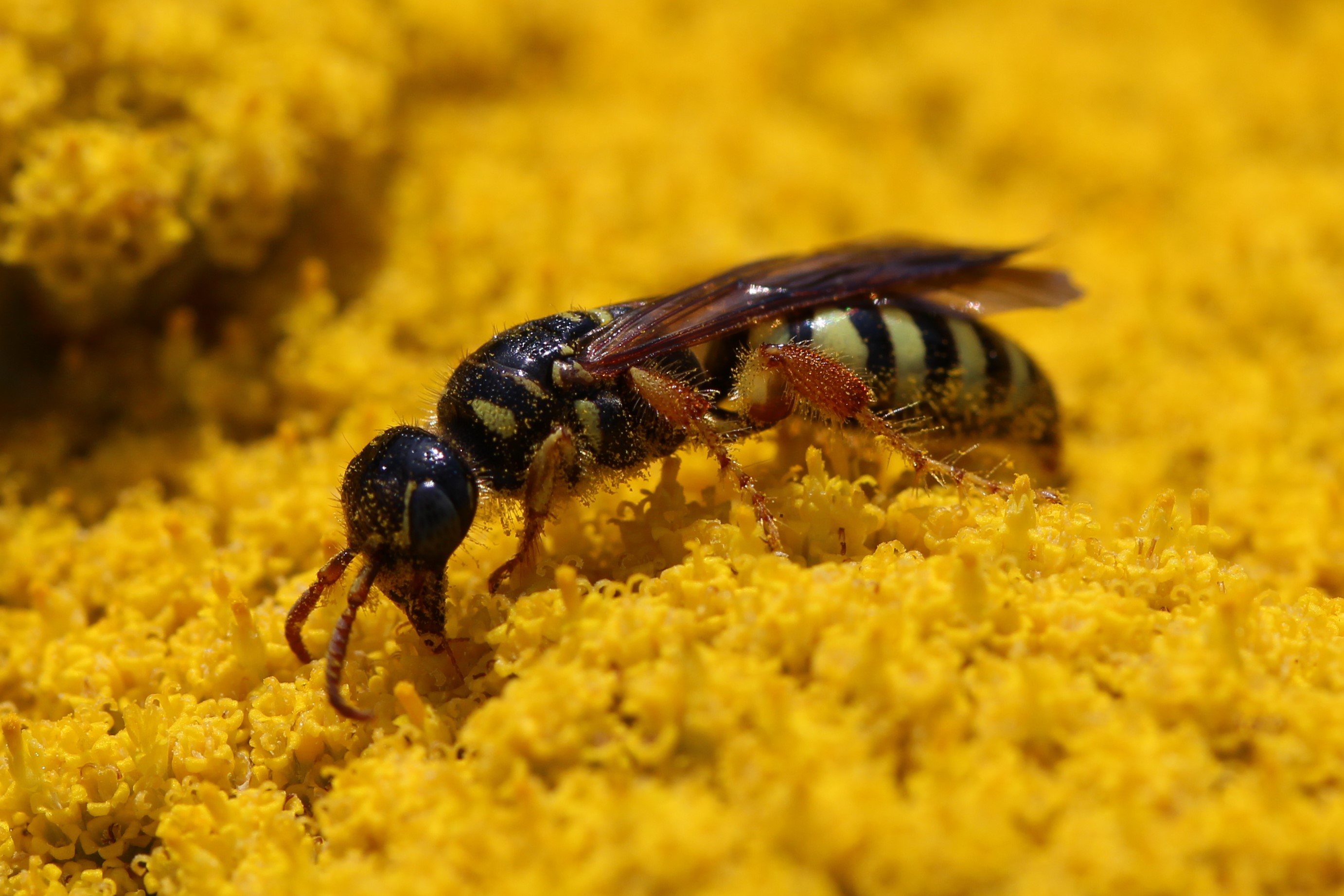
Five-Banded Thynnid Wasp (Myzinum quinquecinctum), Backyard, July 2024:
These large wasps again demonstrate the familiar patterning and colouring of a social paper wasp, but are very distinct in their life cycle. Female Five-Banded Thynnid Wasps dig up to six inches into the ground at night, in search of scarab beetle larvae (or occasionally tiger beetle larvae) (Holm 2021). Once found, the female paralyzes the grub and lays her egg on its abdomen (Holm 2021). The wasp larva consumes the beetle larva and creates a silken cocoon within its late host’s underground chamber to spend the winter (Holm 2021). Once spring arrives, the wasp pupates and emerges as the impressive adult pictured above in summer (Holm 2021).
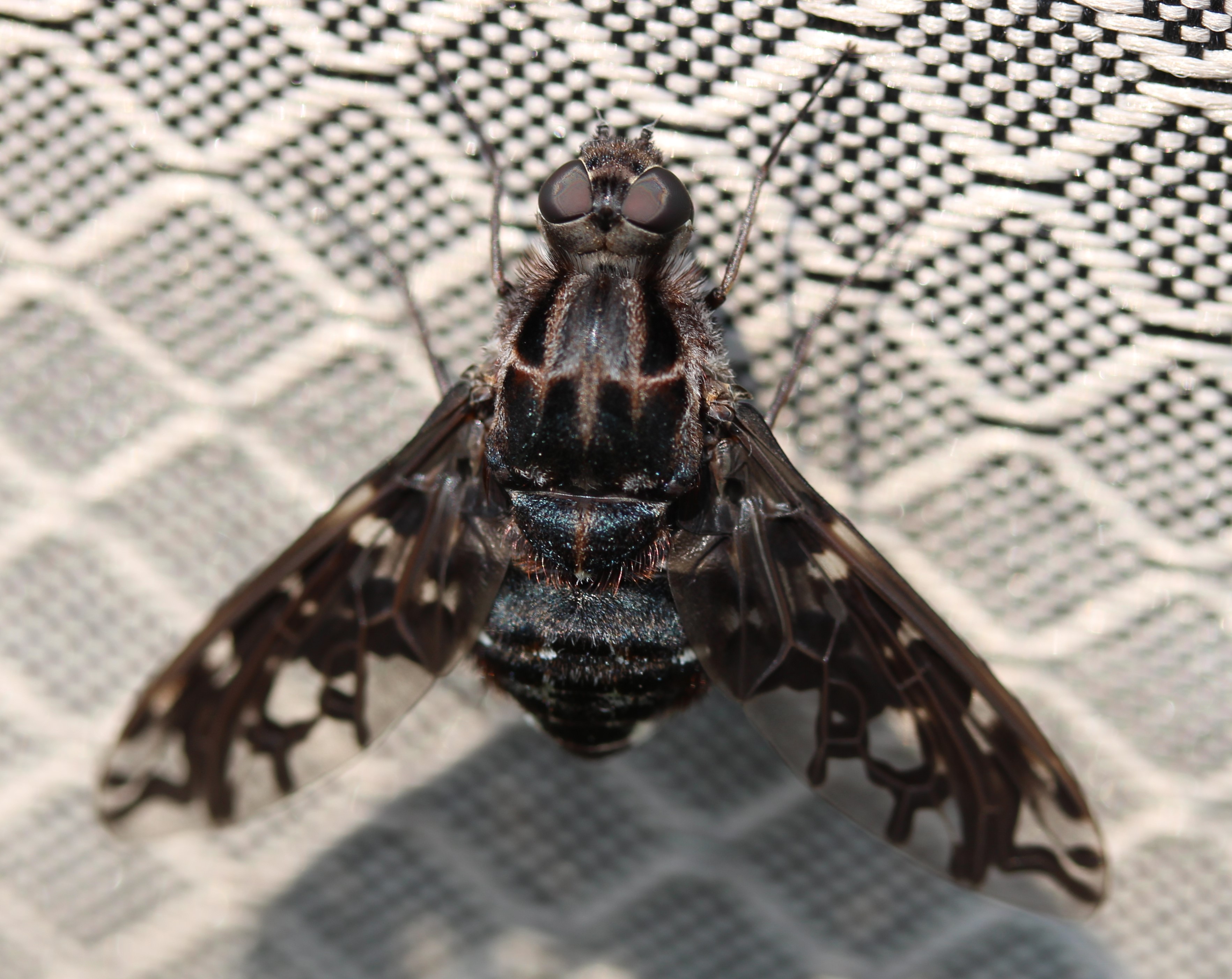
Despite its large and striking appearance, this formidable fly does not bite or sting people and should only be feared by its prey: Carpenter Bees (Xylocopa spp.). The Tiger Bee-Fly lays its eggs near Carpenter Bee nests, and the larvae make their way inside to consume the bee larvae.
Belted Kingfisher (Megaceryle alcyon), Grant Anderson Park, September 2024:
I have tried in vain to take a good, clear, photo of a kingfisher for many years now. These distinctive, charismatic birds are always on the move, and very aware of me whenever I approach with camera in hand. They need their good senses to spy fish underwater which they dive and catch. This past September, I finally managed to get a nice photo of this bird in the local park in Simcoe.
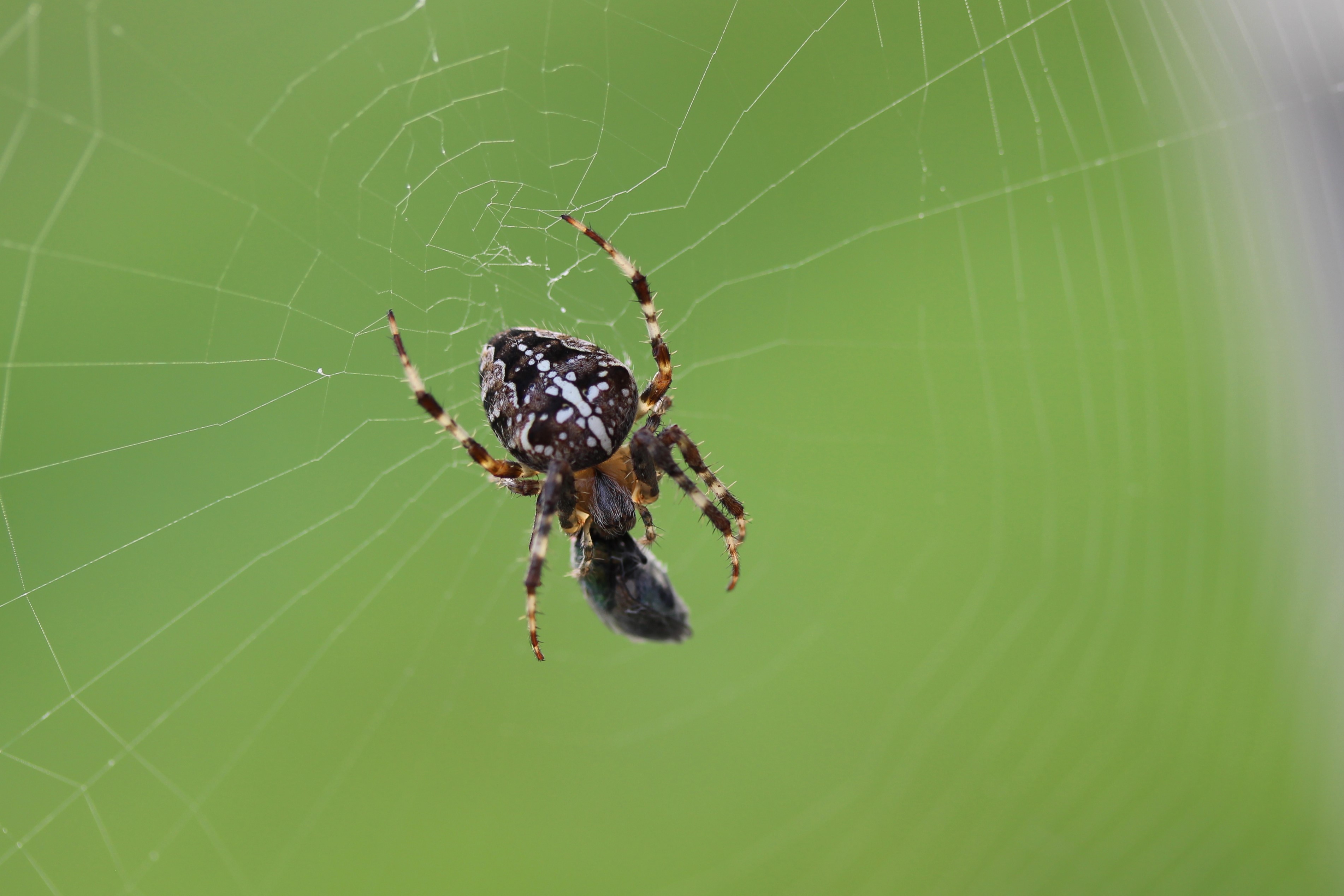
Cross Orbweaver (Araneus diadematus), Backyard, September 2024:
This large spider feasting on its dipteran prey had constructed a web on the edge of my back porch. Cross Orbweavers are introduced spiders here, native to Europe.
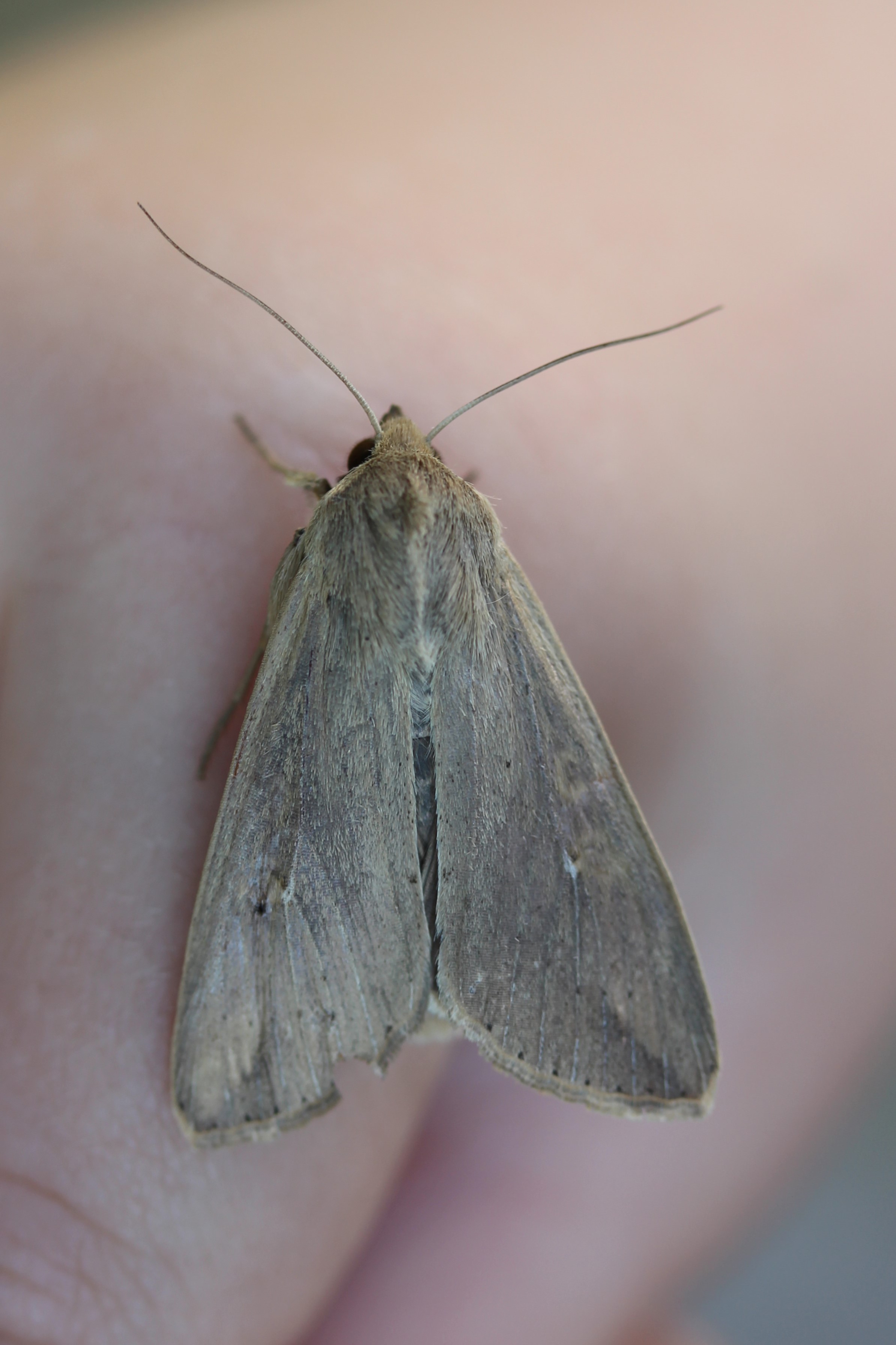
Mythimna Moth, Backyard, September 2024:
I believe this moth is of the genus Mythimna, but I’m not quite sure as it’s a fairly nondescript moth. The moths in this genus feed on grasses when larvae which would also line up with its discovery within my lawn (Beadle and Leckie 2012).
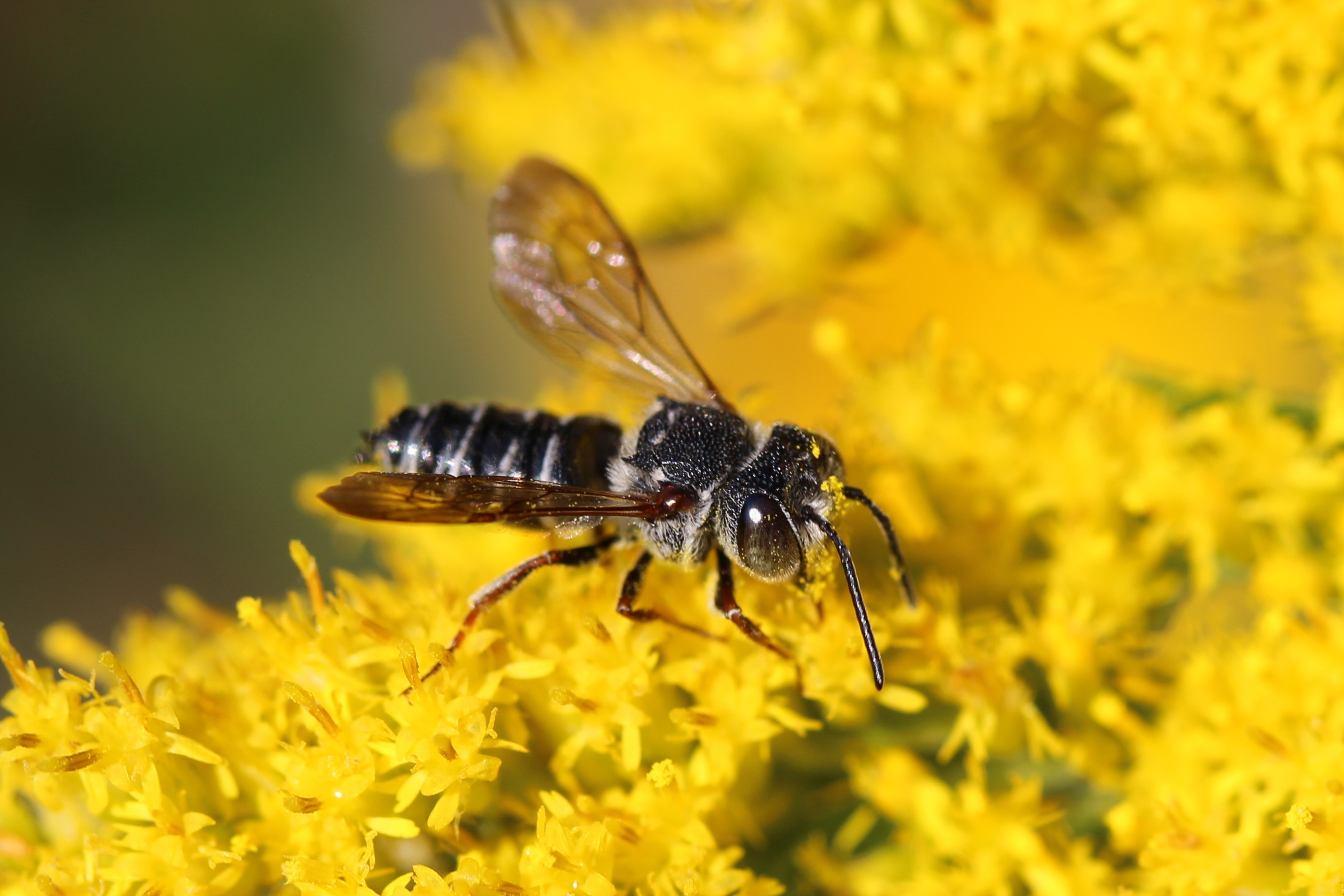
Sharptail Bee (Coelioxys), Backyard, September 2024:
Although the proportions of the pictured individual lead the head to be much larger than the thinning abdomen, the common name “Sharptail Bee” refers more to the females of these bees (the bee in the photo is a male) who have very pointed abdomens used to puncture the nest cells of Megachilid bees (Wilson and Carril 2016). Coelioxys eggs laid inside their hosts’ nests hatch and the emerging larva “uses tweezer-sharp mandibles to snip the egg or young larva of the host bee in half” (Wilson and Carril 2016). The larva then proceeds to consume the pollen that was stored away for the host bee’s young.
Apple Leaf Skeletonizer Moth (Choreutis pariana), Backyard, September 2024:
These are day-active moths, with larvae that feed on crab apple leaves. They were introduced to North America sometime around 1917 (Beadle and Leckie 2012).
References:
Beadle, David and Leckie, Seabrooke 2012. Peterson Field Guide to Moths of Northeastern North America. Houghton Mifflin Harcourt.
Beletsky, Les. The Red-Winged Blackbird: The Biology of a Strongly Polygynous Songbird. 1996. Academic Press.
Costa, James T. 2006. The Other Insect Societies. Harvard University Press.
Holm, Heather 2021. Wasps: Their Biology, Diversity, and Role as Beneficial Insects and Pollinators of Native Plants. Pollination Press.
Lisak, Sarah C., Hailey N. Shanovich, Amelia R.I. Lindsey, and Brian H. Aukema. “The Polydrusus Weevils (Coleoptera: Curculionidae) of the United States of America and Canada: Identification and Insights into the Ecology of Two Nonnative Species in Hazel (Corylus Spp.).” The Canadian Entomologist 156 (2024): e10. https://doi.org/10.4039/tce.2024.7.
Marshall, Stephen. 2018. Beetles: Their Natural History and Diversity. Firefly Books.
Marshall, Stephen. 2023. Hymenoptera: The Natural History and Diversity of Wasps, Bees, and Ants. Firefly Books.
O’Neill, Kevin M. 2001. Solitary Wasps: Behavior and Natural History. Cornell University Press.
Stokes, Donald and Stokes, Lillian. 1983. A Guide to Bird Behavior Volume 2. Little, Brown and Company.
Wilson, Joseph S. and Carril, Olivia M. 2016. The Bees in Your Backyard. Princeton University Press.
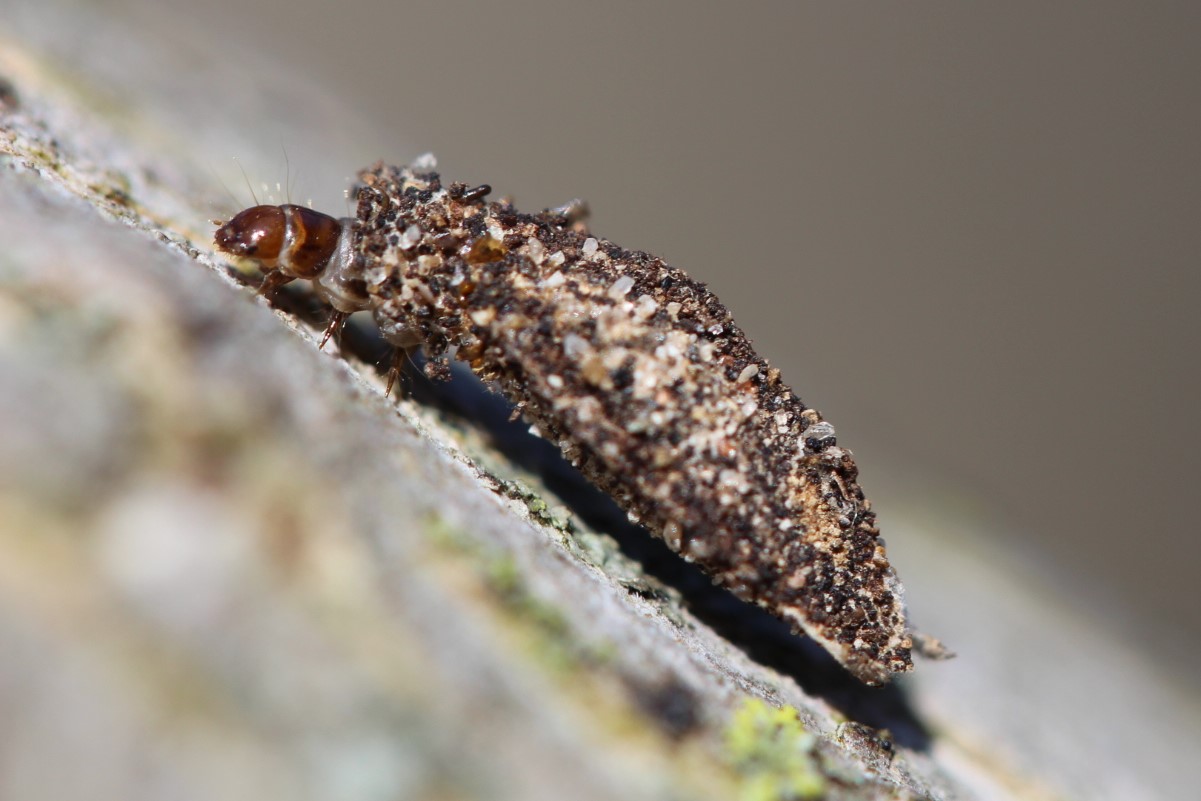
Siederia walshella, on the Lynn Valley Trail, April 2023:
On a walk on the trail by my house, I spotted this tiny creature (about a cm long) climbing up the trunk of a tree. I’m not positive on the identification, but it’s based on iNaturalist’s auto-ID for my photo and seems to match from what I can tell. If the ID is correct, this tiny caterpillar was likely searching for lichen to eat.
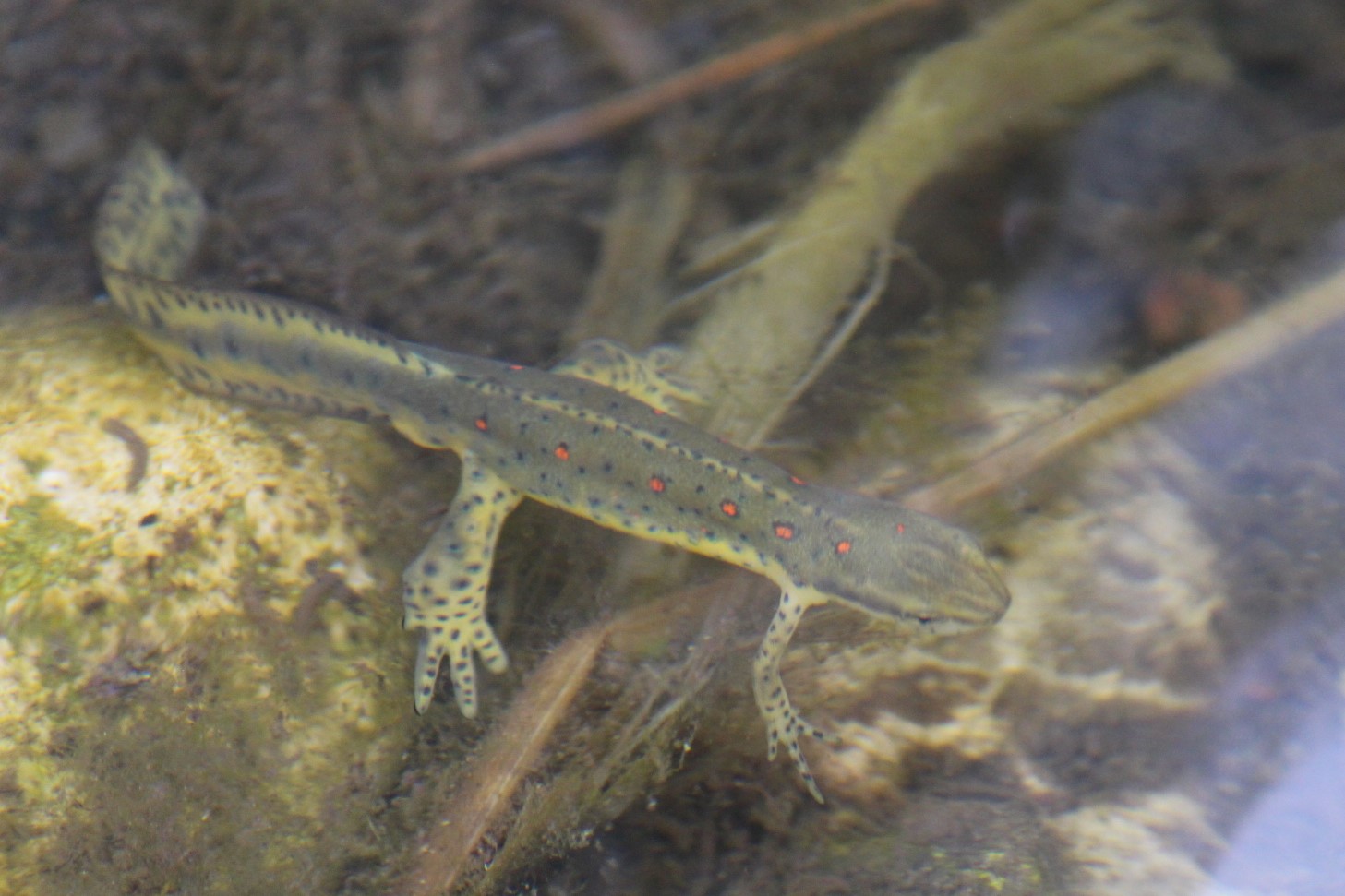
Eastern Spotted Newt (Notophthalmus viridescens), in my Parents’ pond, April 2023:
For the past few years, my parents’ garden pond has been host to these amazing creatures. All amphibians impress with their transformation from aquatic to terrestrial life but the Eastern Spotted Newt outdoes this life cycle with some incredible twists and turns. Larval newts transform into terrestrial juveniles (known as “efts”) and leave the water behind, living in the leaf litter. While on land, the efts have a rough reddish brown skin which keeps moisture in. After two to seven years, the efts undergo another transformation, darkening in colour and gaining a raised tail fin which aids them as they return to the water as aquatic adults. The newt pictured above is in this final stage of life: an aquatic adult. This isn’t necessarily the end of the newt’s transformations however, since some newt adults leave the water and regain some of their terrestrial attributes (rougher dry skin, loss of tail fin) for hibernation on dry land (Harding and Mifsud 2017).
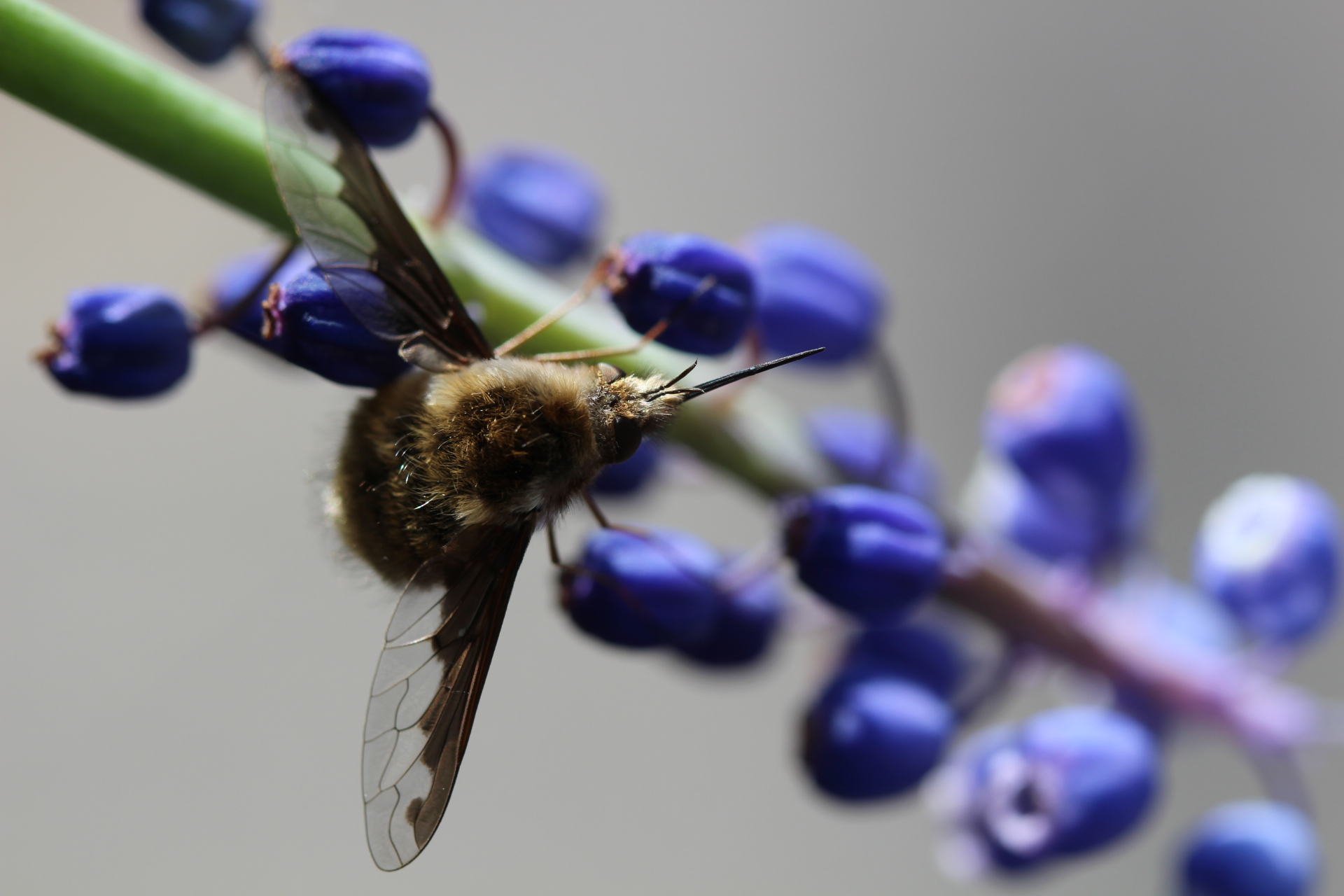
Greater Bee Fly (Bombylius sp.), Lynn Valley Trail, April 2023:
This fuzzy fly has special adaptations to gather sand in its abdomen which it coats its eggs with before launching the eggs into solitary wasp nests (dug in sand presumably) (Marshall 2012). The larvae hatch from the eggs and enter the nest chambers of their host before feeding on a single host larva each (making the Bee Flies parasitoids, consumers of a single prey item).
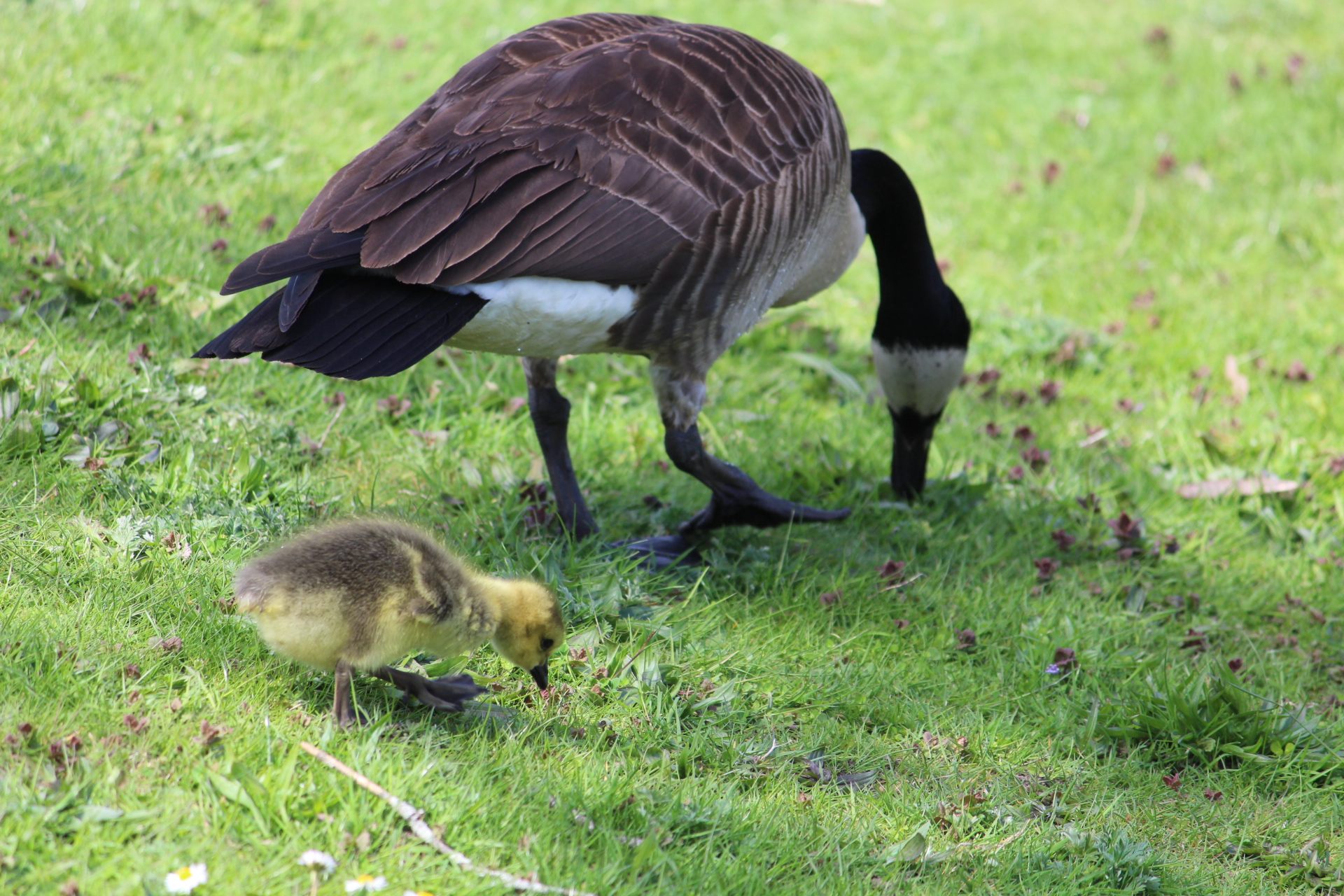
Canada Goose (Branta canadensis) Parent and Gosling, Grant Andersen Park, May 2023:
Canada Geese are both common and abundant so they usually don’t catch my eye, but I really liked how the gosling was in the exact same pose as its nearby parent in this photo.
Spotted Sandpiper (Actitis macularius), Grant Andersen Park, May 2023:
The picture is blurry because the action was taking place across some water from my camera lens, but this fascinating courtship display was happening right in the middle of Simcoe in Grant Andersen Park. These shorebirds performed their display a few times and then mated and dispersed.
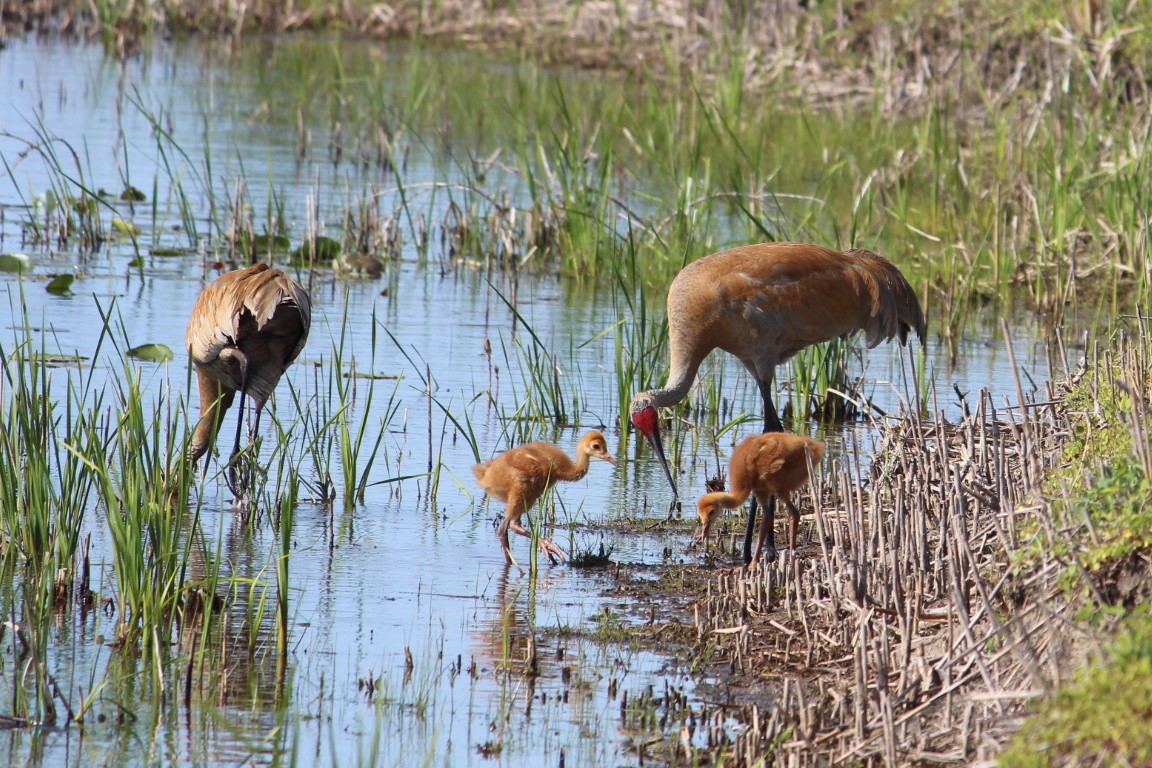
Sandhill Crane (Grus canadensis) family, Long Point, May 2023:
Sandhill Cranes have captures my heart with their wild resonant calls and their impressive size. It was a special treat to watch this family of two parents and two young foraging at the edges of a marsh in Long Point.
Canada Warbler (Cardellina canadensis), Long Point Old Cut Birding Station, May 2023:
Canada Warblers migrate into Ontario to breed during May/June, creating nests near the ground on stumps or small mounds (Bezener 2016). Then in late summer/early Fall they set off again to leave the Canadian winter behind them. Like other Wood-Warblers (the Family Parulidae) they consume insects and spiders, taken from plants or the ground.
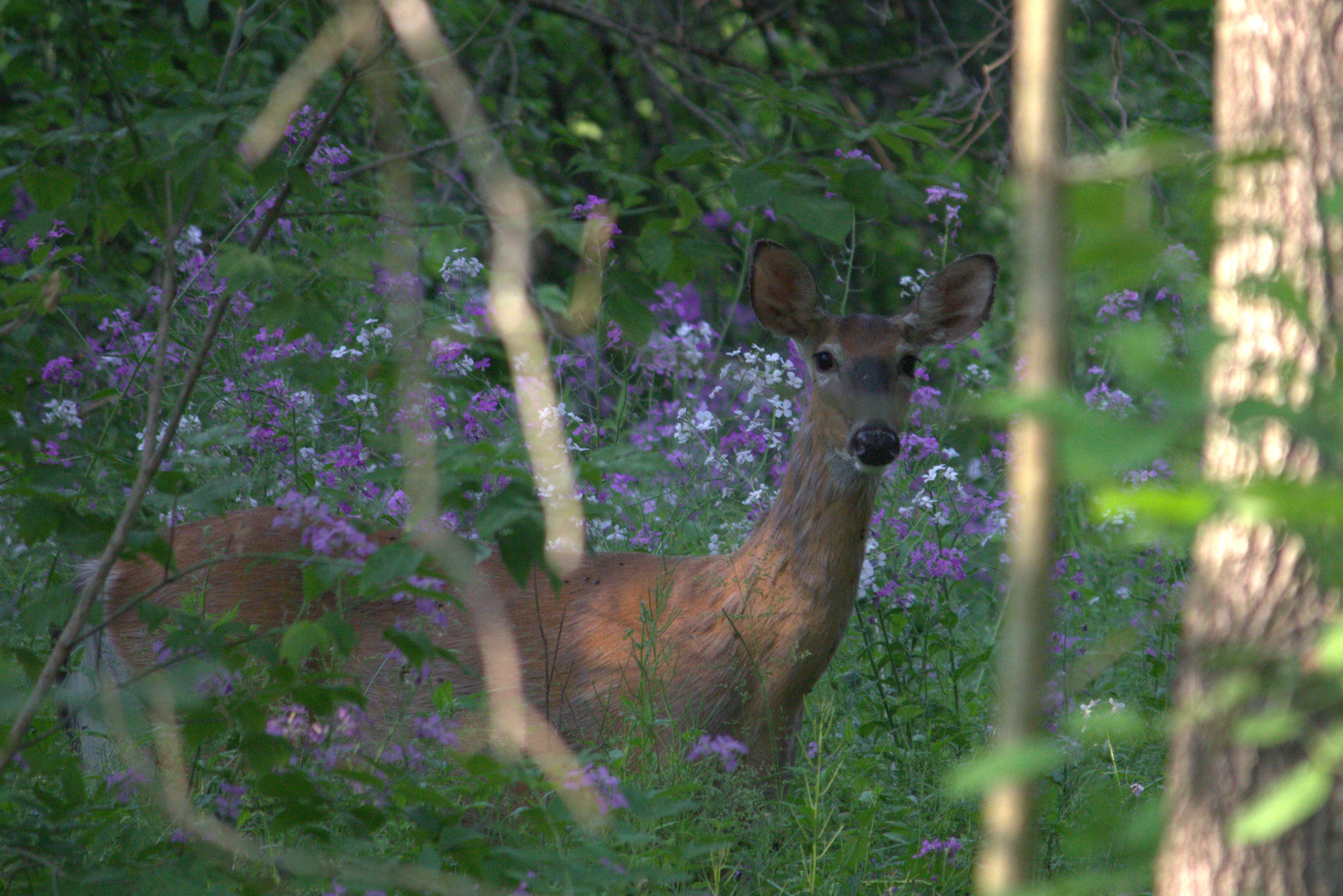
White-Tailed Deer (Odocoileus virginianus), Lynn Valley Trail, June 2023:
This deer was incredibly close to the trail, so I was able to capture its gaze among the purple wildflowers.
Velvet Ant (Timulla vagans), Backyard, July 2023:
Velvet Ants are not members of the ant superfamily (Formicoidea) but are instead solitary wasps (members of the family Mutillidae). Their larvae develop as parasitoids on the larvae of other wasps (in the case of Timulla vagans, their hosts are Crabronids and Eumenine wasps (Marshall 2023)). The males of Timulla vagans are winged unlike the ant-like females and will carry the wingless females in their mandibles during their mating flight (Waldren et al 2020).
Physocephala marginata, Backyard, July 2023:
Although this insect drinking nectar appears to be a wasp, it is actually a fly of the Family Conopidae. Female Physocephala marginata seek out their lookalikes (wasps and bees) at flowers. After apprehending a host wasp or bee, P. marginata uses its abdomen to insert an egg inside the host’s abdomen (Marshall 2012). The egg hatches inside and the larval Conopid consumes the host from the inside.
Tachinid Fly (Exorista sp.), Backyard, August 2023:
Tachinid Flies are yet another group of parasitoid insects. Stephen Marshall, in his giant book on flies had this to say about this huge family of flies: “The Tachinidae is in many ways the ultimate fly family. With almost 10,000 named species and thousands more awaiting description… exhibits an unparalleled variety of sizes, shapes and colors. The range of life history strategies is equally amazing, at least within the constraint that every know species in the group is a parasitoid that develops inside another insect… or related arthropod” (Marshall 2012, p 386). Hosts of this genus are caterpillars or sawfly larvae.
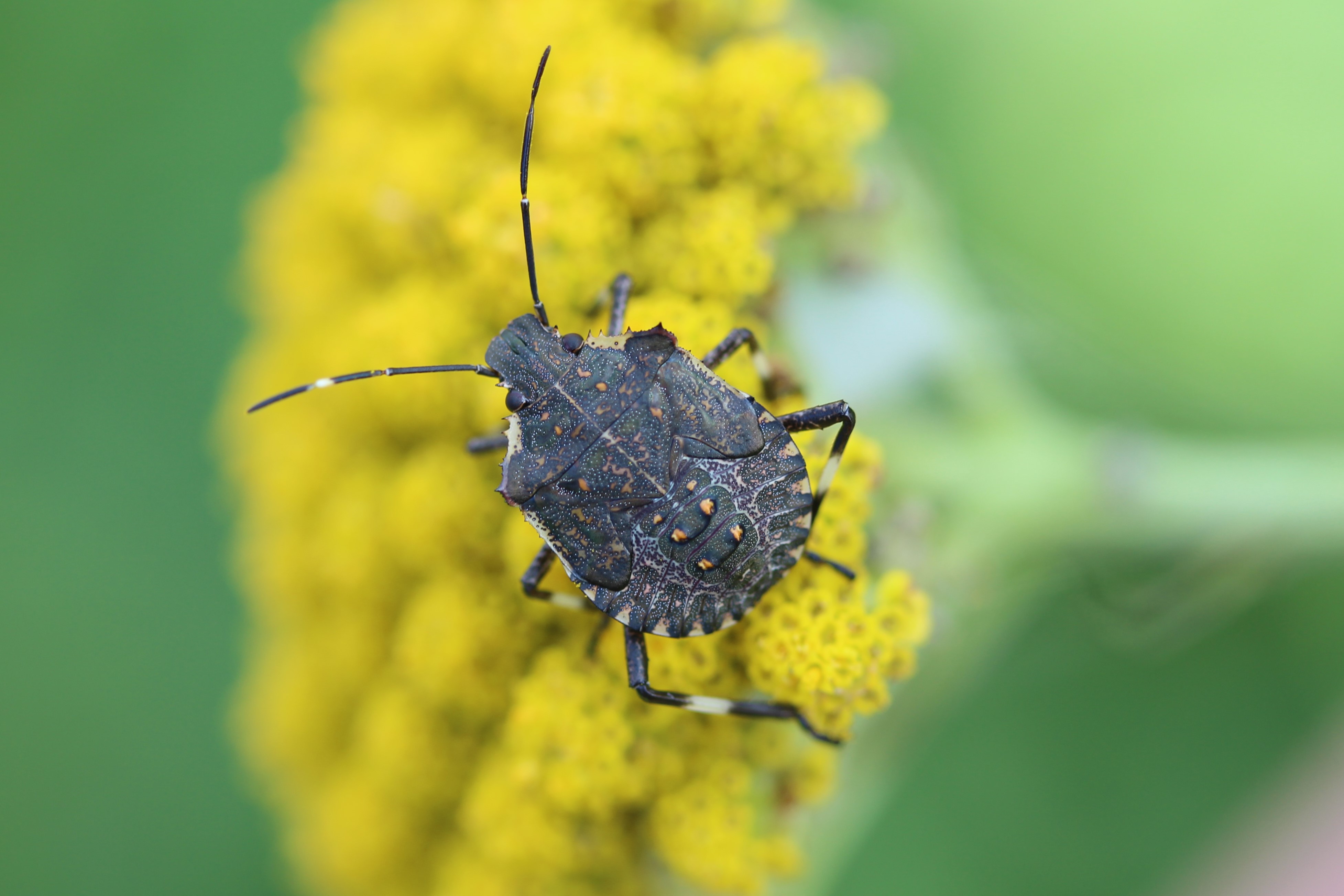
Brown Marmorated Stink Bug (Halyomorpha halys), Backyard, August 2023:
This species of Stink Bug is native to East Asia but was introduced to North America accidentally in the 1990s. As with many successful and widespread introduced species, the Brown Marmorated Stink Bug can feed on a wide diversity of plants and can be a serious pest of agriculture and gardens. The pictured insect is a nymph, not quite an adult because it is missing fully developed wings across its back.
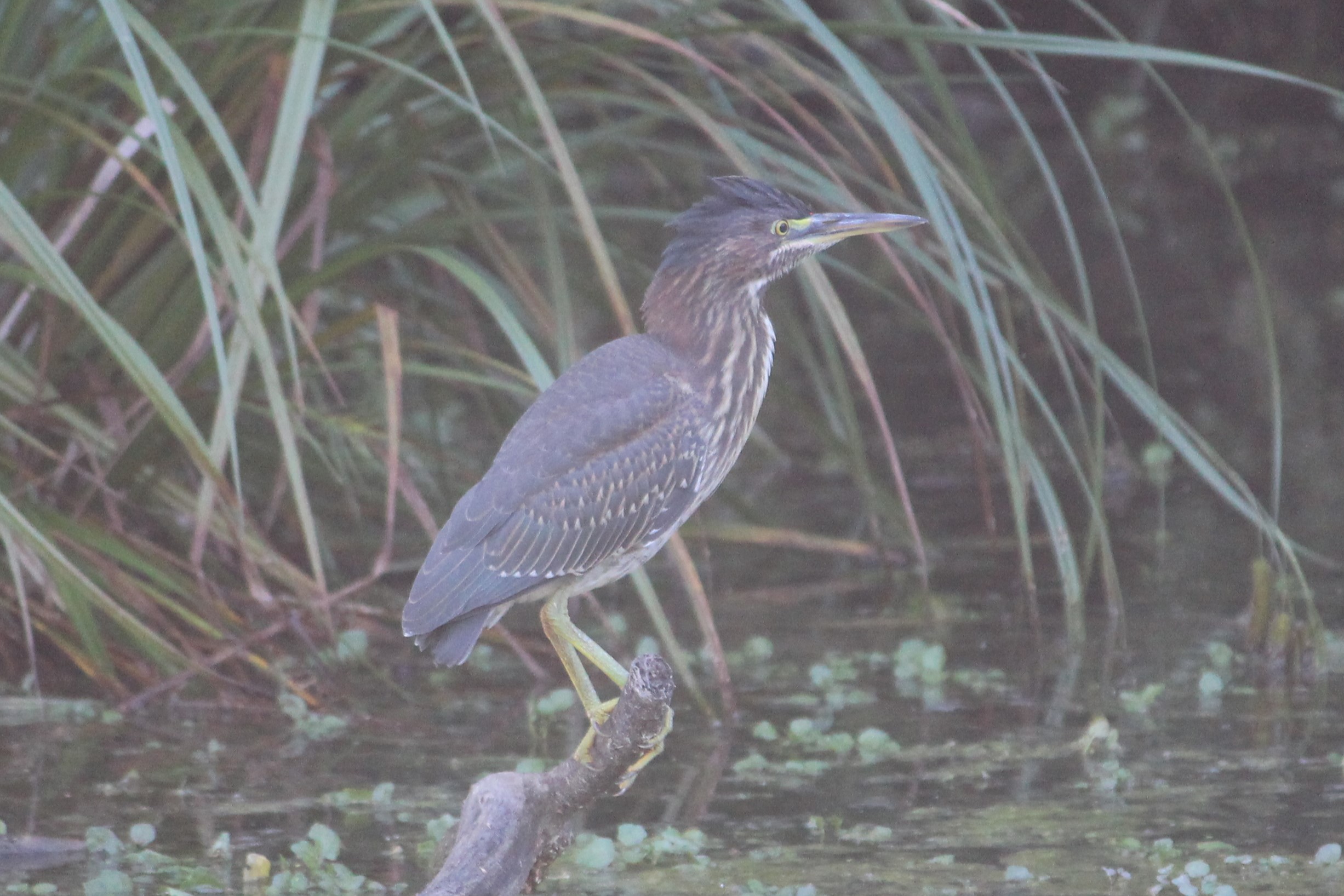
Green Heron (Butorides virescens), Waterford Ponds, August 2023:
The above photo was actually taken by my wife on an outing to Waterford Ponds. She was quicker on the draw to find and focus on this beautiful bird amidst the morning mist and tangled reeds of its marshy habitat. I’ve written an article about these amazing birds because of a different close encounter I had, go here to learn more!
Common Whitetail Dragonfly (Plathemis lydia), Front of House, September 2023:
As I was entering my house, I was stopped by the sight of this wondrous insect framed perfectly on my siding beside my door. I carefully entered the house to retrieve my camera in order to get this picture. One of the first Dragonflies photographed at my house since I don’t have a backyard pond… yet. The Common Whitetail pictured is a male, distinguishable because it has the chalky white abdomen which it uses as a signal to chase other males off of its territory. Females of this species have multiple bands on their wings and a dark abdomen.
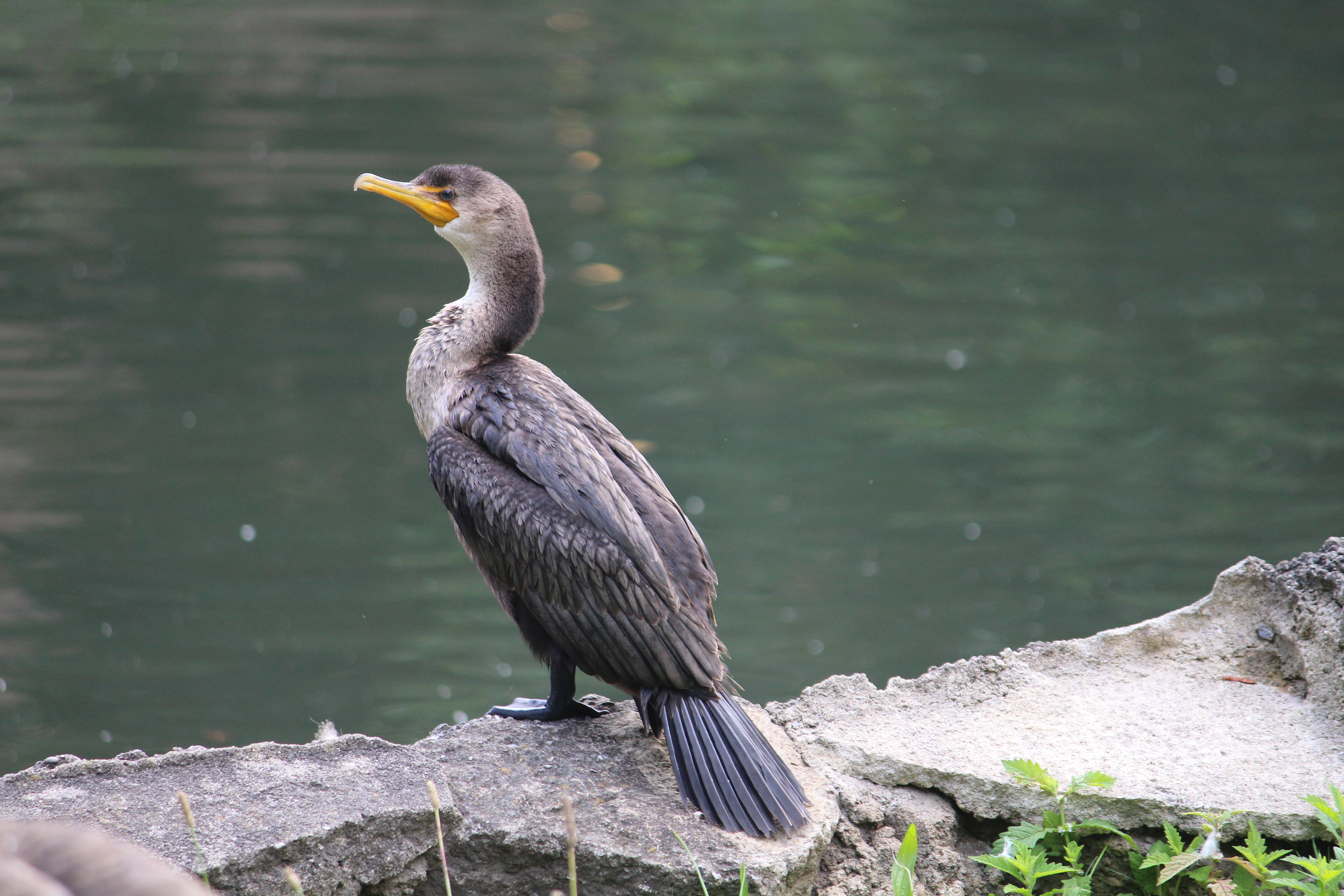
Double-crested Cormorant (Nannopterum auritum), Lynn River, September 2023:
When swimming in the water, a cormorant reminds me of a hook-billed loon or a merganser, but their especially long neck gives them away. Like loons and mergansers, cormorants are underwater divers, pursuing fish prey amid lakes and rivers. This one was foraging in the Lynn River right in the middle of Simcoe, and I was very excited to get a close look at its sleek profile as it dried off on the bank. You can’t see them in the photo, but it was amidst a crowd of Canada Geese.
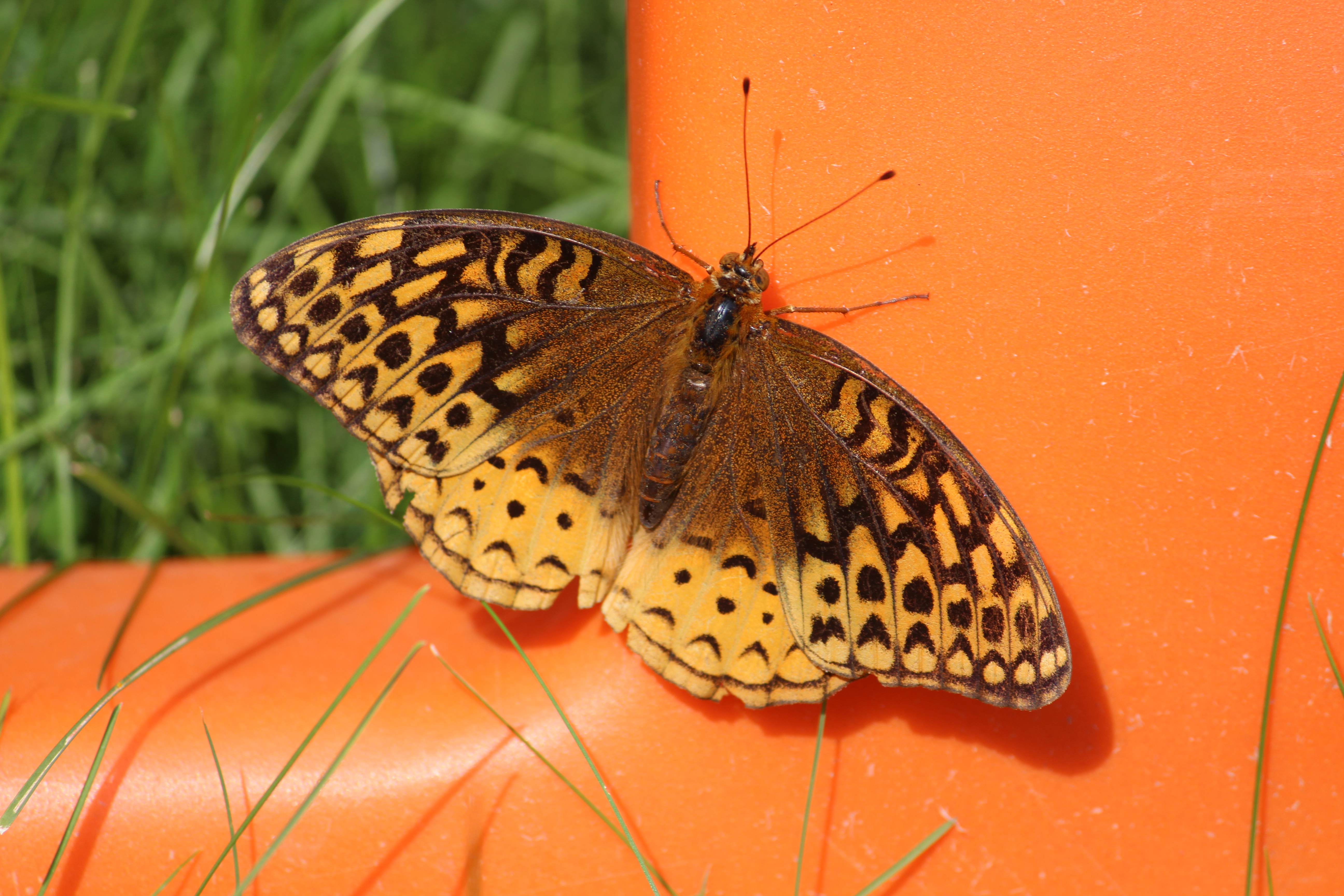
Great Spangled Fritillary (Argynnis cybele), Backyard, September 2023:
I at first thought this large butterfly was a Monarch (Danaus plexippus) as it was nectaring among our milkweed patch, but I quickly realized it was a different species. After patrolling our garden, this fluttering visitor rested and spread its wings on our orange plastic picnic table where I snapped this picture. The caterpillars of this species make it through our winter, after hatching just before the cold arrives (Hall et al 2014).
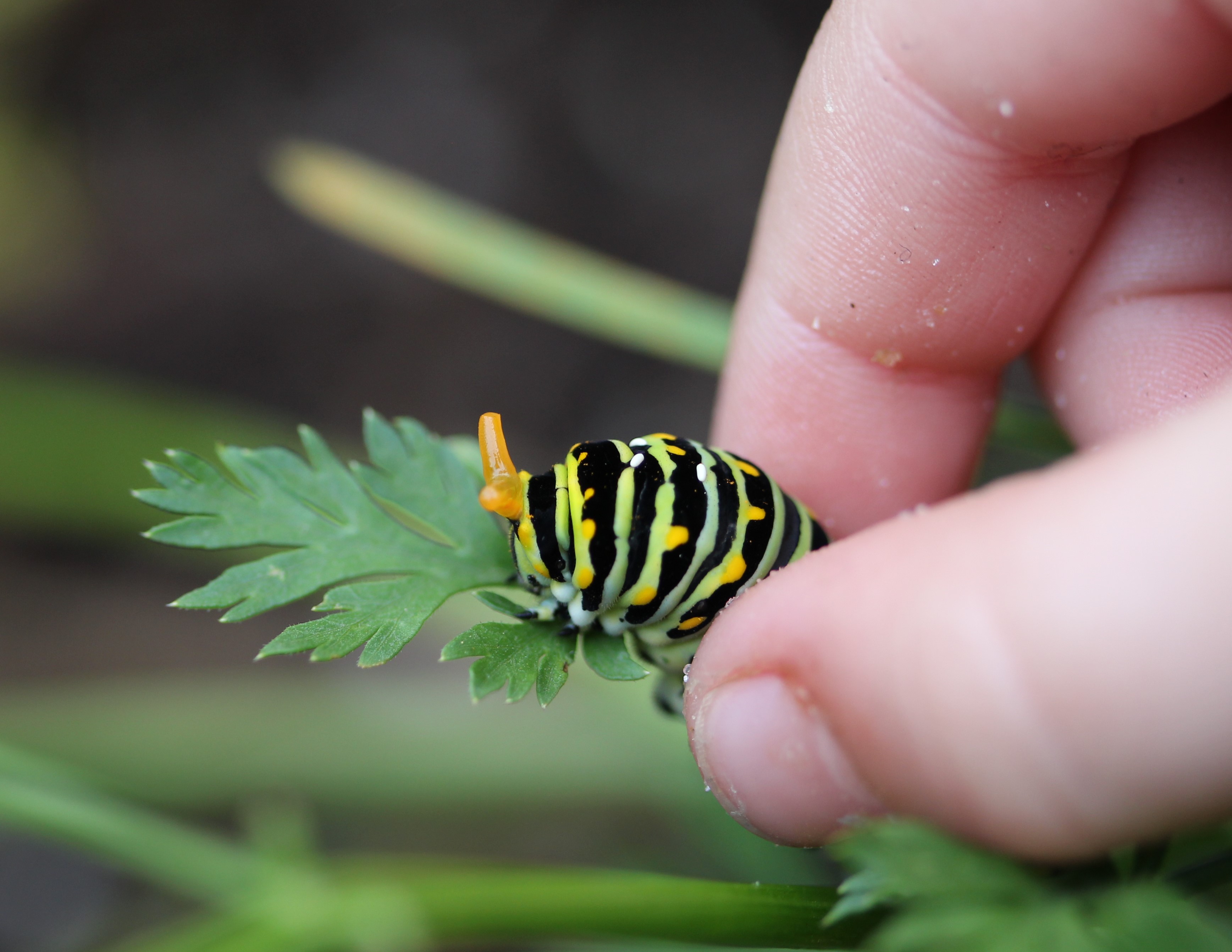
Black Swallowtail Caterpillar (Papilio polyxenes), Backyard, September 2023:
These colourful caterpillars feed on plants in the Carrot family (Apiaceae), and there were several munching away on our garden carrots this year. My 3-year old son helped me demonstrate one of their defensive strategies for this photo. If provoked these conspicuous caterpillars unfold the orange organ featured here, named an osmeterium, which has a foul odor (I would describe it as old rotten cheese, it was surprisingly powerful for such a small creature) (Marshall 2006). If I were a caterpillar-foraging bird or mammal, I would avoid such smelly prey.
Virginia Giant Hover Fly (Milesia virginiensis), Backus Woods, September 2023:
As the name implies, this fly was large and conspicuous in a sunny clearing. The larvae of these large flower flies (Syrphidae) develop inside rotting trees, sometimes inside tree holes (Skevington and Locke 2019).
Shadow Darner (Aeshna umbrosa), Backus Woods, September 2023:
Darners are huge dragonflies (over 7 cm long), instantly noticeable when in flight but this one cooperated in staying still while I took its picture. The Shadow Darner is named after its habit of flying late in the day (even at dusk) and staying mostly in shade (Marshall 2006). This one was photographed in the afternoon.
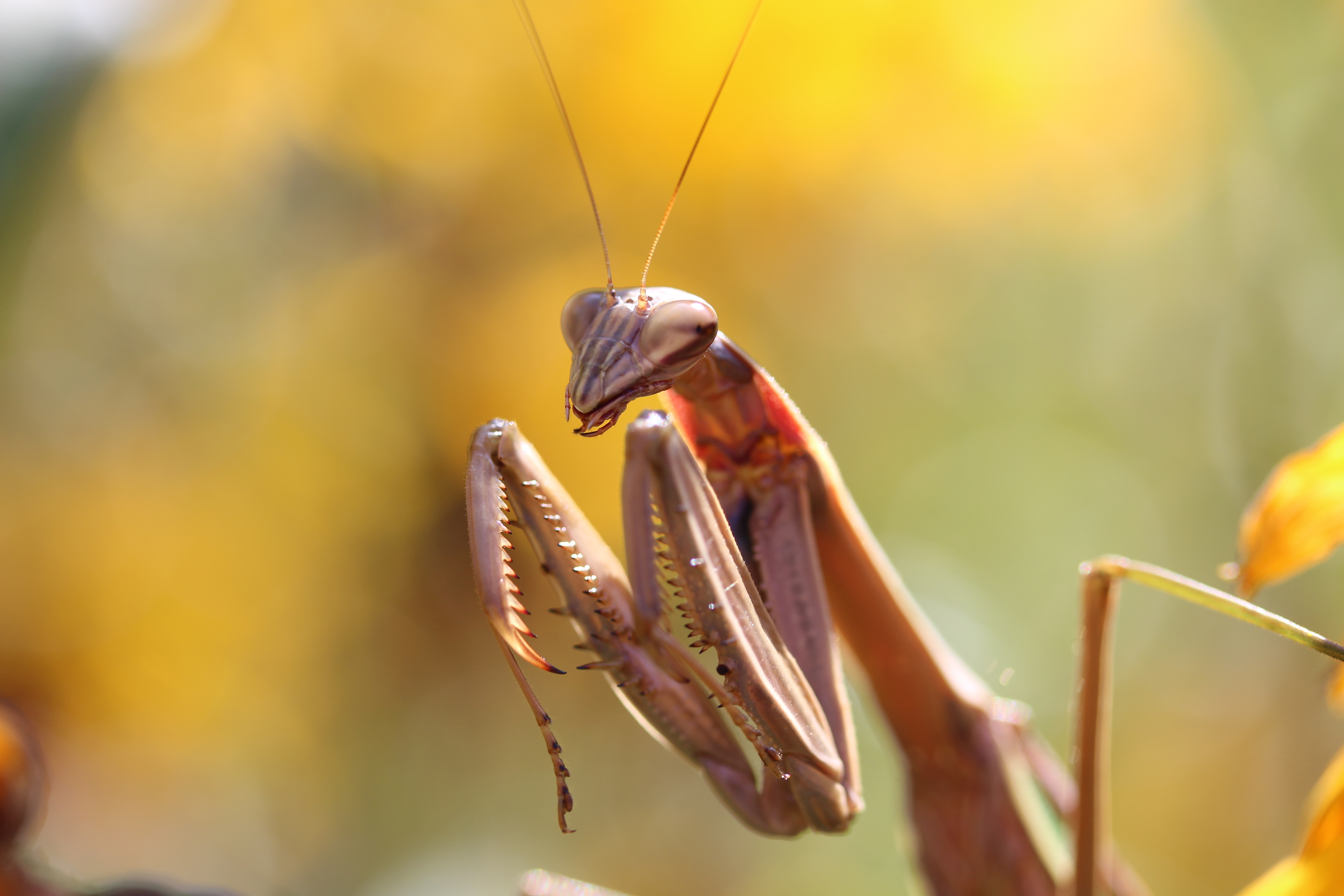
Chinese Mantis (Tenodera sinensis), Backyard, September 2023:
There are no Mantids native to Ontario, both of our common species: the European Mantis (Mantis religiosa) and the Chinese Mantis pictured here, were introduced to North America over a hundred years ago (Marshall 2006). This very large and impressive insect was clambering through my garden and nicely posed for a few pictures but this was my favourite photo I took, showcasing its powerful grasping forelegs and its triangular head.
References:
Bezener, Andy. 2016. Birds of Ontario. Partners and Lone Pine Publishing.
Hall, Peter, Jones, Colin, Guidotti, Antonia, and Hubley, Brad. 2014. The ROM Field Guide to Butterflies of Ontario. Royal Ontario Museum.
Harding, James H. and Mifsud, David A. 2017. Amphibians and Reptiles of the Great Lakes Region. University of Michigan Press.
Marshall, Stephen. 2006. Insects: Their Natural History and Diversity. Firefly Books.
Marshall, Stephen. 2012. Flies: Their Natural History and Diversity. Firefly Books.
Marshall, Stephen. 2023. Hymenoptera: The Natural History and Diversity of Wasps, Bees, and Ants. Firefly Books.
Skevington, Jeffrey H. and Locke, Michelle M. 2019. Field Guide to the Flower Flies of Northeastern North America. Princeton University Press.
Waldren GC, Roberts JD, Pitts JP (2020) Phoretic copulation in the velvet ant Sphaeropthalma pensylvanica (Lepeletier) (Hymenoptera, Mutillidae): A novel behavior for Sphaeropthalminae with a synthesis of mating strategies in Mutillidae. Journal of Hymenoptera Research 78: 69-89. https://doi.org/10.3897/jhr.78.55762
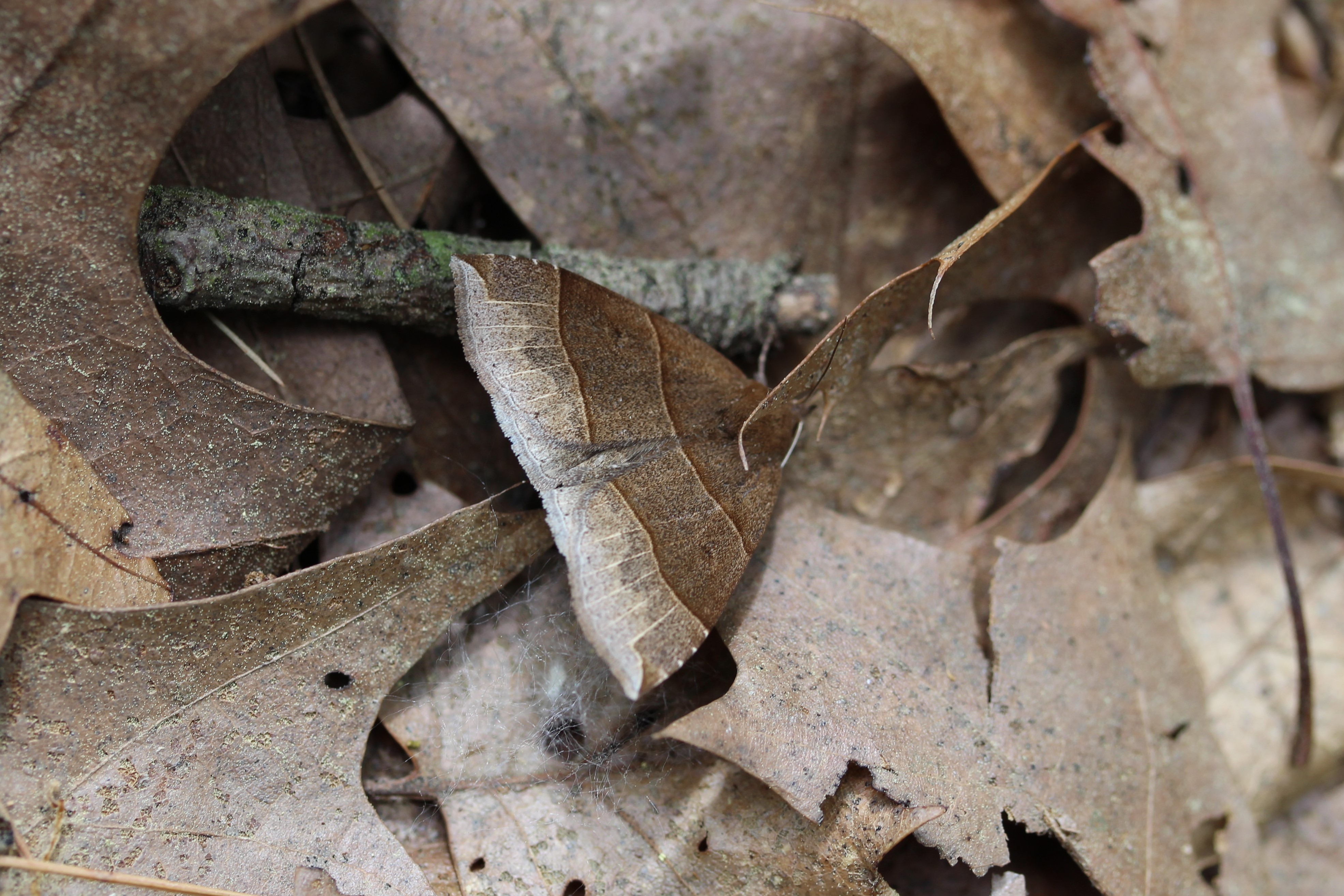
Subject: Maple Looper Moth (Parallelia bistriaris)
Location: Turkey Point Provincial Park.
Date: June 2018.
The Story behind the Shot: While hiking down a trail at Turkey Point Provincial Park, my wife somehow spotted this moth among the leaves which it matched so closely. I was overjoyed to get such a close-up shot of an amazingly camouflaged insect.
The Story behind the Species:
This moth could be the poster-child for camouflage. Such an elegant example of hiding-in-plain-sight. Positioned among fallen leaves which it matches in tone and general shape, this moth is incredibly hard to spot! To hide itself even more, the Maple Looper Moth positions itself head down, thus hiding its least leaf-like feature and accentuating the lighter edge of its hindwings (Keiper 1969).
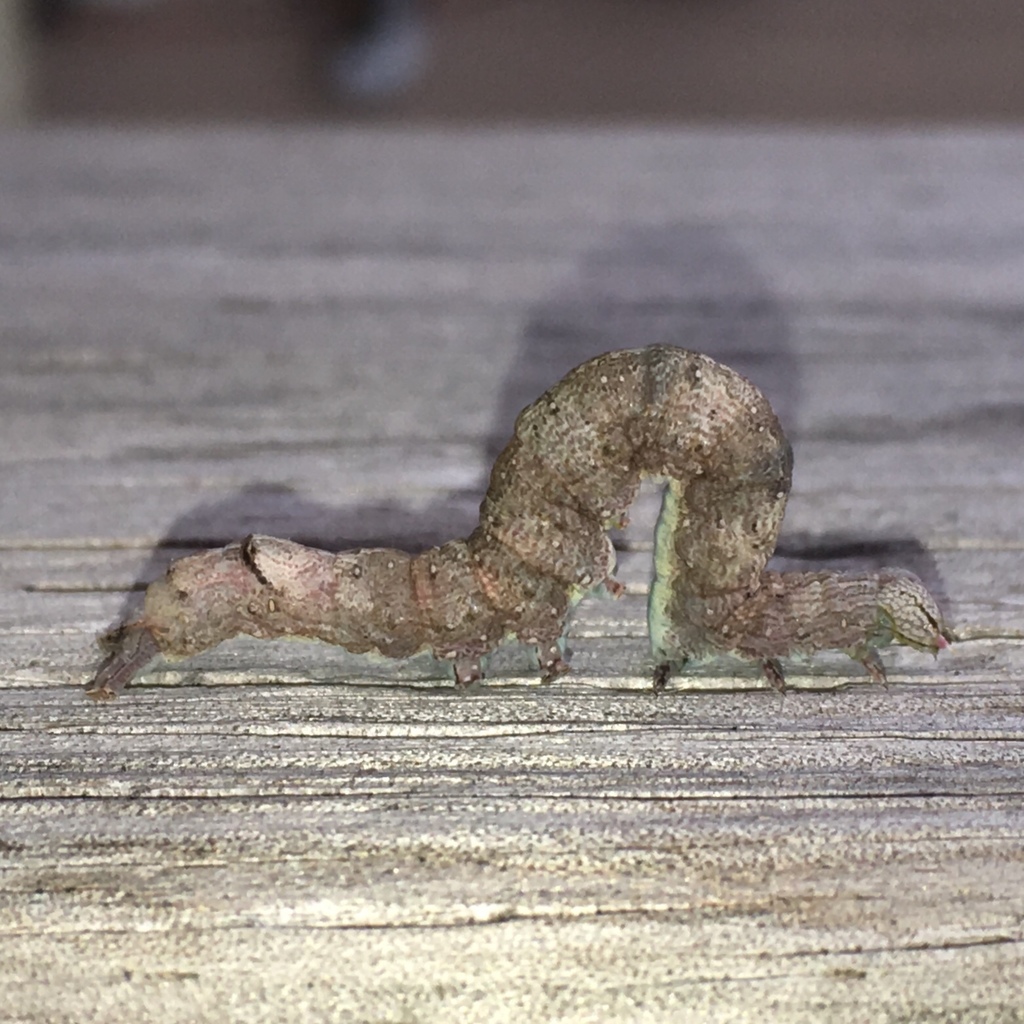
The larvae of this superbly secretive moth are also camouflaged, resembling twigs rather than leaves.
Maple Looper Moth larva (or caterpillar) demonstrating both its twig mimicking colouration and its looping movement. Photo by Dan MacNeal, used with permission.
The larvae, unsurprisingly, feed on Maple leaves (Crumb 1956), but bugguide.net lists Birch and Walnut as food plants as well (https://bugguide.net/node/view/3356).
I’m glad to have found and captured a photograph of this mysterious moth. A beautiful secret of the forest floor.
Keiper, Ronald. 1969. “Behavioral Adaptations of Cryptic Moths IV. Preliminary Studies on Species Resembling Dead Leaves”. Journal of The Lepidopterist’s Society 23: 4: 205-210.
Last year, as part of the Norfolk Field Naturalists, I was able to present 20 of my photos and discuss them. That was what prompted my still-ongoing “Top 20 Nature photos 2013-2020” series (Links to Introduction, 1. The Pale-Painted Sand Wasp (Bembix pallidipicta, 2. Moose (Alces alces) Family , 3. Canada Jay (Perisoreus canadensis) , 4. Common Five-Lined Skink (Plestiodon fasciatus) , 5. Robber Fly Hunting Queen Ant ). This year, I am able to present another 20 photos. I’ve decided this time to keep the range of selection and the range of discussion much more condensed and to form it around my blogging year and my blog’s namesake locality: Norfolk County, Ontario. By keeping the time constrained to a single year, representing each month at least once and the location constrained to a single county in Southern Ontario, I think it can give a sense of the turning of the seasons, something I’ve always been fascinated by. One further restriction is I tried to avoid photos/organisms that have already featured on my blog this year. Introduction complete, here come the photos of my blogging year in review:
Sandhill Cranes (Antigone canadensis) in Port Rowan, December 2021:
These beautiful birds are a sight to see in the winter, snow falling around their dancing forms. Their resonant trumpeting calls, and their acrobatics in the white fields are breathtaking.
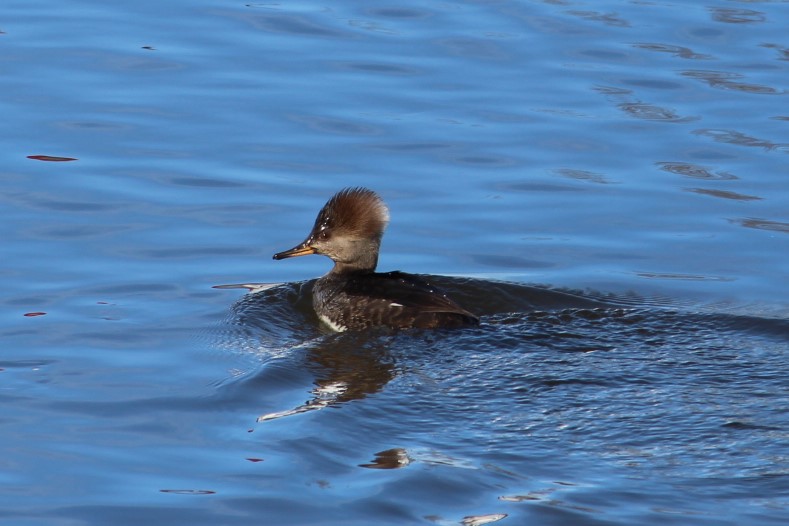
Hooded Merganser (Lophodytes cucullatus) in Simcoe, January 2022:
I’m always pleased to find a species near to home, which I associate with farther away. I first encountered Hooded Mergansers in Algonquin Provincial Park, so I think of them as something from the wild north rather than my own county, but this past January, I took some photos of a female swimming through a park in downtown Simcoe.
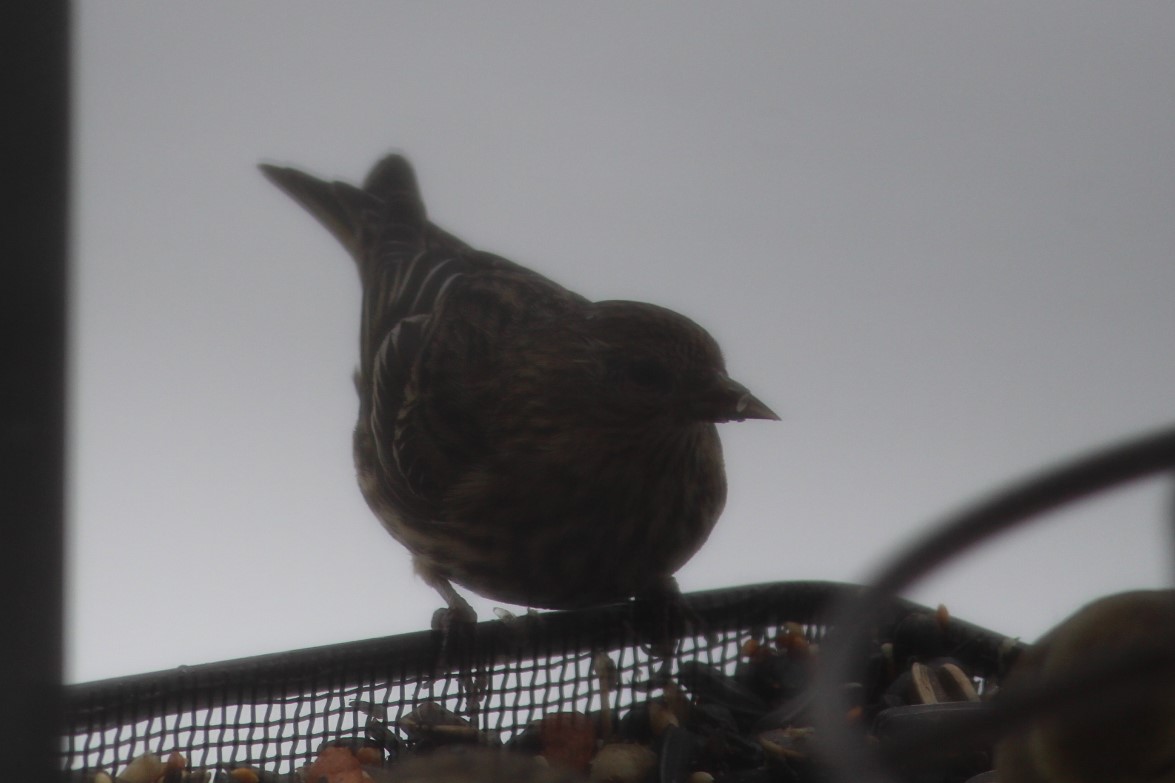
Pine Siskin (Spinus pinus) in my backyard, February 2022:
While reading through nature books and articles, I have read often of Pine Siskins moving through my area during the Winter in some years, and I had always hoped to see them. This year was the first time I saw them, and while my photographs are not very high quality (taken through my back windowpane), I was very excited to see and document this species at my backyard bird-feeder.
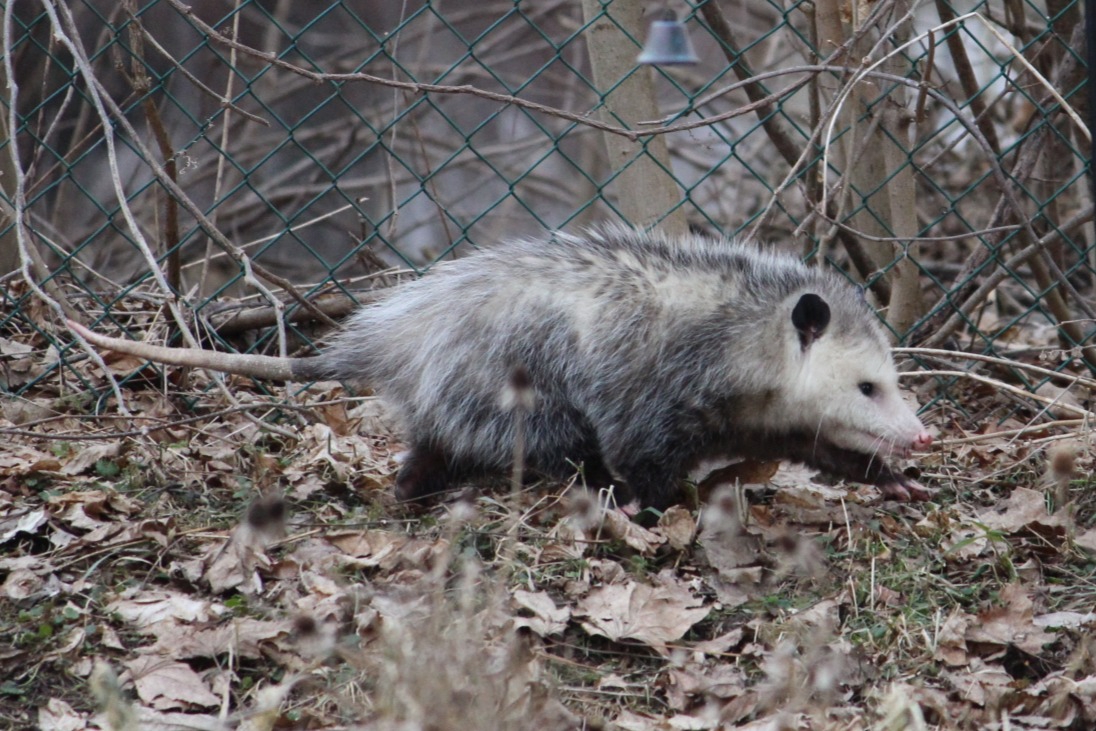
Virginia Opossum (Didelphis virginiana) in my backyard, March 2022:
Virginia Opossums are the only marsupials in Canada, part of a diverse group of mammals that are distinct from the placentals which make up the rest of the Canadian mammals. People often shorten the name to “possum” but this is technically incorrect for these animals. Pouched mammals in the New World (ie. North and South America) are known as ‘opossums’ while those in the Old World (Mostly Australasia for this group) are called ‘possums’.
American Winter Ant (Prenolepis imparis) in my backyard, March 2022:
These common ants are active early in the Spring and late in the Fall, which is how they acquired their association with Winter (Ellison et. al. 2012). Some workers of this species can store excess amounts of food in their abdomens and become living storage canisters, much like the more well-known honeypot ants (Myrmecocystus in North American deserts, or Camponotus inflatus and Melophorus bagoti in Australian deserts) (Ellison et. al, 2012).
Eastern Cottontail (Sylvilagus floridanus) on my Parents’ Farm, April 2022:
The first members of this species were seen in Ontario in the 1860s. Prior to European colonization and agriculture (which opened up preferred habitat for them) these adaptable mammals were located further south in the United States and Mexico (Naughton 2012).
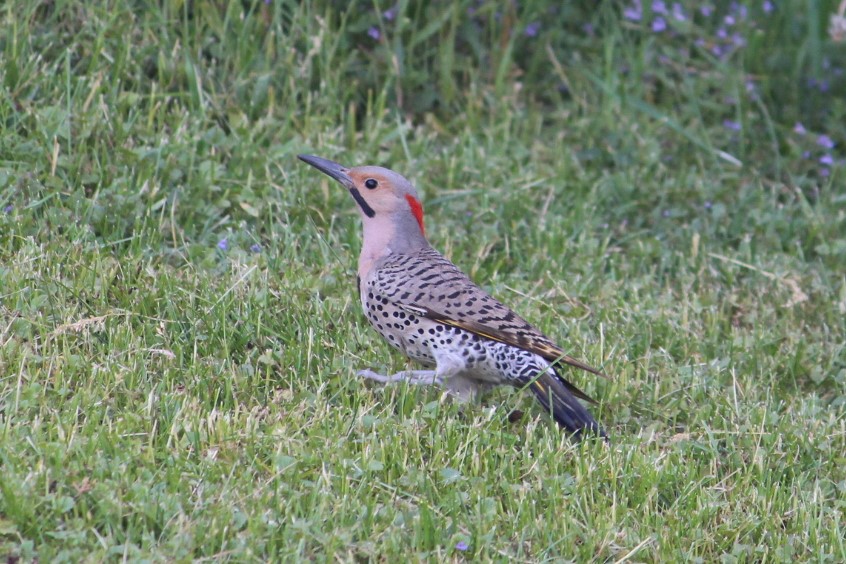
Northern Flicker (Colaptes auratus) in my backyard, May 2022:
Similar to my Hooded Merganser observation above, my first encounter with these amazing ground-foraging woodpeckers has coloured my appreciation for them as unique and surprising. I first saw Northern Flickers when driving through MacGregor Provincial Park in the early morning. Their speckled pattern was striking but even more distinctive was the way they move, like woodpeckers hopping up a tree trunk but horizontally on the ground surface rather than clinging to bark. Seeing a Northern Flicker in my own backyard was an exciting experience (it’s happened a few years now) and adds to my appreciation of the diversity all around me.
European Woolcarder Bee (Anthidium maniculatum) in my backyard, June 2022:
These solitary bees scrape the hairs off of leaves to line their nests (usually in a preexisting cavity in wood or plant stems). As the common name indicates, this particular bee species is introduced from Europe, and is the species you are likely to see in mid-summer (the native Anthidium species are active earlier in Spring) (Wilson and Carril 2016).
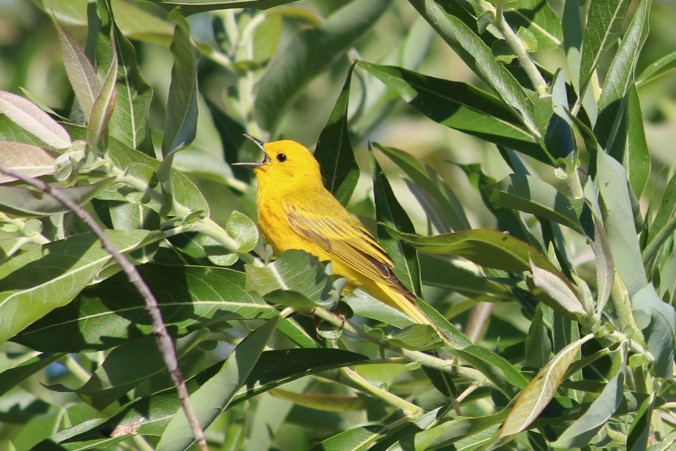
Yellow Warbler (Setophaga petechia) in Long Point, June 2022:
Migratory Warblers are always a treat to see in the Spring and Summer, and this colourful bird singing its heart out is one of my favourites. This species is widespread across North America and northern South America. In the more southern regions of its range, it may breed in mangrove swamps, while in Canada it can be found breeding in windswept tundra.
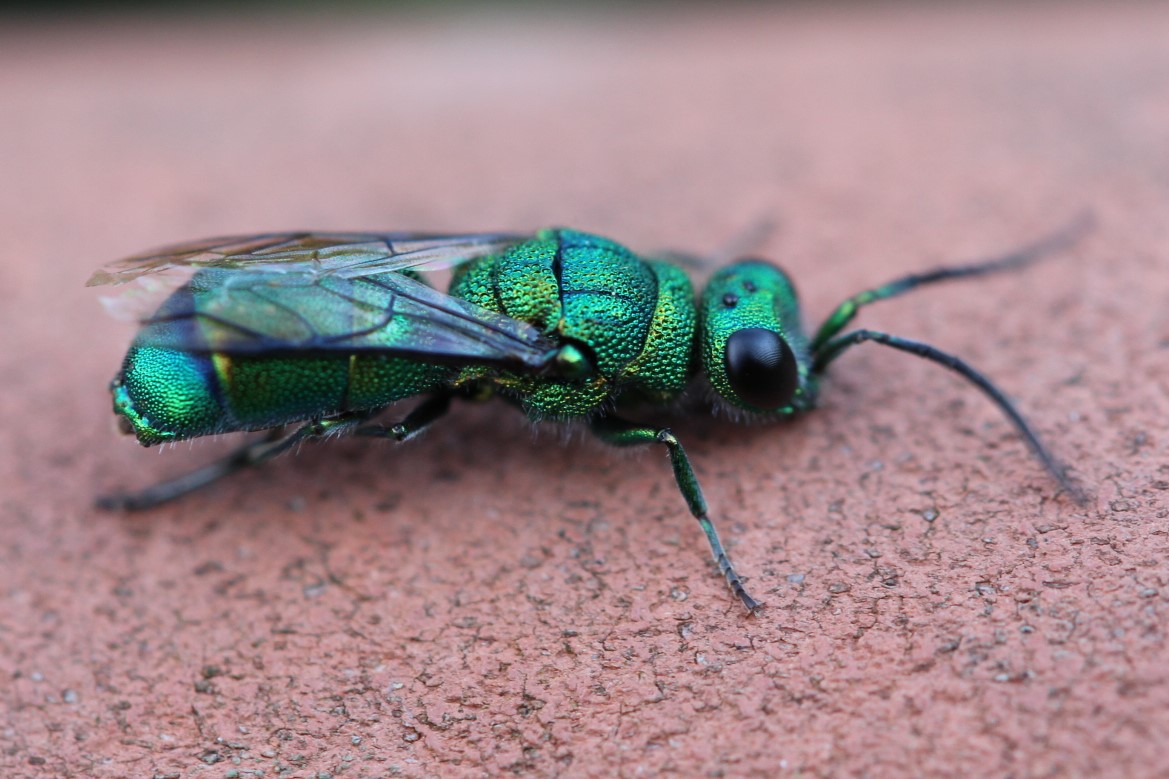
Cuckoo Wasp (Chrysis) in my backyard, July 2022:
Just as Cuckoos lay their eggs within another bird’s nest in order to benefit from the original inhabitant’s parental provisioning, so does the Cuckoo wasp benefit from another insect’s parental provisioning. In the case of this Genus, Chrysis, the female wasp lays her eggs inside the nest of other solitary wasps where the cuckoo wasp larva either feeds on the growing host wasp larva or the host larva’s food supply, placed in the nest by the host wasp parent (O’Neill 2001). The adult cuckoo wasp is well-armoured and can roll into a ball like an armadillo to present this tough shell as a defense against its hosts (Marshall 2006).
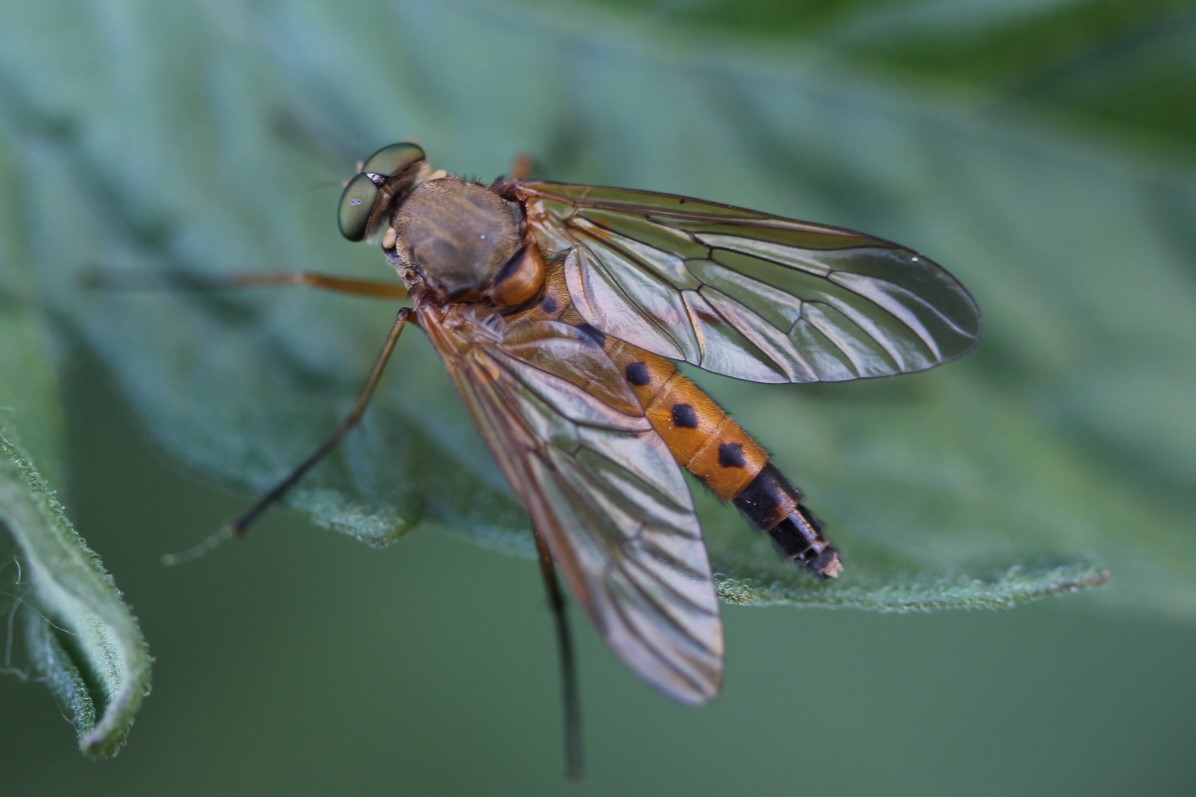
Marsh Snipe Fly (Rhagio tringarius) in my backyard, July 2022:
The larvae of Rhagio snipe flies are predators of invertebrates that dwell within the soil, but the adult diet (if they do eat anything) is unknown (Marshall 2012). This species, R. tringarius is introduced from Europe and is possibly replacing the similar native species, R. hirtus (Marshall 2012).
Eastern Cicada-killer Wasp (Sphecius speciosus) on my Parents’ Farm, July 2022:
Cicada-killer wasps are an example of a species that I had encountered significantly in print before encountering in the wild. I had read of their enormous size and strength, so when I spotted giant robust wasps on a visit to my parents’ farm I had my guess that these were the fabled hunters. These are impressive insects, but despite their large size and the males’ territoriality (the males will occasionally dive-bomb humans), they are not actually dangerous to people and should be tolerated and admired, rather than feared. The female can remove up to 1000 times her weight of soil to create her multi-celled nest which she provisions with adult cicadas (all of which used to be included within the genus Tibicen but which have now been moved to several genera (see Hill et. al. 2015 for a recent taxonomic review of the Cicada genus Tibicen)). Each larva is given 1-4 cicadas to feed on, males are given only 1 and female larvae more because females are sometimes 2.5 times larger than males (Evans and O’Neill 2007). The reason for this size disparity is that females do the digging and carry the giant prey items. The cicada-killers cannot carry paralyzed cicadas in flight unless they first drag them to a height and drop, which they will do occasionally in order to transport their large prey (Evans and O’Neill 2007).
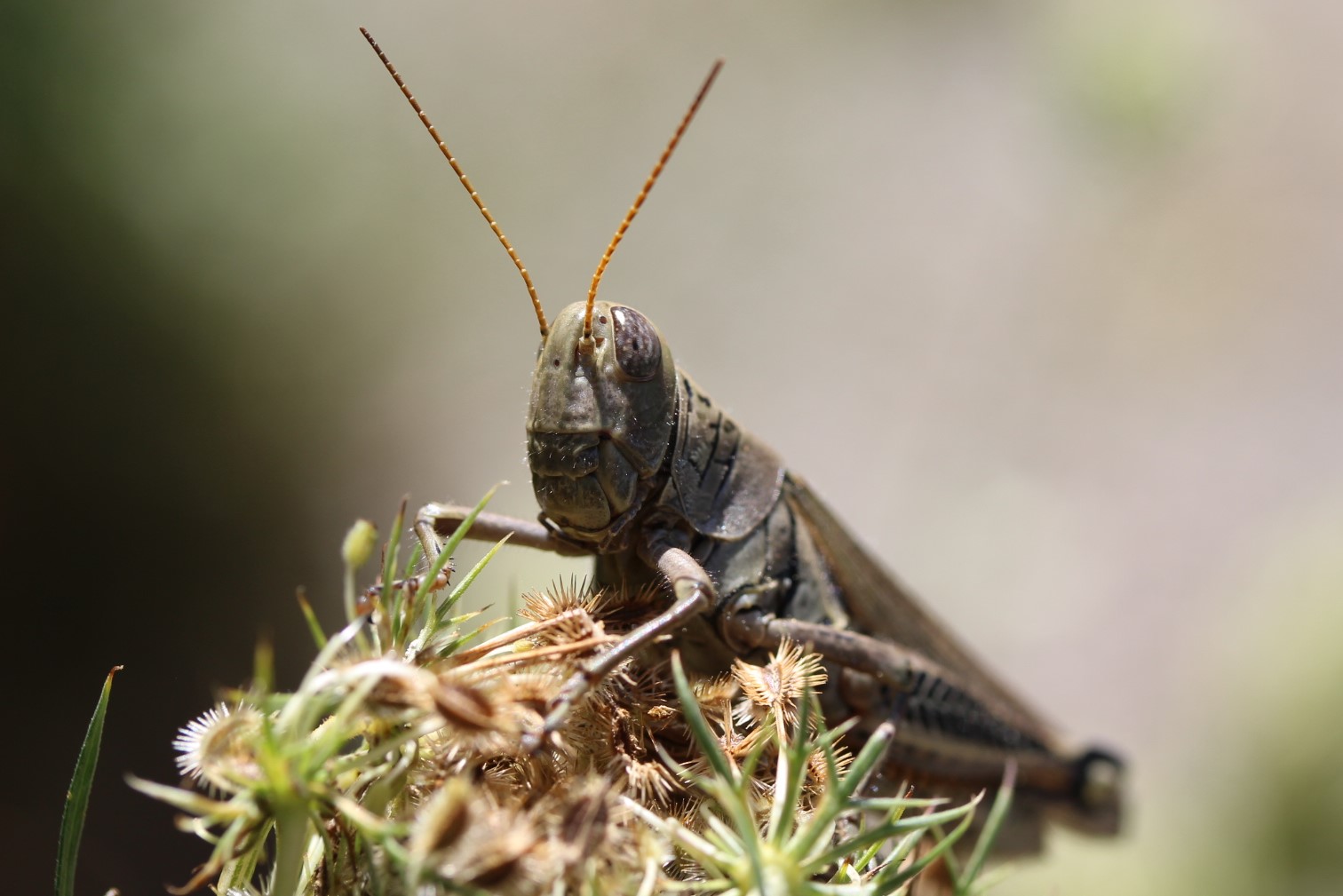
Differential Grasshopper (Melanoplus differentialis) in my Parents’ garden, August 2022:
This very large grasshopper can be up to 4.4 cm long and feeds on a variety of plants and crops (Marshall 2006).
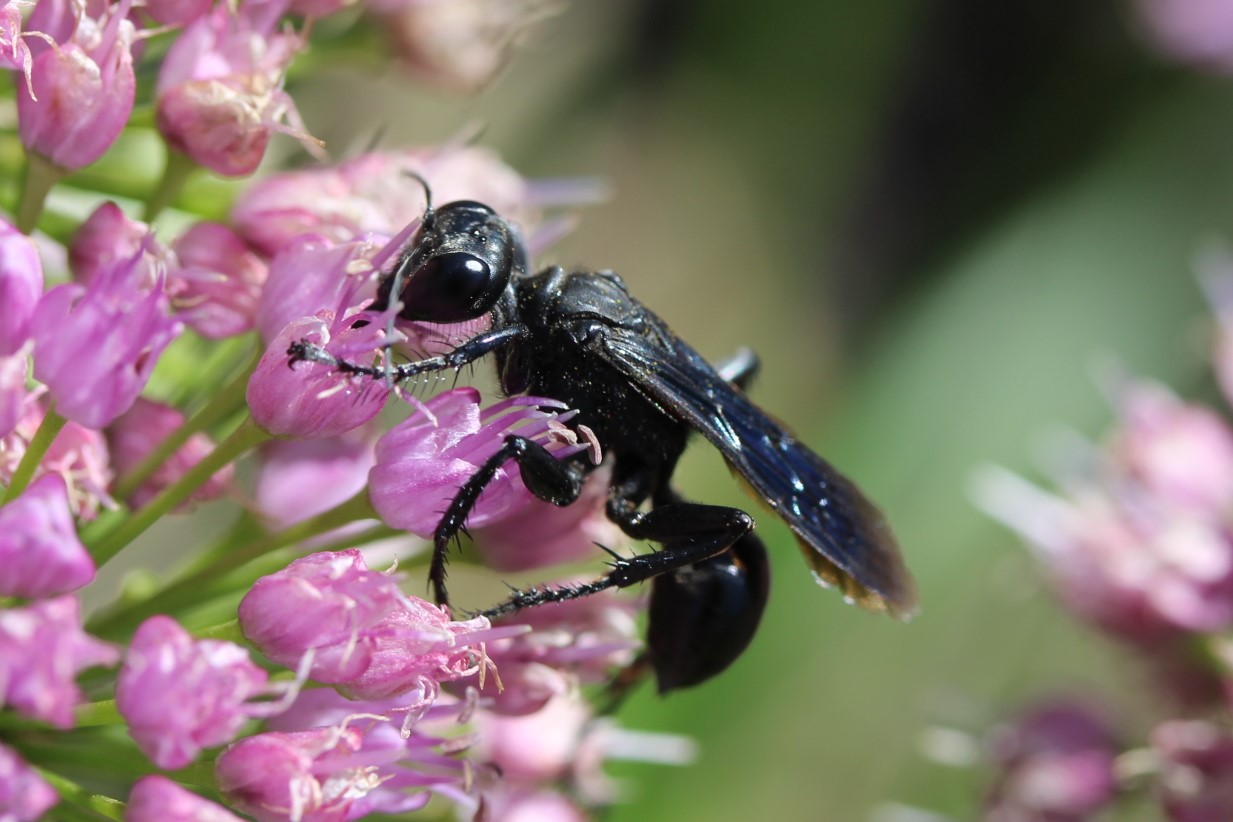
Prionyx atratus in my Parents’ garden, August 2022:
Prionyx atratus is a solitary wasp which hunts late-instar* or adult grasshoppers, like the one photographed on the same day in the same garden above. The wasps sting the grasshoppers on the head or thorax, and then construct a burrow in soil for their single prey item. Once the nest is constructed they will place the paralyzed grasshopper inside with an egg attached and close off the nest. While working on the nest, the female hunter will sometimes cache the grasshopper prey nearby (O’Neill 2001). Researching this species led to a rather alarming observation noted in O’Neill 2001: “I have seen the cached grasshopper prey of Prionyx species devoured by other grasshoppers”. It seems that grasshoppers are not always only plant-pests but will consume each other if given the opportunity.
*instar refers to any larval stage between moults, so a late-instar means a larval stage that is close to being an adult.
Northern Leopard Frog (Lithobates in Long Point, September 2022:
One foggy morning in September, I was out taking photos in Long Point. The main thing I was looking for was birds, but every step I took along the wetland trail was punctuated by the sound and motion of leaping frogs. Taking a closer look at the path, I managed to crouch down and capture some closeups of this Northern Leopard Frog, helpfully sitting very still.
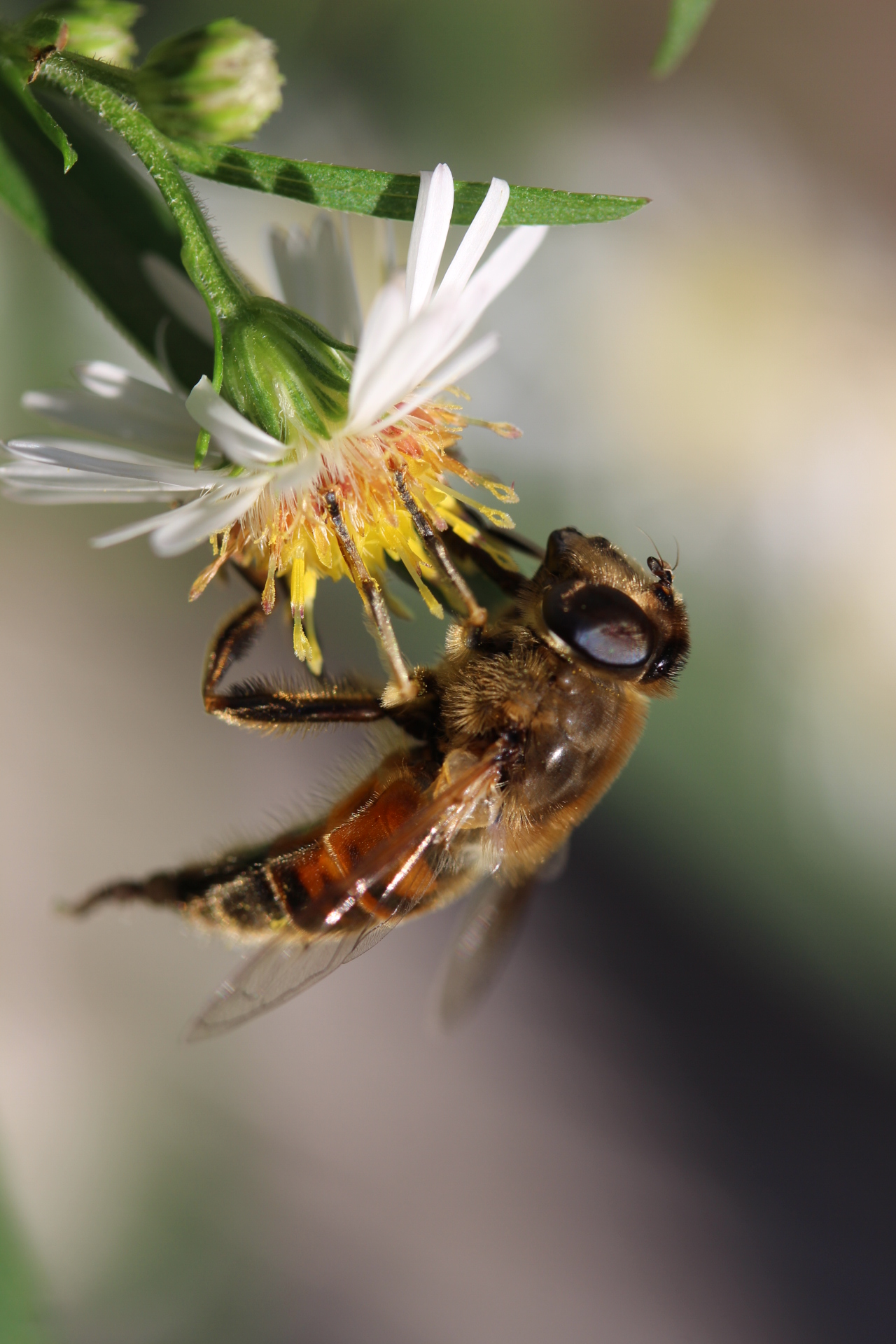
Common Drone Fly (Eristalis tenax) in my backyard, October 2022:
There comes a time in the year when insect populations begin to go into hiding or die off as Autumn and Winter creep upon the land. Every buzzing, whirring, crawling invertebrate at this time of year gains my attention all the more because I am conscious of the seasons’ turnings that will soon cover the flowers with snow and a hush will fall upon the local pollinators. So in October, I was quite excited to find a small gathering of pollinators right by my back step where an Aster was growing. This photo shows one such late-Fall insect: a Drone Fly.
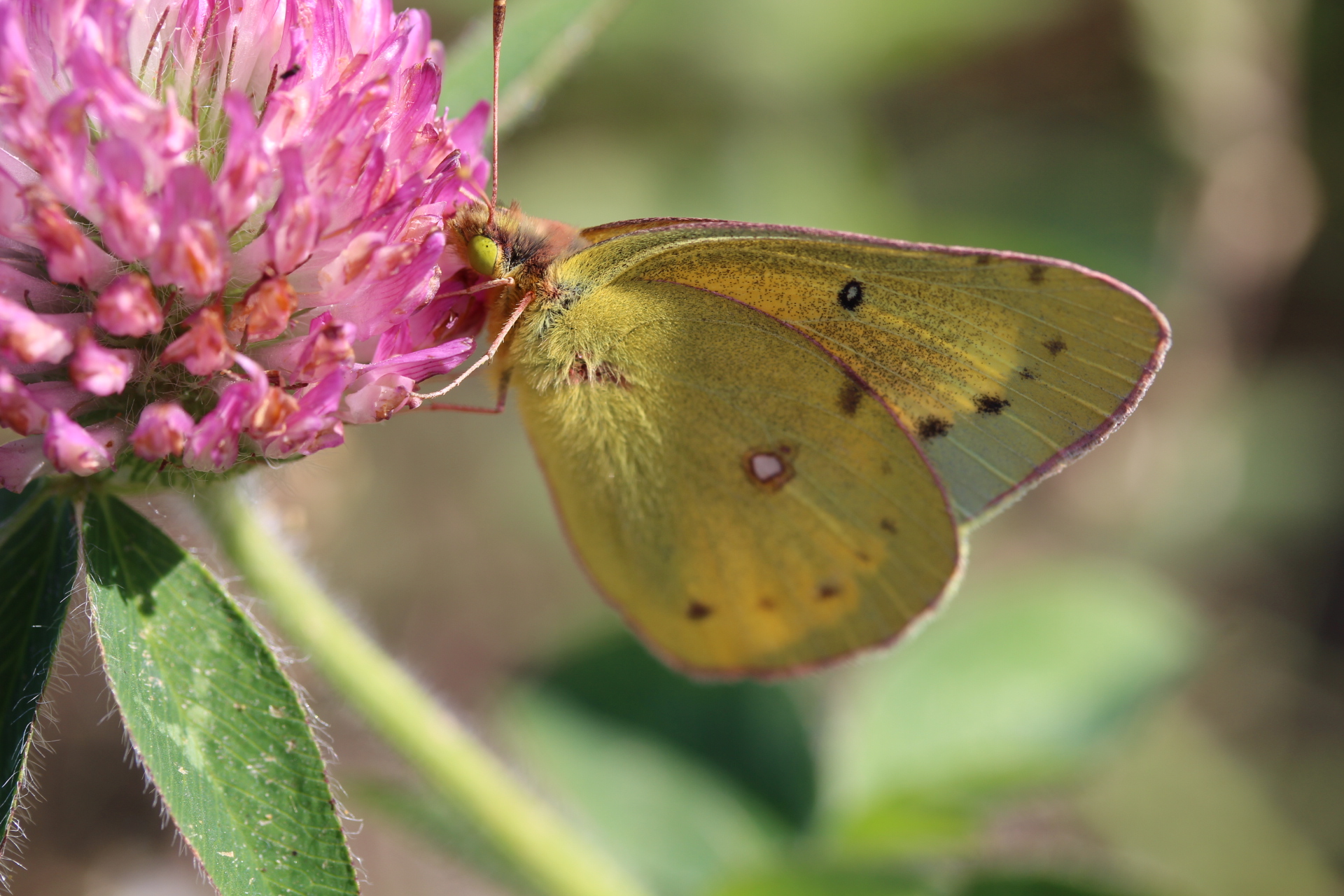
Orange Sulphur (Colias eurytheme) on my Parents’ Farm, October 2022:
Yet another late-flying insect caught my eye in October, this time a butterfly: an Orange Sulphur. This species of butterfly may or may not overwinter in Ontario. The adult individuals that we see in the Spring are likely migrants from its southern range (which includes Central America and the United States) (Hall et. al. 2014). I’m guessing this means that this individual spotted in the Fall was possibly on its way South to warmer climes.
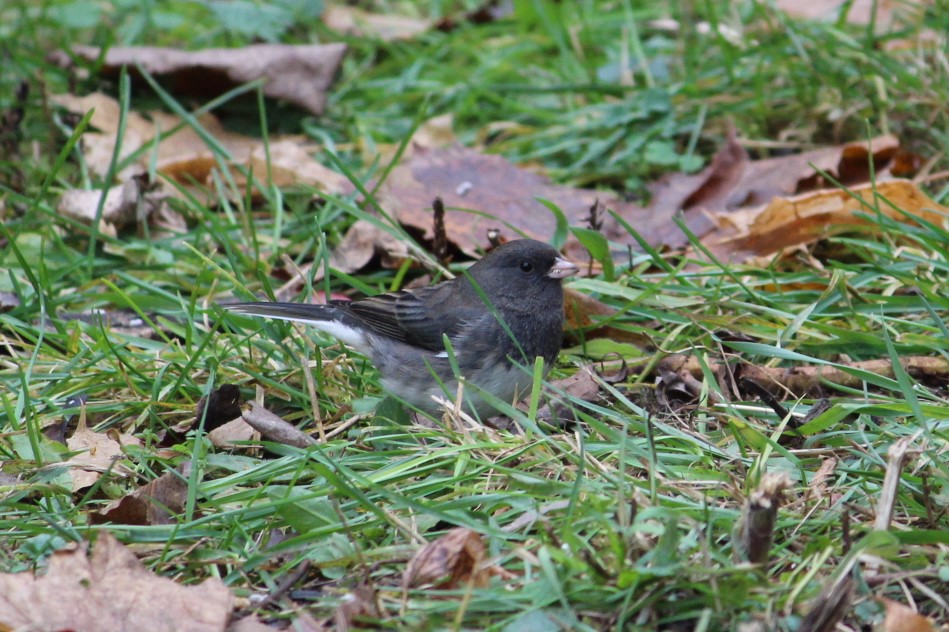
Dark-eyed Junco (Junco hyemalis) in my backyard, November 2022:
As I prepared to choose at least one photo from every month of the past year, I realized that I didn’t have any photos taken in November. So I rushed outside in my backyard to take some photos of the backyard birds at our feeders. My favourite picture was this of a Dark-eyed Junco. Juncos are familiar and common backyard birds, though they prefer to feed from the ground, rather than directly from the hanging feeders. I feel like this is a perfect species to end with: very common and familiar, found in my own backyard, yet I still find it exciting to see and observe these amazing creatures. I’m looking forward to next year, and can’t wait to see what other species I will wonder at and learn about through 2023.
References:
Ellison, Aaron, Gotelli, Nicholas, Farnsworth, Elizabeth, adn Alpert, Gary. 2012. A Field Guide to the Ants of New England. Yale University Press.
Evans, Howard and O’Neill, Kevin. 2007. The Sand Wasps: Natural History and Behavior. Harvard University Press.
Hall, Peter, Jones, Colin, Guidotti, Antonia, and Hubley, Brad. 2014. The ROM Field Guide to Butterflies of Ontario. Royal Ontario Museum.
Hill, Kathy, Marshall, David, Moulds, Maxwell, and Simon, Chris. 2015. “Molecular phylogenetics, diversification, and systematics of Tibicen Latreille 1825 and allied cicadas of the tribe Cryptotympanini, with three new genera and emphasis on species from the USA and Canada” Zootaxa Vol. 3985 No. 2: 10 Jul. 2015. [you can read the article yourself here: https://www.mapress.com/zootaxa/2015/f/zt03985p251.pdf] DOI: https://doi.org/10.11646/zootaxa.3985.2.3
Marshall, Stephen. 2006. Insects: Their Natural History and Diversity. Firefly Books.
Marshall, Stephen. 2012. Flies: Their Natural History and Diversity. Firefly Books.
Naughton, Donna. 2012. The Natural History of Canadian Mammals. University of Toronto Press.
O’Neill, Kevin. 2001. Solitary Wasps: Behavior and Natural History. Cornell University Press.
Wilson, Joseph, and Carril, Olivia. 2016. The Bees In Your Backyard. Princeton University Press.
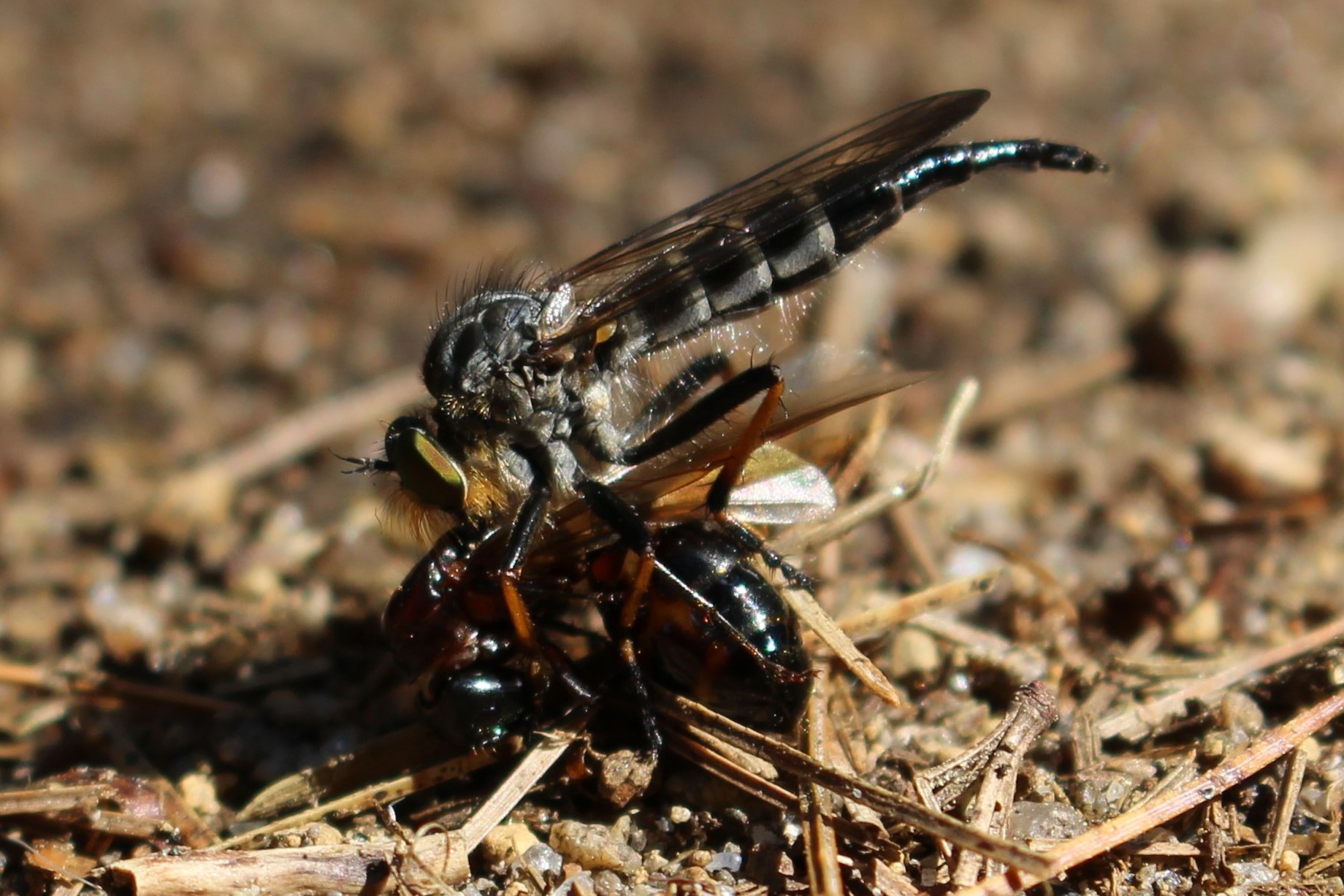
Subject: Underworld Robber Fly (Neoitamus orphne) and New York Carpenter Ant Queen (Camponotus novaeboracensis).
Location: Algonquin Provincial Park.
Date: July 2017.
For an Introduction to this series (my Top 20 Nature Photos of 2013-2020) go here.
The Story Behind the Shot: Every ant colony, each civilization in the soil, has to begin with a single type of individual: an ant queen*. Queens are special individuals, easily separated from the workers by their wings (at this preliminary stage) and their relatively large size. While camping in Algonquin during the summer of 2017, my campsite was in the path of dozens of queen carpenter ants. I watched as several different individuals wandered through the pine needles and discarded their wings. I had also been separately observing a large robber fly that had taken up residence on my camping table, using the surface to survey for potential prey. At some point the robber fly descended upon one of these ant queens and I was lucky enough to spot the unfortunate queen and its fortunate hunter.
*nature never lets me get away with generalizations… I would have liked to say, for the drama, that every colony begins with a single individual, but that isn’t true at all. There are many species of ants that create new colonies with multiple queens as a rule, and many times groups of workers accompany the queen (or queens). One of the most famous of these species is the Southern Fire Ant Solenopsis invicta, but dependent colony founding (that is, colonies that begin with a queen dependent on workers as opposed to independent colony founding) is widespread in ants. As in all things in the natural world, the picture becomes increasingly complicated, the more we know (Peeters and Molet 2010).
The Story Behind the Species:
Part 1: New York Carpenter Ant (Camponotus novaeboracensis):
The ant queens that I saw that day had emerged from a colony in what is termed a mating swarm. Multiple colonies in the area, triggered by the weather conditions must have swarmed at the same time, winged ants filling the air and meeting to mate. The males of these ants die soon after mating, but the queens will live for several years if they can establish a colony. The vast majority of ant queens will also die during this mating flight. Holldobler and Wilson (1990) describe this well: “It follows that the brief interval between leaving the home nest and settling into a newly constructed nest is a period of intense natural selection among queens, a dangerous odyssey that must be precisely timed and executed to succeed.” After mating, the ant queens descend to the earth and never leave it for the air again, removing their wings and absorbing the flight muscles within to provide the nutrients for their first batch of eggs. Camponotus novaeboracensis prefers nesting in dead standing trees or fallen logs or stumps, but they are occasionally found nesting under rocks or cow dung (Ellison et. al. 2012). Contrary to what you may think, carpenter ants (the genus Camponotus) don’t consume wood for food, instead carving into decayed wood in order to create a nesting site. One of their major sources of food is actually honeydew from Homoptera (true bugs such as leafhoppers, treehoppers and aphids), but they also collect sap and hunt insects and will scavenge on dead vertebrates as well (Hansen and Klotz 2005).
Foraging as an ant worker is dangerous, there are many other creatures foraging that would hunt down ant workers, and that’s ok for the colony because each worker is just one small part of a larger whole. Camponotus novaeboracensis colonies can contain almost 9000 workers (Hansen and Klotz 2005), but usually only a single egg-laying queen*. So workers can be lost, and the colony continues, but the queen is important so the colony can begin. If she is lost before she can find a nesting site, as in my observation here, there can be no colony of thousands.
*Akre et. al. 1994 report that C. novaeboracensis colonies rarely have more than one queen, but it does happen.
Part 2: Underworld Robber Fly (Neoitamus orphne):
Robber flies are incredible hunters, swooping out from perches on branches or twigs (or in this case, camping tables) to pounce upon insects and stab them with their powerful piercing mouths. There are over 7000 species of Robber Fly (members of the family Asilidae) worldwide (Marshall 2012). Neoitamus orphne has a specific name, orphne, which refers to a spirit of Greek mythology that lived with Hades in the Underworld, and is sometimes referred to by the name “Styx”. I love the idea of this fly being named after a spirit of the Underworld, as this robber fly must send many souls of insects to Hades on a frequent basis. The individual pictured is a female, which willuse that long tubular abdomen to lay eggs inside flower heads or leaf sheaths. The larvae then hatch and drop to the ground, where they will hunt down soil-dwelling invertebrates presumably (Marshall 2012). I say “presumably” because I don’t think anyone knows for certain what this species of robber fly eats as larvae but robber fly larvae are predators and this genus has larvae that live on or in the ground so it makes sense.
My photo captures a battle between two mother insects, one which has the potential to generate a social colony of 9000 worker ants, another which lives a solitary life snatching prey out of the air.
References:
Akre, R. D., L. D. Hansen, and E. A. Myhre. 1994. Colony size and polygyny in carpenter ants (Hymenoptera: Formicidae) J. Kans. Entomol. Soc. 67: 1-9, cited in: Hansen, Laurel and Klotz, John. 2005. Carpenter Ants of the United States and Canada. Cornell University Press.
Ellison, Aaron, Gotell, Nicholas, Farnsworth, Elizabeth, and Alpert, Gary. A Field Guide to the Ants of New England. 2012. Yale University Press.
Hansen, Laurel and Klotz, John. 2005. Carpenter Ants of the United States and Canada. Cornell University Press.
Holldobler, Bert and Wilson, E. O. 1990. The Ants. Harvard University Press.
Marshall, Stephen. 2012. Flies: the Natural History and Diversity of Diptera. Firefly Books.
Peeters, Christian, and Molet, Mathieu. 2010. “Colonial Reproduction and Life Histories” in: Lach, Lori, Parr, Catherine L., and Abbott, Kirsti L.(eds.) 2010. Ant Ecology. Oxford University Press.
I hope you enjoyed my foray into the lives of these fascinating insects. My next post in the ongoing series of My Top Nature Photos is going to be about a sneaky little amphibian.
Once again, I’m going to repost one of my tumblr blog posts, this time from May of 2018.
On May 18-21, 2018, we took a trip to MacGregor Point Provincial Park. Today’s post is going to be a highlight of the animal observations/encounters that we had that weekend.
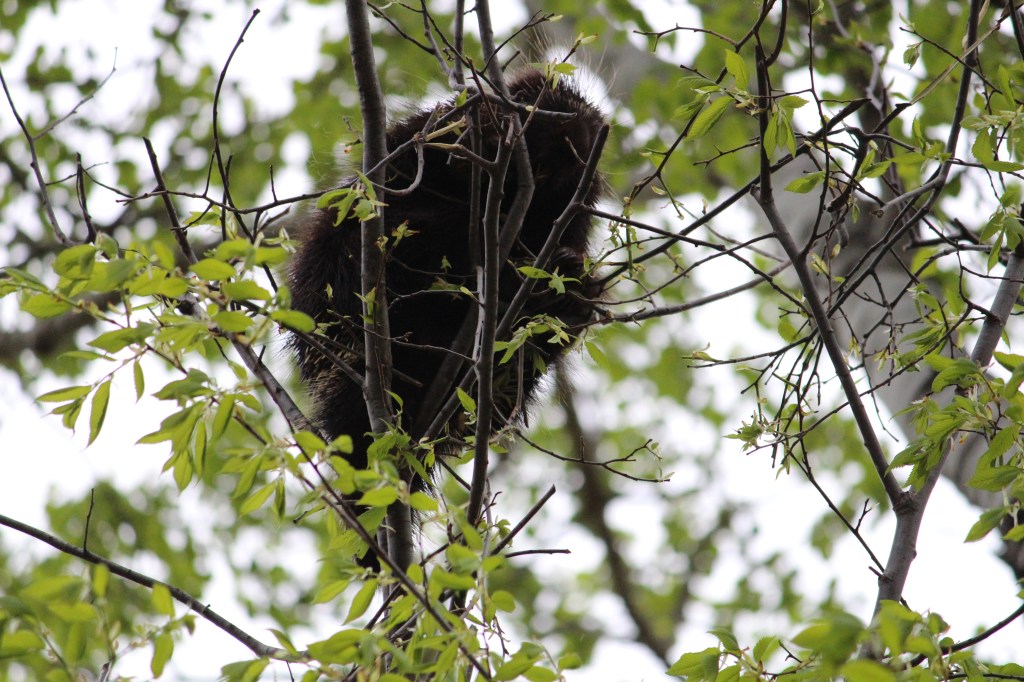
We awoke early the first morning of our stay and looked at the grey skies that promised rain. Hoping to spot some wildlife beneath the somber dawn sky, we set off on the Tower Trail. Our early start was rewarded with the sight of a strange animal resting in a tree.
It was a mammal with spines, and the second largest rodent in North America (only beaten by the Beaver): a North American Porcupine (Erethizondorsatum). After consuming some buds and plants that it foraged in the night it found a perch to rest in for the day, one that seemed awfully thin for the size of the animal.
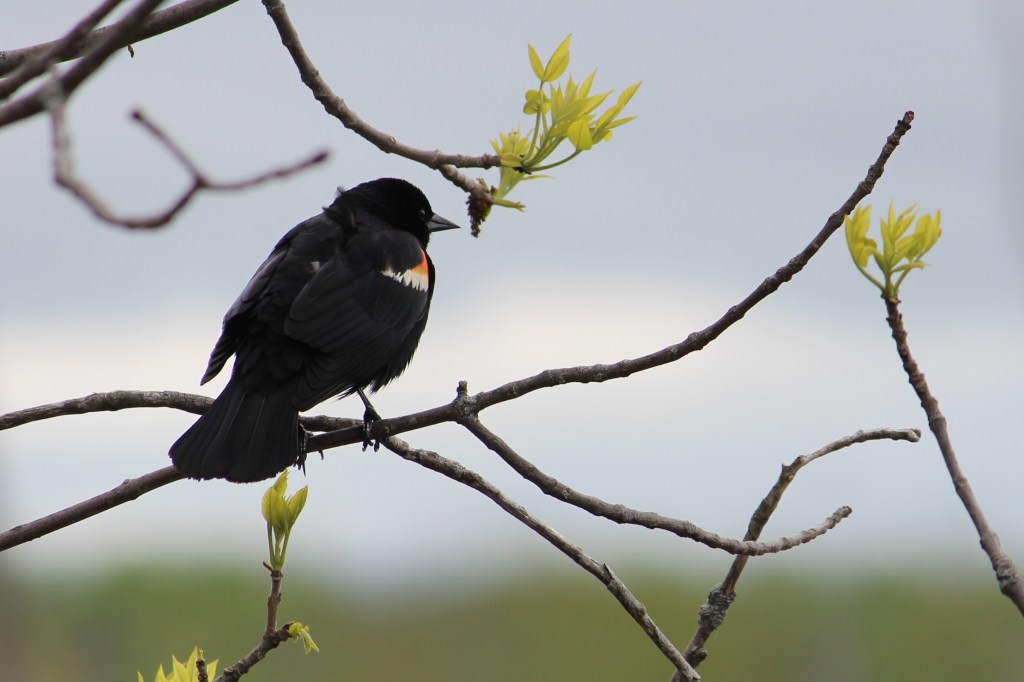
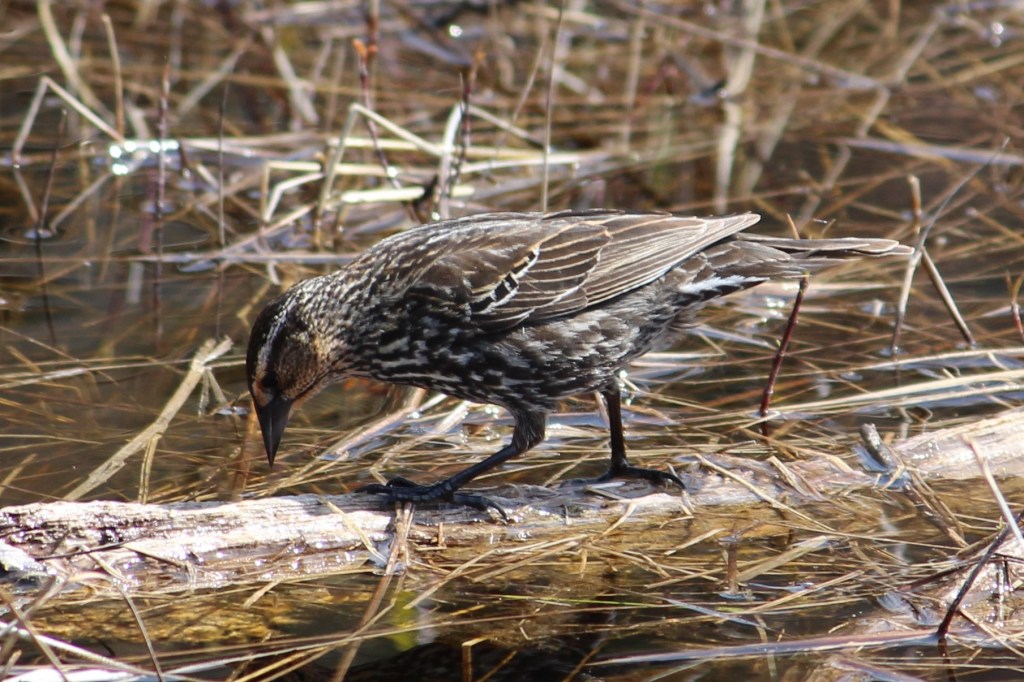
Further down the trail, we moved through various ponds until the horizon opened into spreading wetlands filled with reeds and bordered by grasses and trees. Here, the red-winged blackbirds (Agelaius phoeniceus) were in abundance, uttering their O-ka-leeeee calls from their various perches. We saw males with their velvet black plumage offset by epaulets of red-and-yellow, and we also occasionally spotted the much more camouflaged females. On our last morning camping, we saw one of the females and believed it to be a different species of marsh-bird, but later came to the realization that it was a female red-winged blackbird.
Male (top) and Female (bottom) Red-winged Blackbirds (Agelaius phoeniceus).
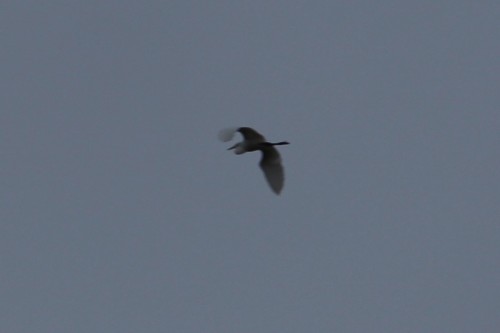
Mixed with the sounds of the blackbirds, were the trumpeting calls of the Canada Geese (Branta canadensis), always the loudest birds present. As we were leaving the wetlands, we heard a strange call and a bird departing the marsh. We were able to snap a quick picture of it and now believe it’s a Great Egret (Ardea alba).
Our fleeting glimpse of a Great Egret (Ardea alba).
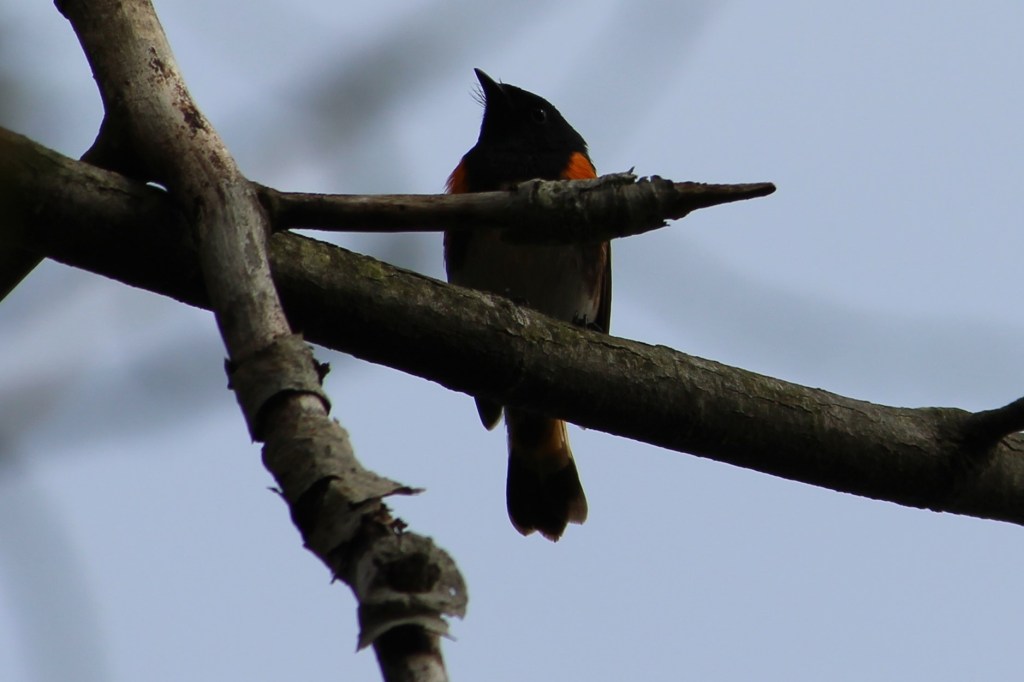
Throughout our stay, our campsite was host to several small, flitting birds that would rarely sit still. Every time the eyes caught one in full view the birds would then dart off again, a streak of orange flickering through the branches of the tree like an avian fire. We were barely able to take some pictures of these quick warblers foraging among the branches. They were American Redstarts (Setophaga ruticilla), who had returned from their wintering grounds in Central America and northern South America. Like the Red-wings, the male and female birds look very different- the male sporting a dark coat with orange dashes on the wings and chest, and the female a gray-white with yellow patches on the sides.
Male (top) and Female (bottom) American Redstarts (Setophaga ruticilla). The pictures unfortunately do not capture their boundless energy.
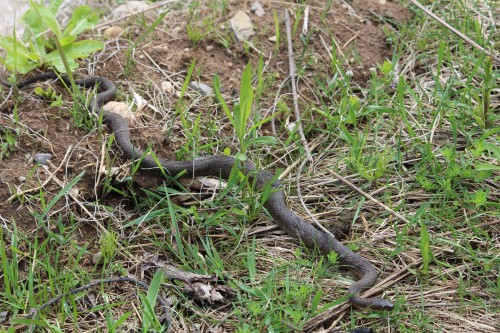
Beneath clear skies the next day, we set off on the Tower Trail once more, hearing and seeing the blackbirds again. On our way through the wetlands trail, we spotted another creature enjoying the warmth and sun: a Northern Watersnake (Nerodia sipedon).
Northern Watersnake (Nerodia sipedon) basking in the sun.
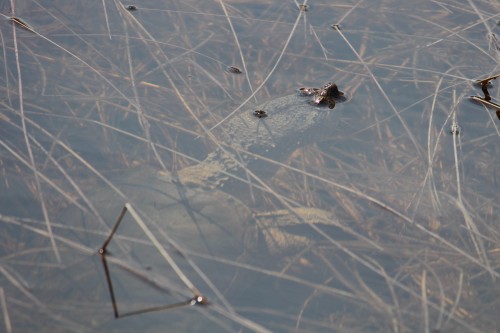
While visiting the trail near the Visitor’s Centre, we were in the right place to see a creature that resembles a mythical beast: a swimming Snapping turtle (Chelydra serpentina). Snapping turtles are beautiful creatures and the one we saw moved very stealthily. Despite the clear waters, and the size of the reptile, it was difficult to keep track of its scaly skin among the water-plants as it slowly and gracefully swam through.
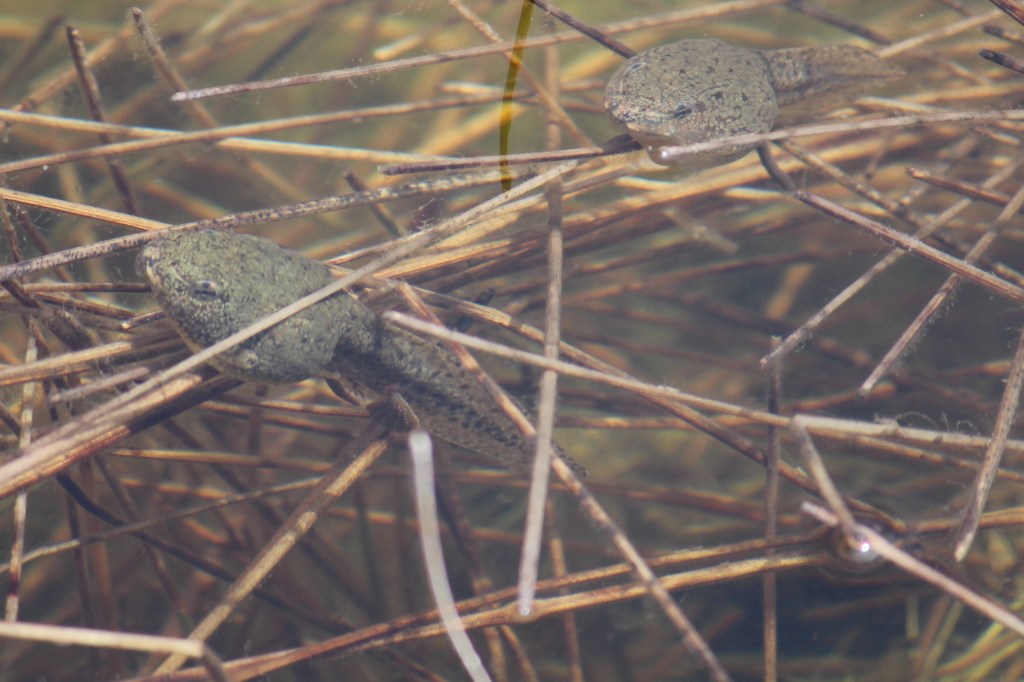
Also moving through the waters of the marsh were large tadpoles, with heads the size of a toonie or larger. Some were beginning to display the stubs of legs, but continued to swim in wriggling pollywog fashion, so unlike the athletic strokes of their adult frog legs.
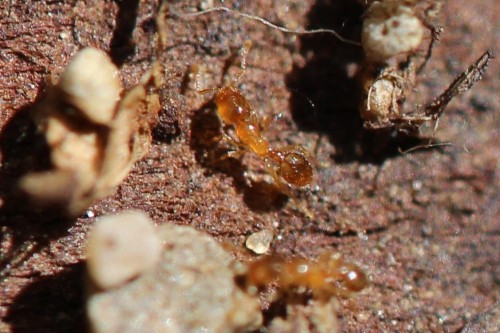
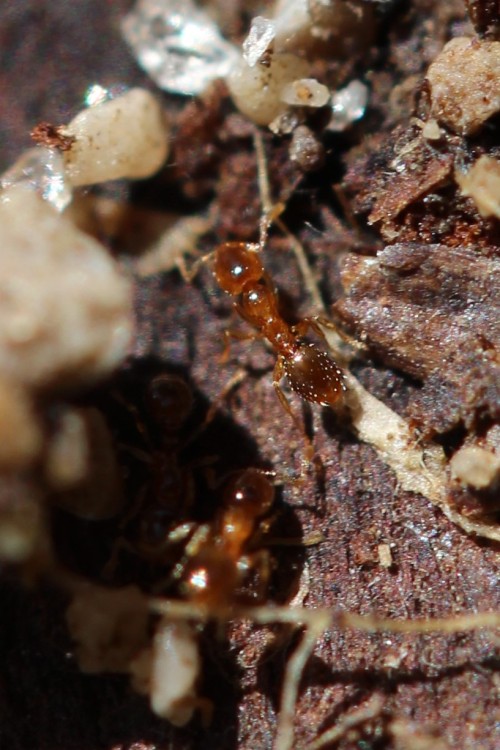
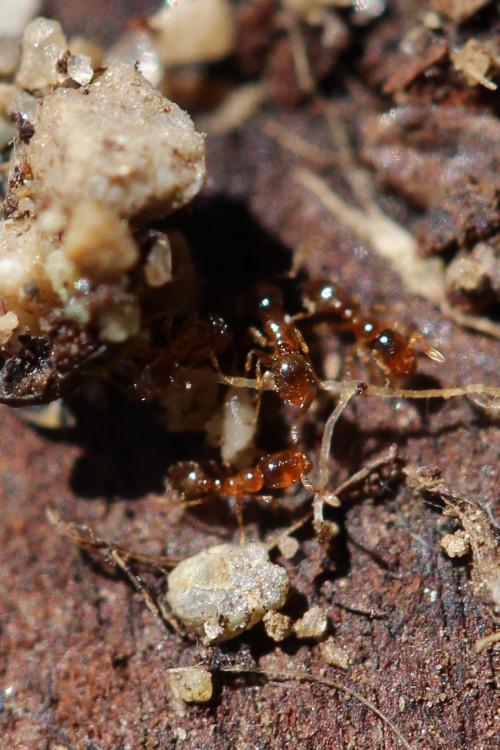
Once back at our site, I had an itch to use my macro lens to capture some of the tiny creatures that abounded there. Turning over a piece of bark on the gravel of our site, no larger than my palm revealed a portion of a miniature society. Tiny orange-brown ants scurried frantically about. They were Temnothorax ants, which are also known as “acorn ants” because some species of Temnothorax house their entire colony within an acorn.
Temnothorax ants, tiny workers under a piece of bark.
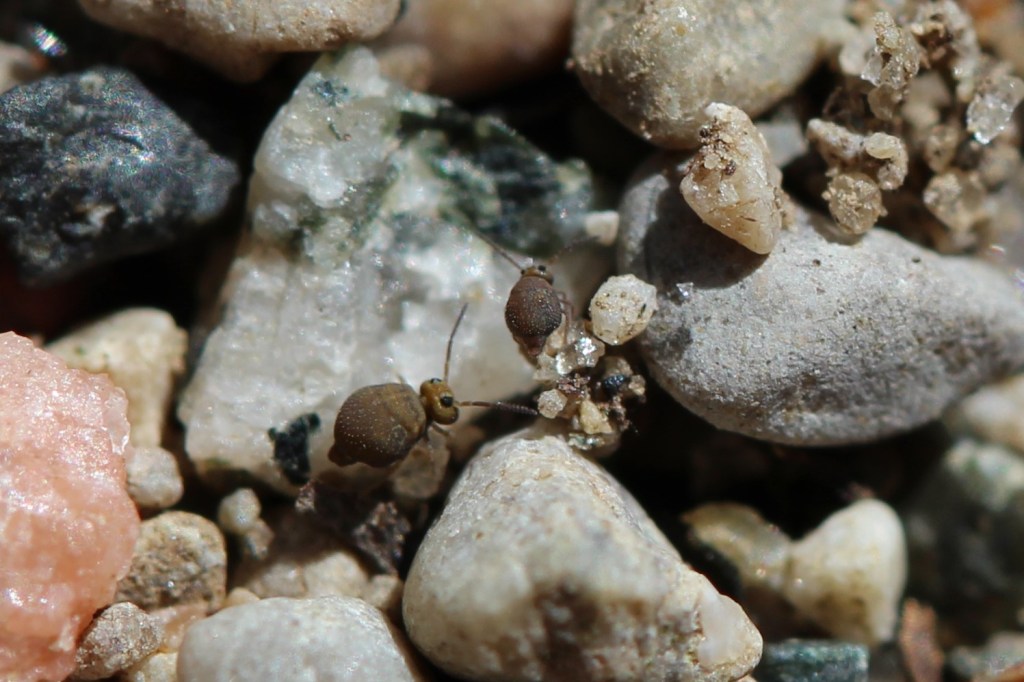
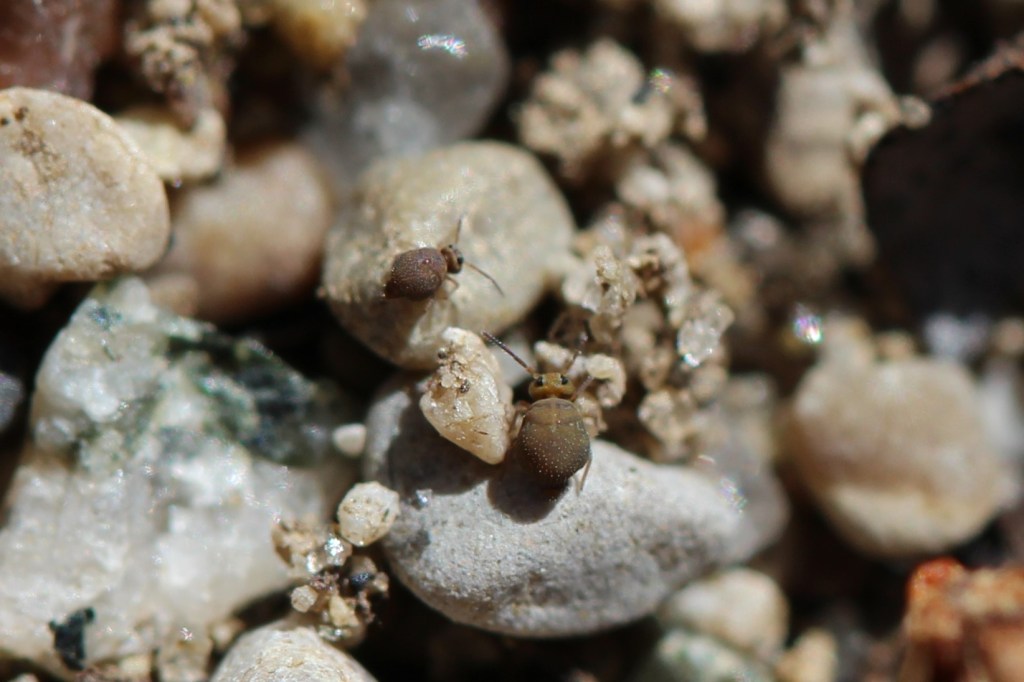
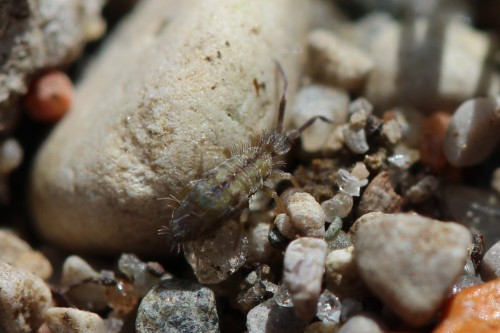
I turned my gaze on equally tiny, but even more numerous inhabitants of our site. Everywhere one looked in the sun, dark specks that slowly moved or hopped about on the gravel, could be seen. To see them in their full was a delight to me. The specks were Springtails, and these were a quite different kind to the ones I had seen before in the snow and on the trail by our house. These Springtails were like tiny rabbits when one could view them up-close. They were Globular springtails (Order Symphypleona) and I’m fairly sure the species was the Garden Springtail (Bourletiella hortensis) or something closely related:
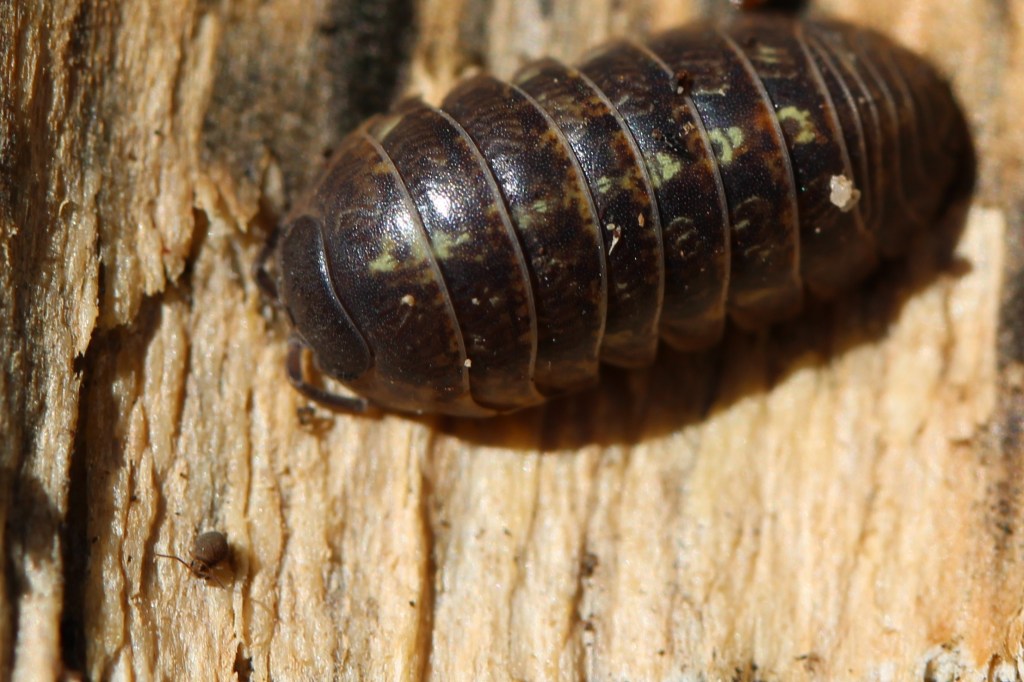
For size context, see the following picture of a Woodlouse (Armadillium vulgare). In the bottom left corner, there is one of the little Springtails:
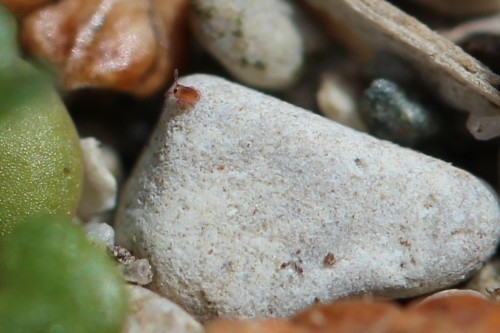
In my quest to focus the macro lens on these miniature creatures I inadvertently took a picture of something even smaller than an adult Springtail: a baby Springtail!
As if to demonstrate fully the diversity of these tiny almost-insects, an entirely different species of Springtail was also rushing through the gravel: a member of the genus Orchesella, one of the Elongate Springtails:
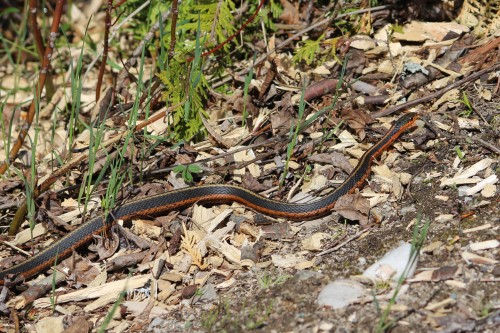
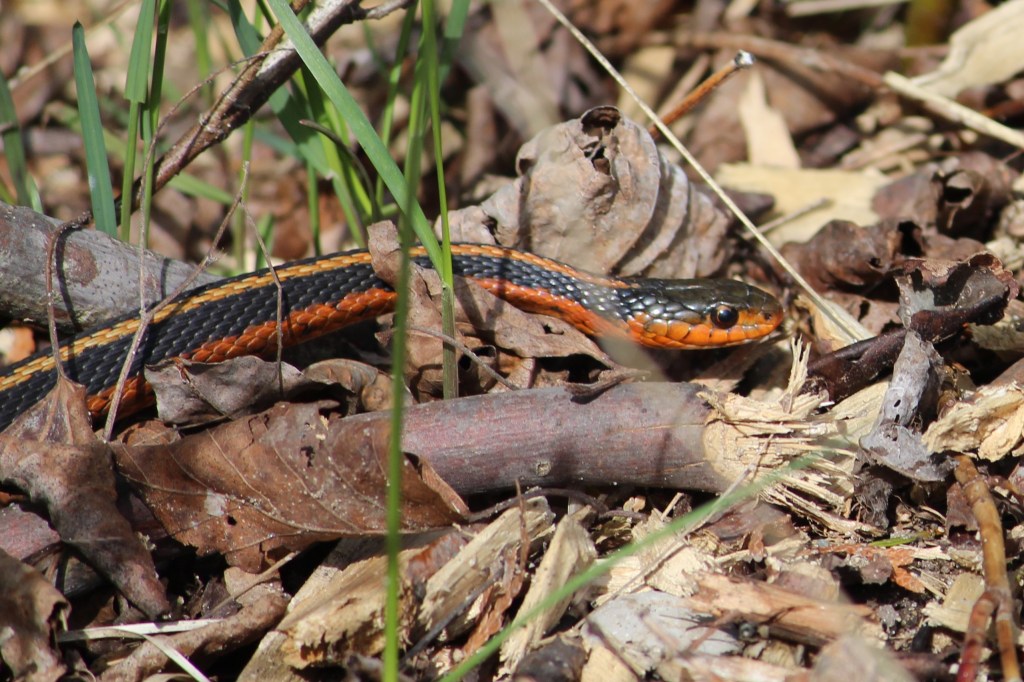
Right at the edge of our site, my friend Marshall sighted a beautiful snake with orange underbelly and stripes along its dark body. We thought it must be a rare species but it turned out to be a variant of the diverse Eastern Garter Snake (Thamnophus sirtalis), which did nothing to diminish its beauty or wonder.
A beautiful Eastern Garter Snake (Thamnophis sirtalis).
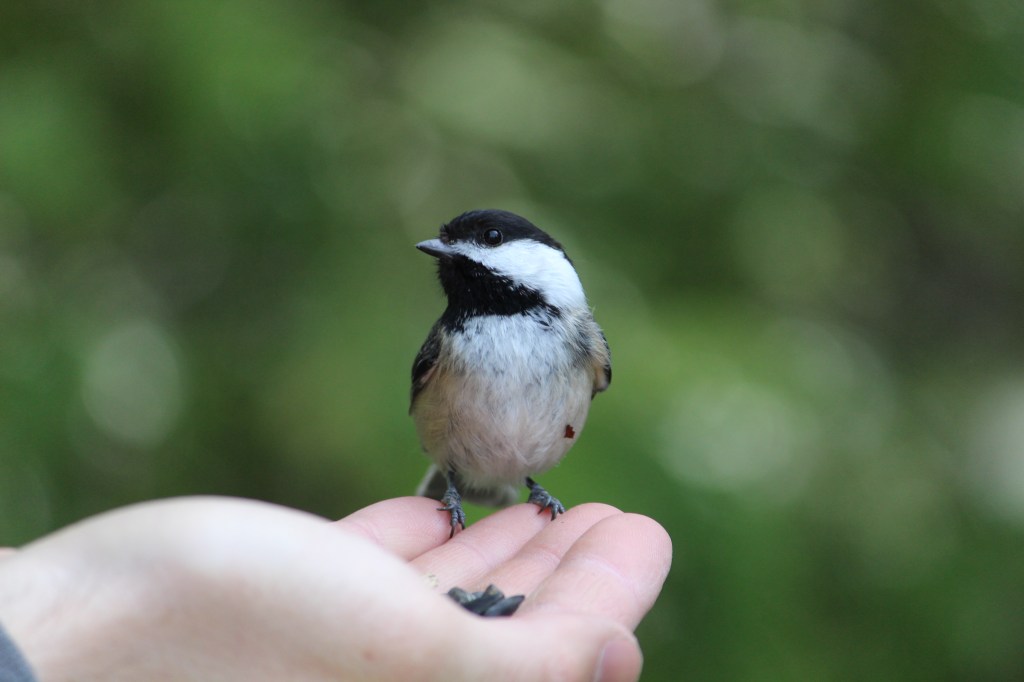
On our last day we went to the Visitor Center trail to feed the Chickadees (Poecile atricapillus) from our hands, along with the occasional red-breasted Nuthatch (Sitta canadensis). Despite some of the rain and cloudy weather, we observed a variety of wild organisms at MacGregor Point and marveled at their diversity and beauty.
The temperature was up, the sun was out, and with it the invertebrates were active and visible. I arrived at the Spruce Bog Boardwalk Trail with my macro lens equipped, and I used it quite extensively.
At the beginning and near the end of the trail, I took pictures of Hooded-Owlets (Cuculia), which are not baby owls with their faces obscured, but instead the name for a genus of moths (these moths have some crazy names. One of the species I observed is similar to a moth that goes by the common name “Asteroid Moth”… I have no idea why…). The first was a brightly striped caterpillar of the Brown Hooded-owlet (Cuculia convexipennis).
Brown Hooded-Owlet Caterpillar.
Near the end of the trail I found another Hooded-Owlet, and I’m not so sure on the identification for this one, but it was much less colourful than the first.
Unidentified Hooded-Owlet (Cucullia sp.).
Landing briefly on a flower was a Tachinid Fly in the Genus Phasia. Tachinids are fascinating Flies and incredibly diverse. This is what Stephen Marshall has to say about them in his incredible book about Flies: “The Tachinidae is in many ways the ultimate fly family. With almost 10 000 named species and thousands more awaiting description, this ubiquitous group… exhibits an unparalleled variety of sizes, shapes and colors. The range of life history strategies is equally amazing, at least within the constraint that every known species in the group is a parasitoid that develops inside another insect… or related arthropod.” (from Marshall 2012, p 386). Phasia tachinids are parasitoids of True Bugs in the families Pentatomidae and Pyrrhocoridae (Marshall 2012).
Phasia Tachinid Fly perching on a flower, possibly P. auralans?
Another flower was visited by a wasp of the Ectemnius genus. These wasps are part of a group of wasps called the “Square-headed wasps” (Subfamiily Crabroninae) and I think you can see that characterization borne out here. I certainly noticed its huge head right away while taking the pictures. Members of the genus Ectemnius hunt mostly adult Flies (Diptera) which they store in their nests for their larvae to feed on. Some species of Ectemnius wasps nest in soil, while others nest in rotten wood (O’Neill 2001).
Ectemnius wasp, visiting a flower.
Visiting flowers for nectar is a common activity for many groups of flying insects. This fact has been exploited by predators, and I spotted one of these on a flower nearby: a Jagged Ambush Bug (Phymata) lying in wait with raptorial (that is, grasping) front legs at the ready to nab unwary pollinators.
Ambush Bug lying in Ambush. Look at that incredible profile.
I spotted some mating grasshoppers on a leaf, which were otherwise engaged and allowed me to take some decent photos. If you know something about Orthopterans (members of the Order Orthoptera, which includes Katydids, Grasshoppers, and Crickets) you might know that unlike butterflies and moths (Order Lepidoptera) and many other insect groups which have very distinct larval forms, young stages of grasshoppers appear the same as adults except for the absence of wings. This photo might be confusing then… since these grasshoppers are clearly mating (a strictly adult activity) and they clearly don’t have wings (a characteristic of larvae). The problem is solved when you find out that the species is called the Wingless Mountain Grasshopper (Booneacris glacialis). Although possessing wings as adults is a characteristic of all major insect groups, there are members of all groups which have later (as in evolutionarily later) lost the wings.
Mating Wingless Mountain Grasshoppers.
Within the sparse woods of the Black Spruce Trees, I found a caterpillar of the Datana genus. These caterpillars stick together in their younger stages, and separate when they are in their final larval stage before adulthood (Marshall 2006).
Datana Caterpillar, likely in its final larval stage because it was alone.
Growing out of the side of the railing on this part of the boardwalk trail was the beautiful branching form of a Beard Lichen (Usnea). Lichens are truly the Corals of the terrestrial realm: they have similar appearances and colours (some are green, brown, orange etc), but they also consist of a partnership* between two very different forms of life. Corals consist of an animal and algae living together and Lichens consist of fungi and algae.
*this is of course a very simple way of describing the relationship between a lichen fungus and a lichen alga. In fact, there can be many variations on the degree of partnership, with many relationships resembling parasitism rather than traditional ‘symbiosis’.
Usnea Beard Lichen growing out of a bridge railing. If this picture had enough blue tint, you might believe it was a photo of a coral attached to a shipwreck.
Once past the railing I came upon the wildflower meadow, which housed an appropriate medley of visiting Insects. Hymenoptera were present in abundance. A Yellow-Banded Bumble Bee (Bombus terricola) busily moved from flower to flower, thrumming through the air. Bumblebees amaze me, and they almost seem like they shouldn’t be able to fly with their stout fuzzy bodies but they fly quite well enough for their purposes.
Yellow-Banded Bumblebee.
A brief appearance by a member of the Sand Wasps (Bembicidae) was an exciting find (have to continue the Sand Wasp series some time, I’ve only done the Introduction and one tribe!). The Sand Wasp I observed in Algonquin is possibly a member of the genus Gorytes. Species in this genus fill their nests with True Bugs, mostly Hoppers (members of the families Cercopidae, Cidadellidae, and Membracidae) (Evans and O’Neill 2007).
Sand Wasp, possibly a Gorytes.
The Spider Wasp Episyron was a very distinct Hymenopteran. Although it sort of has a squat appearance somewhat reminiscent of Spiders, the name “Spider Wasp” comes from the fact that these wasps (members of the Family Pompilidae) hunt Spiders which they feed to their young. Species in the genus Episyron hunt specifically Orb-weaver Spiders (Araneidae) (O’Neill 2001).
Episyron Spider Wasp.
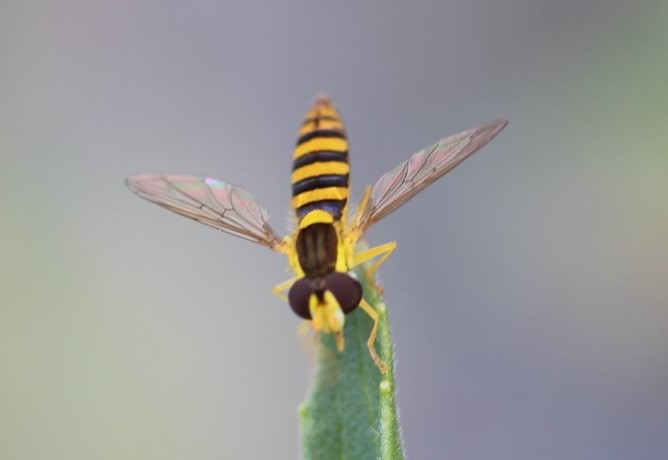
Flower Flies (Syrphidae) were of course frequently seen visiting the flowers. Frustratingly, a new one to me was elusive enough that I didn’t manage to get a very good picture of it. This was the largest Flower Fly I’ve ever seen (though not large in most terms, probably about honeybee size) a member of the Genus Sphaerophoria.
Sphaerophoria Flower Fly.
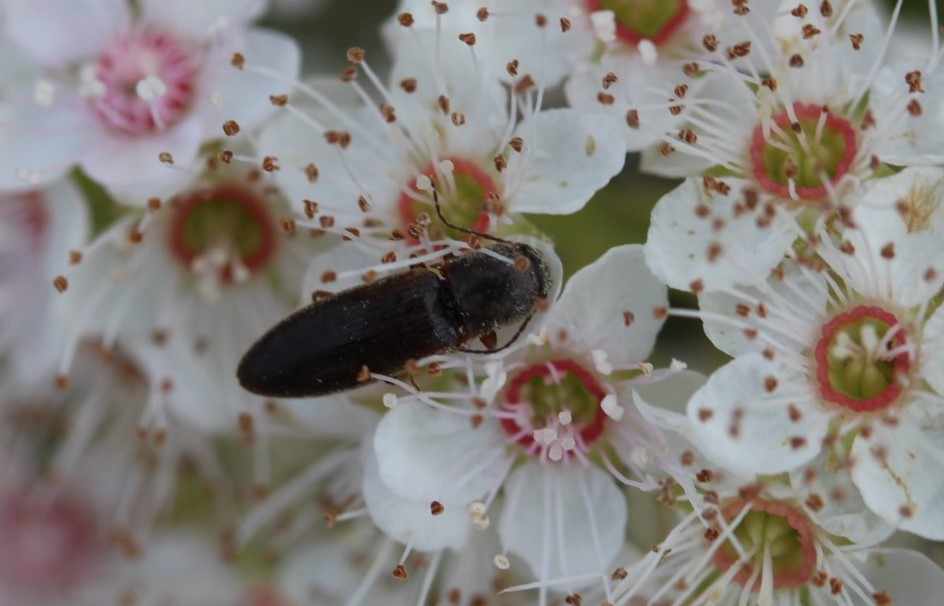
Not as common, and certainly not as associated with flowers were a couple of Beetle species I observed visiting the flowers. One was a click beetle (Elateridae), possibly of the genus Dalopius. Apparently click beetles aren’t usually desirable flower visitors as they are often feeding on the flowers and pollen themselves (as opposed to the nectar), and don’t contribute to pollination very often (Willmer 2011). Dalopius feeds on other Insects, so perhaps it’s hunting among the flowers for prey, and/or snacking on pollen in the meantime (Marshall 2006).
Click Beetle (Dalopius sp.?) among the flowers, possibly eating pollen, possibly hunting prey.
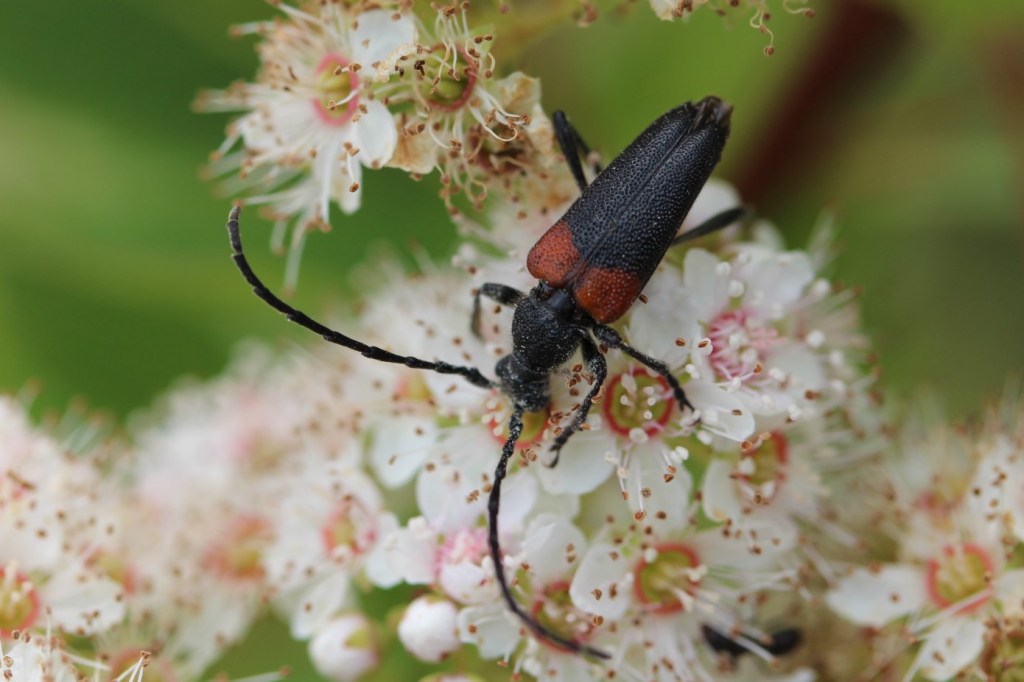
By contrast, the other flower-visiting beetle that I observed was part of the Family Cerambycidae (the longhorn beetles), which is a group that includes important and frequent pollinators (Willmer 2011). The Red-shouldered Pine Borer (Stictoleptura canadensis) is part of the aptly named subfamily Lepturinae (the flower longhorns) within Cerambycidae.
Red-shouldered Pine Borer, a Flower Longhorn Beetle.
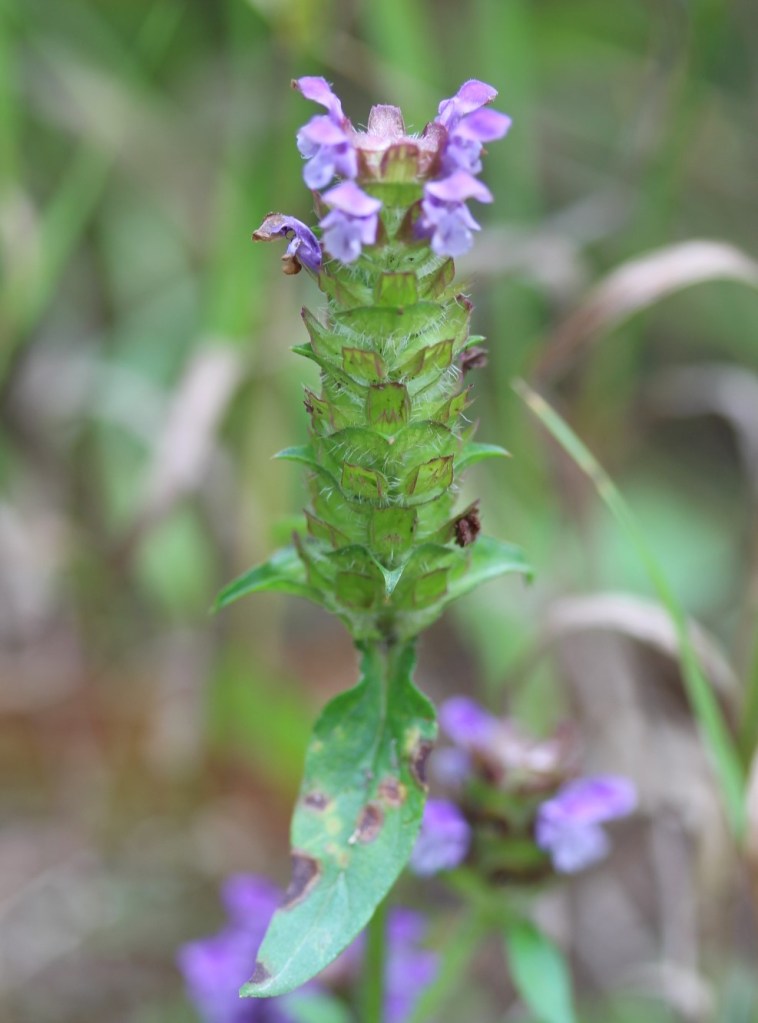
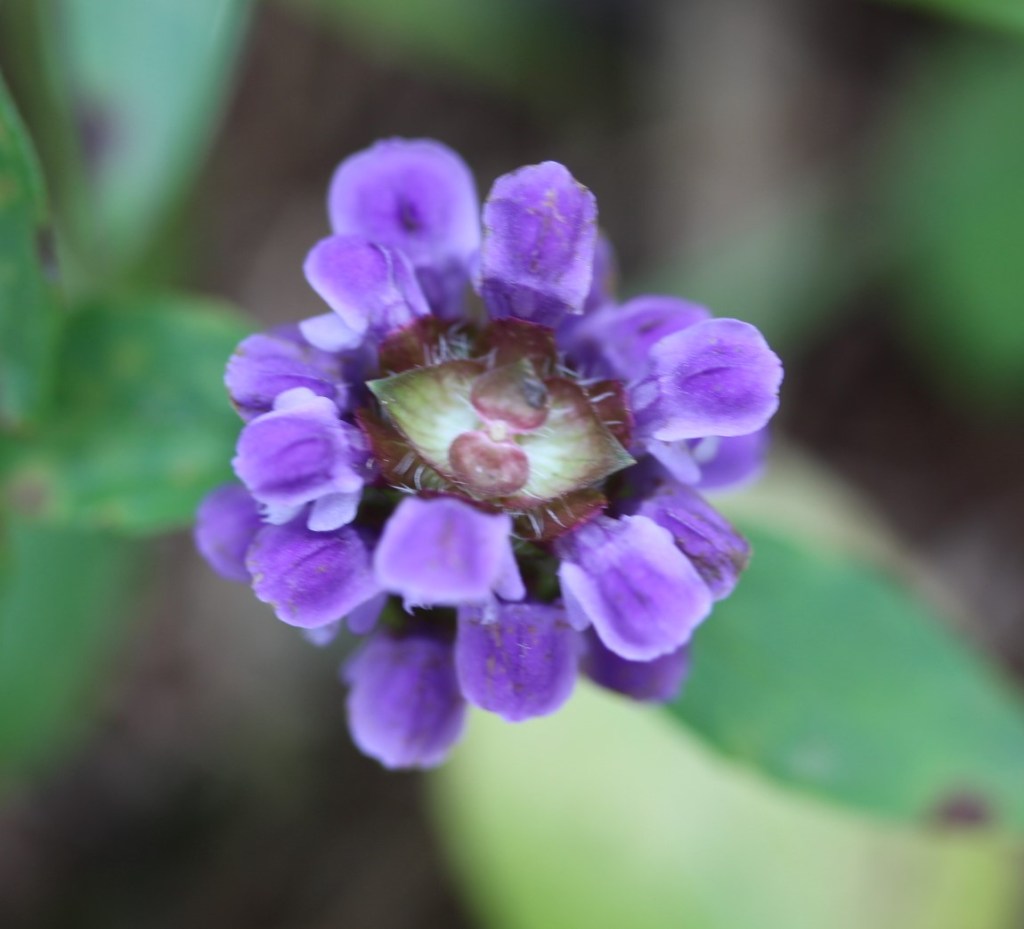
One wildflower that caught my attention as I was continuing down the trail was a small purple flower with strangely square-shaped petals. The flower was a Common Selfheal (Prunella vulgaris). As you can guess from the common name, this flower was used in the past to cure many different illnesses, particularly of the mouth and throat because of the flower’s resemblance to a yawning mouth (Wernert 1982)… because that’s how things were supposed to work…
Common Selfheal, a very interesting-looking wildflower.
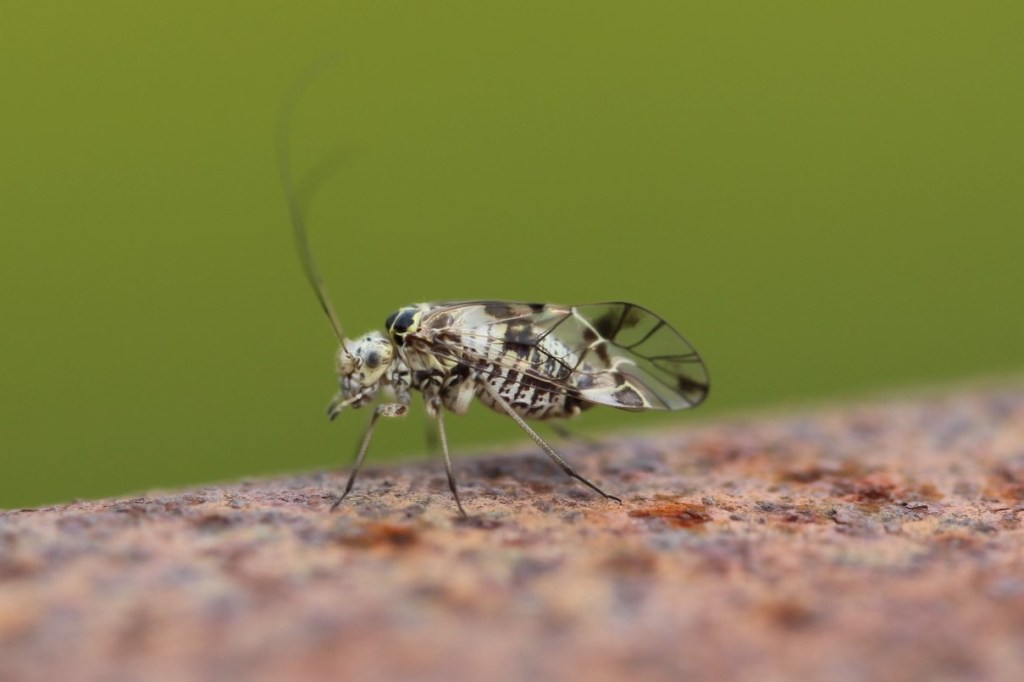
Leaving behind the multitude of flowers and insects of the wildflower meadow area, I was arrested by the sight of a peculiar tiny insect: a Barklouse (Order Psocoptera). As Marshall writes in his excellent overview of Insects “One doesn’t hear much about barklice.” (Marshall 2006). Indeed, though this individual is beautifully patterned and distinctive (I believe it’s Metylophorus novaescotiae) I can find little information about this creature. If my identification is correct, I can say that this species lives on shrub and tree branches (Mockford 1993), and presumably feeds on lichen there. Most members of the Order Psocoptera produce silk out of their mouths (specifically, labial glands), and some use this to cover their eggs, while others use the silk to construct shelters for themselves or others (!). There’s a tropical group called the Archipsocidae which can create silken shelters that “enshroud entire trees”, and in which there is some form of sociality (Costa 2006). I would love to learn more about these amazing insects.
Barklouse (possibly Metylophorus novaescotiae).
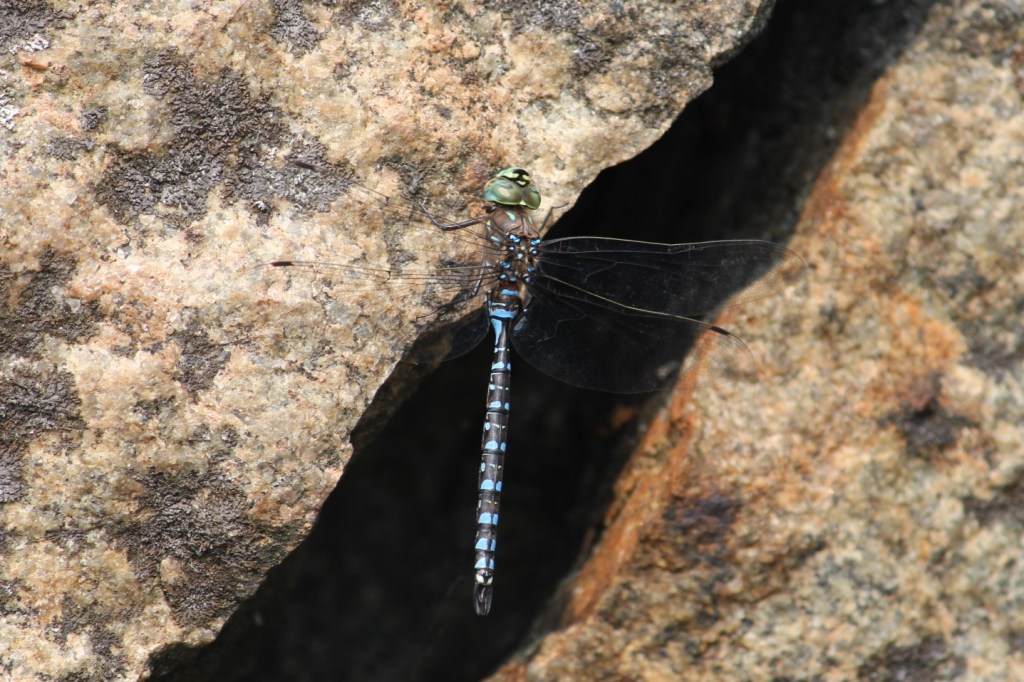
The final observation of my hike forced me to switch back to my telephoto lens. I actually thought for a second I was seeing a bird zooming back and forth above the path because of the size of the animal, but it was in fact an insect, and more specifically a Variable Darner Dragonfly (Aeshna interrupta). These Dragonflies are among the more acid-tolerant of Ontario Odonates so it makes sense that this individual could have developed as a larva within the acidic waters of the Spruce Bog (Pollard and Berrill, 1992). This amazing dragonfly (possibly about 15 cm long) was my last observation on the Spruce Bog trail and an excellent contrast to the diminutive (less than a cm long) barklouse, demonstrating once again the incredible diversity of the Insects.
Variable Darner Dragonfly at rest, after foraging across the trail.
References:
Costa, James. 2006. The Other Insect Societies.
Evans, Howard and O’Neill, Kevin. 2007. The Sand Wasps: Natural History and Behavior.
Marshall, Stephen. 2012. Flies: The Natural History and Diversity of Diptera.
Marshall, Stephen. 2006. Insects: Their Natural History and Diversity.
O’Neill, Kevin. 2001. Solitary Wasps: Behavior and Natural History.
Pollard, J. B., and Berrill, M. 1992. The distribution of dragonfly nymphs across a pH gradient in south-central Ontario lakes. Canadian Journal of Zoologyhttps://doi.org/10.1139/z92-125
Wernert, Susan. 1982. Reader’s Digest North American Wildlife.
Willmer, Pat. 2011. Pollination and Floral Ecology.
And with that, I have finally completed my five-part journey through my 2021 Algonquin Observations series. What’s next for the Norfolk Naturalist? More nature observations, this time in Norfolk County itself (a fungi-spotting hike in Backus Woods with the Norfolk Field Naturalists), and a Podcast Review. Also, I attended Tetzoomcon 2021 this past weekend and it was awesome! A detailed post about the event will follow hopefully soon…
And if you’re interested in seeing more of my photos and learning some facts about the organisms I’ve observed, follow me on Instagram at norfolknaturalist.
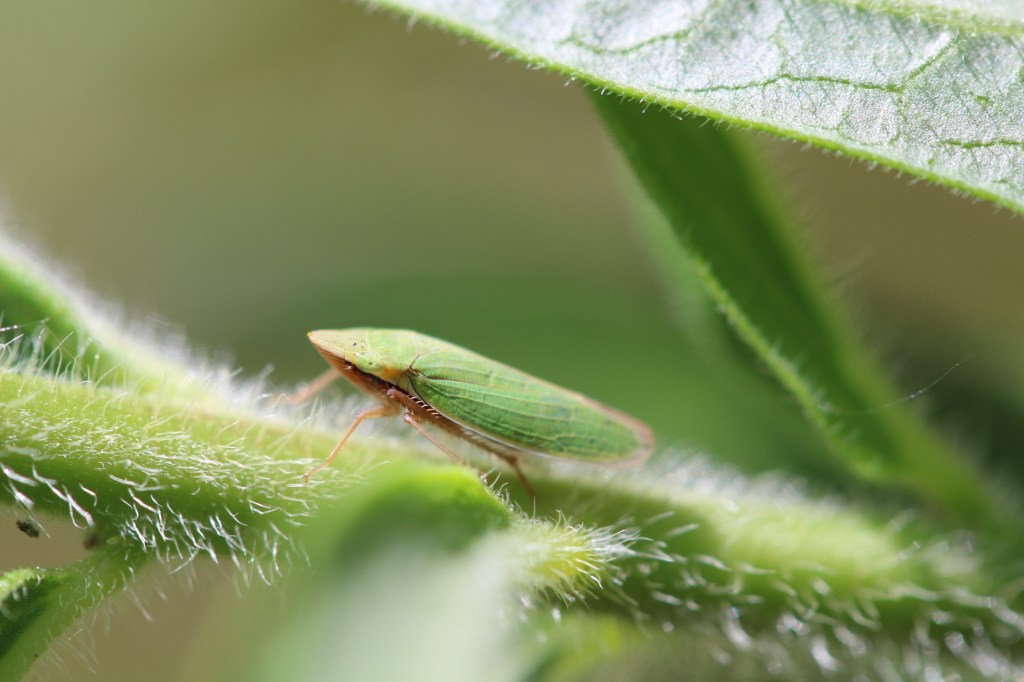
Common visitors to my backyard (and probably any backyard with any sort of plant life) are leafhoppers (Cercopidae) and I’ve become familiar over the years with a few of my regular visiting genera. This past month I managed to get a really clear picture of Draeculacephala, with its distinctively pointed head.
Draeculacephala Leafhopper.
And this Latalus leafhopper kept flicking its wings around, similar to the Sepsid Flies I’ve seen flashing wings in the sun. Not sure if it was display behaviour of some kind or if it was trying to rid itself of some nuisance. The wing-flicking was very rapid, I’ve never seen a Leafhopper doing this before.
Latalus Leafhopper.
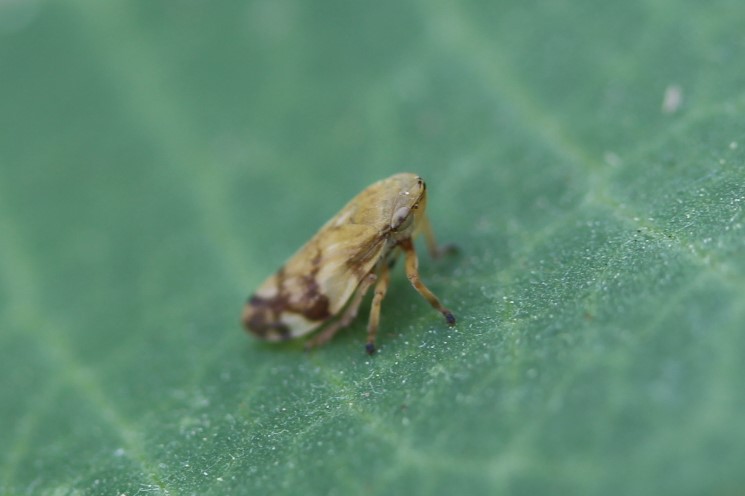
Similar to the Leafhoppers are the aptly named Froghoppers (Cercopoidea). I’m pretty sure this is one of them or at least a related family, based on its very toad-like appearance.
Froghopper/Spittlebug of some sort.
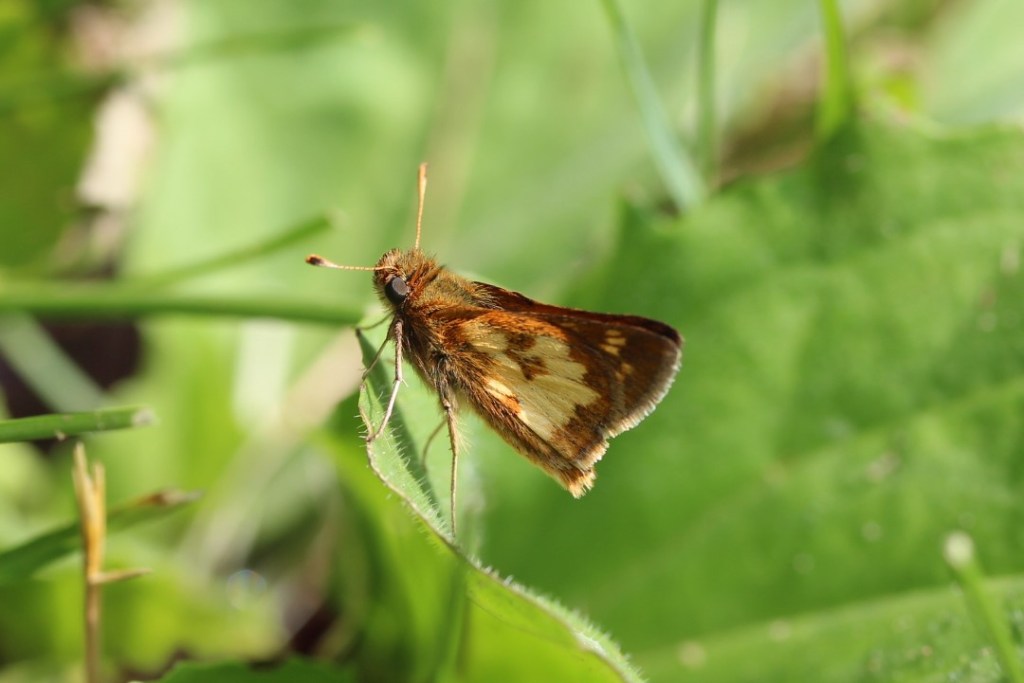
Other common Insect visitors to my backyard are Lepidoptera (Butterflies and Moths). Skipper Butterflies (Family Hesperiidae) are some of the most common Butterflies around in my experience. They’re skittish and difficult to get close to because they’re seemingly always on the move, but I’ve had some good luck with a few in the past. Last month I was able to catch this Peck’s Skipper (Polites peckius) in a moment of rest with my Macro lens.
Peck’s Skipper momentarily at rest in my backyard.
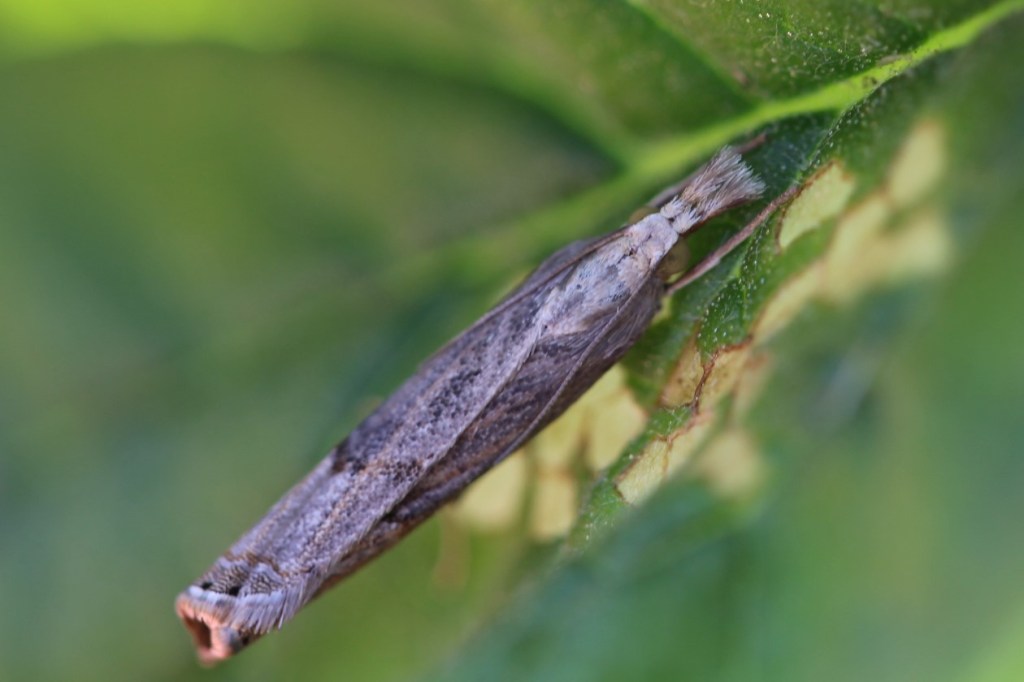
A much stranger Lepidopteran visitor was this bizarre Moth. Its wings look like a rolled up carpet, and its antennae look like tassels of said carpet. I’ve seen this same individual or at least a similar one in several different places around my yard, but always in this head down, wings up position. These Moths are classified as Crambidae (a Family) or Crambinae (a Subfamily) depending on the scheme being followed. There are thousands of species of Snout Moths (which is what these Moths are called), and I’m not sure where to begin on identifying my backyard variety.
Snout Moth in my backyard.
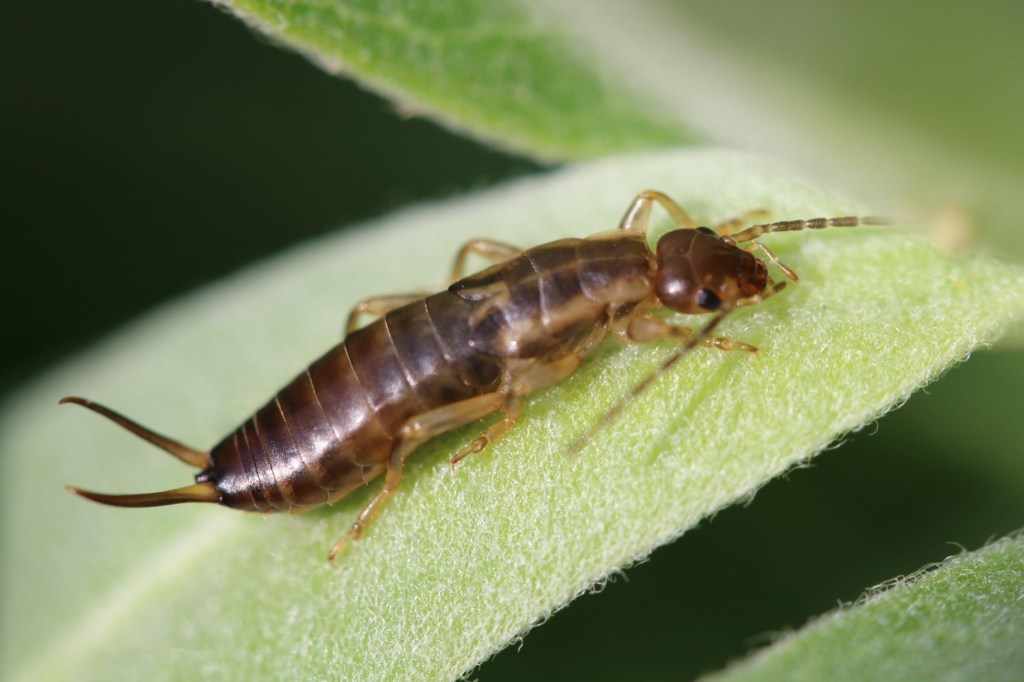
We have a patch of Milkweed growing in our backyard, and I check it on a regular basis for signs of Monarch Butterfly activity. (there should be adults flying up North here during June and beginning to lay eggs). I still haven’t spotted any eggs or caterpillars on the Milkweed plants (when I wrote these observations in June, wait for the July Observations…), but several other creatures have been evident among them. One morning, at the top of each Milkweed plant there were young earwigs. I guess they were just resting there?
Earwig (I believe the European Earwig (Forficula auricularia)) exposed in its place among the top leaves of Milkweed.
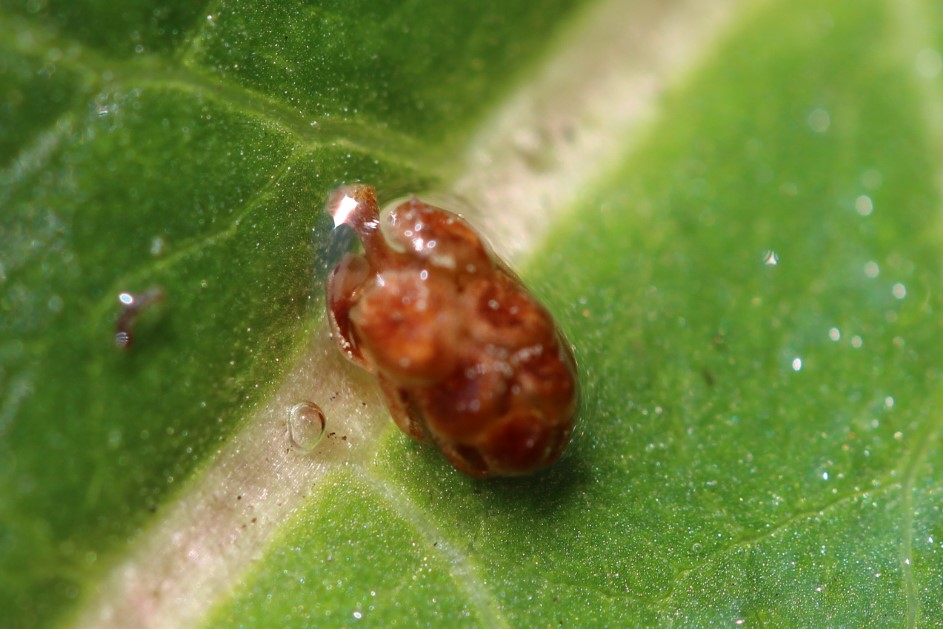
One creature that I have nowhere to begin with is this strange object… I feel like I’ve seen it before and found an ID for it, but I can’t recall what the ID was. I believe it’s some sort of insect (maybe a pupa?), but I don’t know:
Mysterious seed-like object on a Milkweed leaf.
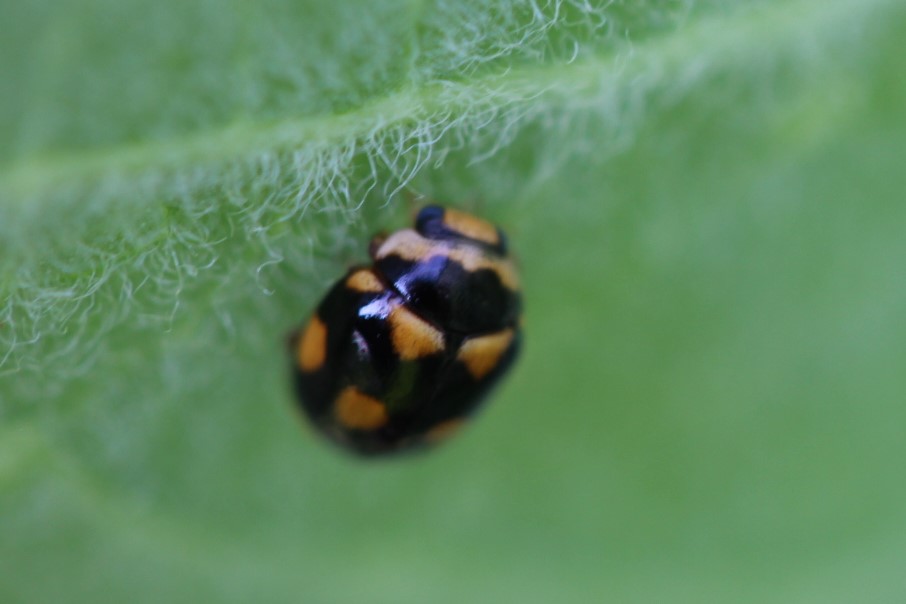
Wandering about on the Milkweed leaves were what I like to call “Reverse Lady Beetles” because the typical Ladybug in my head is one that’s orange/red with black spots, where these Beetles were the opposite. I didn’t get great pictures of them yet (they’re smaller than the more common introduced Asian Lady Beetles (Harmonia axyridis)), but you can see what I mean.
“Reverse” Lady Beetle under the leaf of a Milkweed.
I’m pretty sure these Lady Beetles are in the Genus Brachyacantha. At least one of the species in the Genus feeds on Hemiptera (mealybugs/aphids) in ant nests during its larval stage (presumably species that the ants are protecting for their honeydew secretions!) (Marshall, 2018).
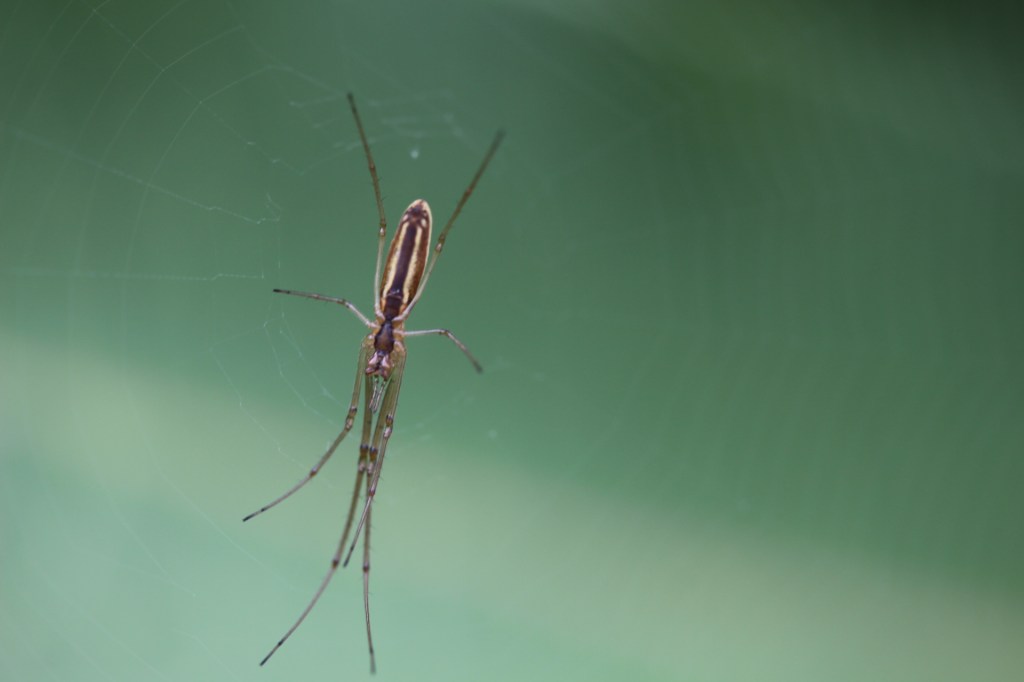
A long-jawed Orbweaver (Tetragnatha) took up residence among the Milkweed as well, with a web that spanned between the leaves.
Long-Jawed Orbweaver Spider on its web.
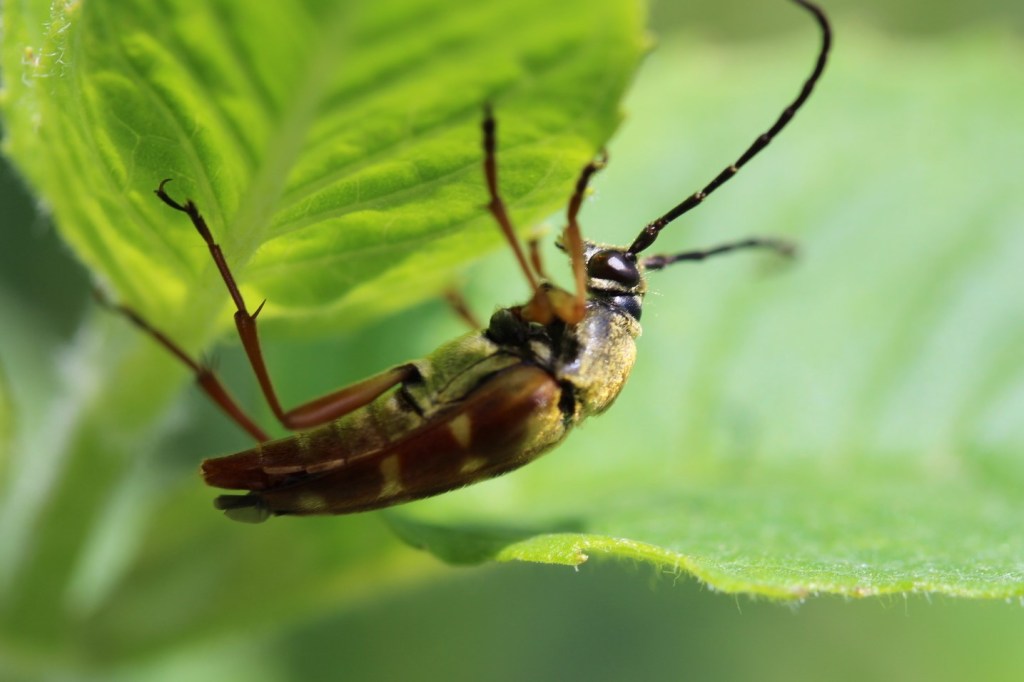
One final visitor of note was this Banded Longhorn Beetle (Typocerus velutinis). These Beetles develop as larvae inside decaying trees or logs, emerging as the beautiful Beetle seen here hanging beneath a leaf.
Banded Longhorn Beetle hanging beneath a leaf.
References:
Marshall, Stephen 2018. Beetles: The Natural History and Diversity of Coleoptera.


























 Norfolk Naturalist