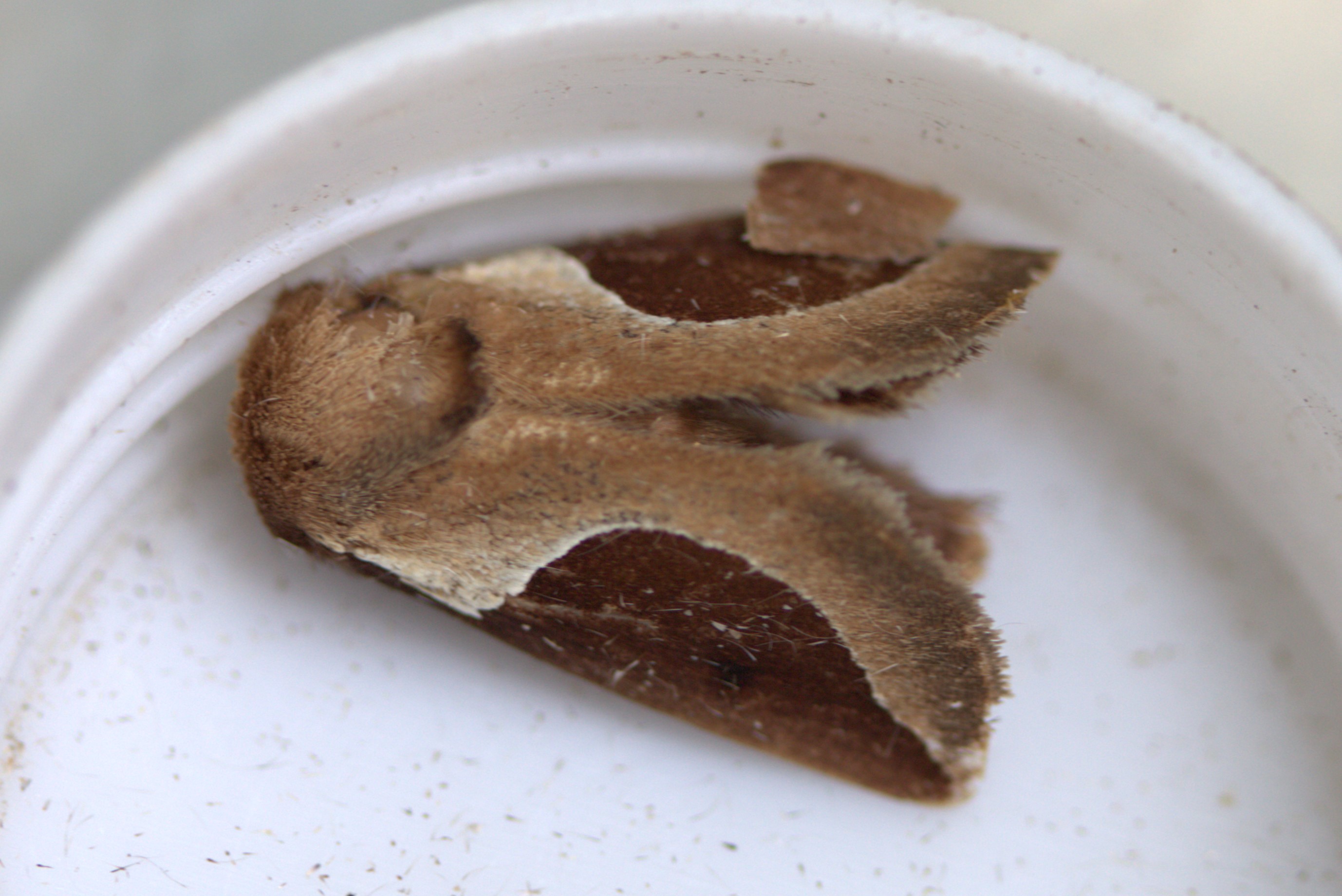
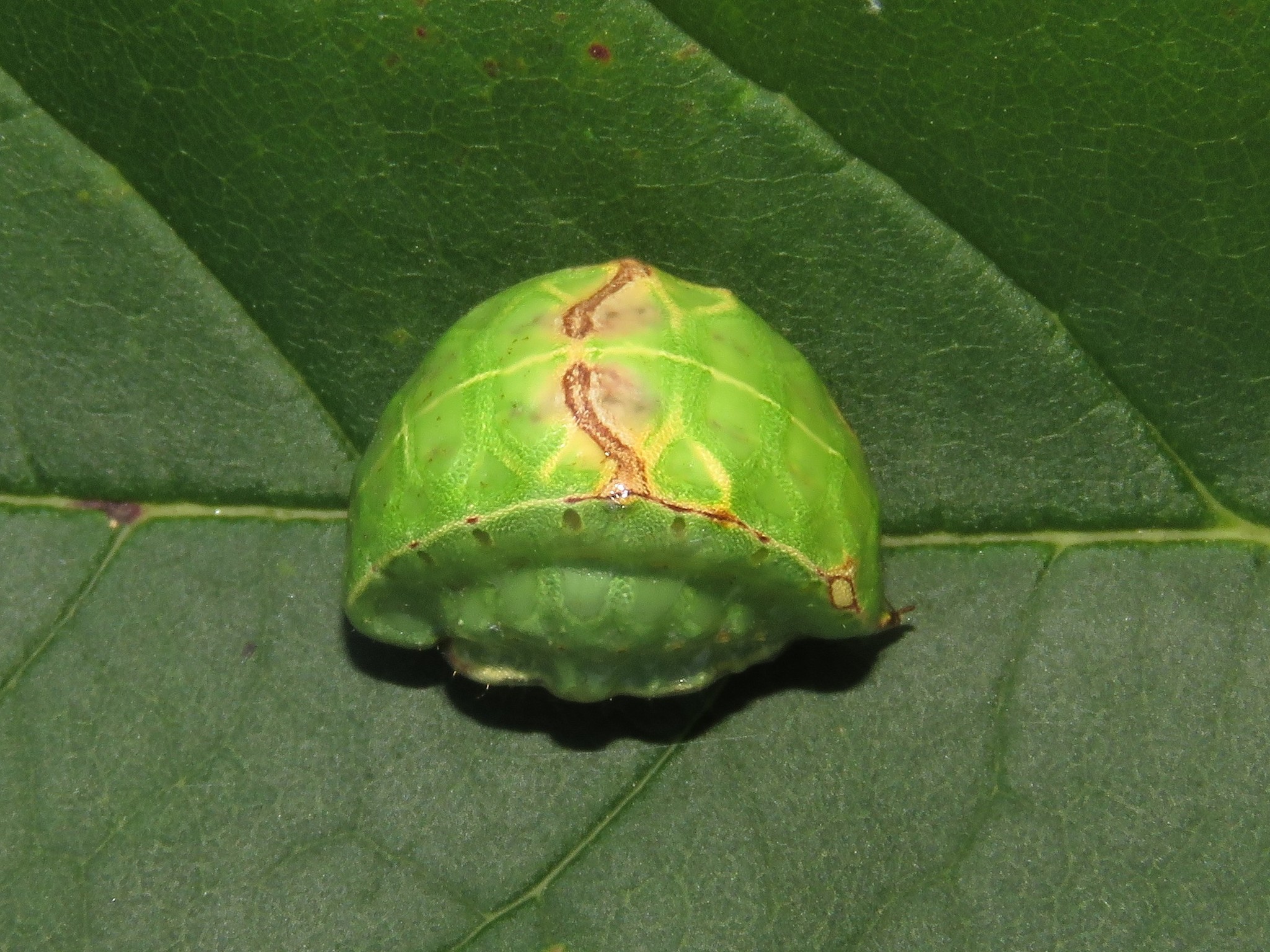
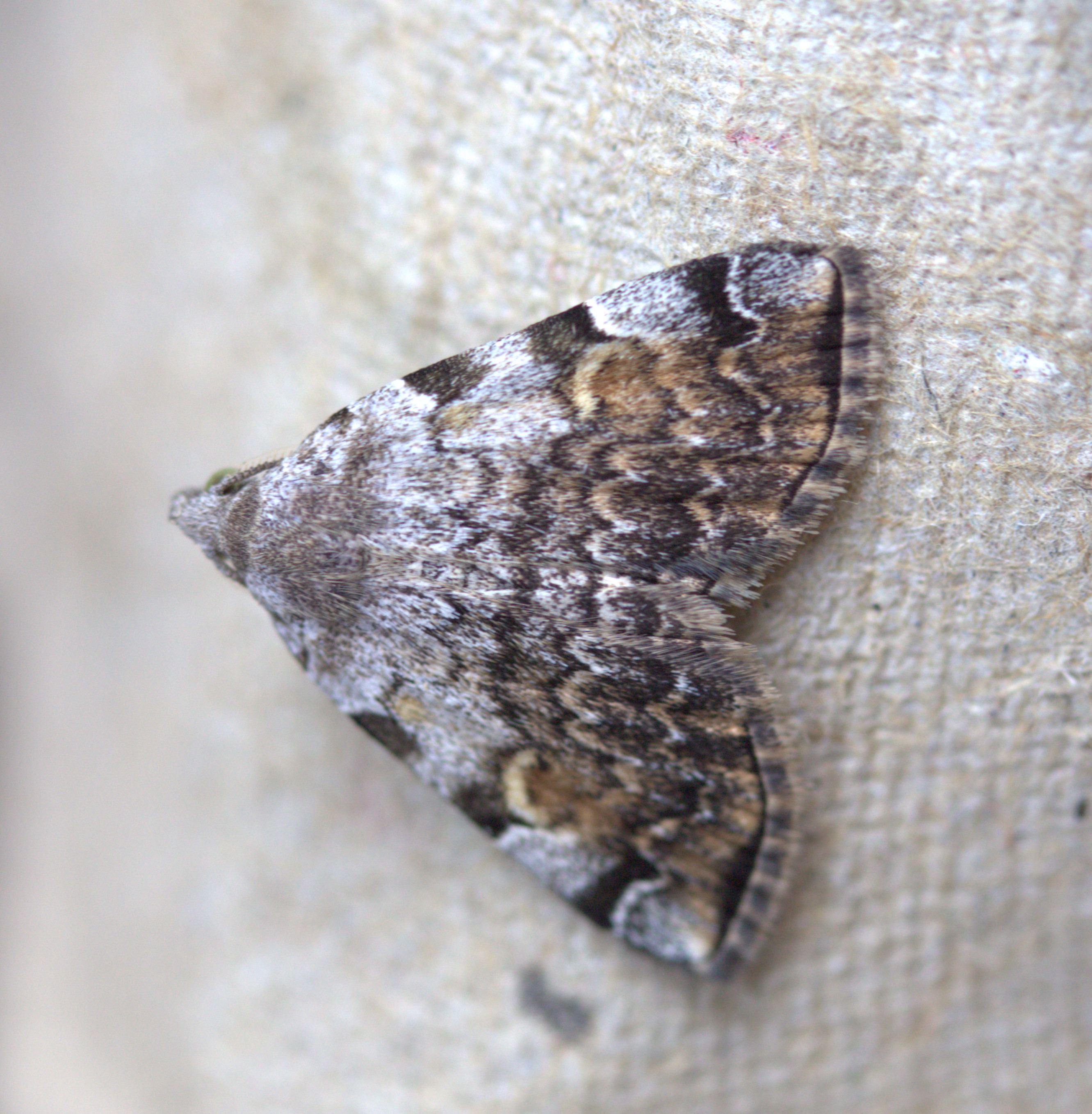
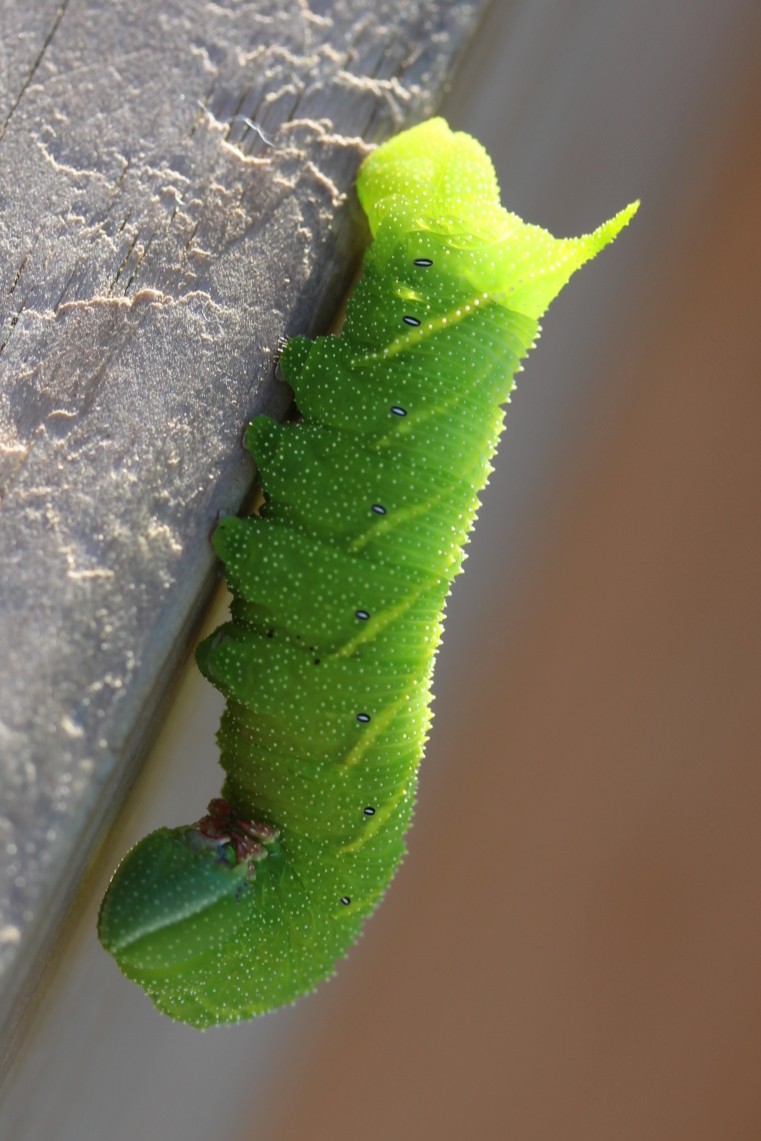
The Limacodidae are known as “Slug Moths” in reference to their bizarre caterpillars (see below). Although there are almost 2000 named species, many of them are tropical and I only observed one at the mothing event, the Skiff Moth. These moths feed on various trees and woody plants as larvae including “birch, blueberry, oak, poplar, and willow” (Beadle and Leckie 2012). Some slug moths (especially the tropical members of this group) have bristly spines that can give a nasty sting, but the Skiff moth larva doesn’t seem to have any of these venomous defenses, perhaps relying entirely on its strange non-caterpillar appearance for evading predation or disturbance.
Skiff Moth (Prolimacodes badia)Skiff Moth Caterpillar (Prolimacodes badia), photographed in Port Dover, Ontario by Dan McNeal (used with permission).
References:
Beadle, David and Leckie, Seabrooke 2012. Peterson Field Guide to Moths of Northeastern North America. Houghton Mifflin Harcourt.
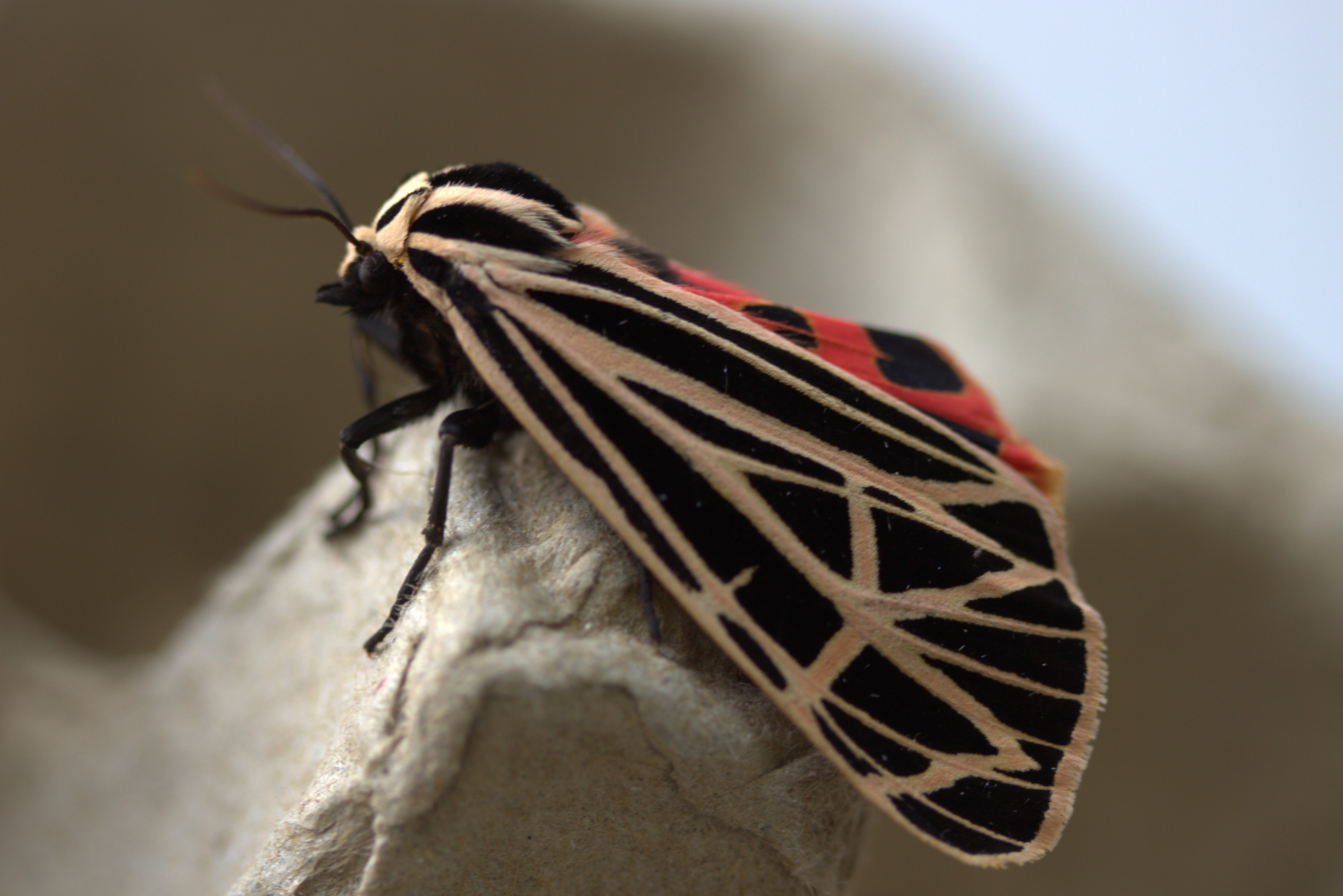
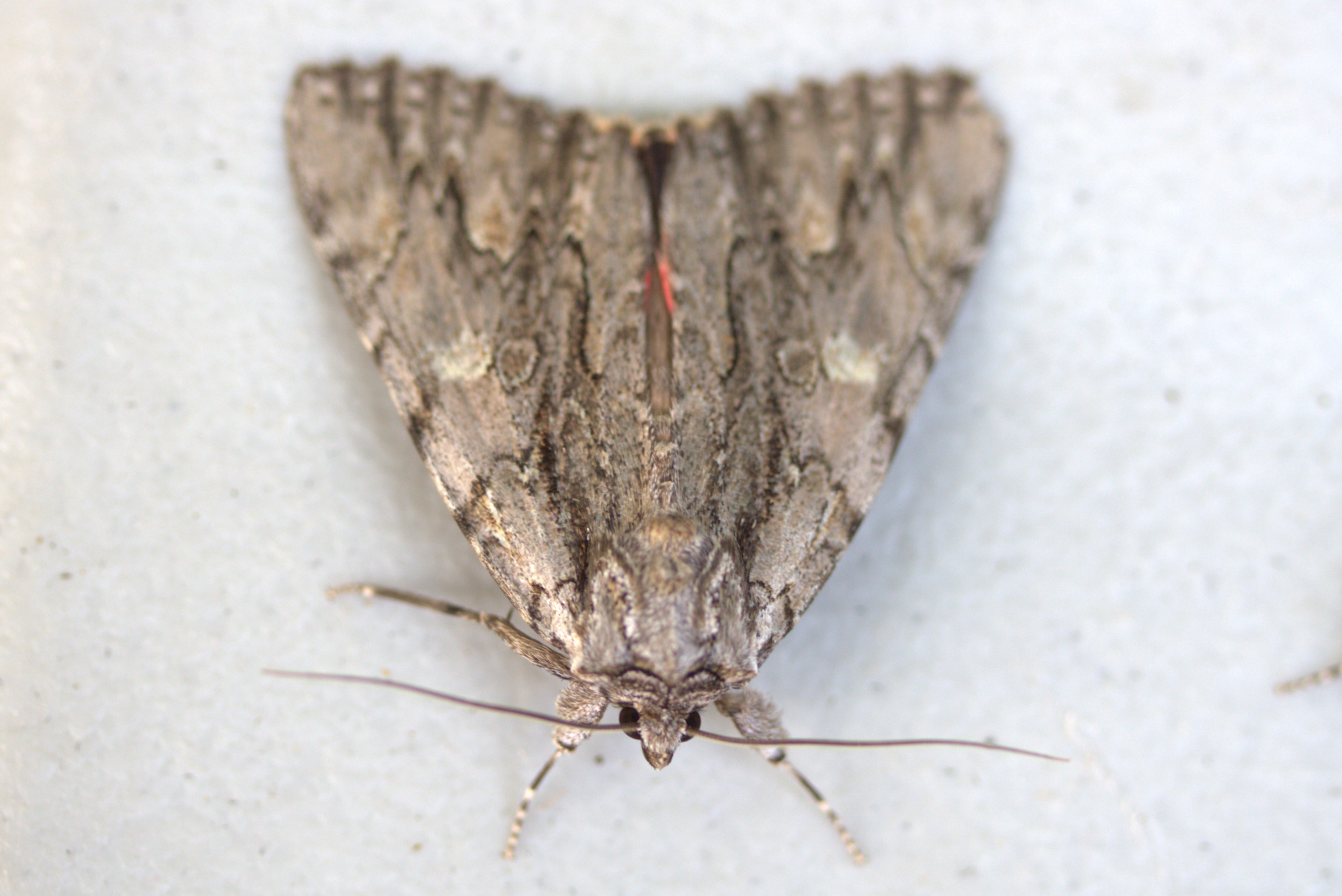
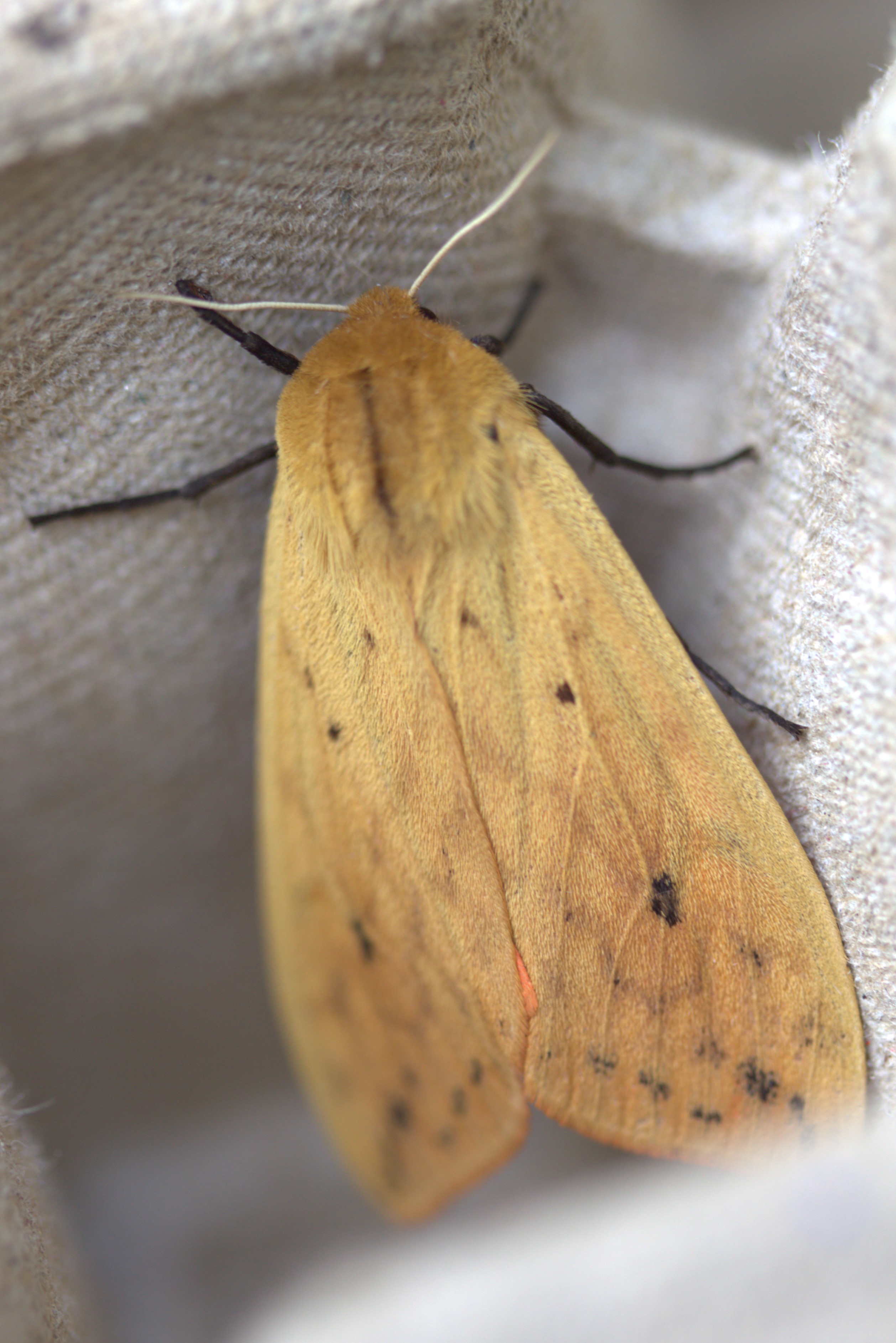
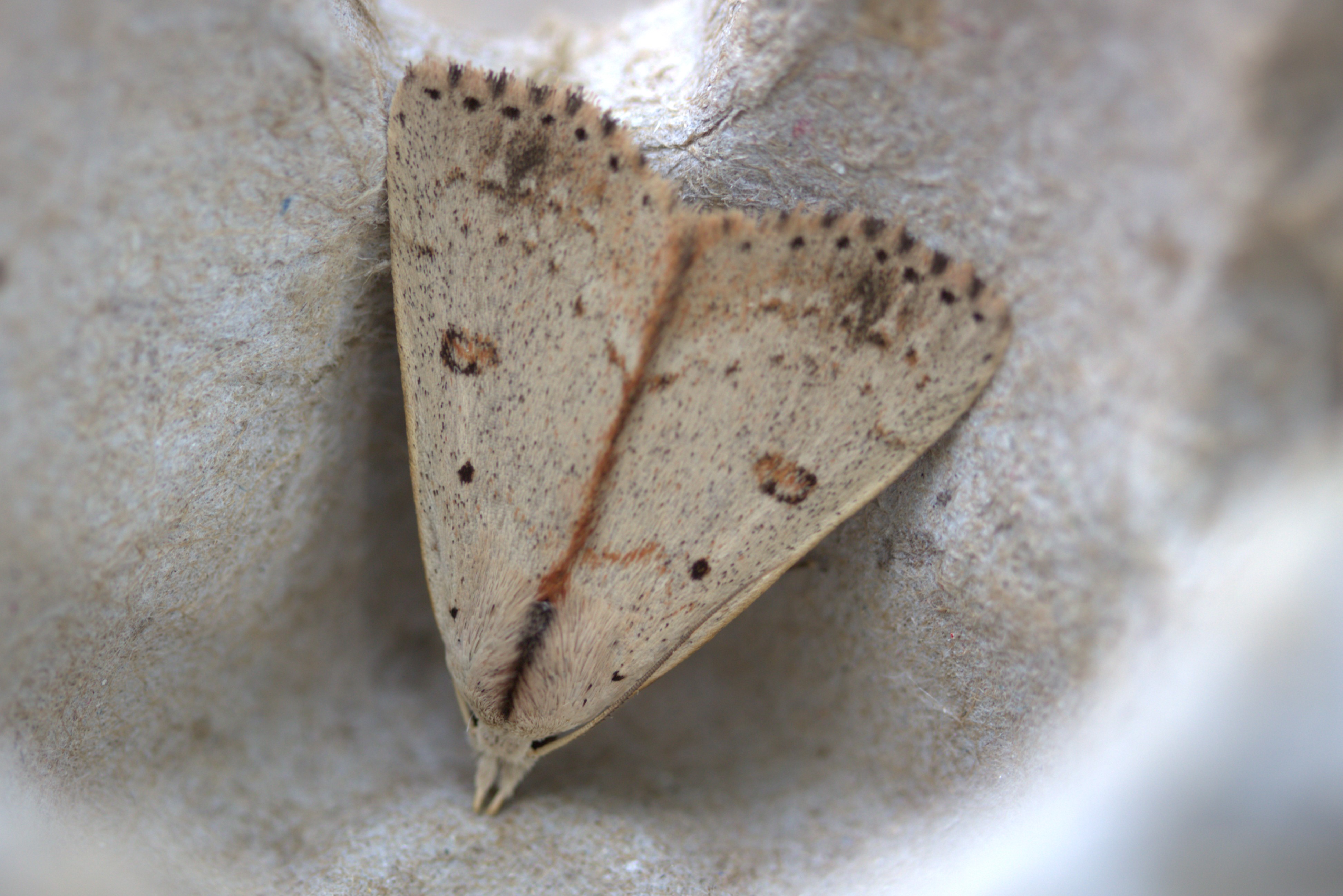
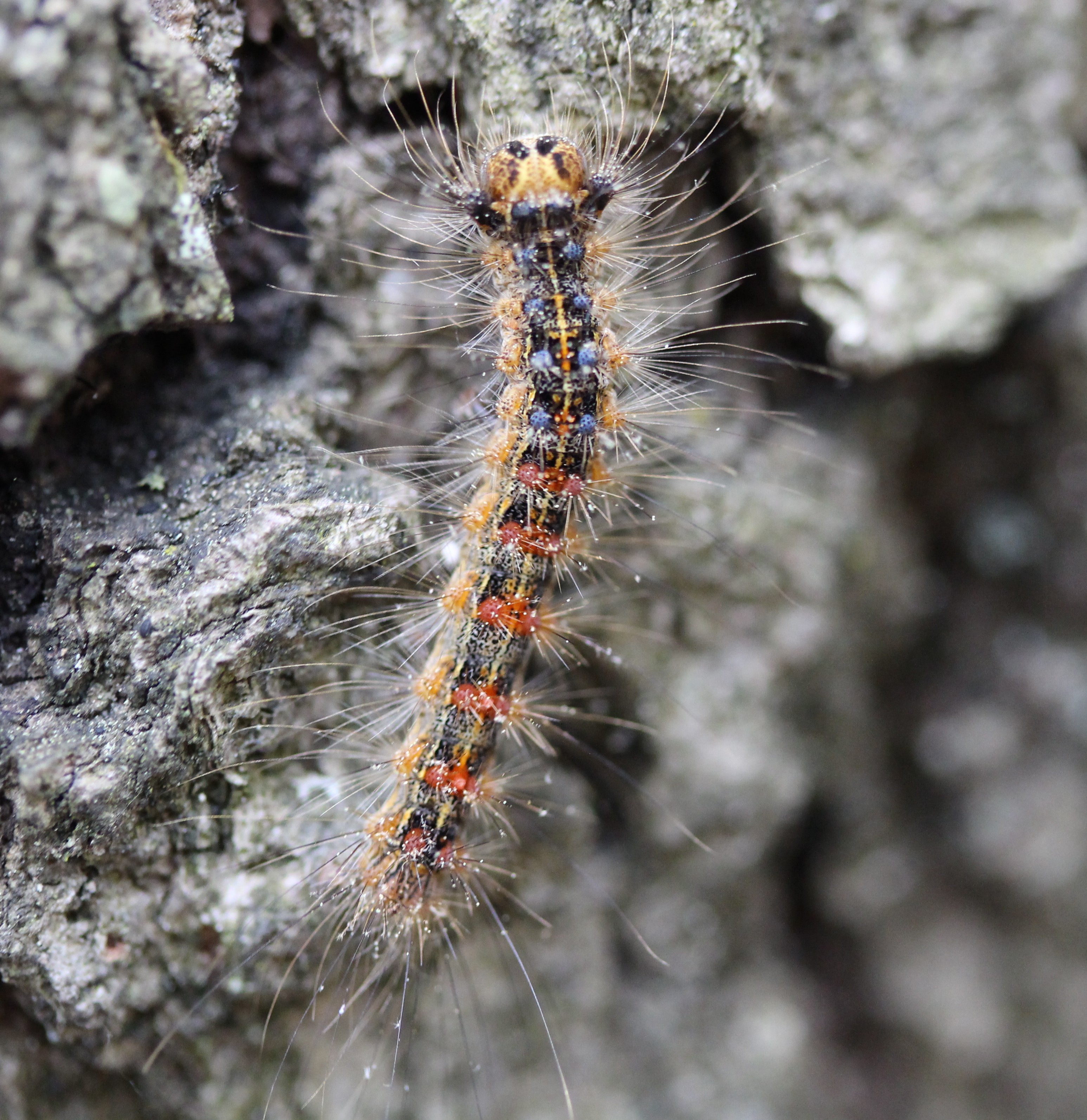
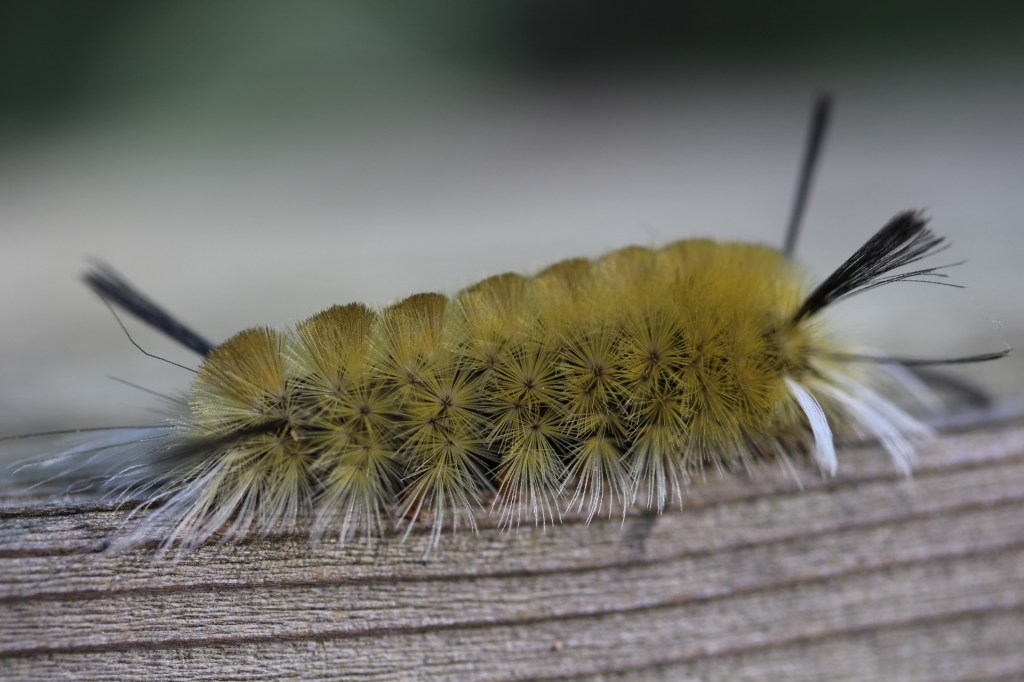
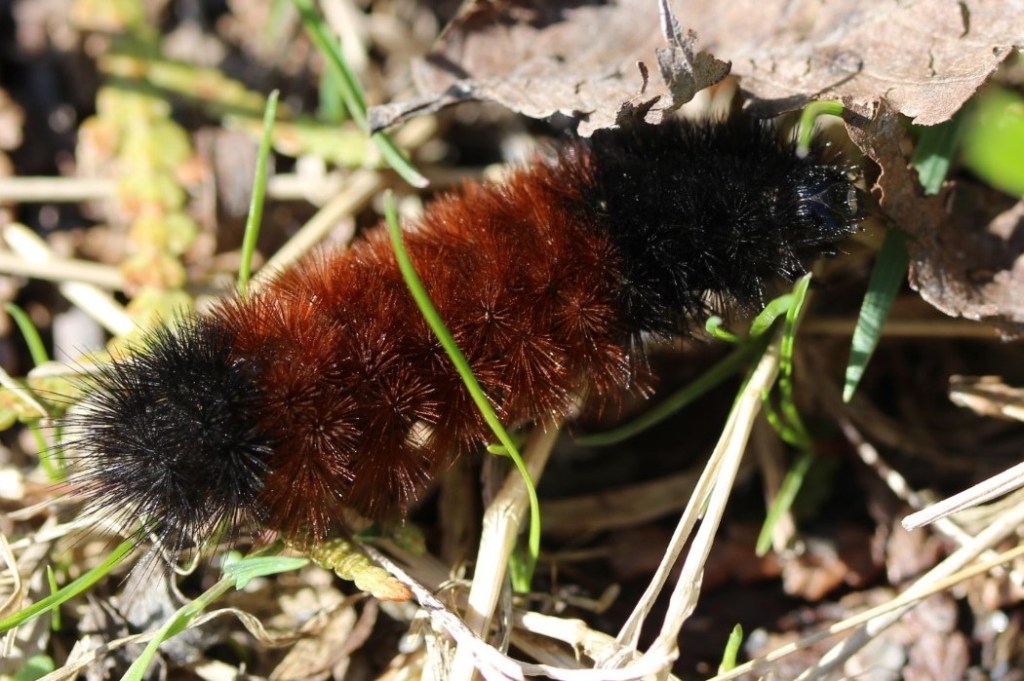
Moths in the Family Erebidae are widespread and diverse (in fact, they are the most speciose family of moths, with over 24,000 described species). They are some of the most colourful and fantastic night fliers, some of the most familiar and exotic moths. Perhaps the most commonly encountered Erebid moth in North America is the Spongy Moth (Lymantria dispar), because of its incredibly invasive caterpillars that have spread across the continent. Spongy Moths are part of the Tussock Moth group, known for their spiky caterpillars covered with long ‘tussocks’. One such moth is featured below, the Banded Tussock Moth. Another incredibly common Erebid caterpillar is the trundling Woolly Bear caterpillar, the adult moth is featured below (known in its winged form as the Isabella Tiger Moth). Another group of Erebids are known as Lichen Moths because their caterpillars feed on lichen. Another lichen-feeding species is featured below: the American Idia, a drab grey moth in contrast to the colourful pastels of its lichen-feeding cousin the Painted Lichen Moth. The Virgin Tiger Moth and the Giant Leopard Moth are two of the larger and more striking of the Erebid moths that I photographed. Other moths in this group are striking for their evocative names such as “The Herald Moth” or “Deadwood-borer Moth”. Another subsection of this family are known as “Underwings” because they have often brilliantly coloured wings concealed beneath their often drab forewings, the better to startle predators with when discovered.
Spongy Moth Caterpillar (Lymantria dispar), Turkey Point Provincial Park, June 2018Banded Tussock Moth Caterpillar (Halydisota tessellaris), Lynn Valley Trail, September 2020Woolly Bear Caterpillar (Pyrrharctia isabella), Lynn Valley Trail, August 2019. Another name would be the Isabella Tiger Moth Caterpillar.
References:
Beadle, David and Leckie, Seabrooke 2012. Peterson Field Guide to Moths of Northeastern North America. Houghton Mifflin Harcourt.
In the bygone days of July 2023, I attended an event with the Long Point Basin Land Trust which was all about exploring the diversity of moths. I was unable to attend the night-time event where moths were attracted to sheets and photographed and observed in their element, but I was very excited to be able to observe and photograph many species of moths that were caught in traps and released the next morning. In a series of posts I plan to explore the diversity of the moths of Southern Ontario via the subset of moths that I was fortunate enough to observe and photograph. I’m going to go Family by Family in no particular taxonomic order, but rather when each Family’s post is completed. So here goes for the first one!
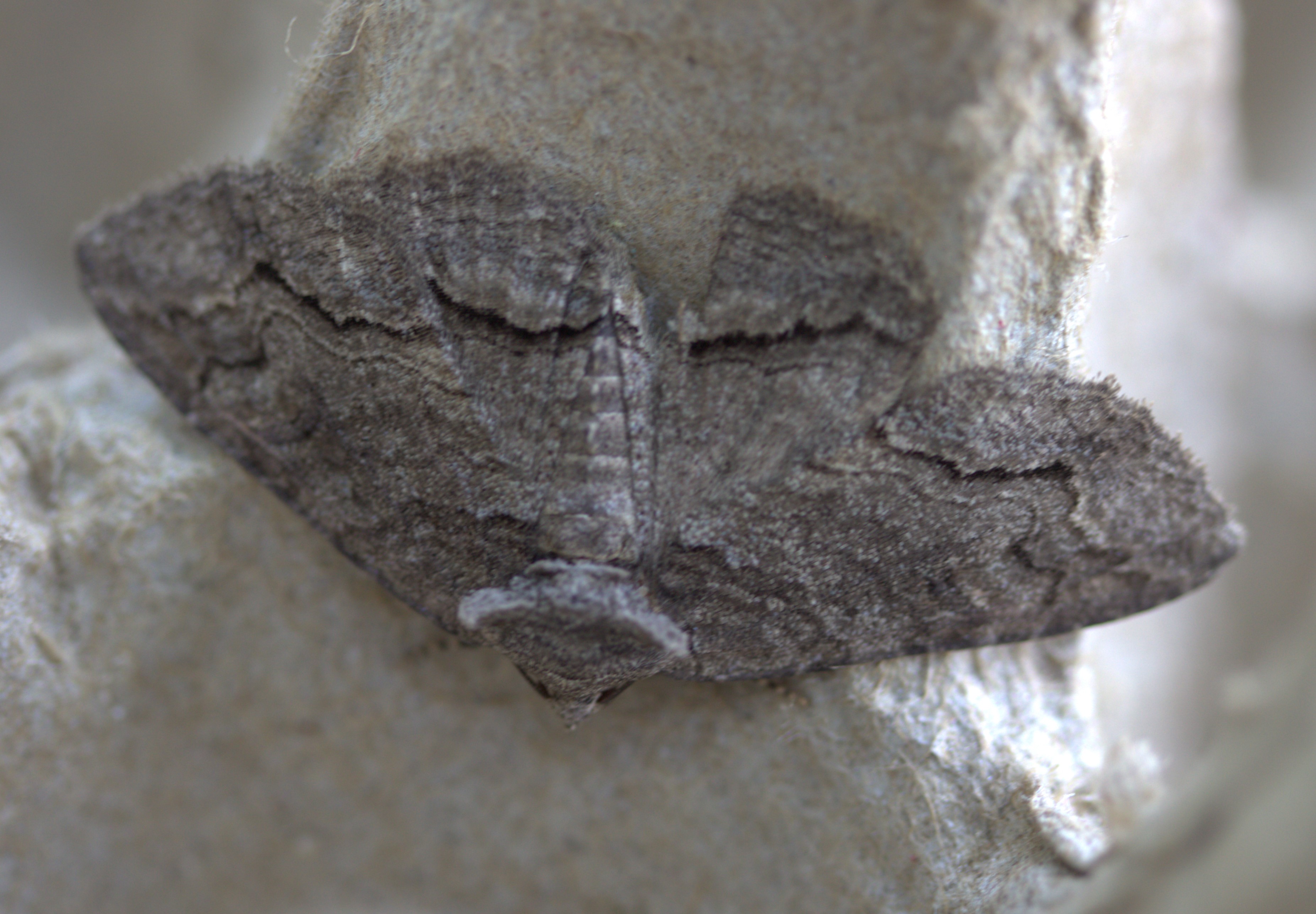
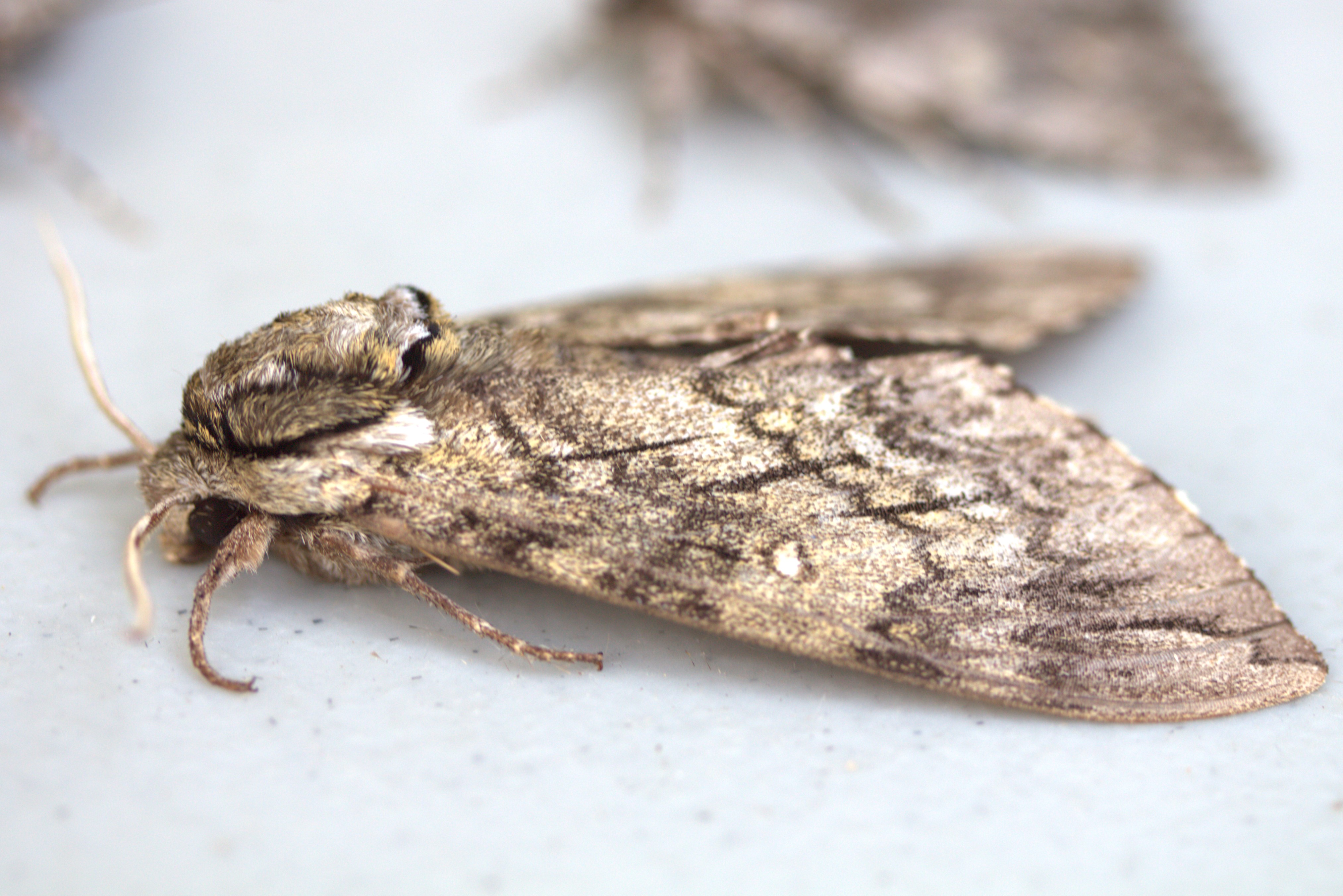
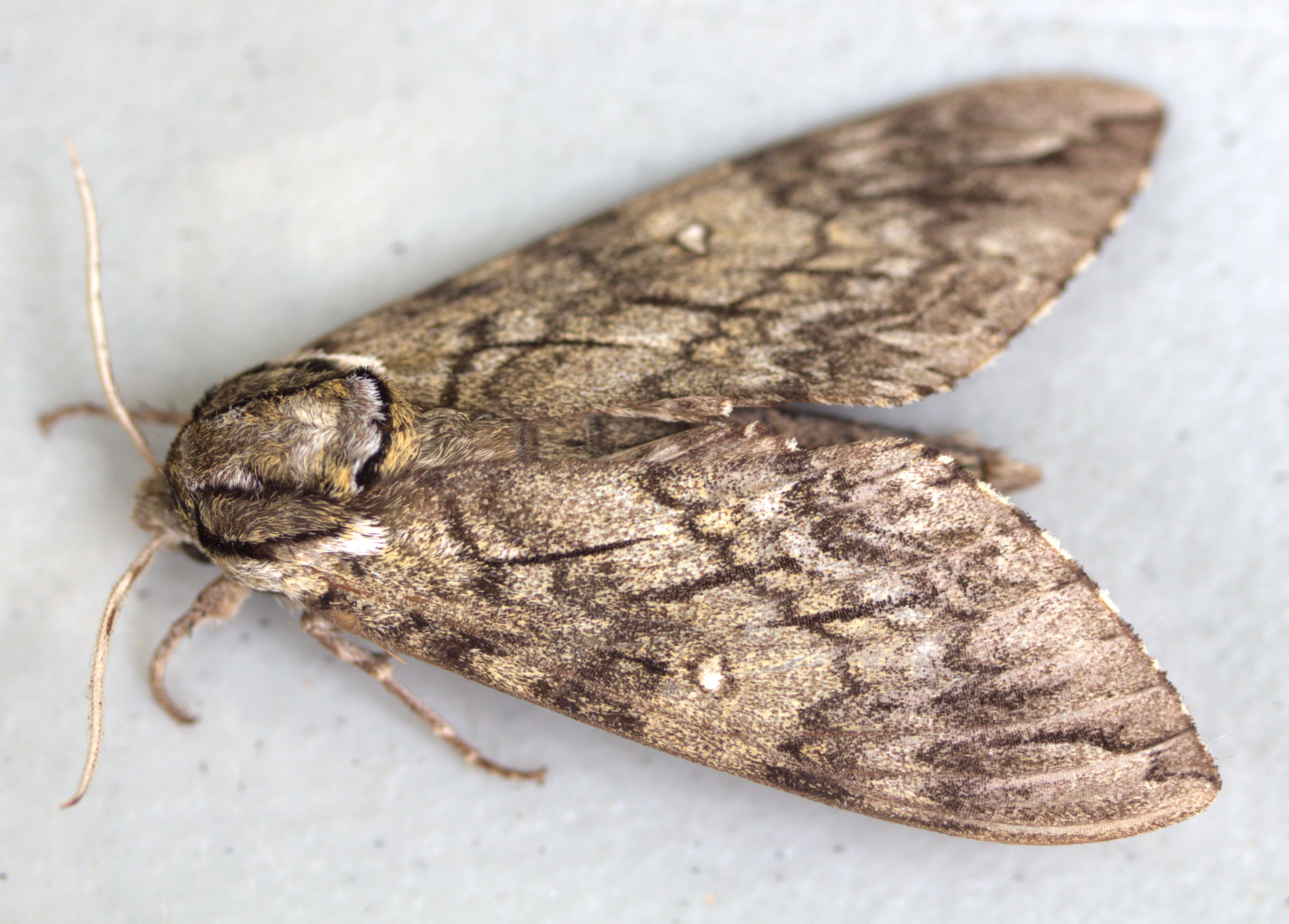
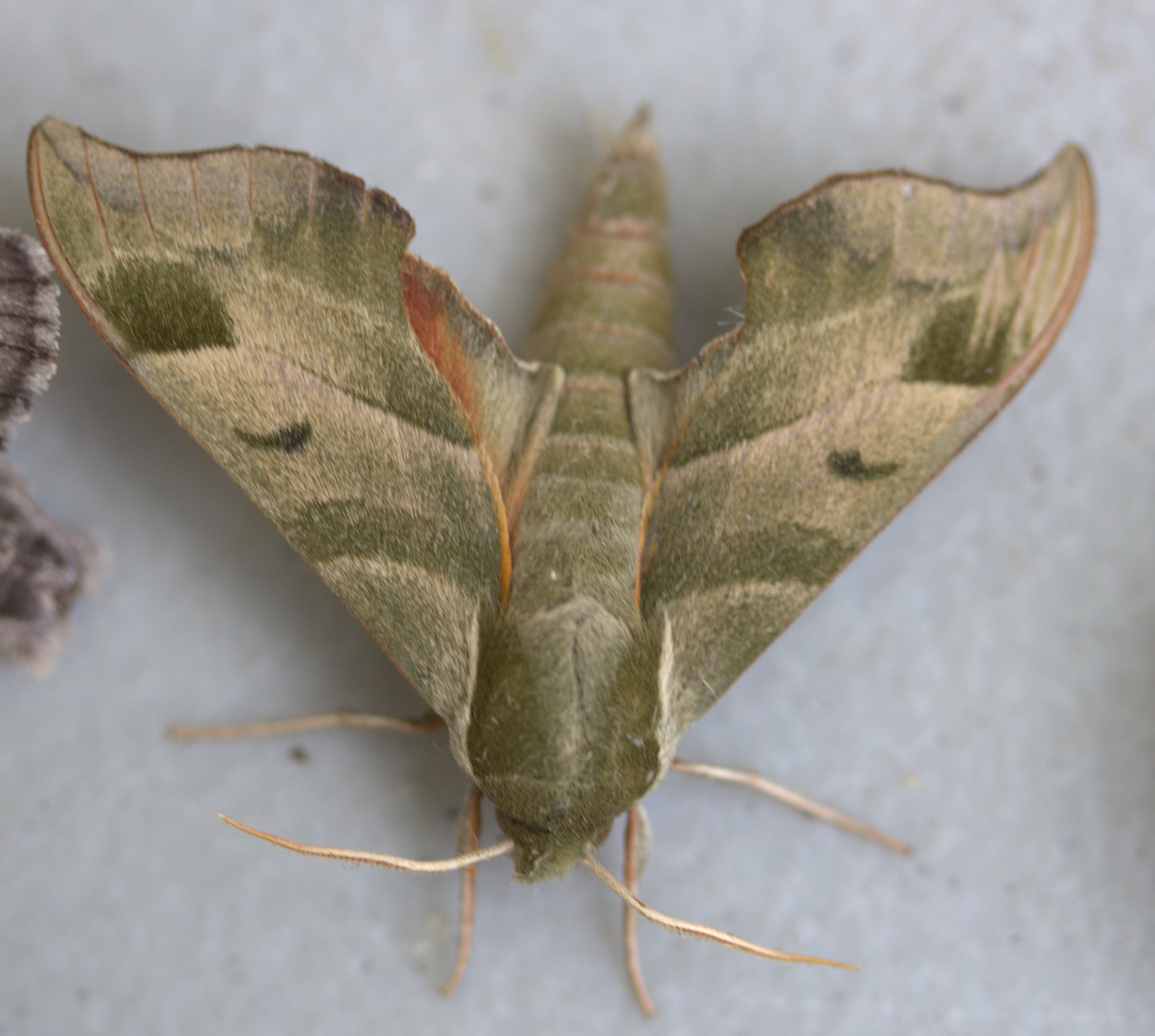
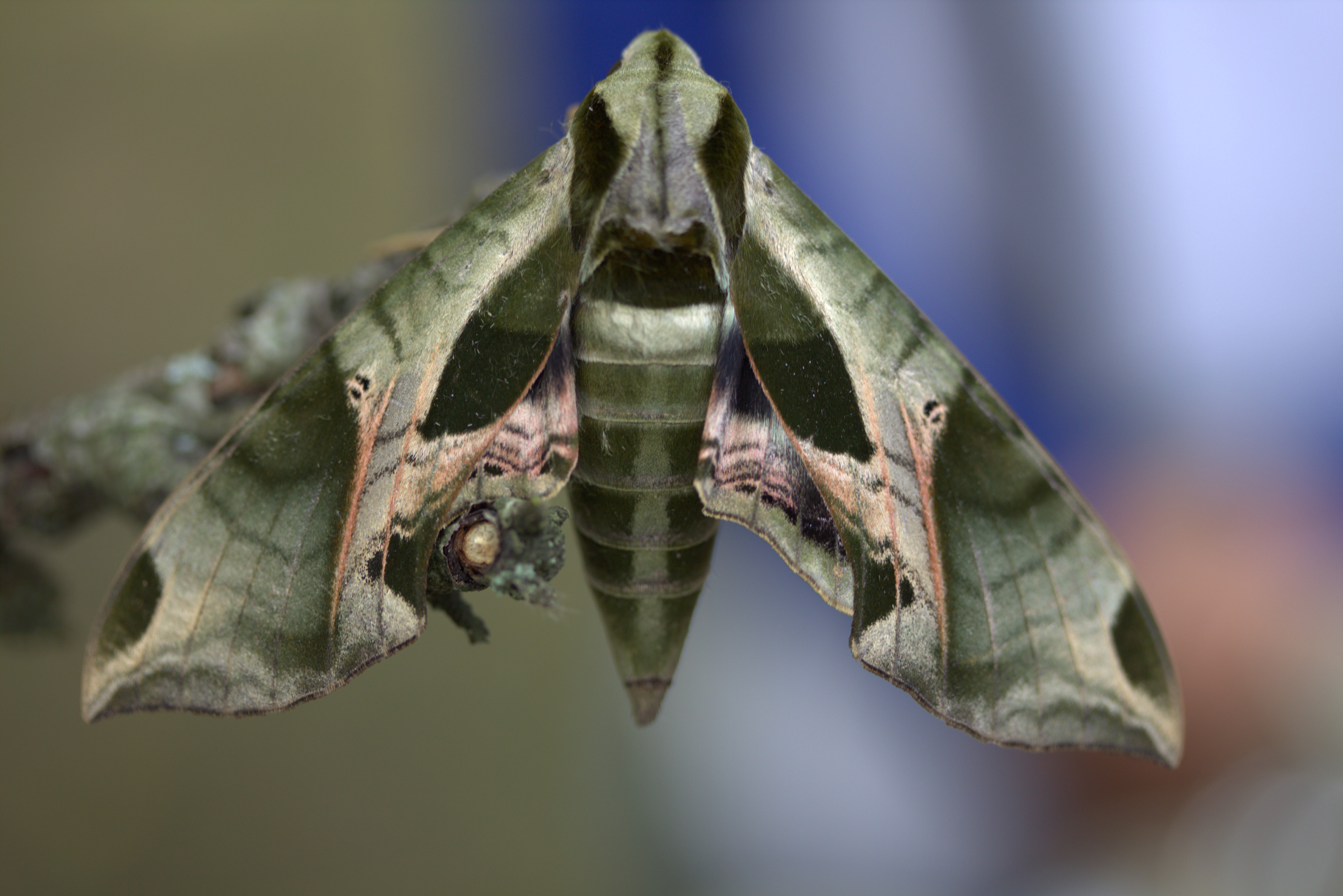
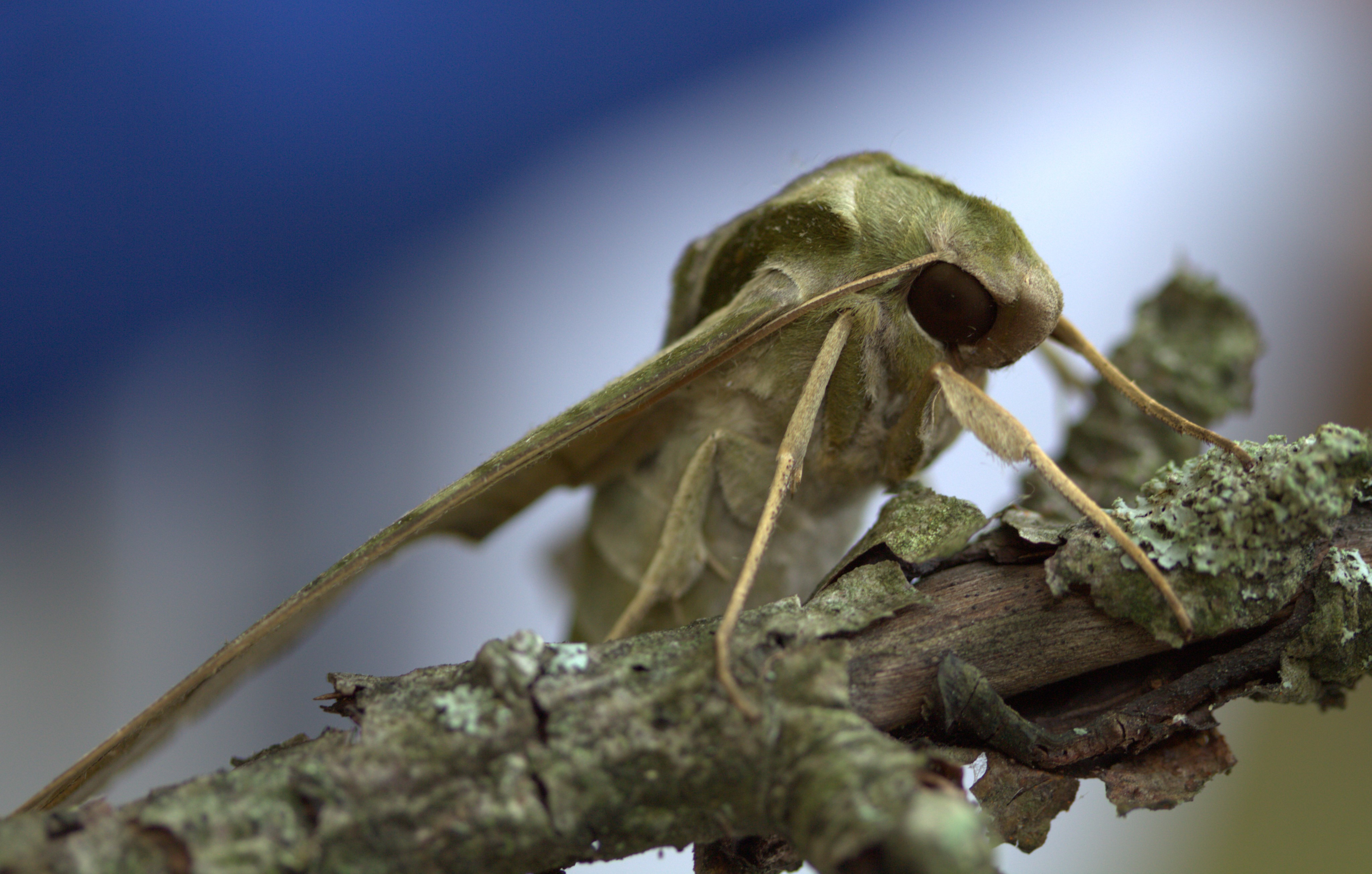
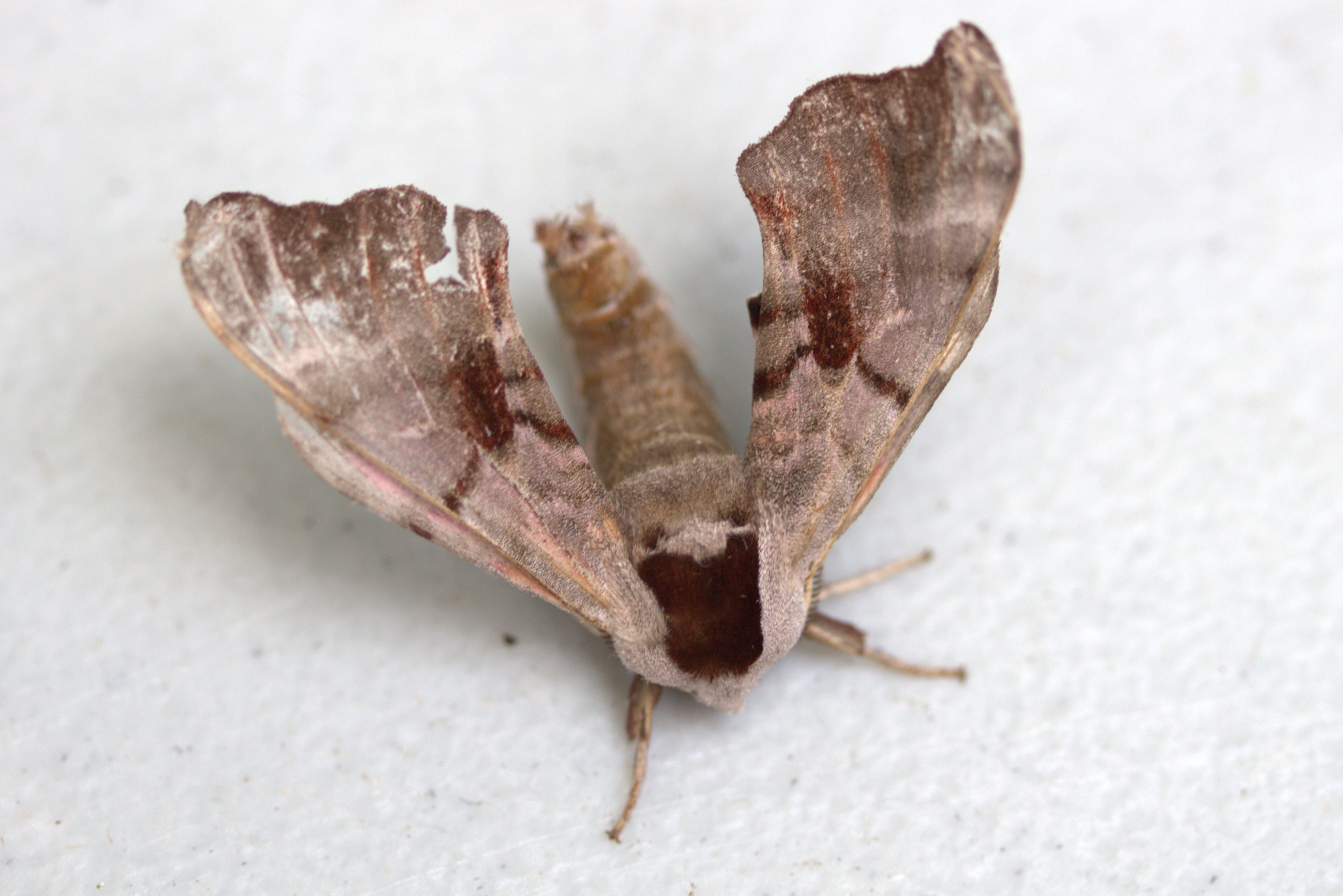
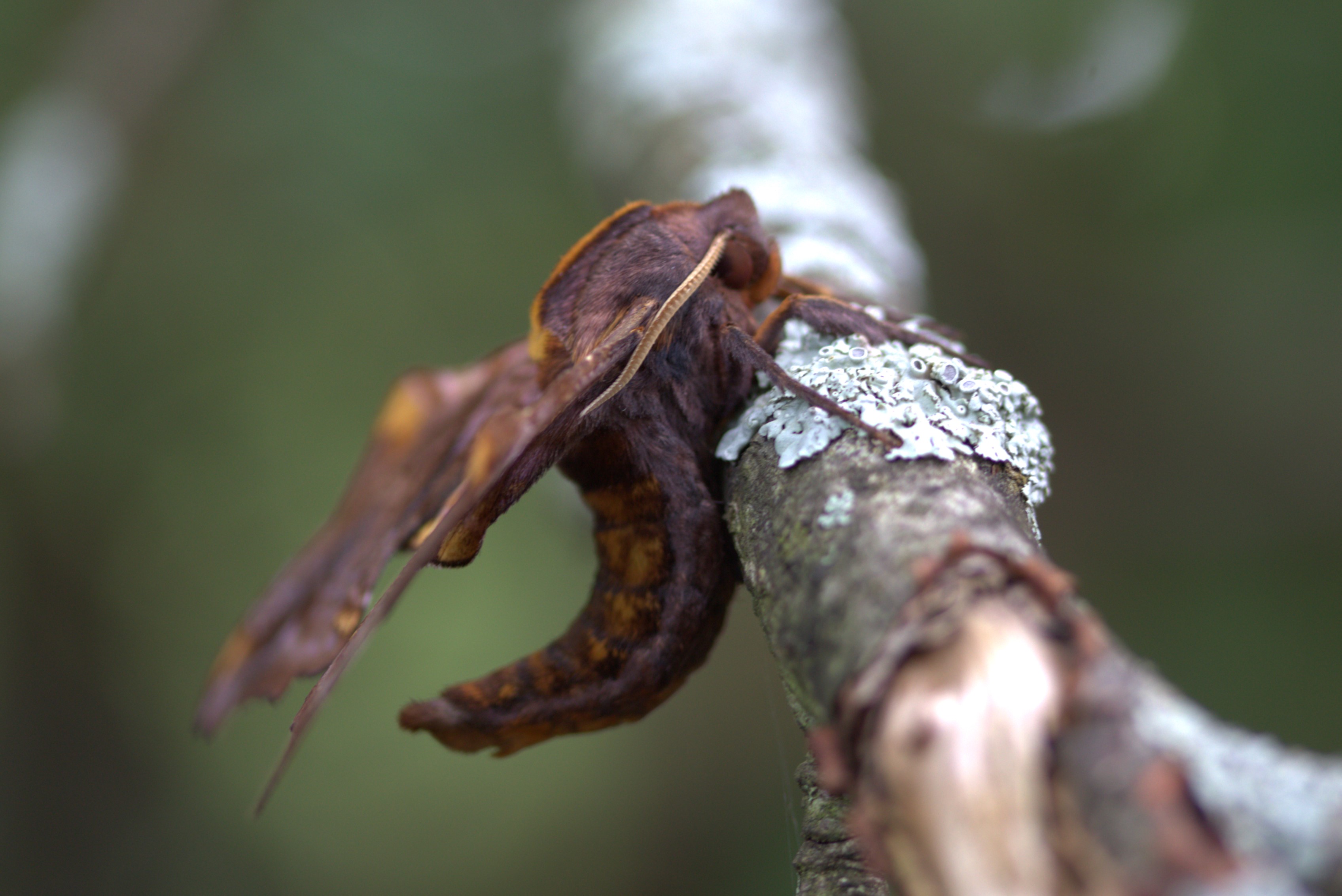
Sphinx Moths, or Hawk Moths (Family Sphingidae) are some of the largest moths in our area and are quite stunning to see. This family includes almost 1500 named species worldwide, and some very surprising members such as the Hummingbird Hawkmoths which are day-flying nectar feeders that look shockingly like insect hummingbirds. Larval Sphinx Moths are often called “Hornworms” because of the projections on some of their heads which resemble horns. Some hornworms are well known for their destructive feeding habits such as the Tomato/Tobacco Hornworm (Manduca sexta). Adult Sphinx moths feed at flowers with their long proboscis (Beadle and Leckie 2012).
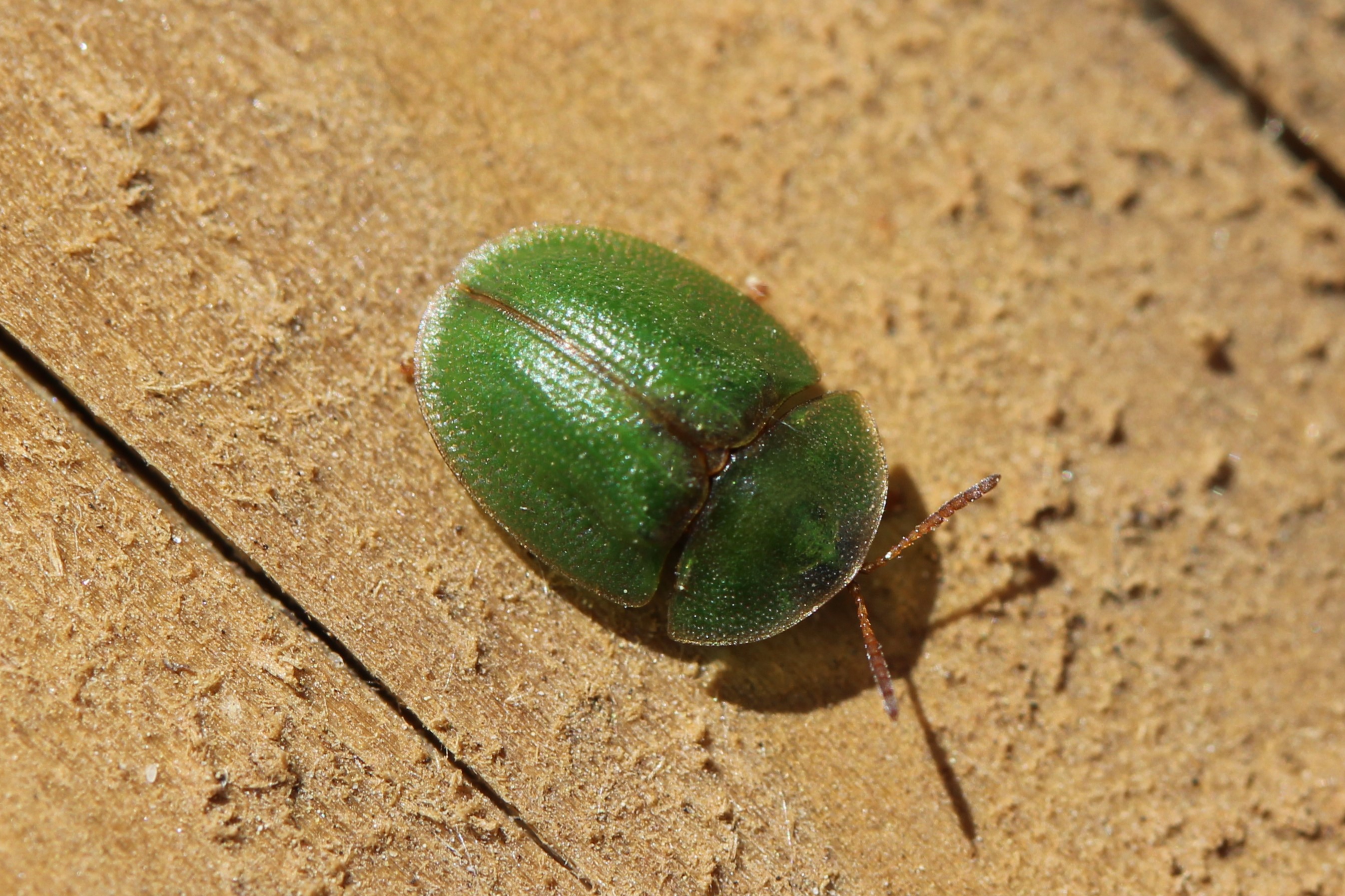
Thistle Tortoise Beetle (Cassida rubiginosa), Backyard, May 2024:
Tortoise Beetles (Beetles in the subfamily Cassidinae of the Family Chrysomelidae) have always been some of my favourite insects. Their wide elytra (wing-covers) protect their limbs and heads from predators and provide them with an appealingly round shape. The Thistle Tortoise Beetle is not native to Canada (having been introduced to combat the non-native Thistle plant), but it was still exciting to spot this charismatic insect on my back porch, trundling along. Their larval stage is less appealing, but still interesting, protecting itself not with a hardened armor covering but a “fecal parasol”. Yes, that’s right, larval Tortoise beetles carry their poop within a forked abdomen curved forward over their backs to ward off predators. There is even a specific word for this behaviour: “merdigery” – from the Latin for “dung” and “carry” (Costa 2006). Likely not a word you’ll find too much use for.
Armored Resin-bee (Heriades), Backyard, June 2024:
This strange-looking bee lays its eggs inside of constructions left behind by other insects, “especially beetle holes in wood, but they may also use pine cones” according to Wilson and Carril (2016). Their nest cells are divided with resin which is where they get their common name of “resin-bee”. Their generic name “Heriades” means “wool” referring to their woolly hairs, evident in the photo.
Related Chaclid Wasp (Leucospis affinis), Backyard, June2024:
Although her colouration may remind you of a paper wasp or other social, stinging wasp, the long ovipositor curled over her back indicates that she is in fact something quite different: a parasitic wasp. This female will lay her eggs inside the nest of a leafcutter bee (bees in the family Megachilidae), and the larvae that hatch will locate and consume their host bee larvae (Holm 2021). Holm, in her amazingly detailed books on common garden wasps, says this about the larval stage of this wasp: “The larva is initially equipped with sensory and locomotive hairs on its head and body to help it find the host as it moves around the dark nest cell… has an oversized head, and large mandibles used to kill the host larva and destroy any other Leucospis eggs. Like many cleptoparasitic bees, the larva loses most of these prey-finding apparatus after molting” (Holm 2021).
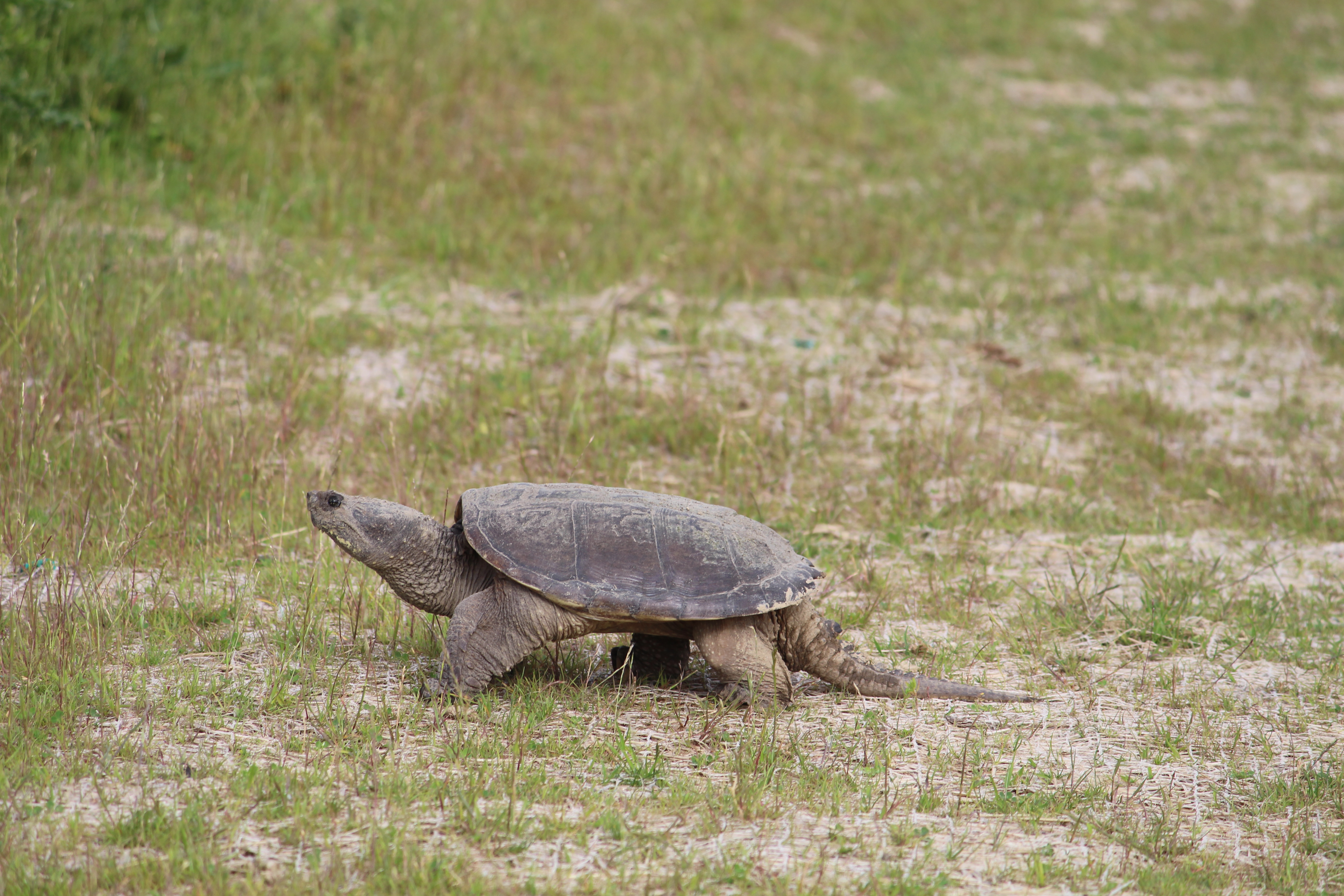
Common Snapping Turtle (Chelydra serpentina), Long Point, June 2024:
The sight of a Snapping Turtle walking across land always makes me think of a prehistoric beast lumbering out of some primeval swamp. Despite the fact that Snapping Turtles are well adapted to their environment, and no more primitive a species than any others, they give the impression of an ancient power, a relic from the days of the lumbering dinosaurs.
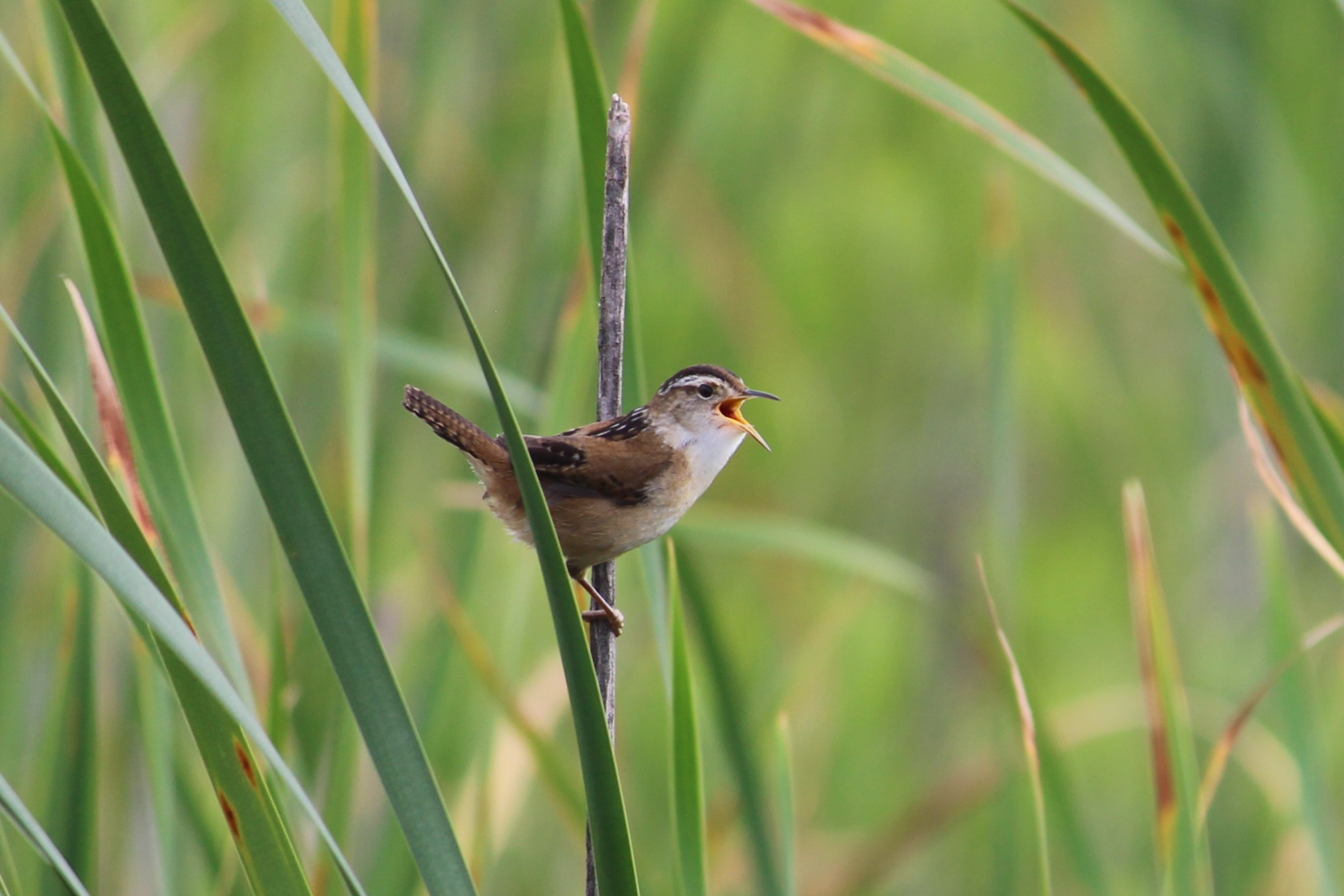
Marsh Wren (Cistothorus palustris), Long Point, June 2024:
The sound of these energetic birds clambering among the cattails of a wetland is one of the backdrops of my summer, going out to take photos of birds and other wildlife. I was surprised to learn that Marsh Wrens are major predators on Red-winged Blackbird eggs and nestlings in some parts of their range (Beletsky 1996). Marsh Wrens mostly eat insects, and they construct several nests within their territories from which the females choose, just like in House Wrens (Stokes and Stokes 1983).
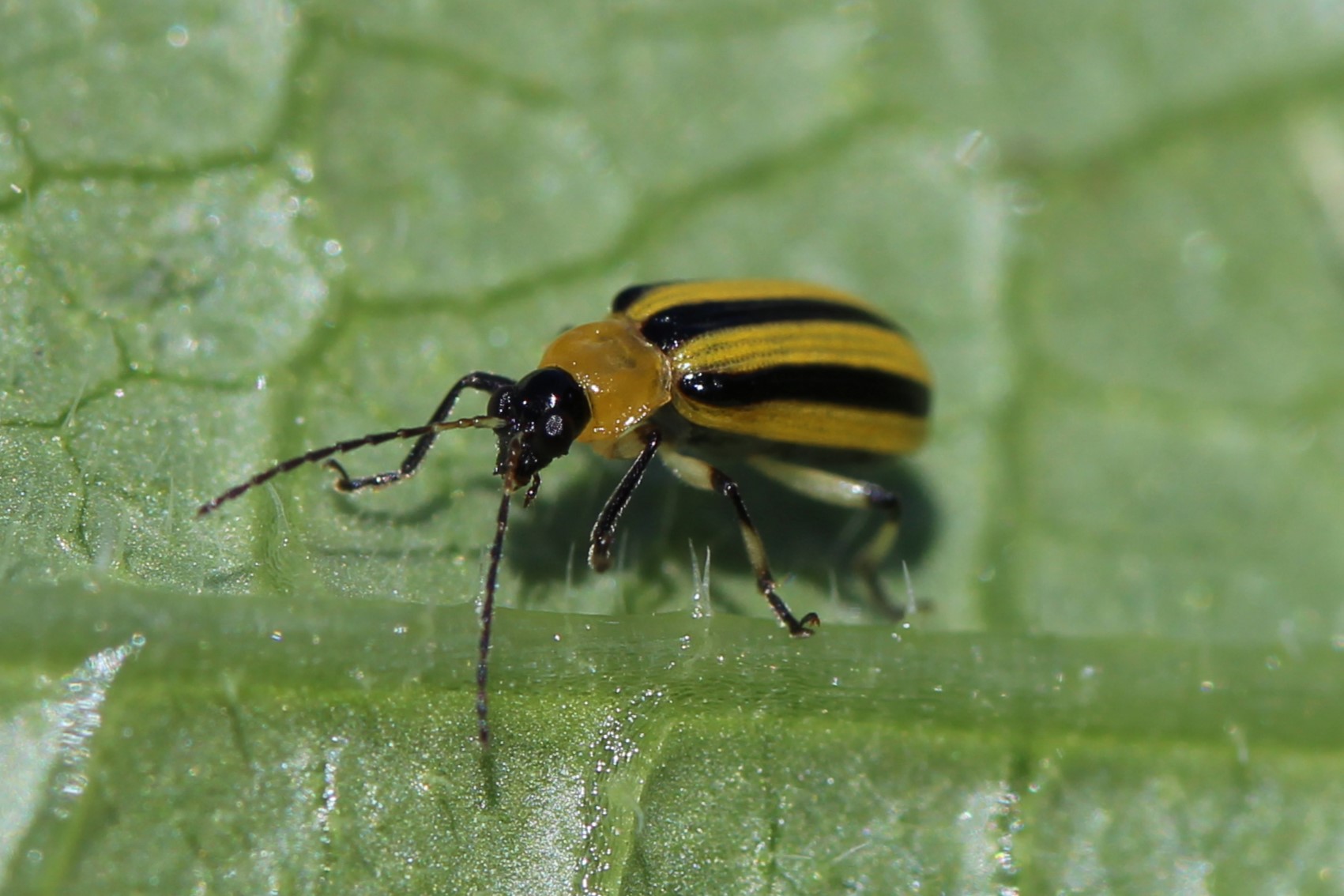
Striped Cucumber Beetle (Acalymma vittatum), Backyard, July 2024:
The Striped Cucumber Beetle is considered a pest because it consumes plants that we like to consume ourselves: members of the Cucurbitaceae (cucumbers, watermelons, gourds, pumpkins, squash and many others). The adults feed on leaves, while their larvae feed on the roots (Marshall 2018).
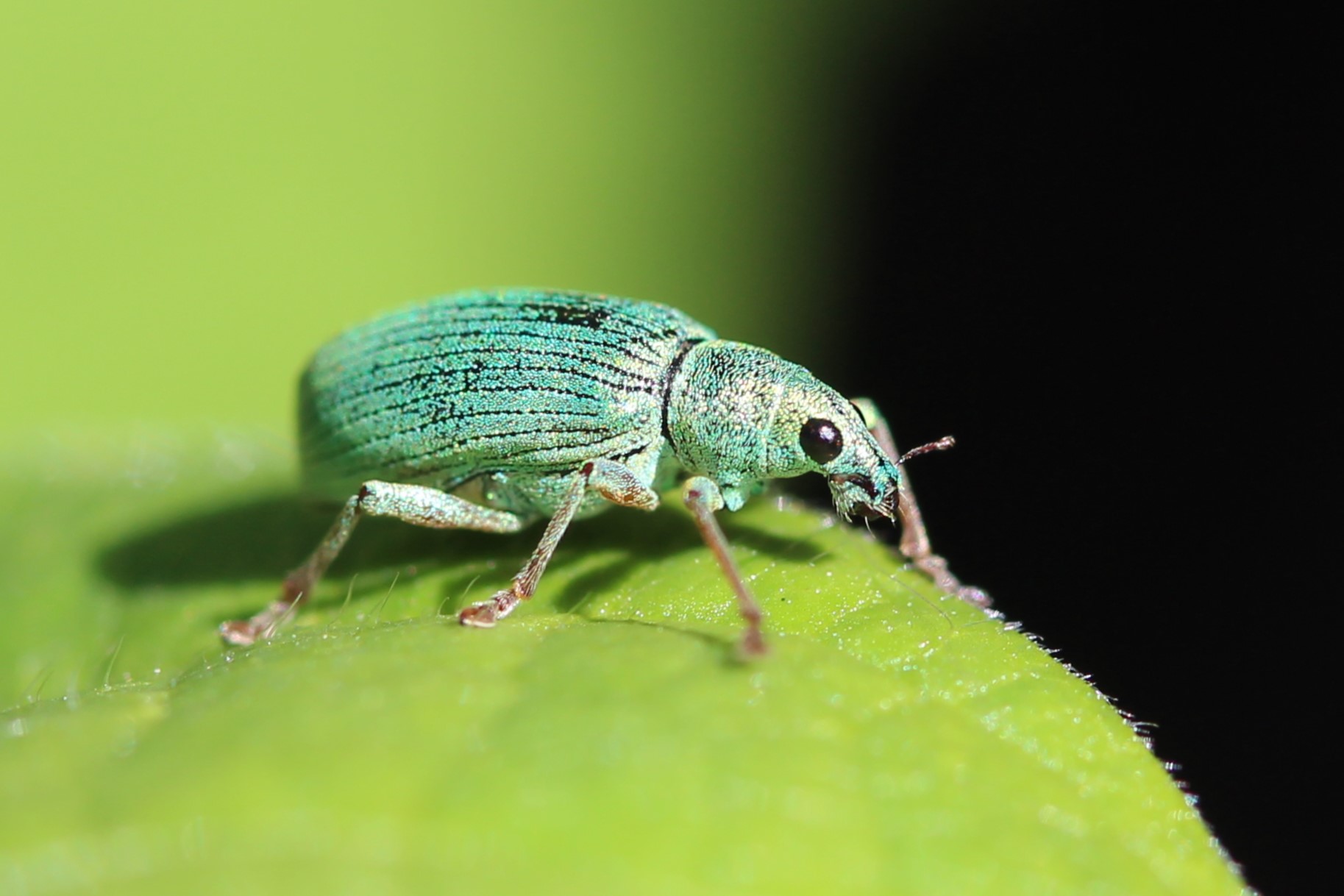
Green Immigrant Leaf Weevil (Polydrusus formosus), Backyard, July 2024:
Another pest beetle species, this one non-native to North America (accidentally introduced, and not deliberately like the Thistle Tortoise Beetle), the Green Immigrant Leaf Weevil feeds on various shrubs and trees. Eggs are laid in the bark of host plants or in the soil, the larvae feed on roots through Spring and Summer and then emerge as adults in the following Spring (Lisak et. al. 2024).
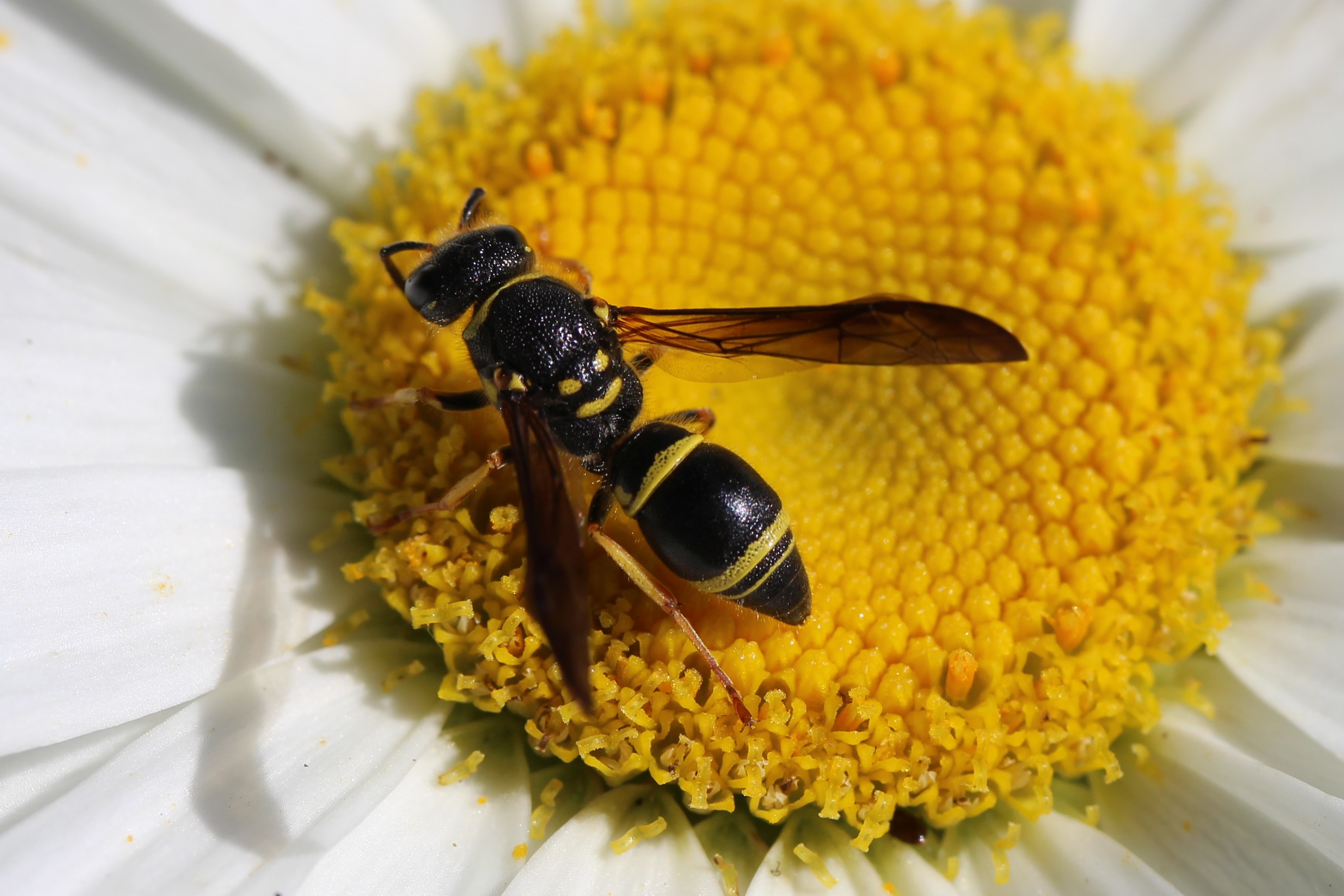
Smiling Mason Wasp (Ancistrocerus campestris), Backyard, July 2024:
In the photo above, you can clearly see the smile emblazoned on the Smiling Mason Wasp’s thorax. These wasps lay their eggs in pre-existing cavities, creating several nest cells by dividing the cavity with mud walls (Holm 2021). You can think of each nest cell as a nursery for individual wasp larvae, as the Smiling Mason Wasp female lays a single egg in each chamber (and hangs it from the ceiling by a silken thread) (O’Neill 2001). Each nursery is filled with several paralyzed caterpillars for the larva to consume upon hatching (Holm 2021).
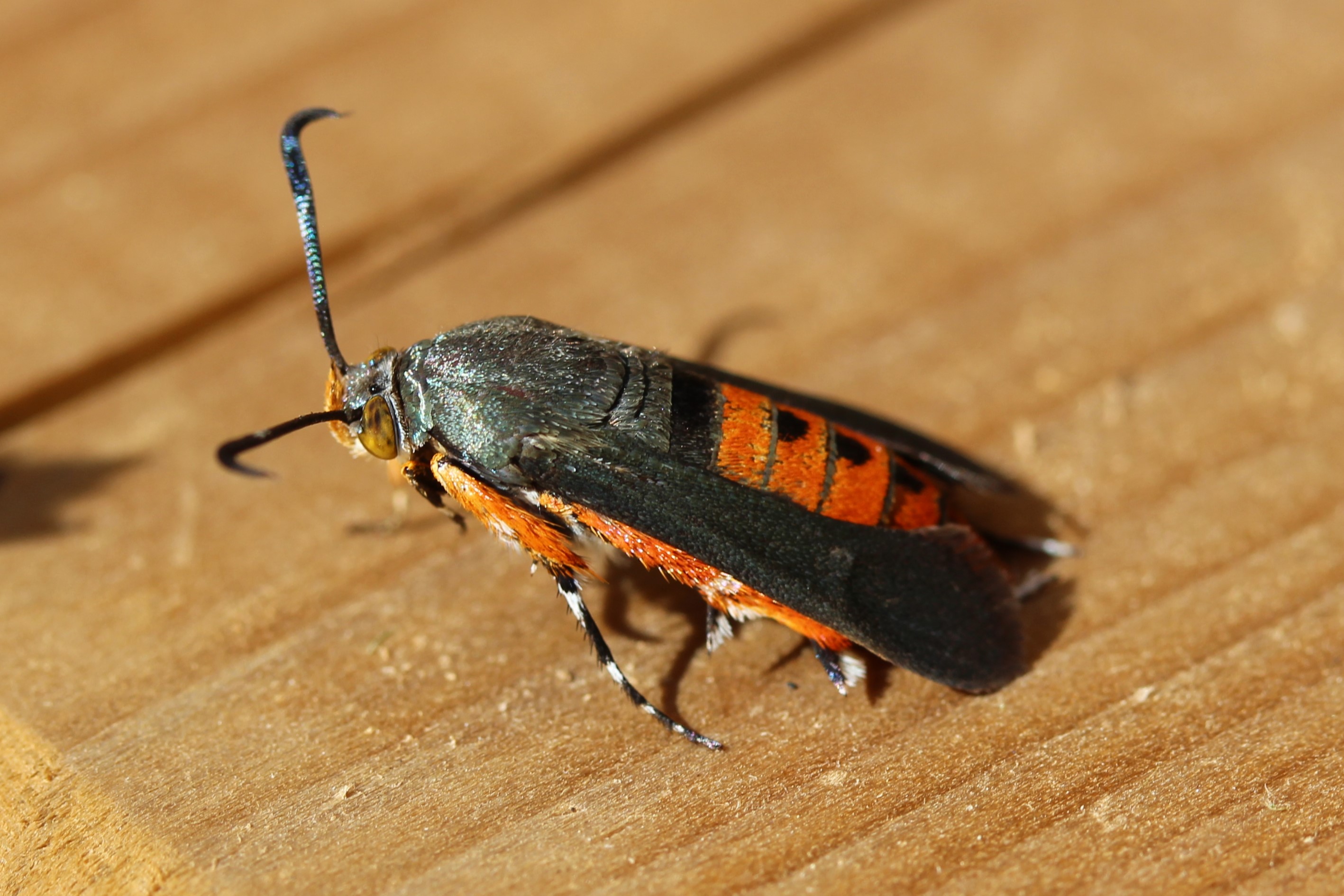
Squash Vine Borer (Eichlinia cucurbitae), Backyard, July 2024:
Standing still, the illusion is not very convincing, but when this little moth was in constant buzzing motion, hovering from flower to flower, the resemblance to a wasp was impressive (specifically the Great Golden Digger Wasp, Sphex ichneumoneus). The mimicry helps keep this moth safe from predators which hesitate to interfere with a stinging wasp but would love to snack on a harmless moth. As with several other insects on this list, the Squash Vine Borer feeds on squash, cucumbers, gourds, or pumpkin during its larval stage, giving some indication of what we were growing in our garden this past summer.
Pruinose Squash Bee (Peponapis pruinosa), Backyard, July 2024:
Unlike many other bees, Squash Bees are specialist pollinators on one plant family: the Cucurbitaceae (the pumpkins, squash, cucumbers etc). These are solitary bees, meaning that each female creates her own nest for her offspring, rather than contributing to a social construction such as a honeybee or bumblebee colony made up of many non-reproducing individuals. Female Squash Bees dig their nests into the soil, 1.5 feet deep or more, before branching off the main tunnel into several off-shoots with each one receiving pollen and an egg (Wilson and Carril 2016).
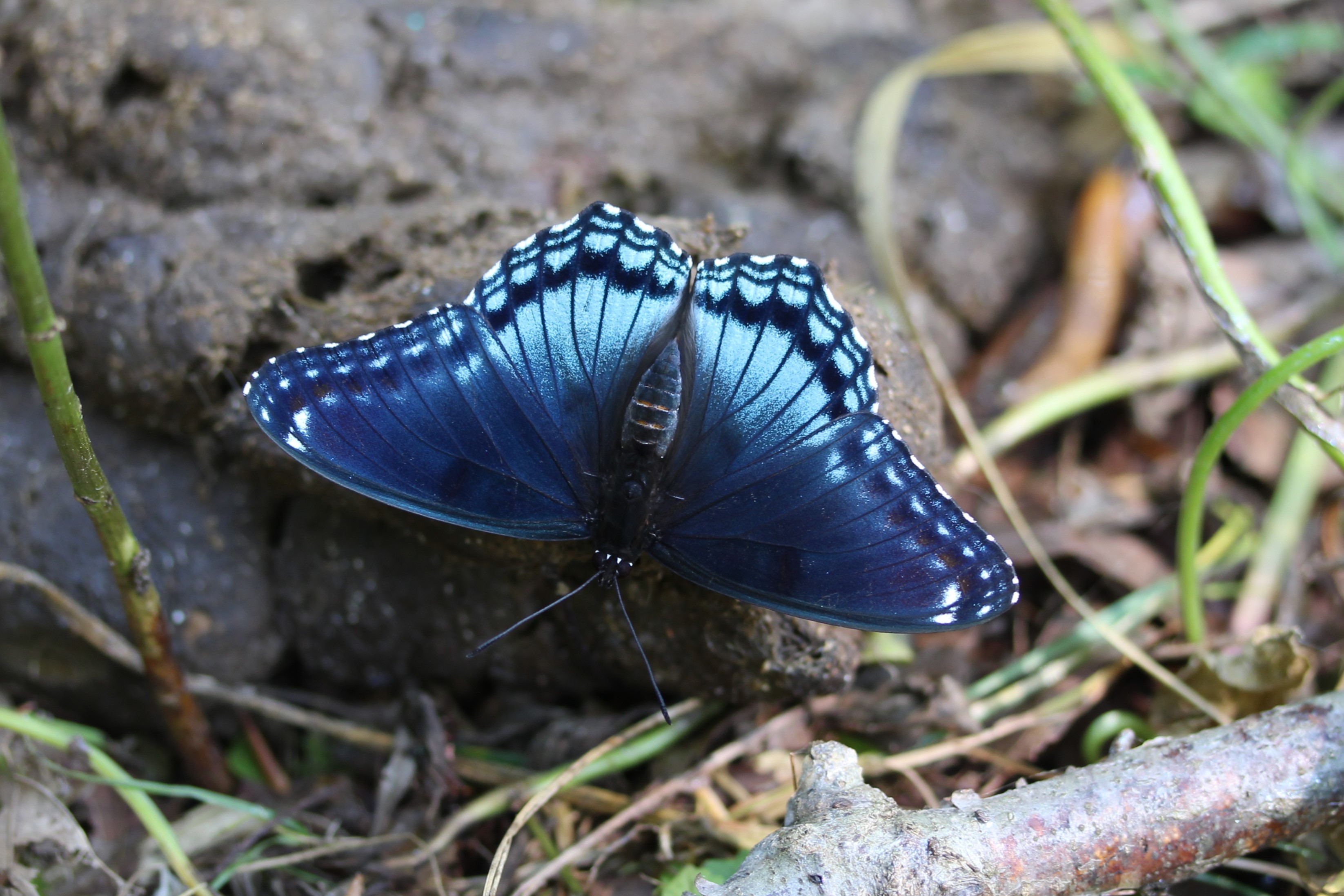
Red-Spotted Purple Butterfly (Limenitis arthemis astyanax), Backus Woods, July 2024:
This beautiful butterfly was spreading its wondrous wings as it fed on dung (I believe this was of the horse variety). Many butterflies feed on dung for valuable minerals, creating such jarring juxtapositions.
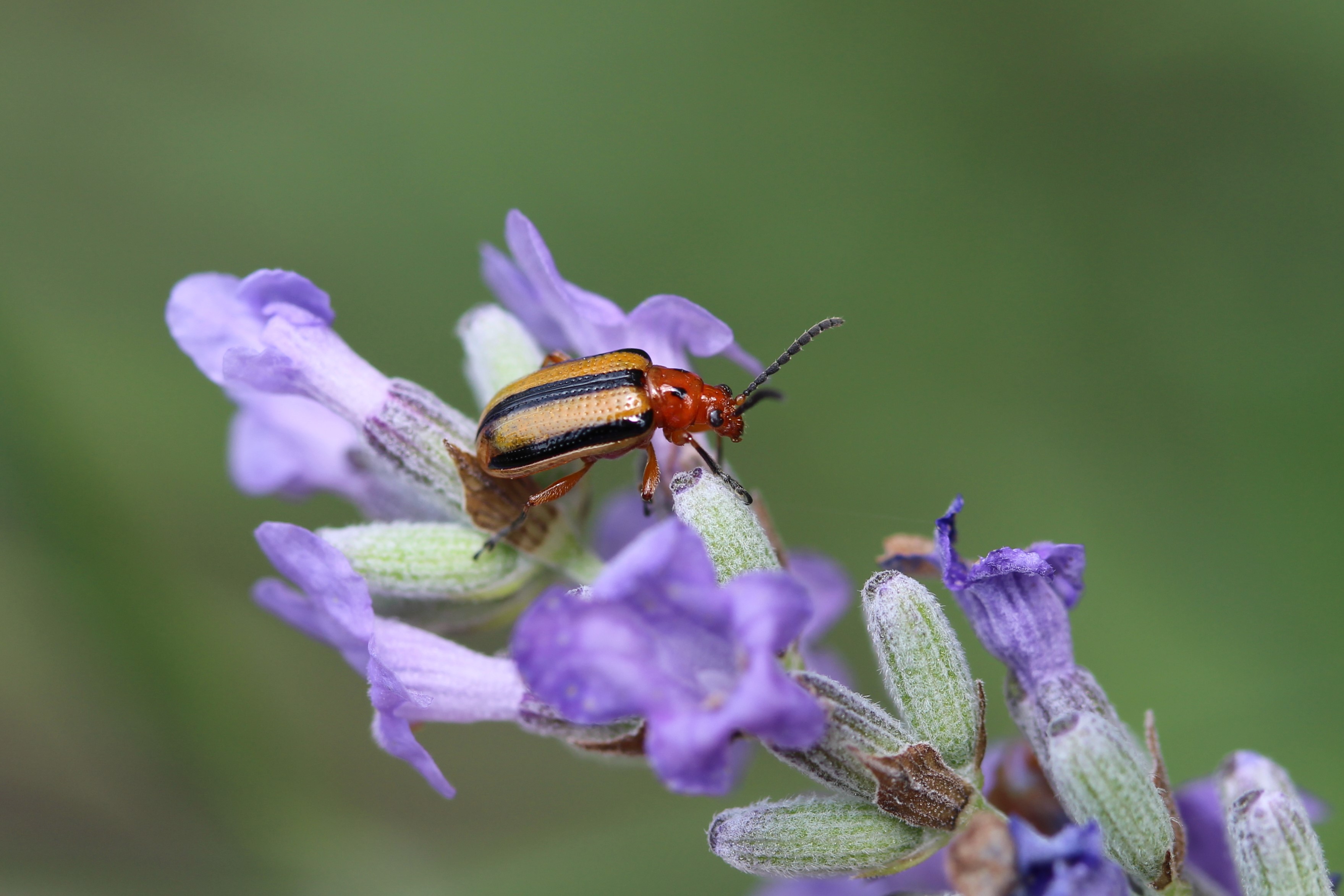
Three-lined Potato Beetle (Lema daturaphila), Backyard, July 2024:
This attractively coloured beetle is a native leaf beetle (in the subfamily Criocerinae) which feeds on potatoes and other related plants. Its larvae exhibit merdigery (bet you didn’t think that word was coming back again so soon, did you!?).
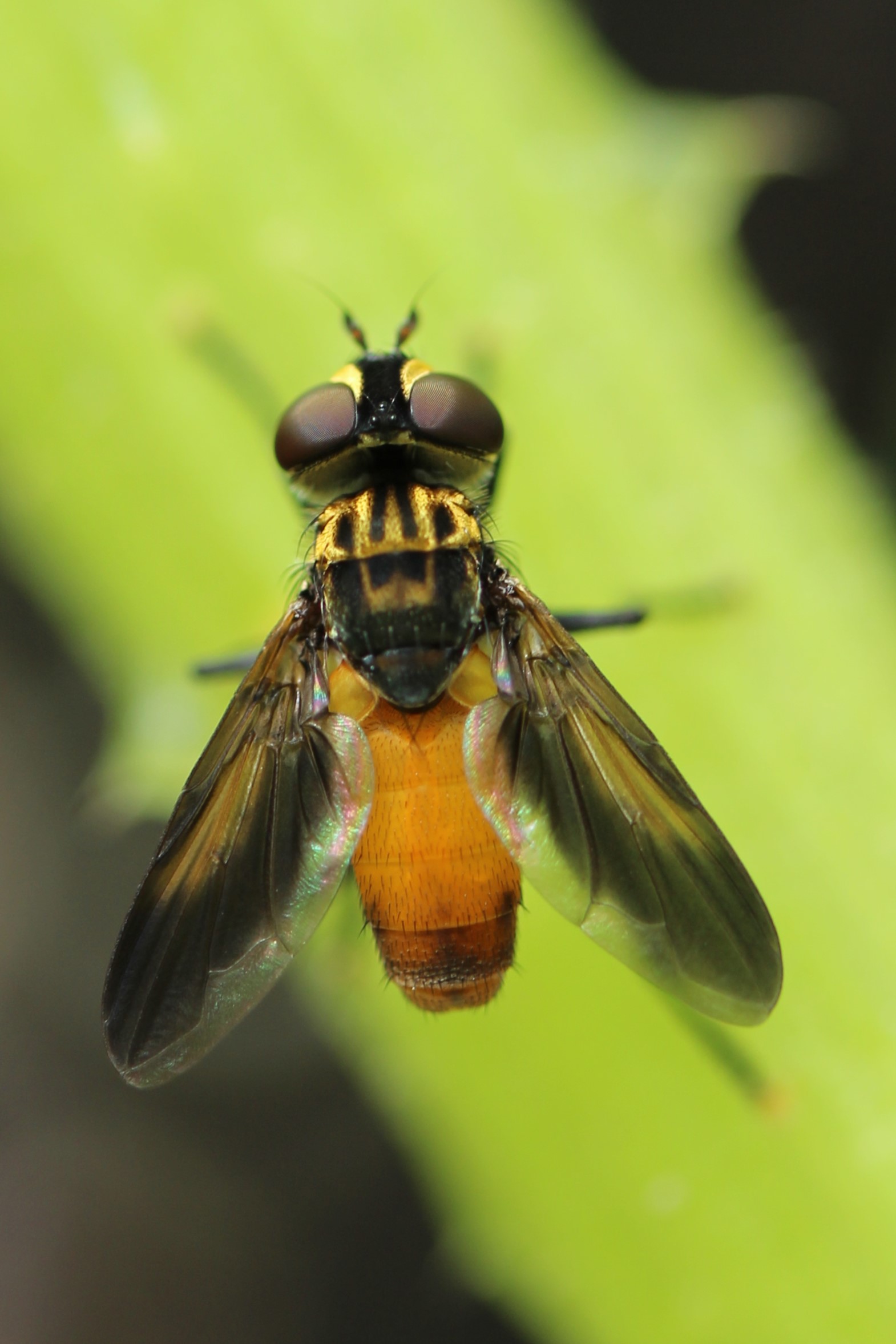
Swift Feather-legged Fly (Trichopoda pennipes), Backyard, July 2024:
These flies are part of the vast fly Family Tachinidae, which are largely bristly and parasitic. Trichopoda pennipes lays its eggs directly onto its hosts which are various true bugs (Hemipterans), including Squash Bugs, Stink Bugs and Leaf-footed bugs. The egg hatches and the larva burrows directly into the host bug, consuming it from the inside. This gruesome life cycle is helpful to gardeners as many of its hosts are pests of garden plants.
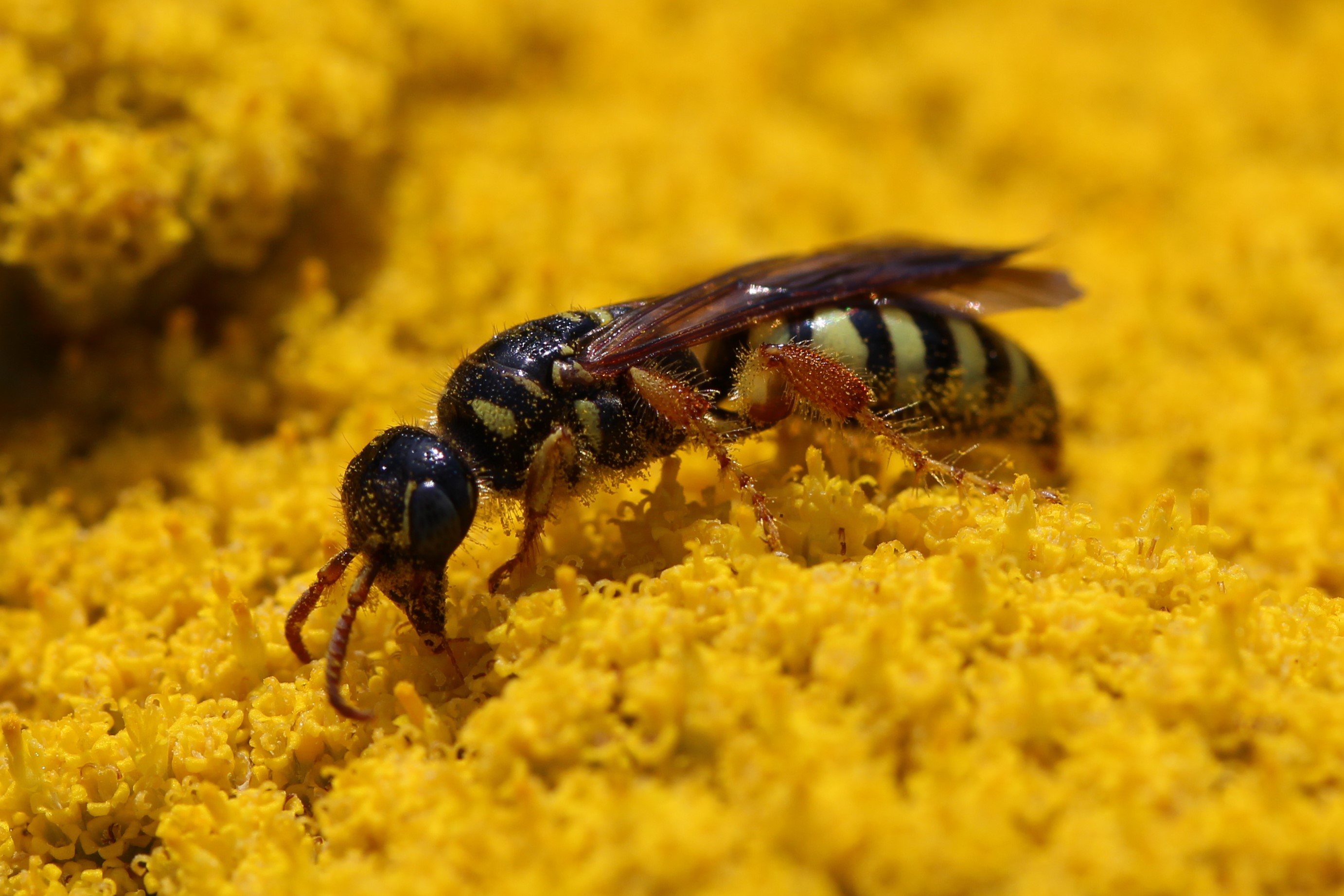
Five-Banded Thynnid Wasp (Myzinum quinquecinctum), Backyard, July 2024:
These large wasps again demonstrate the familiar patterning and colouring of a social paper wasp, but are very distinct in their life cycle. Female Five-Banded Thynnid Wasps dig up to six inches into the ground at night, in search of scarab beetle larvae (or occasionally tiger beetle larvae) (Holm 2021). Once found, the female paralyzes the grub and lays her egg on its abdomen (Holm 2021). The wasp larva consumes the beetle larva and creates a silken cocoon within its late host’s underground chamber to spend the winter (Holm 2021). Once spring arrives, the wasp pupates and emerges as the impressive adult pictured above in summer (Holm 2021).
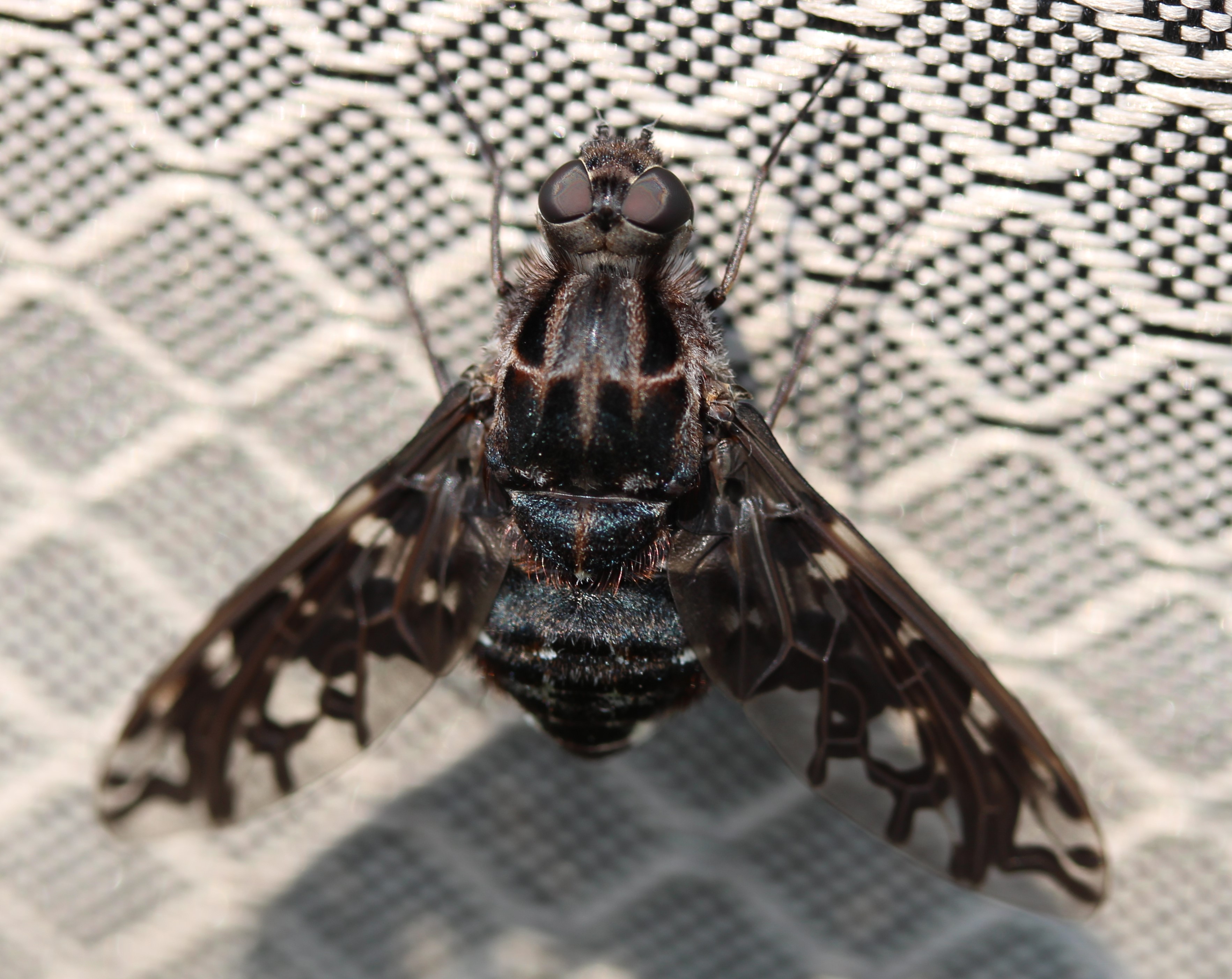
Despite its large and striking appearance, this formidable fly does not bite or sting people and should only be feared by its prey: Carpenter Bees (Xylocopa spp.). The Tiger Bee-Fly lays its eggs near Carpenter Bee nests, and the larvae make their way inside to consume the bee larvae.
Belted Kingfisher (Megaceryle alcyon), Grant Anderson Park, September 2024:
I have tried in vain to take a good, clear, photo of a kingfisher for many years now. These distinctive, charismatic birds are always on the move, and very aware of me whenever I approach with camera in hand. They need their good senses to spy fish underwater which they dive and catch. This past September, I finally managed to get a nice photo of this bird in the local park in Simcoe.
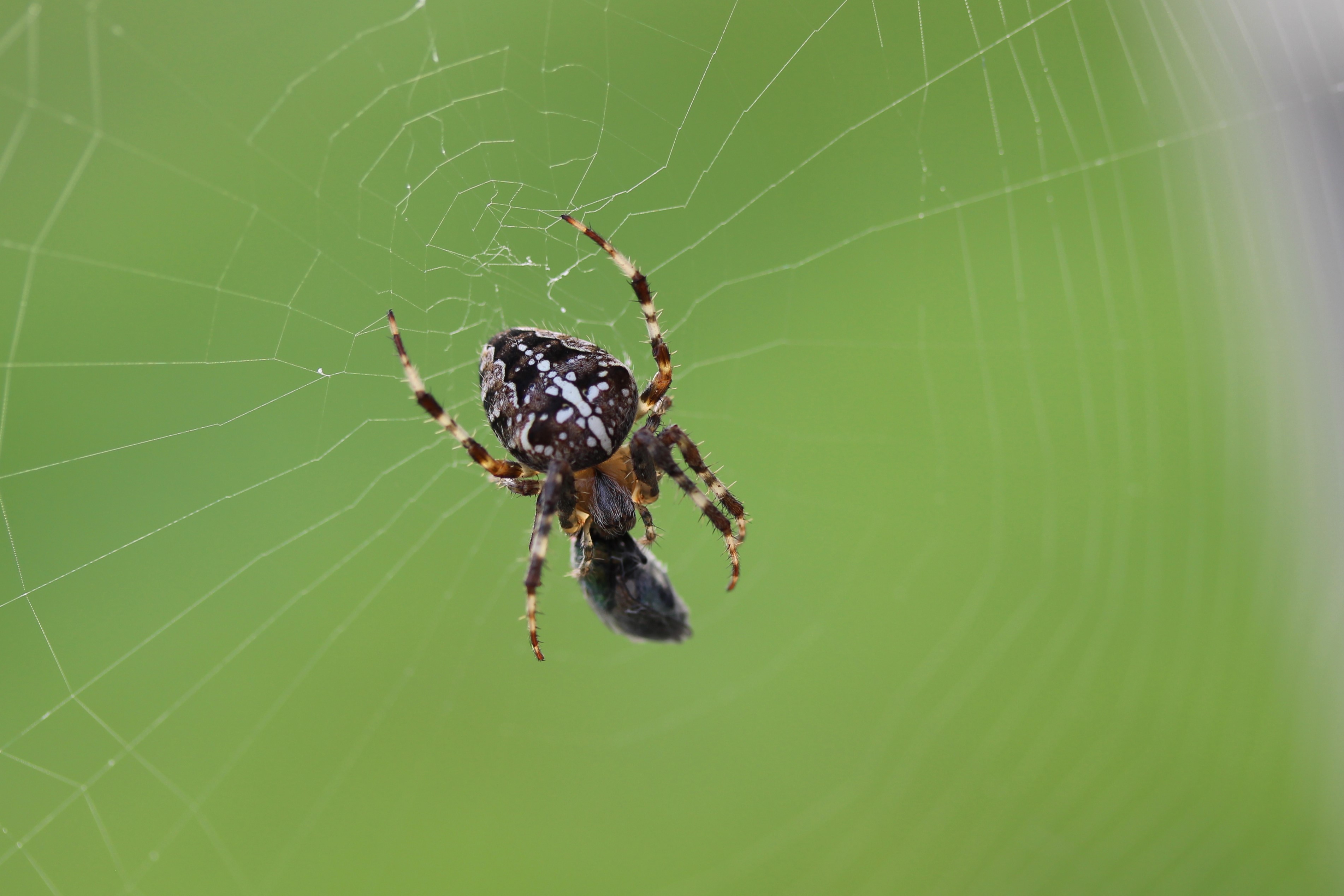
Cross Orbweaver (Araneus diadematus), Backyard, September 2024:
This large spider feasting on its dipteran prey had constructed a web on the edge of my back porch. Cross Orbweavers are introduced spiders here, native to Europe.
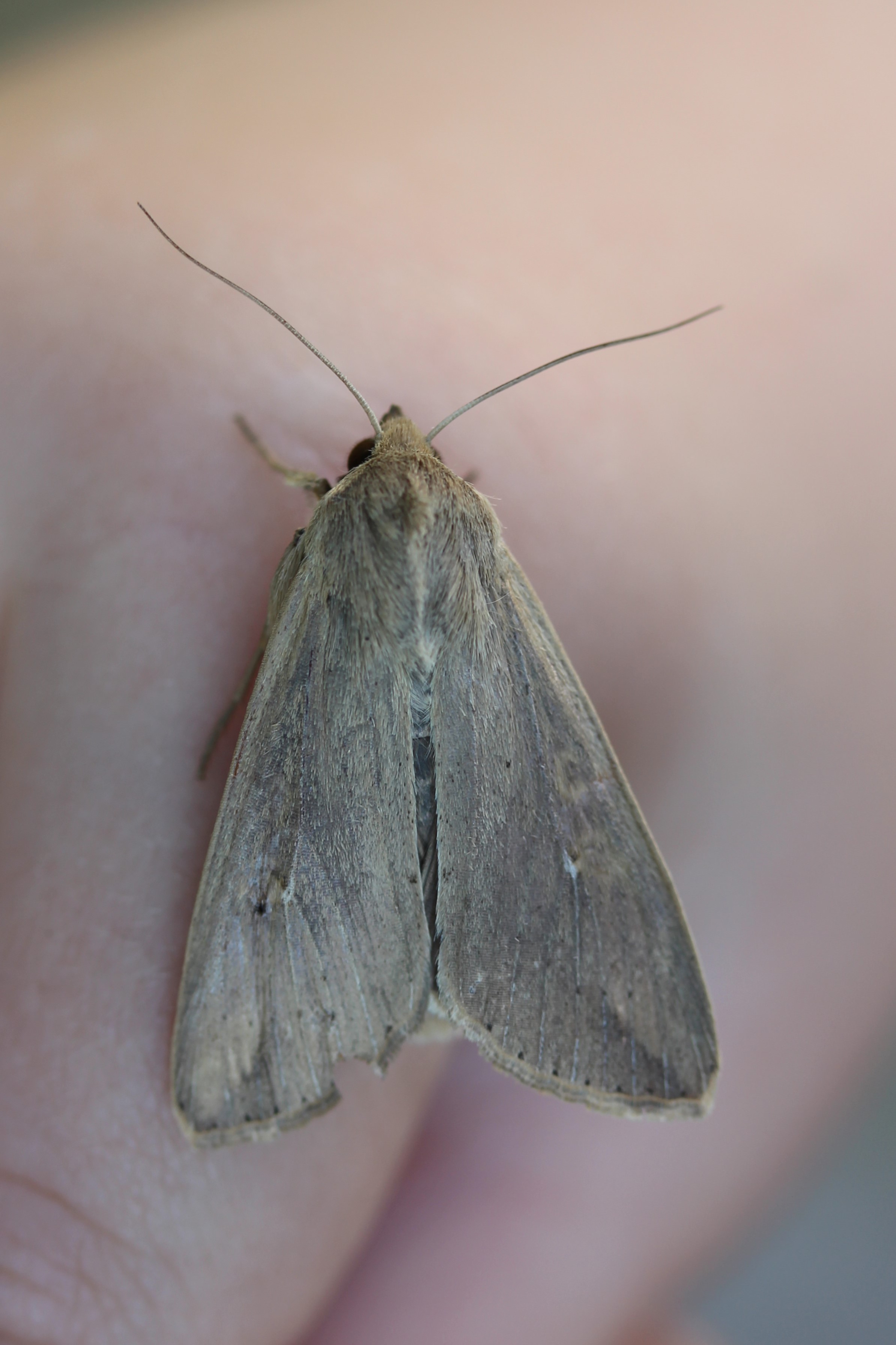
Mythimna Moth, Backyard, September 2024:
I believe this moth is of the genus Mythimna, but I’m not quite sure as it’s a fairly nondescript moth. The moths in this genus feed on grasses when larvae which would also line up with its discovery within my lawn (Beadle and Leckie 2012).
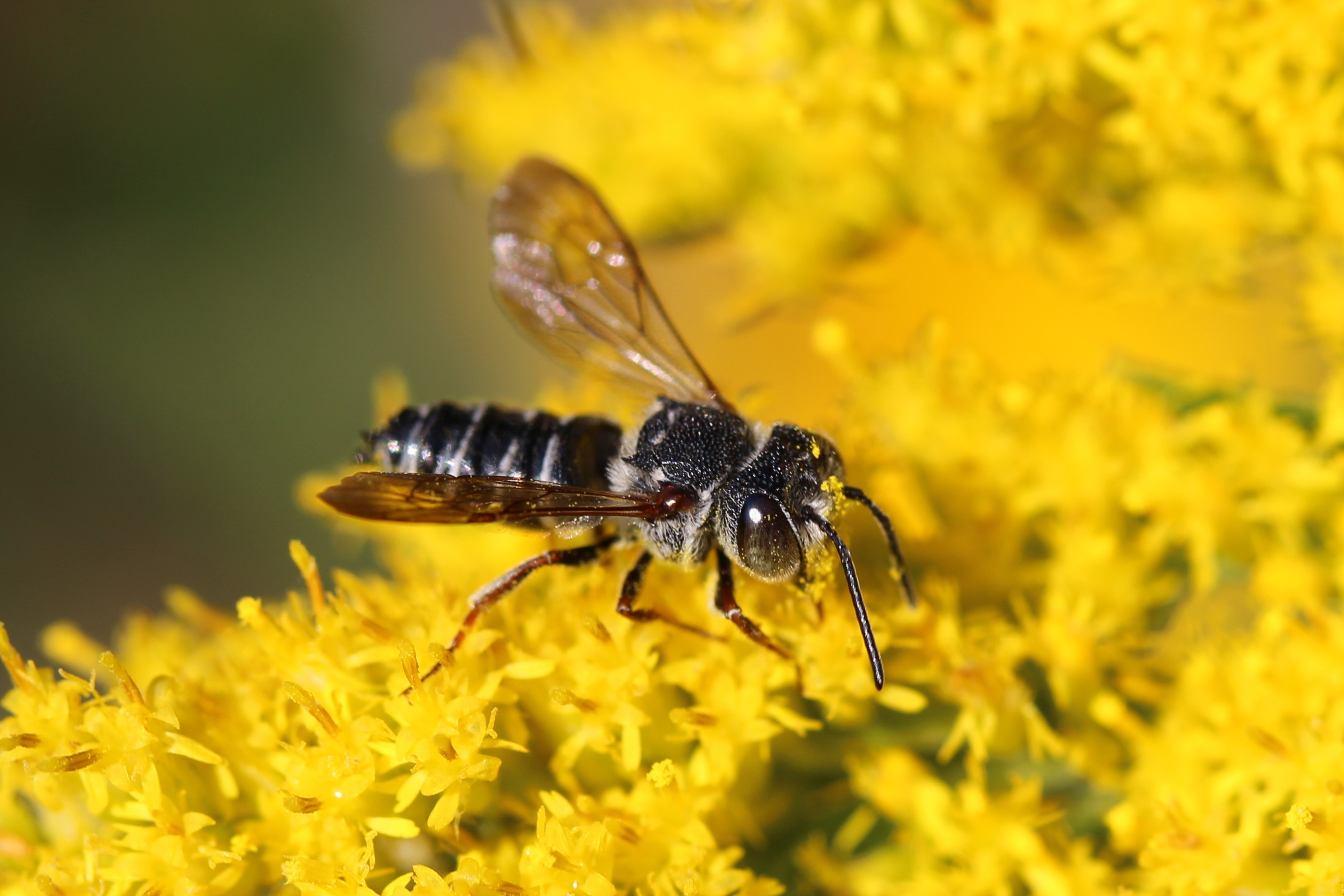
Sharptail Bee (Coelioxys), Backyard, September 2024:
Although the proportions of the pictured individual lead the head to be much larger than the thinning abdomen, the common name “Sharptail Bee” refers more to the females of these bees (the bee in the photo is a male) who have very pointed abdomens used to puncture the nest cells of Megachilid bees (Wilson and Carril 2016). Coelioxys eggs laid inside their hosts’ nests hatch and the emerging larva “uses tweezer-sharp mandibles to snip the egg or young larva of the host bee in half” (Wilson and Carril 2016). The larva then proceeds to consume the pollen that was stored away for the host bee’s young.
Apple Leaf Skeletonizer Moth (Choreutis pariana), Backyard, September 2024:
These are day-active moths, with larvae that feed on crab apple leaves. They were introduced to North America sometime around 1917 (Beadle and Leckie 2012).
References:
Beadle, David and Leckie, Seabrooke 2012. Peterson Field Guide to Moths of Northeastern North America. Houghton Mifflin Harcourt.
Beletsky, Les. The Red-Winged Blackbird: The Biology of a Strongly Polygynous Songbird. 1996. Academic Press.
Costa, James T. 2006. The Other Insect Societies. Harvard University Press.
Holm, Heather 2021. Wasps: Their Biology, Diversity, and Role as Beneficial Insects and Pollinators of Native Plants. Pollination Press.
Lisak, Sarah C., Hailey N. Shanovich, Amelia R.I. Lindsey, and Brian H. Aukema. “The Polydrusus Weevils (Coleoptera: Curculionidae) of the United States of America and Canada: Identification and Insights into the Ecology of Two Nonnative Species in Hazel (Corylus Spp.).” The Canadian Entomologist 156 (2024): e10. https://doi.org/10.4039/tce.2024.7.
Marshall, Stephen. 2018. Beetles: Their Natural History and Diversity. Firefly Books.
Marshall, Stephen. 2023. Hymenoptera: The Natural History and Diversity of Wasps, Bees, and Ants. Firefly Books.
O’Neill, Kevin M. 2001. Solitary Wasps: Behavior and Natural History. Cornell University Press.
Stokes, Donald and Stokes, Lillian. 1983. A Guide to Bird Behavior Volume 2. Little, Brown and Company.
Wilson, Joseph S. and Carril, Olivia M. 2016. The Bees in Your Backyard. Princeton University Press.
In August of 2023, I returned to one of my favourite places: Algonquin Provincial Park. While there, I photographed and encountered varied organisms and I’d like to take the opportunity to explore and describe these nature observations in a series of blogposts, as I often do.
When first arriving at our campsite, I observed not a living thing itself, but rather the mark of a living thing on its environment: I found a bird nest. According to iNaturalist it is likely the creation of a Vireo (genus Vireo, who said Scientific names were hard to remember?). The most common Vireo in Southern Ontario is the Red-eyed Vireo (Vireo olivaceus), so this was likely constructed by a member of this species. A description of their nest construction is appropriate here: “The female spends 4 to 5 days constructing a nest of bark strips, grasses, pine needles, wasp-nest paper, twigs, and plant fibers that hangs below the branch. She glues the materials (some of which are provided by the male) together and to the branch fork with spider-web adhesive, occasionally supplemented with spider egg cases and sticky plant fibers.” (Cornell Lab of Ornithology 2019). I love thinking of the time and effort that went into this small nest. Just think of the spiders’ webs and egg cases that went into this architecture.
Small eye-level nest of a songbird, likely a Vireo of some sort.
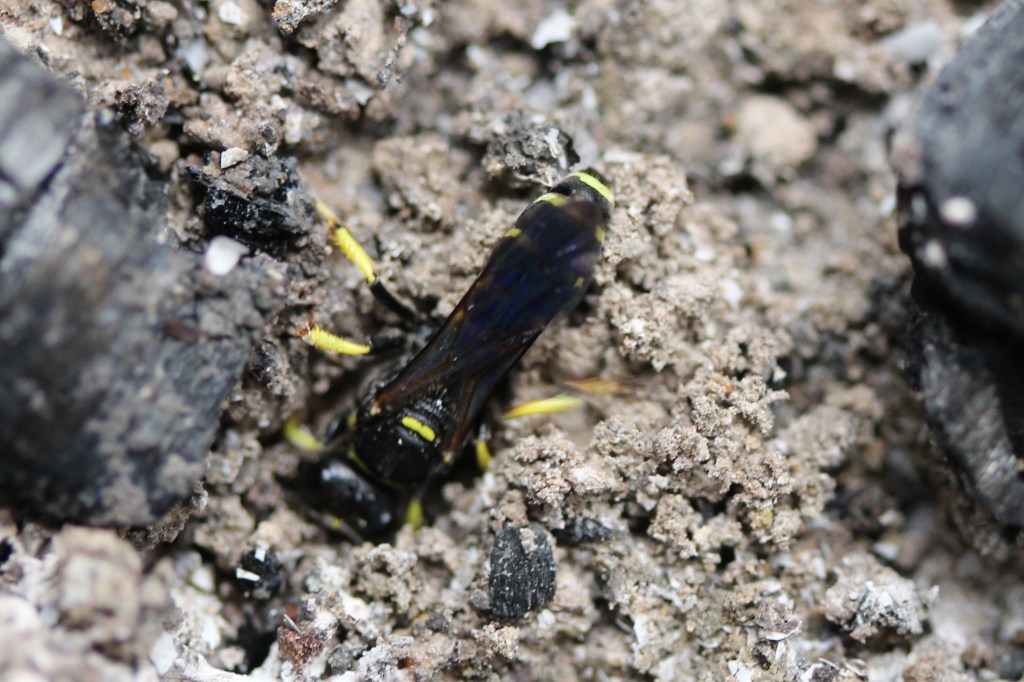
While exploring our campsite, a very different organism was in the process of creating a nest, a crabronid wasp female. This tiny black-and-yellow wasp was investigating the ground of our campsite for a location to create a burrow. The wasp landed several times and dug a little bit into the sandy soil then hovered for a while, circling the area before dropping to the ground once more. At one point, it entered the firepit and dug rapidly into the ashes within, crafting itself a very easily constructed but frightfully unwise burrow. It put me in mind of the parable of the man building a house on sand, perhaps there is a Hymenopteran equivalent about “digging one’s burrow in ashes”. In any case, I don’t think the wasp was settled on the firepit as its burrow location because after forming these temporary exploratory burrows, she flew off and wasn’t seen the rest of the day.
“Do not dig your burrow in ash” – ancient Hymenopteran proverb.
A few days later, I spotted her hovering form once more, this time accompanied by a prey item. Dragging below her was a corpse larger than herself, that of a Horse Fly (Tabanidae). I never witnessed the end of her journey, I’m not sure if she found a good spot to bury her large prey to feed her young. But I hope that she did.
Crabronid wasp dragging her larger horse fly prey below herself.
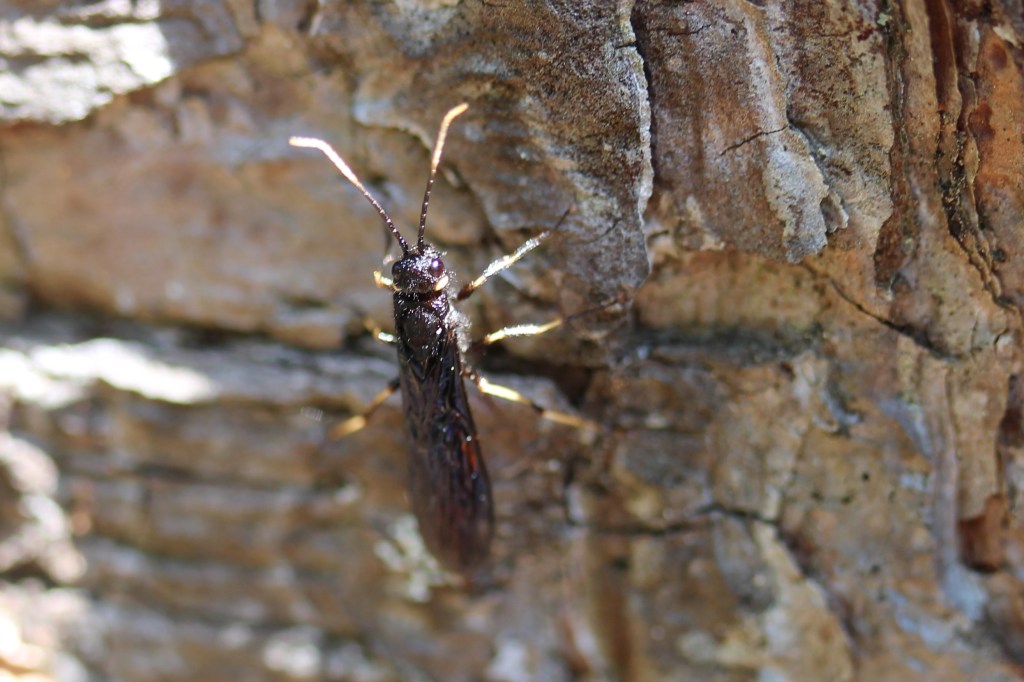
Another Hymenopteran was looking to provision for its young, although its prey was far larger than a horsefly. The creature was a Black-and-red Horntail (Urocerus cressoni) and its prey was a tree. Horntails (Suborder Symphyta) lay their eggs inside the trunks of trees and the larvae feed within. Urocerus cressoni larvae feed inside of Pine trees and their relatives (Marshall 2023).
Black-and-Red Horntail (Urocerus cressoni) resting on the trunk of a tree, likely searching for a place to lay her eggs.
Many other insects were observed on the trees, plants and litter of our campsite and the surrounding areas of the Pog Lake Campground. Some True Flies (Order Diptera) caught my attention. A bright and shiny Dolichopus skittered about in the leaf litter, and an elongate Robber Fly (Genus Machimus) was spotted on fallen pine needles.
Dolichopus Fly.Robber fly of the genus Machimus.
Some of the most beautiful insects found in the Pog Lake campground were the Dragonflies (Order Odonata). A strikingly large Dragonfly of the genus Aeshna was basking in the sun on the trunks of trees and (when I was able to take its photo) on our dining tent entrance.
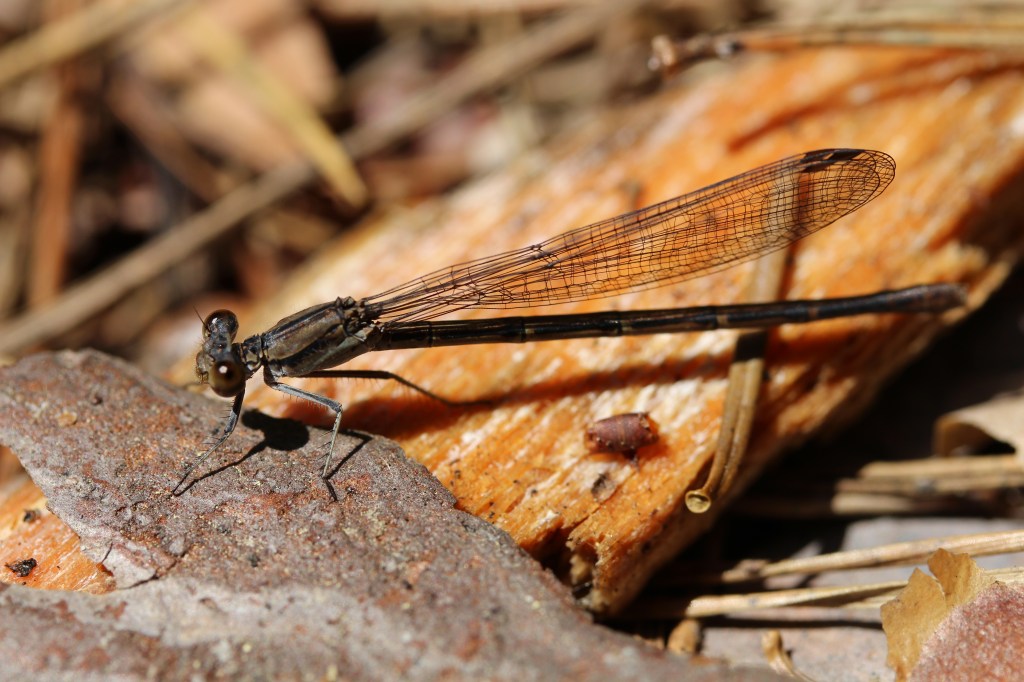
A much more easily missed odonate was the Variable Darner (Argis fumipennis), a smoky grey presence among the pine needles and fallen bark.
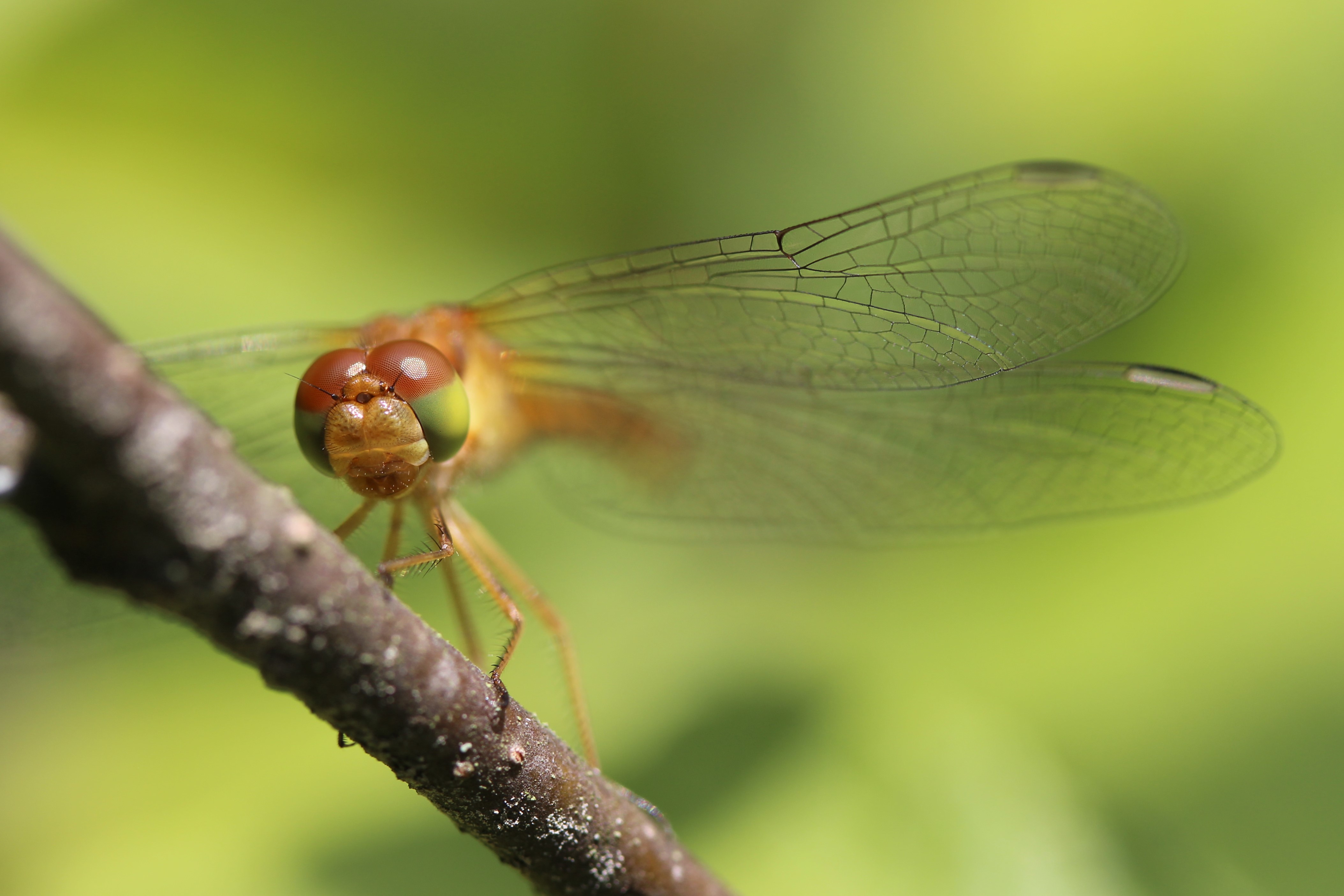
Resting along a branch was a beautiful Autumn Meadowhawk (Sympetrum vicinum), in a colour phase that I hadn’t observed before. Males of this species are a bright red with a rusty-red thorax, but females (like the one I encountered) are yellowish. I was able to get very close to this dragonfly and was rewarded with some beautiful photographs.
We didn’t just hang out by our campsite in Pog Lake, but we spent quite a bit of time at the campground beach and that will be the focus of my next blogpost.
Siederia walshella, on the Lynn Valley Trail, April 2023:
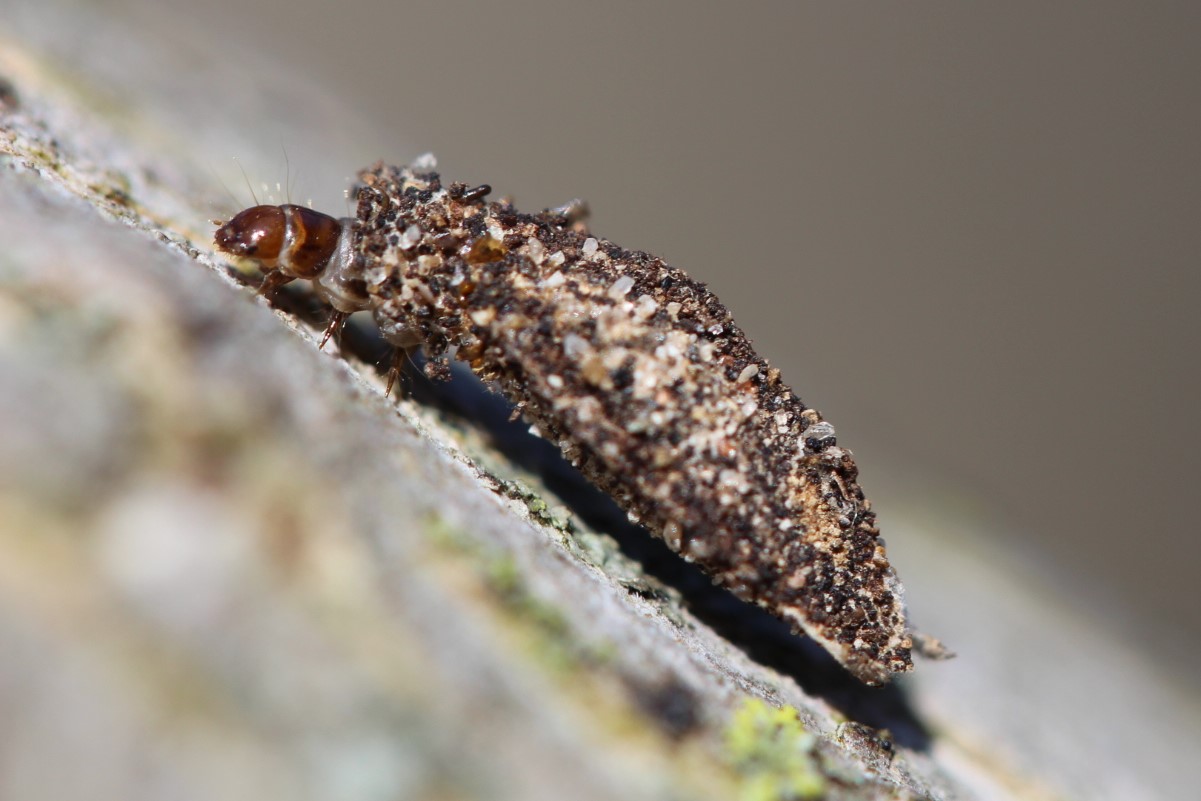
On a walk on the trail by my house, I spotted this tiny creature (about a cm long) climbing up the trunk of a tree. I’m not positive on the identification, but it’s based on iNaturalist’s auto-ID for my photo and seems to match from what I can tell. If the ID is correct, this tiny caterpillar was likely searching for lichen to eat.
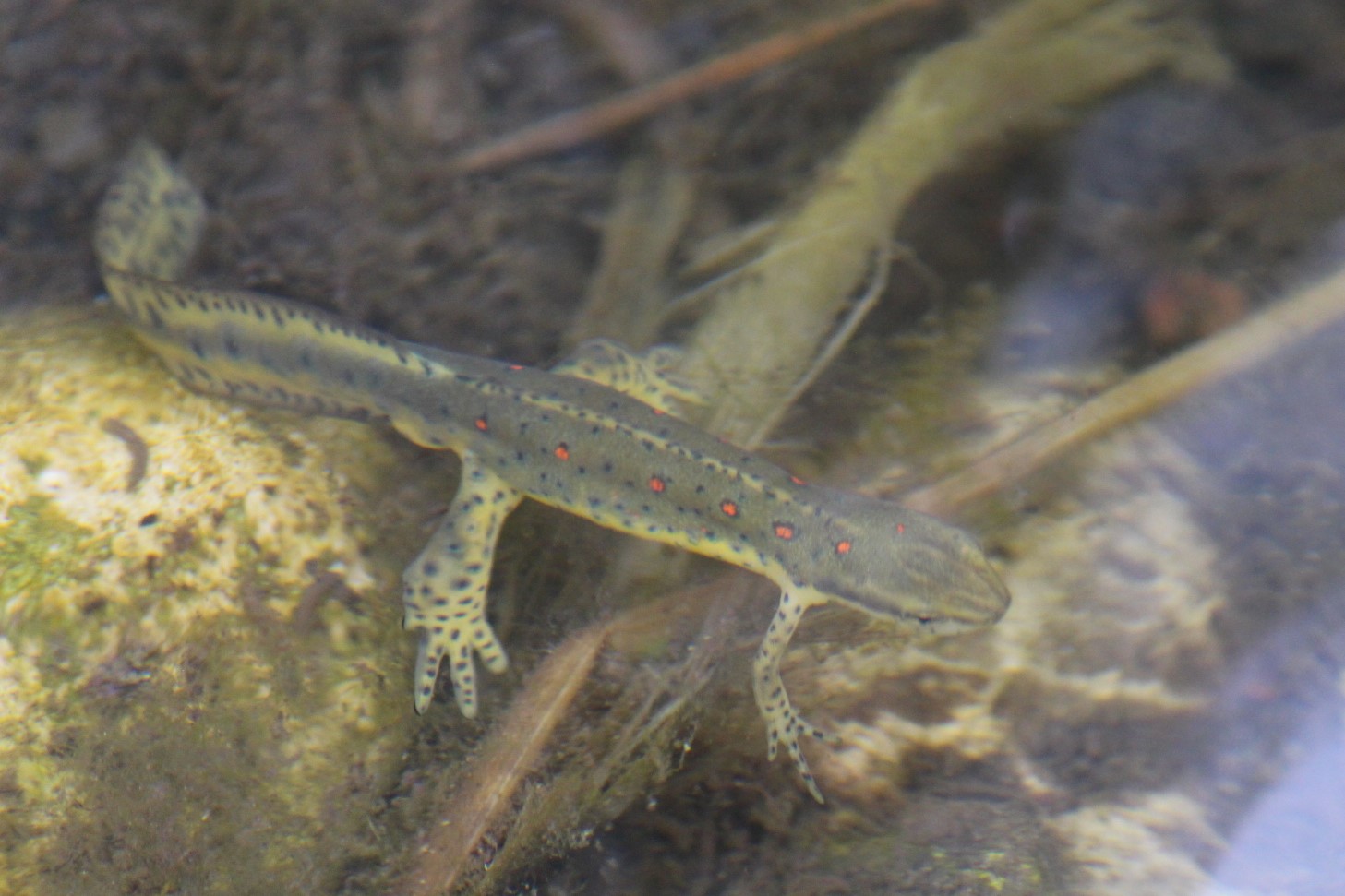
Eastern Spotted Newt (Notophthalmus viridescens), in my Parents’ pond, April 2023:
For the past few years, my parents’ garden pond has been host to these amazing creatures. All amphibians impress with their transformation from aquatic to terrestrial life but the Eastern Spotted Newt outdoes this life cycle with some incredible twists and turns. Larval newts transform into terrestrial juveniles (known as “efts”) and leave the water behind, living in the leaf litter. While on land, the efts have a rough reddish brown skin which keeps moisture in. After two to seven years, the efts undergo another transformation, darkening in colour and gaining a raised tail fin which aids them as they return to the water as aquatic adults. The newt pictured above is in this final stage of life: an aquatic adult. This isn’t necessarily the end of the newt’s transformations however, since some newt adults leave the water and regain some of their terrestrial attributes (rougher dry skin, loss of tail fin) for hibernation on dry land (Harding and Mifsud 2017).
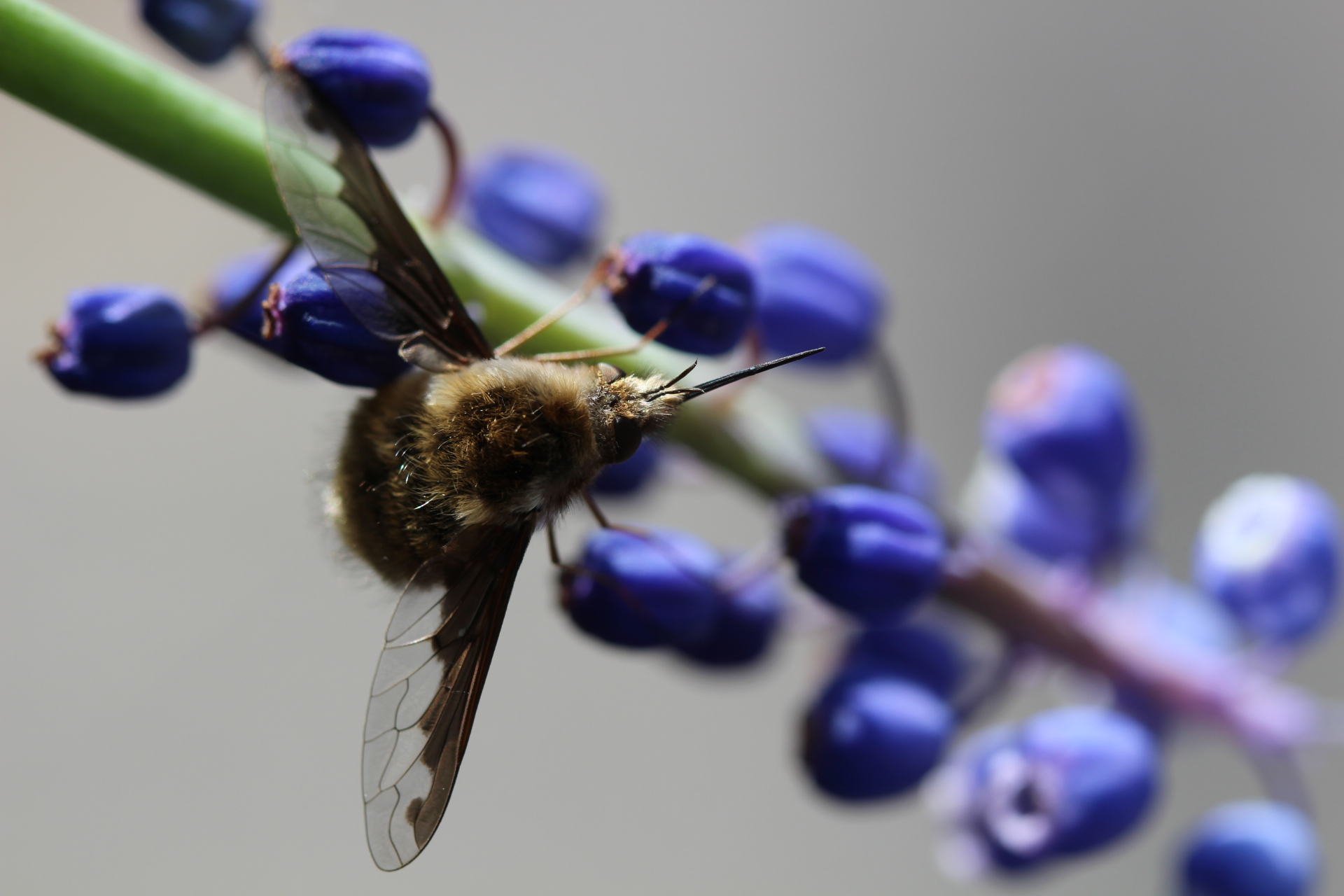
Greater Bee Fly (Bombylius sp.), Lynn Valley Trail, April 2023:
This fuzzy fly has special adaptations to gather sand in its abdomen which it coats its eggs with before launching the eggs into solitary wasp nests (dug in sand presumably) (Marshall 2012). The larvae hatch from the eggs and enter the nest chambers of their host before feeding on a single host larva each (making the Bee Flies parasitoids, consumers of a single prey item).
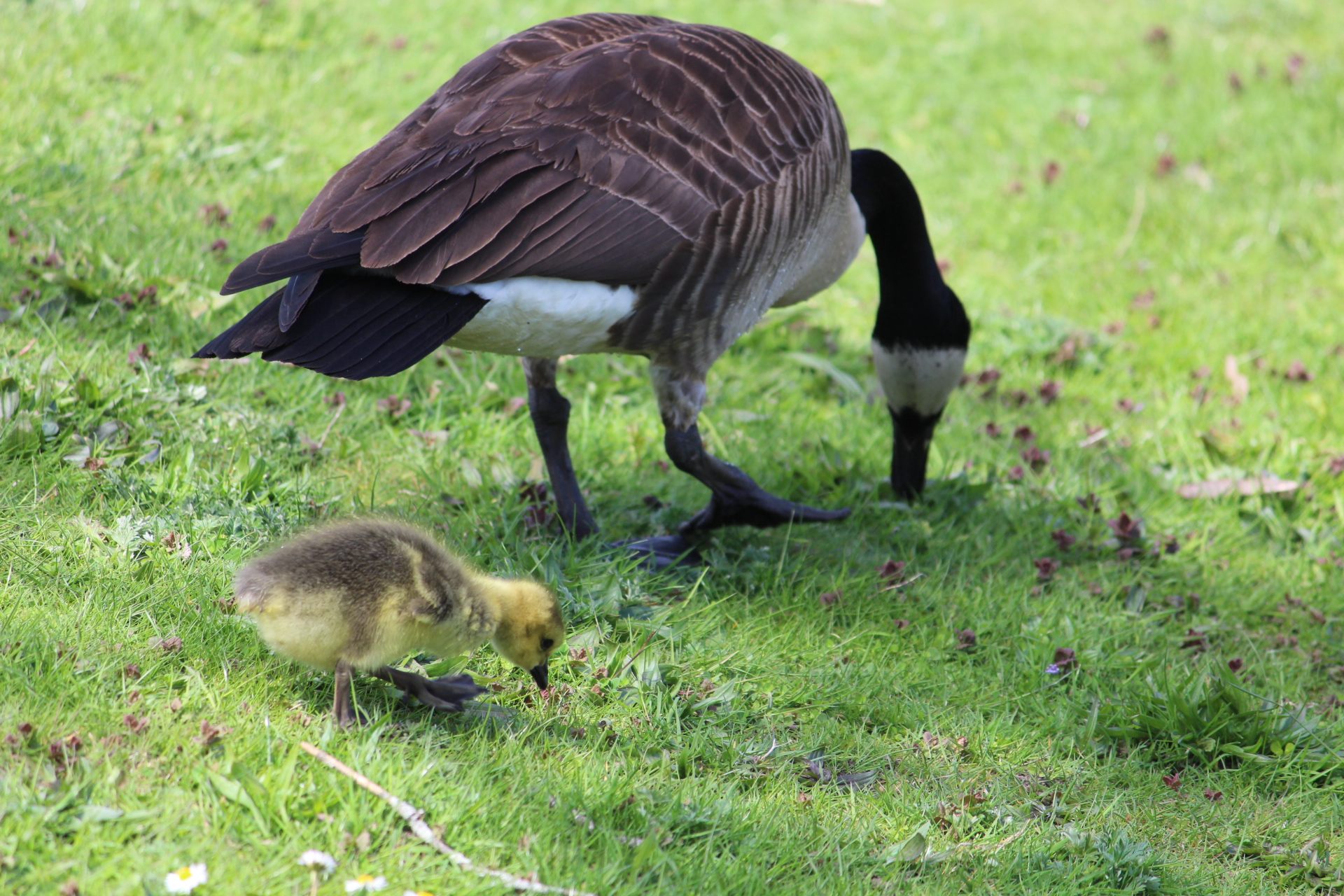
Canada Goose (Branta canadensis) Parent and Gosling, Grant Andersen Park, May 2023:
Canada Geese are both common and abundant so they usually don’t catch my eye, but I really liked how the gosling was in the exact same pose as its nearby parent in this photo.
Spotted Sandpiper (Actitis macularius), Grant Andersen Park, May 2023:
The picture is blurry because the action was taking place across some water from my camera lens, but this fascinating courtship display was happening right in the middle of Simcoe in Grant Andersen Park. These shorebirds performed their display a few times and then mated and dispersed.
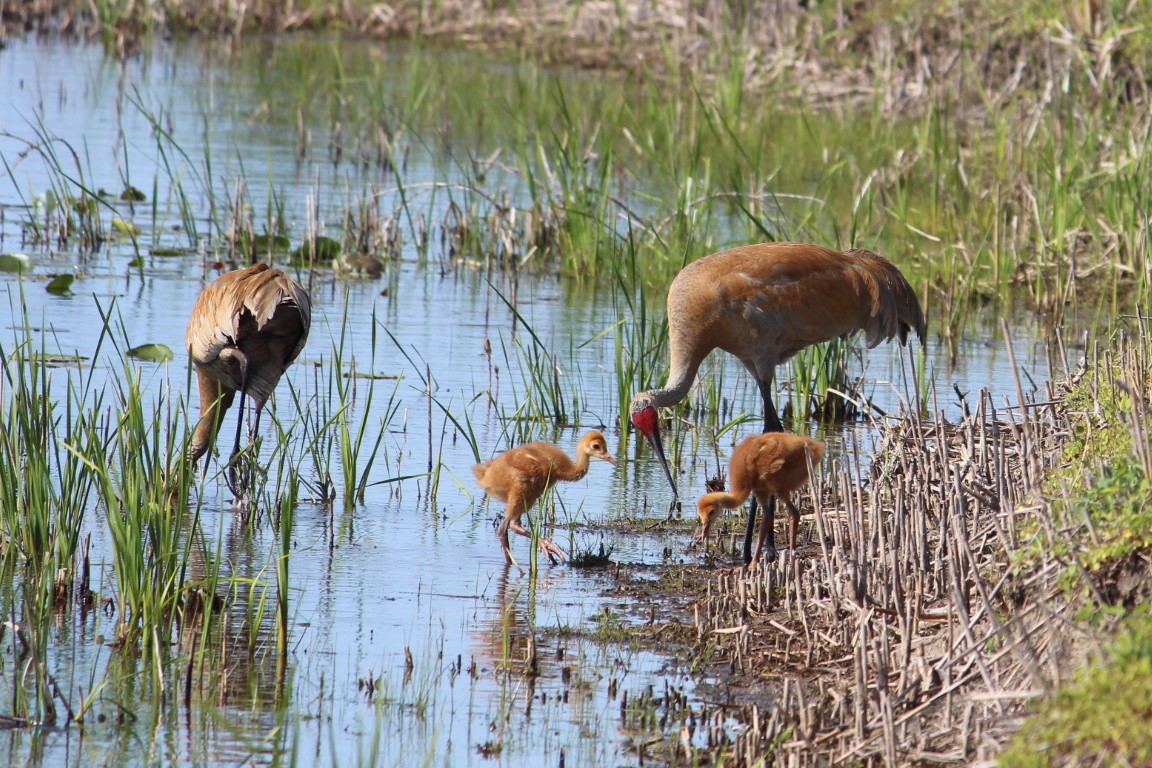
Sandhill Crane (Grus canadensis) family, Long Point, May 2023:
Sandhill Cranes have captures my heart with their wild resonant calls and their impressive size. It was a special treat to watch this family of two parents and two young foraging at the edges of a marsh in Long Point.
Canada Warbler (Cardellina canadensis), Long Point Old Cut Birding Station, May 2023:
Canada Warblers migrate into Ontario to breed during May/June, creating nests near the ground on stumps or small mounds (Bezener 2016). Then in late summer/early Fall they set off again to leave the Canadian winter behind them. Like other Wood-Warblers (the Family Parulidae) they consume insects and spiders, taken from plants or the ground.
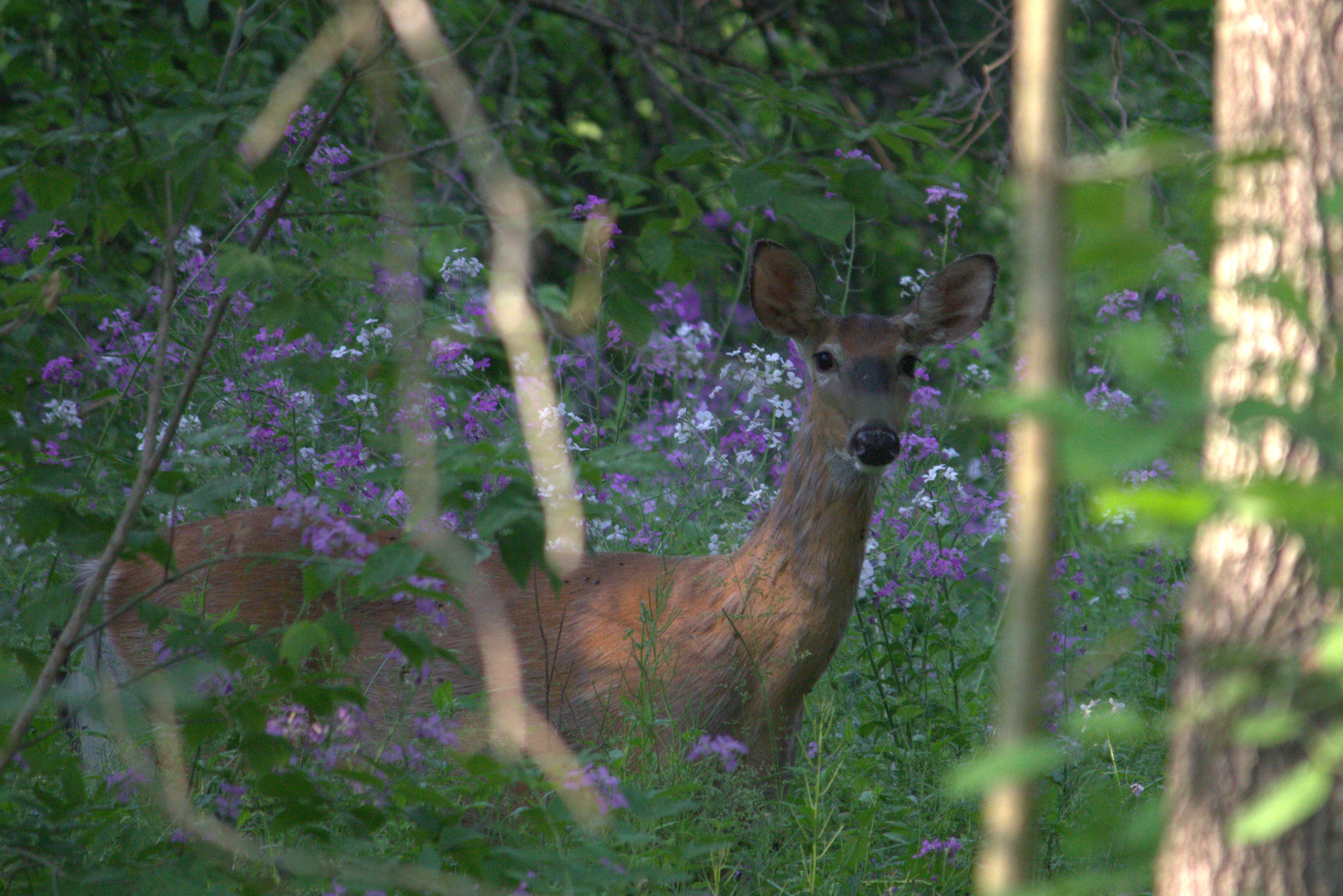
White-Tailed Deer (Odocoileus virginianus), Lynn Valley Trail, June 2023:
This deer was incredibly close to the trail, so I was able to capture its gaze among the purple wildflowers.
Velvet Ant (Timulla vagans), Backyard, July 2023:
Velvet Ants are not members of the ant superfamily (Formicoidea) but are instead solitary wasps (members of the family Mutillidae). Their larvae develop as parasitoids on the larvae of other wasps (in the case of Timulla vagans, their hosts are Crabronids and Eumenine wasps (Marshall 2023)). The males of Timulla vagans are winged unlike the ant-like females and will carry the wingless females in their mandibles during their mating flight (Waldren et al 2020).
Physocephala marginata, Backyard, July 2023:
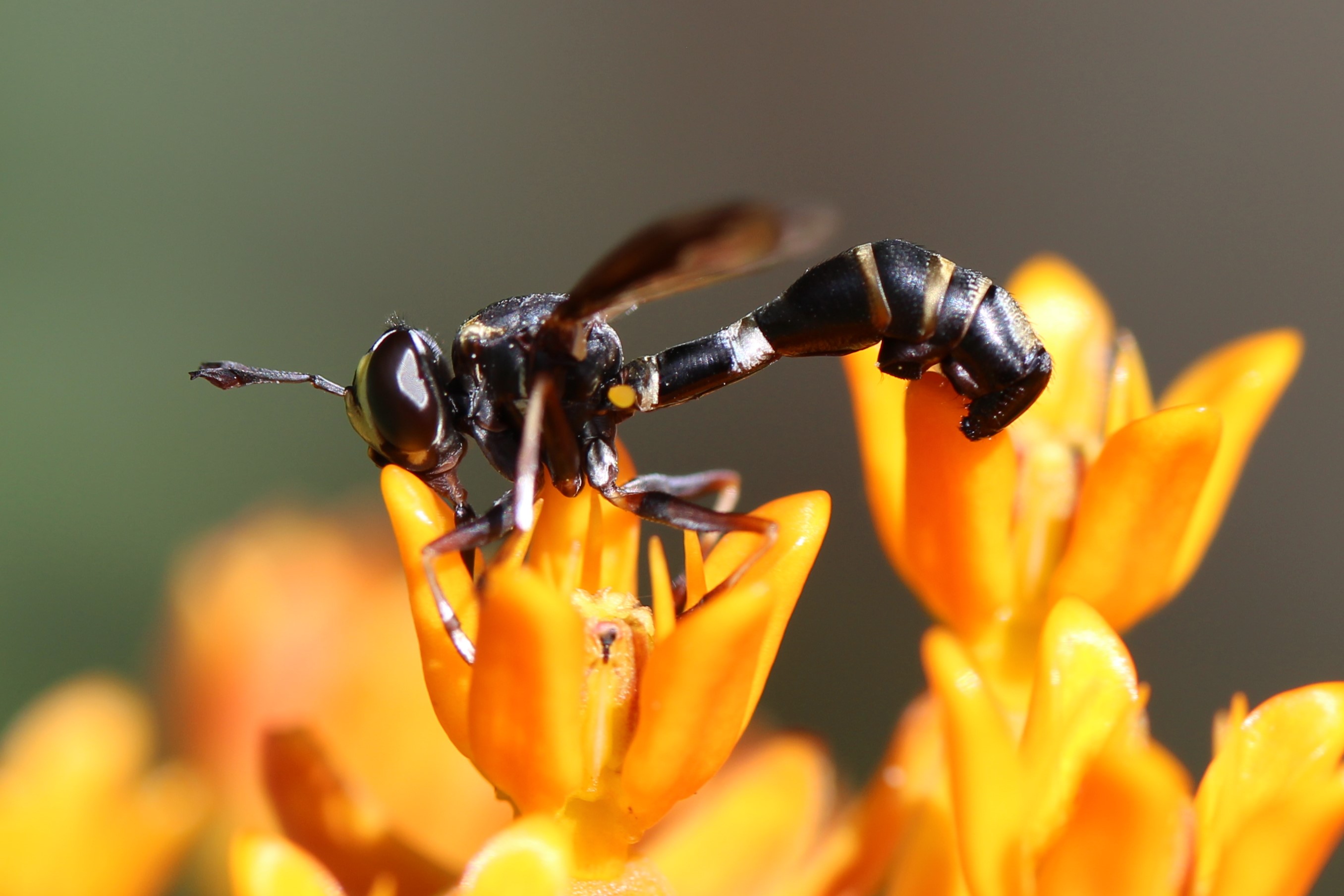
Although this insect drinking nectar appears to be a wasp, it is actually a fly of the Family Conopidae. Female Physocephala marginata seek out their lookalikes (wasps and bees) at flowers. After apprehending a host wasp or bee, P. marginata uses its abdomen to insert an egg inside the host’s abdomen (Marshall 2012). The egg hatches inside and the larval Conopid consumes the host from the inside.
Tachinid Fly (Exorista sp.), Backyard, August 2023:
Tachinid Flies are yet another group of parasitoid insects. Stephen Marshall, in his giant book on flies had this to say about this huge family of flies: “The Tachinidae is in many ways the ultimate fly family. With almost 10,000 named species and thousands more awaiting description… exhibits an unparalleled variety of sizes, shapes and colors. The range of life history strategies is equally amazing, at least within the constraint that every know species in the group is a parasitoid that develops inside another insect… or related arthropod” (Marshall 2012, p 386). Hosts of this genus are caterpillars or sawfly larvae.
Brown Marmorated Stink Bug (Halyomorpha halys), Backyard, August 2023:
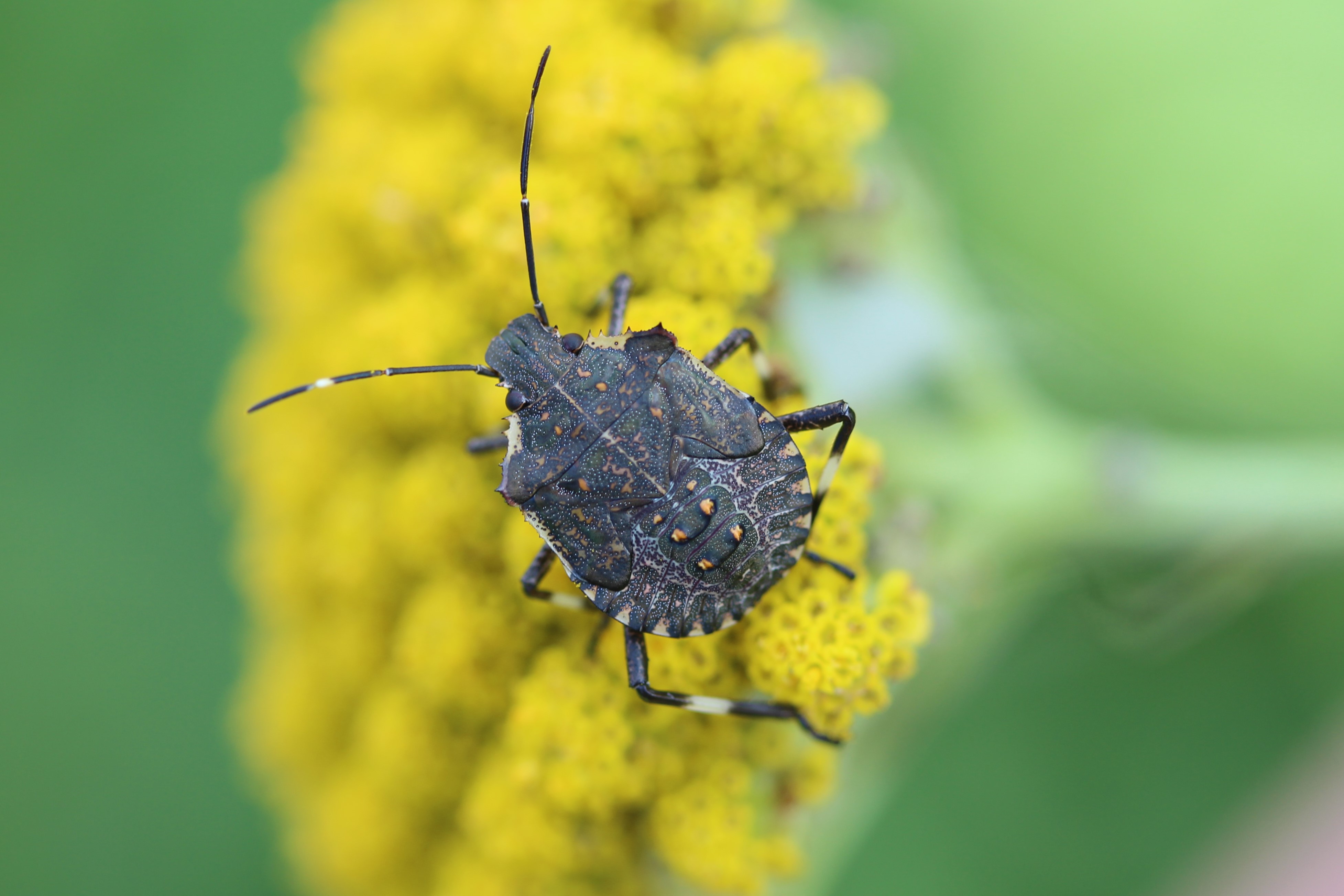
This species of Stink Bug is native to East Asia but was introduced to North America accidentally in the 1990s. As with many successful and widespread introduced species, the Brown Marmorated Stink Bug can feed on a wide diversity of plants and can be a serious pest of agriculture and gardens. The pictured insect is a nymph, not quite an adult because it is missing fully developed wings across its back.
Green Heron (Butorides virescens), Waterford Ponds, August 2023:
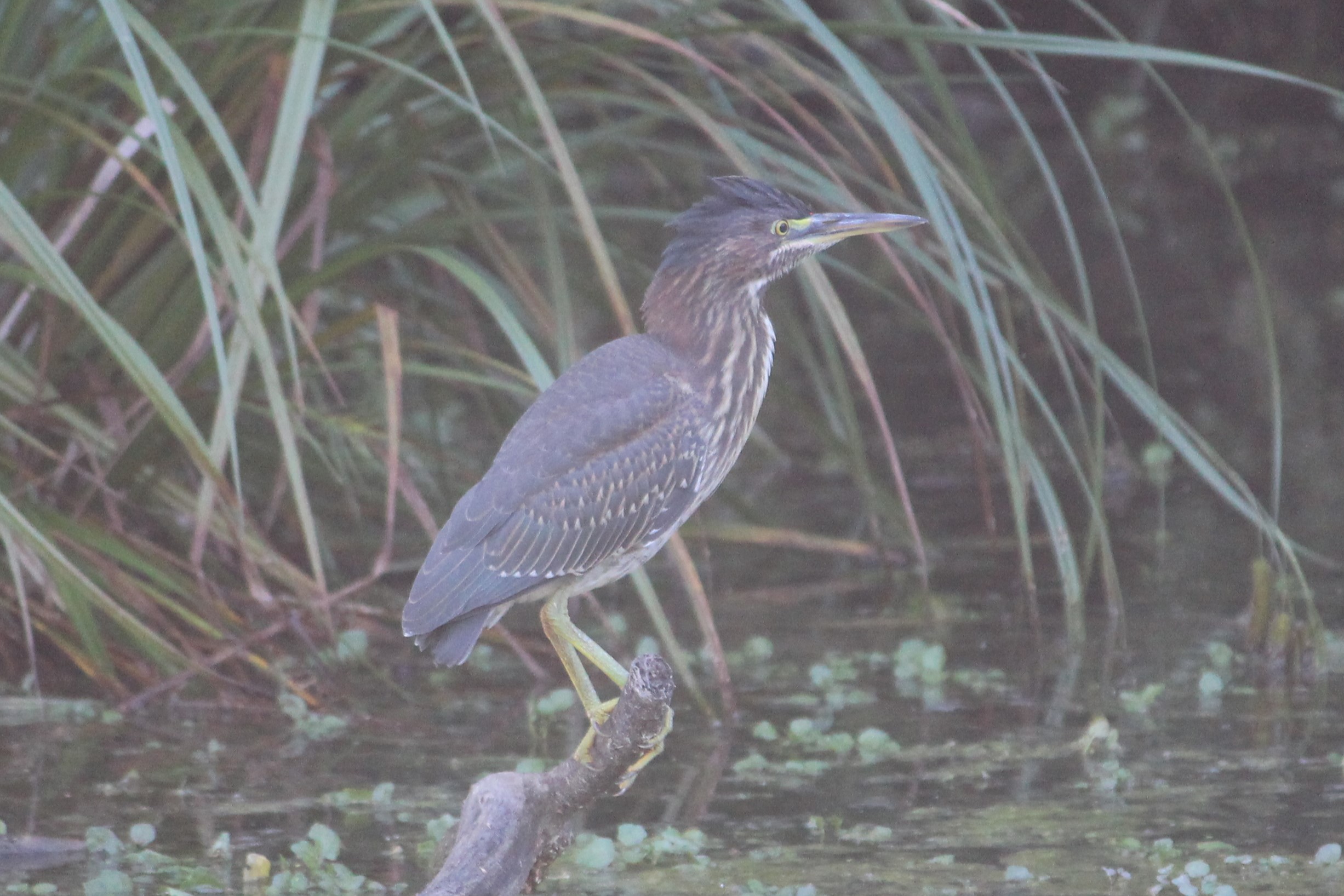
The above photo was actually taken by my wife on an outing to Waterford Ponds. She was quicker on the draw to find and focus on this beautiful bird amidst the morning mist and tangled reeds of its marshy habitat. I’ve written an article about these amazing birds because of a different close encounter I had, go here to learn more!
Common Whitetail Dragonfly (Plathemis lydia), Front of House, September 2023:
As I was entering my house, I was stopped by the sight of this wondrous insect framed perfectly on my siding beside my door. I carefully entered the house to retrieve my camera in order to get this picture. One of the first Dragonflies photographed at my house since I don’t have a backyard pond… yet. The Common Whitetail pictured is a male, distinguishable because it has the chalky white abdomen which it uses as a signal to chase other males off of its territory. Females of this species have multiple bands on their wings and a dark abdomen.
Double-crested Cormorant (Nannopterum auritum), Lynn River, September 2023:
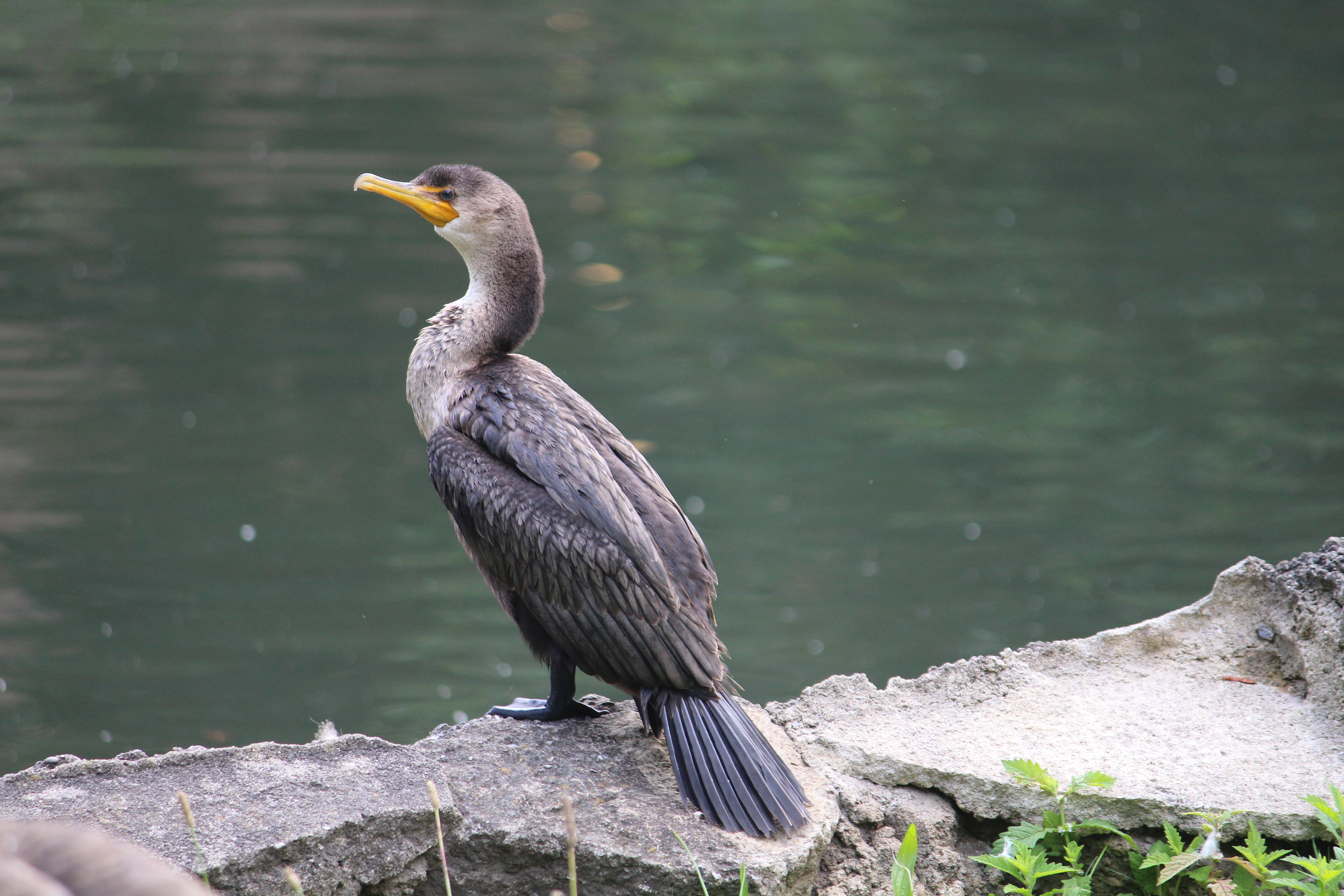
When swimming in the water, a cormorant reminds me of a hook-billed loon or a merganser, but their especially long neck gives them away. Like loons and mergansers, cormorants are underwater divers, pursuing fish prey amid lakes and rivers. This one was foraging in the Lynn River right in the middle of Simcoe, and I was very excited to get a close look at its sleek profile as it dried off on the bank. You can’t see them in the photo, but it was amidst a crowd of Canada Geese.
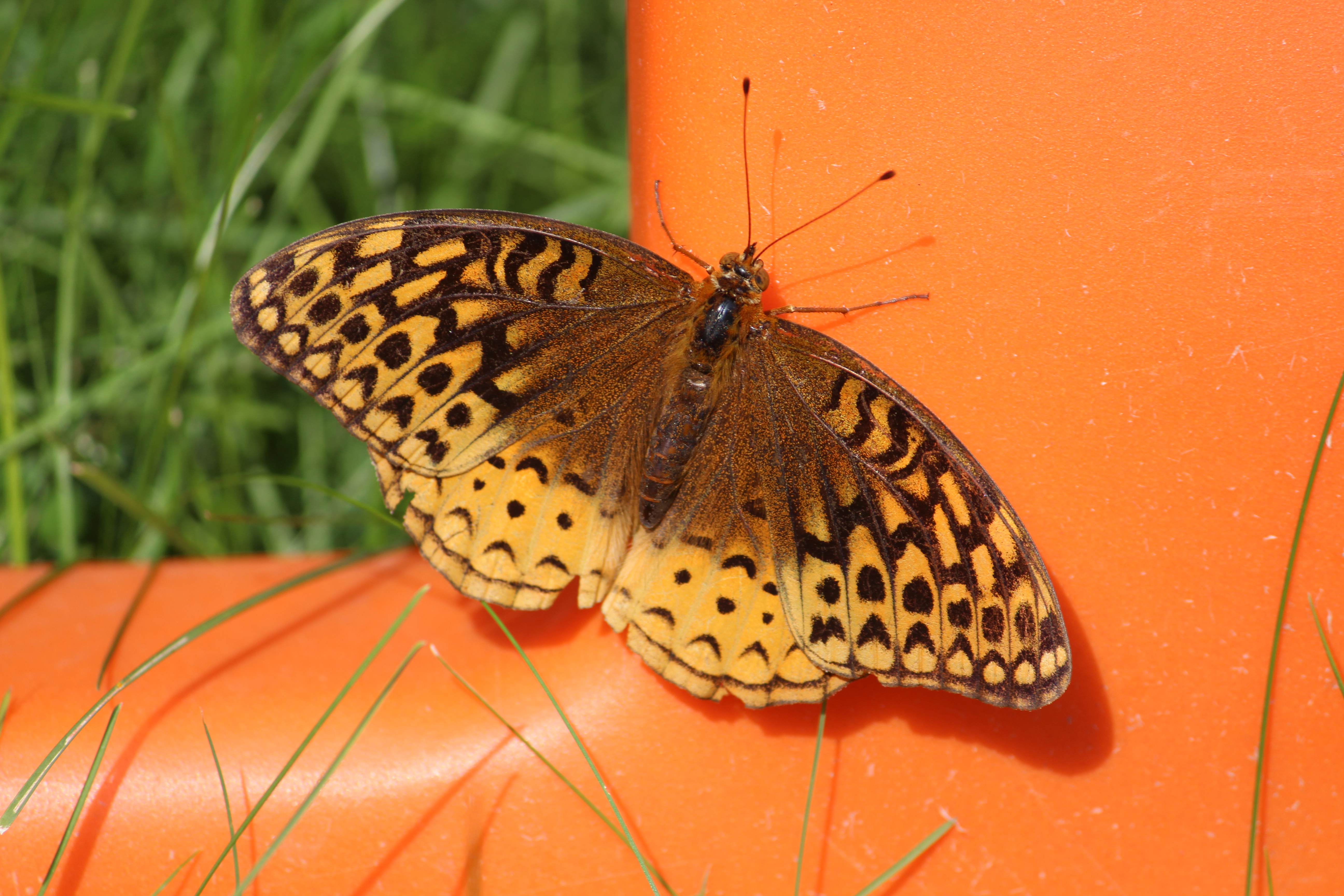
Great Spangled Fritillary (Argynnis cybele), Backyard, September 2023:
I at first thought this large butterfly was a Monarch (Danaus plexippus) as it was nectaring among our milkweed patch, but I quickly realized it was a different species. After patrolling our garden, this fluttering visitor rested and spread its wings on our orange plastic picnic table where I snapped this picture. The caterpillars of this species make it through our winter, after hatching just before the cold arrives (Hall et al 2014).
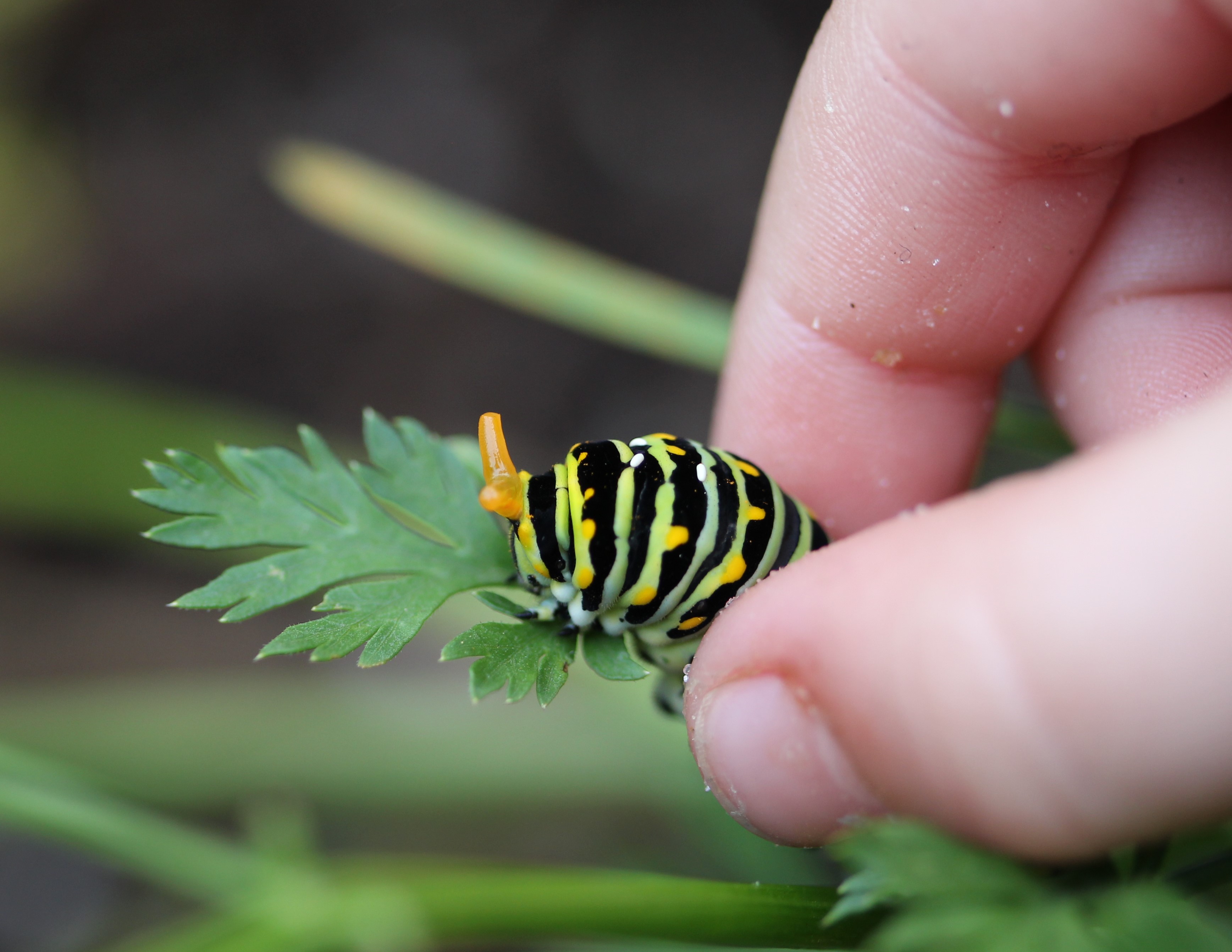
Black Swallowtail Caterpillar (Papilio polyxenes), Backyard, September 2023:
These colourful caterpillars feed on plants in the Carrot family (Apiaceae), and there were several munching away on our garden carrots this year. My 3-year old son helped me demonstrate one of their defensive strategies for this photo. If provoked these conspicuous caterpillars unfold the orange organ featured here, named an osmeterium, which has a foul odor (I would describe it as old rotten cheese, it was surprisingly powerful for such a small creature) (Marshall 2006). If I were a caterpillar-foraging bird or mammal, I would avoid such smelly prey.
Virginia Giant Hover Fly (Milesia virginiensis), Backus Woods, September 2023:
As the name implies, this fly was large and conspicuous in a sunny clearing. The larvae of these large flower flies (Syrphidae) develop inside rotting trees, sometimes inside tree holes (Skevington and Locke 2019).
Shadow Darner (Aeshna umbrosa), Backus Woods, September 2023:
Darners are huge dragonflies (over 7 cm long), instantly noticeable when in flight but this one cooperated in staying still while I took its picture. The Shadow Darner is named after its habit of flying late in the day (even at dusk) and staying mostly in shade (Marshall 2006). This one was photographed in the afternoon.
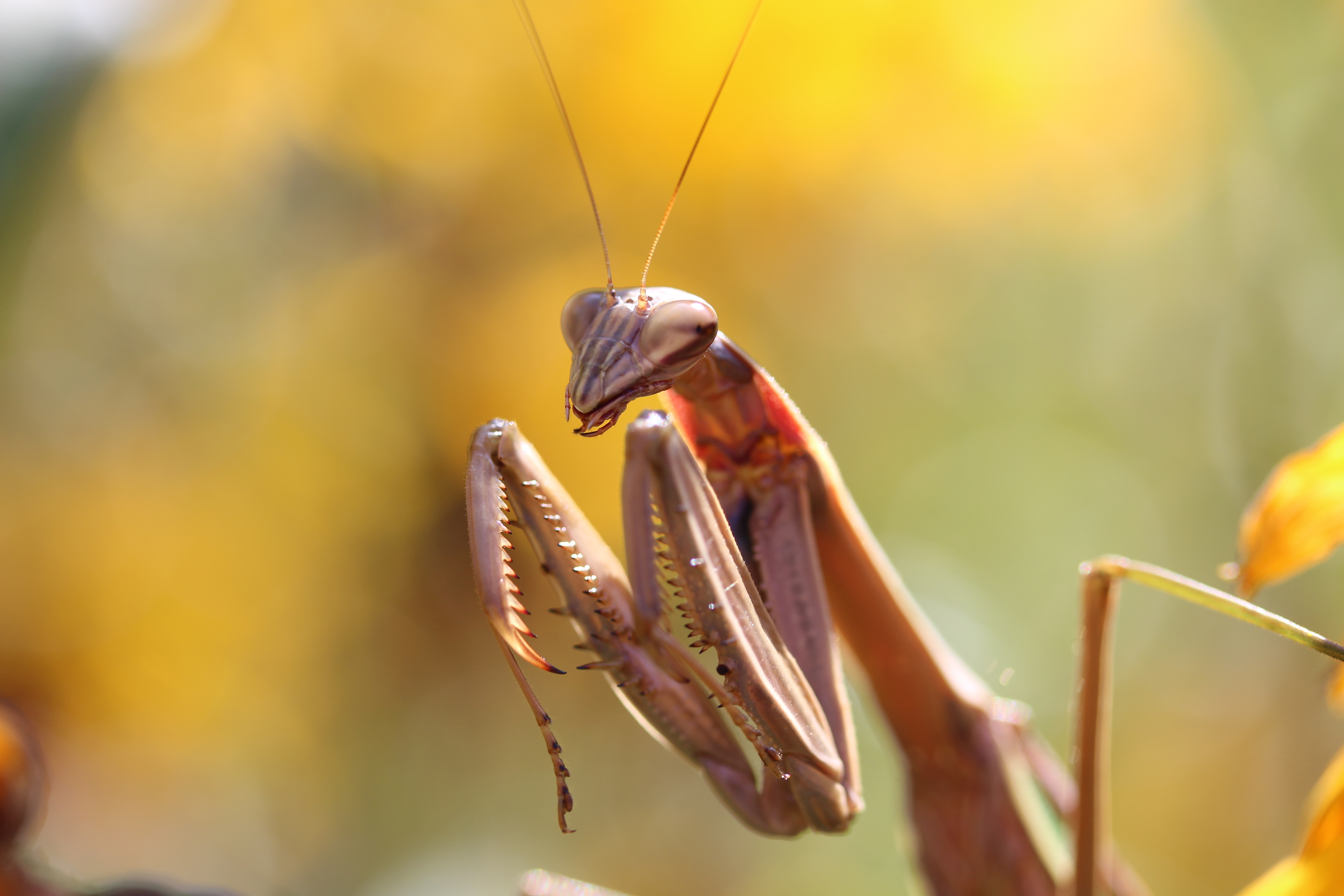
Chinese Mantis (Tenodera sinensis), Backyard, September 2023:
There are no Mantids native to Ontario, both of our common species: the European Mantis (Mantis religiosa) and the Chinese Mantis pictured here, were introduced to North America over a hundred years ago (Marshall 2006). This very large and impressive insect was clambering through my garden and nicely posed for a few pictures but this was my favourite photo I took, showcasing its powerful grasping forelegs and its triangular head.
References:
Bezener, Andy. 2016. Birds of Ontario. Partners and Lone Pine Publishing.
Hall, Peter, Jones, Colin, Guidotti, Antonia, and Hubley, Brad. 2014. The ROM Field Guide to Butterflies of Ontario. Royal Ontario Museum.
Harding, James H. and Mifsud, David A. 2017. Amphibians and Reptiles of the Great Lakes Region. University of Michigan Press.
Marshall, Stephen. 2006. Insects: Their Natural History and Diversity. Firefly Books.
Marshall, Stephen. 2012. Flies: Their Natural History and Diversity. Firefly Books.
Marshall, Stephen. 2023. Hymenoptera: The Natural History and Diversity of Wasps, Bees, and Ants. Firefly Books.
Skevington, Jeffrey H. and Locke, Michelle M. 2019. Field Guide to the Flower Flies of Northeastern North America. Princeton University Press.
Waldren GC, Roberts JD, Pitts JP (2020) Phoretic copulation in the velvet ant Sphaeropthalma pensylvanica (Lepeletier) (Hymenoptera, Mutillidae): A novel behavior for Sphaeropthalminae with a synthesis of mating strategies in Mutillidae. Journal of Hymenoptera Research 78: 69-89. https://doi.org/10.3897/jhr.78.55762
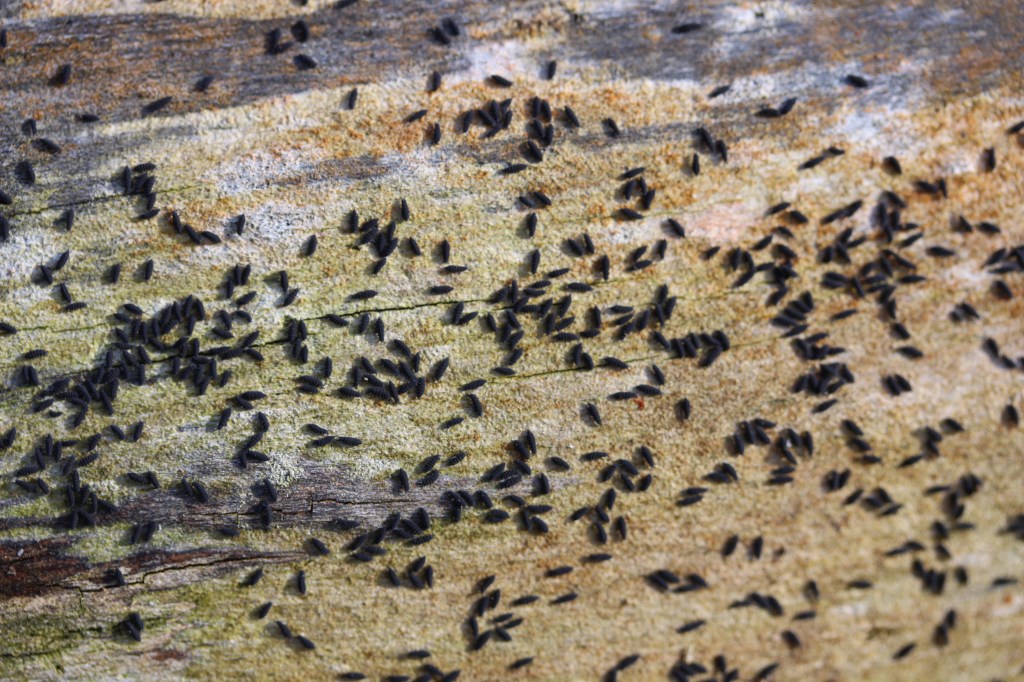
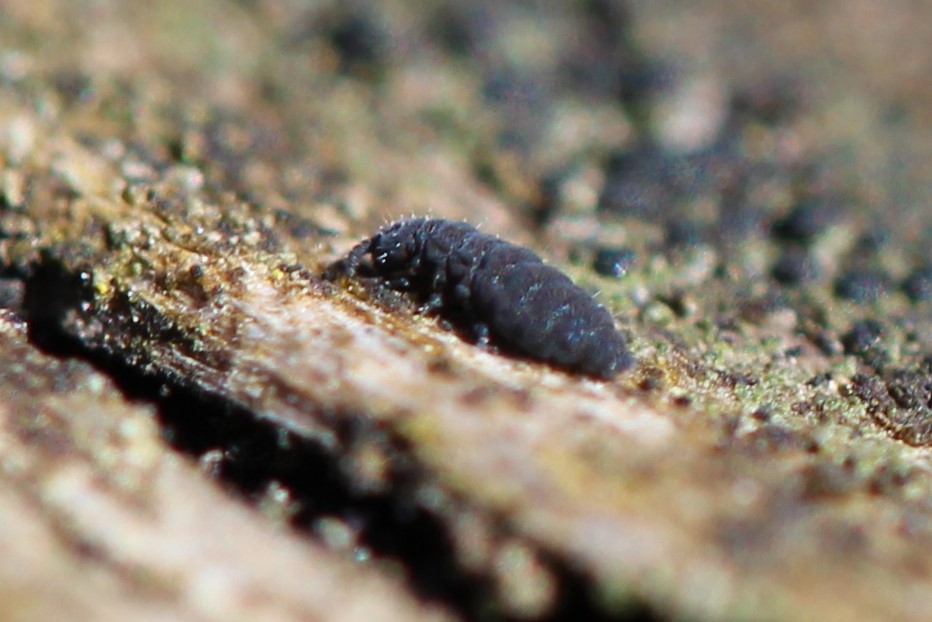
Using a magnifying hand lens, or a macro camera lens opens up whole worlds of detail and diversity unappreciated by the naked eye. One of these worlds is that of the Springtails.
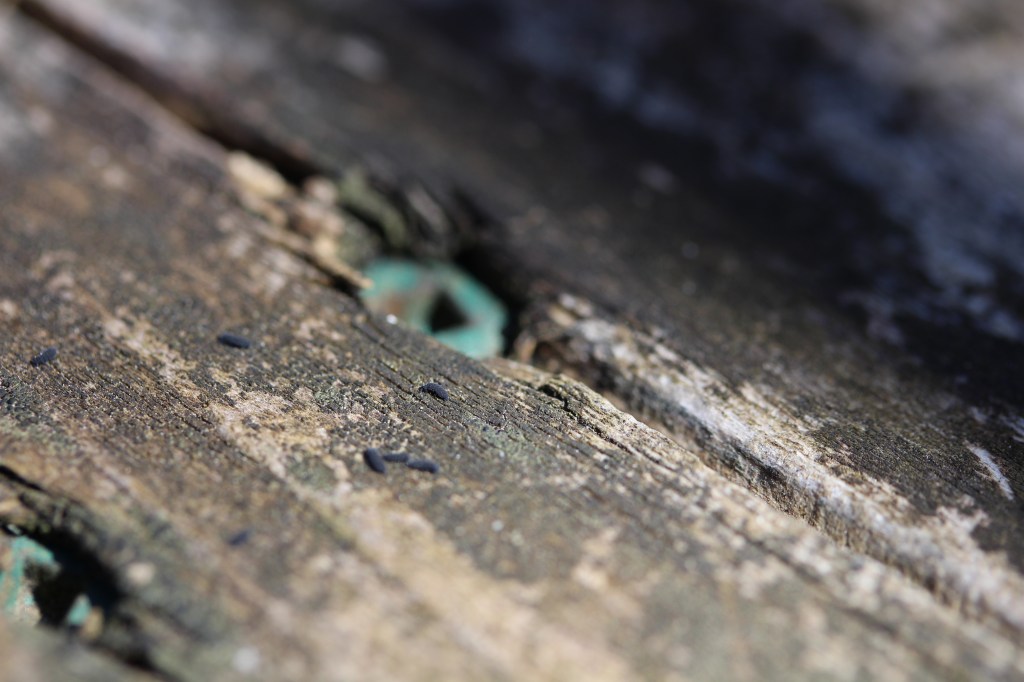
A group of Springtails on the Lynn Vally Trail on a log.
This past winter* I encountered them where they are most often seen, even without any sort of magnifying equipment: bounding by the millions atop the snow. While at Algonquin’s Mew Lake Campground, I observed these tiny pinpricks of dark life in stark contrast against the bright white snow. In this context, these Springtails are called “snow-fleas”, and it’s easy to see why. The tiny creatures are about the size of fleas and hop about with amazing ability. Springtails are not fleas, and leap about not by their legs but by a “spring-like tail” that curves under their body and can launch them through the air.
*This was originally written and posted on my tumblr blog in April 2018, so the winter referred to was 2017-2018.
They are actually part of a group known as Collembola, which is not quite under the group Insecta. They are not true insects, but are closely related. I had the privilege of being able to observe Springtails several times since our Algonquin trip and it is an incredible pleasure to be able to resolve something so tiny (about 1-3 mm long) into an individual animal, complete with legs, head, and antennae.
Even though they are quite numerous, they are small, and many Springtails spend most or all of their time belowground. This makes them difficult to study, and little is known about these amazing creatures.
Some closer views of individuals.To give some more context on their size: the green blurred object in the background is the head of a screw on the bridge, and the Springtails are the bluish-grey specks in the focus.
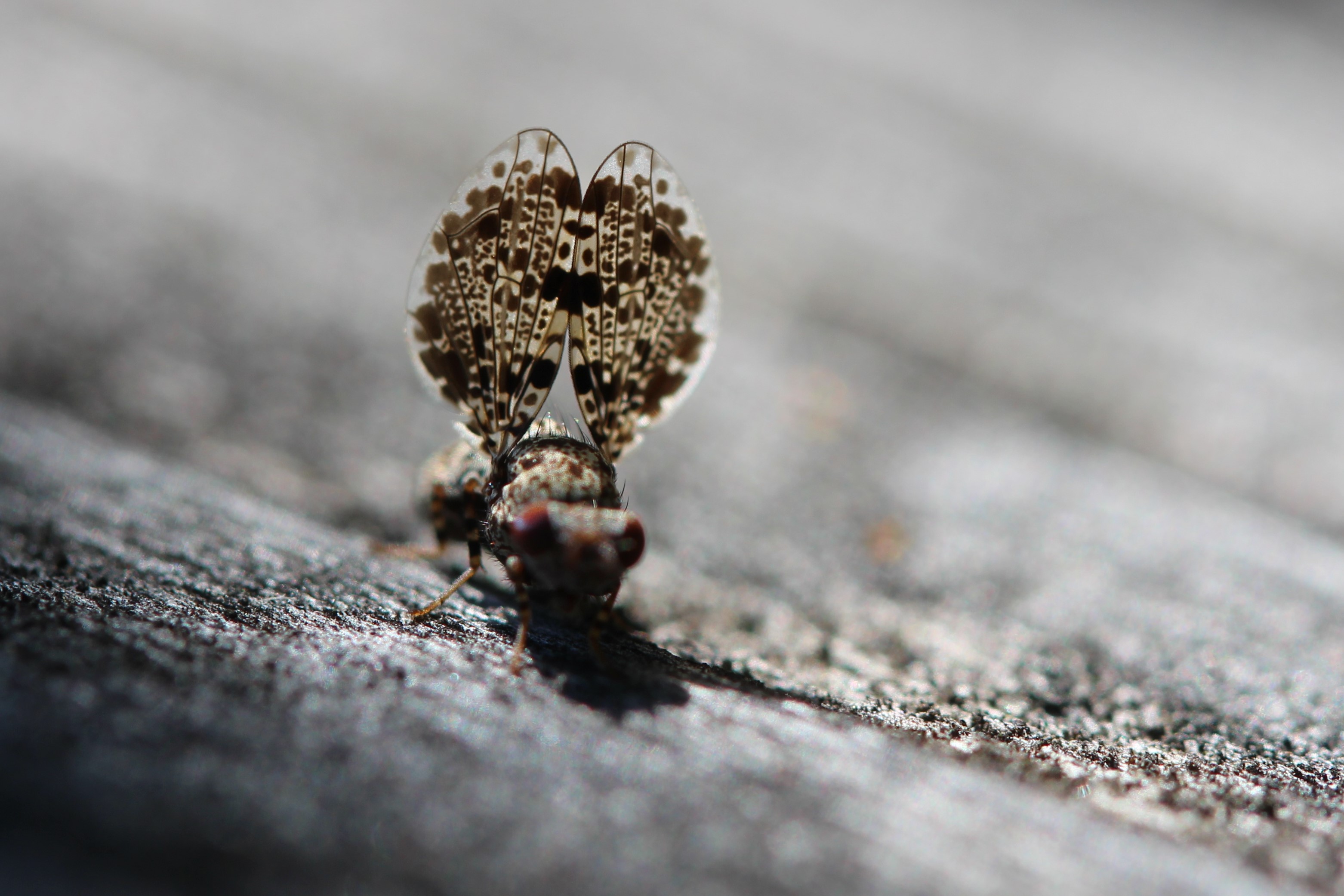
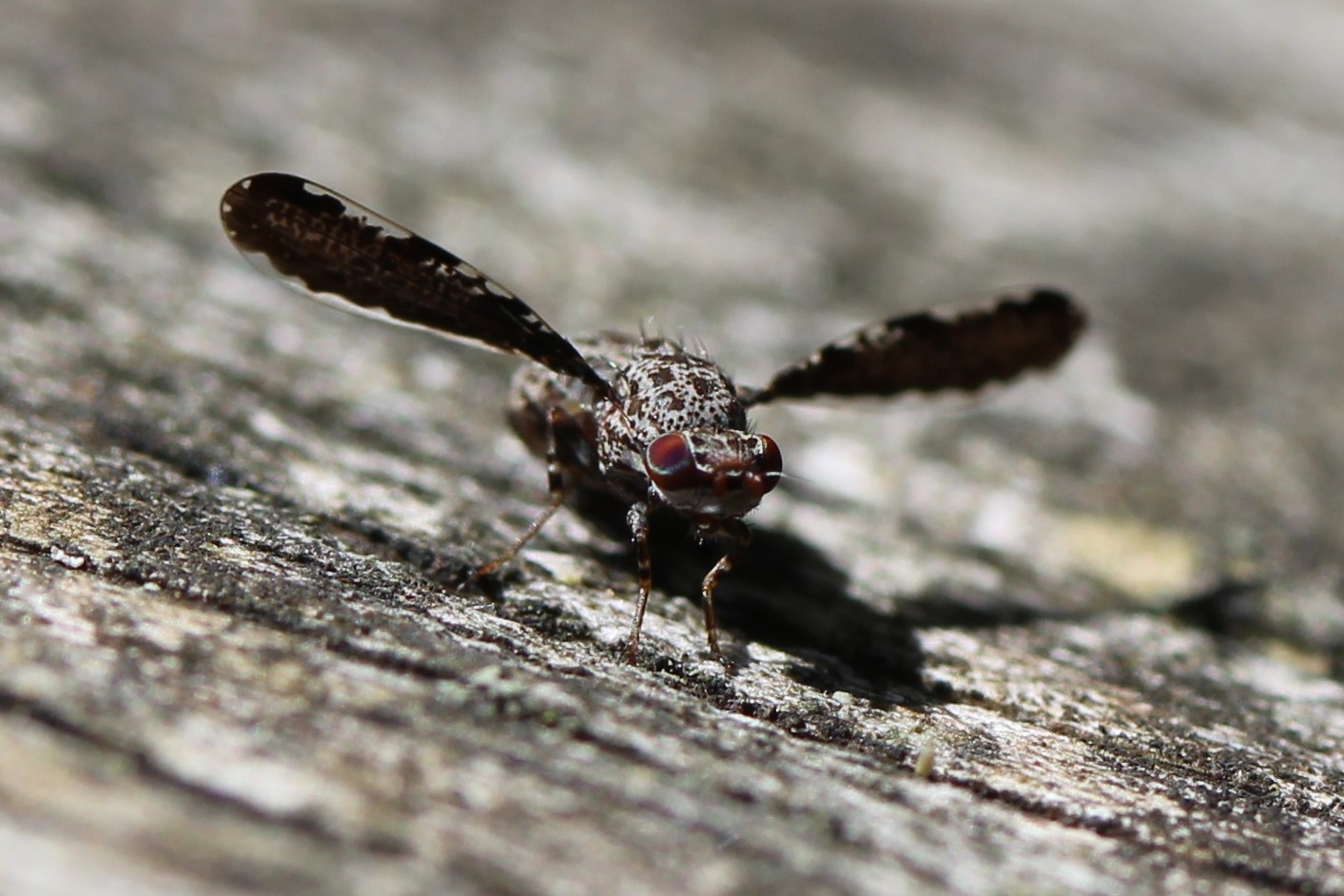
For this article I’d like to consider one of the most beautiful insects I’ve ever had the pleasure of observing: the Peacock Fly (Callopistromyia annulipes) and its relative, the only other member of its genus the Peahen Fly (Callopistromyia strigula)*. The main difference in appearance between these two species is in their wings: C. strigula contains much narrower wings than C. annulipes (Kameneva and Korneyev 2006).
*There is no common name for C. strigula, so I made one up. You might be surprised that there isn’t a common name, but consider that there are hundreds of thousands of species of Flies, and many of these are only known within specialist groups that study the differences between them. This is also the reason that there isn’t much information available for these Flies despite their beauty and conspicuousness.
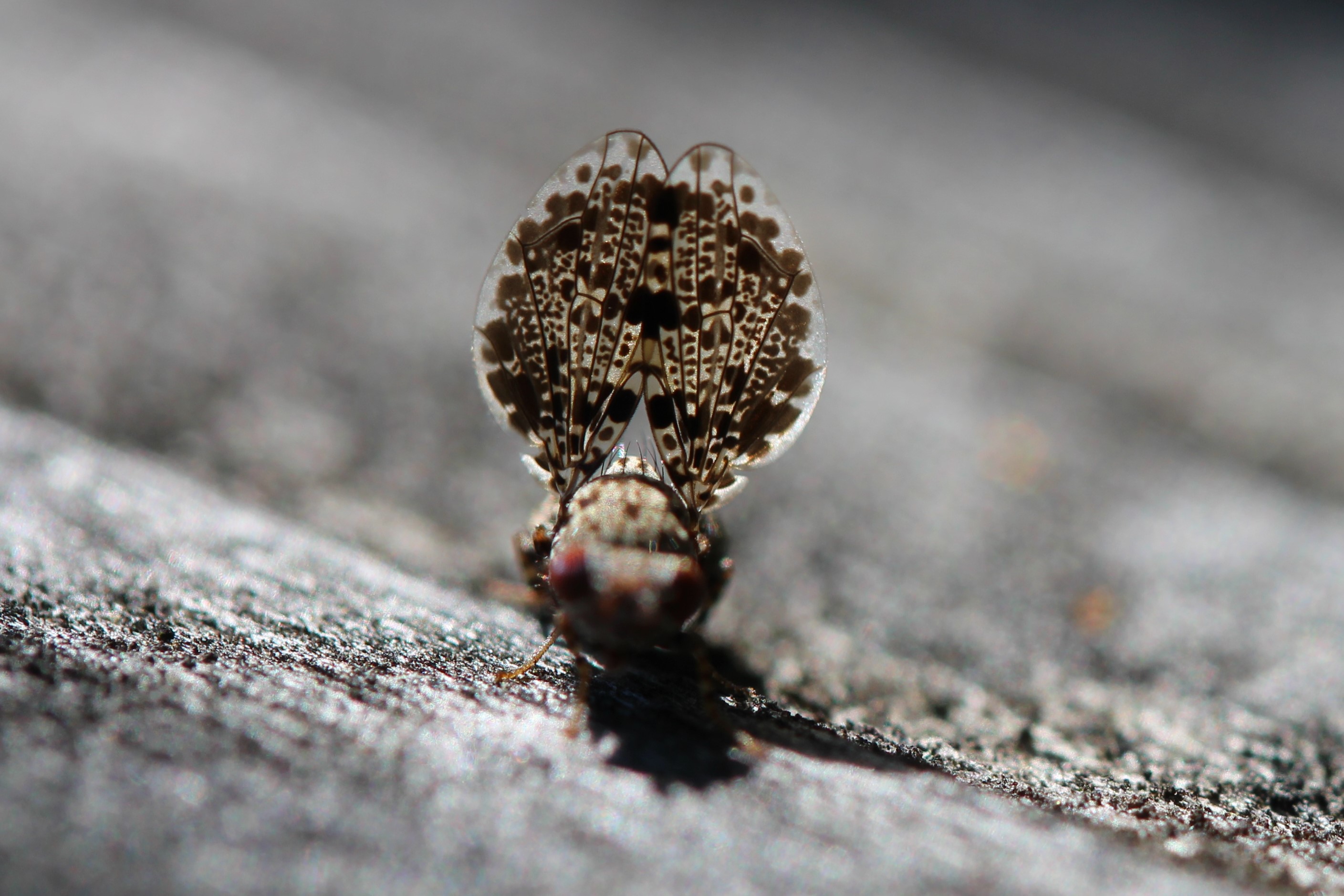
Callopistromyia annulipes, the Peacock Fly. Note the wide wings and the position they are held in above the body.Callopistromyia strigula, the Peahen Fly. Note the relatively narrow wings, and their position held out to the sides of the body.
C. annulipes is distributed across the United States and occurs in three provinces of Canada: British Columbia, Alberta, and Ontario, while C. strigula is found in Manitoba, Ontario and Saskatchewan as well as several States. Over the past several years, this species has spread into Europe as well, no doubt via human means (Pintilioaie and Manci 2020).
In both species males and females display, contrasting with many fly species in which only the males display for the females to choose from among them. I don’t want to discuss sexual selection and mate choice here in any depth. Suffice to say that because both males and females perform displays there is likely mutual sexual selection going on in these species, meaning that traits are preferred and chosen by both sexes in this species, rather than a female-choice bias or male-choice bias.*
*of course, this only applies if the displays and accompanying appearances are sexually selected for, but there are other ideas for what forces are selecting these displays (see further below).
Video of Peacock Fly (Callopistromyia annulipes) displaying on a bridge railing on the Lynn Valley trail in Simcoe.
Little is known of these species’ biology other than that they display on conspicuous surfaces (more on this below), and there are records of the adults of C. annulipes feeding on the frass from wood-feeding beetle tunnels* (Steyskal 1979). Their puparia** have been found beneath the bark of various deciduous trees, so it’s presumed that their larvae feed on dead wood, or fungi within dead wood or something associated with dead wood.
*Frass is a fancy way of saying “insect excrement and related material” usually used in connection with wood-boring insects… that ‘related material’ bit is key here since although a lot of what we call frass passes through an insect’s digestive system it can also be broken up bits moved behind a wood-boring beetle, so less insect “poop” and more insect “debris”.
**puparia refers to the hardened larval skin that encloses the pupal stage of derived Diptera… which probably doesn’t explain very much unless you know what those other terms mean. Basically, instead of nothing surrounding the pupa (the transformative stage of insects, between larva and adult), a huge branch of the Fly Family Tree (the Cyclorrapha) hardens their final larval stage skin into a protective case, sort of the fly version of a chrysalis.
As with many Diptera, their larvae are mysterious. After much searching, I managed to find a few pictures of Callopistromyia larvae online. I was amazed and contacted the person who recorded these organisms to obtain permission to share the relevant information and images.
The pictures depict larval and pupal C. strigula which were found feeding on the inner bark of a boxelder tree (Acer negundo) (van der Linden 2018). I can’t find any pictures or information pertaining to C. annulipes larvae, but presumably they have the same or similar feeding habits.
Finally, the most attractive thing about these species are their displays. The reason I’m writing about these flies is because I noticed them, and the reason I noticed them is because they strutted about on the railings of bridges on the Lynn Valley Trail. The Peacock Fly (Callopistromyia annulipes) in particular raises its large wings so that they meet above its back presenting a very noticeable display. By contrast, C. strigula adults display their wings in a more horizontal fashion. Presumably, these displays are about attracting mates and because the displays are performed by both sexes, they are about mutual mate choice. In other words, males are displaying to attract the attention of females and females are displaying to attract the attention of males. An intriguing possibility is that these wing displays are about more than finding a mate… they could also be an example of predator mimicry.
Can you see the face of a Jumping Spider in the Peacock fly’s wing-pattern?
A fascinating paper with an excellent title* describes how other species of Ulidiidae (the family of Flies that includes Callopistromyia) have wing patterns and displays that mimic the appearance of Jumping Spiders (Salticidae) (Hill et. al. 2019). The reason? Jumping Spiders are visually hunting predators of basically any insect they can catch. The wing patterns are possibly exploiting the visual system of Jumping Spiders by causing the spiders to believe they are staring down another Jumping Spider and so to be cautious. I can’t help but be intrigued by this idea, and somewhat skeptical. Despite its appeal, there are some problems with the hypothesis. One problem that came to my mind is that Jumping Spiders will hunt other Jumping Spiders. So if the pattern is supposed to resemble a Jumping Spider and deter them from predating the fly, why would it? The paper acknowledges that there are still many unknowns, but the authors make a good case that at least some insects are manipulating salticid responses to prey with visually deterrent patterns. And they also note: “In a natural setting even a brief delay in the attack of a salticid could allow these flies to escape” (Hill et. al. 2019). As always in science, more studies are needed…
*The title, for those of you who don’t read through the References section, is “Do jumping spiders (Araneae: Salticidae) draw their own portraits?” The idea is that in avoiding hunting insects that resemble themselves, jumping spiders leave those ones alive to reproduce in like kind and so jumping spider resemblances are crafted by the natural selection of the jumping spiders themselves.
There is always more to learn, and always new organisms to explore in the world. I hope you enjoyed my dive into the beautiful flies of the genus Callopistromyia, the Peacock Flies.
References:
Hill, David, A. P. C., Abhijith, and Burini, Joao. 2019. “Do jumping spiders (Araneae: Salticidae) draw their own portraits?” Peckhamia 179.1: 1-14. (full pdf available here: https://peckhamia.com/peckhamia/PECKHAMIA_179.1.pdf)
Kameneva, Elena and Korneyev, Valery. 2006. “Myennidini, a New Tribe of the Subfamily Otitinae (Diptera: Ulidiidae), with Discussion of the Suprageneric Classification of the Family”. Israel Journal of Entomology. Vol. 35-36, 2005/6: 497-586.
Pintilioaie A-M, Manci C-O (2020) First record of the peacock fly Callopistromyia annulipes (Diptera: Ulidiidae) in Romania. Travaux du Muséum National d’Histoire Naturelle “Grigore Antipa” 63(1): 87-91. https://doi.org/10.3897/travaux.63.e50920
Steyskal, George C. 1979. “Biological, Anatomical, and Distributional Notes on the Genus Callopistromyia Hendel (Diptera: Otitidae)”. Proceedings of the Entomological Society of Washington. 81(3): 450-455.
The Story Behind the Shot: The amazing hovering capabilities of Flower Flies (the Family Syrphidae) have always impressed me and I really wanted to capture this one in the air. The fact that I was able to take this shot is a testament to how little these insects falter while hovering in mid-air.
The Story Behind the Species:
Common Compost Fly males are some of the most impressive flyers in the world of insects. They use their skills to patrol among flowers and pursue females which visit the flowers with incredible agility. Their singleminded pursuits seem to have sacrificed discrimination for the sake of directness, as these flies are known to pursue “any insect of almost any size that appears in their search area” (Marshall 2012 p. 307). After mating, the females lay their eggs in decomposing plant material, which can include compost, hence their common name.
Syritta pipiens is an introduced species in North America, brought over accidentally from Europe around 1895 (Skevington et. al. 2019).
References:
Marshall, Stephen A. 2012. Flies: The Natural History and Diversity of Diptera. Firefly Books.
Skevington, Jeffrey H., Locke, Michelle M., Young, Andrew D., Moran, Kevin, Crins, William J., and Marshall, Stephen A. 2019. Field Guide to the Flower Flies of Northeastern North America. Princeton University Press.
Subject: Maple Looper Moth (Parallelia bistriaris)
Location: Turkey Point Provincial Park.
Date: June 2018.
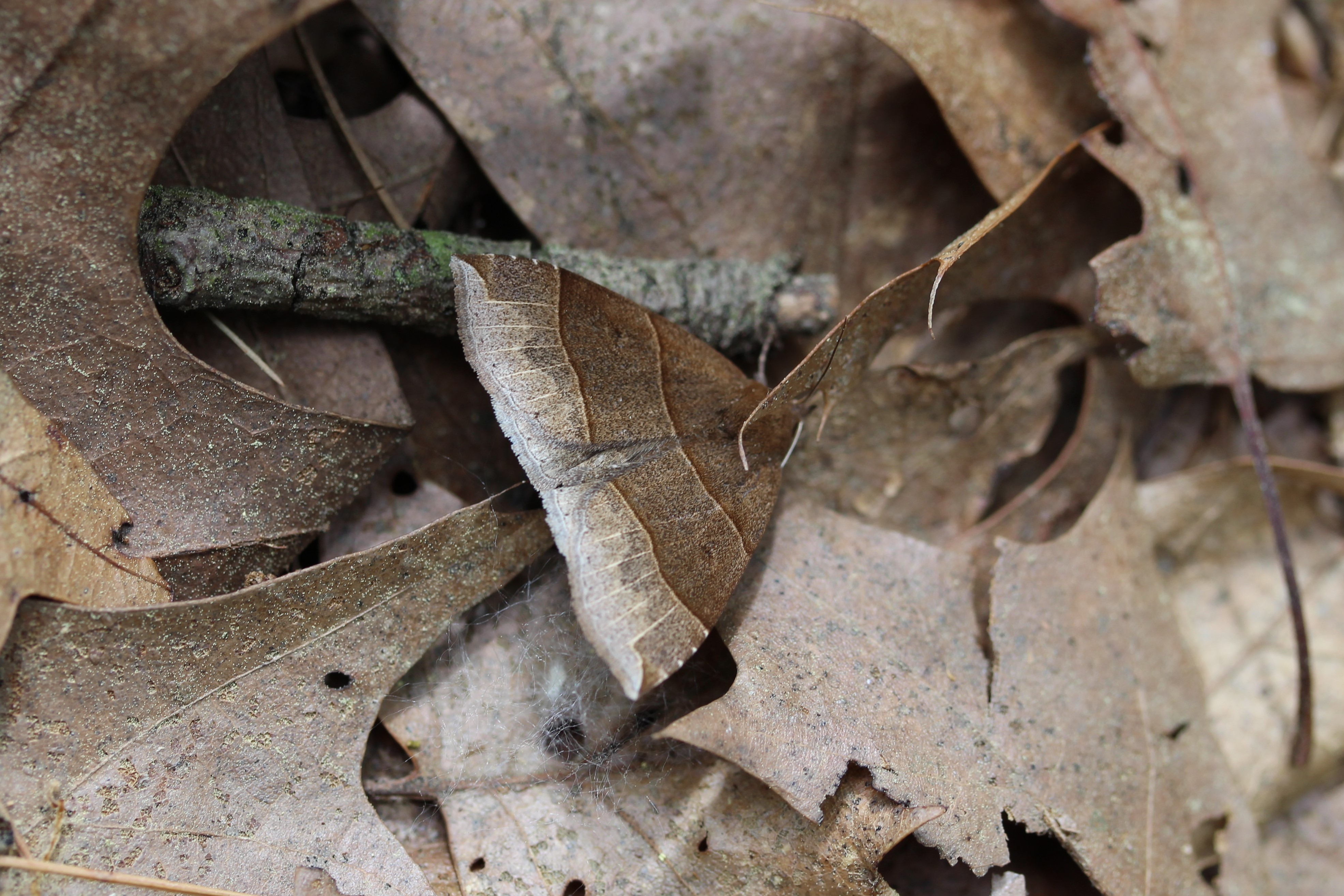
The Story behind the Shot: While hiking down a trail at Turkey Point Provincial Park, my wife somehow spotted this moth among the leaves which it matched so closely. I was overjoyed to get such a close-up shot of an amazingly camouflaged insect.
The Story behind the Species:
This moth could be the poster-child for camouflage. Such an elegant example of hiding-in-plain-sight. Positioned among fallen leaves which it matches in tone and general shape, this moth is incredibly hard to spot! To hide itself even more, the Maple Looper Moth positions itself head down, thus hiding its least leaf-like feature and accentuating the lighter edge of its hindwings (Keiper 1969).
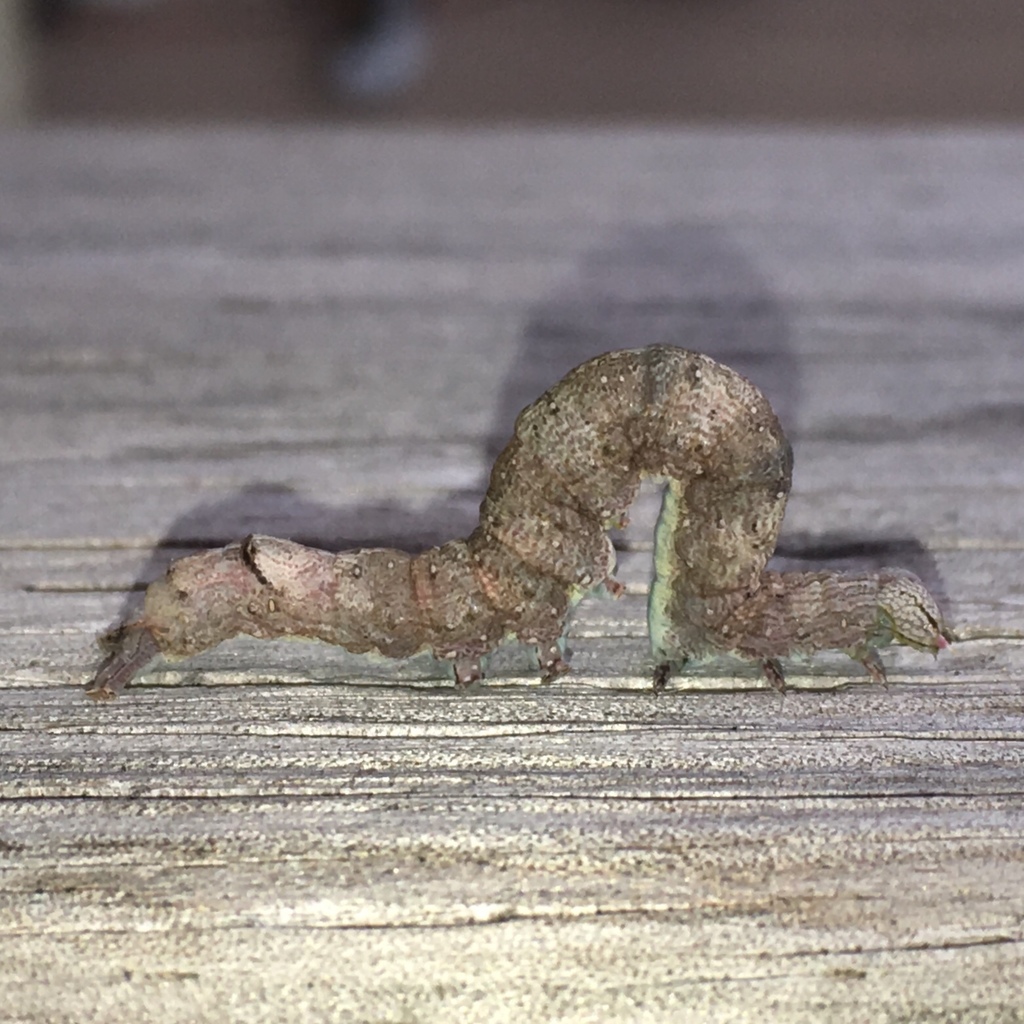
The larvae of this superbly secretive moth are also camouflaged, resembling twigs rather than leaves.
Maple Looper Moth larva (or caterpillar) demonstrating both its twig mimicking colouration and its looping movement. Photo by Dan MacNeal, used with permission.
The larvae, unsurprisingly, feed on Maple leaves (Crumb 1956), but bugguide.net lists Birch and Walnut as food plants as well (https://bugguide.net/node/view/3356).
I’m glad to have found and captured a photograph of this mysterious moth. A beautiful secret of the forest floor.
Keiper, Ronald. 1969. “Behavioral Adaptations of Cryptic Moths IV. Preliminary Studies on Species Resembling Dead Leaves”. Journal of The Lepidopterist’s Society 23: 4: 205-210.





























 Norfolk Naturalist